Room of Keys is a sort of sacred mystery play. I don’t throw that M word out there in the spirit of a whodunnit so much as the old sacred pre-Shakespearean plays that would stage a small Biblical episode.
No wait, miracle is a better M word. It’s a Miracle Play.
And speaking of “M” words we watch & hear someone who cries out that they hate music but mysteriously, miraculously learn to love music. It’s a sacred mystery, and a miracle.
The music too is a bit of a miracle.
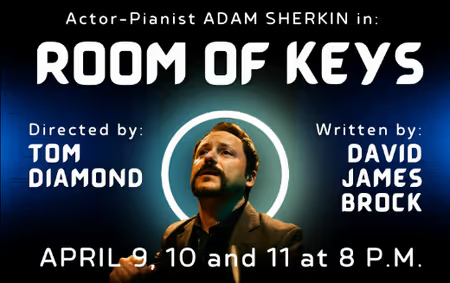
Pianist & Piano Lunaire founder Adam Sherkin was making his debut as an actor at nanoSTAGE at the same moment that David James Brock’s play Room of Keys had its world premiere in the hands and voice and physical presence of Adam. I watched an intense dramatic monologue directed by Tom Diamond that leads directly into a concert, Adam the actor showing us Adam the pianist playing the piano music of Béla Bartók.
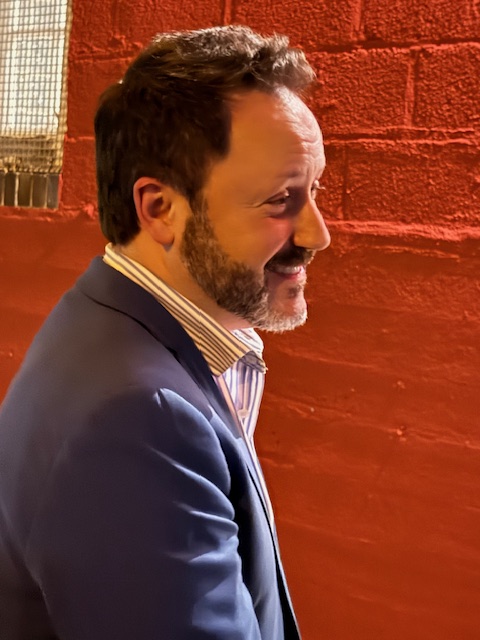
Yes I knew a concert was coming but even so it felt like a miracle, erupting out of David’s poetry. The space was genuinely poetic with some beautiful paintings by Gail Williams & an appreciative audience.
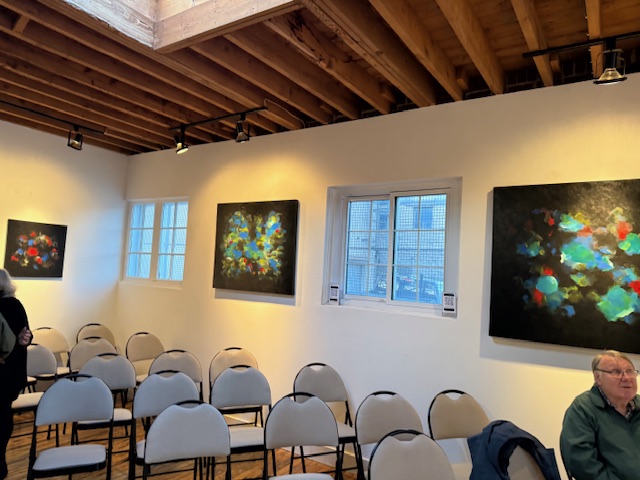
The upcoming Canadian Opera Company revival of Robert Lepage’s production of Béla Bartók’s opera Bluebeard’s Castle was the inspiration for the new work. Duke Bluebeard is taking his new wife into his castle with its seven doors opened by seven keys. Sitting in the front row watching Adam I understood the new play, with its seven different keyboards each with a number and a card containing a special word (such as “play”) was an attempt to explore Bartók, his work and the experience of music itself from first principles.
The mysterious communication between Greenie (played by Adam) a man who hates his father’s music and the messages from his father reminds me of the popular experience of classical music, especially for the musician sitting down to play a score from someone like Bartók. While some of us are brought up loving classical, it’s more normal to prefer beatles or blues to Bartók or Beethoven. Any page of music, though is a bit of a puzzle, a message from a person who may be dead, telling us how to make music. I wonder, can one really make music if one hates what one encounters on the page? You have to at least for the moments you’re playing surrender to that creation as if you like it. That’s also true of any dramatic text, any art we encounter. At the very least there has to be some identification. I recall that Anton Kuerti said in the liner notes for his Beethoven piano sonata cycle, that to play Beethoven you must become Beethoven: at least as your goal. When I place that ideal alongside Greenie, who hates music as he gradually confronts messages from long ago, which can be understood as the heritage left to us by composers of the past such as Bartók or Beethoven, it makes this play seem especially universal in its exploration of the process of music itself, the encounter between the past and present in music.
That we can make music from the dots & lines on a page is surely magical, a sacred mystery whereby we channel the thoughts & feelings of persons alive or dead, bringing those musical moments vividly to life. Sometimes we play accurately, sometimes the requirements on the page may be beyond our abilities.
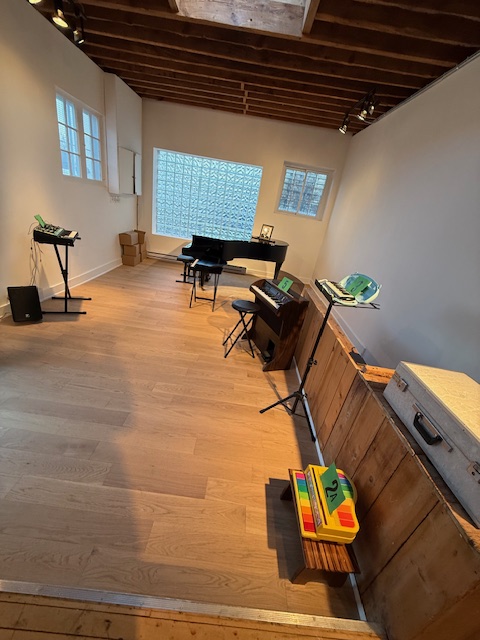
The questions Adam was posing seemed to be the fundamental existential concerns of any musician, as though the music explains and even redeems the world. After he had played different sorts of music from blues to church organ to electronic patterns, Adam segued into a brief powerful concert of Bartók for us on the grand piano upstage.
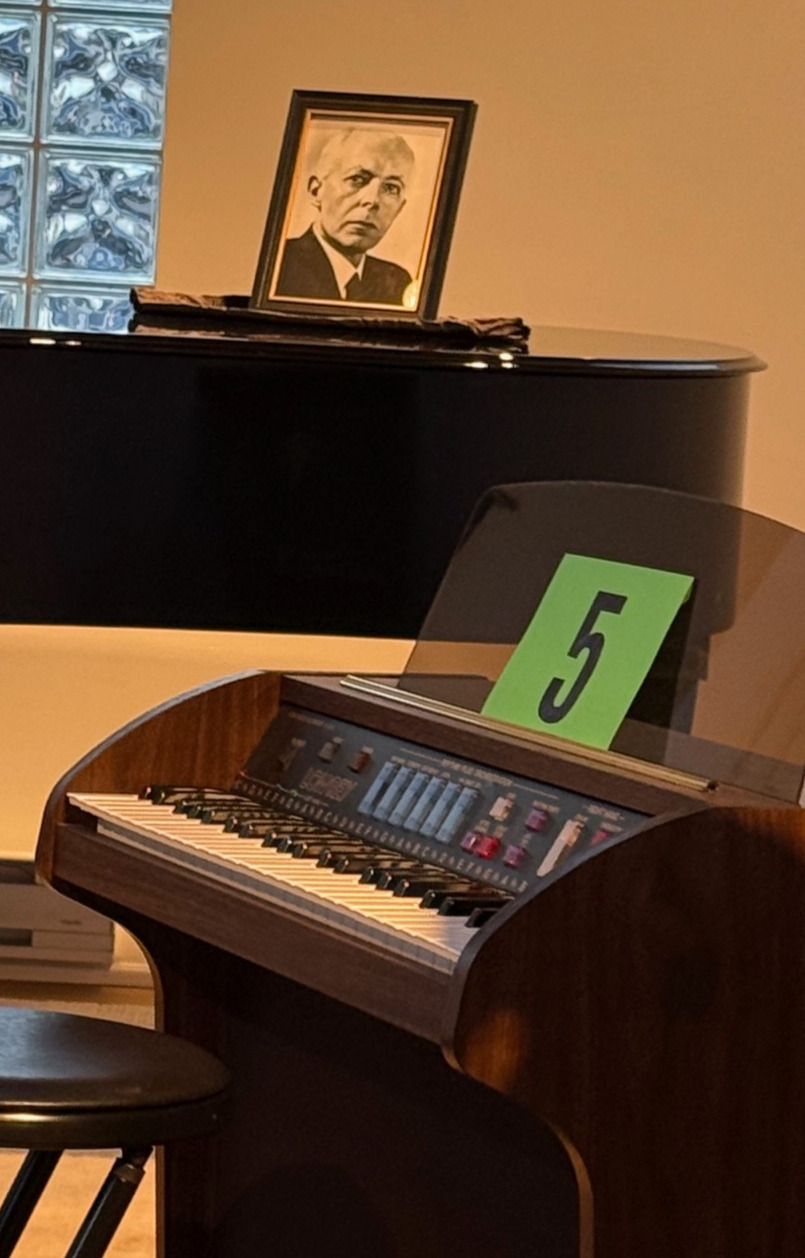
Yes that’s a portrait of Bartók on the piano, as you can see in this close-up.
Adam played very well, not just as an execution of the composer, but as an organic response to what he had been saying as Greenie. I have seen this from Adam before, in his YouTube performance of Mozart, that shows a readiness to improvise / elaborate upon what’s on the page, perhaps as might have been normal in the time, but a delightfully spontaneous approach. Ideally the notes on the page are not dogma but a departure point for a live performance where the artist responds to surroundings, which seems especially important when the music seems to be emerging spontaneously from the situation onstage.
Virtuosity sometimes alienates us because the show-off calls attention to a performance, and brings focus to the ego of the star rather than their portrayal. When I loudly cheer my role as an audience member further disrupts the magic of the portrayal, reminding everyone of the artificiality of the event. At their best a virtuoso like Jimmy Hendrix or Yuja Wang is so intent on their art that they expand the possibilities for those who follow, showing us what’s possible, and aren’t just showing off, even if as listeners we may be so mesmerized so in awe, that the fourth wall is broken. I was impressed that Adam could seamlessly segue into playing the music without it seeming to be artificial, the piano as much a part of his life as his facial hair or his clothes.
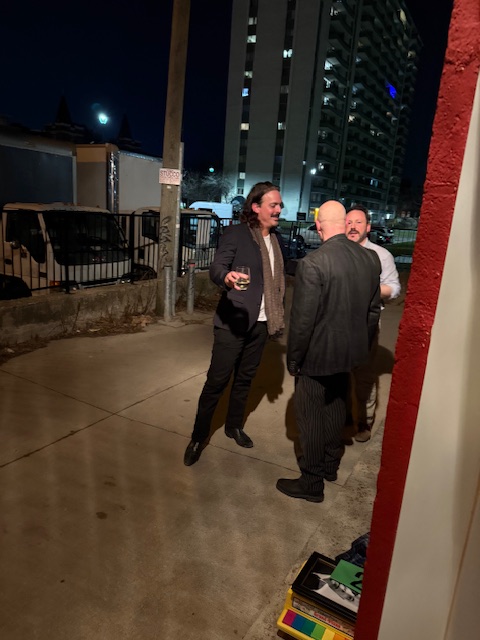
Adam will repeat his performances Friday & Saturday April 10 & 11 at nanoSTAGE – 1001 R Bloor Street West, and again next week April 16 at the Richard Bradshaw Amphitheatre free noon-hour series.
 barczablog