Earlier today I commented on John Gilks’ post about The Lion Heart a new opera by Corey Arnold and Kyle McDonald that received its world premiere in a semi-staged production this past weekend.
Near the end of his review John said “I might suggest that dismissing “modern opera” is not a great starting point for creating one.” In reply, I commented at the bottom of his page. “And yet there’s a long tradition of composers dissing one another even if it’s not terribly nice.“
I had two particular precedents in mind, although there are lots more.
Exhibit A: When Richard Wagner was in exile he wrote several essays and pamphlets, venting his frustration as he could no longer show the world what he could do as a composer or conductor.
His Das Judenthum in der Musik (1850) attacks Felix Mendelssohn and Giacomo Meyerbeer, even though the latter had been one of the most generous & supportive to the German composer during his disastrous first visit to Paris. Talk about ungrateful.
Opera and Drama (1851) is in effect a defense or promotion of Wagner’s own future work even before he had shown us what he might be able to do. Wagner said that opera made a fundamental error, in confusing means and ends; the means (Music) becomes the end, while the supposed end(drama) has been reduced to its means. In other words, instead of music being employed to make drama and theatre, opera is using theatre and drama in the creation of something musical. Wagner in effect disrespects every opera ever written, in the process throwing down the gauntlet.
Lohengrin had premiered in 1850 in Weimar thanks to Wagner’s friend Liszt. In the 1850s –after the big essay was written—Wagner set to work on his Ring operas, composing Das Rheingold and Die Walküre, almost as if to show us how an opera could fulfill the precepts laid out in the essay. And amazingly he did a fair job of creating something that justified his critique of opera, although one might well point at the “arias” and scenes in his music dramas that still seem to fall into the old trap of making music the end goal, rather than drama. Yet even so he is a genuine reformer. We might point at second generation Wagnerian operas such as Pelléas et Mélisande or Elektra as better examples of works that employ musical means to create drama.
Exhibit B: Thomas Adès came on the scene more recently, a composer of operas that arguably stand among the most important of the last quarter century. But in addition to his musical activities Adès also tried his hand at the game of disparagement. In April 2013 I wrote twice about Conversations with Tom Service, a book that seems to echo Wagner in its disparagement of earlier composers, although this time Wagner is the target.
Adès sets himself up as a peer to Wagner. It’s a brilliant way to promote himself and his music.
And now Kyle McDonald & Corey Arnold are possibly within that tradition. So far we’ve heard the first part, where they issue critiques (in a recent interview). Kyle said the following:
To the “layperson,” much of opera can seem like speaking coding to a person who just wants to play the video game. We’ve had a nasty habit in the last 50 or so years of increasingly pushing the “coding” in fine arts, deconstructing beauty until it becomes mere atoms. Highly specialized people with certain personalities enjoy this, but the majority of the rest of the species do not.
To save opera, we have to make it for humans again, which means i) making it a gateway to feeling and not to thinking (i.e., in a language we speak, with humane runtimes, and bending the score to accommodate acting, and not the other way around), ii) ignoring Twitter entirely, and iii) letting go of the past.
I can relate to this critique. When Kyle says “bending the score to accommodate acting, and not the other way around” he reminds me of what Wagner said.
The question is: will the new operas they create live up to such a critique?
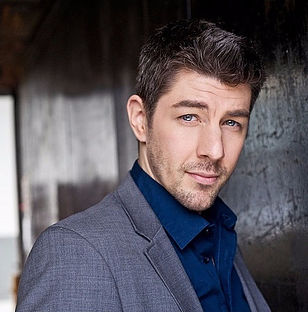
I watched the live-stream of The Lion Heart, the premiere of a new opera from Corey Arnold (composer & conductor) and Kyle McDonald (librettist and singer of the lead role).
Or at least part of it. Alas connection issues prevented me from seeing Act I and part of Act II, missing the first 40 minutes. I think I saw more than half of the work, which ended at 9:40 pm, after beginning at 7:30 (or so I assume).
First off, let me mention some important subtext for me and hopefully for you. Any first opera should be permitted to fail, to contain bad choices, from which the composer and librettist learn and grow. Verdi and Wagner each wrote several operas before they had any real success. What we witnessed was a first opera, and as such it was quite good.
I try never to judge, I seek to understand, but please note that I had no program, no synopsis and no titles for an opera sung in English that was often unintelligible due to the reverberant space at College St United Church, especially when two or more were singing at once. I wonder if this is what all the virtual customers face in which case I’d say they need to fix that. I had a comp ticket, facing the additional puzzle of coming into the show half-way through.
Yes that’s a humongous preamble. Even so there’s lots one can say.
I believe it’s more or less the same story as that of Richard Coeur de Lion by Gretry (courtesy of opera-arias.com):
On his way home from the Third Crusade, King Richard has been imprisoned by Leopold, Archduke of Austria. The king’s faithful squire Blondel seeks him out disguised as a blind troubadour. He arrives in Linz where he meets the English exile Sir Williams and his daughter Laurette, who tell him of an unknown prisoner in the nearby castle. Laurette is in love with the prison governor, Florestan. Countess Marguerite, who is in love with King Richard, arrives and offers Blondel her help. Blondel goes to the castle where he sings the song Une fièvre brûlante (“A burning fever”). Richard recognises the music and tries to communicate with Blondel, who is seized by the guards. But he is freed when he tells Florestan of an assignation Laurette wants with him the following night. Blondel reveals the truth to Williams and the countess and they plan to free the king. Marguerite holds a party, during which Florestan, who had come to meet Laurette, is held captive. The countess’s troops besiege the castle and rescue Richard.
I’m one of the few people around here with some experience of that opera, produced long ago in Europe, for which I had the fun of playing through the score as my brother learned the role of Richard. And I think Opera Atelier spoke of doing it somewhere in Europe, although I don’t know if that ever came to fruition. Otherwise it’s rarely mentioned although it deserves to be better known, one of the earliest of the genre known as “rescue opera”.
For the new opera The Lion Heart the characters are partly the same. We again have Leopold and Blondel and Richard. Once again we have Leopold imprisoning Richard while he was presumably on a crusade (I suspect that’s something we hear about in the first act). The ending seems to be a successful rescue, although not as triumphant as I would have wished. Perhaps that’s something to be enlarged in a future revision, with additional choral & orchestral firepower in support.
And once again we have an opera where almost everyone is male. I mention that because we have seen some young companies started in the Toronto area who seemed to have the gender question as part of their raison d’etre, producing new operas that might offer women roles, when they are otherwise starving for opportunity.
We heard a fourteen-piece orchestra led by the composer. It’s a melodic score, diatonic for the most part, with ventures into chromatic harmonies and occasional dissonance. Arnold was successful at generating suspense in the scene where Richard earns his nickname, battling a lion. For my money that’s one of the greatest things you can have in an opera, namely music that paints a picture and sets a mood.
I didn’t notice anything like an aria or a conventional operatic set piece, as the arioso (singing with orchestra in other words) was more or less continuous, the singers zipping through the text at a faster rate than what one usually sees in opera. That’s a mixed blessing. It’s good because the story is advanced, but problematic if singers don’t enunciate. Titles (which can be a lot of work and/or expense) would be ideal. It may be that the production team didn’t realize how this was going to sound in the performance venue, which is likely more reverberant than their rehearsal spaces.
The presentation was semi-staged, the singers attired as for a concert performance.
There are times when the orchestration shows subtlety, as for instance in a lovely cello solo during one of Richard’s solos in Act III. I found the libretto a bit verbose at times. As the characters stand there in the semi-staged version it makes sense that they tell us so much, but ideally we’d have action as in cinema. Verdi’s Otello is an ideal macho creation through his terseness, a man of few words; I wish Richard were more like that, especially when he is alone. Without subtitles I’d wish the text were delivered slower, to enable me to hear every syllable clearly, which wasn’t possible tonight.
There were some scenes that were better than others, possibly as a reflection of the composer’s commitment & inspiration. The scene in the last act between Richard and Mirella (sung by Nicole Dubinsky) was very sensitively scored, the orchestra very unobtrusive, the vocal lines soaring easily and intelligibly. The scene between Richard and the Captain of the Guard (Andrew Tees) was a great pleasure; for all the testosterone in the scene, the singing was beautiful and sensitive.
The scenes including Blondel (Tonatiuh Abrego) and the sadistic Leopold (passionately delivered by Andrew Derynck) called for lots of high notes, splendidly sung. Speaking as a tenor, I wonder if composer Arnold –himself a splendid tenor—might reconsider the demands he makes on these two, in the interest of getting the work produced. You shoot yourself in the foot if you make the piece so difficult to sing that no company dares to undertake it. Rossini’s William Tell, for instance, features so much spectacular singing that the work is almost impossible to produce, because of the challenge in finding enough talent. I don’t mind the music, but am speaking now about the challenges the composer imposes upon the company who would produce the work.
I don’t dare say much more, indeed maybe i’ve already over-stepped, as I didn’t properly see the work. Watching from home, and missing the first half, working without a synopsis or program, I’m hardly in a position to say anything. Had I been able to attend I might have a different perspective, and might have heard the text more clearly.
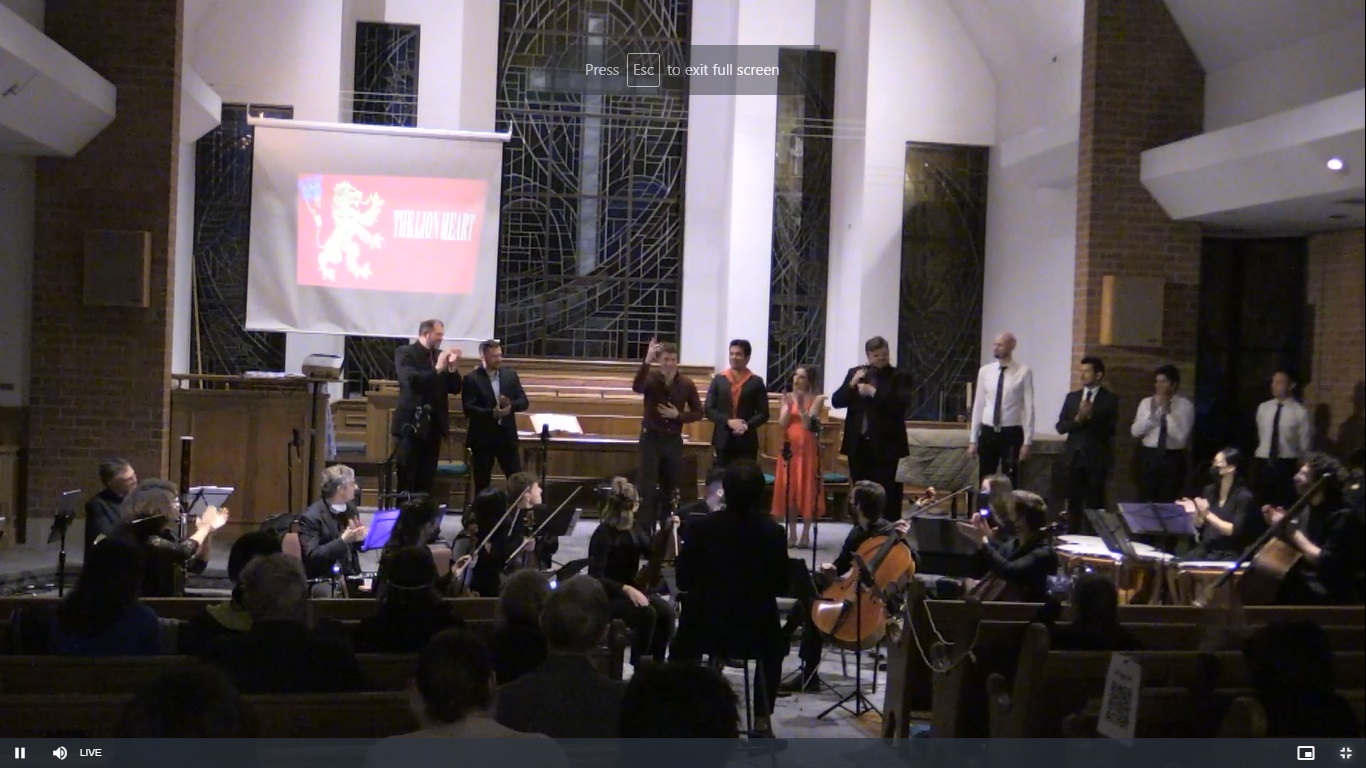
I did see that the work was well-received. I have a screen capture of the applause, wishing my own bravo could be added for all cast, crew and especially the creators.
Librettist & star Kyle McDonald takes his bow at the end.
But I do look forward to more from Kyle and Corey, two young creators who have just begun. Of course if you look at their website you can see that they’ve got lots of irons in the fire, projects upcoming. They’ll be back soon.
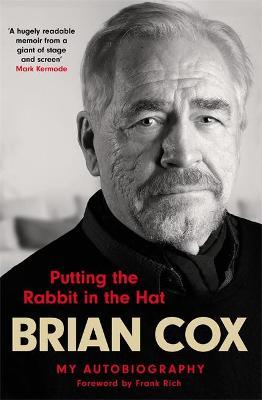
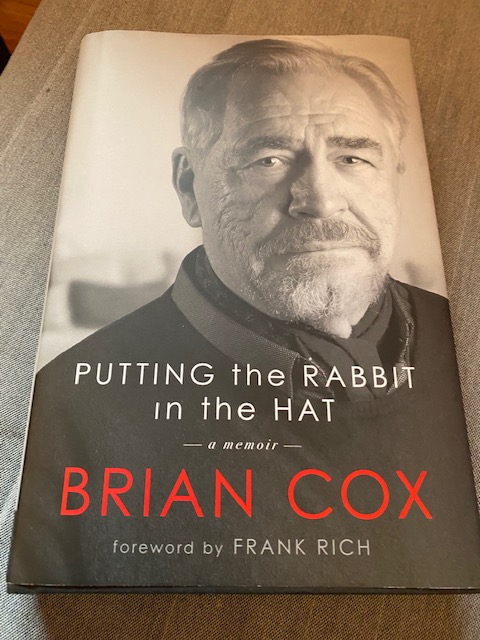
Power’s interviews often signal the books I need to get. Harvey Fierstein’s memoir, for instance, was promoted in the Q interview more recently, a book I’ve just begun to read. And a couple of episodes earlier in March came Power’s interview with Brian Cox, whose memoir is subtitled “Putting the Rabbit in the Hat”.
I didn’t understand the excitement about Succession, so I’ve started catching up on that too, which I’ll have to discuss another time.
But now I’ve read Cox’s book.
The greatest artists don’t necessarily make the best books or conversely, we might say that the best books don’t necessarily come from the best actor. Yet I was swallowed up in the entertaining prose of Brian Cox’s memoir. No I don’t immediately think of him as a brilliant actor. But he’s written a terrific memoir, full of anecdotes and also many observations on acting.
I might sum it up in the story he tells about Troy (2004), a favorite film I’ve seen many times. In this version of the story, Priam comes to Achilles begging for the body of his son Hector, dishonoured in the battle with Achilles. It’s funny because this moment in the Iliad is the stirring opening image of a recent powerful TED talk about wakes (meaning the poetry of Homer’s Illiad not the film adaptation). You can find that here, and excuse me if I seem to be digressing. Please bear with me, I’m making an elaborate metaphor.
It’s the very first thing we hear, the first two minutes of poet Kevin Toolis’s talk.
I want to cite this discussion of poetry and honour alongside the scene between Brian Cox and Peter O’Toole in the film, admittedly the outcome of a script and a director, not the specific choice of Brian Cox naturally.
First though, let’s set it up with a scene between Priam and Achilles. It’s intriguing because it juxtaposes a fine actor of a previous generation with an under-rated actor of our own, namely O’Toole and Brad Pitt. Cox goes into some detail about the efforts of a young actor seeking to transcend his physical gift (his beautiful body) in his quest to become a genuine actor. You see that in this clip, as Pitt holds his own alongside O’Toole.
And then, towards the end of the film in a clip that I must caution you about –it’s violent & horrible—Priam is brought down by Agamemnon. It’s a bit of poetic justice I suppose, that the two leaders should meet, even if there’s no poetry in this justice. Agamemnon stabs the honourable King Priam in the back, and further disrespecting him in denying him any sympathy for the innocents in the war.
You can watch it.
Or you may prefer to read this paraphrase of their last lines in their exchange.
PRIAM: (shouting at the Greek soldiers, watching them despoil the temple) Have you no honour?! Have you no honour!?
(a spear stabs into him and through from behind; Priam collapses, and we see it’s Agamemnon’s spear)
AGAMEMNON: I wanted you alive. I wanted you to watch your city burn. PRIAM: Please… the children. Spare the innocents… (fading as he is dying) AGAMEMNON: Nobody is innocent. Nobody. (walks away)
Watching the TED talk I was struck by the poetry of honour, alongside the conspicuous lack of poetry in the modern world.
Watching episodes of Succession this week (a dark show full of nasty selfish people rarely illuminated by empathy or love) a series I contrast with Ted Lasso (a glimmer of light for many of us, as gentle and kind as Succession is brutal and cruel), I’m thinking that Brian Cox is in many ways come of age, the actor for and of our time. Or our time has caught up with him.
Perhaps he wouldn’t want to be typecast as a backstabber? Yet the slaying in this clip could just as easily be the younger pragmatic generation of actors (plug in Viggo Mortensen or Ed Norton) sweeping aside the poetic previous generation of stage actors (O’Toole or Gielgud or Olivier).
Cox is just right for Succession, even if he’s striding through a world without poetry or kindness, just as he did in Troy.
Thank goodness Cox’s memoir contains something essential, missing from many memoirs and thank goodness is also found in Fierstein’s memoir. When you’ve finished a book and recall an episode such as the scene I described from Troy between Peter O’Toole and Brian Cox, the index is indispensable.
Cox is not just telling us stories about celebrities & stars. The title is apt. Magic is pulling the rabbit out of the hat, right? Cox truly addresses the craft and the art of acting in cinema and onstage: to propose how we might first put the rabbit into the hat. If you were just starting to explore this question you could do worse than to read Cox’s ideas, reminding us of famous stories such as the encounter between two styles in the film Marathon Man, where Laurence Olivier famously told Dustin Hoffmann (whose method acting was exhausting him) “My dear boy why don’t you just try acting?” It’s such a delicious rejoinder, I’ve always wondered if it was a real moment or not. But it doesn’t matter, as it has become like a parable.
Yet perhaps Cox isn’t quite on one side or the other, not just because his career is largely among American film-makers. I’m devoutly against the notion of “stars” and the foregrounding of virtuoso acting chops, particularly at this time of year: when the Oscars seem to regularly get it wrong. Cox is more of a character actor than a star, reflecting my preference. That you probably know Cox for something he’s done in a supporting role is for me a positive sign of a real actor. Being a star is a dubious honour. Cox has worked with every famous name in the business, often in the OTHER version that wasn’t seen. Before Anthony Hopkins got rich playing Hannibal Lector, Cox played the same character in Manhunter, a film nobody saw. He played Winston Churchill the same year that Gary Oldman won an Oscar playing the same historical figure. You could have seen him in the Bourne films, a Scot playing in Braveheart and Rob Roy, but not likely the star you remember.
And now suddenly his role in Succession is one we remember even if it’s much the same anti-heroic character as his Agamemnon, the back-stabber without honour. But perhaps that’s the way business and plutocracy works.
After decades of playing roles without quite breaking through, he seems to have a hit with Succession, a television series that’s finished its third season. As I watch that trailer for season one, from the vantage point of partway through season two, I’m staggered by the simple fact: Cox is at the centre of the family dynamic that drives the series.
Cox tells us that according to the original plan Cox was hired to do the first season as the patriarch of the family and then was supposed to die. Ha, as if..! Impossible. And that factoid is itself as much a matter of big money as it is about the mechanics of the drama.
But it reminds me a bit of Scheherazade, who avoided being killed off by telling entertaining stories. It’s apt, because if nothing else, Cox himself is a superb story-teller. His book overflows with his tales.
Index or not, I’ll be re-reading it soon, because it was so much fun to read.
It’s subtitled “Opera in Pasticcio“, a form where Kyle combined existing music from opera with his comical lyrics to tell his spy story. For example he takes the tune of “Non più andrai” from Nozze di Figaro, with the lines “The name is Bond, James Bond, don’t be nervous” rhymed with “I’m in her Majesty’s Secret Service”.
Today I heard about something in a different style, namely The Lion Heart. This original opera gets two semi—staged performances this weekend: 7:30 pm Saturday March 19 and 5:00 pm Sunday March 20.
Kyle wrote the words. Instead of the pasticcio approach, he is teaming up with composer Corey Arnold.
You can find out more, including booking tickets for in person or virtual at their website.
I wanted to find out more.
Barczablog: Corey, is this your first opera?
COREY I’ve composed a couple of art songs recently, arrangements for jazz combos and jazz orchestra on and off throughout my 20s, and a couple of musicals in my early 20s This is my first opera.
Barczablog Gentlemen, how long have you been talking about a collaboration, and how long did this work take to bring to fruition…?
KYLE:: We met while singing in Ottawa around 2016/2017 (Corey’s dating on this is more reliable).
COREY Kyle and I met in Ottawa in 2016 during a production of Rigoletto with Pellegrini Opera. A year later, we did Tosca with the same company where I was singing Spoletta and understudying Mario. The first weekend we lost the rehearsal pianist due to a personal issue so I stepped in to play for a day. It was my first time playing piano for an opera and I was quite nervous, but I had been accompanying myself while learning the role. Then they asked me to finish the production as the pianist but I wanted to show the conductor I could sing Mario… so one rehearsal, I sang Mario for Act I from the piano while the tenor went through the staging.
The next day Kyle and I were chatting backstage. He said something like “You’re a bit of a music freak eh? Want to write music for an opera?” The imposter syndrome I had as the rehearsal pianist was nothing compared to that which I experienced at the thought of writing an opera, so it took some persistent prodding from him, but by 2019 I was really getting into it. It was complete a month before the pandemic started and it took many grant applications before we had the budget for the orchestra, never mind the many delays due to the pandemic.
KYLE: I approached Corey with a libretto I had written many years before. I had written it somewhere in the period of 2005-2008. So, let’s say this work has taken since 2005 and to bear fruit! So…17 years? Our collaboration has worked out so well on The Lion Heart that we’ve gone ahead and started another original opera, which will ideally be finished in 2023. We have to be tight lipped about it for now, but let’s just say it will both horrify and arouse…
Barczablog: You’re working in the world of opera, meaning singers with particular skillsets. Maybe you don’t expect subtle method acting, but that’s not usually relevant in opera. Please identify your favorite operas, (when you look at what operas work best in your experience) , and then speak to what you’re aiming for in this piece.
COREY For me, I think historically in terms of the number of times that a movement has emerged in opera for more realism. Verismatic opera comes to mind but there were earlier movements as well. We need another similar movement today, which looks at the pacing of drama in the most popular forms of film and television media, at the intensity of the drama in those moments, and at the musical language that we are using to communicate all of this. My favourite opera for dramatic pacing as well as really accessible musical moments mixed with more tonally chaotic moments, is Gianni Schicchi. I don’t think another opera exists that has the same quality of musical timing, beautiful melodies, and action packed orchestral textures. Unfortunately the brilliance of the timing of the libretto is almost entirely lost in translation to English, or to audience members having to read subtitles…
KYLE Interestingly, when you get singers singing in their mother tongue, the acting tends to take care of itself…
My favourite operas… Turandot by Puccini (though there isn’t really an amazing role for me to sing in here, but overall, it’s just spectacular), Mefistofele by Boito, and The Barber of Seville, by Rossini -> which is probably the best first opera for someone to see IMO.
There are so many good operas it’s hard to choose, but these are the ones that have captured me. Mefistofele is largely because I want to sing Mefistofele, so I cop to bias there (though, one of the themes from this opera was used as inspiration for Richard’s recounting of the Crusades in The Lion Heart).
In The Lion Heart I wanted to convey both glorious hope, and intimate nuance, and I think Corey has done a magnificent job of both. Opera must be grand, otherwise, it would be something else – why have an orchestra? But feeling must never be general and must rarely be loud – specificity is what triggers mirroring responses in other human beings – thus, there must be intimacy.
So much of everything being made now is dystopian and hopeless. I’m tired of this. The Lion Heart is meant to awake the lion of hope in everyone – no matter how dormant. Whether it’s fighting a lion or offering an encouraging word, acts of bravery both large and small are in all of us.
And of course, I want music that delights and burrows. I think we’ve achieved that, and, it’s my hope that, sometime around the beginning of April, you find yourself humming one of our themes in the shower, and you curse our names because you can’t get it out of your head.
Barczablog: My wife loves to point out the rip-offs in pop culture, for instance the way the Batman theme (Elfman / Burton in 1989) is so similar to the way Richard Strauss begins the first of the 4 last songs, “Fruhling”. But Elfman was being pragmatic. For centuries church organists, kapellmeisters and music-directors have been lifting the music from other sources. JS Bach did it. So did lots of other composers. Could you talk for a second about how you see opera being saved / revived with your approach.
COREY: I don’t know what the future holds for me. But at 19 I wrote in my journal that I wanted to write an opera. And the reason I wrote it is because some operas give me delight and full-bodied satisfaction like nothing else in life, and I wanted to share that feeling with people. At 28, as my career as a singer started to get really frustrating, I sat there asking myself, how can this operatic industry be shrinking endlessly, with most of our professionals desperate for the tiniest career, while:
Orchestral film scores from Zimmer, Williams, Glass, etc… are so popular and omnipresent in the biggest budget films globally,
Modern Musical theatre has a following significantly larger than ours… and we can massively outdo musicals in melodrama with our voices, orchestras, and production size,
and every time I used to sing opera in this tiny restaurant in Ottawa where I worked washing dishes, the phones came out, the energy would shift higher, moods would shift more friendly… operatic voices are a wonder…
Within this context… how are we not able to create truly meaningful and influential new works? We need to let our drama evolve with the times, integrate all of our experimental music effectively and EXPRESSIVELY with contemporary musical idioms so that our new works are not just lost on 99.99% of the population, and then trust our artists (singers, orchestral players, etc…) to use their instincts to interpret the music through the lens of their contemporary lives.
It’s amazing to see singers sing a new, “friendly music” opera in English, because you see more of the operatic artist shine through than you’ve ever seen before! And in the end, if our artists and audience are so burdened with performance practice, avant-garde musical language, singing in foreign languages, or “musical language barriers” from older genres, they can’t bring themselves fully to the table, and EVERY SINGLE other entertainment medium that is succeeding today knows that if we don’t have performers that are free to expose themselves to an audience, it just rings inauthentic and audiences disengage.
Our goal is that through these works, we can remove the burdens we’ve placed on the artists and the audience by creating something that just connects. We’re only interested in changing you… so that you walk out feeling exhilarated, wonderful, and alive.
KYLE: As for ripping off existing opera, personally, I’ve begun to make a career of it in my pasticcios. Who wouldn’t want to hear their favourite song again for the first time?
However, Corey and I are in the business of trying to make new favourite songs.
With regards to orchestral nods, Corey is in a much better position to comment on that, but I’ll say The Lion Heart has at least 4 incredible “hit” themes – which is pretty impressive considering most pop albums only have 1 or 2.
Saving opera: there is much to say, and I don’t want to black hole your time, so I’ll just offer some quick sketches:
Whenever the topic of opera or orchestral music comes up with someone involved in the industry, I ask people to tell me about the first time they realized they were in love with it. The majority of the stories are similar in the respect that the person was changed. My “awakening” was very much the same – it changed me.
I didn’t start out training to be a singer or a musician – I’ve been hands on, learning as I go, not institutionally educated – so my journey has been guided solely by the love of it, and not by academic standards: this, I believe, is the position of the regular person.
To the “layperson,” much of opera can seem like speaking coding to a person who just wants to play the video game. We’ve had a nasty habit in the last 50 or so years of increasingly pushing the “coding” in fine arts, deconstructing beauty until it becomes mere atoms. Highly specialized people with certain personalities enjoy this, but the majority of the rest of the species do not.
To save opera, we have to make it for humans again, which means i) making it a gateway to feeling and not to thinking (i.e., in a language we speak, with humane runtimes, and bending the score to accommodate acting, and not the other way around), ii) ignoring Twitter entirely, and iii) letting go of the past.
And just to put a regional spin on this – companies in France and Germany have expressed interest in The Lion Heart, but they want it in French and German. Why don’t we do the same here?
Barczablog: We must talk again. But first I am looking forward to seeing The Lion Heart.
KYLE: Oh, and my next opera in pasticcio will be premiering in May,
…But first, The Lion Heart this weekend at the College St United Church 452 College St. W. in Toronto. For further information or tickets go to their website.
The other night when I saw Cyrano at my local Scarborough CINEPLEX, I made it a double feature, because they had only one showing that was to begin at 10:45 p.m. I filled the time before Cyrano watching The Batman, latest incarnation of the comic book hero.
Size matters, we’re told.
I had the option to watch it in IMAX, meaning a big beautiful image and sound to match. I inserted balled-up Kleenex into my ears, a trick I learned from a music critic back in the 1970s, at an Elvis Costello concert, while standing at the urinals. When I recall Peter Townsend and other musicians who have had their hearing damaged by music, I insert the Kleenex without hesitation.
And writing days later I can say that my ears survived the ordeal.
I think I’ve seen every previous Batman film. I remember them more by thinking of the directors as much as the person playing the title character.
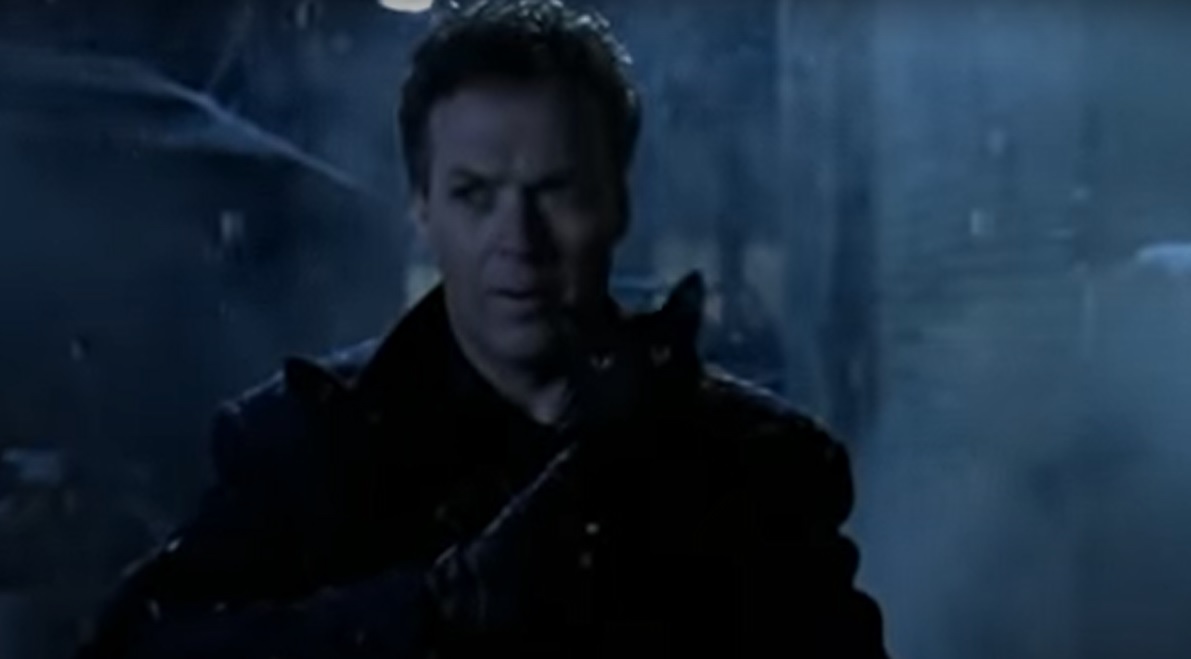
Director Tim Burton is the emphatic creator of the modern obsession with comic book superheroes and villains, beginning with Batman (1989), and a sequel Batman Returns(1992). Although Danny Elfman scored both, I think of the first as much via Prince’s songs as in its score. The second film is even more extremely quirky, which translates onto the screen as something operatic. The clearest examples are in the endings for the villains. First there is the grotesque ritual Elfman and Burton give The Penguin…
And here’s the whimsical cat-music Elfman gave Catwoman.
For Batman Forever (1995) Burton stepped into a different role, as producer alongside the director Joel Schumacher. I wish I knew the truth about the dynamics behind the scenes, but I felt that commercial pressures were tampering with the artistic impulses we’d seen from Burton, with the result drifting away from art, pulled back to the original two-dimensional quality of a cartoon. Schumacher’s next opus Batman & Robin (1997) went further in that direction, which is to say, lots of action but nothing I would call art.
I find it pretty hard to watch.
After a break of nearly a decade the franchise was reborn in Christopher Nolan’s trilogy of Batman Begins (2005), The Dark Knight (2008) and The Dark Knight Rises (2012) taking Burton’s gothic vision into even darker realms, and not mitigated or relieved by much in the way of art or beauty. Given the way Nolan harnesses suspense & horror to hold our attention, it should be no surprise where we end up in 2022.
Even without IMAX The Batman (2022) is a loud nasty film. As I watched the last hour I wondered if the producers had decided to pay writer / director Matt Reeves by the body-count; how many dollars is each death worth, I wonder. I say this as someone who has been triggered by the news over the past few weeks, as someone with family in Eastern Europe. If you’re likely to be sensitive don’t see this film. It pushes several of my buttons, both in its violence and the echoes of recent news events such as the suggestion of the January 6th DC insurrection. I don’t think this is a spoiler, not when the film should carry a disclaimer at the beginning for the faint-hearted.
It’s a well-made commercial product.
I am reminded of the course I used to teach on the most popular operas, when we would ponder the meaning of “popularity”. I recall something simple yet profound in the documentary Zappa that came out at the end of 2020. Zappa said “This is the dawning of the dark ages again. Never have the arts been in such bad shape in the United States… The business of music is all about this fake list of who sold what. The whole idea of selling large numbers of items in order to determine quality is what’s really repulsive about it”. Commercial pressure is also the difference between the artist starving in the attic or finding success. I believe that pressure is what led from the fascinating films of Tim Burton to the more commercial mediocrities we got from Schumacher. Nolan commercialized is Matt Reeves, every film delivering more explosions and jolts to your nervous system.
Perhaps this time the product will continue to make the studios money, without falling down the way Schumacher’s films did. Is the solution louder explosions and a bigger body-count?
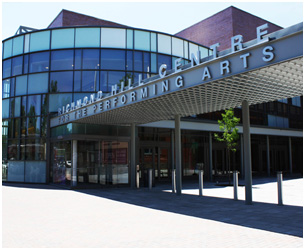
Last night I heard Kindred Spirits Orchestra playing at the Richmond Hill Centre, led by their conductor Kristian Alexander with piano soloist Naomi Wong.
From outside it looks nice enough..
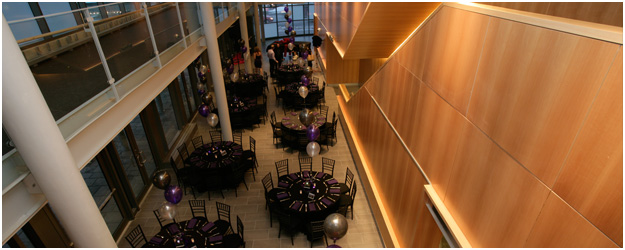
I forget the beauty of this space, until I enter.
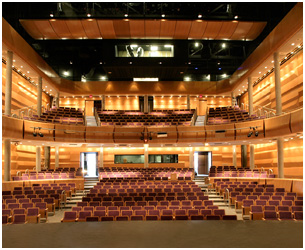
The lobby of the Richmond Hill Centre for the Performing Arts, designed by Jack Diamond
My friend Brian and I were sitting 30-40 feet away, roughly eye level with the Steinway piano, with most of the audience in front of us. The RH Centre website says their capacity is 631, with 360 at the orchestra level.
The acoustic in this little jewel of a hall enabled us to easily hear Wong playing the Chopin piano concerto #2, her notes soaring over the sonorities of the orchestra arrayed behind her on the stage.
Even if we were to sit this close to a soloist downstairs in a big space such as Roy Thomson Hall, we’d be hearing the sound dispersed into a space that can hold 2600, over four times the size of RH Centre. When a soloist undertakes a concerto in the big space, they have to ostentatiously take the stage with their playing (like an actor on a big stage) even in the softer passages. Wong had the luxury of this intimate space, every note clear on the instrument. And it was really lovely to be able to see her fingers as though she were performing across the living room from us. Wong doesn’t have the preening ego that some pianists develop, very humble about her playing as conductor Alexander gently encouraged her to take her solo bows.
The KSO opened the program with Prokofiev’s “Lieutenant Kijé Suite”. I recall we played the “troika” theme in my high-school band many years ago in an arrangement (as I quietly remarked to Brian, wondering if he remembered it from when we went to that school long ago). One of the chief joys of the piece is the way the themes gets handed among different sections, creating a genuine sense of community as each of us got a turn at the melody. It’s a tuneful composition calling for lots of solos from the wind players and intriguing orchestral colours, at times overwhelming in its enthusiasm.
Alexander led the KSO at a bold pace. Again, how wonderful to hear every note so clearly in this tiny hall. The trade-off one makes when choosing between a concert from a community orchestra like KSO and the premiere ensembles such as the Toronto Symphony is evident at such moments. TSO might be better, but in this space we’re hearing and seeing everything with perfect clarity, the players lovingly surrounded by family, friends plus the supporters in Richmond Hill and the surrounding area.
After the interval we heard Elgar’s Enigma Variations, the big piece that was the orchestra’s focus. While the concerto is also substantial, for that piece the soloist is the obvious star, with the orchestra in a supporting role. After the interval that shifted.
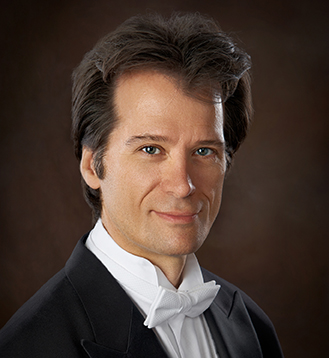
KSO Conductor Kristian Alexander
For a young group such as the KSO –comprised of a mix of young players and professionals—the question of repertoire looms large. One can imagine that Alexander and his team carefully aim for works that will entertain the audience, while not over-reaching by selecting music beyond the capabilities of the ensemble. Alexander functions as both an interpreter and a teacher, leading the musicians while helping in their development.
But what is the enigma, you may ask. I believe it’s a mistake to think of Elgar’s piece as a puzzle to be solved, however many musicologists may dig into the score in search of the answer. I saw a quote from Elgar saying that a “dark saying must be left unguessed.” Where have we heard such things? Indeed, given the timing of the composition, in 1898, I’m reminded of Elgar’s contemporary Claude Debussy, whose Nocturnes were composed at this time, and whose symbolist opera Pelléas et Mélisande was composed in that decade.
Elgar said “So the principal Theme never appears, even as in some late dramas – eg Maeterlinck’s L’Intruse and Les sept Princesses – the chief character is never on the stage.” There it is. Maeterlinck’s The Intruder premiered in 1891, while Maeterlinck’s Pelléas had its premiere with Debussy in attendance in 1893. The mistake I’ve often seen is to think of “symbolist” meaning that the symbol is to be decoded and explained, when the essence of the symbolist aesthetic is a reticence, a refusal to be explicit, a tendency to be obscure, vague, shadowy. The symbolist movement can be understood as a response to the growing influence of science in modern life, the reductive tendencies of thinkers seeking to be explicit. The symbolist enjoys mystery as Elgar likely enjoyed the ambiguities created for the listener in his Enigma Variations. Whether or not Elgar should be thought of as a symbolist, he’s only explicit when he tells us that we should not seek clarity in our understanding of his enigma. I’m inclined to listen to that suggestion.
Perhaps the over-riding idea or theme behind the piece is Elgar himself, as this work is in some respect a self-portrait. If we understand it as a series of portraits of his friends, the last variation is Elgar himself, containing within it the music of his chief influences.
Alexander led a stirring performance, building slowly but inexorably in the “Nimrod” variation: the one that’s so well known, that we sometimes hear at funerals or on Remembrance Day. At the conclusion (concerts still a relative novelty for most of us in March 2022) our ovation attempted to return the favour, in an eruption of joyful gratitude.
Lent in 2022 is becoming darker, war casting a horrific shadow over our fortunate prosperity on this side of the world. I treat gratitude as a kind of sacrament, the foundation of everything; we begin with recognition that we are so lucky here in North America.
I’m praying every night. Is it for me? perhaps. I hope that when I ask for mercy for my loved ones, for the safety of those who might be in danger or harm’s way, that perhaps my prayer is heard. At the very least I am meditating, making myself feel better.
I’ve been thinking about The Lord’s Prayer not just because I run it through my head several times every day, but because it exists in multiple versions for me. If we read it in the Sermon on the Mount as it appears in Matthew Chapter 6, we already encounter multiple versions: depending on The Bible we read. The King James Version was drilled into me early, and so it’s still my go-to if I am reciting, a prayer I learned long ago. Although Luke 11 has a version of a prayer that’s startlingly similar (considering the divergences we get in parts of the Gospel accounts), Mathew’s is the one I’ve been reciting, especially since COVID disrupted church services, forcing me back on my own devices.
It’s ironic that in being chased out of church, we might in some respects be closer to honouring what Jesus told us to do: as I shall explain.
I think that chapter six of Matthew, which includes that prayer, is mostly about performing. No it’s not Stanislavsky or the Method, we’re not being taught the mechanics of performance. But Jesus is talking to us about sincerity and purity of purpose in our actions. Actors going through the motions, simulating piety are the problem, and we shouldn’t be troubled if we’re not simulating faith as boldly. That’s not what He wants.
The opening of chapter 6 may seem to be talking about charity, when it says “Be careful not to practice your righteousness in front of others to be seen by them. If you do, you will have no reward from your Father in heaven.” The chapter will also speak to us about prayer and fasting. But it’s less about charity or prayer or fasting, and much more about our sincerity of purpose: how we perform the actions.
When I speak about performance I mean Jesus’s underlying question. Are you really praying, really giving sincerely: or is it all an act, all for show?
We’re told “And when you pray, do not be like the hypocrites, for they love to pray standing in the synagogues and on the street corners to be seen by others. Truly I tell you, they have received their reward in full. 6 But when you pray, go into your room, close the door and pray to your Father, who is unseen. ”
I have always found this hard to reconcile with performances of sacred text, and perhaps I’ve even talked your ear off about this? (sorry!).
I used to be a soloist in churches. While I am still comfortable in the role of organist or in a choir, I’m troubled, conflicted about singing text to a congregation who listen. Indeed, the last time I sang –when I was especially tormented—someone came up to me afterwards to comment on how sincere I seemed to them. It was a lovely gesture, yet I felt horrible, because I was being torn in two, and haven’t been able to sing a text in church since that time.
Yes I can play the organ, or sing in the choir because that’s a more purely spiritual thing, free to each person to interpret.
Indeed, this commentary could just as easily apply to sung versions of “Ave Maria”: featured so prominently in the current Batman movie, sung by the Riddler, please note.
Sometimes when I pray I employ the sung version of The Lord’s Prayer in my head, silently. It’s an oxymoron. To perform this aloud, especially if it were admired for its sincerity, would be in direct contradiction to what we’re told to do, how to pray in the very chapter of Matthew where he gives us the prayer. How weird to perform this prayer–meaning to model faith before others—when the prayer was given as an example of something to be done silently in private, not before others.
Perhaps I sound like a prude or a stickler. But I find the contradictions illuminating. Perhaps in church we’re not really praying, given that we’re all hearing one another, hearing the organ and the choir that might resonate inside ourselves later when we pray alone.
Maybe the way it should be done in church is in its context: with Jesus’s admonition (via Matthew): to do this alone in the dark, not on a street corner where we’re showing off our piety. To sing it without the preamble is to miss the most important part of the lesson.
I stumbled upon a sermon from Justin Schwartz today that made me very happy, thrilled when my own wandering in the dark corresponds to something another person is thinking or saying. Justin served an internship at Hillcrest Church in Toronto during his graduate school days, before taking up a post in the USA. His recent sermon comes about two minutes into the video after a crisp clear reading of the relevant text of Matthew’s Gospel, from First Christian Church, Disciples of Christ in Louisburg Kansas, USA. I feel lucky that I can follow him and hear his sermons through the magic of social media.
His words are applicable every day of the year, especially now.
When we sing the Lord’s Prayer in church –in a sense contradicting what Jesus said in Matthew 6—I wonder: what are we doing? Are we praying, or is church like a school where we practice what we’ll do at home on our own..?
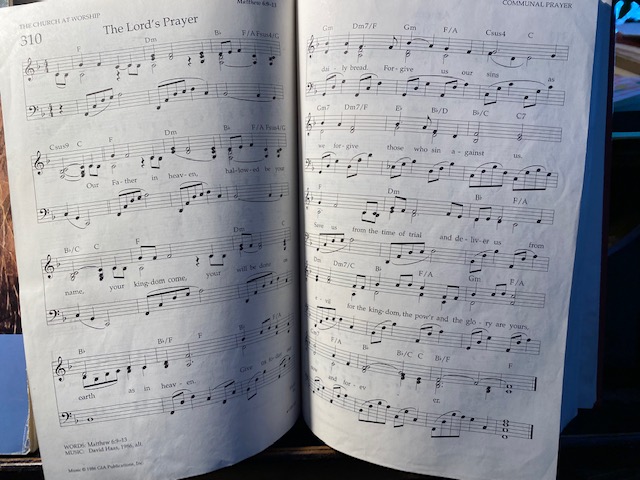
As I ponder this question (one I’ve been mulling over for over 50 years), I’m going to briefly look at the four versions of The Lord’s Prayer in the Chalice Hymnal. Each one has its merits.
#307 is the one that employs the nice old King James Version text. As such it takes us to a place that in some respects is even more of a contradiction to Matthew’s words. If the text says “for Thine is The Kingdom and the power and the glory”, surely it’s wrong-headed to be glorifying ourselves on those words. The glory and the power and The Kingdom are His. Not ours. The big musical climax on that phrase (going up to a big high note in the music) is very much like the behaviour being castigated at the beginning of Matthew Chapter 6.
So how can one sing this without puffing out one’s chest like one of those people Jesus spoke of? “And when you pray, do not be like the hypocrites, for they love to pray standing in the synagogues and on the street corners to be seen by others. ”
Each of the next three versions in the Chalice Hymnal offer something as a sort of answer to the conundrum.
#308 gives you a West Indian song that has a meditative quality reminding me of Taizé singing, where we seem to be hypnotized away from pure logic into something more genuinely spiritual. I love this tune and hear it in my head long after. That the melody functions as a sort of “ear-worm” is to me a true blessing, allowing me to use it in the night when I pray silently alone.
#309 is more of a spoken litany, another pathway that may help make the prayer meaningful. This doesn’t work for me when I try it alone but I can see the value in this, especially if the opening invocation helps to focus one on a prayerful mindset.
#310 is the one I find myself using most often, possibly because it was our usual sung version at Hillcrest. This one is in a soft folk-rock style, with a direct address to God in the second person. I find this very helpful when I pray at night, whether sung or not. And in contrast to #307, it’s crystal clear when we sing that “the pow’r and the glory are yours”, we humble ourselves.
I’m still spellbound by the contradiction, the performance of a text meant to be heard in solitude.
But that same 19th century play is the basis for a new film named Cyrano, actually a film musical based on a recent stage musical adaptation of Rostand’s original. After briefly opening in December 2021 –something they do in order to qualify for the Oscars– the film went into wide release February 25th, not even two weeks ago. It has made roughly $3.8 million of its $30 million budget. I went to see it this week at my local Scarborough CINEPLEX, knowing that it couldn’t last much longer, and suspecting that its poor box office performance was not a proper reflection of its merits.
I was the only person in the theatre, for the one showing that day at this location.
There are several reasons why it might be doing poorly, up against blockbusters, at the end of the pandemic, with a war breaking our hearts.
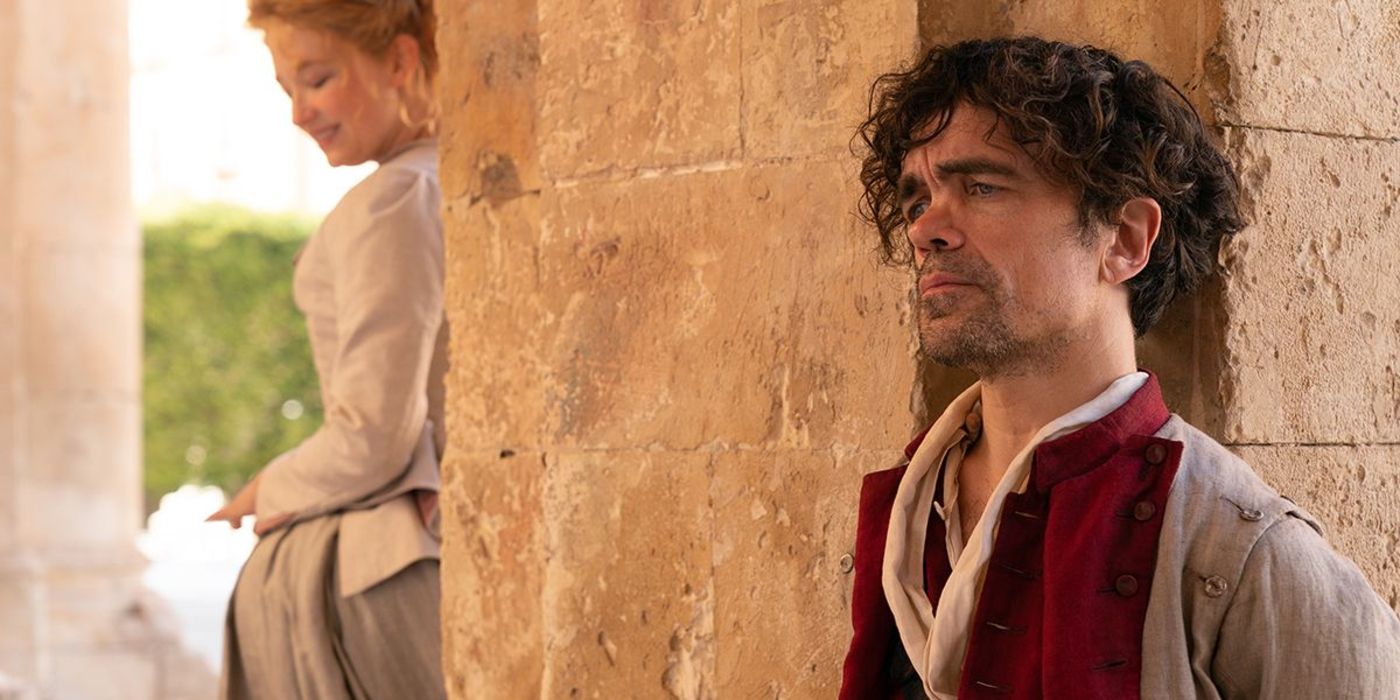
The most obvious difference? Instead of a cantankerous hero with a big nose, we get Peter Dinklage, a 4’4” tall hero.
Roxanne (Haley Bennett) and Cyrano (Peter Dinklage)
Don’t misunderstand me, I love the guy. He has a wonderful speaking voice and a good singing voice. You may recall him from Elf (2003) as Miles Finch, the famous author of children’s books.
Dinklage’s portrayal of a hero unable to believe that the beautiful girl could possibly return his affections is totally relatable. And he’s brilliant in the part. I can even believe his swordplay.
While audiences haven’t shown up in theatres to prove that they can make the willing suspension of disbelief, it’s a beautiful idea (Peter Dinklage’s height, in place of the usual big nosed Cyrano), at least in theory
That is not the only change. We meet Roxanne (Haley Bennett) first, only encountering Cyrano later. Roxanne’s part seems enlarged to my eye. Is it relevant that Haley Bennett is having a relationship with director Joe Wright? possibly.
And the hero is different in other ways too. Both the 1950 film of the Rostand play with Jose Ferrer and the 1990 Gerard Depardieu film en français are mostly Rostand and a hero with a big nose, meaning a cranky SOB who has so many enemies that he is ambushed and fatally injured at the end of the play, to set up his death scene. Purists who are fond of either of the aforementioned films or who love the play as Rostand wrote it will be bothered by the ending as given to us by the team of playwright Erica Schmidt and director Joe Wright.
The love-duet we get between the hero & his beloved bugged me so much I left the theatre right away without staying for the credits. While I mentioned that the director is in love with Roxanne (that Joe Wright and Haley Bennett are having a relationship, possibly married by now) in fact the adaptation by Erica Schmidt is really the issue, as she puts a love-duet in place of the usual ending of the play, totally emasculating Cyrano in the process.
Instead he’s been made nicer.
(shudder)
Their duet is titled “No Cyrano” although perhaps more properly it should be titled “No Joe!” or “No Erica”, my cries at their changes, marring Rostand’s hero.
Cyrano has had a nose job. And it’s not pretty.
Until that moment though, I was mostly enraptured, hypnotized, won over. If you do get to see it on the big screen you’ll see $30 million worth of choreography, art direction, beautiful design and cinematography up there on the screen. The score for the musical by Bryce and Aaron Dessner, two rock musicians reminding me of the gentler numbers in Les Miserables. It’s easily intelligible, sometimes excellent.
There is one musical number that moved me to tears, namely “Wherever I fall”. We hear soldiers speak of war, then watch them actually go into battle. Christian (Kelvin Harrison Jr) falls before us, Cyrano wounded not in an ambush by his enemies, but in the same battle, three years before his death scene. The link I’m giving you is really like a demo version, and audio only. The visuals accompanying this in the film are stunning.
Now if they would just re-write the finale, not as a duet but as a soliloquy with that last line back in place, we might have something truly brilliant.
I can’t decide if the last line is wit or a punch-line to a joke, possibly because I am not sure I get all the nuances and allusions/echoes in the line. In a musical I imagine it ending with a brilliant flourish somewhat like the very end of Debussy’s piano prelude number 12, or Ravel’s Tombeau de Couperin: but just the end, mind you, as it must be set up by something respectful and serious in tone.
But please, not a love duet.
So for what it’s worth, read it & weep. And thank you Project Gutenberg.
CYRANO: I tell you, it is there, There, that they send me for my Paradise, There I shall find at last the souls I love, In exile,–Galileo–Socrates! LE BRET (rebelliously): No, no! It is too clumsy, too unjust! So great a heart! So great a poet! Die Like this? what, die. . .? CYRANO: Hark to Le Bret, who scolds! LE BRET (weeping): Dear friend. . . CYRANO (starting up, his eyes wild): What ho! Cadets of Gascony! The elemental mass–ah yes! The hic. . . LE BRET: His science still–he raves! CYRANO: Copernicus Said. . . ROXANE: Oh! CYRANO: Mais que diable allait-il faire, Mais que diable allait-il faire dans cette galere?. . . Philosopher, metaphysician, Rhymer, brawler, and musician, Famed for his lunar expedition, And the unnumbered duels he fought,– And lover also,–by interposition!– Here lies Hercule Savinien De Cyrano de Bergerac, Who was everything, yet was naught. I cry you pardon, but I may not stay; See, the moon-ray that comes to call me hence!
(He has fallen back in his chair; the sobs of Roxane recall him to reality; he looks long at her, and, touching her veil):
I would not bid you mourn less faithfully That good, brave Christian: I would only ask That when my body shall be cold in clay You wear those sable mourning weeds for two, And mourn awhile for me, in mourning him. ROXANE: I swear it you!. . . CYRANO (shivering violently, then suddenly rising): Not there! what, seated?–no! (They spring toward him): Let no one hold me up– (He props himself against the tree): Only the tree! (Silence): It comes. E’en now my feet have turned to stone, My hands are gloved with lead! (He stands erect): But since Death comes, I meet him still afoot, (He draws his sword): And sword in hand! LE BRET: Cyrano! ROXANE (half fainting): Cyrano! (All shrink back in terror.) CYRANO: Why, I well believe He dares to mock my nose? Ho! insolent! (He raises his sword): What say you? It is useless? Ay, I know But who fights ever hoping for success? I fought for lost cause, and for fruitless quest! You there, who are you!–You are thousands! Ah! I know you now, old enemies of mine! Falsehood! (He strikes in air with his sword): Have at you! Ha! and Compromise! Prejudice, Treachery!. . . (He strikes): Surrender, I? Parley? No, never! You too, Folly,–you? I know that you will lay me low at last; Let be! Yet I fall fighting, fighting still! (He makes passes in the air, and stops, breathless): You strip from me the laurel and the rose! Take all! Despite you there is yet one thing I hold against you all, and when, to-night, I enter Christ’s fair courts, and, lowly bowed, Sweep with doffed casque the heavens’ threshold blue, One thing is left, that, void of stain or smutch, I bear away despite you. (He springs forward, his sword raised; it falls from his hand; he staggers, falls back into the arms of Le Bret and Ragueneau.) ROXANE (bending and kissing his forehead): ‘Tis?. . . CYRANO (opening his eyes, recognizing her, and smiling): MY PANACHE.
As usual I’ve been watching tv with my mom when I visit her to bring her lunch and dinner.
During the Winter Olympics she would sometimes get up in the night to watch opening or closing ceremonies, given the time difference.
Yesterday I helped her find the CBC broadcasts of the Paralympics. The French channel broadcasts from 1:00 to 3:00, then at 3:00 one can then switch to the English channel. My mom doesn’t care what language they’re speaking, as it’s hard for her to understand in either of our official languages.
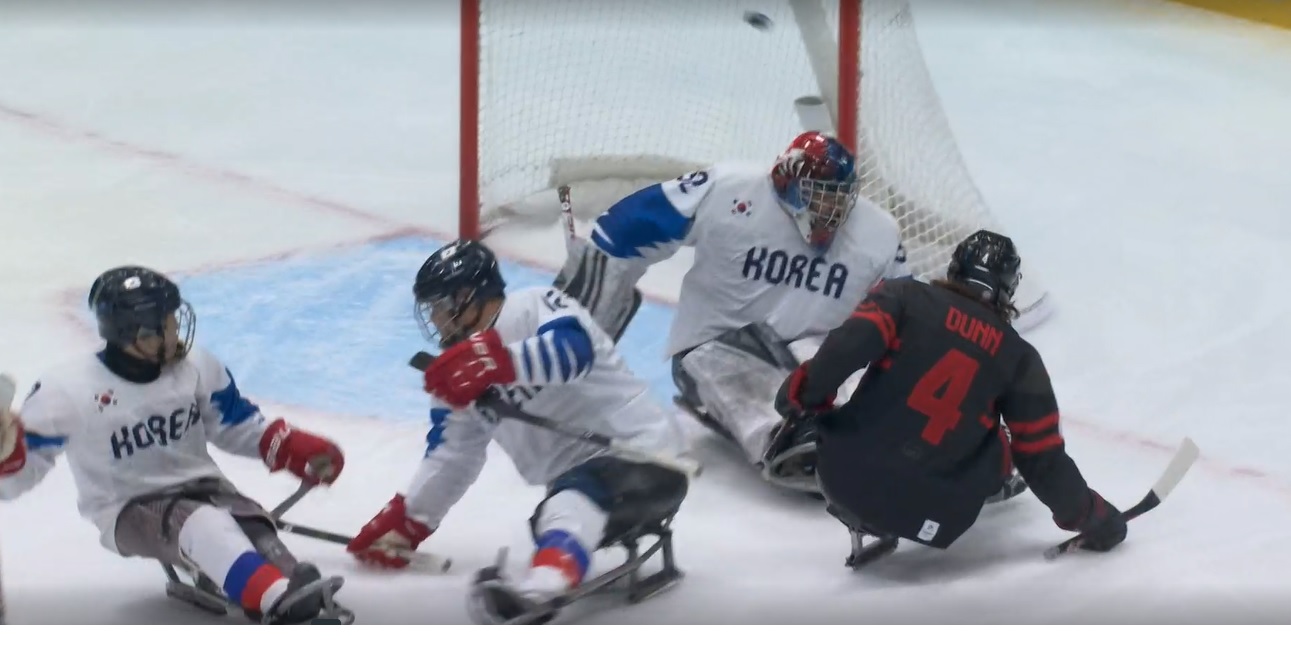
We watched Canada beating Republic of Korea in hockey.
One of James Dunn’s three goals, a blur entering the net above the Korean goalie’s shoulder.
My mom is capable of slowly walking with her walker for awhile each day, doing her physiotherapy exercises. But mostly she was sitting beside me in her wheelchair.
As we watched James Dunn get his hat-trick in a 6-0 triumph, I giggled. Finally! After all these years, we were watching hockey together, something that never interested her before.
My mom looked at the way they were playing, the limits of their movements. It was great to hear her recognition that those guys are amazing in what they can do, as she said “I shouldn’t complain about what I can’t do.”
We watched cross-country skiing, marveling at their speed and agility.
We discussed the weight of the curling rock, how difficult it must be for anyone to throw it, let alone someone with the challenges of the competitors we watched on the broadcast.
I explained how the sport of curling works. It’s not just hockey, we’ve never watched curling together either.
It was a day of insights. We talked about how difficult it is for the physio-therapist who encourages her or any patient to go past their limits, enduring pain.
She remarked that it is hard for us, when her children try to get her to endure discomfort.
You don’t win popularity contests making people go “ouch”, even if that’s what helps keep you going.
The Princess Bride is showing at Roy Thomson Hall, accompanied by the Toronto Symphony Orchestra who play the accompaniment live.
It’s the perfect film for 2022. How?
It features a tyrannical villain who lies shamelessly, just like certain people we see on the news.
At one point we’re told by Fezzik that “People in masks cannot be trusted” which got a big laugh, in a theatre full of masked patrons. There was an even bigger laugh when Fezzik asked the Man in Black why he’s in a mask, to be told “they’re terribly comfortable. I think everyone will be wearing them in the future.” Not bad for a film released in 1987.
Not only were we masked, not only is the capacity at Roy Thomson Hall still reduced for safety, but they even asked us for our vaccination passports even though the law doesn’t require it anymore. For those of us who are still hesitant about venturing out, it’s a relief.
If you’ve seen other films in the TSO series – such as the Star Wars films, Vertigo, or Back to the Future—in each case you were listening and watching the orchestra re-creating the musical score played by an orchestra that was heard in the original.
But for The Princess Bride? it’s slightly different, as you can hear in this CP24 interview of conductor Lucas Waldin from earlier this week. https://www.cp24.com/video?clipId=2394478
I was there to see it tonight and agree with Waldin’s description. They’ve taken the original score by Mark Knopfler, that featured guitar and subtle electronics mimicking orchestral sounds.
Lucas Waldin, conductor
What’s remarkable in this case is we get something that Waldin calls “reverse-engineered”. That’s another way of saying that it’s a transcription, something like what we get taking Mussorgsky’s piano piece “Pictures at an Exhibition” in Ravel’s flamboyant orchestral version. As with Ravel’s piece, there’s an expansion of the original. It’s subtle because the music mustn’t interfere with the film.
The score serves an important dramaturgical purpose in the film. You will recall that the grandfather (Peter Falk) tells a story to his grandson (Fred Savage), although from time to time the boy resists the romance of the story. At those moments the music abruptly cuts out, because the illusion is ripped apart by his questions or complaints. Whenever we’re immersed in the tale, we’re bathing in the music.
Listening to Waldin’s comments, I wonder if they might try to assemble other films that employed electronics for us to watch at the TSO. You may recall Blade Runner or Chariots of Fire, both employing wonderful electronic scores from Vangelis. OR there’s the pre-recorded music that Stanley Kubrick used in 2001: A Space Odyssey.
Judging from the rhapsodic response of the audience, I know there’s an appetite for this kind of concert performance of cinema.


 barczablog