Last night I saw Inge(new): In Search of a Musical from Theatre Myth Collective, a piece by Evan Tsitsias that challenges its audience from the beginning, reminding me at times of an intelligence test. I don’t mean like an IQ test so much as a theatre test, requiring someone savvy at decoding theatre codes and seeing between the lines.
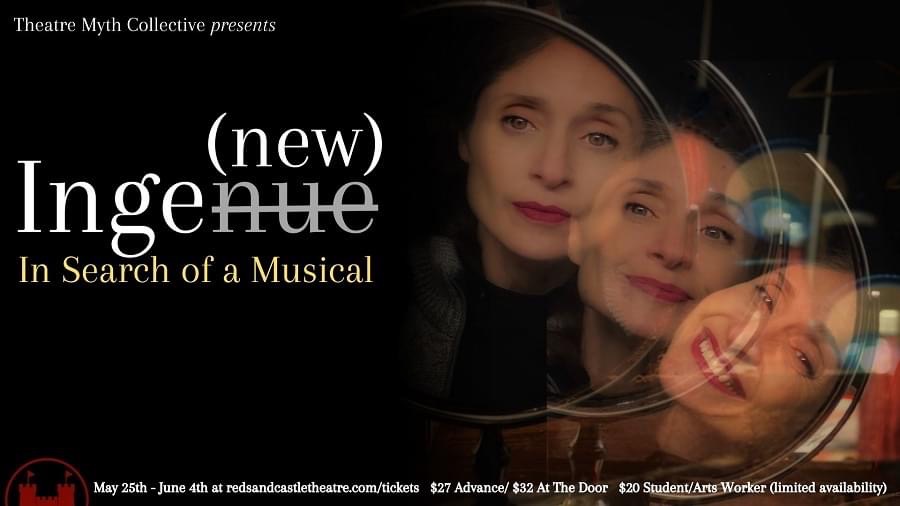
I believe that a good show raises questions. The best art reminds us of the objectives of artists in the world, both in showing us their special gifts as well as reflecting upon their predicament in the world. The nerds I know and admire see it that way. As I ponder how to respond to a new musical that seems to raise a lot of questions about the medium and how to respond to it, I recognize that it’s holding up a mirror to all of us.
So there’s a caveat with my response to Inge(new), that if you’re looking for a good time with songs you know, as in Mamma Mia or an old-time book musical, this show is not for you. We’re more in the realm of Pirandello (recalling that the title of this play vaguely echoes one of his plays) or Ionesco, a world as absurd as our own. I’m not sure how to speak of a show that reminds us so much of reality, when I know some are at times struggling to hang onto their sanity in the wake of COVID and the devastation in the arts sector. Inge(new) is at least superficially a comedy, although the laughs are often of the painful variety. There are places in this show where I was the only one laughing, other places where I was silent while others giggled nervously. I’m hesitant about applying a genre label to Evan’s new play, indeed scared of labels generally as they can be misleading.
It’s why I backtrack to the question of criticism itself, asking “why am I here.” I think it’s worth distinguishing between the reviewer and the critic. Excuse me if I sound pretentious in this but haha when speaking of a show as ambitious as this one we’re all being pretentious, so I hope I can be forgiven, absolved with all the artists. I will misquote Dietrich Bonhoeffer, who when speaking of the church and Christ, said the following:

Let’s speak instead of art rather than the church and substitute “criticism” in this equation, to suggest the difference between the reviewer (who functions in the commercial realm to sell tickets and advise the audience what’s worth seeing) and the critic, who is another sort of dramaturg, assisting in the analysis and understanding of drama itself. The reviewer may write to flex their influence or power, in which case they’re as corrupt as the churches Bonhoeffer would caution us to avoid. A critic is in service to the art and to the artists. If they’re not helping and serving they’re not doing it right.
That’s my preamble to suggest that Inge(new) is not an easy play and should not be judged the way popular musicals are judged. Never mind mainstream / commercial aspirations, when you’re being this ambitious. Its drama is generated out of the tension of an audition situation, Bridget (Mairi Babb) directing questions at the director for whom she’s auditioning. We’ll also meet the much younger Joy (Elora Joy Sarmiento) who’s also auditioning and Gertrude (Astrid Van Wieren) who is older still. The problematics of the title begin to come into focus as we are reminded of how the audition process is conditioned by expectations around casting, and the ambiguities around age. It’s something that has long fascinated me, the way middle aged opera singers get cast as Butterfly (age 15) or Juliet (age 12). In fairness, when opera and operetta (aka musicals before WW II) required virtuoso singers the audience was expected to check their requirement for verisimilitude at the door, singing somehow compensating for what our eyes told us. That was far easier to do sitting far away from the stage, than in our time of high definition broadcasts and close-up camera work.
Which is a good time to mention how perfect Red Sandcastle Theatre works as the venue for this premiere, a narrow strip of theatre putting the performers right in your face. You can see exactly how old they are, including Cory O’Brien who was especially vulnerable in his portrayal of Max.
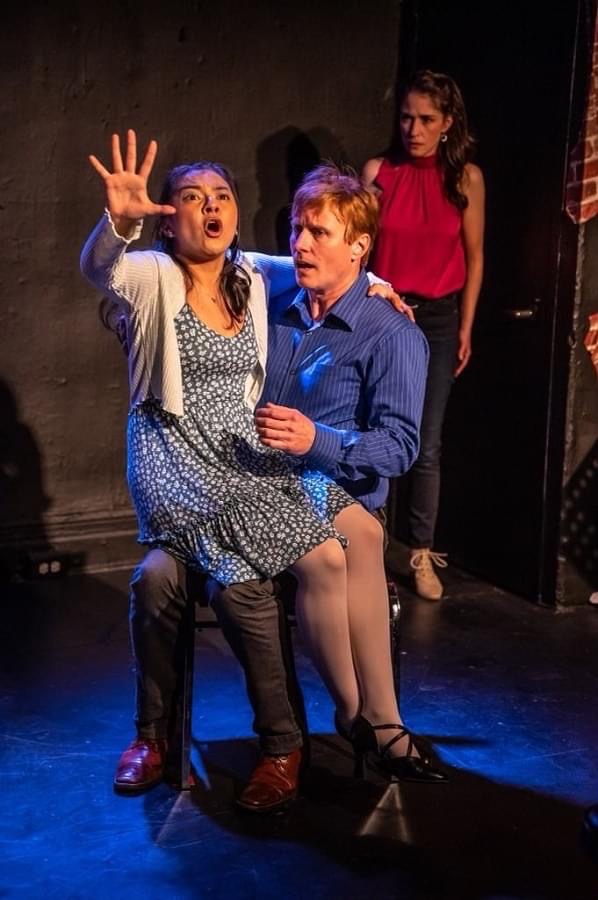
(photo: Dahlia Katz)
Inge(new) is provocative. There’s tons of tension between the characters, enormous drama as we tippy-toe along the knife-edge between comedy and tragedy. Whenever a song begins there’s some relief although we may still be playing with levels of meta-theatre, the question of whether this is real or allusion, imagined or actual. It’s quite delightful even if at the same time, it’s a reminder of what a shit-show theatre can be, especially if you’re a woman. I wrote a review recently with the headline “Macbeth closing performance: women have it harder”: as I observed that in the spring Canadian Opera Company season, one show (Tosca) was cast all by males save for a soprano (Tosca), while the other (Macbeth) was all men but for two women (Lady Macbeth and her lady in waiting). It can be every bit as challenging (aka unfair) in the realms of straight theatre or musicals.
By a funny coincidence the opera review talks about an understudy who went on when the soprano got sick. Similarly Mairi Babb bravely took on the lead role of Bridget eight days before the show opened. Mairi is the anchor of the show, rock solid throughout.
The vicarious composer in me wishes the show had a slightly different approach, wanting more satire and comedy. The play is very serious, at times very painful to watch. I think it could be lighter with more music, perhaps employing something parodic, sending up the situations it would explore. All the music is excellent, don’t get me wrong, music director Kieren MacMillan does a great job noodling away under the action, totally self-effacing, the songs emerging in the most organic way out of the situations. But I think this show is a bit too narrow and nerdy in its focus, thereby losing the chance to really change hearts and convert people to its cause. It has the potential to be profound, but because it’s a tad too long, becoming a bit exhausting. In fairness I should explain that I also find Hamlet and Lear exhausting. I say this in the interest of seeing this show grow and evolve into a really brilliant work next time, as I hope there must be a next time for such a worthy project.
Inge(new): In Search of a Musical continues until June 4th at Red Sandcastle Theatre.
 barczablog