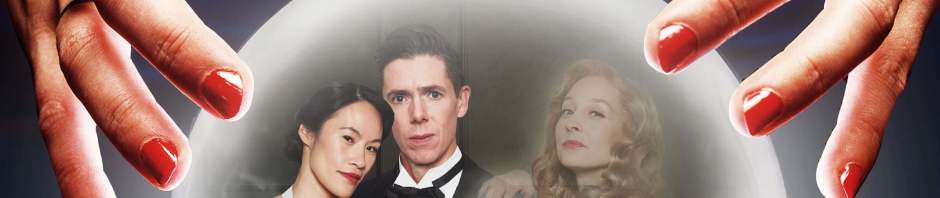
Hmm: another trip to Shaw, another ghost story.
Last time it was Wharton’s The Shadow of a Doubt. “Shadow” is another word for spirit, right in the title.
This past weekend Erika and I went to see Blithe Spirit at the Festival Theatre.
My mind boggles at the cleverness of Noel Coward, his manifest awareness that some of us see spiritualists as fraudulent while others hang on their every word. Although that divide impacts the different ways producers approach the story (in productions like this one, or in film adaptations) the play supports either approach.
After watching the show on the weekend at Shaw, Erika and I watched two very different film versions:
There’s the 1945 version produced by Noel Coward, directed by David Lean, and starring Rex Harrison, Constance Cummings, Kay Hammond and Margaret Rutherford, and featuring a wonderful score by Richard Addinsell.
There’s also a 2020 version directed by Edward Hall, starring Dan Stevens, Isla Fisher, Leslie Mann and Judi Dench.
One of the mind-boggling aspects of Coward’s work is how cleverly the text straddles the faith divide, playing equally well for those who think seances are bunk, and those who lap it up. Speaking as someone who is open to the experience (and I can point you to a rather lengthy discussion of my beliefs in my interview with a psychic) , I was struck by how subtly the subject is treated in the text, provided one doesn’t undermine it by mocking it.
Rutherford’s portrayal of Madame Arcati is rather dignified and considering some of the things we’ve seen in her career this is understated. While the lines of skepticism are in the play, they bounce off her full-steam ahead confidence. Dench is asked to make a cynical presentation who is then taken aback by her own unexpected success.
I was delighted to observe the divergence between the play and the two films, having forgotten the key difference at the end of the play, namely the obvious plot twist we get in the films that hasn’t happened, at least not yet. Rex Harrison ends up dead in a car accident, between his leading ladies as we fade to black. For Leslie Mann and Isla Fisher in the 2020 version it’s an actual murder, although the distinction is pretty small.
I love the 1945 version, a flawless piece of film, compared to the 2020 travesty, which features all sorts of embellishments that only show the insecurities of the team. Why turn Charles the writer into Charles the plagiarist, unaware of his theft because his deceased wife Elvira wrote all his novels? This is a new version of the story with nasty karma, in spite of the insertion of a sentimental moment when Madam Arcati reunites with her deceased husband. Dench can’t rescue the work. Nor can Fisher (whom you might recall from Wedding Crashers) nor Leslie Mann (Judd Apatow’s muse and wife). Elvira’s violence is over the top this time, and for some reason the producers decided to let Charles consummate his relationship with his dead wife, that they would somehow have sexual relations. Why do that? I don’t know but it’s one of several creepy things about this adaptation, suggesting a lack of faith in the original. I love the older one and will watch it yet again. I’ll avoid the new one.
Meanwhile, there’s that live show at the Shaw Festival, considerably longer (at three hours and five minutes with an intermission) than either film (roughly 95 minutes) because so much of the original exposition is cut out in the films. The version we saw flew by all the same, immensely enjoyable in the Festival Theatre.
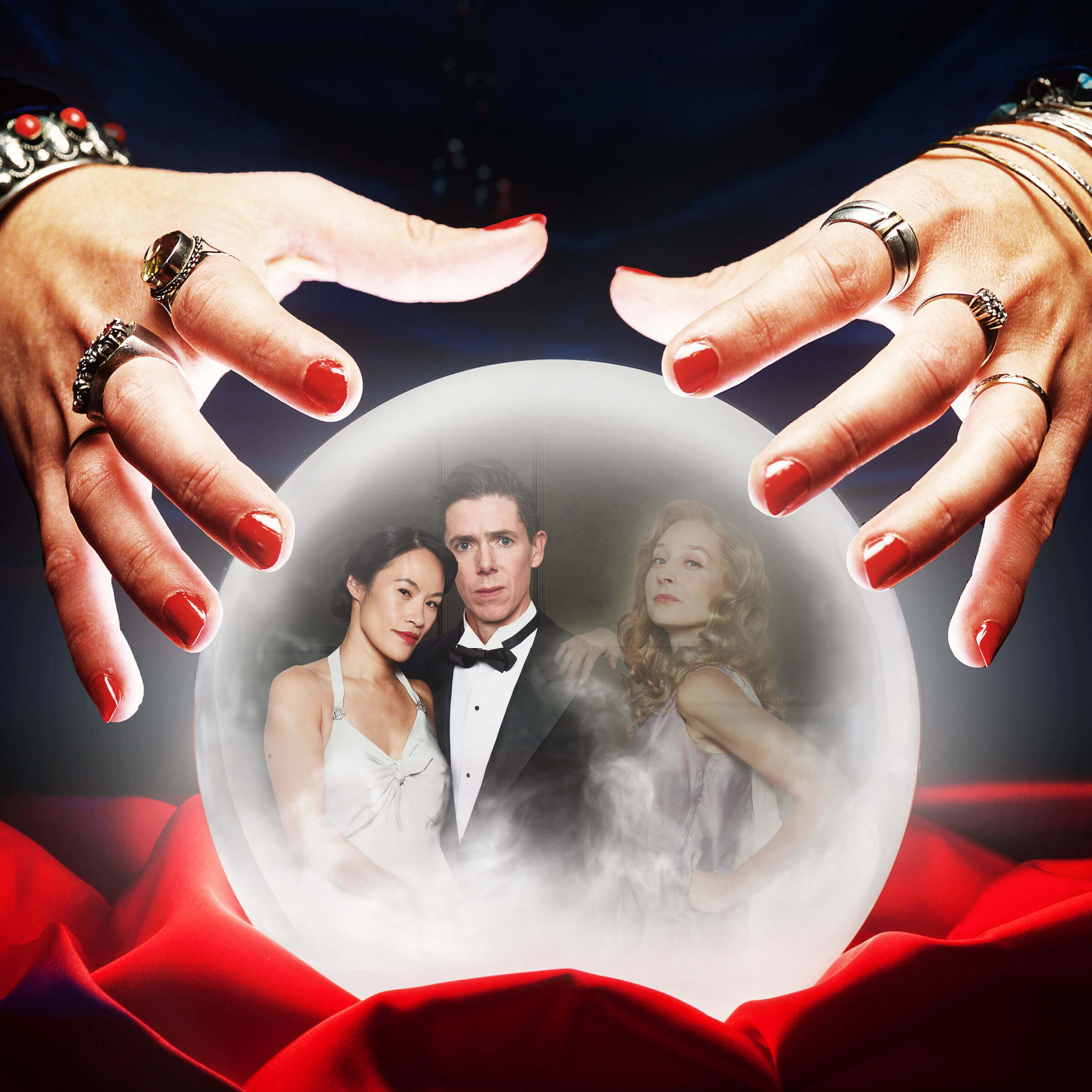
Damien Atkins carries a huge load, a large number of lines as Charles the writer having a séance ostensibly to learn the tricks of the trade by watching Madame Arcati at work, not expecting real results. And he’s got the somewhat thankless task of playing straight man to his dead wife Elvira (the ghost), ironically delivered by Julia Course. Ruth the wife who eventually also becomes a ghost was Donna Soares, herself also playing even straighter while others get the big laughs. We were at a seniors matinee, with some cast changes, namely Jenny Wright as Madame Arcati the medium, and Kate Hennig as Dr Bradman’s wife.
There are so many ways this show can be played. Director Mike Payette offers us something uproarious and energetic throughout, although towards the end it’s wonderful that he lets it get a little scary.
Or to quote Bert Lahr’s lion, “i do believe in spooks I do I do I do…”
There is a kind of magic in live theatre that you don’t get on film, whether we’re speaking of metaphysics or singing voices. When it’s done in the same room as your own viscera, you’re moved in a different way than when it’s a series of special effects. It seems like a real magic trick.
I’m not sure I understand the design, very much the opposite to the all black Shadow of a Doubt we were debating (responses to my review). I suppose it’s fun and stimulating to the eye? There may be some purpose to the colour scheme, that makes the men –especially Charles—seem foppish. The ghostly apparitions though were splendidly accomplished, so I’m not complaining. I was hypnotized, even if there were times that the lines were being delivered a mile a minute. But that makes sense when the show exceeds three hours in length, a fabulous display of energy and passionate commitment.
Jenny Wright was having a good time playing up Madame Arcati’s silliness, a comical turn that sustained us for much of our afternoon, alongside the ironic delivery of Julia Course’s Elvira.
I find that the Shaw Festival never lets me down, especially with a period comedy of manners such as this one. It’s like a glimpse of another time.
Blithe Spirit runs until October 8th.
 barczablog