It’s a pleasure and privilege to watch a film at tiff followed by a talkback, where directors and performers respond to our questions.

A woman in front of me asked writer & director Chloé Robichaud the question I would have asked, and she asked much more cleanly than I would ever have said it.
“Why did you use those pieces of music?”
We had just seen her film Days of Happiness aka Les Jours heureux. I wasn’t sure about the title, btw, which hits me as kind of generic, without any hint of the wonders to be found in it.
Hmmm. But I loved this film.
Here’s part of Norm Wilner’s synopsis from tiff’s website. Beyond this I will do my best to avoid spoilers that might give away the story.
Charismatic, gifted Emma (Sophie Desmarais, who starred in Robichaud’s breakout, Sarah Prefers to Run, TIFF ’13) is on track to become a major player on the Quebec classical music scene. Audiences are enraptured by her work, but her career is very closely managed by her controlling father, Patrick (Sylvain Marcel), who’s also her agent. After years of acquiescing to his demands, Emma is finally in a position to re-evaluate both their professional and personal relationships — and that’s when cellist and single mother Naëlle (Nour Belkhiria) enters her life, offering her the chance to experience an entirely different type of family dynamic.
But let me get back to Robichaud and that talkback question. She remarked that the pieces were like characters in the film. I would go even further, to suggest that they represent an alternate text. It’s as though there’s a double film, two stories one on top of the other.
1-We have these personages –Emma, Patrick, Naëlle and other family members and colleagues– going through the emotions of their interconnections.
2-And we have the pieces Emma conducts.
That makes a curious sort of sense if you think of artists who balance their personal and creative lives, events and persons moving as if in two separate dimensions that sometimes occlude one another, sometimes separate and distinct. I was struck by how much this reminds me of real life, where you go about your business, making breakfast, changing diapers, taking a child to school, and then, zipping away to another realm for a show or a concert. And sometimes the music will be in your head, because naturally, you’re not a machine, you’re a living being with those feelings inside you, from those pieces of music that constitute their own drama.
Robichaud even signals this to us, putting three titles onto the film:
Mai Mozart
Juillet Schönberg
Septembre Mahler
The titles signal the passage of time and the music that goes with it.
Emma (Sophie Desmarais) is facing the dramas of her life with family and colleagues, and then when she undertakes each concert, also facing the drama of that piece. When she is immersed in the music we’re watching her conducting the Orchestre Métropolitan, whose music director Yannick Nézet-Séguin participated in the film’s preparation.
I aim always to be spoiler free, so let’s say that I will speak of the musical text rather than the plot. Emma goes from the G-minor symphony of Mozart, her style still somewhat overly controlled and in her head, as she’s told by colleagues, to excerpts from the Pelleas und Melisande symphonic poem by Arnold Schönberg, and later to the 5th symphony of Gustav Mahler.
The film’s plotline involving Emma’s family relationships seems perfectly matched to what we’re hearing in the film’s music, as Emma faces passionate conflicts and disorder in her life as she confronts the challenges of the Schönberg, before finding her way to Mahler. While it’s not really as dissonant as the script would have us understand it (a stunning early piece from Schönberg before he invented truly atonal composition), the passages we hear emphasized are still of a passionate late romantic style, very apt for strong feelings.
This is perhaps the normal way music works in a film, as an invisible commentary, although Robichaud is offering something more ambitious, as the arc of the musical plot (of three composers) parallels Emma’s arc.
And it’s unique in using music that is almost entirely source music, even as it functions in the usual ways. We see the OM playing the Mozart, the Schönberg or the Mahler while Emma conducts it, although as we see her subsequently walking away from those scenes, the music plays on: as if inside her head, the way we’d see in a non-diegetic musical score. It’s powerful and makes sense at least as a continuation of what we’ve been experiencing.
There is a fourth composition presented to us in the final credits, when Emma is again conducting, that might suggest a happy ending, even if I’m not giving you any details. Emma and the OM are rehearsing Amy Beach’s Gaelic Symphony, which could be read as a political statement by the film-maker, given that it’s one of the first major symphonies by a woman composer.
We were given a laughter-inducing disclaimer stating that while it’s an IMAX theatre, this was not a film shot with the IMAX process. No matter, I love the big fat sound whether or not we also get the big fat IMAX camera lens. Full disclosure, I’d even watch Adam Sandler conduct an orchestra if it meant I get to hear music as beautifully played as this.
I didn’t see the credit, but if as suspected this is Yannick’s work with his OM, no wonder they sounded so superb. He is arguably the most successful Canadian conductor, and hopefully will be doing great things for years to come.
The question I recall hearing with Tár was whether Kate Blanchett really looked like a conductor, whether her body language suggested a real conductor. It’s a funny question when we recall that every conductor is first and foremost a performer, both for us in the audience and even for their orchestra. When Gustavo Gimeno arrived at the Toronto Symphony I watched his deportment, his arms and his eye contact with the ensemble, watching how the players responded. When Yannick first stepped in front of the OM or the Metropolitan Opera Orchestra, yes he was there to conduct, but it was a performance. He was standing before all those musicians, winning them with his body language and his manner. While in hindsight perhaps I might be expected to judge Sophie Desmarais, evaluating the actor’s conducting, how she held a baton or a pencil (as I suddenly recall so many people cutting up Tom Hulce’s deportment in Amadeus, from a historical era btw when there weren’t any conductors…. But nevermind, classical music can be a catty community), I was swept up in the experience. I was watching the musicians respond to her, listening to the music coming at me, hesitant briefly with the Mozart as I asked myself whether her beat was something the players could follow, and then drawn into the performance of the music. It’s all a series of performances of course. It was compelling, especially in the tight cinematography of Ariel Méthot , right on top of the players and Emma as their conductor. Her face sometimes filled the big screen.
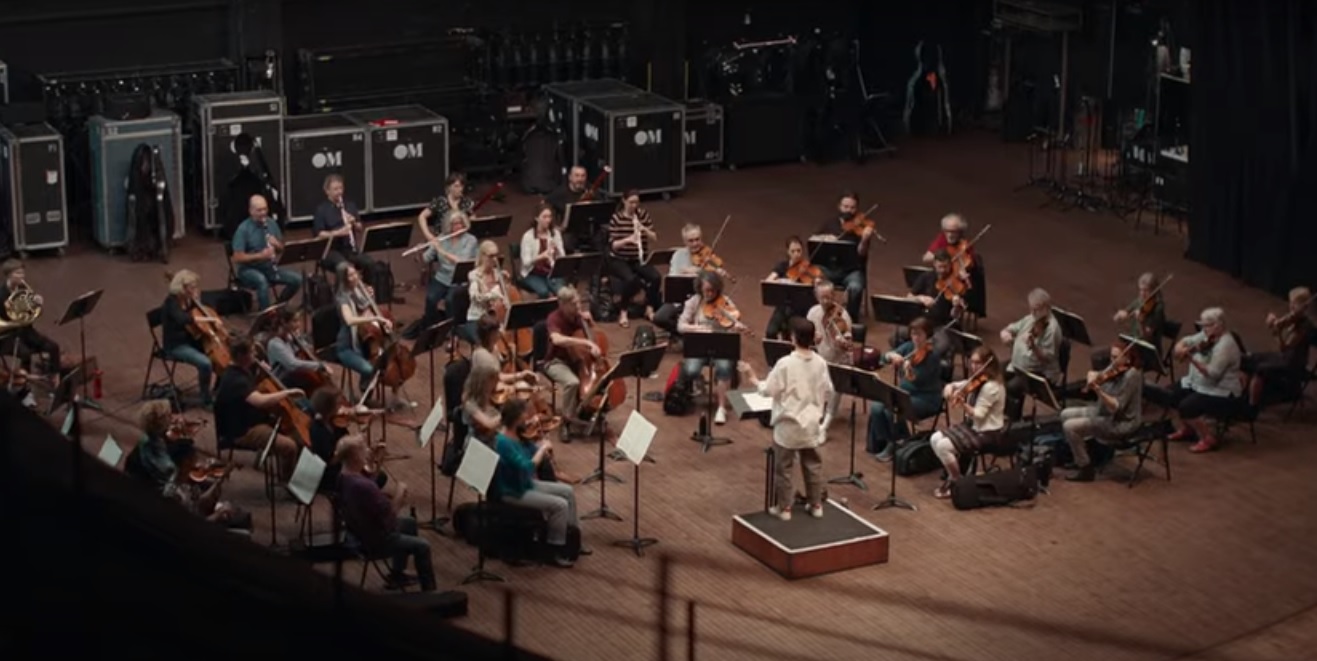
Days of Happiness does offer us some fascinating family dynamics. Music seems to encourage a special kind of tension between people, possibly because the prospect of performance messes up the clarity of communication. The extra layers don’t necessarily lead to happiness.
Oh yes, there’s that word. It’s not obvious, this story. There’s work to be done, opening up to this. There’s a great deal that’s unsaid in this film, and it’s a brilliant layer, considering the added text of the music. Emma and her father Patrick (Sylvain Marcel), have some phenomenal exchanges, where it’s as much what’s unsaid as what’s said. The funny thing is, I know when I watch it again, I won’t necessarily have clarity, but I will have the enjoyment of watching the interaction, the unfolding of the relationships and the complementary storytelling of the music. That’s what I was after before and expect to enjoy next time.
The talkback included a question or two about Tár. I heard a voice sounding skeptical when one looks at the similarities, right down to the same piece of music (Mahler’s 5th symphony) at the core of both films. Speaking softly to defend herself, Chloé spoke of the 7 years it took to write the film plus 2 years preparation.
And after all, Schönberg didn’t know about Debussy’s opera when he composed Pelleas und Melisande.
The frequency with which we’re seeing women conducting seems to be an exciting development if you ever go to the symphony or opera, where you’d encounter Barbara Hannigan or Keri-Lynn Wilson or Gemma New or Speranza Scapucci, let alone Marin Alsop (who famously critiqued Tár).
And maybe it’s long overdue.
 barczablog