Last night I went to see Topdog/Underdog by Suzan-Lori Parks, promoted as “The Greatest American Play of the past 25 years” according to the NY Times and identified as “a darkly comic fable” in one of the ads.
Directed by Tawiah M’Carthy, presented by Canadian Stage at the Baillie Theatre on Berkeley St. we watch Mazin Elsadig (Booth) and Sébastien Heins (Lincoln) for two and one half hours inhabiting a small stage resembling a boxing ring. We will hear bells ring as though a round has begun or ended.
I felt out of step with an audience including a large teenaged contingent of students lending their nervous energy to the proceedings. The play includes a fair sprinkling of profanity, moments when condoms and porn magazines are prominently discussed to great hilarity especially among the youthful cohort.
Some will see more comedy in this story than others. I was feeling down, having received some scary news about a friend just before the show. While I am usually the guy with the loud obnoxious laugh in the audience I was quiet throughout. Even so the play managed to make me laugh a few times, in spite of myself. We’re watching a huge number of lines delivered quickly over two and a half hours, a bit of a tour de force by two actors going head to head as if they were actually boxing. The skill level is nothing short of brilliant.
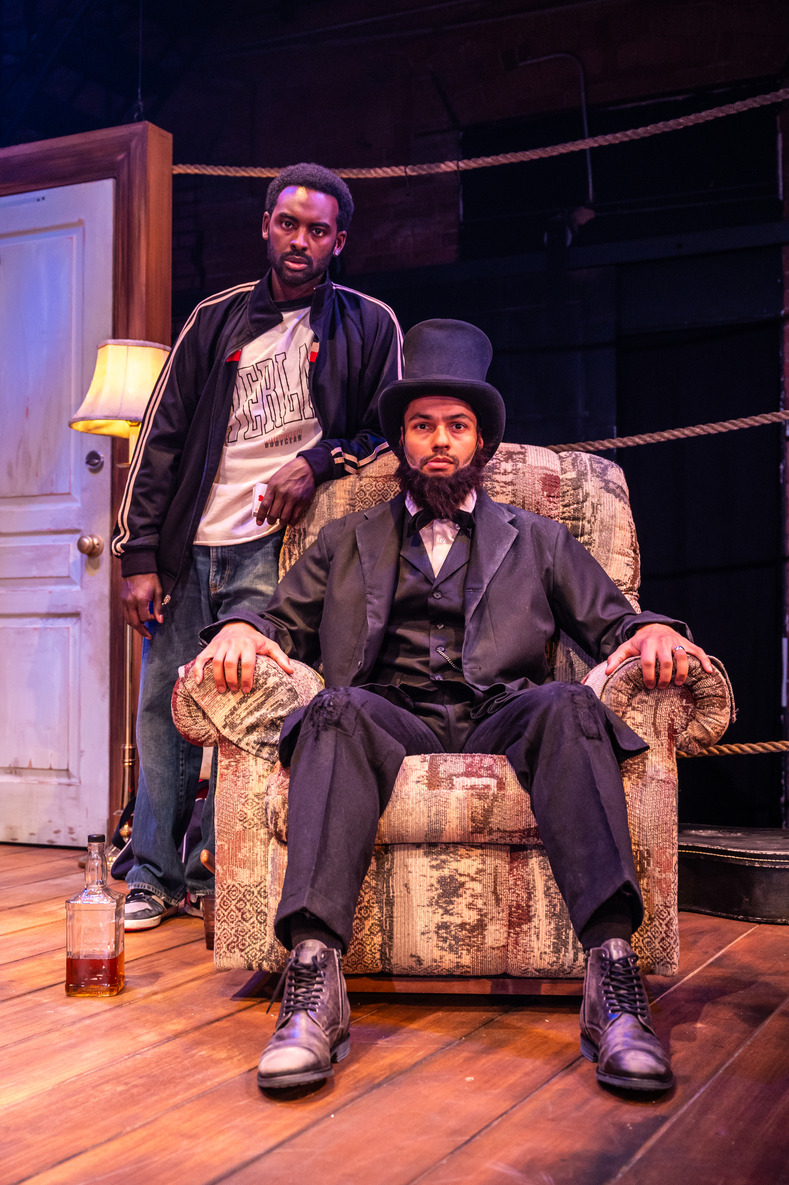
Did you catch that? The names are Booth and Lincoln. A pair of brothers, black men named by a father with a curious sense of humour, Lincoln happens to have a job wearing whiteface impersonating the famous guy in the stovepipe hat, as people pay for the privilege of shooting him.
Worried about the possibility of losing his job to a mannequin, Lincoln practices hamming it up while dying. That part makes for incredible physical comedy. He believes this job is more dignified than what he used to do, as a card player. This isn’t the only time we hear someone say something jaw-dropping that they believe whole-heartedly. It’s hard to watch when someone is being taken, being fooled or being tormented. I suppose that’s the essence of comedy, that we watch a clown fall down or lose his girl-friend to another clown. But to the clown it’s horrible.
Booth is more intent on card-playing, even though he’s nowhere near as sharp as his brother and doesn’t really understand the essence of the game.
This is a family drama even though we never meet the parents. But we are hearing about them regularly, their impact hanging in the conflicted air, their legacy hidden away, money kept as a treasured remnant from the past for a possible future. We are watching Booth and Lincoln sparring, talking about past lovers and past jobs, current dreams and future hopes. At times they are supportive of one another, at times they are fighting one another. They’re just like real brothers.
It can be a bit daunting to confront a work of art that carries a label affirming its greatness. If you like it, all well and good, when you enjoy something that you are supposed to like.
But when you’re conflicted or troubled in the presence of that work what does that say about you? Wuthering Heights was on TV last night, a story I have been unable to penetrate because I find its sadness so unrelenting. Topdog/Underdog is a million miles away from the Bronte novel (or its various film incarnations), even though I see all sorts of parallels. However much one admires the writing, the performances, the artistry of all concerned, your love of theatre will collide head-on with the darkness of this piece. There are resonances for me with other great works that I can’t stand to see too often, such as Beckett’s Godot or a dark tragedy such as King Lear, presenting images of futility and inevitability.
We’re watching a lot of card-playing, as Booth is endlessly practicing three-card monte, which is not really winnable. That pushes buttons for me. Booth doesn’t fully understand the nuances of the game. I was reminded of a friend I have who pours all his available money into various attempts to get rich. He plays the track, betting on football and hockey, always buying lottery tickets. I’ve heard lotteries described as a tax on the poor, given that many of the people betting can’t afford it. One might call this tragic if it weren’t so avoidable. Gambling is an addiction. I find it darkly depressing, knowing how it works for my friend, and was reminded of him by poor lovable Booth. I must sound moralistic, but it’s only in context with this play and how it hit me. When Booth discovers the meaning of the word “mark”, and that he has been the mark it hits him hard, with predictable results.
What’s magical about Booth and Lincoln is how in spite of their conflicts and struggles they sometimes do show loyalty to one another, brotherly love in a tough situation. Poverty doesn’t daunt them. even if one can’t miss the destiny laid upon them by the names and their circumstances. The dialogue is masterfully written, executed beautifully by these two men, their presence so vital and alive in the intimate space.
I was grateful for the young students in the theatre, watching them captivated by the magic of the show. The audience surrounding the tight space on two sides give us the additional spectacle of the audience responses to the performances.
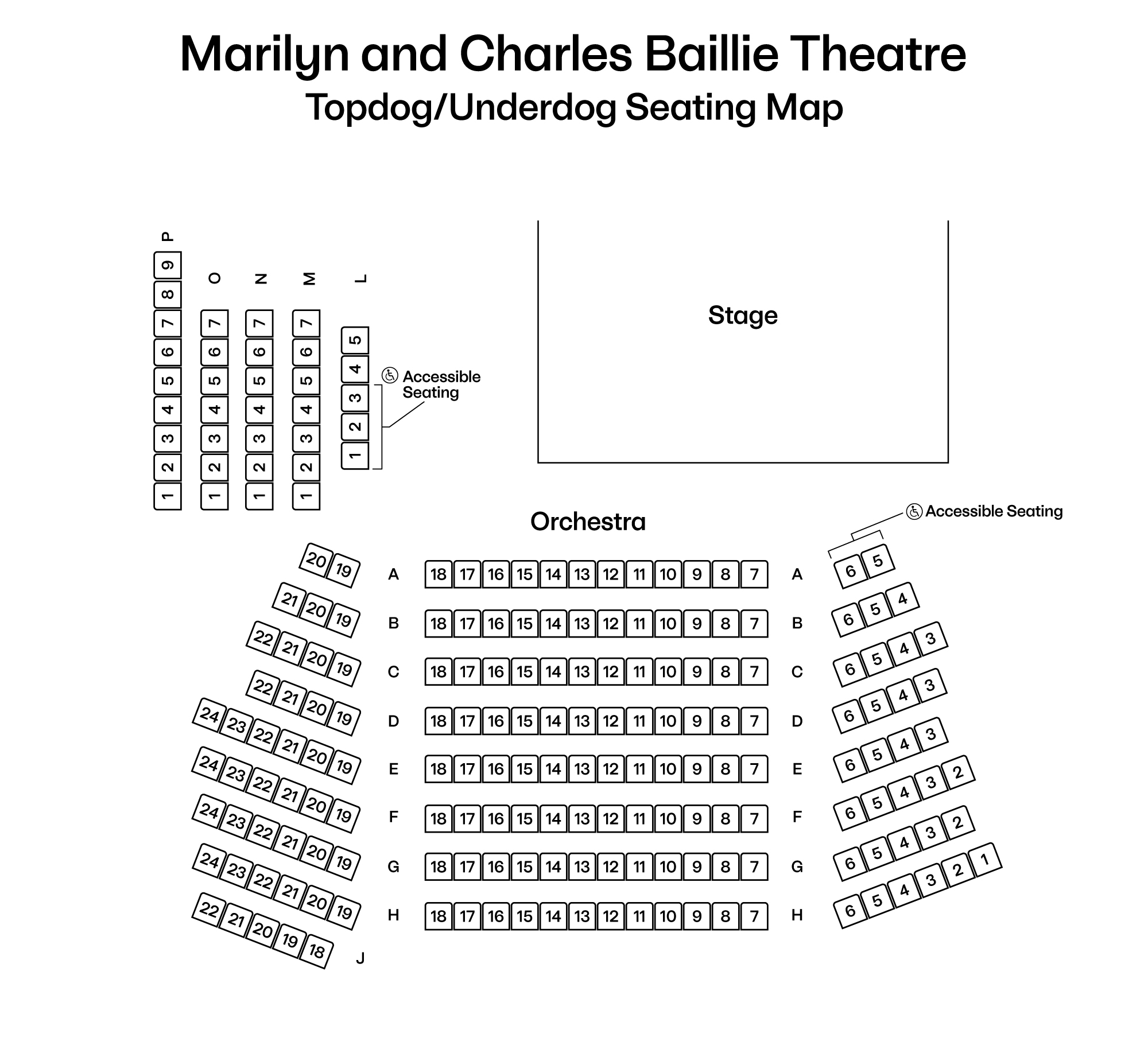
Topdog/Underdog continues at Canadian Stage’s Berkeley St theatre, held over until October 22nd.
 barczablog