I heard that OperOttawa are presenting Mozart’s The Magic Flute, an opera I’ve heard called misogynistic, in November with a cast that’s 100% female!
I had to ask their their artistic director Norman E Brown about it.
Barczablog: Do the men’s roles get played by women (as trouser roles) OR are the women actually playing some or all roles as women? If the latter, does the story change: and how?
Norman E. Brown: The female singers play female characters. In the case of those roles traditionally sung by men, we have changed the names: for example – Princess Tamina, Sarastra, Pipogena, and Monostatas.
These are not pants roles in any way.
Synopsis of the ALL FEMALE version
A mythical land between the sun and the moon. Three ladies in the service of the Queen of the Night save Princess Tamina from a serpent. When they leave to tell the Queen, the birdcatcher Pipogena appears. She boasts to Tamina that it was she who killed the creature. The ladies return to give Tamina a portrait of the Queen’s daughter, Pamina, who they say has been enslaved by the evil Sarastra. Tamina immediately falls in love with the girl’s picture.
The Queen, appearing in a burst of thunder, tells Tamina about the loss of her daughter and commands her to rescue her. The ladies give a magic flute to Tamina and silver bells to Pipogena to ensure their safety on the journey and appoint three spirits to guide them.
Sarastra’s slave Monostatas pursues Pamina but is frightened away by Pipogena. The birdcatcher tells Pamina that Tamina loves her and is on her way to save her. Led by the three spirits to the temple of Sarastra, Tamina learns from a high priestess that it is the Queen, not Sarastra, who is evil. Hearing that Pamina is safe, Tamina rushes off to follow the sound of Pipogena’s pipes.
Monostatas chases Pipogena and Pamina but is left helpless when Pipogena plays her magic bells. Sarastra enters in great ceremony. She punishes Monostatas and promises Pamina that she will eventually set her free. Pamina catches a glimpse of Tamina, who is led into the temple with Pipogena.
Sarastra tells the priestesses that Tamina will undergo initiation rites. Monostatas tries to kiss Pamina but is surprised by the appearance of the Queen of the Night. The Queen gives her daughter a dagger and orders her to murder Sarastra.
Sarastra finds the desperate Pamina and consoles her, explaining that she is not interested in vengeance. Tamina and Pipogena are told by a priestess that they must remain silent and are not allowed to eat, a vow that Pipogena immediately breaks when she takes a glass of water from a flirtatious old lady. When she asks her name, the old lady vanishes. The three spirits appear to guide Tamina through the rest of her journey and to tell Pipogena to be quiet. Tamina remains silent even when Pamina appears. Misunderstanding her vow for coldness, she is heartbroken.
The priestesses inform Tamina that she has only two more trials to complete her initiation. Pipogena, who has given up on entering the sisterhood, longs for a wife instead. She eventually settles for the old lady. When she promises to be faithful she turns into a beautiful young Papagena but immediately disappears.
Pamina and Tamina are reunited and face the ordeals of water and fire together, protected by the magic flute.
Pipogena tries to hang herself on a tree but is saved by the three spirits, who remind her that if she uses her magic bells she will find true happiness. When she plays the bells, Papagena appears and the two start making family plans.
The Queen of the Night, her three ladies, and Monostatas attack the temple but are defeated and banished. Sarastra blesses Pamina and Tamina as all join in hailing the triumph of courage, virtue, and wisdom.
Barczablog: How does the plot work if all are female? If there is anything new/changed, please break it down for us in your new version, what is the nature of the contention / conflict between Sarastra and the Queen of Night , and how will the couples (Tamino & Pamina, Papageno & Papagena) work?
Norman E. Brown: The idea of doing an all female version of Magic Flute definitely posed some challenges with respect to the plot, and the relationships. The only solution is to let the audience interpret as they wish. The relationship between Tamina and Pamina is clearly a case of same-sex attraction, as is between Pipogena and Papagena. But, at the end of the day – Love is Love!
Barczablog: There are misogynistic lines in the libretto. Are you leaving the text intact? Or fixing it / altering it?
Norman E. Brown In addition to changing names, as well as pronouns etc. I have rewritten all the dialogues keeping it in the vernacular of the audience in English but also shortening it substantially. With an all female cast it was a no-brainer to remove all misogynistic text from the dialogue and libretto.
Barczablog: What will the speaker decry if he becomes a she..? (current libretto says in reply to Tamino’s report that Pamina has been kidnapped, as told by mother of Pamina: “a woman told you this” in a dismissive tone.)
Norman E. Brown We have changed words such as Herr to Frau, Männer to Leute and tried to keep things fairly neutral.
Barczablog: What vocal type do they sing (ie is the person singing Tamino still using a higher voice than the person singing Sarastro, even when it’s gender-switched? )
Norman E. Brown The female roles such as Pamina, the Queen, the 3 Ladies, the 3 Spirits etc will be sung as is. But, the changed roles will be sung up an octave, for example Tamina is a soprano, Sarastra is a mezzo, Pipogena is a mezzo, and Monostatas is a soprano. It will be most interesting to hear the resulting sound and harmonies with all the voices in the same region of the voice.
Basically a role sung by a tenor is sung by a soprano; baritone by a mezzo and bass by a mezzo with great low notes.
If I were to do something similar, be it with a remount of Magic Flute or recreate another opera, I would twist the gender-blend concept a bit more and do a 100% gender change. Female roles sung by men and male roles sung by women. I would have to choose carefully since I can see how in some operas it might not work, dramatically or vocally. But what tenor has not dreamed of (and probably tried) singing say, the Queen of the Night.
Barczablog: Interesting. I think the arias in Don Giovanni for Donna Elvira and especially Donna Anna sound more masculine, truly ballsier than anything Don Ottavio gets to sing. I used to sing (or try to sing) “Or sai chi l’onore” which would be the most macho thing ever, if it weren’t for the gender(!), and also “Ah chi mi dice mai” . They might require a heldentenor voice.
Your future projects sound intriguing…(!)
So, who is singing in your production?

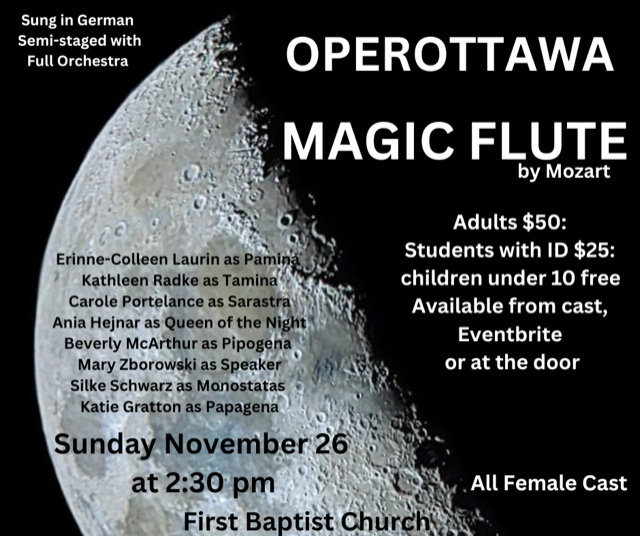
CAST
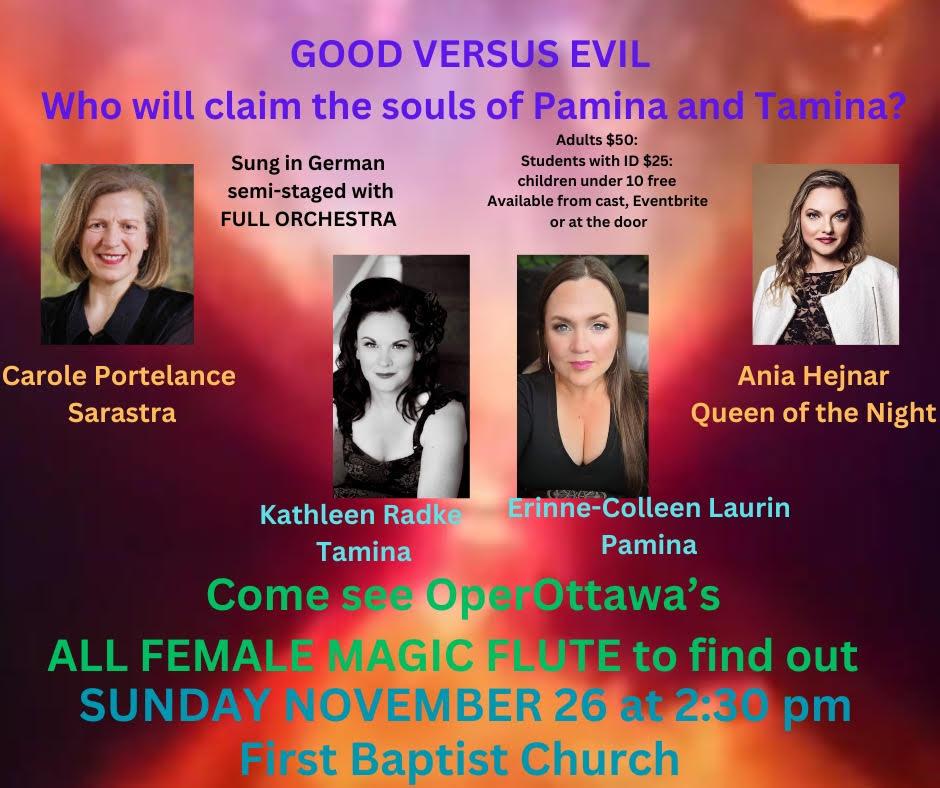
Pamina – Erinne-Colleen Laurin, soprano
Tamina – Kathleen Radke, soprano
Sarastra – Carole Portelance, mezzo
Queen of the Night – Ania Hejnar, soprano
Pipogena – Beverly McArthur, mezzo
Speaker – Mary Zborowski , mezzo
First Lady – Stéphanie Brassard, soprano
Second Lady – Isabella Cuminato, mezzo
Third Lady – Pauline van der Roest, mezzo
First Spirit – Melanie Anderson, soprano
Second Spirit – Sherrie Spelchuk, soprano
Third Spirit – Jean-e Hudson, mezzo
Monostatas- Silke Schwarz, soprano
Papagena – Katie Gratton, soprano
Priestess/Guard 1 – Patricia Beckett, soprano
Priestess/Guard 2 – Brenda Haddock, Colleen Woodhouse, mezzos
Priestess of Sarastra – Diane Reid, soprano
Priestess of Sarastra – Sue Postlethwaite, female tenor
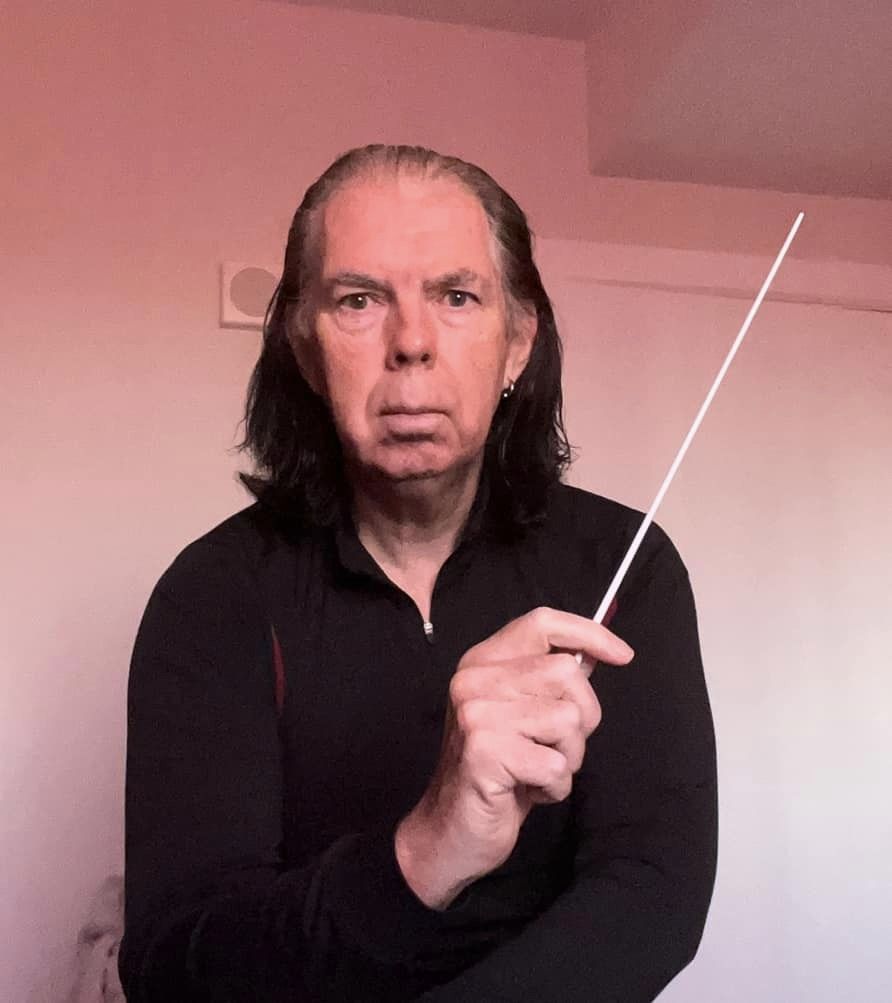
Conductor – Norman E. Brown
Several of our cast have sung Magic Flute before either in chorus or excerpts. Some have sung one or more of the roles written for women.
Barczablog: How do the singers feel about singing a role usually sung by a man, that is not a pants role?
Norman E. Brown
From our Sarastra Carole Portelance
Carole Portelance:
Singing the role of Sarastro as a female (thus, Sarastra!) has proven to be its own special challenge, unlike any role I have had to sing so far. Naturally, as a mezzo-soprano, I’m singing this role one octave up from the original. While that makes it feasible for me to sing it, I’ve found that my voice type can’t help but fundamentally change the characterization of the role. Sarastra’s voice is now not only higher, but, by necessity, relatively lighter – she is, after all, singing a Mozartian role, not a Wagnerian one! Thus, she now comes across as a more lyrical (and perhaps motherly) character.
Lighter does not mean less power, of course, and Sarastra’s voice must still have the same capacity to move the other characters and the audience (especially with those low notes!). And just to be very clear, singing this role as a female, with a female voice does not take away any of the gravitas and authority of the role! But, the challenge remains to portray the wisdom and power of this now female Sarastra in the spirit that Mozart intended, with a higher and relatively lighter voice, without subconsciously trying to imitate what a basso profundo would do! I certainly hope this makes sense. It has been quite a journey discovering Sarastra!

Norman E. Brown:
From our Tamina Kathleen Radke
Kathleen Radke:
About singing a tenor role
Having sung the role of Pamina, being Tamina will be very interesting. I get to interpret the story from the other side and I am looking forward to it. I see her as a very “Lawful good” character – pure of heart with nothing but good intentions. Yes, it’s strange to sing a traditionally tenor role but I’m enjoying it.
Look out tenors – I’m coming for your girl and your roles!
Barczablog: Papageno & Papagena are the most normal heterosexual couple going talking about having little ones, etc….. How does it work in your version ?
Norman E. Brown Love is love, and in today’s society same-sex couples are fairly common, and there are so many options available in planning for a family. Why should Pipogena and Papagena be any different.
Barczablog: Will there be any chorus in your version?
Norman E. Brown In the OperOttawa production of Magic Flute there are no cuts. All the choruses are intact. And will be sung in four part harmonies as in the original. The OperOttawa ensemble of females is quite strong as was evidenced by their spectacular performance and singing in Suor Angelica (September 2023)
Angelica sung by Kathleen Radke
Barczablog: Is this approach to Magic Flute driven by population of available talent (as usual there are so many women, and few men?), or just for fun…(?)
Norman E. Brown One of reasons I chose do an entire season only using female voices (Suor Angelica, an all female Magic Flute, and a world premiere Requiem by Hui Litster written specifically for female voices in March 2024) is the fact that there are so many amazing female singers in and around Ottawa who are underutilized. In a typical show I can perhaps hire 2 sopranos, and 1 mezzo, the rest being men. That, and the fact I like to think “outside the box” and do things differently, evidenced by setting Suor Angelica in a Catholic girls’ high school full of very delinquent students instead of a convent of nuns.
Barczablog: Is Monostatos (or “Monostatas”) and lines spoken by them / at them changed in any other way, besides gender, given the racist tone of some of the lines..?
Norman E. Brown The only change made in Monostatas’ singing text was to change the word black to bald – she will be wearing a “bald” wig when she speaks about reasons no one loves her.
Barczablog: Will you address any of this either in your publicity, your in-house program or during the show? (perhaps pre-show chat?)
Norman E. Brown Without giving away too much of the surprise, our publicity and marketing only mentions an all female production, sung in German, dialogue in English, with full orchestra.
As part of OperOttawa’s continuing growth last Spring we produced Handel’s ALCINA using full baroque orchestra, then with Suor Angelica in September we had an even larger orchestra and now for Magic Flute we will have our largest orchestra yet!
Barczablog: Do you have any future possible gender-bender shows in mind?
Norman E. Brown I have already shortlisted several operas for our 2024-25 season. There will definitely be a few “surprises “ in store and there could be occasion for some gender-bending or twisting. We shall wait and see.
Productions like these rely heavily on two sources of revenue. Ticket sales, which, have not totally returned to pre-Covid levels, and government grants, which are always welcome but becoming harder and harder to access.
*****
OperOttawa present The Magic Flute in their All Female version on November 26 at 2:30 pm at First Baptist Church.
 barczablog