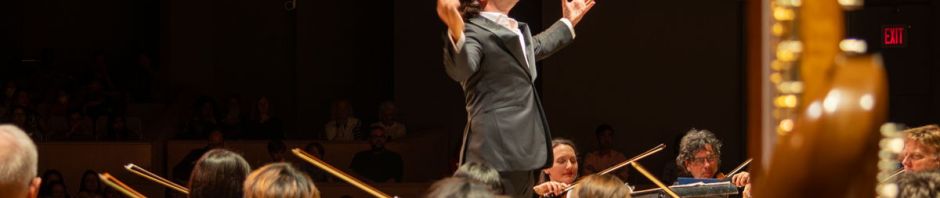
Last night’s Toronto Symphony concert titled “Beethoven’s Seventh” was another chance to watch the ongoing romance between the TSO and their new music director Gustavo Gimeno.

Whether it’s a love of Beethoven or delight in the ongoing lovefest between orchestra & music director, we had a full house midweek, a knowledgeable crowd without any phone phaux pas, enormously enthusiastic applause for every piece regardless of its century, and so much stillness during quiet parts to suggest something approaching rapture.
After a break for two nights of Carmina Burana with the Toronto Mendelssohn Choir tonight & Friday they’re back to repeat the program Saturday night at Roy Thomson Hall and a Sunday matinee at North York’s George Weston Recital Hall with one piece excluded as noted:
-Dreydl – Olga Neuwirth (not included Sunday)
-Violin concerto – György Ligeti
–intermission–
-Plumes – Tansy Davies
-Symphony #7—Ludwig van Beethoven
Virtuosity was front and centre in each half of this remarkable concert.
We began with Olga Neuwirth’s exotic Dreydl in its Canadian premiere. The title connotes the spinning tops we know from Chanukkah. Neuwirth’s eleven minute curtain-raiser was my favorite piece on the entire program, making me want to find more of her music. I was reminded of the flamboyance of Bolero, the exotic suggestion of other cultures hinted at through long melodic lines and simple repeated patterns and rhythms. Dreydl isn’t as rigid in its shape as Ravel’s piece, which is another way of saying it’s far more interesting, its ethnicity elusive: or maybe that should be “allusive”. We have percussion as a backbone with synthesizer, guitar and eventual orchestral passages too, building something quite hypnotic. I think there were some odd bar lengths (or so it seemed as I watched Gimeno’s baton), but I’m not certain. It was a fabulous preparation for the Ligeti concerto that followed, getting everyone leaning forward in their seat for a piece that begins on the very threshold of audibility.
Jonathan Crow has assumed a higher profile as concertmaster than what we’ve been accustomed to in Toronto, between his artistic directorship of the Toronto Summer Music Festival, and his regular appearances as a soloist. With Ligeti’s challenging concerto Crow took an even bigger step.
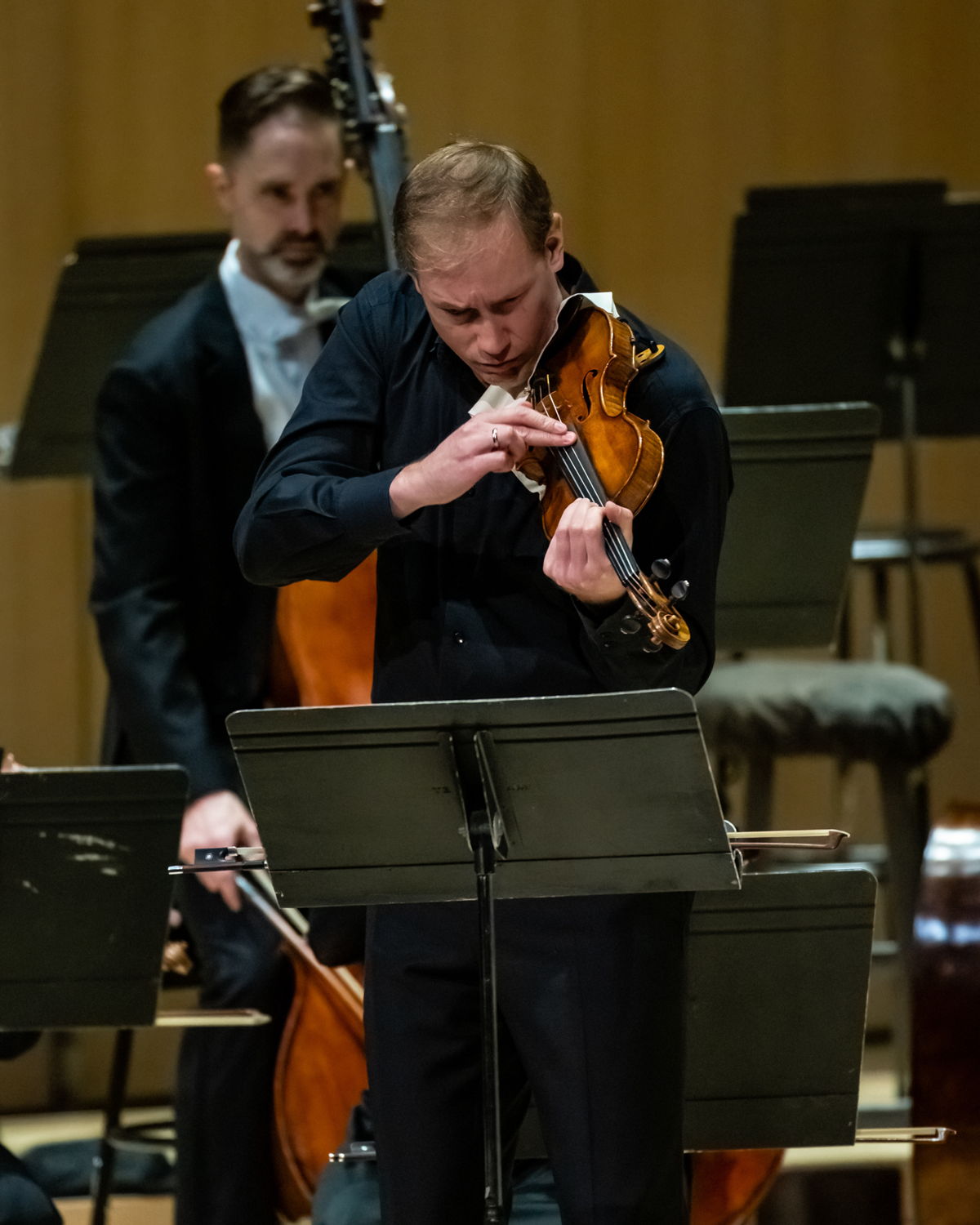
Ligeti gives us a simple repeated group of notes in an open fifth that I found suggestive of the ambiguities of the beginning of time, something like the way Beethoven opens the 9th Symphony out of a kind of blank void. Before long Crow is playing lots of notes, but this isn’t the usual concerto by any means. After the short introductory movement the second movement gives us a plaintive aria from the violin that’s tonal, lyrical, reserved. Considering the edgy modernism we heard from Ligeti in the 1960s, that gave us the famous compositions heard in the film 2001 A Space Odyssey, this 1990s version of Ligeti seems considerably mellower, a mature thoughtful voice. The orchestra at times will pick up the thread, at times will seem to parody what the violin is doing, as for instance in a cohort of ocarina players making mockery of serious conservatory discipline. At one point, in turn, the violinist seems to be rebelling against what the orchestra is doing or saying in blunt forceful attacks on his instrument that are not the only time the orchestra and soloist seem to be in conflict. But there are also sections that look back at older forms, a theme passed between sections, sometimes compressed sometimes slower. In the last movement we’re hearing echoes of earlier movements not unlike what Beethoven gives us to open his 9th symphony, but not as a simple recapitulation. And perhaps to remind us that yes this is still a concerto, we end with a long cadenza. Crow is equal to the task of this virtuoso composition, one that is a million miles away from Paganini and the old idea of a concerto.

After intermission we had another new work, Tansy Davies’ Plumes in its North American premiere. While its five minutes went by quickly its elemental dissonance made a perfect setup for the pastoral splendors that open the Beethoven symphony that followed.
Full disclosure: I was very uncomfortable in the second half of the Beethoven symphony, trying not to be too much of a nuisance to those sitting nearby as I writhed with extreme pain from the sciatica I sometimes experience. It’s my own fault. should have stood up at intermission to walk around, instead of feverishly making notes. But I was also very grateful to Gustavo Gimeno for the fastest tempi I have ever encountered for these movements. How do you spell relief? “P-r-e-s-t-o.“
The first two movements were more conventional yet still on the quick side. It’s in the scherzo (presto) and the allegro finale that I was pondering virtuosity, pondering the way the performance was embraced by the audience. Yes quick readings are impressive. But there’s more to it than that. The conductor can’t simply put his foot on the gas pedal. At this pace, the articulation becomes harder, the risks of mishap are greater. Yet this orchestra again responded to Gimeno’s leadership, following him on the roller-coaster ride that is the last half of this symphony.
I found that I was thinking of my mom, who is hard of hearing. If I speak too quickly, or if there’s a family gathering where too many of us speak at once, she won’t understand. The experience of music is really the same, as it’s not so much a matter of what you hear as what you are able to discern / understand as far as the notes and voices. While symphonic music doesn’t have words (Beethoven’s Ode to Joy notwithstanding), it is still a kind of discourse, a series of notes from different voices that we hear and comprehend after a fashion. I remember the jarring impact when I first encountered historically informed performances of Mozart and Beethoven (thinking of Norrington, John Eliot Gardner, or Tafelmusik led by Bruno Weil) with their fast interpretations, wondering how it was understood back in the day of the original performances when the pieces were premiered. At first I wondered whether our hearing had changed, but then, especially noticing different approaches to romantics such as Mahler, Wagner and Strauss, it was clear that it was more a matter of taste (meaning the preferences of artists and their consensus about the music) that had changed. And of course that meant that tastes could change again.
All that is meant as a kind of preamble to my thoughts about Gimeno’s Beethoven. While I grew up listening to Klemperer and von Karajan, who were not just slower but more Wagnerian in their approach, that’s an old approach. They’re obsolete now. Their brass in the old days seemed to be more important possibly because in their interpretations that’s where they placed their emphasis, as if Mozart or Beethoven were early exponents of Wagner’s philosophies. Devoted Wagnerians seemed to see his influence everywhere, and played their Handel differently as well. But there are other ways to play this music, and maybe Beethoven wasn’t as Wagnerian as all that, not when one recalls Rossini and the Italian masters such as Domenico Scarlatti (who has his birthday today). Toscanini sometimes took the tempo very fast. I remember being a bit confused upon hearing his Beethoven 7th presto, which was faster than any I had ever encountered, even in its trio. The brass are still there but no longer treated like a climactic nugget of gold, but merely one voice among several. Perhaps Gimeno is true to his Latin roots, less German and more in the direction of a Toscanini. It’s certainly a legitimate option, and the audience ate it up, giving the orchestra a huge ovation afterwards.
But as I said, I was grateful for the brisk tempi of the last two movements, rescuing me from my sciatica.
Speaking of back, the TSO will be back, Thursday and Friday with the Toronto Mendelssohn Choir, then back for this program Saturday & Sunday as noted above.
 barczablog