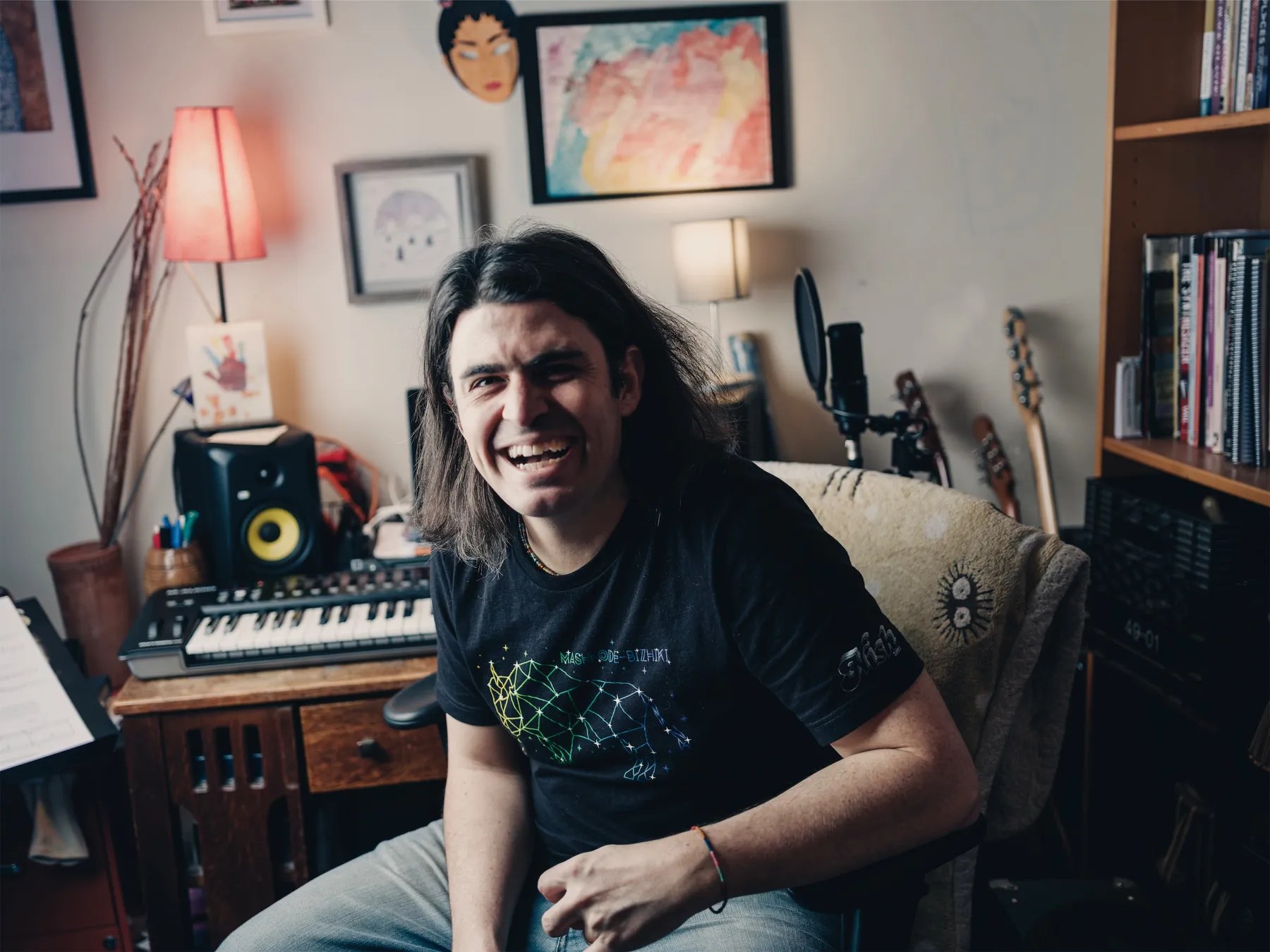
Jack Hui Litster has recently had two original operas produced by OperOttawa.
Jack is a multi-instrumentalist and composer of concert music and film and TV score based in Ottawa, blending his classical and popular music training. As Composer-in-Residence for OperOttawa, Jack composed and produced his first opera “The Day You Were Born”, an innovative online performance using videos of the cast members singing from their homes during the coronavirus lockdown, informed by interviews Jack conducted with midwives and new parents and by Jack’s own experiences as a father of two young children. Jack’s second opera was premiered by OperOttawa in June 2022. Titled What Is Love?, this opera grows out of poetry from Kahlil Gibran’s beloved book The Prophet. Links to both operas can be found at the end of the interview.
Jack began his musical career as a jazz drummer, then decided to broaden his horizons and complete a degree in International Development. In the non-profit sector, he spent ten years fighting for international human rights and collaborating with community activists from Africa, Asia, and Latin America. All the while Jack stayed engaged in the Ottawa music scene, notably with his retro-pop music duo The Ticket, a collaboration with Adam Waselnuk, as well as performing in diverse styles of music including folk, Afro-beat, jazz, and opera.

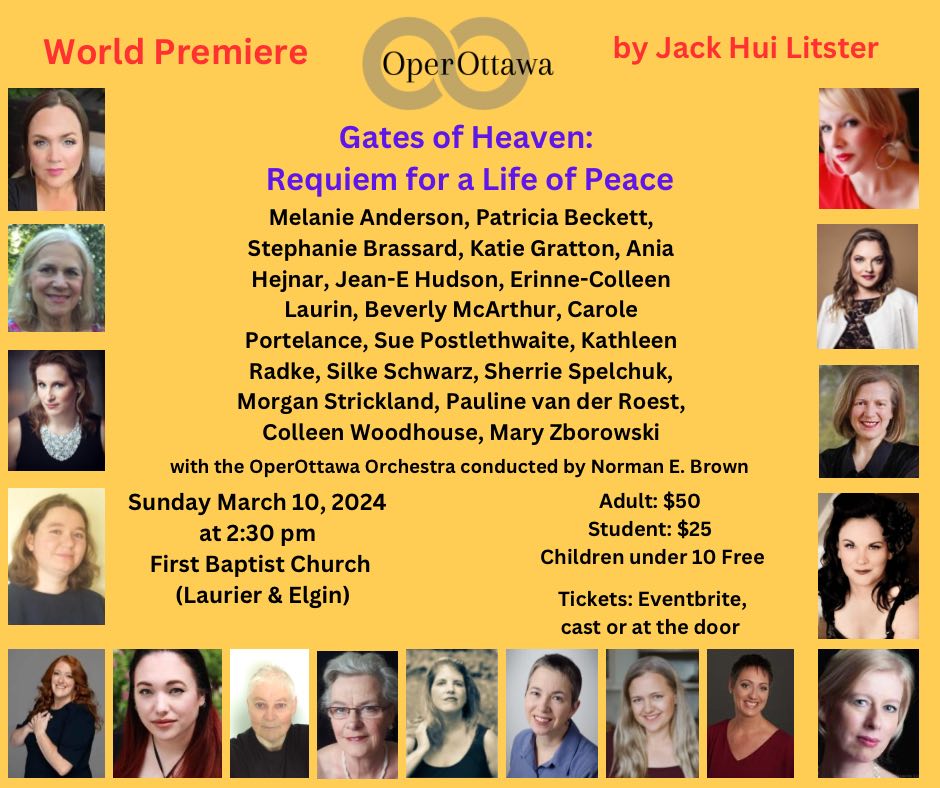
Sunday March 10th will see the world premiere of Jack’s Gates of Heaven: Requiem for a Life of Peace to be presented in Ottawa. A kickstarter campaign launched today February 8th to raise funds for the requiem.
To find out more about Jack’s music and his upcoming project with OperOttawa I asked him some questions.
Barczablog: Are you more like your father or your mother?
Jack: Starting off with a deep question here Leslie! I’ll need to give this some thought… Let’s see, I would say that I have a lot of characteristics of both of my parents in me. From my Mum I get my spontaneously evolving creativity, and the drive to create new projects and new artworks. My Mum and I are both people who step up to take on ambitious large creative projects, even in instances when we can’t yet clearly foresee the end result of a project before we take the first steps. My Mum has done this time and time again throughout her life, from creating incredible artistic projects like an intergenerational dance and documentary film project, to completing a semi-autobiographical book. For me this comes through in all the times when I take on a new project that I’m pouring my own personality and character into, projects that express my own artistic visions, like the operas and requiem that I’ve had the opportunity to write for OperOttawa. I think my Mum and I are both unafraid of embarking on a creative journey into the unknown, without a roadmap or a model to follow, armed only with the faith that the journey (and the connections made along the way) will have been worth it in the end. From my Dad I get the love of honing a craft, of developing an artistic skill set that you can then put into practice in community with others. My Dad is the one in my family who demonstrated to me what it is like to be a musician in collaboration with others and within the community. He played piano and sang at our church when I was growing up, he was the accompanist for countless musical theatre projects in schools, he sang in choirs. My Dad always made space for me and my brother to join him and participate in those musical projects, and he was always a supportive guiding presence for us, also always giving us the freedom to find our own way to express our own art. I will always love performing music live and making music with others, whether in professional, community or family spaces, and the joy that I receive from those experiences is something that I inherited from my Dad.
BB: What is the best or worst thing about what you do?
Jack: The best thing about what I do is the open door. When you are a freelance musician like me, there is no single set path that you are expected to follow. There is no rigid framework that you need to work within. There is no workplace with norms and an established list of acceptable methods, roles and responsibilities. Instead there is the open door. Each musical project, each collaboration, each opportunity, and on a more micro level, each song and even each note of music, is a gateway into nearly-infinite realms of possibilities. And the longer that you work as a musician, and the more projects you have worked on, the more diverse and different are the doors can become open to you. I’m not talking here in terms of privilege and opportunity – the question of who gets funding, who gets recognition, who gets an audience – though those are of course real factors that we all are forced to navigate in our work as artists. What I’m talking about here, though, is the freedom that we inherently have as artists to define who we want to be as an artist, and what forms of art we want to create. We have the freedom to determine what we want to express with our art, who we want to express it with, how we want to express it. The freedom of that open door and the fuel that it gives to my imagination, is unparalleled. I am so grateful that I am able to pursue that creativity, because it is a journey into who I am, what my art can express, and what that might mean to the world that I live in.
BB: Who do you like to listen to or watch?
Jack: Good question Leslie! I do a lot more listening than I do watching, to be honest. As a father who is quite active in the work of our household, taking care of our two children, cooking, cleaning, etc. I don’t spend much time watching tv or films. We actually don’t have a television set up in our house. But I’m always listening to music. For most of my life, I have generally listened to between 6-12 hours of music every day. I do have particular albums that I come back to, I have favourites. But I like to keep finding new artists, new and old, to listen to, to enjoy and to be inspired by. So I’m sure if you asked me this same question again in 6 months my answer would be quite different. The “who am I listening to” response keeps changing and evolving. But for now, as of February 2024, I’m listening to a lot of music by Hauschka (Volker Bertelmann), and I’m also studying a lot of Stravinsky’s music at the moment, primarily the music that he wrote for ballet. Those are the two artists on heaviest rotation for me at the moment. But I also spend a lot of time listening to recordings by local artists, because the Ottawa music scene is so rich and vast. So I’m listening to recordings by Dinuk Wijeratne, Raphael Weinroth-Browne, Nick Schofield, and Nathanael Larochette at the moment, and feeling grateful to be living in the same city as amazing artists like them and so many others.
BB: What ability or skill do you wish you had, that you don’t have?
Jack: I wish I was a better cook. I’m okay as a cook, I can often make food that tastes pretty good. But I wish I had a more innate understanding of flavours, ingredients, dishes, and cooking processes so that my cooking could be as diverse and wide-ranging as the music that I try to make!
BB: When you’re just relaxing and not working, what is your favourite thing to do?
Jack: Hands down, my favourite pastime is to hang out with my family. That often involves reading chapter books together with my kids, and also board games. But we also love spending time outside, whether that means going for walks in the neighbourhood or on hiking trails, or just playing at the park. Also, I must say that one of the most relaxing things for me has always been to sit and read a good book. I could get lost for hours in a good book.
BB: What was your first experience of music ?
Jack: My first memory of music would be when I was maybe 4 or 5 years old. It was around then that I remember learning how to turn on our stereo, put a vinyl record on the record player and drop the needle. I remember putting on records like James Taylor’s Greatest Hits and just lying down on the floor in the dining room where our speakers were, so that I could listen and get lost in the music. My first-ever favourite song was James Taylor’s song “Carolina in My Mind.”
BB: What is your favorite opera?
Jack: I’ll cheat a bit on this one and give two – one really old and one quite new. If I had to just pick one it would be Tan Dun’s opera “The First Emperor” which premiered at the Met in 2006. I love Tan Dun’s music. He is one of my favourite musicians of all time. When I was studying at Carleton University for my graduate degree, my thesis was an exploration of the intercultural music that Tan Dun composed for the film Crouching Tiger, Hidden Dragon. Intercultural composition is on display in a big way in The First Emperor as well. In that opera, Tan Dun, a Chinese American composer, tells the story of one of the most epic leaders in Chinese history, Emperor Qin Shi Huang, the man who implemented the construction of the Great Wall of China. And Tan Dun uses his deep understanding of Chinese opera traditions integrated with the lush melodic grandeur of late Romantic Italian opera. It’s an epic opera: fitting for an epic historical figure.
My second favourite opera, if I may – and this one is also not one of the more predictable choices – would be “King Arthur” by Henry Purcell, which premiered in 1691. Now I know for the purists out there, technically this is actually a semi-opera, as the principal characters have spoken roles, but the music in it, including arias, duets and choruses, and many instrumentals, are performed as concert pieces frequently to this day. King Arthur was a major influence for me when I was writing my first opera, “The Day You Were Born.” I had been commissioned by OperOttawa, and I was seeking examples of operatic music in English that would fit well with an opera company who specializes in early music, particularly Baroque. Listening and understanding how Purcell used the particular harmonic language of his time and the way he set English text to music, was massively influential for me.
BB your style blends classical and popular influences. Talk about how that works for artists and singers performing your music.
Jack: So as a performer I come from a popular music background, and as a composer I’ve studied orchestral and choral writing. I love finding the ways that these different musical traditions can influence each other. Musicians have been blending classical music and pop music for generations, and one of the styles of music where this has been happening in fascinating and creative ways for several decades is in film music, which is the style of music that I associate myself most with as a composer. I write music for recordings and music for performance. When I’m writing music for performance, my favourite way to approach this is to write for the specific musician or singer. The instrument they are performing on is important as well of course, but at the heart of it I am really trying to write for the particular player. This is more feasible in chamber music and when you are writing for the solo voice or a solo player. When I wrote my first two operas I very much had each soloist in mind for each piece that I wrote for them, always being mindful of their particular sound, their character and personality, and their own distinct individual musical superpowers. I take it as an honour and a privilege to write music for another artist to perform, so I want to always take the time to set them up to really shine and feel at home and comfortable in the piece that I’ve written for them. In my upcoming requiem we are keeping it pretty traditional in terms of instrumentation, using a small string section along with two brass and three woodwinds, percussion and 18 women’s voices. However, I do have a new project in the works which will likely take shape and hopefully come to a stage in Ottawa sometime in late 2024, which will feature improvising musicians on a mix of orchestral instruments and instruments from pop music and African musical contexts.
BB: Do you prefer using trained operatic voices, and do you ever use microphones as in popular music?
Jack: It all depends on the project, and the parameters for every project that I work on are always somewhat different from one to the next. When I’m working with OperOttawa, one of our main goals is to create new music that can be performed by trained operatic voices. It has been such an honour for me to be able to write for these singers, and to gain some insight into what is and what is not comfortable for each of them to perform. In terms of using microphones, that’s an interesting question. We don’t amplify our performances with OperOttawa as we’re working in an a style of music that evolved in a time before amplification was even invented, so the sound mix, the balance that we have acoustically with the instruments and voices we use with OperOttawa is already strong and does not require microphones. We certainly use microphones for recording OperOttawa’s performances though! And in other projects that I’m working on, we don’t necessarily always have operatic singers, and much of my music uses microphones and electronics of all kinds. But it really depends on the aesthetics of each individual project.
BB in your bio it says you have “a degree in International Development” and that In the non-profit sector, you “spent ten years fighting for international human rights and collaborating with community activists.” Please talk about your experiences.
Jack: Sure! I mean it was ten years of my life so I could talk for days about what those experiences were like. But in a nutshell, I first studied music, and worked as a professional performer in my early 20s before realizing that I wanted to go back to school and study a broad range of subjects outside the scope of music. I completed a Bachelor of Social Sciences degree in 2009 with a focus on international development and then I was fortunate to find work in international human rights organizations here in Ottawa. After working for the Canadian Council for International Cooperation for three years, I spent from 2013-2020 working as a Community Engagement Manager for Inter Pares. I was able to co-organize several speaking tours throughout Canada for women’s rights activists from the Philippines. I was able to meet and get to know Inter Pares’ committed donors throughout BC, in Alberta, Manitoba, throughout Ontario and Quebec, and in the Maritimes. I got to work as the liaison with Inter Pares’ board of directors, I got to work on foundation grant proposals and reports. I received my designation as a Certified Fundraising Executive. I was on several hiring committees to bring excellent new staff into the organization. I built and managed a volunteer program. I got to emcee and provide background music for one of the organization’s largest-ever annual events, a performance of a documentary play about women’s rights. I helped to build a strategy for the organization to engage more deeply with Indigenous rights activists across Canada.
It was a lot. I loved it, and I met such inspiring people and lifelong friends. But at the end of the day, when you are an artist, your art keeps calling you. And I came to a point when I realized that if, God willing, I live to a ripe old age, I don’t want to look back on my life and ask the question “what if I had given my music a second chance?” I knew that I needed to find out the answer to that question. So I left Inter Pares to go to Carleton University where I spent two years completing my MA in Music and Culture (during the pandemic!). By that point I had already begun working as a composer for OperOttawa. And so far, the opportunities have continued to blossom. So I’m thankful that this transition has gone smoothly. And I’m grateful for the decade that I got to spend in nonprofit organizations.

Norman E Brown
BB: In his October interview Norman E Brown founder and Artistic Director of OperOttawa said
One of reasons I chose do an entire season only using female voices (Suor Angelica, an all female Magic Flute, and a world premiere Requiem by Hui Litster written specifically for female voices in March 2024) is the fact that there are so many amazing female singers in and around Ottawa who are underutilized.
Tell us what voices you will be using and what this piece will sound like.
Jack: We will have 18 amazing, accomplished operatic singers from Ottawa and Montreal performing this requiem, which is titled Gates of Heaven: Requiem for a Life of Peace. With the exception of two movements which feature solo voices, this requiem is primarily choral.
Several of the movements feature 6-part harmony, and I had such a great time writing close harmonies for these women’s voices, who between them have a range of two and a half octaves.
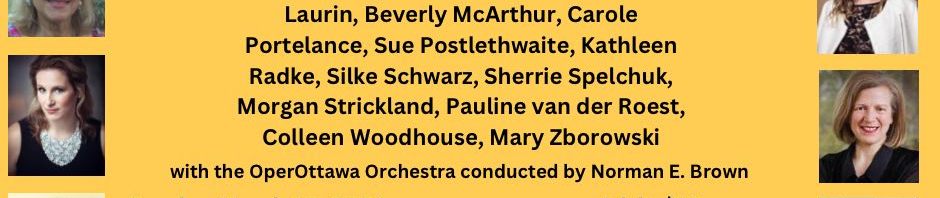
This requiem will be sung by the talented singers of OperOttawa, including Melanie Anderson, Patricia Beckett, Stephanie Brassard, Katie Gratton, Ania Hejnar, Jean-E Hudson, Erinne-Colleen Laurin, Beverly McArthur, Carole Portelance, Sue Postlethwaite, Kathleen Radke, Silke Schwarz, Sherrie Spelchuk, Morgan Strickland, Pauline van der Roest, Colleen Woodhouse, Mary Zborowski.
Our singers will be accompanied by the OperOttawa Orchestra, conducted by Norman E. Brown.
Often a requiem is written in memory of a certain person. Gates of Heaven: Requiem for a Life of Peace is dedicated to the memory of Canadian women leaders throughout history. During the performance of the requiem, we will include three pauses in which a commemoration will be read honouring these Canadian women leaders: Allie Vibert Douglas, Viola Desmond, Madeleine Parent, Keiko Margaret Lyons, Rosemary Brown, Ethel Stark, Portia White, Kathleen Livingstone, Kenojuak Ashevak, Mary Ann Shadd, Hide Hyodo Shimizu, Lotta Hitschmanova, Violet King Henry, and Shirley Greenberg.
At its origins, a requiem is a mass for the dead. Over the past six centuries, requiems have been written by celebrated and gifted musicians, from Palestrina to Mozart, Verdi to Fauré, Duruflé to Rutter, and many, many more. There are requiems that are quite dramatic, like Verdi’s requiem or Mozart’s requiem, which seem at times to be exploring the subject of death from the perspective of devastated mourners at a funeral. Then there are other requiems which are more meditative and less dramatic, which have a flowing quality to them, such as parts of Duruflé’s requiem. My vision that I held on to as I was writing my requiem was that this would be the music that someone would hear after their death, at the moment of their arrival at the Gates of Heaven. I wanted the music to lean more into the celebration of a life well lived, rather than the grief and heartache of those left behind. So I pictured the relief that you would feel, arriving at the gates of heaven, to have a choir of angels sing you home.
BB: What words are you setting in this Requiem?
Jack: This requiem takes elements of the standard Latin text for a requiem, including Introitus, Kyrie, Offertorium, Sanctus and Benedictus, Pie Jesu, Agnus Dei, Lux Aeterna and In Paradisum. It’s a bit unorthodox but we have added a Gloria as well (partly as an homage to Bach’s Mass in B Minor, and partly because my wife’s name is Gloria so I couldn’t pass up the chance to write a piece in which a choir repeats her name endlessly!). And then the one moment in which we are breaking out of the Latin text is in the final movement. I’ve integrated some English text, titled “Golden Valley” to my setting of “In Paradisum.”
BB do you have any advice to young composers trying to find their way?
Jack; I hope that a young composer somewhere might read this blog. That would be very exciting for me. If you are a young composer reading this, please reach out to me. I would love to hear from you! Even though I still feel that I’m a young composer trying to find my way, I can certainly offer a few words of advice that I’ve picked up along the way.
First, try to find ways to embrace the paradox that on one hand composing is a solitary process – we spend so many days and nights every year by ourselves in our studios, at our instruments, alone with our creative ideas, creating new music in recorded or notated form – and on the other hand, to thrive as a composer, you need to always be growing and nurturing your network of fellow musicians, collaborators and other artists! This paradox is helpful because making time for the important work of relationship-building is a nice antidote to the loneliness of composing by yourself. Remember that your next award-winning, life-changing long-term collaborative partners could emerge at the most unexpected places and times. Keep alert for these possibilities, stay curious, and take the time to be aware of and engaged in the artistic communities that you want to be working with.
Second, it’s okay to have sidelines. Hardly any composers in history have been able to have composing as their singular sustainable income source. And that’s okay. You’re not a failure if you have other income streams besides composition. Composition-related income, in so many cases, is sporadic, short-term, and nearly always project-based, whereas bills are paid monthly and as humans we’re required to buy food on a daily basis. Having a part-time side gig that provides predictable steady income can give you peace of mind, which can help you to be in a better head space when you are doing your creative work. In my case, I am currently juggling roughly 6 part-time jobs, I work as the composer-in-residence for two arts organizations, I freelance as a composer, producer and performer, I teach several music students privately, I’m a contract instructor in a local university’s music department, and I work 10 hours a week at a bookstore in my neighbourhood.
Third, remember that being a composer is a long-term game. Our projects are long and time-consuming. But over time, as my mentor Dinuk Wijeratne likes to say, we are building assets (our compositions) which will continue to earn revenue for us in the years to come. The more years that you work as a composer, the more established you become, and the deeper your list of works becomes, and the more collaborators you have.
BB: Do you have any influences or teachers you would like to recognize?
Jack: I have had so many teachers and mentors who have left an imprint on my music and have each opened my eyes and my ears to what music has the potential to be. In my family, my Nan and my Auntie Eve, who were singers and whose performances I went to often as a kid – they showed me the joy of being on stage, and the emotion that a strong performance can give to an audience. My Dad and my brother Pete, who I performed with in countless projects all throughout my childhood – they made music fun for me from day one. All my uncles and my cousin Aaron, all such incredible singers and choristers, whose effortless harmonies gave me, from a young age, a deep love for Renaissance choral music, as well as choral music more broadly. My high school music teacher Doug McIlwain, who saw something in me and put musical opportunities in front of me, giving me the opportunity at age 17 to be the composer and director for our school’s first ever percussion ensemble. I think that it is only as I grow older that I look back on that and see how much of a vote of confidence and leap of faith that was. My drum teachers, particularly Tom Wolf and Kevin Brow, who gave me so much inspiration and such a deep love of my instrument, as well as so much insight into how much deeper it was possible to go. Dave Restivo, Tom Daniels, Greg Carter, John McLaggan, Lisa Berg in the music department at St. Francis Xavier when I studied there – all such incredibly inspirational professors and instructors. Kareem Clarke, Ben Newhouse, Dave Kusek and Jack Freeman at the Berklee College of Music, who were each so down-to-earth, passionate, and wise about the various aspects of music that I had the chance to study with them. Here in Ottawa, all my many musical mentors, Dr. James K. Wright, Dr. Jesse Stewart, Mark Ferguson, Dinuk Wijeratne, Robbie Teehan and Ed Eagan. I have been so blessed to have the ongoing opportunities to work with and learn from such gifted and generous artists.

Sunday March 10th will see the world premiere of Jack’s Gates of Heaven: Requiem for a Life of Peace to be presented by OperOttawa. The Kickstarter campaign to raise funds for the requiem can be found here:
Here is the link to Jack’s first opera, The Day You Were Born:
Here is the link to his second opera, What is Love?
 barczablog