They began with this artistic manifesto:
As a collective of artists working within a creative circle associated with the Scarborough Philharmonic Orchestra, we have asked ourselves how artists can and should respond to the times we live in. Our answer has been the one word “Hope”. Drawing on various texts from the classical to the new, and set within our own musical styles, we have jointly conspired to infect our audiences virally with Hope.
They are the collective of musicians, singers, composers, brought together under the auspices of the Scarborough Philharmonic Orchestra, the Odin Quartet. The program lists Danielle MacMillan, Mezzo Soprano; Maghan McPhee, Soprano; Odin Quartet (Alex Toskov, Tanya Charles Iveniuk, Matt Antal, Samuel Bisson); Kaye Royer, Clarinet; Gilles Thibodeau, Horn; Kristin Day, Bassoon, Lisa Tahara, Piano, Vanessa Yu, piano, Ronald Royer, Conductor, Ted Runcie, Conductor.


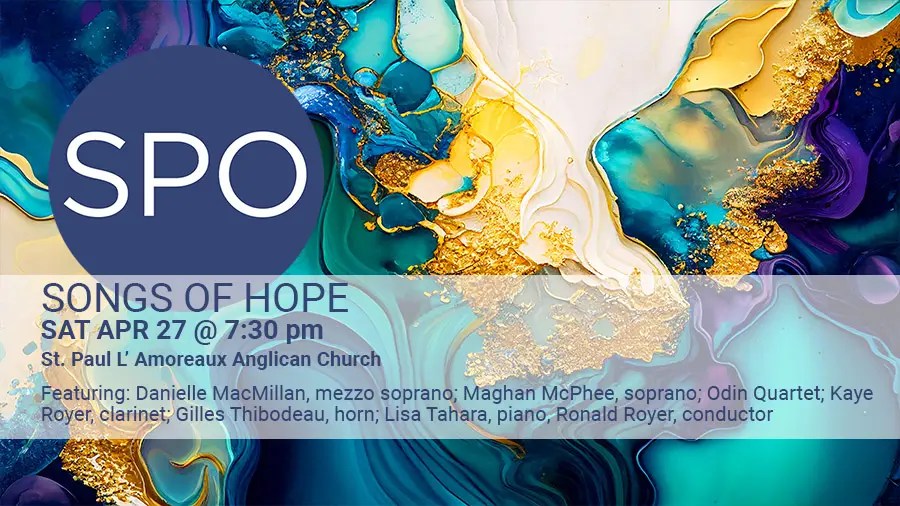
Friday night’s “Prelude to Hope” from that collective at the Heliconian Hall was the first of two concerts. Saturday’s “Songs of Hope” at St. Paul’s L’Amoreaux Anglican Church (3333 Finch Avenue East) includes additional pieces while reprising many of the same compositions.
Ron Royer, Artistic Director of the SPO, was our host and master of ceremonies encouraging each composer in attendance to come forward to speak before their pieces. Their comments underlined how challenging it can be.
I find myself asking chicken & egg questions lately, unsure which came first between composers composing, writers writing, ensembles commissioning, teachers encouraging, and an eager audience making it all come to life.
I can’t decide whether the concert I saw last night was more apt for springtime –when new growth flourishes — or autumn–when the fruits are harvested.
Saturday night’s concert includes much of the same music heard in Friday’s program (listed here):
Daniel Mehdizadeh, composer Jess Azevedo, librettist, New Castles, for Soprano, Mezzo Soprano, piano and cello (SPO Commission and Premiere)
Elienna Wang: Rosé Leaves, for Mezzo Soprano, Viola and Piano
Ryan Fwu, composer, (Maya Toussi, words) , The Midnight Garden, for Soprano and Piano
Anika-France Forget: composer, (Aude A. Saint-Laurent, words), I Will Whisper Your Name, a Sweet Boy’s Lullaby, for Mezzo Soprano, Cello and Piano
Yuhan Zhou: Tonight, for Soprano and Piano
Rachel McFarlane, music and words, Eternal Embrace, for Mezzo Soprano and Chamber Ensemble (New Generation Composer, SPO Commission and Premiere)
Alexander Glazunov: Serenade for Horn and String Quartet
Shreya Jha, music and words, Walk with Me, for Mezzo Soprano and Piano (New Generation Composer, SPO Commission and Premiere)
Ted Runcie: Where Shadow Chases Light (words by Rabidinath Tagore) for Soprano, Mezzo Soprano, and Chamber Ensemble (SPO Commission and Premiere)
~intermission~
Bruno Degazio: Seven Parables of The Rising Dawn, words by St. Thomas Aquinas for Soprano, Mezzo Soprano, and Chamber Ensemble (SPO Commission and Premiere)
Hsiu-Ping Patrick Wu: That Last Moonlight, for Soprano, Cello and Piano
Ronald Royer: English translation adapted from Dante Sapia of Siena and Beatrice from Women of Dante’s Divine Comedy, for Mezzo Soprano and Chamber Ensemble (SPO Commission and Premiere)
Mitsuko Fernandes: A Song for the SPO, for Soprano and Piano
Leela Gilday, music and words, (arranged by Martin Loomer) All Alone, for Mezzo Soprano and String Quartet

I have never been to a concert with so many original pieces getting their premiere. Except for the Glazunov and the Gilday, everything was a premiere, and perhaps the arrangement of Gilday’s piece is new too.
It’s a reminder that at its core, poetry, art, music can be understood as a proposition, energy directed towards the eyes and ears of others, especially when one participates as I did in the excitement to give thanks in response.
I came in asking myself “How does one signify hope in music”? It helps to have titles and text, poems or meditations, although at times the abstract composition takes you from a place of fear or sadness towards something happier, from darkness to light, from slower to faster, from doubt towards commitment & confidence. Some composers opted for a very simple and direct approach, others probed in poetry or meditations to dig more deeply.
I might misquote Descartes’ “cogito ergo sum”, to suggest that when we sing therefore we are alive. I am thankful for the arts councils funding projects like this one, the schools like UTS encouraging students (including a few we heard on the program).
I am inspired by what I saw and heard.
 barczablog