A good pre-concert introduction from the artist can make a big impact.
Last night’s Toronto Summer Music Concert by pianist Philip Chiu with violinist & TSM artistic director Jonathan Crow at Walter Hall was sold out.
Titled “Dreams and Shadows” here’s the program (timings in brackets from performances on YouTube):
Elizabeth Raum — Les Ombres (9 minutes)
Kaija Saariaho — Tocar (7 minutes)
Johannes Brahms — Sonata No 3 in D minor Op 108 (29 mninutes)
–intermission–
Jules Massenet — Meditation from Thais (6 minutes)
Sergei Prokofiev — Sonata No. 1 in F minor, Op. 80 (26 minutes)
Philip gave a light talk at the beginning to introduce the pieces by Brahms, Saariaho and Raum, reminding us that he is now a TSM festival regular. Yes indeed and thank goodness. It’s a reason why I found & then reviewed his wonderful CD that won a Juno last year. His collaborations with Jonathan have been a highlight of recent summers at TSM, thinking especially of 2021 and a belated celebration of Beethoven (that should have happened in 2020, when no concerts were permitted), as we tentatively came back from the pandemic in distanced venues. Their music-making banished all our cares.
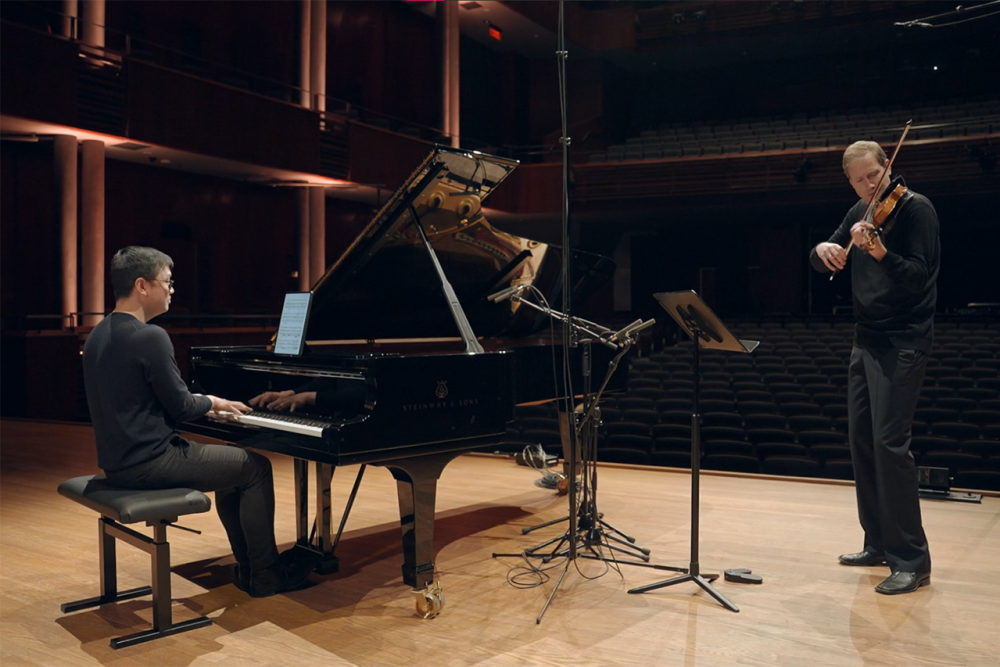
Philip’s joking told us a great deal about the security of their relationship: as artists and as friends. He finished by drilling down on Tegan Niziol’s program note to the Raum piece, reading it as the audience giggled:
“Raum describes the work as a “true duo”, with each part afforded an equal level of prominence. In her notes to the score, Raum indicates that the interaction of two main structural elements –repeating short musical figures known as ostinati, and melodic lines shared between the violin and piano– define the work’s overall form. She ascribes a sensual quality to the interactions between the two instrument as they form a flirtatious relationship.” According to Raum shadows (the English translation of Les Ombres) are evoked by imitative voices within the composition“. (Tegan Niziol)
The two halves of the concert couldn’t be more different, one from the other, especially as introduced by the artists.
I was put in mind of the design on the page, something we think of when looking at the scores of Debussy (for example) who spoke of arabesques both in his own work and in the baroque, patterns on the page. A shadow is if nothing else, the trace or effect of light being blocked by another. I’m looking at the shadow of the top of my laptop as I type this. A shadow is a kind of image of something else, not unlike what we encounter in counterpoint, but also not as rigorous as counterpoint. Shadows are capricious, sometimes they aren’t visible. MAYBE I am overthinking the name and the implications of the title, certainly less fun than what Philip made from the program note.
Les Ombres dates from the 1980s, and contrasts in interesting ways with Tocar, Saariaho’s piece that dates from 2010. Raum makes each instrument work rather than making the piano subservient or somehow an accompanist. The patterns that we hear articulated across the imagined stafflines, like musical gestures drawn in the air, are emulated, rather than echoed. It’s as though we’re observing a kind of encounter between the violin and piano, who do not speak the same language either in their sound or their physical – gestural vocabulary. We’re sometimes seeing them synthesize into something harmonious, sometimes watching one trigger something in reply. At times it’s a dialectic, a response in a new direction. When we’re getting towards the end –and you can tell when the ending is coming– there is something like a stretto, a concentration of the materials into a unified expression of the closing ideas.
Saariaho is doing something different in Tocar (a word meaning “touch”). It’s intriguing that both pieces employ a word in another language that in some respects characterizes the music via a kind of metaphor. I think it’s very helpful that Philip’s language encouraged a playful engagement with these pieces. My understanding of the word “tocar” doesn’t focus on what I saw in the program note, which spoke chiefly of the interaction between the two instruments. When I hear this piece the first thing that catches my ear is the curious way each instrument is sounded, which brings us back to the physical process of playing each instrument. Philip touches the piano, Jonathan touches the violin, and the notes diverge. The obvious contrast is made a few times, when Saariaho gets the violin to venture between tones, something you can’t do on a piano. There is a wonderful variety to this short piece, including segments of tremendous rhythmic vitality: that Philip & Jonathan exploited with effortless acceleration. The dynamic variety they displayed reminded us of their rapport, playing as if the two of them operate with one mind. The tentative exploratory quality of the beginning –when we watch each one make music on their instrument as if from first principles–returns at the end. Everyone in the audience leans forward, fascinated by this piece…
I’ll insert a tiny anecdote. One time I was picking up a family member at the Toronto airport I saw Saariaho. I approached her, introduced myself as a fan and spoke briefly of her opera Love from Afar. She was very patient with my starstruck tongue-tied manner, smiled and then I let her go on her way. Unfortunately she died last year, a composer who I thought still had lots to offer us.
We then listened to the Brahms sonata for violin & piano op 80. Of the three Brahms sonatas it’s the hardest, a quantum leap in difficulty both for each player and in how they articulate and make something from what’s going on in the relationship between the two instruments, who often work together for a joint effect. To make that come off one has to be pristine in one’s command, absolutely solid and clean, otherwise it just sounds busy or cluttered and won’t really work. I say this having experienced such a failure, but now having a better idea listening to the stunning playing by Philip and Jonathan. Especially in the second movement I was struck by how Jonathan Crow is seemingly at the peak of his game, a big full sound full of expression pouring out of him without any struggle, anytime he wants to call it forth.
And it seems to get harder, the further we go. While the piano was more of a conventional accompanist earlier (the melodies & phrases & rhythms perhaps reminding you of what we hear from Brahms in his piano concerti) for the last two movement Brahms takes us into something suggestive of a Hungarian or Roma influence, dance rhythms and a huge amount of energy. In the last movement it’s intensely demanding of the piano and violin, quick passages of many notes, cleanly articulated yet often understated to illustrate the maxim “less is more”. Then when we get to the big climactic passages we get genuine drama in the dynamic contrasts. Their subtlety in holding back at first pays off, so much of the sonata played more quietly than one might expect yet at such a high energy level and quick flow of notes.
It was magnificent, and the audience exploded with applause in appreciation.
After the intermission it was time to hear from Jonathan, the artistic director of the festival and likely the one who selected this program of music for violin and piano. He spoke briefly of the Massenet which was played to honour someone’s passing (sorry I didn’t catch the name), and much more passionately about the Prokofiev. This was more of a cautionary exercise to warn us of the loud edgy piece that we were about to hear, almost an apology: but in defence of its quirks. I’m hugely grateful that what Jonathan was pointing to was the context for the work’s creation in the crazy times of the composer. Where Philip was drawing our attention to the light that we should hear in the works to begin the concert, Jonathan encouraged us to embrace and even celebrate the dark.
I repeat, Jonathan seemed to be apologizing, admitting that when the work was new the first interpreters were told to make the piano part even heavier regardless of whether it drowned out the violin. We were reminded of how the composer described a passage where the violin ascends rapidly up and down, as “wind passing through a graveyard.” The place where we hear that in the first movement, the piano’s chords reminded me of church-bells, an eerily beautiful evocation, something we hear again (but differently) towards the end of the piece. In between we get extremes of dynamics that remind me more of Shostakovich or Mahler than Prokofiev, the heartbreak of the human comedy.
I hope Philip and Jonathan record this piece, indeed everything we heard deserves to be captured for all time, as this pair are at the peak of their powers.
Toronto Summer Music continues until next weekend. I should also mention that among Philip’s light-hearted commentary at the beginning were reminders about fund-raising for the Festival, which offers a matching program for a few more days (sorry I’m not sure when it ends).
For further information (about making a donation or to see/hear one of the concerts in the final few days of the festival that concludes on August 3rd) visit their website.

 barczablog