On September 8, 1949 composer and conductor Richard Strauss died after a long productive life. I think of him as a romantic composer carrying on the stylistic traditions of Richard Wagner. In Salome and Elektra he was the modernist pushing expression and tonality to the limits of propriety taste and dissonance, before turning back from the precipice where he and the art were teetering, returning as a neo-classicist & late romantic to the warm melodic possibilities one could create in a tonal sound-world. Somehow one wouldn’t expect a man born in 1864 to have been alive so recently.
As regular readers may have noticed, I am sometimes a bit compulsive about dates and anniversaries. I’m thinking about the anniversary of Strauss’s death on September 8 2024, the 75th anniversary of his passing. I haven’t heard anyone mention this, possibly because there are usually other commemorations (for instance the Year of Czech Music or the centennial of Cunning Little Vixen) that get more attention. I guess this one is meaningful to me because Strauss has made an impression on me over and over throughout my life.
When I’m asked who I’d call my favourite composer I’ve never said Richard Strauss, even though maybe he’s always been there inside my head. That’s what I’m thinking about in this little summary.
In 1968 I didn’t wait long to see 2001: A Space Odyssey. I saw it twice in its first year, and bought the soundtrack album, featuring pieces by Ligeti and Johann Strauss Jr alongside the brief signature piece that opens the film. People refer to it as “The 2001 Theme”, that opening fragment from Also Sprach Zarathustra.
While that music has become ubiquitous, quoted in films and tv commercials, and the film itself has entered the conversation as the greatest film ever made, at least partially thanks to that revolutionary soundtrack, in 1968 its impact was still in the future. At this point in my life I was also listening to the Beatles while sometimes playing the piano accompaniment for my brother’s songs or arias. It would be years before I would get a recording of the complete tone poem Also Sprach Zarathustra, or read the poetic Nietzsche work underlying Strauss’s composition.
In 1969 one of the first really exciting operas I saw was presented at the University of Toronto Opera School (as it was then known) at the MacMillan Theatre, a production of Ariadne auf Naxos directed by Hermann Geiger-Torel and conducted by Ernesto Barbini. They called it “Ariadne on Naxos” because they presented it in English translation.
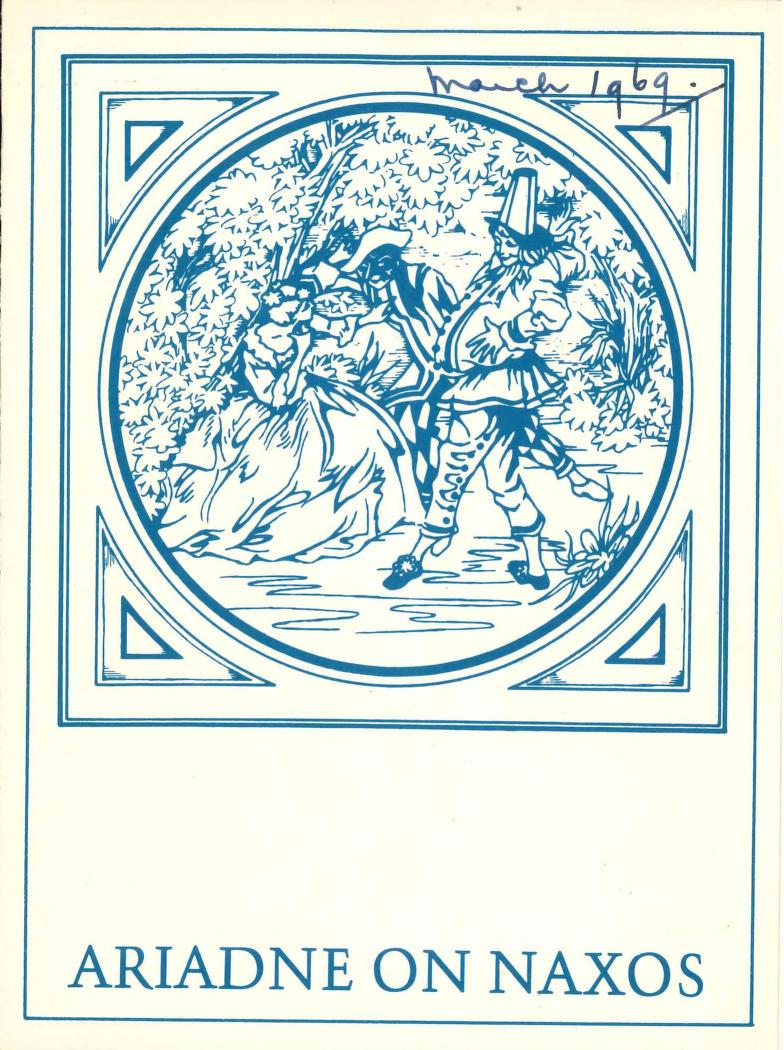
Was it staged to commemorate the 30th anniversary of Strauss’s passing? If they did there’s no mention of it in the program.
Even so it was the most exciting thing I had ever seen live on a stage. I didn’t expect to love it so much.
It’s been a bit breath-taking to peruse the program, to see familiar names on the cast list. I will have more to share as I look more closely at the files in the EJB Library archives. I went to see it mostly because my brother Peter Barcza was just 19 years old in the Opera School, singing the small role of the Wigmaker.
But this opera with its strange mixture of mythological characters (Ariadne, Bacchus, three nymphs) and Commedia dell’arte figures (Arlequino, Zerbinetta, Truffaldino, Brighella, and Scaramuccio) blew me away. To this day it’s one of my favourite operas. I realize this is also where I first encountered Commedia dell’arte, another life-long preoccupation.
In my teens I started an addiction that persists to this day, collecting and listening to recordings of music. At first it was on vinyl, later on CDs and DVDs. In addition to the operas I became intrigued by the tone poems of Richard Strauss, including that aforementioned Zarathustra. I was particularly impressed by the recordings of the Dresden State Orchestra conducted by Rudolf Kempe, who seemed to have a special instinct for this music. Their Ariadne auf Naxos recording is still my favourite version of the opera, featuring James King, Gundula Janowitz, Sylvia Geszty, Theo Adam, Teresa Zylis-Gara, Peter Schreier, Hermann Prey and a transparent clarity in the recording of this radiant score.
It’s such a thrill to pull it up on YouTube to have a brief listen.
I remember when one had to struggle to find and obtain such recordings: costly for a kid, welcome gifts from a generous & supportive family. And now they’re available online for free. Is it a golden age? Or the ground-rules of our economy have changed, offering us so many free treasures, while devastating the livelihoods of the artists.
But I digress, I was speaking of a childhood getting acquainted with music through recordings and occasional live encounters in performance.
A few years later, when I was at University of Toronto doing my undergrad, I met a few remarkable people who participated in the shows I would get to do with the Trinity College Drama Society, a magical period that infected me like a disease with the theatre bug. We had a woodwind quartet with me on David Neelands’ harpsichord for a production of Beggar’s Opera, when David was the College Registrar, an extraordinarily generous individual fostering our creativity. The horn player (whose name I’ve forgotten! a divinity student) showed me his score for the Strauss horn concertos. The first one was much easier for both of us: although he seemed able to play both almost effortlessly. I didn’t appreciate how spectacular and rare he was until later. The last movement of each concerto is a bit of a thrill-ride for the pianist.
And there it was, another bit of Strauss embedded in my head. Of course I bought Peter Damm’s recording of the two concerti conducted by Rudolf Kempe with the Dresden State Orchestra.
Around the same time I would start writing at the Varsity. My first interview was with Bill Shookhoff, whom I met through my brother. I remember that he told me Salome was the toughest opera score. So of course I had to start playing that, always astounded at how it sounds on the piano while maybe also a bit intimidated by the thought that people like Bill could play this daunting piano score.
It may be a bit of madness on my part that I don’t approach one of these piano scores (Strauss Wagner or Verdi as well) as piano music, but rather always hear them as orchestral music, wanting to sound orchestral. Delusional? Perhaps.
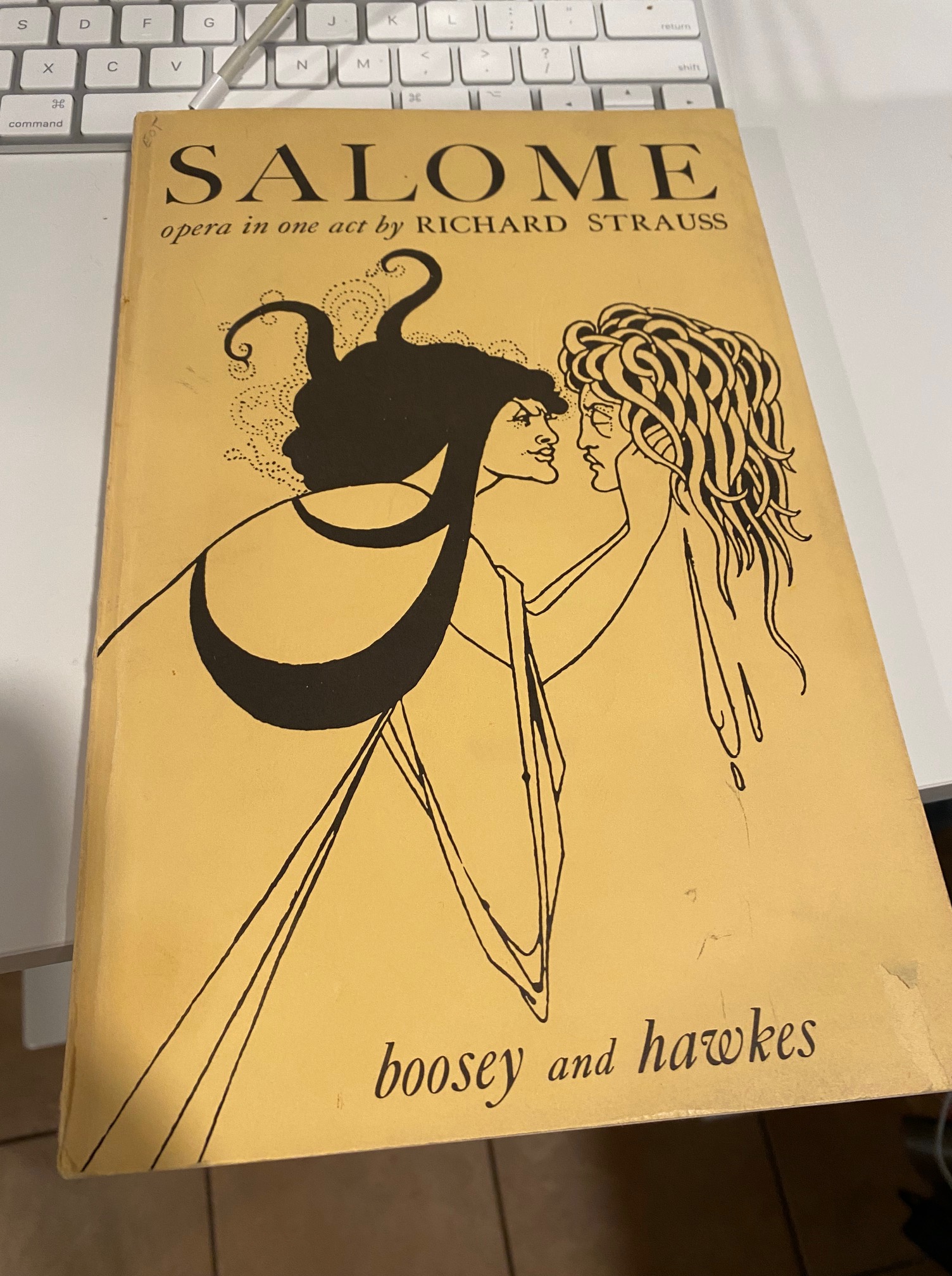
I don’t just collect CDs. Piano vocal opera scores are an amazing resource. I bought this beautiful score of Salome for $12 at a used book store. Yes I have a weakness for used books, particularly when they sell musical scores.
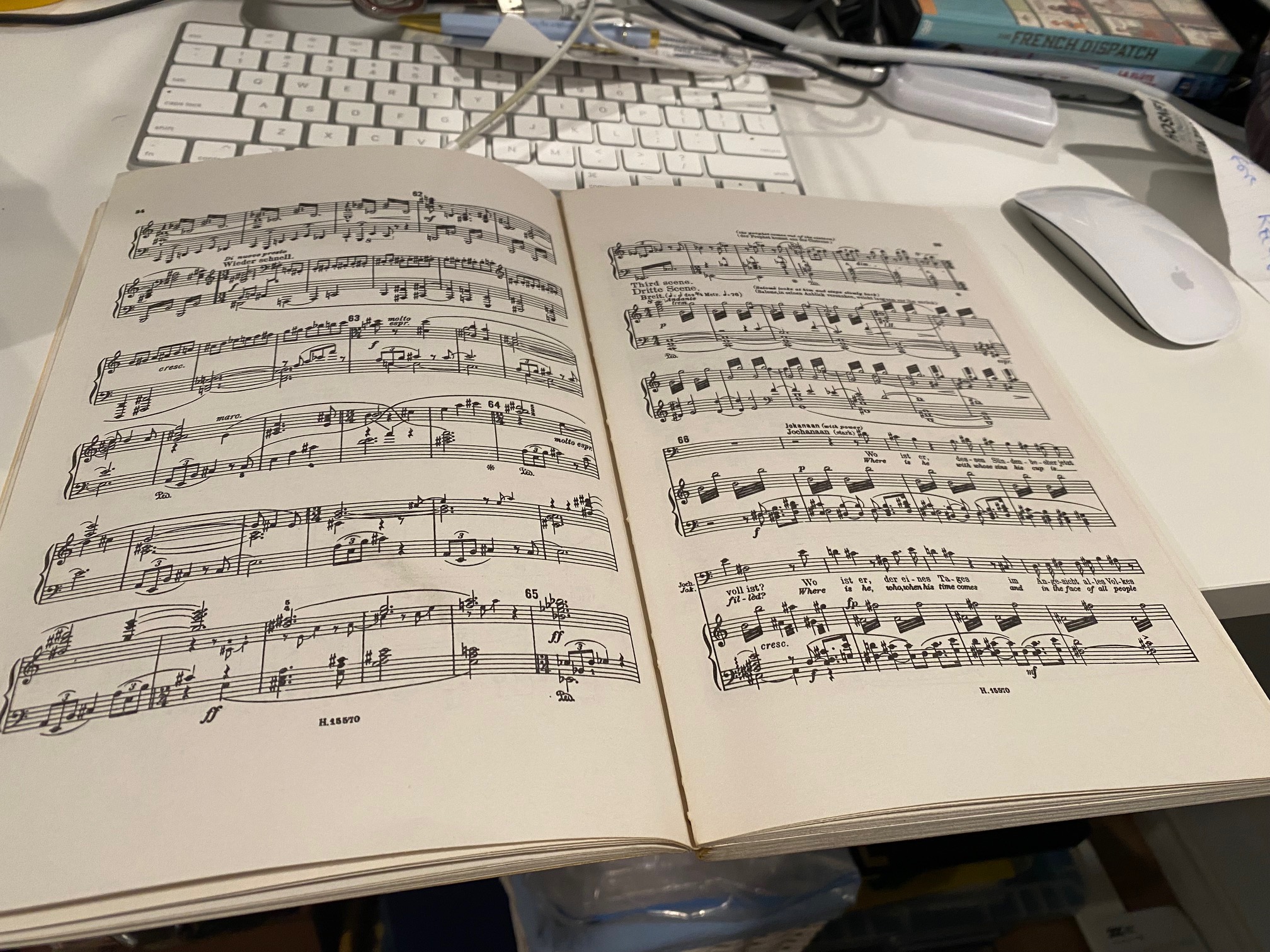
The sequence where Jochanaan emerges out of his captivity under the stage is intoxicating, music that is so much fun to play even if the piano is a pale imitation of the orchestra. It’s fun to imitate an orchestra at the piano, especially in the transitional passages or the Dance of Seven Veils when there’s no singing anyway, written in the overpowering tradition of Wagner.
Notice (if you look closely) where the score naturally falls open. Yes this is the sequence I mention above. On the previous page Narraboth commands the guards to bring Jochanaan up, Salome says “ah”, and the orchestra (or piano) takes over for a few pages. The next vocal line is Jochanaan singing “wo ist er” on the page at right.
When I went to graduate school I was living an even more divided life, sometimes studying in class, sometimes enacting practical theatre on stage, and meanwhile also holding down a full-time job.
In 1999 during my PhD I realized it was 50 years since Strauss had died. I don’t know if anyone anywhere commemorated this date, but I did, via a mid-day mosaic concert at Hart House Music Room. I had recently composed an operatic adaptation of Venus in Furs that was presented at the Drama Centre during their festival of original theatre in the spring of 1999. I called upon Counter-tenor Mathieu Marcil who had sung in the opera in May to reprise some of what he’d done in the autumn.
My own music was an afterthought in my own mind. The program I conceived was meant to bridge Strauss’s life, asking Mathieu to sing songs from Strauss’s childhood before the age of 12 in a counter-tenor voice to begin the concert, imagining a young boy’s voice such as the composer might have had at the time when he composed the songs. And the other end of the composer’s life was represented by me concluding the concert with the Four Last Songs. In between Mathieu and I sang from my opera and Mathieu sang the prayer from Akhnaten by Philip Glass.
There are layers to this act of self-indulgence, from the self-promotional aspect of any artist promoting their own music, plus the petulant desire to push back against strictures prohibiting certain sorts of performance, thinking of how the Four Last Songs are usually sung by a woman. For me it’s not a gender thing so much as a musical thing. In 2024 I no longer have the high B natural needed for the first song, and as I’m not singing much lately, it’s an academic question.
But please note, in my research into Debussy and the fin de siecle Wagnerians in Paris of that time it was very different from now, as no one had ever heard Wagner, and so a pianist might sit down and perform all the parts of an opera for a group of eager listeners. Before that period the piano was even more central to creative life, as for instance in the efforts of Franz Liszt earlier in the 19th century to popularize works that were otherwise unknown through the magic of transcription. Later 20th century virtuosi such as Rachmaninoff or Percy Grainger thrilled audiences with fanciful rewrites of music. You can still recognize the original.
The pendulum of taste seems to have swung to the other extreme, in an insistence on authenticity rather than imaginative paraphrasing. But it doesn’t have to stop us from enjoying some of the wonderment found in a piano reduction. Currently on the 75th anniversary –again thanks to the University of Toronto’s Music Library– I feel fortunate to have found piano transcriptions of some of the tone poems, bringing me full circle. While they don’t always work that well at the piano, and sometimes are very difficult to play, they still serve to stimulate the imagination, especially if we hear the orchestral version in our heads.
And they’re still a lot of fun.
 barczablog