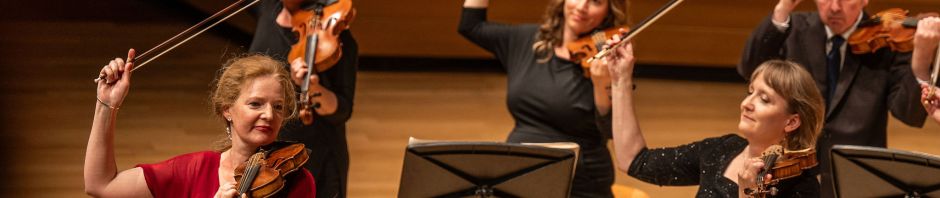
As I look at this stylish picture of Wolfgang Amadeus Mozart I wonder.
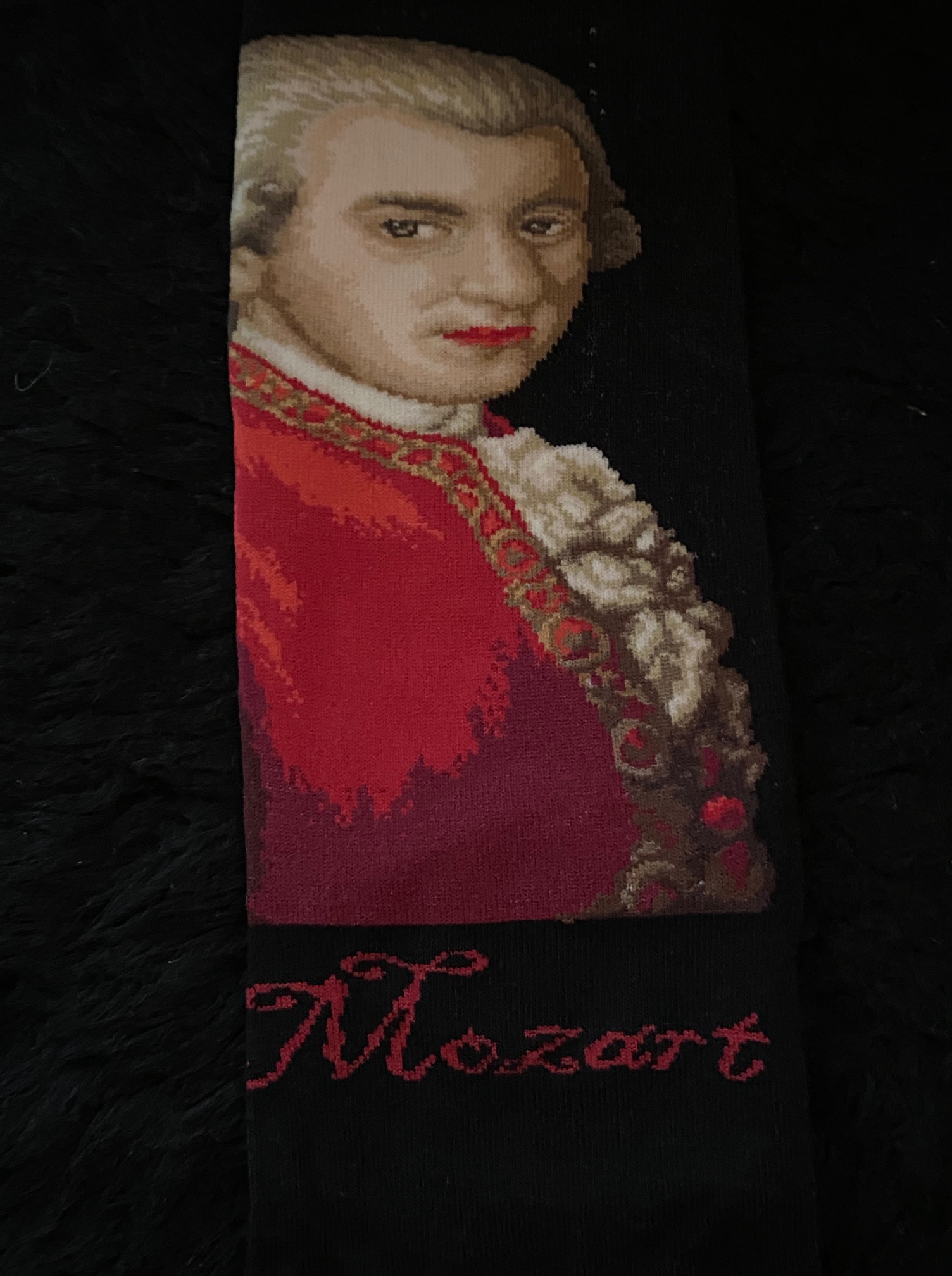
Through the decades I have been listening to his music there are a variety of approaches, sometimes so respectful as to put Mozart on an impossible pedestal. The historically informed performance movement has gradually changed the way we understand his music and how to play it. He is one of the most frequently played composers, tremendously popular: yet maybe misunderstood, in how he is played.
I say that after the breath-taking performances heard Friday night in an all-Mozart program from Tafelmusik Orchestra under the leadership of Rachel Podger at Koerner Hall to begin the season.

If you love Mozart please please find a way to go hear this concert. What I heard was so strong and confident as to be paradigm shifting. I’ve been listening to Mozart’s C major Symphony (known as the “Jupiter”) and the violin concerti all my life. Last night’s was astonishingly different. It felt brand new, refreshingly direct, simple. Please note Tafelmusik have inspired such feelings in me before. Their Mozart, Haydn or their Beethoven contrast with the usual ways we heard well-known pieces, given that their historically informed performance style meant going faster, without the same sorts of vibrato, and with the delightfully rich timbres of original instruments.
Yet this was a quantum leap, more impressive than ever before.
For starters there’s the benefit we enjoy of the usual Tafelmusik thorough scholarship, playing in a historically informed style, and the sweet-sounding winds and the deeper throb of the strings that an orchestra employing original instruments offers. and they usually play pieces in a far quicker tempo than we heard in the generations before. I recall a time when Mozart was played with a big orchestral sound, much slower. The meaning of the discourse changes in much the same way the delivery of lines is altered by someone doing the William Shatner approach (sorry Captain Kirk…).
Do you say “to be or not to be, that is the question”? or do you ham it up, to squeeze meaning through pauses, saying “to be….. or…. not to be… that…. is the question”. In the quest for more meaning the listener is no longer pondering meaning because it’s ponderous. Weighed down by its own quest for ultimate heaviosity, when we treat something with too much respect.
Similarly, the opening to the first movement of the Jupiter Symphony. You don’t have to know the piece for me to explain (as I aim to be inclusive).
The first phrase is a series of notes on the beat, with a quick flourish of notes sliding up to that note, with an answering softer phrase from a different complement of instruments.
Earlier generations of conductor (whom we admired of course) would conduct the piece to give you every note played (C, g-a-b-C, g-a-b-C) as though it were important to be played as part of the meaning. Last night I think I saw and heard what Mozart really wanted, as Podger and Tafelmusik gave us something more like C – C – C, the notes in between so light & quick as to resemble ornamentation rather than a meaningful utterance. That older generation of interpretation resembled the William Shatner delivery, giving the notes emphasis that wasn’t likely given back in the 18th century, but rather to be thrown away.
I feel certain that Mozart never meant us to really notice these notes, because of what follows. The soft phrase that answers when done this way takes us almost into the realm of call and response. No Mozart wasn’t writing blues, but suddenly there’s a playful conversational element that’s missing when we think of this as (perhaps while genuflecting to the great Mozart) the Jupiter symphony. The name wasn’t from the composer of course but added years later. If we lose the pompous fear and instead acquire a modicum of playfulness? that’s likely closer to the right spirit.
And Tafelmusik were playing together with Rachel Podger violinist, herself making eye contact around the ensemble as though (to quote Paul, the friendly gentleman seated beside me) Tafelmusik were a chamber ensemble not a big band requiring a conductor with a baton. That’s especially exciting when we come to the last movement, an extraordinary display of musicianship accomplished by players listening to one another.
There is a rhetorical elegance to what we were hearing and yes, seeing. I must compliment Rachel and Tafelmusik for their dramaturgy. It may be that in fact the ensuing tutti, when everyone comes in forte, was a moment later than it might have been from a modern orchestra with conductor, slaves to the metre and the baton. But this felt like genuine dialogue, discourse of the highest sort. We saw the orchestra speaking and answering. To speak of call and response is perhaps a modern idea, but there are many places where Mozart has sections going back and forth, as though in conversation. The third movement is especially dramatic that way, a drama that’s clearer when instead of a conductor enforcing an interpretation, we actually have Mozart speak to us, through the back and forth of sections who listen and respond to one another with the fluidity of a string quartet.
I feel that Rachel Podger gets Mozart, understanding his music as no one I’ve ever encountered. Her leadership of Tafelmusik is truly inspiring.
And it doesn’t hurt that we were in Koerner Hall, where the sound is particularly transparent.
Rachel plays the phrases, her body language a tiny bit larger than necessary because her head and arm and shoulder movements serve to indicate where the downbeat is, where the others should also place their downbeat. I saw eye contact across the stage between players.
I also saw some amazing smiles and expressions from Rachel, and it’s a mutual thing. When the players in the orchestra are smiling in every section you know something good is happening.
She was sometimes looking out at us, particularly during the violin concerto.
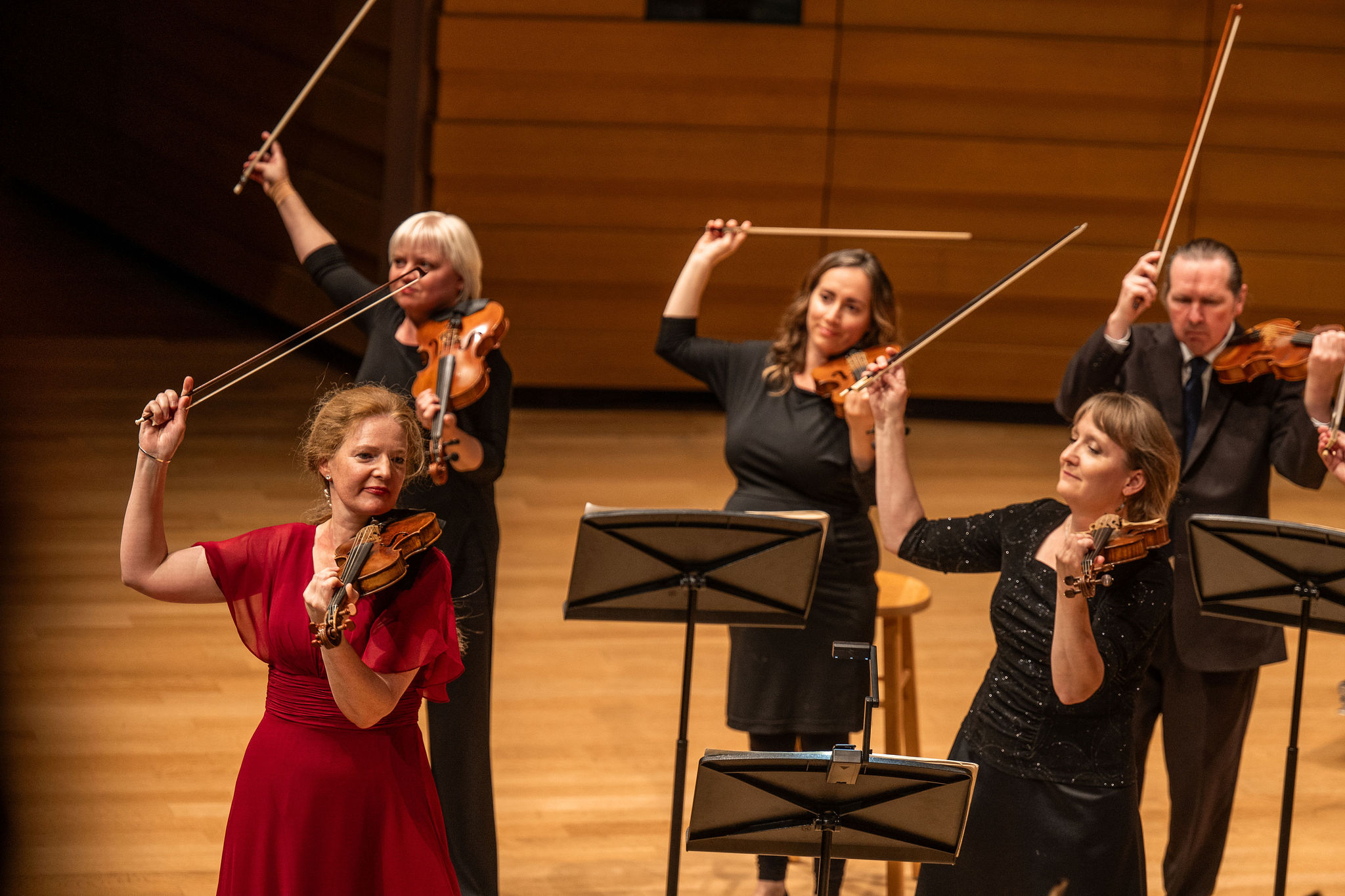
Rachel seemed to be playing with us at times, teasing us, testing us. Audience members on all sides were giggling with me, as I wasn’t the only one to observe something that felt like a kind of gamesmanship, pushing the rules of the concerto procedure to its limit. We see that there’s a moment when the soloist has the option to pause or continue. She looks out at us with a whimsical expression as if to say “what do you think audience? will I continue? what will I do?” And of course she went on, pushing the pause to its limit without in any way broaching the rules of period performance. I think at that moment a few hundred people were in love, the violin a subtle instrument of witty comedy. We were reminded that a virtuoso such as Mozart (who played his own concerti) had all sorts of freedom to elaborate or pause especially during cadenzas.
I’ve previously made a mental division, associating the Toronto Symphony with newness and modernity while aligning Tafelmusik with the baroque, early music and their older period instruments. While that’s more or less true, yet we heard something edgy and new in Koerner Hall tonight, as though an old portrait had been cleaned and we saw it as though for the first time.
Rachel and Tafelmusik seem to have a special chemistry. Rachel said in an earlier interview that she’s “always been struck by the spirit of Tafelmusik, the lovely sense of collaboration”. That is what we saw and heard. And I look forward to hearing Rachel Podger’s ongoing contribution to Tafelmusik in the concerts to come.
But first “Mozart Jupiter” as the concert is titled is repeated this weekend, September 29 and 30 at Koerner Hall. See and hear it if you can.
 barczablog
I’ve always enjoyed Tafelmusik. I first heard them doing Messiah, and also felt I was hearing it for the first time. Sadly, I’ll miss this one, but look forward to others down the road
I wish they would record the pieces on this program. It’s remarkable.