Today I saw the closing performance of the Canadian Opera Company’s new production of Gounod’s Faust, in a week when it seemed everyone was selling their soul to the devil even without the manifest falsehoods of politicians at election time.
We interrupt this blog to speak for a minute about reviews and reviewers, as I recall being told that some people said negative things about the COC Nabucco, the fall show that I prefer to their Faust. I can’t comment on what they think they are doing, but let me repeat what I have said before including my statement of principles under the heading “steal this thought”. I abide by the Hippocratic oath (and no i don’t mean I’m a hypocrite even if that sounds apt for a critic), which says “above all do no harm.” A critic is a dramaturg, helping in the digestion of the work but we shouldn’t cause indigestion. Our purpose is to be helpful or we serve no purpose other than self-promotion.
So I want to unpack a bit more about the Faust production now that the run is over, now when arguably i won’t do any harm by being a bit more direct in my commentary. My usual approach is to omit mention of someone i dislike or euphemize, speak in positives rather than tear down a performer: because when all is said and done they are putting themselves out there and I want to be supportive.
I was at the final Faust performance, when Ariane Cossette sang her single performance as Marguérite. I was there not because I was really interested in reviewing her but simply because I’m a COC subscriber. I was privileged to get complementary tickets early in the run for the purpose of reviewing, and happy to see the show a second time as I did earlier with Nabucco.
It was a substantially different show this time. I reported that the music was superb last time, but that I felt no real chemistry between the two leads, “the principals seemingly lacking a connection with one another.” I wanted to attribute this to the intellectual ambitions of the production, but after a second look it’s much simpler, watching Ariane at work. Please note, what I’m reporting is from the second row where I sit for my subscription, able to see the singers up close.
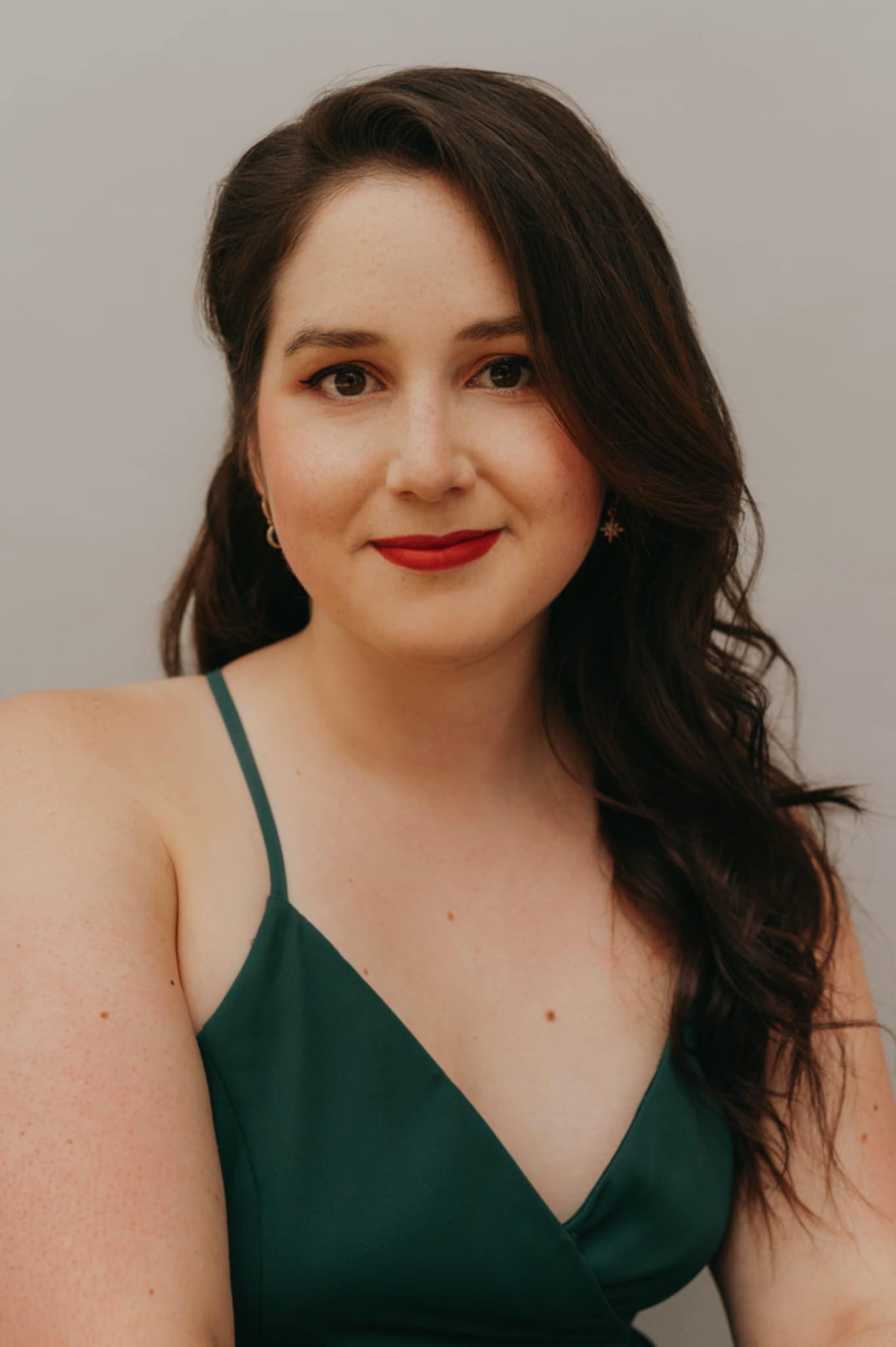
Faust earlier in the run? Great singing, principals distant. Saturday November 2nd? Suddenly I’m watching Ariane staring at Faust even while singing. Long Long her Faust only looked at her when he wasn’t singing. Otherwise he was watching the conductor. Now of course who can blame him, the role is difficult. But pardon me while he has a superb ringing voice, tremendous high notes, and wonderful phrasing: he seemed very self-absorbed. When you’re singing love music and only look at your girlfriend when you’re not singing, sorry that’s problematic to me. It’s almost as though we could see he’s gonna dump her because he’s a narcissist who cares for his high C more than his sweetie (and maybe our earlier Marguerite had a similar focus on the conductor rather than her lover). Ariane boldly looked at her Faust even while singing. Maybe Conductor Johannes Debus was being extra careful with her? Maybe she had lots of help preparing her for her single performance, her one chance to perform the part. But it worked.
The arias were great too. The roi de Thulé tune was lovely. The jewel aria especially idiomatic, dare I say it: sparkling. Ariane brought something extra to the scene where her brother curses her. The moment after he dies when she reaches meekly for him I lost it, I started to cry. Perhaps the scene is one with huge resonance for me as my brother sang the role of Valentine 50 years ago with the COC at O’Keefe Centre (as it was then known), and this music is deep in my bones, something I know through and through. I did not expect to suddenly be moved to tears, and was especially surprised to be moved not by the plight of Valentin but by poor Marguérite. Maybe that argues for the cuts the director made? But I think at the very least it’s the excellence of a singer making her one performance count.
So I’m thinking a lot about adaptations and interpretations, partly because there are so many other Fausts lately (in my review I mentioned Art of Time doing Stravinsky’s Soldier’s Tale and De Palma’s Phantom of the Paradise with a score by Paul Williams). And even Gounod’s Faust exists in many versions. I was lucky to see the Met’s Faust in 1972 when they included the Walpurgisnacht ballet, adding an extra 30-40 minutes to the last act, not included this time of course.
And the COC production chose to omit something that I find a bit perplexing. Franz Schubert gave us Gretchen am Spinnrade, a profound song that captures the disquiet of the woman who is waiting for Faust to come back. Gounod’s spinning song is nowhere near as deep, but still is a wonderful bit of story-telling. It isn’t a difficult virtuoso piece but a moody picture of a young woman on the edge of despair, and important in her character arc, getting us to the church scene where we see Méphistophélès pushing Marguérite to the brink of madness. Otherwise the opening after the intermission (Marguérite in the church holding the baby) is a huge leap ahead in the story, perhaps a bit cinematic the way it leaves it up to us to make the connections. But hey if we’re going to work that way why bother with opera at all? I think we need to see this transition. I think it gives Marguérite dignity if we see her full story. I suppose I sound a bit grouchy, frustrated by all the cuts & changes. Oh well.
One last thing about Ariane, is the trio at the end of the opera. When I notice who holds my attention I want to report that because I think it’s important. I found that I couldn’t take my eyes off of her in the last scene, as she sang with Faust & Méphistophélès. Yes they all sounded good. But I’m thinking of the dramatic element, the conviction. I find that Gounod’s best moment is not at the end, but earlier. Berlioz’s ending makes my knees weak, I love it so much. For me the ending of Gounod’s Faust is pompous and not persuasive, speaking as a regular churchgoer.
Oh wait there IS one other thing to say, and those of you who know me may be able to predict what I’m going to say. No I didn’t go on and on about Ariane’s performance just because she’s Canadian. But excuse me, why only one performance? Or so I wondered. The COC are sometimes loyal to the “C” in their name, as they were a few days ago with their Ensemble Studio’s Centre Stage event. Ariane is a superb artist whose acting made the opera work far better for me than the imported stars I saw earlier in the run, each self-absorbed in their efforts to follow the conductor. In truth I recall hearing that in fact Ariane was to be the cover (the usher called her the “understudy”), and they offered her this show as a bonus, to see if she could rise to the occasion. And she did. From where I sat she deserves to be heard, and I hope to hear her again sometime.
Okay I will get off my hobby horse.
I want to again remark about the performance of Kyle Ketelsen our Méphistophélès (and no i’m not selling my soul or in the pay of KK), his voice at that superb level of intonation that is absolutely always on the right note regardless of how high or low (and he does go quite high). That he came through so clearly where I was sitting — with the orchestra practically in my face– is to his credit. Higher voices are easier to hear. A bass? that’s a tougher assignment. Kyle was very musical, very adept at the drama. I feel the show was built in such a way that they hand it to him on a silver platter. But he takes the stage, grabs every moment. My previous times seeing a Mephisto were the towering presence of Jerome Hines with the COC and Cesare Siepi at the Met back in the 1970s. Kyle’s performance is every bit as charismatic, stunning musically, a worthy peer of those brilliant singers.
Also I must comment on the chorus. I love the COC chorus, enjoying their work. One reason I was far happier with Nabucco was because I felt the chorus were given the chance to shine in a production that didn’t fight with the work. Nabucco is early Verdi, a piece we might call flawed or at least the first giant step of a composer bound for greatness: but still not yet as great as he would become. Faust is a grand opera that offers its soloists moments to shine but also is filled with magic, spectacle, moments to take your breath away: if that director will allow that. I had high hopes.
In Faust the first time we see a chorus I thought I was watching a director who didn’t know how to direct a chorus. In view of my desire to do no harm, I didn’t say that first time out, trying to see what was being done and seeking to figure it out. I wanted to give it a chance in case I was being too harsh. But seeing it a second time? it’s a mess. Sorry, soldiers, men & women. Perhaps the set design constricts the space? I don’t know. But I didn’t think we were looking at something coherent. Yes the Kermesse (fair) is supposed to be a scene of movement and energy: but it seemed abstract energy without any sense of logic or drama. Great to listen to, I didn’t know where to look.
The soldiers chorus had boisterous energy, but disrupted by the deconstructive edge of the director. Yes it was great to see the glamorous kick-line dancing resembling a pair of Rockettes, in the entourage of Méphistophélès, who we can call Lucie (Sierra Richardson) and Bubbs (Tina Desroches), as I mentioned a couple of weeks ago in the review. I think the tempters, the demonic figures, all tend to bemuse directors, perhaps a sign that the director finds piety boring..? Similar mistakes were made by those who mistook Satan as the “hero” of Paradise Lost. The bad guys are always glamorous.
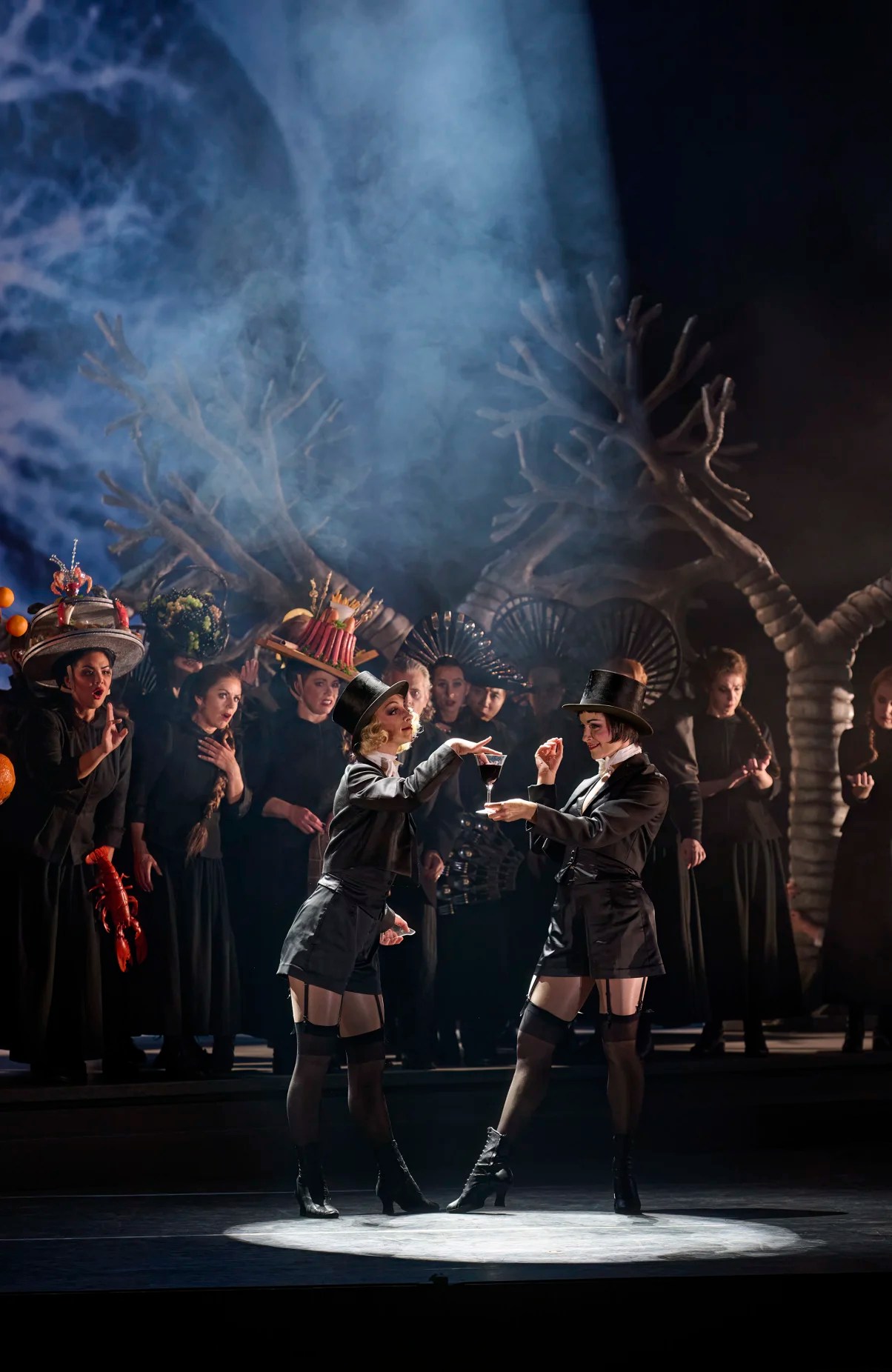
And once again I was in awe of the musicianship of Johannes Debus leading the COC Orchestra. The stirring passages created the excitement we want & need, drama underscored by powerful climaxes erupting from the orchestra pit. I love sitting close where the effects are extra powerful. The trio where Valentin ( Szymon Mechlinski, holding nothing back in the closing performance!), challenges Faust with the help of Méphistophélès might be the most macho piece of music in all of opera. I find myself pulled in two directions, the adolescent in me admiring the testosterone while the adult in me cringing at the same time. Proud Valentin self-destructs, while the orchestra pumps out powerful music leading up to his death.
So yes, I’ve been feasting on Fausts. There’s the silent film from FW Murnau (1926). The whole film is available on YouTube.
I watched Phantom of the Paradise. It’s more of a satire of the music business than a serious treatment of the Faust story but Paul Williams’ score is worth a look / listen. And if you only know Jessica Harper from My Favorite Year or Love & Death, you might be surprised by her. That is really her singing.
And yes I’ve been playing Gounod’s Walpurgisnacht ballet music that’s in my piano vocal score. Sadly that’s never included in performances anymore. Too bad, it’s awesome music. This is just a sample.
Maybe COC, when you revive this production you could include the ballet next time? Please consider it. While the piece is made longer you’d have something extra to sell. But I know, it’s unlikely.
And in fact the adaptation of Faust that I dream of for the COC and Johannes Debus is Berlioz’s Damnation de Faust. It would again allow the company to exploit their strong chorus and orchestra. But I’m not holding my breath on that one either. Here’s a tiny glimpse of the Met production directed & designed by Robert Lepage.
 barczablog