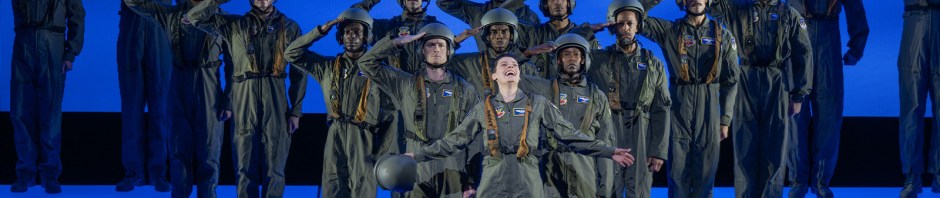
I was disappointed to miss the live High Definition broadcast of Grounded October 19th, seeing the Canadian Opera Company Nabucco. I thought that the main reason I wanted to attend was to see brilliant mezzo-soprano Emily D’Angelo in the lead role.
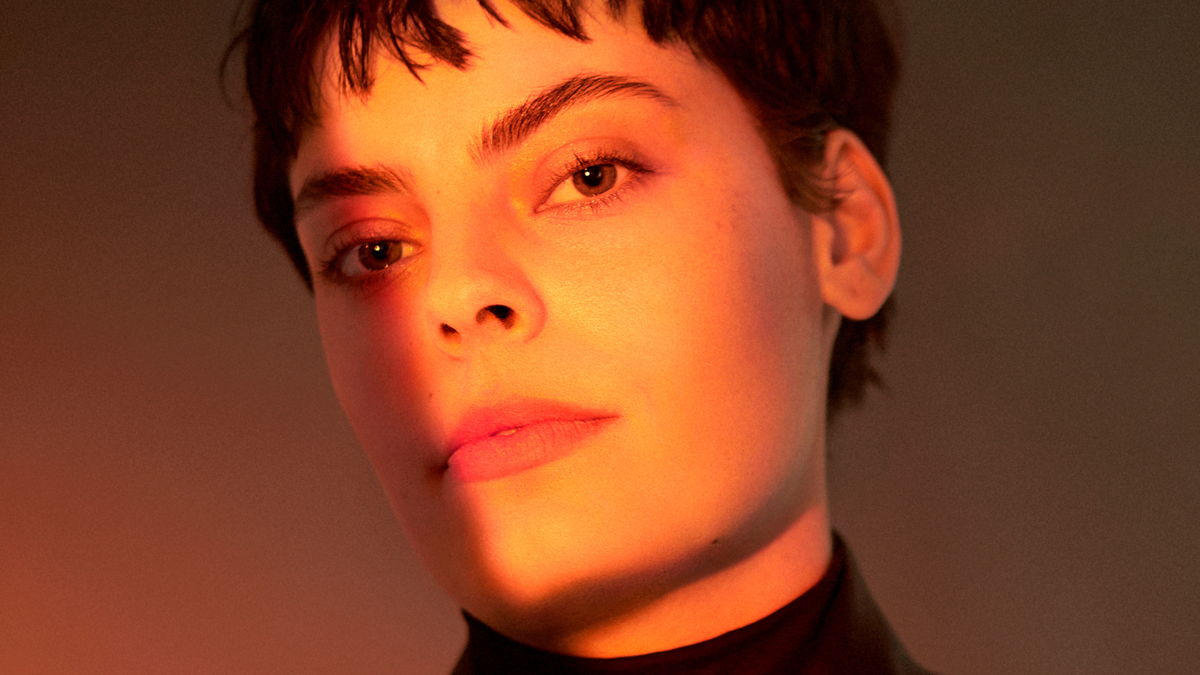
Little did I realize that seeing the encore today on November 9th would be even better, when the American election is still fresh in our minds and Remembrance Day is the day after tomorrow.
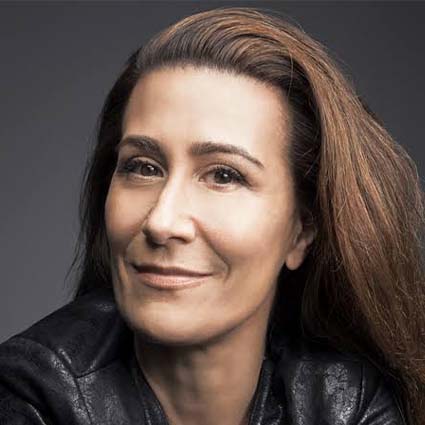
Grounded premiered with Washington Opera in 2023, opened the current season at the Metropolitan Opera last September 23, with music composed by Jeanine Tesori and a libretto by George Brant, based on his 2013 one-woman play: the opera expanding the scope of the play considerably.
When I see a new work I try to acknowledge both the text and its interpreters. And yet before I even get to any of that I have to again take a deep breath while noticing how this piece makes me feel at this time in history. A couple of days ago I saw John Adams conducting music with great resonance to current events, so I was already primed for this.
Brant and Tesori hold up a mirror to Americans who watch a story of a woman pilot who gets pregnant, becomes a drone pilot, and then is grounded when she disobeys orders, refusing to kill someone & crashing her expensive weapon. For much of the opera we’re watching humans who seem to be marching in lock-step as though they were all programmed to obey orders, lacking empathy for their enemies. But the pilot Jess (Emily D’Angelo) is changed, seemingly torn in two by on the one hand getting pregnant after a one-night encounter with Eric(Ben Bliss) and becoming mother to Sam (Lucy LoBue), while continuing to fight as a drone pilot, working the controls in Nevada. We watch Jess become progressively more conflicted by her life as a mother and warrior as she is sensitized to the devastation of what she causes on the ground with her attacks.
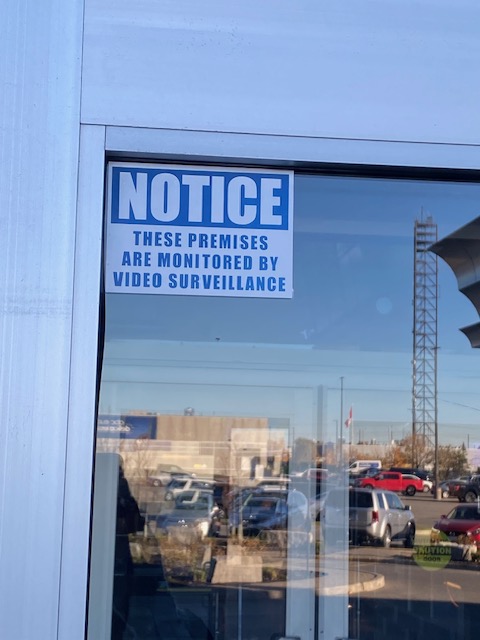
She notices the surveillance even in her own home town when she goes shopping. Coming into the theatre I couldn’t help noticing this sign.
At one point she remarks that in the Odyssey the hero didn’t come home from the war every night. You want to talk about work-life balance?

I have not read any criticism about the opera, have no idea about its reception. But it strikes me today that Brant is telling an important story that likely will be seen differently since the election. I’m going to say something that American friends may find upsetting, but I speak while recalling my pride in Jean Chretien’s rejection of the invitation to join the coalition that fought in Iraq. There were no WMD (and if you don’t know what that stands for good for you, that you’re not tormented by such factoids). The Gulf War under Bush the 1st, and the Iraq War, under the management of Dick Cheney were both cathartic exercises of American manhood, restoring confidence after the debacle of Vietnam. The first act of this opera shows a lethal war machine with no empathy for anyone on the ground under their bombs, but then again I suppose all armies are like that. The magic of this opera is watching the birth of empathy in Jess, as she is changed by motherhood and by seeing the bodies on the ground blown up by her drone. While this might not strike anyone as realistic, that’s beside the point. Jess is a stand-in for the American psyche even if her attitude may be a rare kind of dissent especially in the days to come. The opera is a mirror, an opportunity for reflection. It’s brilliant even if we may not like what we see when we peer into that mirror. After November 5th it seems especially precious, a reminder of who America can be even if that may be more and more elusive in practice.
My original objective –to watch Emily’s performance– was still worth the drive to the Cineplex. I lost count of how many times I cried, although it’s more than 3 different places in the opera. Torontonians know Emily and her remarkable range. Normally we use that word to speak of a voice, but I meant as a singing-actor. We’ve seen her sing serious and comic roles. We know Emily is talented, bound for great things. I see she’s just had her 30th birthday.
I am not surprised to read that the work was developed as a vehicle for her unique abilities.
Even so I believe the work might be better were it presented on a smaller scale especially after watching the Debussy/Adams Livre de Baudelaire, a work that hit me as a bit of a travesty of the original Debussy songs when done in the cavernous space of Roy Thomson Hall. Similarly I wish someone would present the original one-woman play by Brant, without the extras added by Tesori for the opera. I suspect that if the opera were staged in a smaller venue with fewer bells and whistles, without so many visuals, and instead making more demands on our imaginations, it would actually be stronger and more compelling.
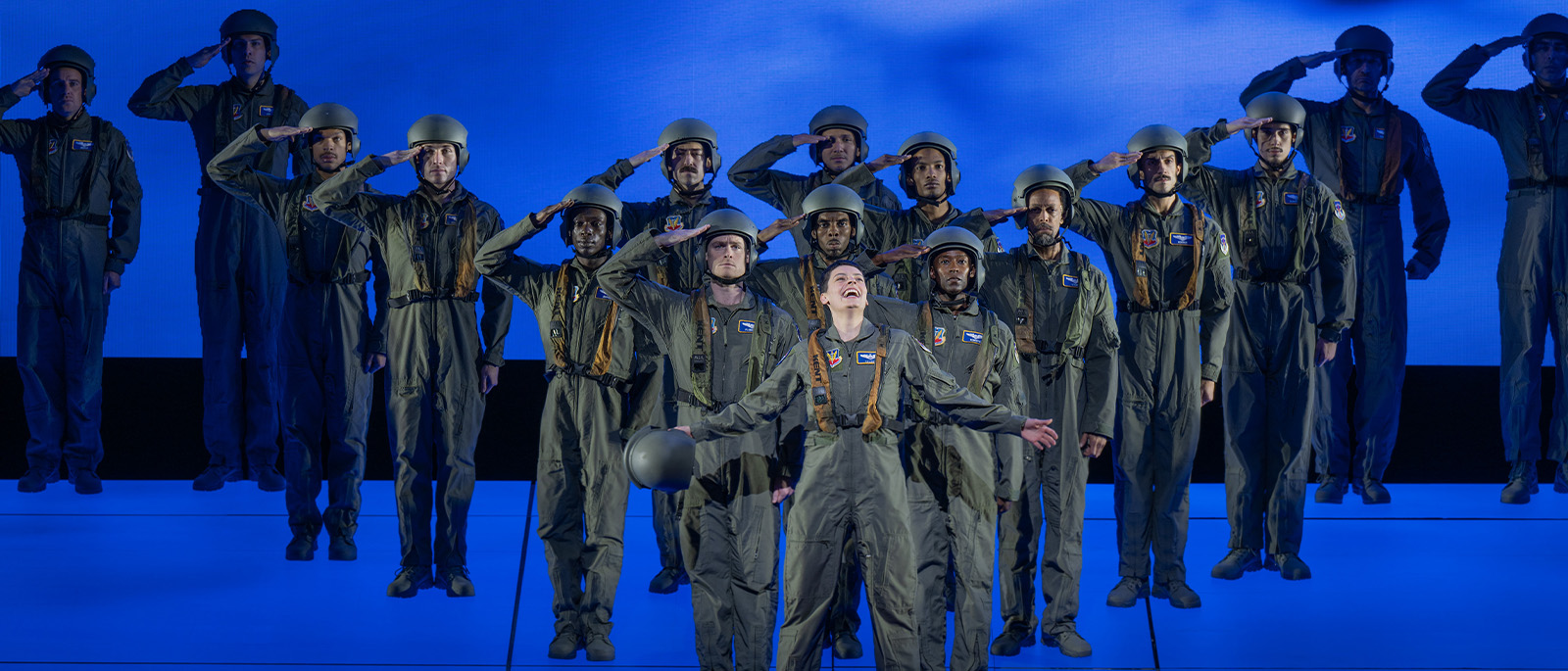
We watch Jess sitting beside Sensor (Kyle Miller), supposedly in a tight space yet there was nothing in the set to give us the claustrophobia mentioned in the text. Sensor is an enjoyable personage whose body language and vocabulary take us into an entirely new realm from the militaristic one where we started. Maybe I’m the only one dissatisfied looking at a set that seems to embrace the ethos of futurism and its fetish for weapons of war. Or maybe I’m hypersensitive since November 5th, triggered by visual cues that seem to celebrate a fascist ethos. But of course that sets up the ending so maybe I should give credit where credit is due, triggered because the set design by Mimi Lien plays into that energy of the text, leading us to a real catharsis.
Yes the score would need to be revised for a smaller ensemble than the large orchestra (ably led by Yannick Nezet-Seguin) if we were to contemplate an intimate staging: but I believe it would be worthwhile. There is a kind of absurdity to begin with, in singing about being a pilot, that I’d place alongside other operatic absurdities such as a woman who’s coughing while dying of tuberculosis: and singing about it. Opera is at its best when taking us beyond words to what can only be expressed musically & vocally. We get that in the last half hour as we watch Jess tormented by the contradictions in her head, and realistic fighter-jets or sky-scapes are not needed to make them compelling. This opera flies on the wings of song and the believable sentiments in the excellent portrayals.
As Eric, the man whose one-night encounter with Jess leads to the pregnancy, Ben Bliss was a good match for Emily’s Jess even if he was the quiet reference point against which we could contrast Jess’s growing disquiet and cognitive dissonance.
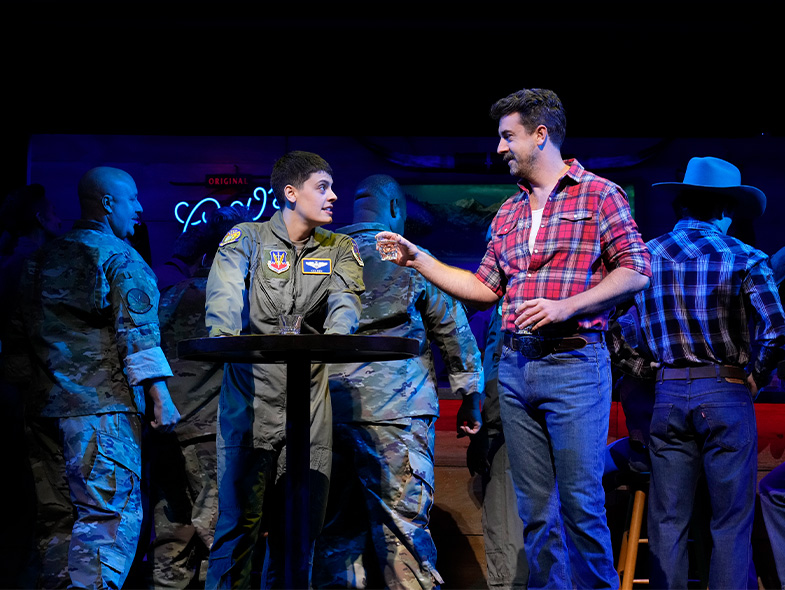
I’ve watched quite a few High Def performances, loving the close-up camera work even if it sometimes strips away authenticity: but this was different. I was as swallowed up in the story as if I were watching a romantic comedy, loving the characters and their struggles. Ben’s voice is usually a gentle lyric sound, perhaps reflecting their respective marital roles. In many ways there’s a bit of a role reversal, given that Jess is a lethal killer via her weapons of war, while Eric is the stable voice of home and family, and mostly the gentler singing voice when they sing together. Ben was believable, while Emily was astonishing in this difficult portrayal.
While I’m not saying Tesori’s score is brilliant, it does the job as well as any film-score, fulfilling the usual prerequisite that you not get in the way or call too much attention to yourself. I might feel different were I to see/hear the opera again but I’m persuaded by the performances, especially the leads. In addition to Emily Jess splits into another personage, Also Jess, played by Ellie Dehn, to help us delve much deeper into the character, especially as she starts to have deeper psychological problems. The effect is stunning.
I need to see this opera produced again. It would even be worth seeing in a smaller venue, or even in concert with a piano if the rights weren’t prohibitively expensive and there were singers who could handle the parts.
 barczablog