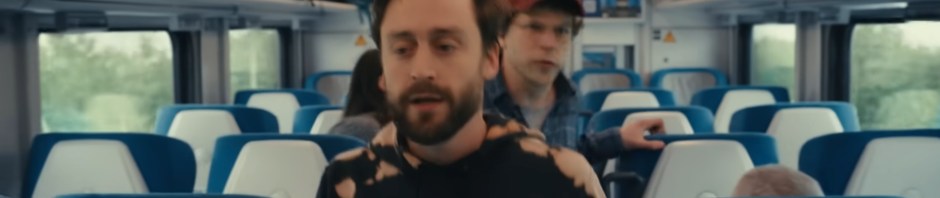
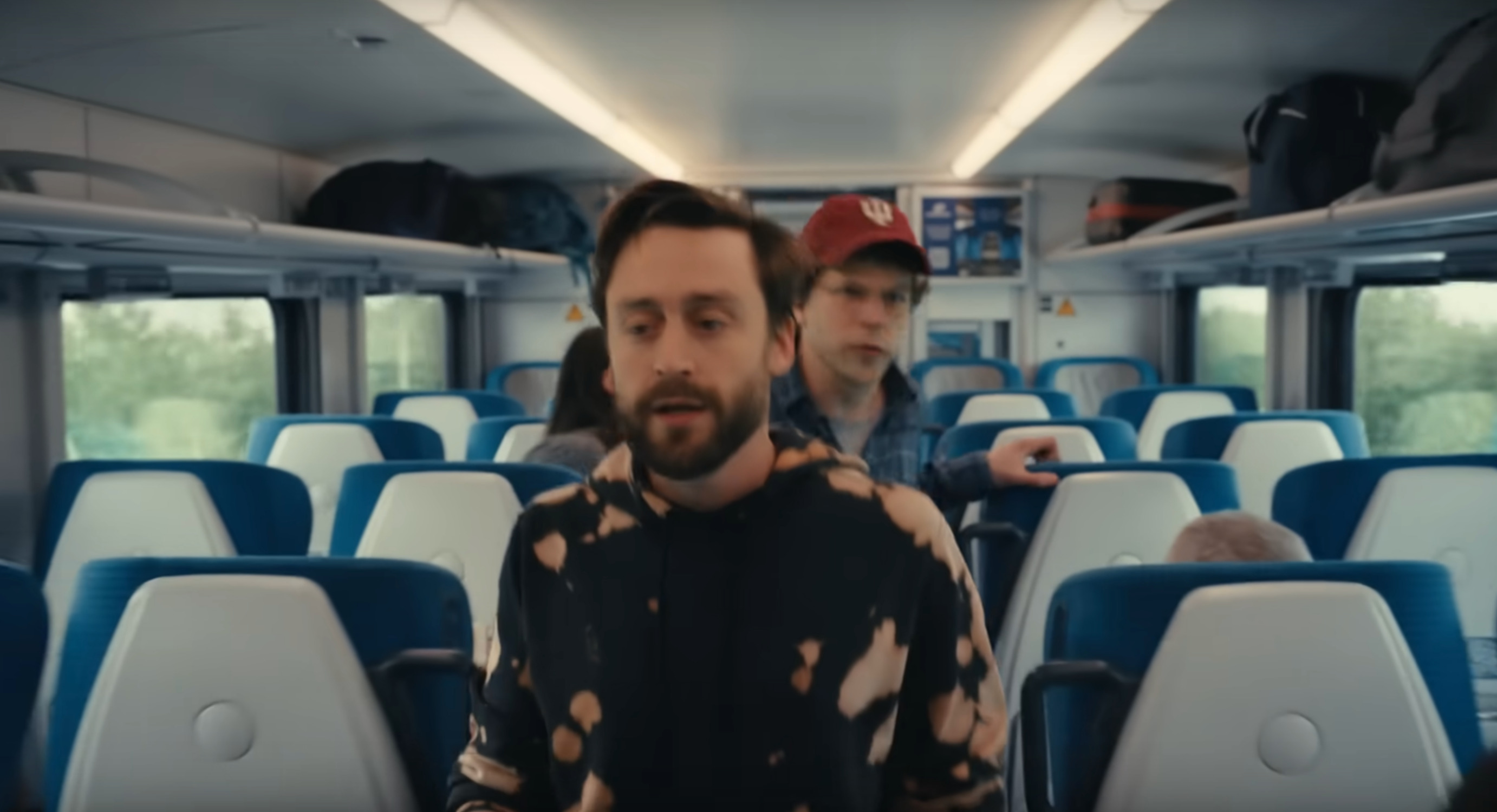
I have just seen Jesse Eisenberg’s film A Real Pain (2024). I call it his, in the sense that Eisenberg wrote & directed and also stars as David opposite Kieran Culkin who is David’s cousin Benji. They are on a modern-day trip to Poland exploring their family background, especially their grandmother who survived the camps & the war, and who just passed away in the past year.
While I’ve heard lots about Culkin, who won the Oscar in the “supporting actor” category, I have heard next to nothing about the soundtrack for the film. Erick Eiser has the Music Supervisor credit for the film. For most of the film we are listening to solo piano pieces by Frederic Chopin coming from the soundtrack, as we watch the travels of David & Benji. I’m trying to understand whether that means anything more than just pretty background music for a film that flits back and forth between glib joy and concealed pain bursting forth into the open. Maybe it’s a Holocaust film, maybe it’s a road movie, maybe it’s absurd to think it fits into any recognizable genre.
A Real Pain is very different from the last movie I saw that combined a story about Poland with Chopin’s music, namely The Pianist (2002), Adrien Brody’s portrayal of Wladyslaw Szpilman.
While the Pianist takes place in the wartime period, showing us more brutality & cruel violence than any film I can recall, don’t let the title of A Real Pain fool you, as this film is precisely the opposite of the Pianist, with pain as a remote topic for discussion and reflection. We hear of a famous slap from years ago, when Benji was struck by the grandmother who has deceased and is remembered fondly for this moment of direct commentary on her grandson. David will also strike Benji (it’s in the trailer so I hope I can be forgiven for this tiny spoiler), one of the few moments when there is pain in this film: and Benji laughs it off. The title is provocative in positioning pain in the foreground of a film where we are mostly remote from the Holocaust horror being remembered by the members of the tour-group.
It’s not just my obsession with film music that makes me want to locate the difference between the two movies in the way they use piano music.
For me the most magical moment in The Pianist comes when Szpilman comes upon a piano and begins to play, silently.
I wasn’t kidding when I said The Pianist seems to be the opposite to A Real Pain, a film featuring the gentle tinkling of Chopin coming from the soundtrack for almost its entirety. For this scene of The Pianist suddenly we’re getting something like that as Adrien Brody as Szpilman mimes playing without touching the keys, while we hear the music as though in his head. Near the end of the film balance is restored as Szpilman gets to play again on Polish Radio, rather than being forced to deny himself. When we see that the pianist actually plays the instrument (or at least simulates it in a film) we are reconciled to reality, not forced to hide anymore.
Let’s compare that to a powerful moment in A Real Pain, that I would consider the heart of the film. Almost exactly halfway through the film, we hear and see diegetic piano music: meaning that we actually see the hands of the player and hear their music, the first time in the film that we don’t just get the remote sounds of the soundtrack. It’s not Chopin by the way, but the song Hava Nagila from a piano in a restaurant, in the scene after the trip to an ancient grave-yard. While I don’t want to disparage Chopin let’s be clear that his piano music is art music, quite different from a folk song that people might dance to, that is strongly associated with a race & their culture.
There is an awkward moment, when David tells a story quoting the words of his grandmother.
David: “First generation immigrants work some menial job, like they drive cabs, they deliver food,…
Second generation they go to good schools, like they become a doctor or lawyer or whatever…
Third generation lives in their mother’s basement and smokes pot all day.”
There’s laughter around the table, but Benji looks intently at David and asks “she said that?”
David looks a bit abashed realizing what he’s implied. “I think she was just speaking generally about the immigrant experience.”
Benji is already interrupting before he finishes, saying “I lived in my mom’s basement.” And we know he smokes pot and has arranged to get marijuana to Poland. We will see Benji and David smoke joints a couple of times in the film.
David nods, now a bit less reticent, saying “she was just talking about immigrants, that’s all.”
But Benji is visibly upset, finishes his beer, slams his empty beer glass down, burps hugely, propels his fork across the room and abruptly leaves the table, trying to play it cool, while clearly everyone around the table is disturbed by the exchange. David apologizes, not for the first time in the film that he’s apologizing for Benji or for himself.
For the next three and a half minutes we hear David talk about pain, including Benji’s failed suicide attempt, apologizing again for what he calls “over-sharing”, while the others in the group comment.
And then we hear piano playing of a different sort, “Tea for Two” coming from the piano. It’s an American popular tune that’s a century old and accident or not, is a song lyric composed by Irving Caesar: meaning it’s again Jewish music but with a familiar American sound.
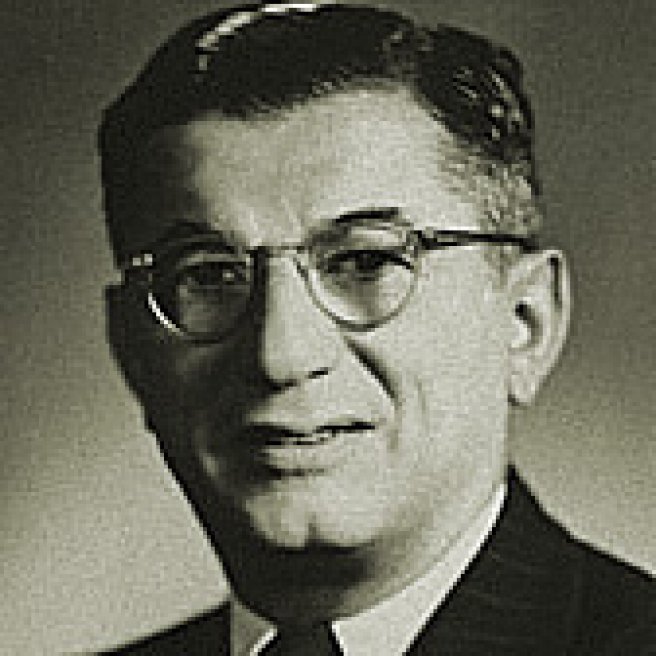
I was pretty sure it would be Jewish recalling Making Americans, a beautiful 2004 book from U of T professor Andrea Most exploring the ways Broadway musicals shaped Jewish identity in America.
And we discover that now it’s Benji who is playing as we see his back, while he plays the piano. Not for the first time, we see Benji bounce back and forth between emotional extremes, where his strategy for balance takes us by surprise, even as it seems to bother and even infuriate David. David explains that both he and Benji took lessons as children, and then it’s his turn to leave. As he goes out of the restaurant we hear the piano music in our heads long after it should be audible, right up to the moment David closes the door en route to bed.
The pain of the title is not just Benji’s or David’s.
I want to call attention to something that could be funny, could be disturbing. Take it the way I offer it, recognizing that cinema is a business at least as much as it is an art-form.
I have spoken only a little bit about the pain of the title. Let me share one of the trailers for the film, as I ask you to notice the music for this trailer, that sounds nothing like the film.
Notice how cheerful and upbeat this sounds for its entire two minutes and twenty seconds. Okay maybe I’m wrong, but I think some people, watching this trailer, might be surprised at what they will get when they go see A Real Pain in the theatre.
This other trailer includes the one painful Chopin piece we hear in the film, the Op 10 #4 (and note, it’s at the very end of the film). This trailer seems like better advertising because it felt much closer to the experience I had. It’s shorter and very powerful.
Either way (with either trailer) , I think this is a fascinating film.
I can’t decide how to reconcile the film to Chopin, who was after all, not Jewish, only half Polish, and himself a composer who wrote some very painful music: that is not heard in this film. We’re listening to the charming parlour music throughout the film, as though Chopin is the musical equivalent of the Poland that lives with the cognitive dissonance only briefly alluded to in the film, when on the visit to a death camp we’re told that the town was only a short distance away. How can one be so close to these murderous camps, we’re asked? We see showers, ovens, piles of shoes. And the music will continue to tinkle happily, melodious and so so very polite. It is ultimately disturbing, but credits the viewer with sufficient intelligence to process this. We don’t get the Wagnerian load of pain in the sound-track. We get something calmer, reflective and from a distance of decades.
See the film. It’s endlessly fascinating.
 barczablog