
Wednesday October 1st was the opening night of Canadian Stage’s production of Slave Play, by Jeremy O. Harris, a very original work getting its Canadian premiere at the Berkeley St Theatre, directed by Jordan Laffrenier.
The premise is only part of what makes Slave Play so good, a series of inter-racial couples undergoing a kind of therapy via psychodrama role-play, what they call Antebellum Sexual Performance Therapy. You’ll recall that “antebellum” is another way of speaking of the period before the American Civil War and emancipation. We find that out in the 2nd Act, when the therapists take charge of a series of analytical conversations, explaining to us what we’ve seen in the 1st Act.
But OMG to begin? it’s not at all clear what we are seeing. I love the ambiguity and perplexing mystery of what we see to begin. It’s not at all clear what we are seeing. First we meet Kaneisha (Sophia Walker) sweeping the floor, but inspired by modern music to twerk as she works.
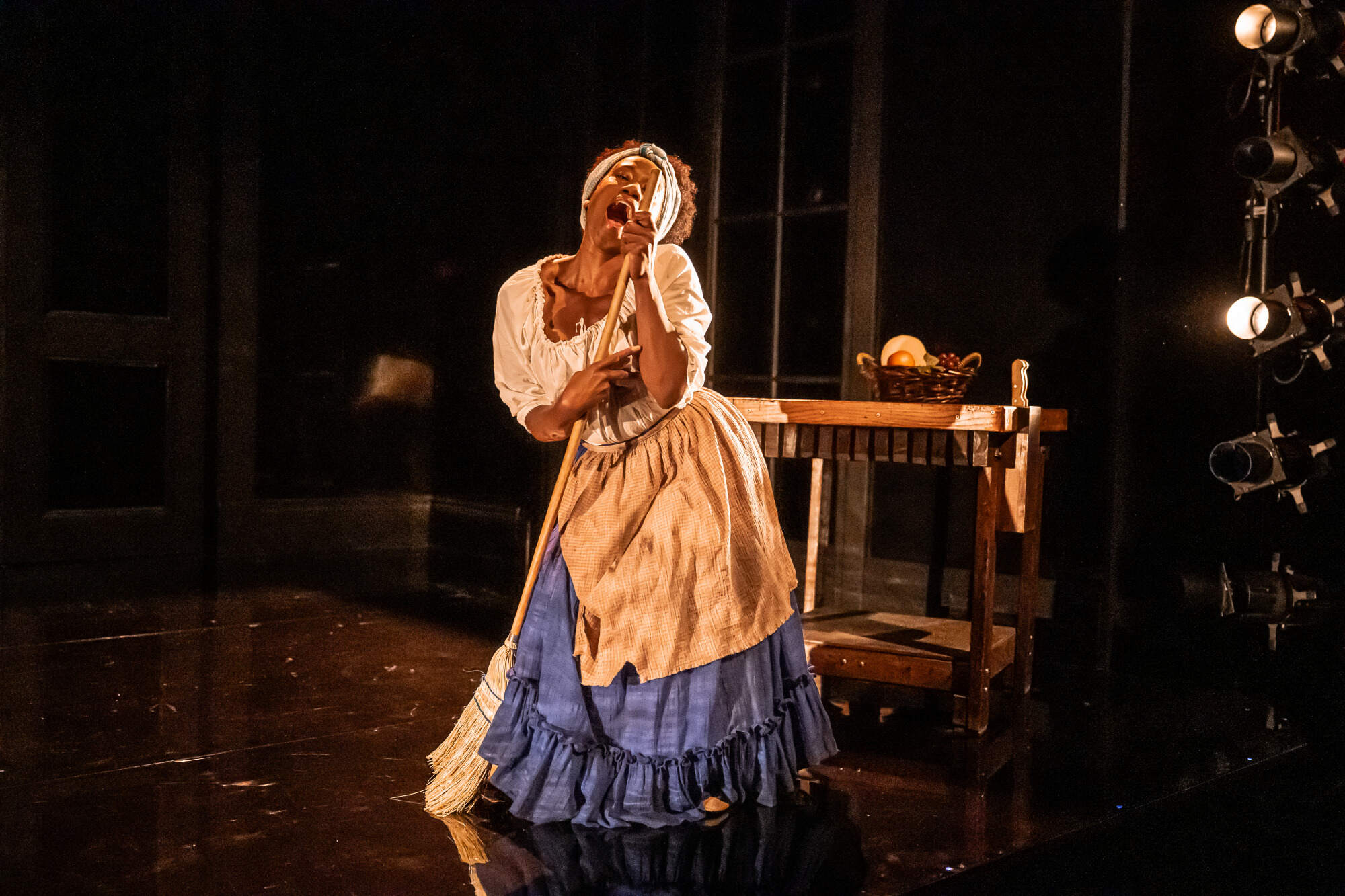
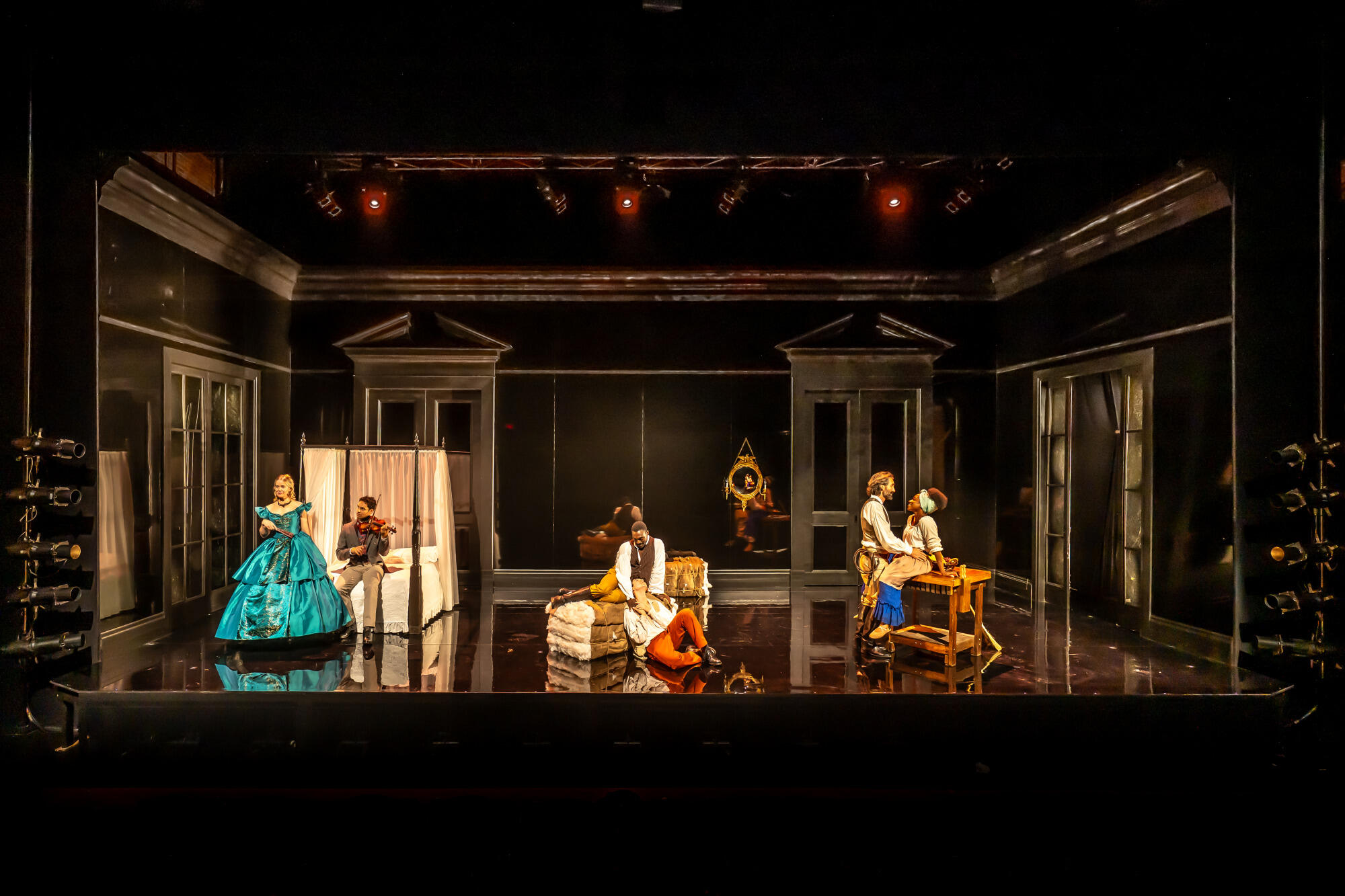
Jim (Gord Rand) comes in, speaking in a southern drawl as Kaneisha’s white overseer, a scenario that becomes progressively more sexual. Hm we’re not watching something from the true antebellum South, not when a woman who is working as a slave is twerking to modern music.
Next we encounter Alana (Amy Rutherford), a well-dressed white woman who might be the wife of the plantation owner, who calls out to Phillip (Sébastien Heine), a well-dressed mulatto who is instructed to serenade her on his violin, that is before things again heat up between them. The sex-toy she has in her hands again functions as a bit of an anachronism, making it crystal clear that no we’re not in antebellum Kansas anymore.
The third couple we meet is first Gary (Kwaku Okyere) the overseer of Dustin (Justin Eddy), a slightly confusing visual given that the overseer in this case appears to be darker than the slave. But again things become physical, first with a struggle between the two men that then leads to intimacy.
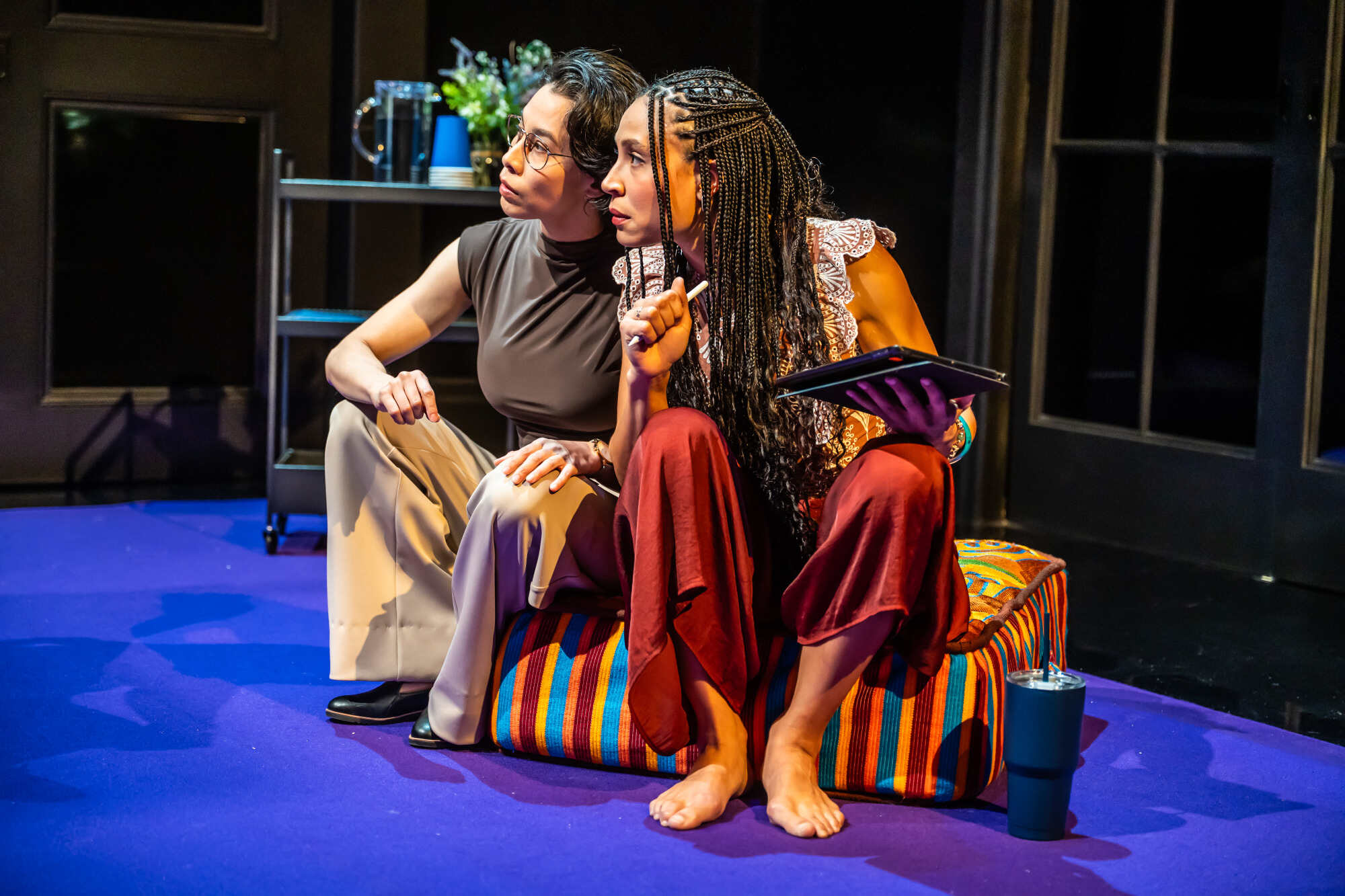
It becomes much clearer in the Second Act with the arrival of Patricia (Rebecca Applebaum) & Tea (Beck Lloyd), who are two young psychotherapists, trying out their new experimental therapy.
I find the structure remarkable, inverting the usual. In the plays of Shaw you might see exposition in Act I, development & complication in Act II and a kind of discussion or debate for Act III. What’s provocative & profound in Harris’ dramaturgy is how we get something mysterious that is only explained/ debated for us in the Second Act, with discussions from the participants, some unpacking their feelings, some expressing their profound doubts about the new therapy. If this were opera it would be as if we had arias in the first act with the recitative explaining the drama only coming later. Because we’re watching role-play in the first act, artificial use of costumes & accents yet anachronistic (for instance in modern twerking music) we are in a kind of metatheatre, artificial performances. Unless you have read the play it’s a bit perplexing, and in the best way. There’s so much richness, so much depth I am dying to see it again.
The last act is in some respects the punchline, and I’d rather not give it away. except to suggest that Slave Play sits neatly on the knife edge, managing to be both a satire full of laughter and a social commentary with moments of genuine pathos.
When I looked for and found the play online I discovered that each Act has a title. Act 1 is “WORK”, Act 2 is “PROCESS” and Act 3 is “EXORCISE.”
Slave Play reminds me strongly of the group therapy and psychodrama I experienced back in the 1980s, complete with the mixture of committed believers and skeptical agnostics. We balance on the edge between a kind of sex comedy and a serious social satire, and I suspect the key might be right in the set design of Gillian Gallow, as we see the show enacted in front of a mirror. You will likely see yourself in this play, but of course it will reflect what you bring. Skeptics will see reason to be skeptical, believers something to believe. The jargon of the therapists is way over the top at times, but they’re not the only ones generating humour.
At a time when white supremacy seems to be making a comeback, thinking especially of our neighbors to the south of us, this is a timely play affording total escapism. I did not expect to be swept away in the complexities of the interactions of the three couples. I found Sophia Walker’s Kaneisha especially sympathetic, Kwaku Okyere’s Gary full of raw vulnerability. Speaking as someone who read most of the play beforehand, I still found so much complexity that I’m dying to see it again. If you haven’t read it the text is likely to be even more absorbing, the ambiguities likely even more challenging. There are some moments that might be triggering especially for persons of colour. But I believe this is ultimately a safe treatment of explosive issues of race dynamics & sexuality.
Seen live, the music adds a remarkable dimension, as though something unconscious is released, something Patricia & Tea (the therapists) call “musical-obsession disorder”, that they say with a straight face (and the audience didn’t laugh although I did softly). There are a few music credits for the show, plus the subtleties of the sound design from Thomas Ryder Paine, and honestly I don’t know whom to credit except to say that this adds another dimension to the play.
Patricia & Tea also describe Racialized Inhibiting Disorder” or RID for short. That’s more serious in my view, although depending on the way it’s presented, there’s a ton of possible comedy buried in this text. Laffrenier manages to balance the comical & serious, the agnostics doubting the value of the new therapy with those who believe. It’s quite exciting.
Slave Play runs until at least October 26th. I strongly recommend you see it.

 barczablog