Friday night Toronto Mendelssohn Choir & Musicians of Kitchener – Waterloo Symphony presented Brahms German Requiem in a sold out Koerner Hall to rapturous applause.
I had been initially concerned that this massive work employing a big choir & orchestra could feel overwhelming in such an intimate space with its live acoustic: but they thought of that. Instead of the usual version we heard a revised orchestration by Joachim Linckelmann for chamber orchestra, last night numbering under 30 players, offering a good balance to the 160 + choristers in the TMC.
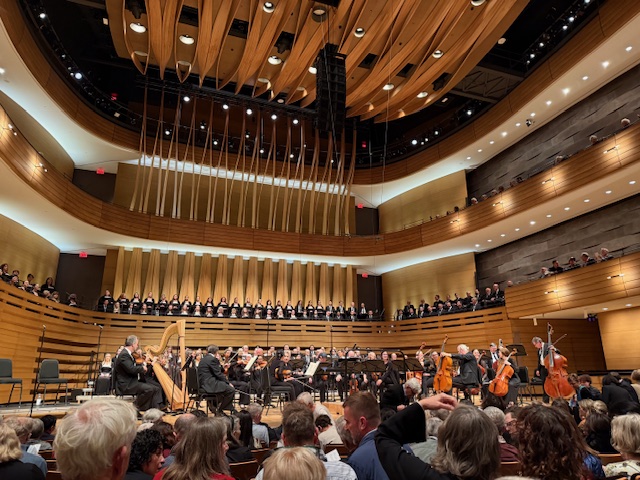
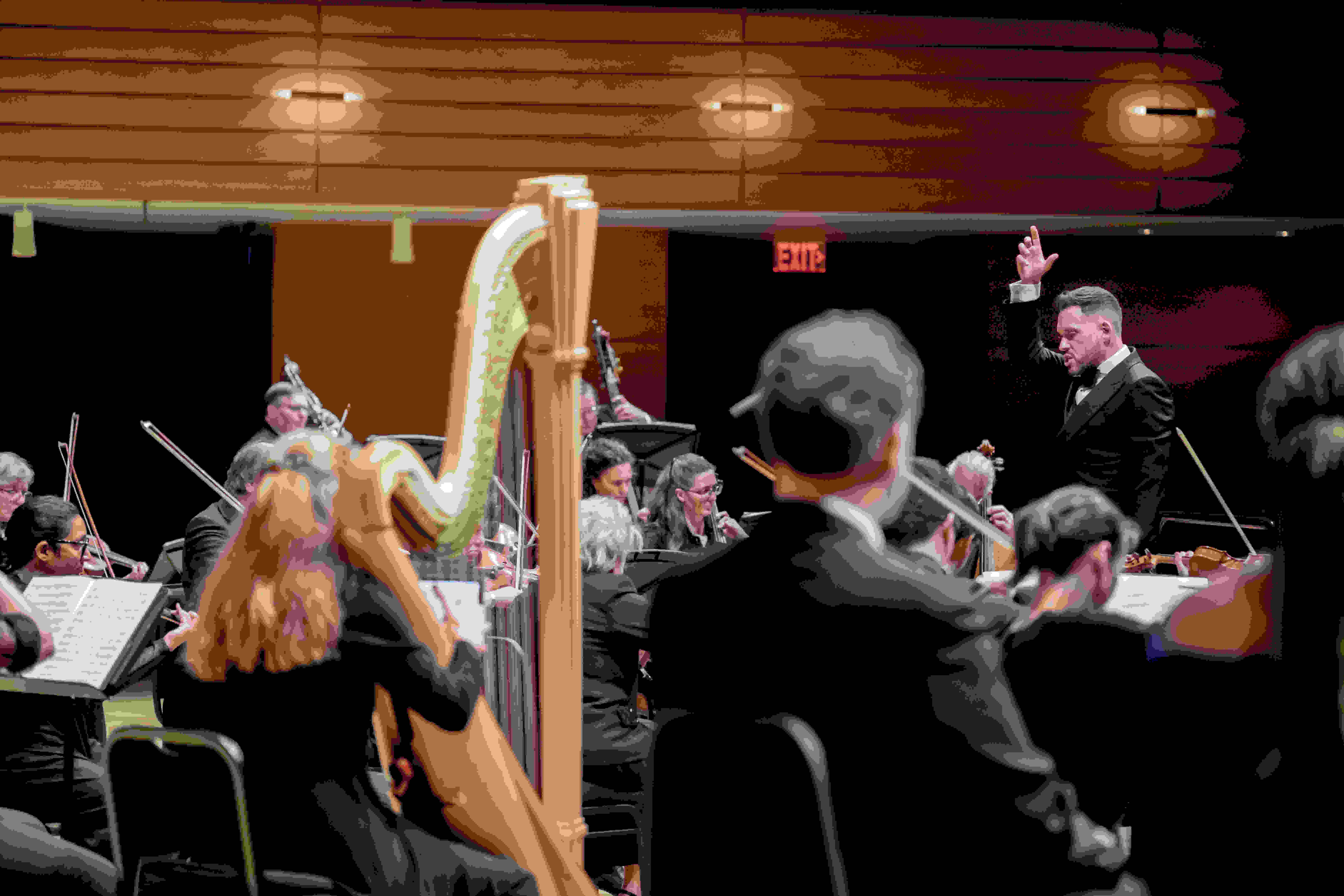
It also helps that Artistic Director Jean-Sébastien Vallée led a restrained & gentle reading of this profoundly fascinating work. Speaking as someone who still uses the old-school term “accompanist” to describe what I do at the piano or organ, I am grateful for an interpretation that doesn’t aim for bombast and drama, when subtlety and patience might be more illuminating. A good accompanist is a good listener and a follower above all. If you’ve heard the piece done in its large-scale orchestration you will likely have heard the orchestra making big sounds, with the choir immersed in that sound. I admire subtlety in a musician, and that’s what we heard, both in the large-scale movements and in the solos from soprano Charlotte Siegel and baritone Russell Braun, singing with great delicacy & sensitivity.
Vallée explained his thinking in his introductory remarks, pointing to the ways in which Brahms chose an unconventional approach. As Vallée explained Brahms’ textual choices and their settings show less concern for the dead than with the survivors, their feelings and how one lives. We’re at the time of year when we’re retrospective both for the Saints we remember on November 1st and another sort of Remembrance on November 11th, as we were reminded by Vallée.
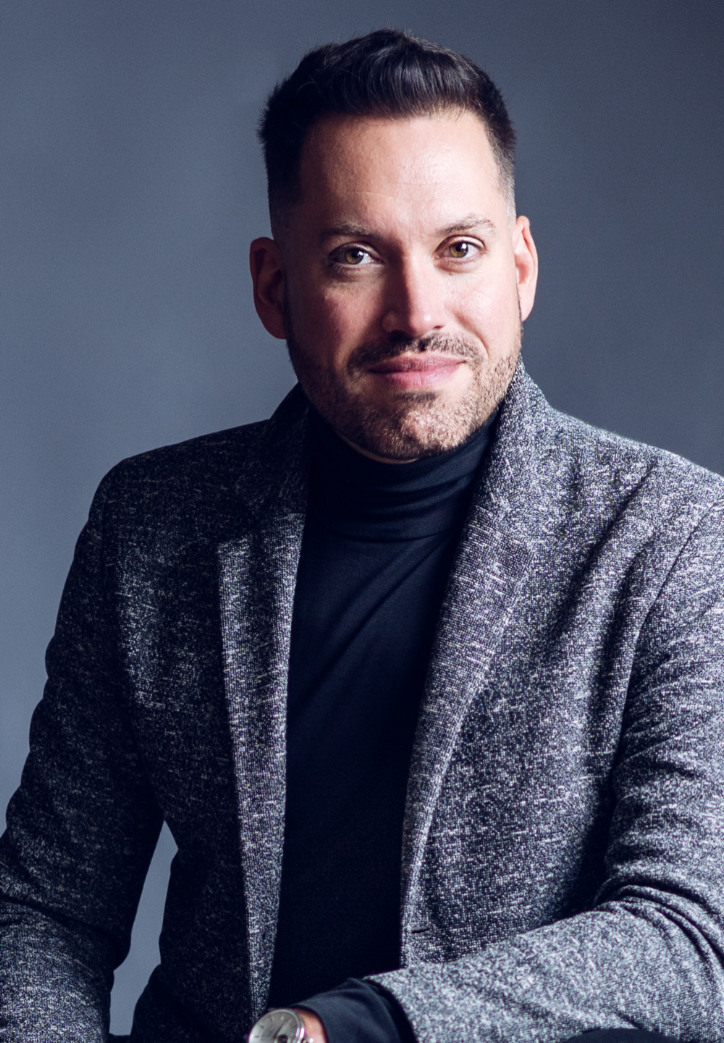
Serendipity is a word I keep using lately, fortunate to stumble yet again upon a performance helping me process grief & bereavement. While the promotional campaign would have you believe that Robert Lepage’s play concerns the space program, I understood Far Side of the Moon as a piece concerning intimate concerns of identity in the wake of his mother’s passing. That was last week. This time it was Johannes Brahms who composed his Requiem in the immediate aftermath of losing his mother.
I must express my gratitude for how well TMC assembled and curated this evening of gentle associations, beginning with the image on the cover of the program. As I Lay Sleeping by Vanessa McKernan, was chosen by Toronto Mendelssohn Choir as the image gracing the cover of the program, an image that was pertinent for both of the pieces being performed.
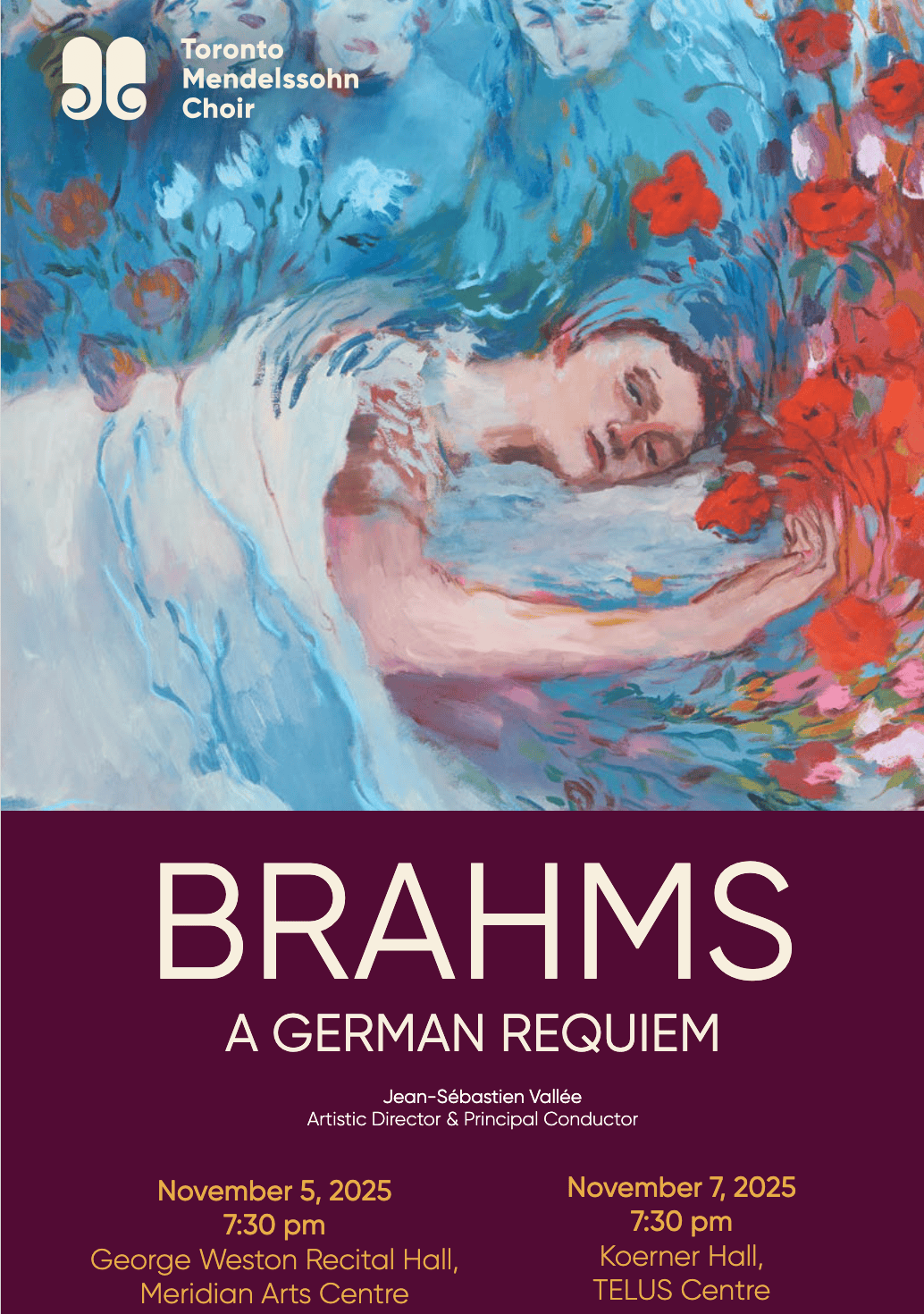
http://www.vanessamckernan.com | Instagram: @vainteInstagram: @vainter
The brief world premiere to open the program from the Mendelssohn choir’s composer in residence Stephanie Martin was also a helpful prelude to what was to come, both as far as its sonorities and its texts.
Here’s an explanatory passage from the program, written by Rena Roussin, the Mendelssohn Choir’s musicologist-in-residence: “Echo is receiving its premiere tonight, and was written expressly for the purpose of being a companion piece to the Requiem. Martin sets the text of an 1854 poem by the English poet Christina Rossetti, joining it to select texts from the traditional Latin Requiem (the Mass for the Dead). Rossetti wrote “Echo” shortly after the death of her father, writing on themes of memory and connection after death.”
First let me show you the poem:
Echo:
Come to me in the silence of the night;
Come in the speaking silence of a dream;
Come with soft rounded cheeks and eyes as bright
As sunlight on a stream;
Come back in tears,
O memory, hope, love of finished years.
Oh dream how sweet, too sweet, too bitter
sweet,
Whose wakening should have been in
Paradise,
Where souls brimfull of love abide and meet;
Where thirsting longing eyes
Watch the slow door
That opening, letting in, lets out no more
Yet come to me in dreams, that I may live
My very life again tho’ cold in death:
Come back to me in dreams, that I may
give
Pulse for pulse, breath for breath:
Speak low, lean low,
As long ago, my love, how long ago
In addition, right in the middle of the poem, Martin inserts an echo of sorts, the Latin words from the Requiem:
Echo:
In paradisum deducant te Angeli Into Paradise: may angels guide you
In tuo adventu suscipiant te Martyres. at your arrival the Martyrs will receive you
I found myself thinking about the way we experience dreams, that a dream can seem like an echo of something we lived, that the recollection and memory of incidents and persons are like dreams. Memory is like an echo. I remember the phrase in the hymn “Oh God our help in ages past”, when it says.
Time, like an ever-rolling stream, /Bears all its sons away;
They fly, forgotten, as a dream / Dies at the op’ning day
Such words are in some respects interchangeable, or at least suggestive of one another. Repetition in an echo is a lot like what we experience in music especially in a hymn, where we repeat something. The effect of repetition in ritual, makes more of an echo. I was very moved by the way Martin set up the entry of that echo phrase in Latin, employing a smaller group of singers in one register, strongly suggesting something dreamlike, spiritual, and appropriately angelic.
If you read the poem, it’s beautiful with a definite suggestion of the afterlife. Martin understood the possibilities of the poem and the musical idea of an echo. What she achieved was in my estimation worthy of its placement alongside the Brahms piece, both in her subtle emulation of Brahms in her harmonies & metre, but also in the gentle handling of the text. I sat with tears flowing down my face, my voice barely able to utter the “brava” Martin so richly deserved. I do hope to hear this again, and hope that the Mendelssohn Choir will record the piece.
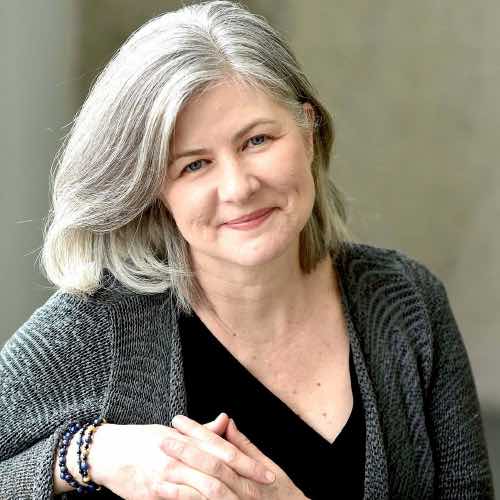
I wondered at the risk of pairing the immense Brahms work with a new piece, a daunting prospect for the composer of the new work. I can’t help recalling R Murray Schafer speaking of commissions to begin concerts while the late-comers found their way to their seats. “The contract read: ‘It is agreed that the work shall have a minimum duration of approximately seven(7) minutes and no longer than ten (10) minutes.’ That is, the work was to be what Canadian composers call a ‘piece de garage’, intended for performance while the patrons were parking their cars. ”
Imagine the challenge in our culture, that your music is to be presented alongside this solemn work, sometimes with such dim expectations. But Martin more than met that challenge. I congratulate her and the TMC, that they planned and created a stunning opener for the Brahms that followed. For me, heresy as it may be to say so, Echo was the highlight of the evening.

I have one small topic to mention yet again, as the Mendelssohn Choir show us what’s possible. While the first piece by Martin was in English with a little bit of Latin, they projected titles above the stage for the entire work. They’re helpful, I can’t say this often enough. And of course when we came to the Brahms they also gave us titles. I wish this were standard procedure, especially for that orchestra who regularly play with the TMC at Roy Thomson Hall.
I had a splendid experience, carefully planned months before when Martin was commissioned to compose a work making perfect preparation for the Brahms. The choir prepared studiously, deported themselves carefully onstage. I’m very grateful for what I saw and heard.
The Toronto Mendelssohn Choir will be back December 2nd & 3rd for their annual Festival of Carols at Yorkminster Park Baptist Church, and will appear with the Toronto Symphony for their annual performances of the Messiah December 16-17-19-20-21 at Roy Thomson Hall.
 barczablog
Pingback: Singsational Bach workshop with Jean-Sébastien Vallée | barczablog