I’m all sentimental about bus trips after spending much of the past few days riding around Florida with the Toronto Symphony. Here’s a list of movies that show us different aspects of life on the road, presented in reverse order a la David Letterman.
Numbers 10, 9 and 8 are variations on fear on the buses, reminders that there can be danger. I will put these aside right away because I want to make you smile or giggle, not scream in fear.
#10-aka “who’s driving this thing?” Keanu Reeves vs Dennis Hopper with Sandra Bullock screaming for help in the driver’s seat, in Speed.
Early in #9 we see a slow-motion bus crash that is the beginning of a lifetime of pain, as seen in Julie Taymor’s Frida complete with surreal puppets.
But violence and terror aren’t always horrible. In #8 the big bus crash set-piece begins a man’s redemption. It’s scary –especially on the big screen where I was lucky to see it—but powerful stuff, as Harrison Ford leads Tommy Lee Jones a merry chase, in The Fugitive.
#7 is a film I cited recently when speaking of politics. There are tons of great bus scenes in Bull Durham, a movie that romanticizes failure, making you feel a bit better about being a minor leaguer. I pick this scene because hey, I was riding with musicians. And looking at this clip, listening to Crash Davis ranting, you might say “everyone’s a critic”. If only we could be this eloquent.
And speaking of music, for #6 why not a song? How about Bono singing “I am the Walrus” from Across the Universe: a film with a few bus scenes.
#5 is from the “Stranger in a Strange Land” category, a bus full of people who all know one another, looking at the newest passenger as though he’s from another planet: the scene at the end of Ferris Bueller’s Day Off. Where has Jeffrey Jones gone? And speaking of classical music remember him in Amadeus? where is he now?
And here’s another one of that scary feeling stepping into a bus for the first time. In #4 schoolbus driver Siobhan Fallon meets young Forrest Gump. I won’t tell you the name of the film. The young lad will do that for you.
Have a look.
In #3 – Mean Girls – the bus is an avenging angel.
In #2 the bus is the pathway offering a couple their escape to a new life, at the end of The Graduate.
In #1, one of the first great road movies, a new life is again dreamt of, namely It Happened One Night. Listen to “The Man on the Flying Trapeze”. Did people once sing this way in public? Have we perhaps lost something in our transition to commodified music that we don’t make ourselves?
For me this series of bus rides is done, although for the musicians there will be other tours, other buses. I’m so lucky to have had this delightful adventure aka #TSOflorida.
Although I’ve been enjoying the Toronto Symphony tour up close, pressing my nose up to the glass of my window on the bus to stare at the world going by, it’s been a kind of workshop in so much more. I’ve had some wonderful conversations:
With Peter Oundjian, the TSO conductor & music director
With Adrian Fung, TSO’s VP Innovation (who sat beside me at a concert & again on the bus today)
With Jeff Melanson, President, CEO, tall guy and role-model.
I need to be careful. Peter’s probably a bigger a role model in our city, and was at the TSO before Jeff arrived. Culture change in an organization takes awhile. Peter may have been earlier in that renewal process, but Jeff is giving it a huge push, while Adrian, a recent arrival, is both a new driver and indeed a sign of the changes at the TSO.
(aside to self, I hope it’s okay with them that I am using their first names, instead of my usual tossing around of surnames, I hardly know them)
Peter Oundjian, autographing the Scheherazade CD for (lucky) me
I had a chat with Peter this morning. I think I resembled the character Mime in Siegfried, who, when given the chance to ask Wotan a series of questions foolishly opts to show off what he knows rather than to actually seek after knowledge. I wanted to convey my appreciation & admiration and indeed was under instructions from home to get that message across. I hope I succeeded. I broached the subject with him that’s in the headline above, that was at the centre of my intense conversation on the bus today with Adrian. Jeff has partially inspired it, just watching him in action, although I think all three of these men demonstrate this in spades. And I want to add a fourth name for at least a hint at gender balance. I’ve been spending a great deal of time with Francine Labelle, who is Manager of Publicity, and my chief interface with the TSO.
What do all four of these people have in common that might connect to the headline?
It’s a sign of the times that jobs have grown because we are living in an era of generalists. Francine isn’t just a PR person, she is also herself a performer, required to organize & communicate. Adrian may have an MBA but he is also a musician and a lateral thinker. Peter is a violinist, conductor, mentor, public speaker (to name only a few). Jeff too steps up to the microphone, not just telling them what to do but walking that walk right onto the stage.
Convergence may be an overused word but I think we’re still discovering its significance. I have a device that I carry in my pocket that not only sends email, records voices or films people, but also files music indiscriminately, the Beatles and Beethoven treated as equivalents (except possibly for the length of the track / size of the file). Calling these files “content” levels the playing field and removes class / disciplinary biases between different media, different sorts of content.
I was joking with Peter about what I saw in the concert last night, what I glibly called “The Toronto 100”, alluding to the Daytona 500. I swear he didn’t actually accept a bow himself, but gave all the focus to his orchestra. Gone are the days of the autocratic conductor, as obsolete as an autocratic VP or an autocratic CEO. And is it any wonder that one of the most obvious things i saw on the bus was manifest chemistry, the cohesion of a team rather than people brought in merely because of virtuosity. It’s less important to play your instrument well on its own, than to be an ensemble musician.
When Jeff says the TSO seeks to change to make itself the most innovative orchestra in the world, it’s not something you can do by simply shouting at the troops and saying “okay boys, innovate”! Change will manifest itself in everything from the music they play to the programs they offer children in our city and so much more. I’m fortunate to have been the fly on the wall, overhearing some wonderful talk, that i am still seeking to understand.
The organization must change in every respect, modelling inclusiveness and an appetite for creativity. That may sound obvious in an orchestra, but we all know that we’ve seen institutions that become, well institutional. Bureaucratic. Rigid. Political, and not in a good way.
The TSO will announce their new season soon, early in February. They are already doing some brave & bold things. I’ve been loving their series of films with live accompaniment this past autumn. Their adventurous take on the Mozart Requiem directed by Joel Ivany is coming up very soon as part of the Mozart @ 260 Festival, led by Bernard Labadie. Their New Creations Festival is coming up. What will they do in 2016-2017, a season when one might expect a possible commemoration: of the sesquicentennial of Canadian Confederation.
Daytona Beach was the location for the latest instalment of the Toronto Symphony tour. I heard them play at Peabody Auditorium, not far from the famous speedway that’s the site of the Daytona 500. In speaking of the venue I hope I will make it clear why I need to talk about this. It’s a theatre, rather than a concert hall, and seats 2 521 (Orchestra-1 518 • Loge-497 • 2nd Balcony-506)
Built in 1949, its space is very much a creature of its time, with advantages & disadvantages. The reverberation time is remarkably brief, the sound fairly dry. Thursday night? There was lots of wood in the last space where i heard the TSO, and at times the wood sucks up the energy, damping noise and harsh attacks, the same way that air-brushing can remove flaws, and help make an aging movie-star look young again. It was a flattering acoustic on Thursday, where we couldn’t fully hear the music.
But on Friday the TSO were playing on the stage of a proscenium arch theatre, which meant that they were raised above anyone in the front of the orchestra; luckily I was about 20 rows back, allowing me to see and hear perfectly (except for my view of the conductor during the concerto, blocked by the lid of the piano). But we were in a space with hard walls that bounce the sound, a theatre designed to be a multi-purpose space. I understand that a production of Aida will be played there in awhile, whereas a concert hall has space for musicians but no stage machinery, the musicians thrust forward into the same acoustic space as the listener (and with no proscenium arch framing the view). For anyone seated in a good seat (as I, sigh, certainly was), the sound was in a sense unforgiving.
Here’s the thing. I could hear the scratch of rosin on the bows, the movement of chairs on the stage floor, the breathing of players, and I think I heard every wrong note. The energy coming out of that relatively small box – the theatre space—was enormous, especially given the Olympian programming choices. Every blemish on the surface of the TSO’s sonic bubble was in evidence.
Ah but there were no blemishes. Or in other words, no wonder Peter Oundjian was grinning tonight.
I should add that this was hardly a day when we might have expected perfection. The bus ride was delayed, meaning that the players were tired, and did not get their usual rehearsal before the concert, which –as luck would have it—was scheduled to begin early, accommodating 300 school children. I wonder if that created a sense of urgency.
Did they perform differently tonight? I can’t be sure, because the performance space is so different, the acoustic generating not just my different impression, but certainly a whole new experience for everyone involved, especially Peter Oundjian, listening and leading on the podium.
Peter Oundjian soaking up some of that Florida warmth, aka applause after the earlier concert (Photo: Michael Morreale)
I had the most intriguing sense of the conductor tonight. We opened again with the explosive sounds of Estacio’s Wondrous Light. I was reminded of the good old days of audio, when one would take a record to test the new systems one was hoping to buy. Estacio’s crisp rhythms, charming phrases, and especially, his heroic brass would be a test for any speakers. But instead of testing a sound system, I was calibrating the hall, so different from what we had yesterday. Don’t disparage halls such as the Peabod-Aud, made of bricks and mortar, as wood is not the be-all and end-all acoustically, especially if misused (as I believe is the case in the Miami auditorium, where energy gets sucked up by the decorative wood). It’s true that the woodwinds, situated upstage sounded a bit remote in the Peabody, especially when the big string sections were playing: who were placed close to the sweet spot(s) of the hall. Jonathan Crow and Joseph Johnson (concertmaster & principal cello respectively) as well as the rest of their sections came through powerfully. Jan Lisiecki’s piano had such clinical transparency one could almost hear his fingernails on the keys (okay maybe I am exaggerating a bit); but where his ultra-romantic reading (of great contrasts) was dampened (as if air-brushed) by the gentle acoustic Thursday, this time everything came across (I’ve posted a separate analysis here).
Yesterday I mentioned how Peter Oundjian offers such thoughtful support of soloists during concerti, and it was so again tonight in Lisiecki’s reading of the Beethoven concerto. But I’ll take it a step further tonight in recognition of how the orchestra played Scheherazade, specifically how they were led.
The piece is full of solos from all parts of the orchestra. You may recall that this is a piece made up of stories. The tale-teller behind The 1001 Nights is the harem girl Scheherazade, whose persona is signified through the solo violin, playing a theme that we hear many times in different forms throughout the long work. Whenever Jonathan Crow had one of his solos Oundjian would cross his arms and in effect stand down as leader, allowing the solo to be freely enacted. There was a moment tonight, possibly created by the lack of rehearsal, when Crow (at the latter part of the third movement) arpeggiates, a spontaneous eruption tonight that for the life of my sounded like a sobbing woman, heart-broken. I’ve never cried listening to this music before but i lost it this time.
At other times, you could see Oundjian smiling his encouragement at various players around the orchestra, some taking on their own solo across from a leader who had momentarily resigned his post to permit that character to take the stage. When necessary –and there are many places where the rhythms and the developing drama require precise leadership—Oundjian steps back into the more conventional role. But I don’t think it’s a coincidence that during the applause –fervent and wild as it was—that Oundjian never really let us clap for him, as he kept gesturing for someone or perhaps a section to take their bow. It was as though he was leading one hundred soloists: which is where i got the reference in the headline to “The TSO 100”.
So in case I wasn’t crystal clear, the orchestral sound in the Rimsky-Korsakov was magical. The violins and cellos were very strong from their location, the woodwinds harder to hear from their location (although their solos came through of course), and then the brass and percussion came through like lightning bolts. The unforgiving acoustic was like an exposed stage where you could hear everything with pristine clarity: but they sounded perfect.
The challenge of such a venue might be worth pursuing from time to time, given the phenomenal performance tonight. I wonder for example how they’d sound at the Four Seasons Centre (even right on the stage).
From the headline you might never guess that this is an analysis of musical performance. Friday I had my second listen to Jan Lisiecki playing Beethoven’s 4th piano concerto with the Toronto Symphony conducted by Peter Oundjian.
Listening to JL and the TSO on Friday in dry clarity of the Peabody Auditorium I heard every note.
Pianist Jan Lisiecki with the Toronto Symphony (Photo: Michael Morreale)
At one moment playing very quickly, I watched his deportment, the notes flying so thick and fast he becomes a blur. JL carried on without stepping out of character as the virtuoso. This too is a big part of the performance, to maintain the persona of the inspired romantic, transported on the wings of song to another realm: or so it might seem especially when, at a climactic moment, his body language and facial expression suggest a kind of rapture. It’s contagious of course, because everyone else feels that way too, as the piece builds to its various climaxes.
I think I discovered something tonight listening to JL. Most pianists come to this work in a more conservative way, less willing to play with tempi & more likely to be ultra-orthodox in how they play the notes.
JL manages to bend the usual rules while still satisfying the stylistic requirements for Beethoven (setting the textual fundamentalists aside). What JL does is juxtapose two different styles, which is pretty mind-blowing when I think about it. Let me unpack that a bit. The first entry of the piano –to start the work—is the statement of the main theme. As it’s usually done this sets the tempo of the work for what follows, as the orchestra quietly answers, the first in a series of conversational exchanges between the orchestra & the soloist. That’s not what JL did, however, as he slows down a bit, making this statement a bit more introspective, if not dreamy. Oundjian has to spur the orchestra to pick it up a bit, as it would be quite reasonable for the orchestra to answer in the slower –dreamier—tempo. And so what we get here is simultaneously in the conservative world of Beethoven (where dream are sometimes explosively alluded to but expressed within a strict framework of tempo and phrasing) and hinting at a less defined romantic world of dreams, perhaps as we might find more in the music of Chopin. I am not saying that JL consciously does this, so much as that he’s playing according to a very self-consistent set of procedures that are 100% defensible, even as they are rare to encounter in this repertoire.
The piece is set up for a kind of conversation between interior and exterior, where the piano is a lot like you or me: living simultaneously with the four-square requirements of mundane reality, while pushing against that in hopes of something else. Mostly, JL is playing a kind of game with the orchestra, so he’s in that world of accuracy but every now and then Beethoven asks the pianist to do something other than one of the two main themes. Those themes are recognizable material, embedded into our heads at a particular tempo. When JL starts to play arpeggios or fast quirky patterns that no longer are motivic, he’s free to play faster, or possibly to go off into a dreamier tempo. So in other words, if this were a painting or a building, the edges or foundation are made of those square parts, but there are also all these other places where something else is happening. It’s understood that for example the music of Chopin calls for a certain freedom, a tendency to use “rubati” (literally stolen time), going faster here, slower there; to play Beethoven this way is intriguing, and relatively rare nowadays.
We see this most clearly in the cadenzas, especially the big one in the first movement. JL takes us off into something bordering on the irrational, the most dissonant and noisy music in the concerto, suggesting at least sturm und drang, if not outright madness or death. This big cadenza is like an ordeal, a fit of irrationality in the midst of the rationality of this sonata form movement, bursting at its own seams. JL pushes as fast as he can in the places where we’re not doing one of those main themes, but comes back to earth for those moments, as though in reference to the edge of the painting or the bottom of the building’s sub-basement. If nothing else it’s an enormous expenditure of energy, a little play within the play, as the soloist seems to fight with and then master his demons for a few minutes all alone. In the moments playing the main themes, we hear playing that sounds Mozartian and conservative, but at times the romantic –as in Chopin– lurks under that classical surface.
Then we come to the second movement, where the battle is most explicit in what Beethoven wrote, and not just a matter for JL’s interpretation. This dark little movement has been compared to the encounter between Orpheus and the Furies of the underworld. I’ll give you a recorded example –for those who don’t know this charming little piece—and notice how the tale seems to be enacted:
The orchestra grumbles like the implacable hounds of hell
The piano enters as calmly as the Thracian Singer: unafraid but also, clearly a different kind of music
The dialogue goes back and forth: and eventually the orchestra –especially confronted with a short brilliant eruption of irrationality from the piano in trills and scales—seems to lose its nerve, or become a little less ferocious.
The result is something calmer and gentler, as if the demons have been moved by his music
Oundjian maximized the drama, giving the orchestra some of the nastiest sounds I’ve ever heard in this piece, angular and jagged, rather than attempting to make a nice accompaniment for the piano (as some do, as in the youtube example).
While the third and final movement has drama, it is more of a celebration, off to the races (well it IS Daytona after all), as we get some marvellous energy released but without so much fatality this time. There are still some flashes of the irrational but nowhere near as scary as what we’ve seen up until now. In places the style is romantic, although at key framing moments JL gives us exactly what we need to be able to call it classical.
As I try to find a parallel to my experiences tonight, I’m thinking back to the hockey series I saw on TV in September 1972 (when Canada defeated the Soviets). It’s not hockey but music, and the only Russian involved was Nicolai Rimsky-Korsakov, a composer long dead.
The parallel may escape you. But at that time a bunch of fans went along to cheer their heroes on, something many of us watched on TV with envy. I wish I had been there.
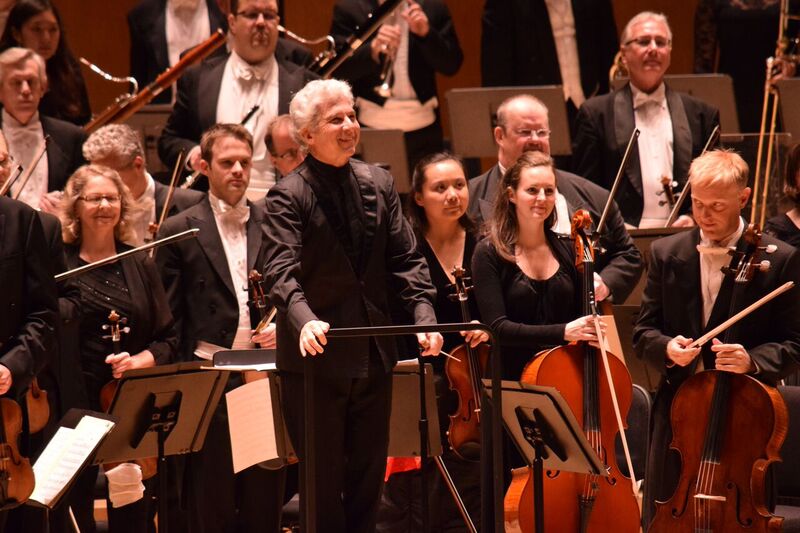
Peter Oundjian with the Toronto Symphony January 7th (photo: Michael Morreale)
But tonight it was as though I heard the Toronto Symphony with a fresh set of ears. The Knight Concert Hall where the TSO played tonight in Miami is a jewel of a venue, smaller than Roy Thomson Hall, and with a warmer acoustic, (matching the warmth of the applause) that offered up the performances with greater clarity than what we usually get at RTH. It’s delightful to be able to hear them so clearly.
There were three strong items on the program. We began with John Estacio’s Wondrous Light, a bold and brassy curtain raiser. I shouldn’t have been surprised, considering the energy with which Conductor Peter Oundjian bounced onto the stage tonight. Maybe what I saw was simply his enthusiasm or something designed to inspire & even goad his players, who had the day off Wednesday (and a leader wanting to be sure that his players answered the call). But answer they did. Parts of the composition that seemed to have a bit of a Latin feel that might have been congenial for the audience in a city with a substantial Spanish-speaking population. This is an accessible composition unlike what one usually encounters in a short contemporary piece to open a symphony concert.
After a break to reconfigure the orchestra – including the theatrical raising of the grand piano to the stage via elevator—we were on to Beethoven’s 4th piano concerto, featuring young Canadian Jan Lisiecki. Again, listening in Florida it was as though hearing the piece for the first time. I can’t imagine how radical this composition must have sounded on its first hearing, the piano coming in all alone to play that single chord, Lisiecki seeming especially eloquent in his opening statement. I call it that because he seems to speak when he plays. The performance was very rhetorical, a series of questions and answers back and forth between soloist & orchestra.
Every time I see him I think he’s getting better. The technique is rock solid of course, but there’s a sense of a genuine maturity in his interpretations. I’ve seen over-bearing conductors who push a soloist out of their comfort zone, and seem determined to be the boss, but it’s a great pleasure watching the interaction between Lisiecki and Oundjian at the podium, who is especially sensitive with young soloists.
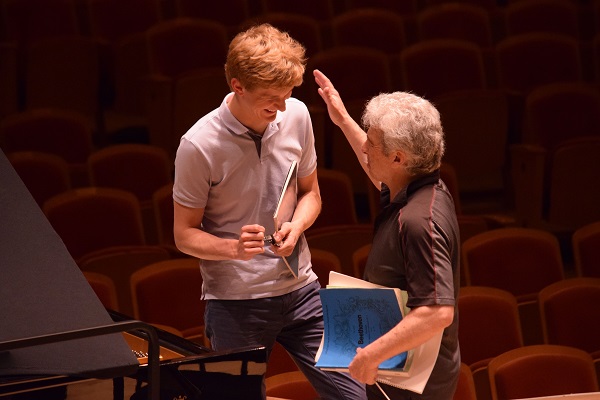
A lighter moment from rehearsal with Jan Lisiecki and Peter Oundjian (photo: Michael Morreale)
The dynamic range was extremely romantic, the orchestra very bold in their opening statement of the second movement, the piano very soft, in a passage sometimes compared to the encounter between Orpheus and the Furies of the underworld. In these utterances young Lisiecki was especially profound.
After intermission came a very different set of challenges, namely Rimsky-Korsakov’s Scheherazade. If the only reason to program the piece were to hear Jonathan Crow’s solo violin, we ‘d be off to a good start, but there were a series of great solos, including cellist Joseph Johnson. This is sometimes called a theatrical piece, but what struck me tonight was that it’s above all, a piece about story-telling. Oundjian seemed to shape the various passages & episodes with the kind of boldness of a raconteur: which come to think of it, is something Oundjian sometimes does before concerts in Toronto. And so instead of telling us stories verbally, it was as though he was shaping the stories from the 1001 Nights at the podium with his baton.
Jonathan Crow, Peter Oundjian and the Toronto Symphony (photo: Michael Morreale)
When the audience clamored for more, the TSO obliged with a powerful reading of the Polonaise from Tchaikovsky’s Eugene Onegin.
Tomorrow’s a bus-trip to Daytona Beach, a concert in the evening, and this enthusiastic fan will be tagging along.
Sometimes the most innocuous choice can seem symbolic, as though it represents a fork in the road.
I was packing my carry-on for my flight down to Florida, as I spend a few days getting closer to the Toronto Symphony on their tour. I am addressing you via the chief occupant of my carry-on aka my acer laptop.
But I have found books a wonderful distraction, especially in the midst of turbulence. I won’t pretend I have no fear, far from it. Denial ain’t just a river in Egypt. It’s my chief pain management strategy (when my arthritis acts up), and also a great way to deal with fear of flying.
Last night I’d put two books into the computer bag, then decided this morning I had to commit to one, ergo the aforementioned fork in the road. (and as I sit near the departure gate I hope it’s a metal fork. Plastic really wouldn’t stand up to any sort of traffic driving over it… What? Not that kind of fork? Yes I know. Whimsy and letting my mind wander = another way to distract myself from myself & aviophobia. Hm is that fear of birds? I will eventually google this).
I was recently re-reading a post I made years ago because someone was kind enough to say they had read it in 2015 (last week that is). I’d talked about an old CBC feature “Cage Match” that would be presented as part of the morning show. I had mused that maybe the show could have settled some important questions. How about the old Montreal vs Toronto rivalry? Can you settle it via music? Or the TSO vs OSM? The best rock band from each city? Celine Dion vs Drake?
But this was just a pair of books vying for the right to be jammed into my bag beside my acer.
In this corner: Michael Pisani’s book about melodrama. It’s an important subject. Everyone uses the word “melodrama” but no one really knows very much about the medium. Oh sure, people read the words of some of the texts, but that is about as relevant as reading an opera libretto without the music. Pisani spent a decade exploring this medium, and his book is must-reading for any serious scholar.
click for more information
And in the other corner: Gabor Maté’s When the Body Says No. I have been reading this one since I bought it at an event of his in the fall in Toronto, when I actually met him. He had said I might find it interesting to read because I have Ankylosing Spondylitis. His book is about a lot of things, but auto-immune disorders feature prominently.
What is the nature of this cage match? At one point I thought it was intellect vs feeling, because Maté’s writing is wonderfully anecdotal and careful to unpack any technical terms. But the two books aren’t really so very different in that respect.
The real difference might be that for me one represents scholarship and the mind (Pisani), the other, feelings (Maté). Too much scholarship, too much work, too much responsibility and perhaps the end result is that the body says no.
So in other words you can tell which book won the ‘match’. And I will revisit Pisani’s wonderful book later of course.
As I embrace the restful implications of getting away to hear the TSO in the warmth of Florida, it might be that my mind and body won’t be at war but might harmonize. Life doesn’t have to be either-or, simplistic dichotomies between extremes. Symphonic music does require discipline and skill, yet it can be presented in an unpretentious manner. One doesn’t have to be in a tux to see opera, one doesn’t have to stifle our emotions, forbidding applause between movements. Everyone seems to be rethinking and reappraising those old relationships, the TSO included.
Toronto has just had the coldest day of the year! Brr-r-r: except it’s only January 5th so that’s a crazy statistic.
Toronto Symphony in Florida
I almost called it a “sadistic”because of course, as i look at the sky and wonder about cold weather, i’m really thinking of the Toronto Symphony in Florida. Sorry if the concept brings anyone pain!
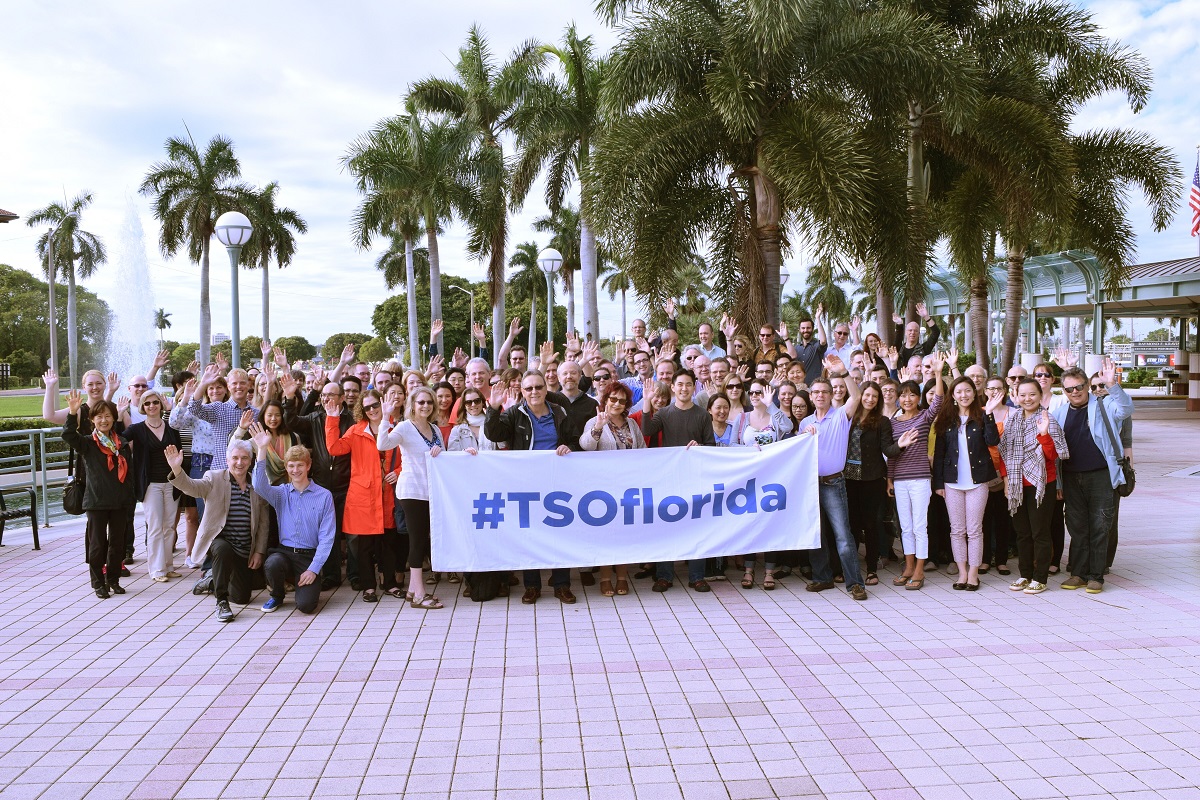
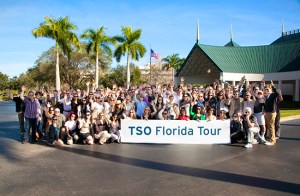
The people in the picture do not look upset, do they? Do they miss our weather? ha! I doubt it. And as the week goes on the weather is warming up, already in the 20s.
Peter Oundjian leading the Toronto Symphony in West Palm Beach (Photo: Michael Morreale)
And you can’t tell from the photos of the musicians at their concerts–in their basic black–whether the weather is warm or cool.
Pianist Jan Lisiecki with the Toronto Symphony (Photo: Michael Morreale)
The headline is always misleading right? No it’s a little game I play. I hope you’ll forgive me. The TSO are not ‘warming up’ as in the little bit of playing one does in preparing to perform. They have already given three concerts (counting the one that started a few minutes ago). I meant they are torn away from our winter, and forced to endure the sun & warmth of Florida: including the applause.
Peter Oundjian soaking up some of that Florida warmth, aka applause after the concert (Photo: Michael Morreale)
I know Brahm Goldhamer as a collaborative pianist of exceptional sensitivity. Of all the Toronto pianists I’ve heard in the concert-opera mode—where piano must stand in for all the instruments of the orchestra—his performance in Debussy’s Pelléas et Mélisande in 2011 for Opera by Request stands out in my memory. At the time I said the following (defending the use of a piano):
I would not be undertaking such a discussion if it weren’t for the extraordinary playing of Brahm Goldhamer, the pianist & Music Director. On the piano, Debussy’s score is transparent, with nowhere to hide from its complexities. But if one can play properly, you hear the work more clearly than ever before. And so, for example, when Golaud & Pelléas emerged into sunlight after having been underground, the steady stream of sixteenth notes created a visceral sense of sunshine: especially because the notes were played perfectly. As the drama built up in Act IV –thinking especially of the violent moments, when the orchestra would unleash primal forces—Goldhamer tossed off lightning fast passages, hammered octaves, always pressing the tempi in perfect synch with the singers, literally hours of precise playing without a wrong note. Even without voices Goldhamer’s playing would have been a virtuoso performance. Best of all was the elegant last page that Goldhamer articulated with the eloquence of an Olivier.
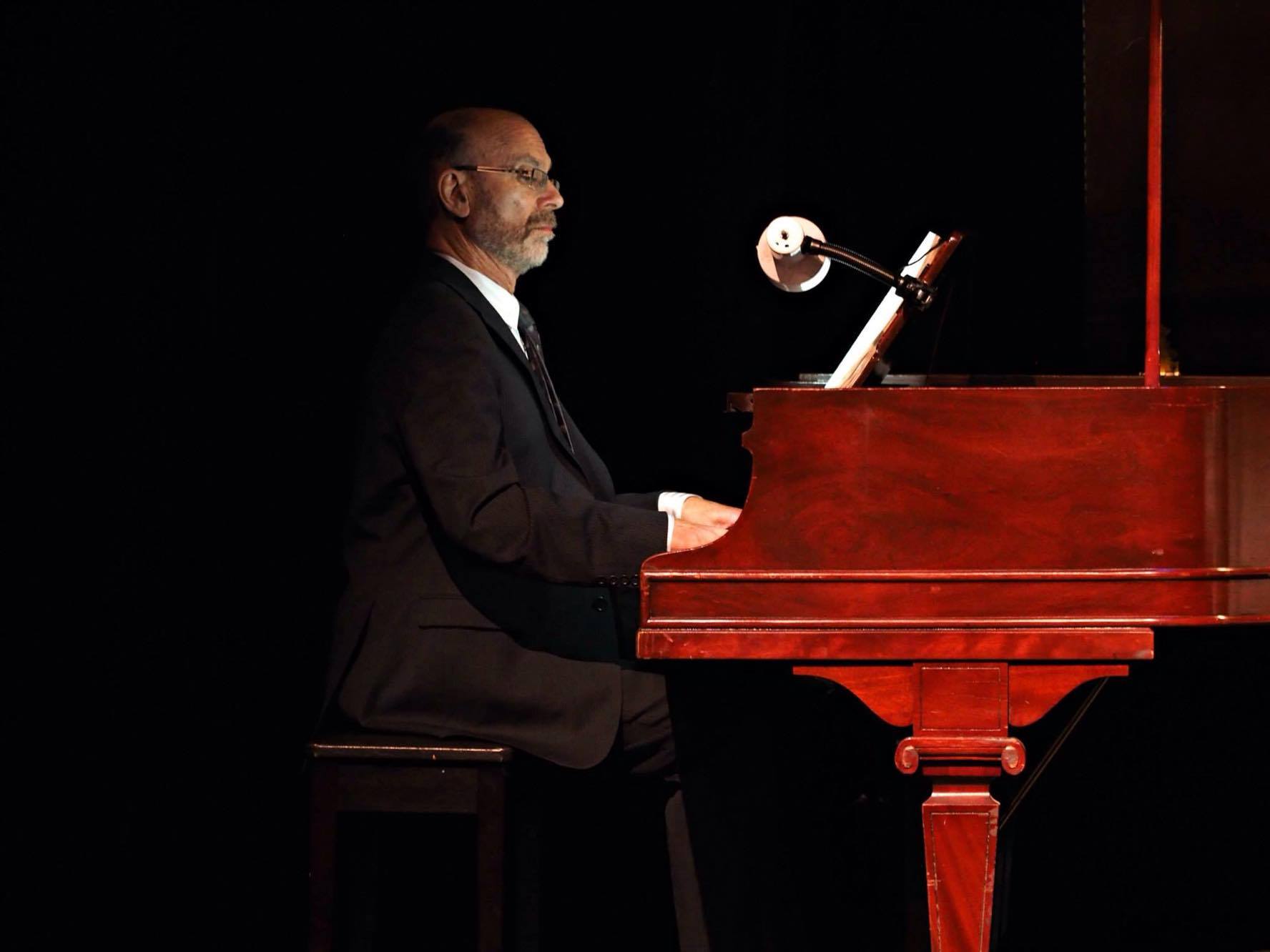
Brahm Goldhamer at the piano with tenor Stephen Bell (photo: Karen Runge)
There are several examples one can find on youtube to hear his exceptional collaborative impulses, supporting singers while playing exquisitely. Here’s one of them, but there are lots more.
Early in 2016 Goldhamer will be going in a new direction, playing a solo recital January 17th at the Royal Conservatory of Music, and I’m eager to hear him, which is why I asked him some questions about going solo.
Are you more like your father or your mother?
Pianist Brahm Goldhamer (click for Royal Conservatory bio)
In terms of musical genetics, it is a mystery that I became a musician, since neither of my parents could really sing in tune. Apparently my grandfather, for whom I am named, was a good amateur singer. Since he died many years before my birth, I have no way of knowing this. My father had an appreciation for beautiful things and an eye for beautiful paintings, some of which ended up in our home. It is a small thing, but his handwriting , earlier on, was really interesting calligraphically. My mother always wrote with the precision of a teacher, which was her profession. Everything was very neat and orderly. My father’s rather free-wheeling personality was closer to mine.
My grandparents had an old Heintzman upright piano at their home and I always enjoyed tinkering with it as a child. I asked my parents for piano lessons. After that I was hooked.
I enjoyed making variations on all the sonatinas that I studied and in fact improvised on every piece that I studied. From this, I became very comfortable with a wide range of styles. My musical education was rather unorthodox in that I was educated by the nuns of the order of St. Joseph and as a Jewish youngster from a traditional Jewish home, I spent several summers in convents with Catholic nuns who were also my piano teachers. My parents did not have to encourage me. I encouraged them to take me to concerts in Montreal, a one hour car ride from home, in order to hear great artists. In particular. Expo 67 in Montreal was a real eye opener for me, due to of all the great artists who performed there.
I heard my first opera, Otello, that summer. However, at the time, I was too engrossed in the piano to take much notice. Not until I studied the Norton scores in Music History at the U. of T. did I really become hooked on opera. I would play endlessly the large excerpt from La Boheme in act 1. After that, I purchased the recording with De Los Angeles and Bjorling and I was smitten.
What is the best or worst thing about being a pianist?
The repertoire is absolutely the best thing. It is endless. To be in touch with the great minds of the past centuries through ones fingers is a beautiful thing. The challenge is that the piano is not a voice with an endless spinning legato. This is what the illusion of playing the piano is. How to be a singer with wood, felts and steel.
Brahm Goldhamer with baritone Michael York (photo: Kira Braun)
Who do you like to listen to or watch?
I am a history buff. I love all of the old videos from the turn of the last century. YouTube is an endless source of creativity. I can live in ancient Greece or Timbuktu. I can travel wherever my dreams take me. I love visiting great art galleries. The Turner exhibit at the AGO was particularly magnificent. This summer when I visited London i went straight to the Tate Gallery to see my favorite Turner oil paintings and was very disappointed to see that they were on tour. How wonderful it was to realize that I could see them here in Toronto.
What ability do you wish that you had?
I am not that handy. I would have love to be able to build a house or repair my car. Alas, this is not in my makeup.
When you are relaxing, what is your favorite thing to do?
I enjoy cooking and reading biography or history. In the summer, I love going to the cottage up north. It is a sanctuary for the soul. Staring out the window at the lake is truly a very special thing.
What is the difference between collaborative piano playing and solo performance ?
I keep thinking that there are words and a voice for me to react to. My instincts are so in tune with poetry that I try to create scenarios for the solo works. They are not so specific as the song repertoire, but do allow for a world without words to be expressed solely through instrumental means. This is a challenge, but your mind can go anywhere it wants, without words. Since I am responsible for the entire musical output, I feel that it pushes me further to express in an even more personal manner what the music means to me. There is, however, a very unique experience of working with a singer, for example collaborating on a beautiful Lied by Schumann or Schubert. It is a perfect game of tennis with a perfect partner. We are always reacting on the spot to one another. I like to allow for the spontaneity of performance without working out every detail, and thus, to energize the performance. I love the sound of the human voice with all of its nuances. I strive to find this in solo repertoire.
Brahm Goldhamer (photo: Karen Runge)
Speak about your all-Schubert programme (Impromptus op 90, and three sonatas: B-flat , A Major and G Major)
Schubert speaks to me very personally. There is a special vulnerability that comes through his music which I can identify with. Since he was such a great composer of Lieder, it is just a step away for me to play his solo piano works as if they were all songs. There is something very mysterious about the Impromptus. With all of Schubert’s music there is, pardon the pun, something “unfinished.” They are not structured the way the sonatas of Beethoven are. They rather wander loosely. This is both their strength and their “weakness.” Schubert has his feet both in the classical time of Mozart, and in the forward looking harmonies of Beethoven. As with all great composers. they are not specific to any one time. They are unique creations, often looking both to the past and to the future.
This is Schubert. The B flat Sonata is a masterpiece, but it at times seems to lack cohesion. There is not the drive forwards to the cadence as we hear in Beethoven. Schubert takes his time and explores the nuances before finally arriving at the pivotal moment. This is what makes him unique. He lives in shadows, going back and forth between major and minor. You are never really sure as to whether the music is truly “happy” or whatever the opposite is. At the end of his life, Schubert was in a lot of physical pain. He does not allow this, as for example Tchaikovsky does, to become a really personal statement. This makes his music even more poignant.
*******
Brahm Goldhamer plays Schubert 3:00 p.m. Sunday January 17th at the Conservatory Theatre, Royal Conservatory of Music 273 Bloor St W.
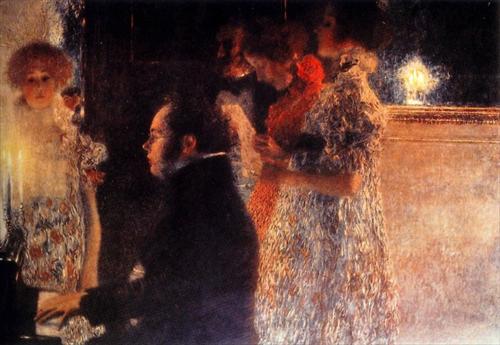
This is a photograph of an 1899 Gustav Klimt painting “Schubert at the piano” that was destroyed in the war. Click for more information on the painting.
The Toronto Symphony’s new year begins on tour in Florida.
click photo for more info
It’s tough enough when a hundred well-rehearsed players take the stage at Roy Thomson Hall in Toronto, where we all presumably eat & sleep; quite another to undertake playing Beethoven or Chopin or Tchaikovsky, having lugged all those instruments & people & music-scores & a miscellany of equipment to a variety of concert halls in another country.
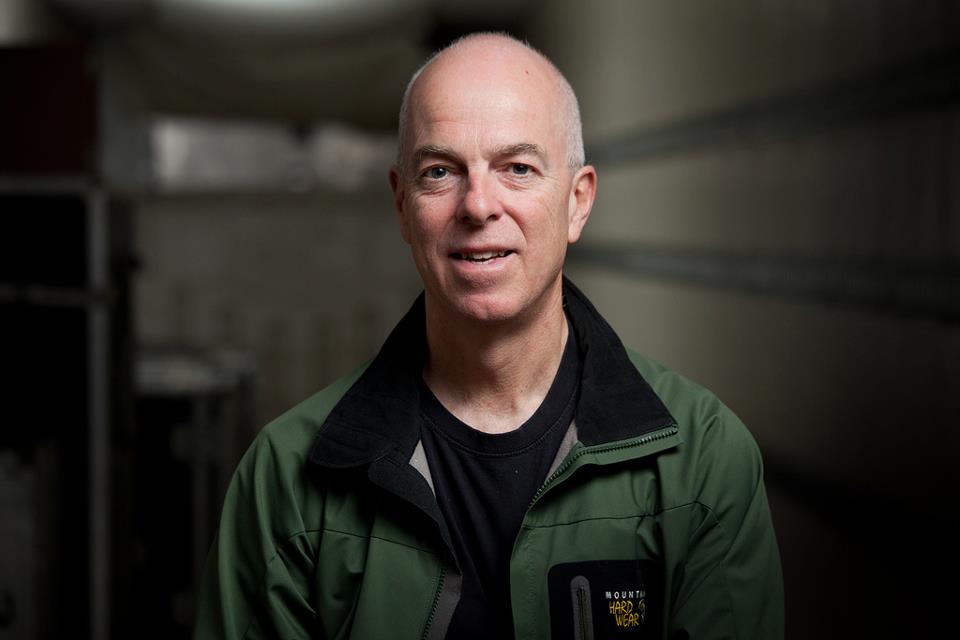
I am in awe of such an enormous undertaking. Just thinking of the possible difficulties makes my mind boggle. This is another one of those complex endeavors resembling an iceberg, where the efforts of support staff ‘beneath the surface’ are invisible. In the spirit of giving credit where credit is due, I wanted to find out more from the TSO’s production manager Chris Walroth: himself someone who insists that he’s just “a small part of a large effort”.
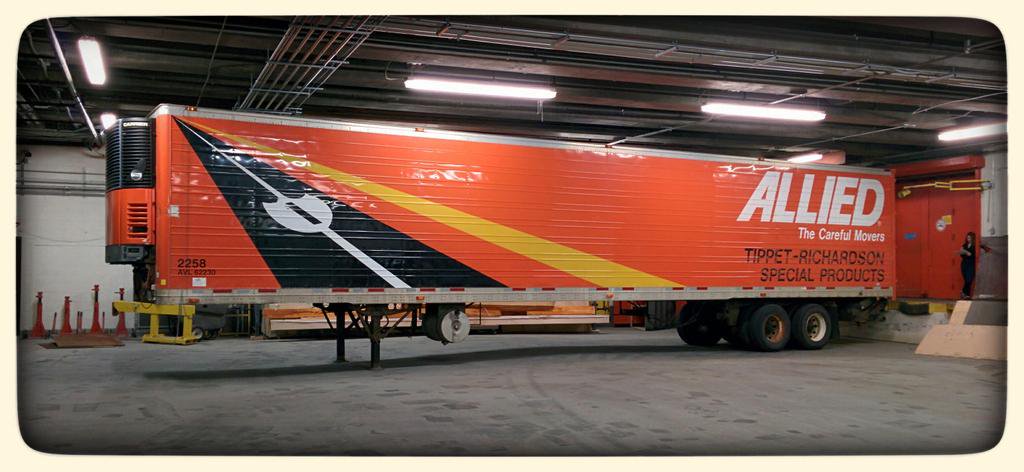
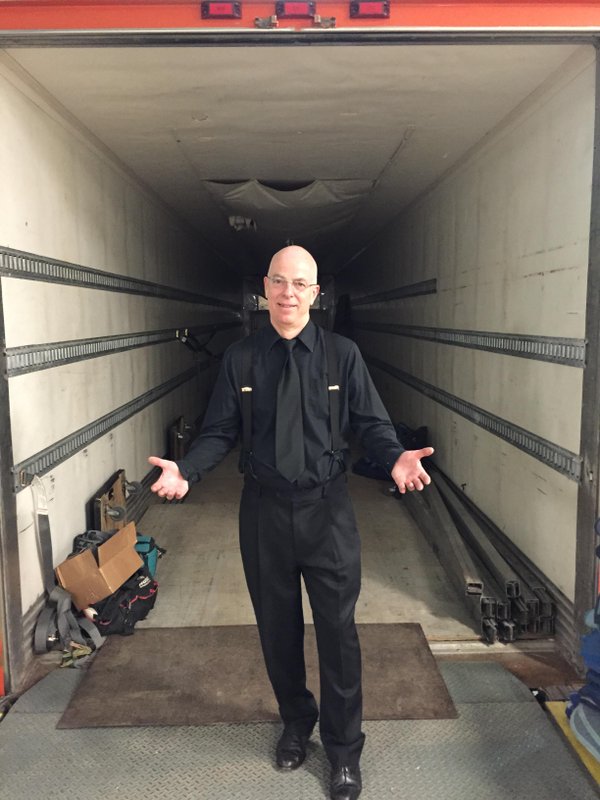
In the back of the Tippet Richardson Truck, Kiwanis Community Theatre Centre loading dock Sault St. Marie, Ontario. (Sean Howard photography)
I asked him ten questions: 5 about Chris and 5 more about taking the big show on the road. Forgive me if I sometimes address him as though he does it all, when he’s often speaking for the team.
1-Are you more like your father or your mother?
Physically I am my father’s son. When I compare photos of my dad in the 40’s and me in the 70’s if you ignore the hairstyles we are the same man. My dad could always find something to keep him busy. I’m a lot like that, I can’t go more than three days at the cottage before I’ve got a project to work on. Dad was very outgoing, the life of the party. In that respect I am more quiet and reserved like my mother. Mom also instilled in me a love of the arts and made sure I saw live theatre, music and dance at an early age. Both parents taught me the value of hard work, how to live happily within my means and the compassion to help others. Performing artists need to get their energy up for a performance, production and technical people who support them need to find their quiet and calm centre so that they can keep things running smoothly behind the scenes. My family tell me I am most like my maternal grandfather: the quintessential calm quiet man.
2-What is the best thing about working with the Toronto Symphony?
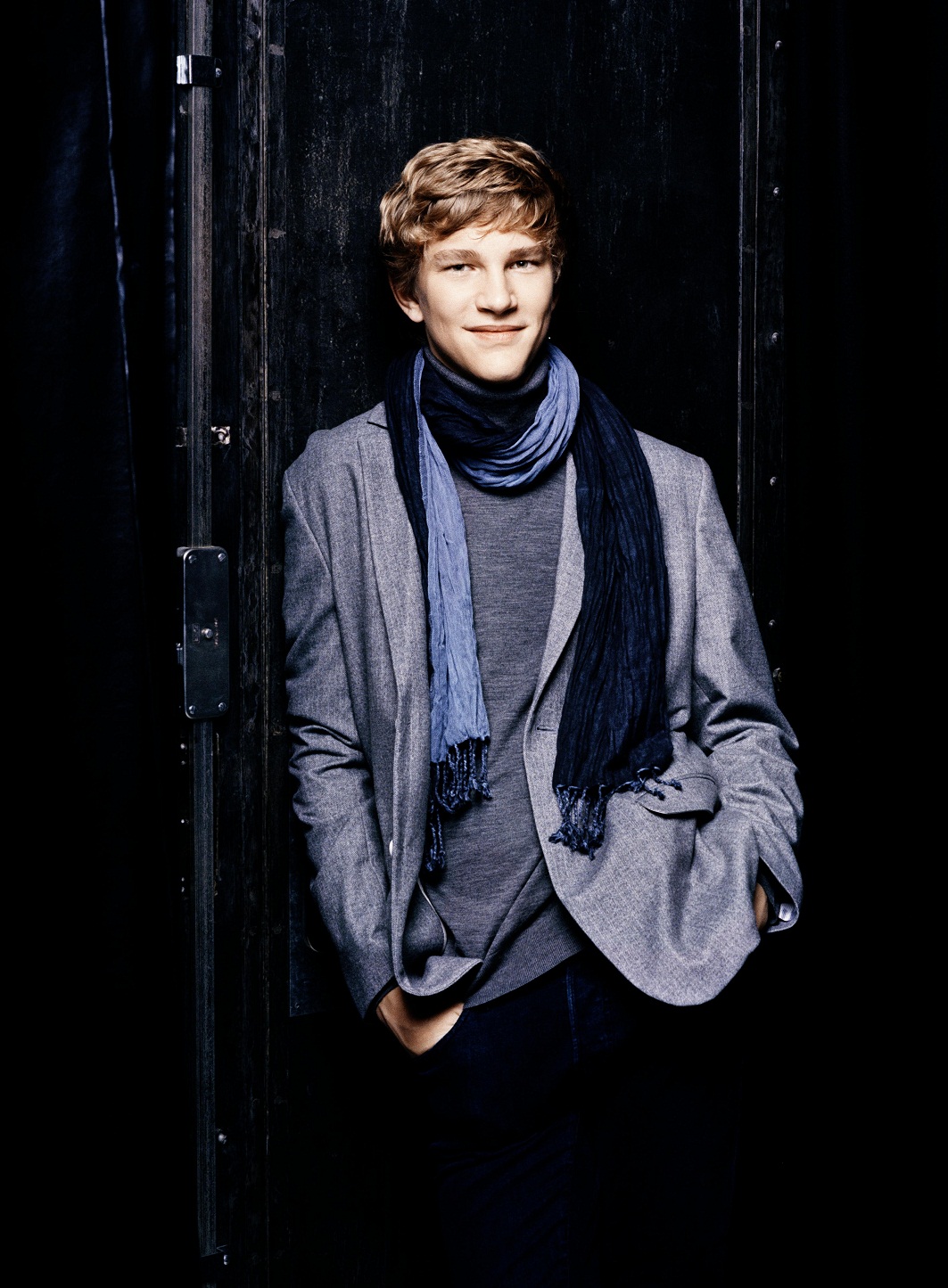
Pianist Jan Lisiecki, who also appears on the TSO tour (photo: Mathias Bothor–DG)
Really I have to say the music and the privilege of getting to know the people who make it. As a lifelong fan of classical music, being able to get this close to the music and the people who have been so welcoming to me, it is really the best part of my job. My desk is about 20 feet from where the conductor walks on stage so the music is always with me, some times I get the privilege of having Jan Lisiecki @janlisiecki practicing within ear shot of my desk or Jeffrey Beecher @jeffreybeecher working out a tricky passage on his bass, and it’s like my own private concert. I also get a free pass to sit in the auditorium and hear the orchestra work at any rehearsal. My favorite seat is in the Harry Belafonte section at Roy Thomson Hall, a block of seats main floor centre dedicated or donated in honour of Harry Belafonte.
3-Who do you like to listen to or watch?
I’m all over the spectrum as far as music goes. With so much live classical music in my life when the orchestra is working I tend to have less of that in my playlist. Lately I’ve been going way back to some of my early influences from the coffee house scene of the 70s. David Wiffen, Doug McArthur, I recently found a copy of Raffi’s Folk album “good luck boy” from the days before he started to write kids songs.
New artists in the same vein like the Good Lovelies are also on my current play list. In the summer during the orchestra’s ten week hiatus I play a lot of classical music. Clearly I miss them when they are gone. I watch mostly drama, not a lot of situation comedy grabs me. Early in my career I worked as the technician for the Frantics comedy troupe, and lighting director for their CBC radio show. (Chris recalls The Frantics)
Perhaps my close association with them makes me more critical of the laugh track driven sitcom. I have to say within living memory TREME, House of Cards, Jessica Jones are among my favourites. I also enjoy quirky reality TV like Time Team: a bunch of British archeologists digging gleefully in mud and rain looking for a bit of pot shard.
4-What ability or skill do you wish you had, that you don’t have?
That’s hard there are so many things I can’t do, I’m barely fluent in one language despite all the big words I am abusing here. I’ve never been particularly athletic. I am surrounded by such great musical talent and I can’t carry a tune or play an instrument. Sometimes I wish I had the discipline and dedication to train not for a professional career but just to play music as recreation.
5-When you’re just relaxing and not working what is your favourite thing to do?
I am never happier than when I am on the water. My first taste of freedom was being able to take a canoe out on my own any time of the day or night. I was a proficient paddler long before I learned to drive. I learned to sail in high school and added Kayak skills more recently. These remain my most relaxing activities. Put a paddle in my hand and you can almost see my blood pressure lower and my shoulders relax. As they say a bad day on the water is better than a good day ashore. The other place you will find me happy is in a woodworking shop, I spend so much time making; plans, phone calls, budgets, that making something out of wood, that is made to last is a great antidote to the stresses of work.
(Photo: Tanya Babalow)
*******
Five more about being the TSO’s production manager, and the orchestra’s upcoming tour
1-How long have you been Production Manager, and please talk about the career pathway.
I’m currently in my eighteenth season with the TSO, barely out of rookie status compared to the 40% of the orchestra who have been here for over 25 years. I am however seventh as far as staff seniority goes. I started out in the theatre as a jack of all trades technician and stage manager. I mostly worked with smaller companies and most of my work was freelance so I was never in one place for very long and I took on a variety of jobs: lighting tech one week, audio the next, a few weeks of carpentry etc… I took a turn into the world of planning corporate and trade shows for awhile, Mary Kay gave me a masters education in people motivation, I also got to play with the latest audio visual toys and special effects before they became more affordable for the arts sector. With a few exceptions most notably Technical Director for Mary Lou Fallis in a variety of her one woman shows, and Elyakim Taussig for his Taussig and Enemies show in which he played the piano and I played most of his enemies. (Me in the check shirt).
I had little work experience with musicians and almost none with orchestras when I joined the TSO. It turns out if you are motivated the basics of orchestra is pretty easy to learn. And I had a lot of mentors in the orchestra who brought me along. What the TSO needed was someone with strong skills outside their comfort zone of overture, concerto, symphony in the same hall every night. So far I seem to have proved up to the task.
2-What’s the best thing about your role with the TSO?
Well since I already talked about the music above, I have to say all the people I interact with every day. I am mostly a pessimistic introvert. So work at the TSO is like a giant therapy session for me. First the ninety musicians, sixty staff, and countless volunteers, venue staff and vendors are all in their way my customers. I have a small bit critical role in co-ordinating and facilitating everyone’s efforts on the concert. Production management is really all about fixing what might go wrong before it happens or before anyone notices. We are always looking for what’s wrong and don’t pay attention to what’s going right. I have learned that most people don’t respond well to a constant barrage of negative so I have tried to retrain myself to notice success occasionally and comment on those things.
3-Orchestras tour so much nowadays that it might appear routine, yet I suspect there’s also a part played by Murphy’s Law: which states that whatever can go wrong, will go wrong. What kind of things can go wrong?
Indeed, “Murphy was an optimist” is the first rule of touring (here’s the “TSO rules of the road” video from a previous tour).
“Eat like a hobbit” is the second rule.
The most important rule of tour stories is you have to tell your own personal most embarrassing story first. So here is mine.
The last thing you do in any venue is called the idiot check, one final look everywhere at everything because if you forget to take it from here you are going to feel like an idiot when you get there and don’t have it. Years ago we were just leaving Quebec City heading for Montréal when I got a call from a colleague who was on tour with us. She told me the venue staff called her to let her know someone’s wardrobe was left behind in a dressing room, she just wanted to let me know that she could swing by and pick it up and bring it to Montréal. Well that’s great I said thanks. She said by the way they told me there was a name on the garment bag. Curious I asked oh whose name? Yours, she replied.
I was also guilty of inadvertently stealing a harp dolly from the National Arts centre. I returned it as soon as I realized we had packed an extra one on the truck at load out but ever since then the NAC crew hide their harp dolly if they know I am coming by.
Tippet Richardson Truck at the NAC loading Dock
Seriously I never sleep well until the whole tour is over and the truck is unloaded for the final time. Once all the instruments and people are home safe I can really relax. On our European tour we shipped over $6.4 million in “professional Equipment” instruments music and wardrobe.
Photo by Chris Walroth
What I have come to realize is the intimate relationship between a musician and their instrument especially for string players is far more important than the monetary value. Loss of an instrument for some of these players working at the highest skill levels can be a huge career challenge.
Chris Walroth: about to pack the truck for the homeward trip on a previous tour
4- How long have you and the team been working to plan the current tour?
TSO Music Director Peter Oundjian
Tour Planning starts way in advance, easily two to three years out with the artistic team led by Peter Oundjian and Loie Fallis working out repertoire and confirming soloist availability. At the same time operations starts to look at budget and logistics and since the fees we earn on tour don’t cover the cost of putting 120 people on the road for a week or two our development and sponsorship team start to identify people or companies that may be willing to underwrite a portion of the cost. The actual booking of the dates is handled by an agent or manager who is familiar with the area we are touring to. They sell our program to the various presenters and try to arrange the dates to maximize the number of concerts per week and minimize the travel hours between locations. I provide a tour rider to the agent, mostly boilerplate stuff every orchestra needs, load in crew, x number of orchestra chairs, music stands, two large dressing rooms etc. There are a few things that vary per show for example on this tour we are asking for two concert grand pianos one for the soloist another for the orchestral overture. If we are touring to a new region the operations team tries to get in an advance tour about a year out, to look at the venues, hotels, restaurants and other amenities, also to travel the same routes the orchestra will take to check drive times available rest stops etc.
If it’s a cross border or overseas tour we start to make the general arrangements for shipping, based on previous tours I can make a fairly good guesstimate about how many pallets and weight for air freight, it’s only about sixty days out I start looking at a more final list of what we need to ship including how many musicians want us to ship their personal instrument.
At the same time I am contacting all the venues to confirm they have our rider, when we can load in, and all the other little details. Our Assistant Production Manager Alaina Viau oversees the tour book we publish for the orchestra with schedules bus calls and a variety of other useful information on each city. Then we pack everything push it into a truck and head out on the road.
Once everything is on the truck it’s in the good hands of our long time Sponsor Tippet-Richardson. Their staff is so great I really don’t have any worries while the instruments are on the truck.
5- Who is the most important mentor or influence you’d care to name that led you to where you are today?
This is the hardest question yet. There have been so many people along the way who gave me opportunity to prove my worth and work beyond my comfort zone. So many mentors and friends over the years, production people are very generous with their time and advice, I guess we all feel it’s a small community and we are all part of the same team. It’s hard to pin down just one. I guess if I take the question literally, there is really only one answer: one of my oldest friends, Fred Bunting. We met over thirty years ago when I brought a touring production of ‘beyond the fringe’ into the Oakville centre. We became friends that first day and worked together off and on ever since. Fred was in this job before me and when he decided to move on he was asked if there was anyone he would recommend. He said only one person and if they could convince me to move back to Toronto from BC they should just give me the job don’t even bother posting it. He then spent the next month browbeating me into sending a resume.
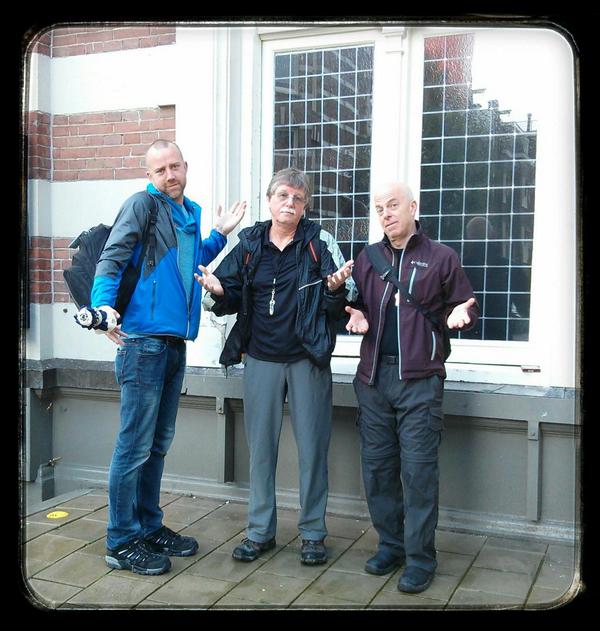
Jon Welmers, Fred Bunting, Chris Walroth. The window behind us is the loading door for Concertgebouw
It was a job I felt totally unqualified for having no experience of orchestras. Fred was persistent countering every objection I made, and I guess almost eighteen years later he has been more than proven right. I have to add only that I could not have been a success without the trust the orchestra placed in me. From day one at the TSO I have felt a welcomed member of this large diverse extended family.
For anyone curious about how our tour is going you can find most everything on Twitter #TSOFlorida.
*******
Chris Walroth and untold helping hands make it possible for the TSO to tour abroad, this time in Florida, January 2-10th, performing six concerts. You can hear Chris five minutes into this TSO podcast where he talks about touring.
The year isn’t quite over yet, but already we’re looking back at 2015 as 2016 draws closer. When we remember Pollyanna’s credo –“if you can’t say anything nice, don’t say anything at all”—no wonder we look back. As the dollar continues to plummet, as rumours of war abound, retrospectives are safer.
It was a year when the Pollyanna sentiment seemed to be in the ascendancy.
Trudeau beat Harper. I can’t help wondering, would that have been the case if the Paris attacks had come just a few weeks earlier, possibly dampening our enthusiasm and our willingness to open our hearts?
Merkel –who welcomes refugees–rather than Trump –who would slam the door– was Time Magazine’s person of the year. Here’s hoping that it isn’t Trump in 2016, because you know what that’s likely to mean in an election year (gulp!).
Refugees have been a big news item in Canada, where the prevailing impulse is welcome & assistance. I’m proud of my country.
I can’t help remembering some of the big stories of the year through those rose-coloured glasses.
January & February is usually the coldest time of year, but can see some wonderful explorations. The Toronto Symphony had their New Creations Festival, curated by George Benjamin, including a residency by soprano & conductor Barbara Hannigan. Opera Five paired a new opera by Darren Russo with Wolf-Ferrari’s Secret of Susanna. Soundstreams gave us Whisper Opera. The COC’s pairing of Tcherniakov’s Don Giovanni and Egoyan’s Die Walküre occasioned some fun headlines at the very least (both “Some resist seduction by Tcherniakov’s Don Giovanni” and “Don Giovanni or Don JianGhomeshi…?“), and several brilliant performances.
March and April can be times of optimism, and I was hopeful traveling to hear Opera Lyra’s Figaro, even though the company would close in the autumn. But this was a heady time of possibilities, including Opera Atelier’s Orpheus and Eurydice (as Marshall Pynkoski showed signs of breaking free of the historically informed strait-jacket), Metro Youth Opera’s Béatrice et Bénédict, a workshop performance of Mozart’s Requiem directed by Joel Ivany comes to fruition next month with the TSO. One of my highlights of the year was Adrianne Pieczonka singing Strauss’s “Four Last Songs” followed by Wagner’s Tristan Prelude & Liebestod. And while we’re speaking of the TSO, the Toronto Symphony were the centre of a major controversy, replacing Valentina Lisitsa with Stewart Goodyear, then eliminating the programmed Rachmaninoff concerto altogether when SG became an online target of harassment. Although TSO President Jeff Melanson took some heat over the cancellation, I think that he did the right thing.
May and June? The COC offered a new Barber of Seville with the Lepage Bluebeard-Erwartung pairing, while later Against the Grain presented Death & Desire, a curious mix of two composers’ song-cycles. I mostly recall a couple of brilliant performances, namely Alek Shrader in Barber¸ but particularly the work of Krisztina Szabó in the COC’s Erwartung and AtG’s Harawi. In high-diving you get marks for what they call “degree of difficulty”; if artistic performance recognized such things, Szabó ’s work on these two jagged pieces of modernity would have her on whatever podium properly recognizes brilliance.
Mezzo-soprano Krisztina Szabo (photo: Bo Huang)
For July and August, Nik Beeson’s Dive, and Karita Mattila’s concert for Toronto Summer Music were highlights in a period when I otherwise seemed to be asleep, busily preparing for a few things in the weeks that followed. Bicycle Opera came to Toronto on the Labour Day weekend to finish their summer tour, another lovely anthology of short littles pieces showcasing great singing actors.
September and October begin a new season. My highlight was an old film offered by tiff in collaboration with the TSO, namely Vertigo, including an appearance by Kim Novak. But I was far more intrigued by the live score with film, seeing two more in the weeks that followed, namely Back to the Future and Psycho on Halloween night. It may be too soon to call this a trend, but I am hoping we see more of these films with live performances of the score. The COC offered us a new Traviata plus the first opera by a Canadian composer in a very long time. The undertaking is admirable even if I was conflicted by the project. Opera Atelier meanwhile went in the opposite direction, bringing us up to date with the 17th century’s Armide, in a very strong production.
Jack Rennie (Amor) holds Peggy Kriha Dye (Armide). Photo: Bruce Zinger
November and December? More experiments, including Tapestry’s “Tap: Ex METALLURGY”, Soundstreams’ Electric Messiah, Soundstreams’ co-production with Canadian Stage of Boesmans’s opera Julie, CASP’s “The Living Spectacle”, combining adventurous song with movement/dance, and another wonderful concert from Sondra Radvanovsky.
And while I am thinking of Pollyanna looking back in gratitude, I’m thinking especially of a group of women who either call Toronto their home or who have chosen to come here:
Canadian Barbara Hannigan, who has been here a few times lately after a long gap, and returns in 2016
soprano & conductor Barbara Hannigan (photo: Elmer de Haas)
American Christine Goerke, who did her first Walküre Brunnhilde last winter (earlier in 2015) , and soon will return to do her first Siegfried Brunnhilde in a few weeks, before taking the role elsewhere.
Sondra Radvanovsky: one of the great singers in the world who happens to live here, and fortunately sings here sometimes as well
Ditto for Adrianne Pieczonka, one of the great singers in the world
And I mentioned Krisztina Szabó who was back for the fall COC season as well.
There are men too even if I seem to be blinded by the aura of these women. The key men in the picture for me are executives, builders such as Alexander Neef of the COC, Jeff Melanson of the TSO, Michael Mori of Tapestry Opera, artists such as, David Fallis, Johannes Debus, Topher Mokrzewski, Jan Liesicki and Stewart Goodyear.
And yes let me echo what Stewart’s name seems to imply. Have a good year!








 barczablog