A Zany COC Barber

The Canadian Opera Company premiered their new Barber of Seville tonight at the Four Season Centre, a colourful co-production with Houston Grand Opera, Opéra National de Bordeaux and Opera Australia  directed by Joan Font, with set & costumes designed by Joan Guillén.  Rossini’s comic masterpiece is well served in this interpretation relying heavily upon the Commedia dell’Arte origins of the story as a departure point for its theatricality.  The stage-pictures they present are glorious, vibrant, throbbing with colour, and always seeming to probe the story for additional meanings.

Perhaps too many? Early on I thought we might be taking this Barber in a very serious direction –picking up clues dropped by Alek Shrader in his recent interview—when he challenged my assertion that the Count Almaviva is inevitably the good guy.  Not necessarily.  There’s at least a hint of something Marxist / materialist to problematize the relationships & the story, as this Count throws wads of money at everyone.  His decision to pretend to be poor is framed within a fundamental question about authenticity that energizes many of the scenes, his ultimate success clouded slightly by his wealth.  There are some subtle changes in the character dynamics, although that may be a result of the singers as much as the direction.

I expected Figaro to be the master – manipulator, always at the heart of the story, but that’s not what I saw tonight.  Joshua Hopkins brings a nice bel canto voice and a likeable personality to the role of everyone’s favourite barber.  Usually the Count is rescued incessantly by his tricky servant.  That’s the essence of CdA, where servants outsmart their masters, young love triumphant.
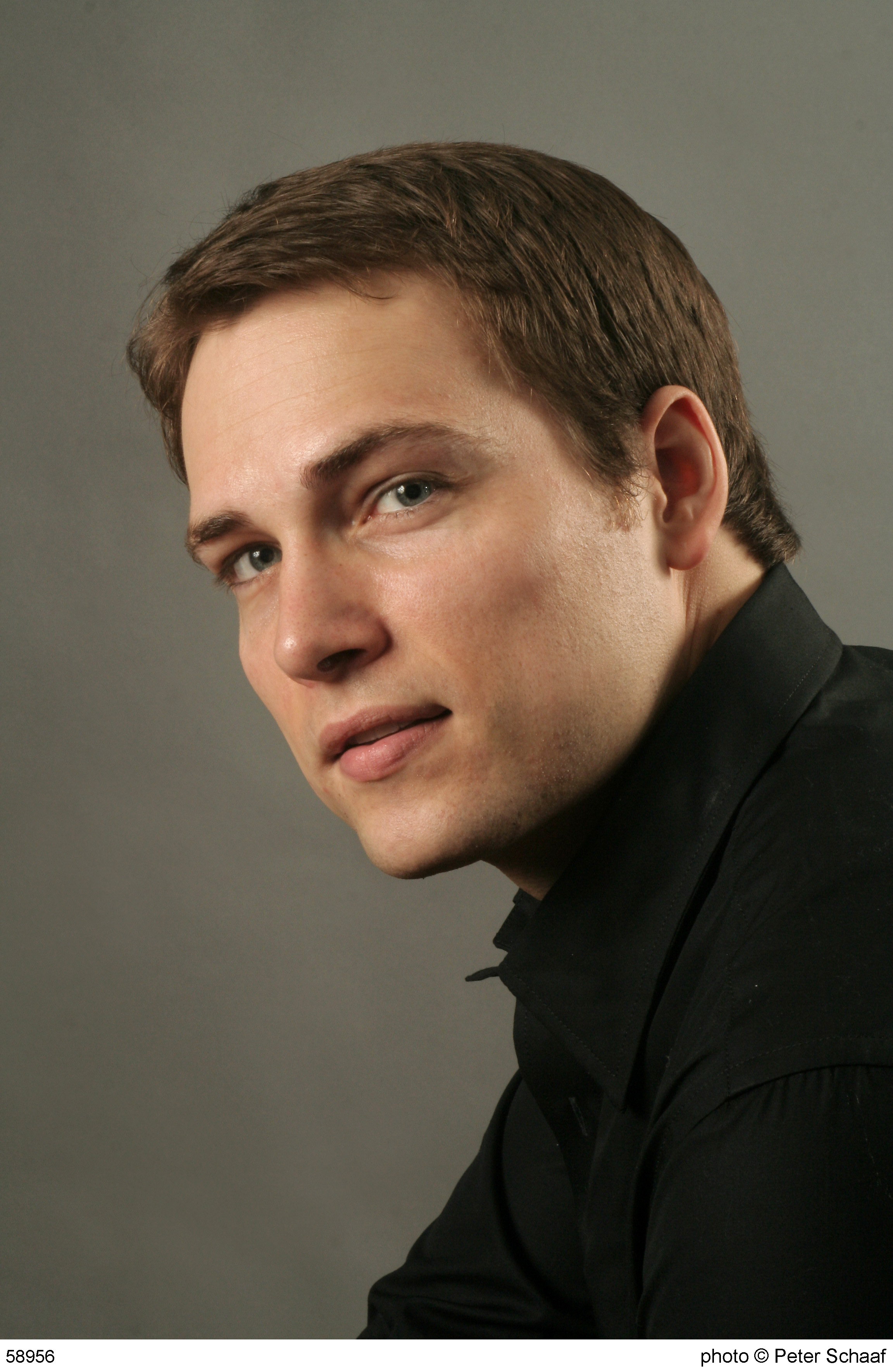
Tenor Alek Shrader (photo: (c) Peter Schaaf)

Tenor Alek Shrader (photo: (c) Peter Schaaf)

Yet it was Shrader not Hopkins who was the central figure because of this slight change in the opera’s emphasis, both dramatically (including both wacky disguises) and vocally.

I’ll be interested to see how this plays in the Ensemble Studio performance coming May 15th, as I couldn’t tell if this was a function of the direction or the flamboyance of the performances.  Font & Guillén make the opening serenade an over-the-top bit of farce with the wacky band who play in support, even as Shrader finds all sorts of additional notes to add to both the cavatina & the cabaletta.
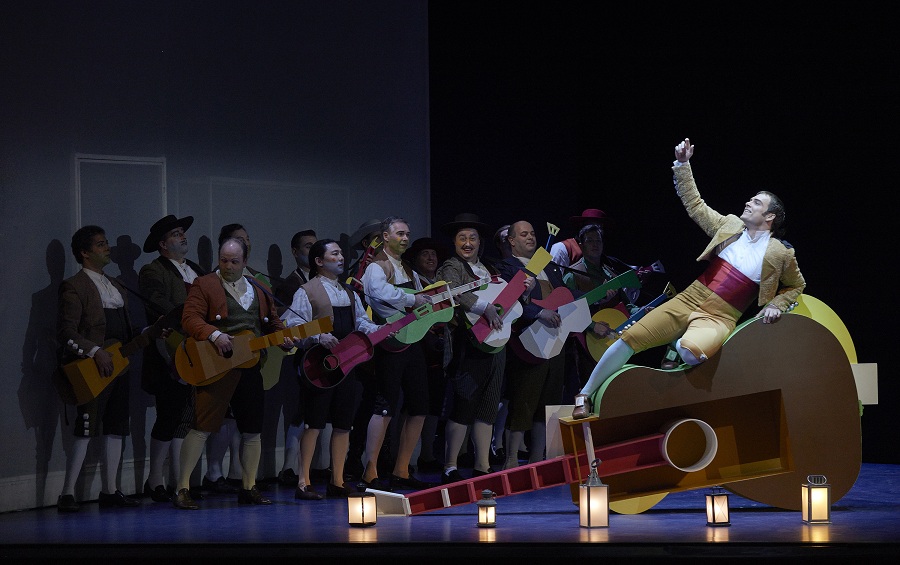
Alek Shrader as Count Almaviva (far right) in the Canadian Opera Company production of The Barber of Seville, 2015. Photo: Michael Cooper

Alek Shrader as Count Almaviva (far right) in the Canadian Opera Company production of The Barber of Seville, 2015. Photo: Michael Cooper

From there on we seem to be sticking closely to the text as written.

The cast was strong throughout.  Serena Malfi was a wonderfully sultry Rosina with a genuinely dark mezzo-soprano colour, and wonderful chemistry with Shrader.   Renato Girolami’s Dr Bartolo was mostly good fun with a hint of genuine gravitas, especially in his domination of his ward.  Robert Gleadow added another solid portrayal as Don Basilio, with a big solid sound. Ensemble members Iain MacNeil  as Fiorello and Aviva Fortunata  (the most luscious sounding Berta I’ve ever heard) more than held their own with the more experienced cast members.

I found myself recalling Els Comediants work on La Cenerentola four years ago, a production that I still recall as one of the best things I’ve ever seen from the COC.  I can’t decide whether the issue is the match between their politics and the opera, or that they simply offered a more thorough treatment on that occasion.  You may recall that just as on that occasion we were interrogating illusion & reality, examining our assumptions about what we see vs what is mere portrayal, so too this time.  But I wonder, did they lose their nerve, or consider that what they were implying was a very dark reading?  If Almaviva is only successful because of his money, a winner due to privilege rather than merit, is that really a happy ending at all?  In contrast, the story of Cenerentola thoroughly reflects their critique of a materialist life, rewarding the one who sees life with greater enlightenment than her superficial & materialistic sisters.  In this case perhaps Font & Guillén felt conflicted or even guilty that the rich boy wins the girl, that there’s some question as to whether he wins on merit.  I’m not saying it’s not a fun production –because in the end they don’t tamper with Rossini—but there are some clear signals that they weren’t taking the text at face value, such as the final image, when the audience appears to be showered in play-money.   Is this whole critique perhaps misplaced, especially when Figaro really comes to life for the first time when he sings “All’idea di quel metallo portentoso, onnipossente, un vulcano la mia mente
già comincia a diventar,” (or in other words, “at the idea of this metal, portentous, omnipotent, a volcano begins to erupt inside me”)…?  There’s surely room for a critique, even a Marxist one, but there’s a limit. Is Almaviva one of the evil 1%? Beaumarchais (the playwright who created the Barber) wanted Figaro to be the smartest person in the room.  Maybe it’s the bump on my head that i got the other night, but that’s not what i saw, however.  Shrader’s Almaviva wins the girl on merit, even though he happens to be wealthy too.  So perhaps you should ignore the money that showers down on you, and simply enjoy the glorious singing and the stylish playing of the COC Orchestra, led by Rory Macdonald.

The COC Barber of Seville continues for another dozen performances, closing May 22nd.
Posted in Personal ruminations & essays | 2 Comments

COC Ensemble Studio: Special Performance of The Barber of Seville

CANADA’S RISING OPERA STARS STEP INTO THE SPOTLIGHT FOR SPECIAL PERFORMANCE OF THE BARBER OF SEVILLE

14/15 COC Ensemble Studio
Toronto – The stage is set for opera’s next generation of stars to shine, when the young artists of the Canadian Opera Company’s Ensemble Studio take on Rossini’s comic masterpiece, The Barber of Seville. This special performance takes place at the Four Seasons Centre for the Performing Arts on May 15, 2015, with all tickets accessibly priced at $25 or $55. This new COC production is sung in Italian with English SURTITLES™.

The Ensemble Studio performance is a once-a-year opportunity for artists of the Ensemble Studio, Canada’s premier training program for young opera professionals, to sing the starring roles in a COC mainstage production. It’s an important step in the young singers’ careers, with most making role debuts or even appearing in an operatic production on the Four Seasons Centre stage for the first time. This year, the singers work with the same creative team as the mainstage cast for The Barber of Seville, in a new COC production from acclaimed Spanish theatre troupe Els Comediants. Led by director Joan Font, the Ensemble Studio artists perform with the full COC Orchestra and Chorus, under the direction of Scottish-born conductor Rory Macdonald.

In what is widely regarded as opera’s greatest comedy, hilarity ensues as Figaro, the barber of Seville, assists a lovesick nobleman win the woman of his dreams. In this production, the Cubism-inspired set plays with scale and proportion, while bursts of Day-Glo colour and innovative lighting conjure a fantasy world hovering between fairy tale and vaudeville.

Hailed as “a singer to watch” (Musical Toronto) with “plenty of power” (Opera Ramblings), baritone Clarence Frazer sings the title role of the wily barber Figaro. Recently, he appeared as Prince Yamadori in the COC’s fall production of Madama Butterfly and Guglielmo in the 2014 Ensemble Studio performance of Così fan tutte. He also appears with the mainstage cast of The Barber of Seville as the Officer.

Tenors Andrew Haji and Jean-Philippe Fortier-Lazure share the role of Count Almaviva, the young nobleman seeking Figaro’s help. Haji has been praised for his “terrific lyric tenor” (La Scena Musicale), and in September 2014 won the Grand Prix, the Press Prize and the Junior Jury Prize at the Netherland’s prestigious ’s-Hertogenbosch International Vocal Competition. Named one of CBC’s “30 hot Canadian classical musicians under 30” in 2014, Fortier-Lazure makes his COC mainstage debut.

Mezzo-soprano Charlotte Burrage is the opera’s charming young heroine, Rosina. After making her mainstage debut in 2014’s Ensemble Studio performance of Così fan tutte as Dorabella, PaulaCitron.com described her as “blessed with a seductive lyric voice of great clarity of tone, overlying hearty expression.” In winter 2015, she sang the role of Grimgerde in the COC’s production of Die Walküre.

Praised for his “gorgeous sound” (Schmopera), bass-baritone Iain MacNeil is Rosina’s guardian Bartolo. Two COC Ensemble Studio Competition First Prize and Audience Choice Award winners, bass-baritone Gordon Bintner and soprano Karine Boucher, sing the roles of the singing teacher Basilio and Bartolo’s servant Berta, respectively. Bintner has been praised for his “firm technique, remarkable musicality, abundant theatrical flair and a princely stage presence” (Musical Toronto), while Boucher has been called a “very gifted singer” with a “knockout stage presence” (Musical Toronto).

The Ensemble Studio performance is part of the mainstage production of The Barber of Seville, which runs from April 17 to May 22, 2015 at the Four Seasons Centre for the Performing Arts. The production team behind this new COC production is Els Comediants, with direction by Joan Font, set and costumes by Joan Guillén, and lighting design by Albert Faura.

About the Ensemble Studio

The COC Ensemble Studio is Canada’s premier training program for young opera professionals. Since the inception of the program in 1980, over 180 young professional Canadian singers, opera coaches, stage directors and conductors have acquired their first major professional operatic experience through the Ensemble Studio. Former members include Ben Heppner, Isabel Bayrakdarian, John Fanning, Wendy Nielsen, Joseph Kaiser, David Pomeroy, Allyson McHardy and Krisztina Szabó.

The members of the Ensemble Studio are the COC’s resident artists and important ambassadors for the company. They receive a blend of advanced study and practical experience through an individually tailored, multi-year program, involving understudying and performing mainstage roles, intensive vocal coaching, language and acting studies, and career skills development, as well as participation in masterclasses with internationally renowned opera professionals.

Ticket Information

Single tickets for the Ensemble Studio performance of The Barber of Seville are $25 and $55 per person and are available online at coc.ca, by calling COC Ticket Services at 416-363-8231, or in person at the Four Seasons Centre for the Performing Arts Box Office, located at 145 Queen St. W., Monday to Saturday from 11 a.m. to 6 p.m.

Standing Room tickets are available for $12 at 11 a.m. the morning of the performance, in person only at the Four Seasons Centre Box Office. Limit of two tickets per person. Subject to availability.

About the Canadian Opera Company
Based in Toronto, the Canadian Opera Company is the largest producer of opera in Canada and one of the largest in North America. The COC enjoys a loyal audience support-base and one of the highest attendance and subscription rates in North America. Under its leadership team of General Director Alexander Neef and Music Director Johannes Debus, the COC is increasingly capturing the opera world’s attention. The COC maintains its international reputation for artistic excellence and creative innovation by creating new productions within its diverse repertoire, collaborating with leading opera companies and festivals, and attracting the world’s foremost Canadian and international artists. The COC performs in its own opera house, the Four Seasons Centre for the Performing Arts, hailed internationally as one of the finest in the world. Designed by Diamond Schmitt Architects, the Four Seasons Centre opened in 2006. For more information on the COC, visit its award-winning website, coc.ca.

*********

“Press releases and announcements” are presented verbatim without comment

Posted in Press Releases and Announcements | Comments Off on COC Ensemble Studio: Special Performance of The Barber of Seville

10 Questions for Krisztina Szabó

My stereotype of Krisztina Szabó is inaccurate of course. My questions may have made her laugh, even though she’s too polite to send me packing. In cobbling together a few questions –concerning a pair of 20th century compositions—I was far too narrow in my characterization of a singer who has cut a big swath through the Toronto scene. While she appeared in the Toronto Symphony’s concert performance of Benjamin’s Written On Skin just a few weeks ago, and played the Pilgrim in Canadian Opera Company’s L’Amour de Loin –the first COC opera composed in the 21st Century—she also sang the mezzo-soprano part in Handel’s Messiah for Against the Grain. So while she’s worked with the experimental opera groups such as Tapestry and Queen of Puddings (who regularly staged experiments that couldn’t happen without artists like Szabó) she also sings Mozart, Bach & Puccini.

This spring Szabó will again be exploring challenging compositions. First she stars in the Robert Lepage production of Schonberg’s atonal monodrama Erwartung for the COC opening May 6th. A few weeks later she sings Harawi in Against the Grain’s Death and Desire opening June 2nd. I had to ask Szabó ten questions: five about herself followed by five more about her upcoming projects.

1-Are you more like your father or your mother?

Somehow this feels like a trick question. Hmmm… well, I feel like I am becoming more my mother every day, but I think that I probably resemble my father more, at least in emotional make-up. Certainly, I resemble neither of them when it comes to career – my father was foreman of a welding company for 40 years and my mother was an accountant. My sister is an actuary, so I am the “weirdo” in the family. But I am told that my father had a beautiful voice – he refused to sing by the time I came into this world because he claimed to have “smoked his voice away”. And both my parents took part in local operettas and plays in their hometown of Écs, Hungary. So perhaps, I’m not such an anomaly after all…?

Mezzo-soprano Krisztina Szabo (photo: Bo Huang)

Mezzo-soprano Krisztina Szabo (photo: Bo Huang)

2-What is the best thing or worst thing about being a specialist in “new” music, often creating original work or singing unfamiliar repertoire?

Am I a specialist in “new” music? How did that happen?! When I think of “specialist”, I think of my dear friend, Barbara Hannigan who has a passion for contemporary music like no one else I know. I have done quite a lot of new music, particularly in Toronto, and I do love it, at least most of the time. I love dissecting music, and yes, I am a bit of a nerd when it comes to sight-reading… I owe that to my 6 years in the Toronto Children’s Chorus and piano training. I think the best part of doing new music is the freedom that it holds – nobody slots you into a box that you don’t fit into..in fact, if you’re lucky you get to work with a living composer who writes music tailor made to your strengths. But, would I love to sing Mozart: absolutely. I would love to sing a lot of things, but mostly I just want to keep singing, full stop.

3-Who do you like to listen to or watch?

I am a slightly obsessive Netflix watcher at the moment. In the last few months, I have watched 10 seasons of Friends, the new season of House of Cards, all 5 seasons of Downton Abbey (twice!) and most recently 2 seasons of Mr. Selfridge. When I’m on the road, I binge watch, and when I’m home, I like to watch an episode of something at the end of a day to wind down and relax.

4-What ability or skill do you wish you had, that you don’t have?

There are many skills that I wish I had, but the one that pops to my brain at the moment is the ability to “schmooze”. I am terrible at it, and in my business, it is an integral part of how things work. I used to be quite a shy child and I don’t think of myself now as shy necessarily, but in situations where I have to talk to people I don’t know, or make small talk with industry people I know only a little, my mind goes blank. Very annoying.

5-When you’re just relaxing and not working what is your favourite thing to do?

Netflix, Netflix and more Netflix. Sleep. Oh, and eat sushi.

*****

Mark Johnson as the Psychiatrist and Nina Warren as the Woman from 2001 COC production of Erwartung, photo by Michael Cooper.  Click for further information about the current production.

Mark Johnson as the Psychiatrist and Nina Warren as the Woman from 2001 COC production of Erwartung, photo by Michael Cooper. Click for further information about the current production.

Five more about Erwartung in the Canadian Opera Company’s spring season (May 6th), and Harawi with Against the Grain Theatre (June 2nd) .

1-What are the challenges in singing Erwartung?

The challenge of Erwartung has so far been learning the thing. It is a beast of a piece – hands down, the hardest thing I have ever learned. And Schönberg doesn’t really help you much with a cue note here or there, or – God forbid – double the vocal line! I can think of only a few bars in which that happens. Learning it was daunting. But it is now learned, and either I have actually gone a little crazy, or I’ve just prepared well, because I’m feeling pretty relaxed about it (at the moment.. ask me again on opening night..!).

The challenge now that rehearsals have begun are to get all the details in the score correct, all the details that my lovely conductor, Johannes Debus, is after, get all the dramatic shifts of her madness.. and then there is the singing with the orchestra! The role can be quite sprech-y in places, but when she goes crazy, its big, full, dare I say “balls to the wall” singing. And its 35ish minutes of just me singing. No pressure..! Gulp.

2-As far as your personal politics vis a vis a work such as Erwartung or your upcoming appearance with Against the Grain Theatre (singing Messiaen’s Harawi), please talk about how modern music might lead to a different way of seeing tragedy and violence in theatre & story-telling, especially for the female roles.

Director Joel Ivany

Director Joel Ivany

I’m not sure I have “personal politics” as such. I’m excited by the human journey of every character I play. And I have been lucky in that I haven’t played too many victimized women, as such, but then, when I’m not doing contemporary shows, I do a fair amount of trouser roles. I like 3 dimensional characters, I like finding my way in the skin of these characters. I love singing Donna Elvira as much as I love singing The Woman. As for the Harawi with Against the Grain Theatre.. since it’s a song cycle that we’re staging, not an opera, there is a freedom to that that is quite exciting. It will be whatever we make it! And I have no doubt that Joel Ivany will take me on an interesting journey with that production..

3-Please talk about the psychology of your portrayals and how you come at the character.

I always approach things rather intuitively in terms of how to portray characters. Yes, I look at the text, but the music – or the choices the composer has made with the text – informs so much of the character. I respond instinctively to those musical choices. And I really try to find a way to make that character a real person with real emotions and a real journey, as much as I can. I have also been lucky to work with many wonderful directors who bring deeper insight into the characters and their journey. I find I really feed off of the process of rehearsing – I love any and all ideas thrown at me because it makes me think more, makes me feel more, and, not to sound too cheesy, it makes me be more.
(Because Erwartung is a remount, Lepage is not here to direct, but we are lucky to work with Francois Racine, who has worked on this show since its inception. The choices made by Lepage and his design team are pretty amazing…I think it’s a remarkable piece of theatre. I’m not sure how much more detail I can give at this point since today was our first day of staging..!)

4-Please put your feelings about new opera and new music into context for us.

My feelings about new opera? Well, I am excited by the possibilities that new opera presents. I like that we are doing innovative chamber operas in funky spaces, I am excited about doing big new operas in traditional houses – like George Benjamin’s Written on Skin and Saariaho’s L’amour de Loin. It exciting to create something new, its exciting to challenge myself as an artist, and I think we, as audience members, need a little challenging as well. One might be surprised at what one loves..

5-Is there a teacher or an influence you’d care to name that you especially admire?

Jean Ashworth-Bartle (click image for more information)

There have been a few pivotal people in my life along the way – I must mention Jean Ashworth-Bartle, founder and former conductor of the Toronto Children’s Chorus, because not only was the TCC the first place I really felt like I belonged and began to thrive, but she was one of the first people to see something special in me and give me a chance. Then, at the University of Western Ontario, I was lucky to find my first singing teacher, Darryl Edwards, who not only given me a solid technique, but guided me through so much – university and beyond, and most recently invited me to teach at the University of Toronto, a position I am enjoying very much. He’s always had my back, and that’s a pretty great thing to have. And finally, two very special conductors – Richard Bradshaw and Bernard Labadie. Richard gave me my first opportunities at the COC, and really was responsible for launching my career. And Bernard Labadie was the first person after my Ensemble Studio days were over to provide me with performance opportunities – so vital to a young artist trying to build a career.

******

Official plug: come see the Canadian Opera Company’s Bluebeard Castle/Erwartung , and Against the Grain Theatre’s Death and Desire!  The COC double bill opens May 6th at the Four Seasons Centre, while the AtG program of Messaien’s Harawi also including Schubert’s Die schöne Müllerin opens June 2nd  at Neubacher Shor Contemporary Gallery.

click for more information

Posted in Interviews, Music and musicology, Opera | Tagged , , , , , , , | 1 Comment

Graceful Orpheus will move you

I can’t think of a performing arts troupe with a more recognizable style than Opera Atelier. For the first twenty years of their existence (give or take a few seasons), they straight-jacketed themselves with the idea of authenticity, portraying themselves as a company exploring baroque dance, movement, singing, music and performance, a selective quest, sometimes including unapologetically modern elements.

At one time I used to joke that Opera Atelier are a dance company masquerading as an opera company, although it turns out that the joke’s on me, considering that the other –bigger—opera company in town balks at grand opera, rarely using dancers even when they’re explicitly called for. And so OA’s dance-oriented style is especially apt for French operas, whether the earlier ones by Lully for that dance-happy King Louis XIV, or as we saw tonight, Gluck’s Orpheus and Eurydice in Berlioz’s 19th century version. Thank goodness that for the past few years artistic director Marshall Pynkoski has drifted away from that rigorous style somewhat, resulting in a product that is more relaxed and self-assured. What we’re seeing now are productions that are less about history books than about theatricality & enjoyment, and unapologetically giving their dancers a high profile.

Mireille Lebel(standing) and Peggy Kriha Dye in a rehearsal photo

Mireille Lebel(standing) and Peggy Kriha Dye in rehearsal

If you’ve never seen anything by Opera Atelier, Orpheus is a great place to start. It’s beautiful on several levels, from a cast that’s gorgeous to look at, giving you a glimpse of heaven and hell as fancifully created by set designer Gerard Gauci, and with extraordinary musicianship at every level. You’ll hear three wonderful soloists, Tafelmusik Orchestra and chorus, led by David Fallis. When I say “hear” it’s worth noting once more how thoughtful Fallis’ leadership is, from a score he has re-created, to levels always letting the singers be heard.

Mireille Lebel is miraculous as Orpheus, striding boldly about the stage with a wonderfully masculine body language, via Pynkoski’s eye for historically informed physical eloquence, without negating her beauty as a woman. The role in its female contralto incarnation lies very low at times, often venturing along below middle C, all clearly articulated by Lebel. Fallis has included such elements as an enormous candenza at the end of one of her arias, so long that one could easily lose ones bearings: but finishing securely on pitch.

Peggy Kriha Dye offers another in her series of remarkable portrayals as Eurydice. The chemistry between her and Lebel’s Orpheus is profound, as I got totally caught up in her emotional blackmail as she tries –and succeeds—in getting Orpheus to turn around and look upon her: which kills her of course. Meghan Lindsay gave us another trouser role alongside Orpheus, playing Amour en travestie.  While the story is sometimes given a very dark colour in some readings, this version is extremely light throughout, for a number of reasons. Pynkoski’s recent style employs a great deal of comedy, especially in his work with Amour, who is a bit of a trickster in this production.

But the heavy use of dance also relieves some of the tension, with the many divertissements that make the opera a great deal of fun. At times the dancers are up on their toes, a first for an Opera Atelier show, as choreographer Jeannette Lajeunesse Zingg at times employed a movement vocabulary breaking out of their usual baroque style, reflecting the work’s relatively modern composition date, at least compared to what’s usual for Opera Atelier.

There are some moments that will sound genuinely new to you, no matter how well you think you know this opera.  I was especially impressed by the opening of Act II, namely the encounter between Orpheus and the Furies.  The “non!” that the Furies declaim in barring Orpheus’ path sounds unlike any i’ve ever heard, so much so that i wish i could see the score they’re working from.  It’s less a sung note and more of a shout, and makes this astonishingly dramatic and edgy, even as Lebel’s gentle voice and expression makes it impossible to sit there without tears.  I suppose i am grateful for one thing Pynkoski did that killed the illusion, when for some reason he has the Furies take the lyre out of Orpheus’s hands even as we hear the harp ostentatiously playing –complete with a spotlight– at the same time.  I always understood this as a simulation of diegetic performance: that the harp would seem to be Orpheus’ lyre as he seeks to pacify the Furies.  So thank you Marshall, as otherwise i would have started sobbing like a little child.  It’s still a wonderful scene for all that, the ensuing scene with the Blessed Spirits every bit as enchanting.

Mireille Lebel (Orpheus) with Artists of Atelier Ballet. Photo by Bruce Zinger.

Mireille Lebel (Orpheus) with Artists of Atelier Ballet. Photo by Bruce Zinger.

Spoiler alert: Pynkoski’s liberation from his old historically informed style and willingness to go for a laugh was never clearer than in the final tableau, when modern signage included a hashtag, earning a huge laugh.  Works for me!

Opera Atelier’s Orpheus and Eurydice continues at the Elgin Theatre until April 18th.

Posted in Opera, Reviews | Tagged , , , , , | 3 Comments

10 Questions for Alek Shrader

It can be embarrassing when you don’t realize you’ve already seen / heard an artist before.  I didn’t realize I’d seen Alek Shrader before, in his impressive turn as Ferdinand in Adès’s Tempest at the Metropolitan Opera.

So in other words, he’s a young, attractive looking tenor with a lovely voice who is already having success.  You can find a detailed bio here.

Shrader will be coming to Toronto to star in The Barber of Seville, beginning April 17th until May 22nd.  I had to ask him ten questions: five about himself and five more about taking on the role of Count Almaviva.

1)     Are you more like your father or your mother?

I’d say I’m a pretty even blend of my father and mother, like a clone of both of them but in one body.  I also find occasionally I’m not like either one of them.  I guess that makes me a rogue clone, ready for misadventures and exploits and whatnot.  I’ve been told Orphan Black is a good show.

Tenor Alek Shrader (photo: (c) Peter Schaaf)

Tenor Alek Shrader (photo: (c) Peter Schaaf)

2)     What is the best thing or worst thing about being an opera singer?

The best thing about being an opera singer is that I met Daniela Mack.  The worst thing about being an opera singer is having to stay healthy.  We don’t get paid if we don’t sing, so catching a cold might mean the rent is late.

3)     Who do you like to listen to or watch?

Honestly, today’s music makes me feel like an old person because I hate most of it.  Even rappers don’t try to rhyme anymore, and that makes me sad.  Musicians used to look cool, but now looking cool is music?  I don’t get it, man.  Get off my lawn.  The Awesome Mix vol. 1 from Guardians of the Galaxy proved to me that music used to be more… musical.  On the other hand, I’ll watch just about anything on a screen.  Screens fascinate me, like a hypnotist handing out free money.  There are far too many shows that I watch regularly to list here (it’s an issue of time), but I will mention Game of Thrones and Community.  I’m always up for a movie – flying from Sydney meant I could power-watch Birdman, Fury, The Drop, This Is Where I Leave You, Whiplash, and Nightcrawler.

4)     What ability or skill do you wish you had, that you don’t have?

I wish I had the ability to not hold grudges indefinitely.  I also wish I could live forever (but in that case, I’d really need the first wish as well, unless I simply outlived those I held grudges against).

5)     When you’re just relaxing and not working what’s your favourite thing to do?

Relaxing is hard for me…  It stresses me out.  I’m always working, though I’m not always singing.  When I’m not learning music or researching opera stuff, I’m doing my other job (which is writing).  I write stories, comics, pilots, screenplays, even poetry that rhymes.  To plot my tales, I read a lot about whatever my subject matter is, going down rabbit holes for hours.  And as I said before, watching TV and movies is an any-time-of-day activity.  In all my jobs/activities, what I do for fun is storytelling – to me, it is an essential part of life.  Writing, reading, watching… Sunlight scares me.

*******

Five more about playing Count Almaviva in the upcoming Barber of Seville.

1) Please talk about the challenges of singing the role of Count Almaviva.

Almaviva has all the classic Rossini vocal challenges: coloratura, stamina, singing in tune, being audible above the orchestra (those might not be uniquely Rossini).  Occasionally (and including this production), Almaviva’s guise as the substitute music teacher has a “funny” voice.  Almaviva’s aria in Act 2 comes at the very end of the show and it can be a challenge to save enough gas for that (but it’s cut from this production, so problem solved).

2) The Count is inevitably the good guy.   How do you approach your portrayal?

Nothing is inevitable!  But you’re right – he’s often traditionally portrayed as the earnest young lover (as he is in this production).  Almaviva comes from money and privilege, and that’s always been enough to get what he wants.  Then he meets Rosina and all of a sudden he needs her to love him for who he is as a person.  That’s how we know this romance is special for him.  That’s why the few conditions of his pursuit of Rosina involve not revealing his status or wealth.  Now, he uses money to further his relationship with her and get out of tricky situations, but what Almaviva is looking for is something that he cannot purchase.  Good guy, bad guy, ugly guy doesn’t matter – the story (well, my story) of Almaviva is a guy who needs to feel like he’s worth more than his money.  You could also say that he’s just like super in love and needs to vet Rosina before they get married, so he puts on a bunch of disguises and bribes some folks.

My approach to Almaviva (and acting in general) is very simple: play pretend.  Many actors and teachers of actors tell me to dig through my own life experiences and wander through that on stage.  That’s a perfectly valid method for acting (and in the end, the correct method is the one that works for you), but I reject that approach for opera acting.

First off, opera is by nature NOT realistic – it is larger than life (it was designed that way).  My own life experiences were exactly life-sized, and even though I could translate my emotions from those experiences to the stage, I’d have to amp up the drama – now I’m pretending that I’m feeling emotions I never felt anyway.

Second, I don’t need another reason than the first one.  Acting is pretending, with calculated sympathy and empathy.  Film/TV actors and (to some extent) stage actors have more freedom to inject “reality” into their performances (they can apply their own volume level, their own timing, their own body language, even the direction they are facing on stage), but opera demands (nay, requires!) a grander portrayal while we all suspend disbelief that all the people on this planet are singing.

You asked (in the part of the question I deleted) how much of my Almaviva is Alek Shrader – the answer is none, but we have a lot in common.

3) Do you have a favourite moment in the opera?

I love the overture (though it wasn’t written for Barbiere).  I always enjoy the moment halfway through the finale of Act 1 SPOILER ALERT… when the cops arrive because of the ruckus in the house.  It’s a sudden full-stop to the escalating chaos.

4) As the Canadian Opera Company presents this highly original production from Els Comediants (the team of Director Joan Font with Set & Costume Designer Joan Guillén), please speak about original & different approaches to opera, and how you feel about working with adventurous directors.

This is indeed a vivid, colorful production with a giant piano, but traditionalists will still recognize good ol’ Barbiere.  If anything, it’s extra tradition-y!  They’ve added the tradition of the Spanish widow who lives in every house, the drunk who staggers on every street, the patrolman who walks his beat at night, and a few romantic combinations between old and young servants.  But we’re still in Seville, Figaro is still a factotum/barber, and all the dots connect to make a Barbiere Bugs Bunny would be proud of.  Joan and his merry band have stayed mostly with the text and even reinserted some classic Commedia dell’arte for flavor.  This really is a traditional Barbiere (through a bright, geometric kaleidoscope).

Directors (“adventurous” or otherwise) wield authority over the storytelling of the piece.  No matter the level of collaboration, in the end it’s their story; how they tell the story is up to them.  La traviata has been the most performed opera in the world, and you’ve got the painstakingly reconstructed original production beside the “fresh take” of Violetta as an alien on Mars (copyright).  My point is that directors have free reign of their story, and we hope they are telling the same one that was written in the libretto of the opera they are directing, I’m not a hater – I personally prefer updating our story to remain relevant/alive.  I’m only illustrating the fact that “adventurous” directing doesn’t always mean “successful” storytelling.  TO WIT, when “collaborating” with “adventurous” directors, it remains VITAL that we all UNDERSTAND why we are telling this story (especially them) and how we are telling it (especially me).  But that’s an ideal situation, and in the end you do what you’re told because the director said so.  (Sorry about all the quotation marks and caps.)

5) Is there a teacher or an influence you’d care to name that you especially admire?

Let’s go full circle here.  I wouldn’t be doing this were it not for my parents, and I wouldn’t still be doing this were it not for my wife.  All of my teachers are amazing (duh).  I especially admire Billie Holiday for saying this: “If I’m going to sing like someone else, then I don’t need to sing at all.” 

*******

Alek Shrader opens in the Canadian Opera Company production of The Barber of Seville April 17th, running until May 22nd at the Four Seasons Centre.

Posted in Interviews, Opera | 1 Comment

Back to music for loyal supporters of TSO

It’s been a difficult week. The Toronto Symphony’s players, tonight’s conductor Jukka-Pekka Saraste, the would-be soloists Valentina Lisitsa and Stewart Goodyear, and the audience have in various ways been through an ordeal. Arriving at the concert tonight, we walked past perhaps a dozen placard wielding demonstrators chanting in support of freedom of speech & the originally scheduled soloist.

Demonstrators outside Roy Thomson Hall before the concert tonight

Demonstrators outside Roy Thomson Hall before the concert tonight

The other soloist has been on an emotional roller-coaster, first in his surprise invitation, and then cancelling in the face of harassment. Inside, burly security guards were in evidence. The concert was anything but routine, a day when people who don’t usually notice the TSO were talking about the events of the past week, and not in a good way.

The extra expense for an organization already in the red must be enormous:

  • Ticket-holders were offered refunds or a free ticket to another concert
  • New programs –with no mention of either soloist—were printed
  • The orchestra was paid to rehearse a work they won’t perform in public anytime soon.

But the performance of Mahler’s Fifth that I witnessed tonight was like a ritual affirming support for the Toronto Symphony, complete with a unanimous standing ovation the instant it ended, the crowd’s roar lancing the boil on the butt of this city.

With all the tensions in the air, the chance to play music must have been a huge relief. The first two movements, which are so full of pain & darkness, were electrifying, played with great energy. Saraste was coming back to an orchestra that he led in the 1990s, which likely still includes some players from that time, even though the ensemble has been reshaped by his successors.

I couldn’t help thinking, though, that this man had a plane to catch, and maybe wishes he could get on that plane tonight.  Surely he wants to get out of town, wants this ordeal to end. For all the work, the magnificent solo playing by the TSO, especially in the brass, in preparing this, the TSO in effect gave this concert away in their offer to refund tickets, somehow behaving as though the concerto –the shorter work– was the really important work.  Yes it’s true that both soloists have a big following, but Mahler’s 5th is hardly chopped liver.   Saraste? I thought he seemed to be very tightly contained, a very remote figure even as he sometimes erupted with enormous amounts of energy (but then again, perhaps i’m spoiled by Peter Oundjian? Saraste is the anti-Oundjian, stoic and remote, rather than effusive and chatty). Sometimes Mahler was well-served, in the delicacy opening the third movement for example. But I found much of the piece seemed rushed, a lot of sound without being connected to genuine feeling. And who could blame him? In the applause I thought his body language said he was embarrassed by the ovation, waving but without even the hint of a smile in evidence. It must have been painful, this strange week. There were some musical oddities, as for instance in the last big turn for home in the rondo, when the main theme is announced. The orchestra didn’t hesitate or even slow as the cadence leads us finally into the home key and the triumphant statement of the main theme.  No, they seemed to take the transition passage on two wheels as they dashed for the finish. It’s one of my favourite pieces of music, yet I hardly recognized it. It was the oddest performance, containing as it did so many wonderful solo moments, so much accurate playing.  This was genuinely brave and deserving of the ovation.

I wish I didn’t have to sound critical. I don’t believe the decision set a “precedent” (to use the key word found in pieces in both the Toronto Star & Globe and Mail) because of course the real precedent was the decision made by Peter Gelb to cave in to pressure, in removing The Death of Klinghoffer from the Metropolitan Opera’s schedule of high definition broadcasts a few months ago.  The cat’s already out of the bag.

The orchestra soldiered on in the face of a very unpleasant sort of scrutiny this week. Goodyear decided to pack it in, whereas the orchestra, who did all the preparation, were left with the one work on the program. Saraste must have felt particularly conflicted, having prepared the Rachmaninoff with the orchestra. To hear Goodyear’s report, their rehearsal a few days ago was a revelation, which doesn’t surprise me. But an orchestra isn’t to be confused with a bunch of laborers, who perform so long as you pay them. These are sensitive people, and morale couldn’t have been high this week.

But as Scarlet O’Hara once said, tomorrow is another day.

Posted in Personal ruminations & essays | Leave a comment

Toronto Symphony: last moment program change

From a press release:

“The TSO has taken a decision to remove Rachmaninoff Piano Concerto No. 2 from this week’s programme.  The concert for Wednesday, April 8  and Thursday, April 9  will focus entirely on Mahler’s Fifth Symphony.  The concert begins at 8pm and will have no intermission.”  Ticket-holders have the option of a complementary ticket or refund.

Posted in Personal ruminations & essays | Leave a comment

TSO controversy: it’s not about the music anymore

The similarities between Valentina Lisitsa and Justin Bieber were noted years ago.

  • They’re self-made stars
  • They get millions of hits on youtube
  • Their overconfidence has led them into trouble

Perhaps Lisitsa needs to have a celebrity roast, as she seeks forgiveness and redemption in the public eye. Right now? She appears unrepentant, unaware that her tweets are in any way problematic.

No, I haven’t seen the tweets in question (except for a couple), but on CBC’s afternoon drive-home show Here and Now, the Toronto Symphony’s Jeff Melanson gave an interview in which he claimed that the Lisitsa dossier contains over 200 offensive tweets, quoting a couple on air.

I miss the good old days, when it was clear who was right and wrong. When Baryshnikov defected here in Toronto, we knew that the USSR were the villains, the artists the heroes of the story. It’s not so clear now, however. However offensive the remarks may be –and I’m not arguing with Melanson—I wanted to hear her play the piano, not speak.   While we’re talking about Bieber (let alone popular culture), nobody usually  cares when an artist sometimes transgresses. Indeed, that’s a great way to generate publicity & buzz. We’re always hearing about actors and rappers getting in trouble with the law or worse. On this occasion I congratulate Melanson for a canny choice, that will increase the attention –and ticket sales—for this concert even as he manages to take the high road. At the same time I’m frustrated, because I was looking forward to hearing Lisitsa. I love Wagner’s music too, speaking of people with views that offend some people.

Protest outside the Metropolitan Opera / Adam Kredo (click image for article “Pro-Israel Protesters Disrupt Anti-Semitic Met Opera”)

A friend of mine observed that the precedent for this cancellation may be the decision by Peter Gelb of the Metropolitan Opera to omit John Adams’ Death of Klinghoffer from the high definition broadcast schedule. Gelb couldn’t ignore pressure from groups calling the opera anti-Semitic.

Lost in all of this is the music.  It’s not about  Mahler or Rachmaninoff anymore.

Stewart Goodyear and Valentina Lisitsa are both wonderful artists, indeed I mentioned them both in a piece awhile ago, assessing the best pianistic talents in history. I regret that Goodyear’s performance is in some ways overshadowed by the sensational story. Similarly, Jukka-Pekka Saraste’s return to his old orchestra to conduct Mahler’s titanic Fifth Symphony is almost an after-thought: a work that dwarfs the piano concerto at the centre of the story.

Posted in Personal ruminations & essays | 1 Comment

Stewart Goodyear replaces Valentina Lisitsa

A change has been announced for the Toronto Symphony concerts this week on April 8 & 9, a concert I was eagerly anticipating, wanting to hear Valentina Lisitsa in person (as I wrote yesterday).

But today the announcement was made that it will be Stewart Goodyear instead of Lisitsa, a performance that I’m just as eager to hear, even if these are hardly ideal circumstances for Goodyear.

There are critics lined up on each side of the question, perhaps rushing to judgment before all the facts are known. Norman Lebrecht questions the TSO’s actions.

On one side you can read something supporting Lisitsa. The language of this post is as hyperbolic as a Soviet era diatribe.

It is no secret that nowadays many alternative media activists face appalling state-sponsored censorship in many nominally free and democratic Western countries. Now it seems that such censorship has penetrated much deeper than we have come to expect. Art itself, the truest form of free expression, is being silenced.

On the other side you can read an analysis that’s much more even-handed, simply quoting the pianist and some of her remarkable comments.

On August 28, 2014 Ms. Lisitsa Tweeted despicable racist commentary with photos of African villagers juxtaposed with Ukrainian schoolteachers. Her snide remarks scoffed at African stereotypes because they wear “tribal dress” as being inferior and unworthy of “Europe”.

I recall the old adage that there’s no such thing as bad publicity. This concert was already news, but the TSO have taken the extraordinary step of paying Lisitsa her fee even as they cancel her appearance. That she’s being replaced by someone who is a favourite son in Toronto mitigates the cancellation. I’m an even bigger fan of Goodyear, even if I am disappointed that we didn’t get to hear Lisitsa.

Jukka-Pekka Saraste

While I don’t know who to believe, it’s nothing new to have artists –especially the great ones–who are fools, monsters, jerks. Wagner was a notorious anti-Semite. I wrote about Lisitsa in context with Justin Bieber, never suspecting that maybe she too will need a celebrity roast to persuade us to feel sorry for her, and maybe to forgive her.

And overshadowed in the circus, does anyone remember that Jukka-Pekka Saraste is coming back to Toronto? I’m looking forward to hearing him conduct the Mahler 5 with the TSO.

Posted in Personal ruminations & essays | 4 Comments

Virtual virtuoso: Valentina Lisitsa to play Rachmaninoff with Toronto Symphony this week

I’ve been thinking about the way that concert performances idealize a work.  Even the most elaborate productions of opera require short-cuts, some sort of suspension of disbelief when fully staged.     The question about concert performances of opera is really a question of virtuality, as we saw in a recent piece in the NY Times by David Belcher.   I grew up listening to opera on vinyl, and later on CDs, only rarely encountering opera on video.  But even a DVD of a live performance is still a kind of virtual performance, because it’s not truly live.   We always watch from the perfect camera angle without the possibility of the head of that tall guy sitting in front of us momentarily blocking our view. And isn’t it funny that singers always manage to hit the high notes: possibly because they only videotape near-perfect performances. Working from an audio recording or a concert performance, our minds complete the visual picture building upon that ideal auditory world.

I have never seen Valentina Lisitsa perform.  Oh sure, I’ve seen her play the piano on youtube.  But is that the same as “seeing” her perform?

Maybe.

I first encountered her playing this Rachmaninoff piece.   The fluidity of her technique is evident in the way her arms move.  Come to think of it I don’t think I’ve ever seen anyone –male or female—play a complex piece with bare forearms (Glenn Gould?  Vladimir Horowitz? Perhaps Martha Argerich).  They’re hypnotic, and yes, very beautiful to watch.

You may have heard Valentina Lisitsa compared to Justin Bieber.

  • Not because she’s been arrested
  • Not because she’s been roasted by celebrities
  • Not because he (meaning the Stratford native) plays Rachmaninoff or Liszt

But there are some intriguing points of contact.

  • They’re both musicians who caught the public imagination via the self-publishing realm of youtube
  • They’re both attractive, indeed beauty is surely a factor in their success (as in the meditation upon her forearms)

What’s remarkable –come to think of it—is not her success, but rather the success of others.  Who authorizes a virtuoso, who decides what pianist or singer is worthy of excitement?  I suppose it happens when a Pavarotti’s high C is heard over and over, creating a buzz.  Youtube –for Bieber, for Lisitsa, and for the next phenom to come—shortens that process, allowing the talent to emerge much faster.

Here’s something of Lisitsa I heard just a couple of weeks ago, playing a ferociously difficult piece, a Busoni transcription of Bach.

Valentina Lisitsa will be in town to play Rachmaninoff’s 2nd Piano Concerto with the Toronto Symphony this week, April 8th  & 9th at Roy Thomson Hall in a program also including Mahler’s 5th Symphony.  Live and in person..!

Posted in Personal ruminations & essays | 2 Comments