The Hutcheons launch Four Last Songs with, what else: singing

When multi-disciplinary authors launch a book, you see people from many places & walks of life.  Whatever else you might say about Linda & Michael Hutcheon, they know some very cool people.  I saw singers, librarians, academics from several departments, and many of the people associated with the opera business in this country.

Four Last Songs concerns aging and creativity, a very inspiring book that I can’t recommend highly enough.

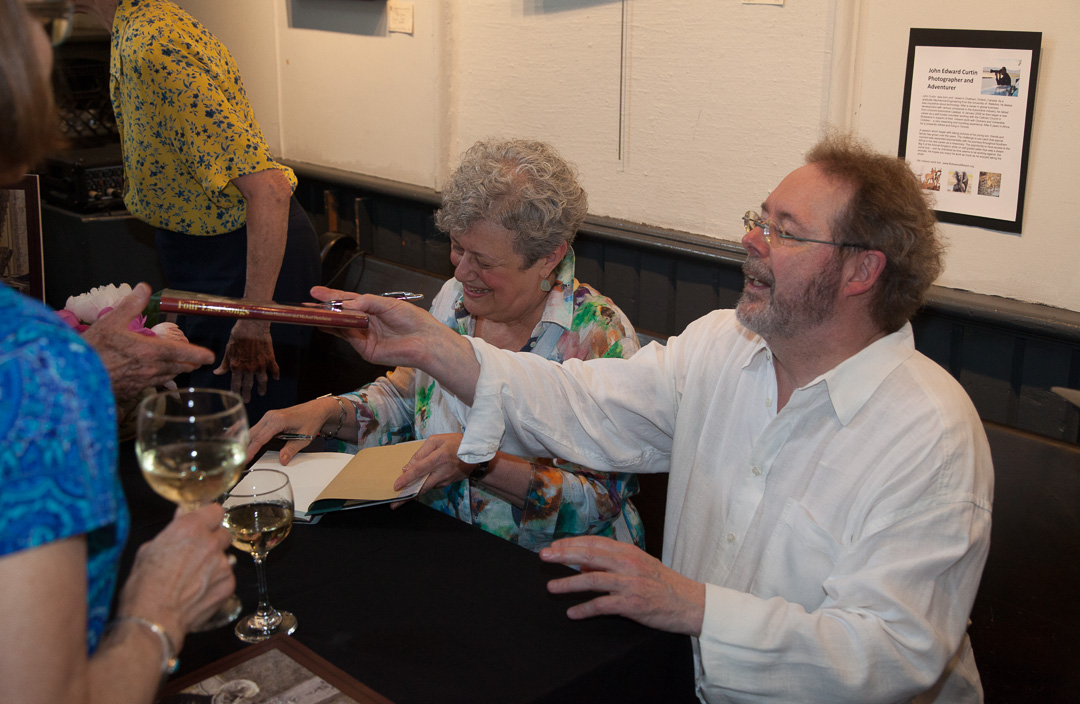
Linda (left) and Michael Hutcheon signing their book for an eager audience.

Linda (left) and Michael Hutcheon signing their book for an eager audience (photo: James Tulk).

Three of the four composers in the book were represented in the mini-concert that was like the delicious bottle of champagne christening the book, except nothing had to be smashed across the bow of a boat (or book for that matter).  The only one missing and rarest of the four was the most recent to be heard in Toronto namely Olivier Messiaen, thanks to Against the Grain’s Death and Desire, a show that the Hutcheons generously supported in their other role as patrons.

The other three?  Richard Strauss, Giuseppe Verdi and Benjamin Britten.

We began with three works from Britten sung by Lawrence Wiliford, who (if I understood what I heard) was introduced to us not just as a singer but also as an actual source for the book in his research on the late composer.  This isn’t the first time Wiliford—the co-artistic director of Canadian Art Song Project—has wandered the borderland between performance and research, a frontier involving creativity, exploration & discovery.  No wonder then that both his performances and introductory comments were genuinely authoritative.

These works, from among Britten’s last compositions when he was no longer able to play the piano and therefore wrote for the harp, were accompanied by harpist Sanya Eng.

We began with “A Hymn on divine music”, a song by Croft arranged by Britten in a style sounding like Purcell.  “Canticle V” brought us powerfully into the 20th century, a far more challenging piece especially for harpist Eng.  And finally we heard “she’s like the swallow”, Britten’s arrangement of the Canadian folk-song.

Sasha Djihanian followed with two offerings accompanied by Jennifer Szeto.

(l-r) Linda & Michael Hutcheon; Sasha Djihanian, Jennifer Szeto

(l-r) Linda & Michael Hutcheon; Sasha Djihanian, Jennifer Szeto

First came Nannetta’s serenade from Verdi’s last opera Falstaff, one of the operas featured in the book.  Where Djihanian gave Verdi a playful ride, she followed with a thoughtful reading of Strauss’s “Zueignung” (or “Devotion”).  When she closed with the song’s heartfelt expression of gratitude, she could have been speaking for all of us to the Hutcheons.  They may have retired from their roles as professors at the University of Toronto, but they continue to lead exemplary lives, contributing to the richness of Toronto cultural life.

“Habe dank” indeed.

Posted in Books & Literature, Music and musicology, Opera, Personal ruminations & essays | Tagged , , , , | Leave a comment

How it Storms: an Opera by Allen Cole on June 17 & 18

How it Storms

The Array Space, 155 Walnut Ave.
2nd floor, Toronto, ON M6J 3W3
416.532.3019 www.arraymusic.com

advance tickets can be purchased at:

http://www.arraymusic.com/how-it-storms/

TOMORROW (Wednesday) and Thursday
June 17 and 18 @ 8PM; $15

It is better to blaze up, even for a moment, than to smolder forever with desire.

A co-production between The Evergreen Club Contemporary Gamelan and Arraymusic

An Opera:

Music by Allen Cole

Libretto by Maristella Roca

Visuals by Rick Sacks

How It Storms taps into the mythologies and allegories that define the human condition. Cole and Roca have infused beauty and poignancy in the flawed and the fallible. The Evergreen Club performs Coles music with:

Molly and the doe: Claire de Sévigné – soprano
Coco: Danielle MacMillan- mezzo
The Beggar and the stag: Chris Mayell – tenor
Pascal: Keith O’Brien – baritone

With the Evergreen Club Contemporary GamelanIt is a great pleasure to again support the work of Allen Cole. How it Storms is a sophisticated work of depth and beauty that challenges the way we view myth, allegory and their relationship to contemporary society. In theatre terms our production is a semi-staged reading. It is our hope that you enjoy the performance and stay to give us feedback in support of the continued development of this exquisite work. Arraymusic thanks the Evergreen Club, Maristella Roca and Allen Cole for bringing this production to the Array Space. – Rick Sacks


“Press releases and announcements” are presented verbatim without comment 
Posted in Press Releases and Announcements | Leave a comment

Picturing the Americas: AGO goes Hemispheric

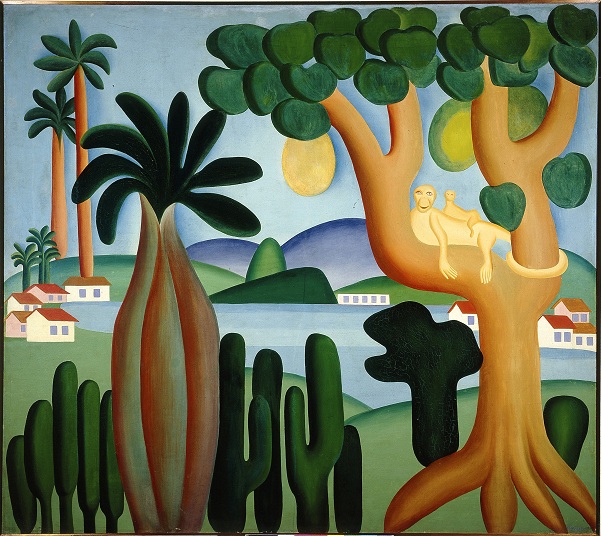
Tarsila do Amaral. Cart„o-Postal. 1929. ”leo sobre tela. 127,5 x 142,5 cm. ColeÁ„o Particular. Rio de Janeiro, RJ Foto: Romulo Fialdini Cat·logo RaisonnÈ Tarsila do Amaral v. I p.186 P112 ReproduÁ„o: 300 dpi 22,1 x 30 cm

Tarsila do Amaral. Cart„o-Postal. 1929. ”leo sobre tela. 127,5 x 142,5 cm. ColeÁ„o Particular. Rio de Janeiro, RJ
Foto: Romulo Fialdini
Cat·logo RaisonnÈ Tarsila do Amaral v. I p.186 P112
ReproduÁ„o: 300 dpi 22,1 x 30 cm

As a swan song “Picturing the Americas” might be Matthew Teitelbaum’s finest hour.  The show is in some ways a triumph of diplomacy, an impossibly congenial meeting between museums and cultures sure to be a feather in his cap, as he says goodbye to Toronto and the Art Gallery of Ontario in the next few days, departing for his new post with the Museum of Fine Arts in Boston.

Co-curated by Peter John Brownlee, Curator of the Terra Foundation; Valéria Piccoli, Chief Curator of the Pinacoteca do Estado de São Paulo; and Georgiana Uhlyarik, the AGO’s Associate Curator of Canadian Art, Picturing the Americas will be on view at the AGO until Sept. 20, 2015, in a summer of Pan American celebrations inspired by the athletic games that are coming a few short weeks from now.

As an insecure Canadian, this show moves me in all the right ways.  In the first room you get to see Cornelius Krieghoff alongside paintings from abroad: and you see him and his work in a new light, as if you were suddenly watching Celine Dion in Vegas or Robert Lepage directing an opera in NY.  Yes, Canadians are so much more than our provincial nervousness might allow, as we sometimes beat up on anything in our own backyard, that might bravely celebrate Canada to the unbiased eyes of those who see our art for the first time.  And in the last room you get Lawren Harris alongside Georgia O’Keeffe, both alongside so many others from the broader world.

None of that is the point of the show, of course.

It started out as a kind of fantasy in the mind of one of the curatorial team.  Brazil talked to USA, and then went looking for a third gallery, choosing the AGO.  Our Pan Am games this year are the convenient pretence for Toronto getting the first version of a show that will go on to Arkansas and eventually Sao Paolo, as part of Brazil’s Olympic celebration in 2016.  The fantasy? What if landscapes of all these diverse countries that make up the Americas were displayed side by side. What would it look like?  What might we learn?
And in my first blushing glimpses I have to say, wow it’s profound.  There is such depth to this show that it can’t really be grasped on a first view.  I will be back.  I stayed longer than I thought I would, one of the stragglers going through, wishing I had even more time.
A good show is like time-travel, and this one especially so because it is presented with such subtlety.  We are dealing less with artistic personalities & quirks, and mostly with their subject matter.  Because of the way the works are organized you can’t help the meta-think, the frames placed around the works, the sense of shifting contexts.

We begin with painters as visitors to a remote land, tourists painting picturesque landscapes. And we get the kind of anthropology you saw in the 18th and 19th century, where painters were natural historians, eye-witness explorers of a new world.   Even when we get into 20th century, we are looking at the ideas and content rather than art and technique and isms.  As such it’s unlike any show I have ever seen: and I mean that in a good way.  The curatorial element is underplayed. The sublime is most certainly here, but instead of analysis, instead of looking at technique, I believe we’re invited to that place art took us when we were children: pure wonderment and delight.  For such an intellectual exercise, I felt free to just look and feel without being buried in theory.

We are often looking at people, especially indigenous peoples.  That is one of the most important parts of this show, and is properly acknowledged as we emerge with images of the contracts between the Mississauga and the English King (or his representative) enlarged on the wall.  I have to think long and hard about this because it’s one element I will be staring at next time, namely the place of the people in these pictures.  Is America utopia? It can be if you’re coming from Eastern Europe as my family did. But that’s only one way of seeing the land.

I will be back.

Posted in Art, Architecture & Design, Reviews | 4 Comments

TSO Delivers Thank You Note(s) to the City of Toronto with FREE Concert

The TSO Delivers Thank You Note(s) to the City of Toronto with FREE Concert

Peter Oundjian and the TSO

Tuesday, July 7, 2015 at 12:30pm at Roy Thomson Hall 

June 16, 2015: “If a symphony orchestra plays in a city and no one is around to hear it, does it make a sound?” Without its loyal audience, the Toronto Symphony Orchestra (TSO) could not share the music! This is why the TSO has orchestrated a special event to express its appreciation, and thank Torontonians for their ongoing support.

On Tuesday, July 7 at 12:30pm at Roy Thomson Hall, TSO Music Director Peter Oundjian conducts the TSO in a FREE concert — which also showcases RBC Resident Conductor Earl Lee — to celebrate the community of Toronto. With a satisfying programme of orchestral gems by beloved composers including Rossini, Mozart, Beethoven, and more, the TSO delivers a musical thank you note to the city. Long-time audience members, newcomers, connoisseurs, neophytes, young and old — all are welcome to enjoy.

Much to celebrate
This concert not only celebrates the musical vitality of Toronto but also the end of an exciting season packed with acclaimed performances for the TSO. Highlights include the 2nd annual Chinese New Year Celebration featuring megastar Lang Lang; the RBC Piano Extravaganza, a two-week festival curated by world-renowned pianist Emanuel Ax, featuring an array of concerts and activities that included Pianos in the City; the New Creations Festival (which comprised two TSO Commissions/World Premières, one North American Première, and four Canadian Premières including the concert performance of the widely lauded opera, Written on Skin) starring soprano Barbara Hannigan and composer/curator George Benjamin; Ararat: The Music of Armenia, an evening of colourful Armenian music featuring brilliant Armenian guest artists and the music of Canadian, Oscar-winning film composer Mychael Danna; and a trio of alluring concerts as part of A Celebration of Sir Andrew Davis’s 40-year association with the TSO.

More than meets the ear
This past season, the TSO has introduced some highly successful new projects and collaborations such as Conduct Us. The event, presented as part of Culture Days, gave members of the public a once-in-a-lifetime opportunity to conduct a full symphony orchestra, and was a resonant success. Other new endeavours included the launch of a series of intimate pre-concert performances featuring The TSO Chamber Soloists, hosted by Concertmaster Jonathan Crow. In collaboration with Zoomer Media, the TSO also launched its own weekly radio show on The New Classical FM in March 2015. Co-hosted by broadcaster and musician Kathleen Kajioka and TSO President & C.E.O. Jeff Melanson, Sunday Night with the TSO quickly became the number one show in its timeslot in Toronto.

To celebrate its 40th anniversary, the Toronto Symphony Youth Orchestra (TSYO) delivered a high-octane performance at Koerner Hall in April 2015, paired with the announcement that the TSYO programme will be offered at no cost to all members as of the 2015/2016 season, making musical education more accessible. November 2014 brought The Second City Guide to the Symphony, a special collaboration between the TSO with the legendary Second City comedy theatre. The first concert of its kind in Toronto, this unique blend of sketch comedy, satire, and songs, was an instant hit and will return next season by popular demand. With the generous support of the Esther Gelber Fund, the Toronto Symphony Orchestra commissioned Toronto-based piano virtuoso Hilario Durán to compose an orchestral piece. The World Première of his Concerto for Latin Jazz Trio and Orchestra, “Sinfonia Afrocubana” was warmly received in April 2015.

The TSO aspires to strengthen the fabric of Toronto’s cultural landscape by forming new relationships with its communities. Fresh partnerships, innovative ventures and exciting public events will be announced in the near future… stay tuned.

The TSO Delivers Thank You Note(s) to the City of Toronto with FREE Concert
Tuesday, July 7, 2015 at 12:30pm
Roy Thomson Hall, 60 Simcoe Street
General Admission. Seats available on a first-come first-served basis
For information, call TSO Patron Services at 416.598.3375 or visit TSO.CA

Peter Oundjian, conductor
Earl Lee, RBC Resident Conductor

Rossini: Overture to La gazza ladra
Holst: “Jupiter” from The Planets
Mozart: Overture to The Marriage of Figaro, K.492
Gary Kulesha: Torque 
Beethoven: Movement II from Symphony No. 7
Stravinsky: Infernal Dance and Finale from The Firebird Suite (1919 revision)

The TSO Season Presenting Sponsor is BMO Financial Group.
The TSO Official Airline is Air Canada.
The TSO Season Patrons are Pam and Chris Hodgson.

Twitter: @TorontoSymphony
Facebook: facebook.com/torontosymphonyorchestra
YouTube: youtube.com/torontosymphony
Instagram: instagram.com/torontosymphony

About the TSO: Founded in 1922, the Toronto Symphony Orchestra is one of Canada’s most important cultural institutions, recognized internationally as an outstanding orchestra. Music Director Peter Oundjian leads the TSO with a commitment to innovative programming and audience development through a broad range of performances that showcase the exceptional talents of the Orchestra along with a roster of distinguished guest artists and conductors. The TSO also serves the larger community with TSOUNDCHECK, the original under-35 ticket programme; the Toronto Symphony Youth Orchestra; and music education programmes that reach over 50,000 students each year.

*******

“Press releases and announcements” are presented verbatim without comment

Posted in Press Releases and Announcements | Leave a comment

Toronto Symphony – Pan American Rhythms

This weekend the Toronto Symphony began a summer of the arts celebrating the Pan Am Games coming to Toronto. There’s much more to come, for example…

  • Toronto Summer Music celebrate their tenth year with a festival titled “The New World” July 16- August 9.
  • The Art Gallery of Ontario open their Pan American arts show June 20th, namely Picturing the Americas.

The Toronto Symphony’s ambitious concert program was titled “Pan American Rhythms”.

Toronto prides itself for its multi-cultural variety, yet come to think of it, we seem to have more awareness of European & even Asiatic cultures (for example) than of countries in our own hemisphere: other than our neighbour to the south that is. Chances are it’s mutual, that while everyone knows USA, Canada’s ignorance of the arts & culture of the many other countries in the Americas is mirrored by their knowledge (or lack thereof) of our own culture. A concert like this feels like a step in the right direction.

There were six wonderful items on the program:

  • Torque by Gary Kulesha started us off in Canada
  • Oblivion by Astor Piazzolla took us to Argentina
  • “Four Dance Episodes from Rodeo” by Aaron Copland represented USA
  • John Williams’ “Overture to The Cowboys” was again USA
  • Concierto en Tango by Miguel del Águila represented Uruguay
  • Huapango by José Pablo Moncayo finished our tour in Mexico.

I wish Roy Thomson Hall had been full for what might have been the best concert I heard all year: both for its programming and the excitement of the performances, led by Earl Lee. Lee, RBC Resident Conductor with the TSO, cut a suave figure at the podium with very fluid baton movements. It may be heresy to ask, but would you rather hear something you love played only moderately well, or something you don’t really know played brilliantly? I think you can see the answer in the attendance (and the empty seats), as few would pick Kulesha, Piazzolla or even Williams over Mahler. While I heard Mahler twice from the TSO this spring, I enjoyed this experience much more. While it may be that the music is easier to play, the TSO played with a relaxed grace today, Lee finding the music in every piece. Each one felt like a possible highlight.

We began with Gary Kulesha’s Torque, a piece anecdotally linked to a car purchase, and no wonder considering the perpetual motion in this energetic curtain raiser, a wonderful warm up for the ensemble. Piazzolla’s Oblivion followed, yet another occasion to luxuriate in the sounds of Jonathan Crow’s violin solos, in an arrangement of sensuous tango music that was as languid and gentle, as the opening was hyper and powerful.

The opening half of the concert concluded with a confident reading of the familiar ballet music from Copland. Does it sound different when framed as a Pan American concert? I think so. Juxtaposed with Latin pieces, I felt a bit like an anthropologist among specimens of Americana, Kulesha’s piece included.

Composer John Williams  (is he Star Wars’ real genius?)

The opening of the second half had my jaw dropping. If the TSO were seeking to teach us something, the John Williams composition after intermission was like an echo of the Copland we had just heard. Where Copland’s score has a purity of rhythm & harmony to suggest artistic integrity, Williams more commercial idiom is transparent in its unabashed desire to please the ear. I may be a bit fixated on Williams, given that I will be teaching a course at the Royal Conservatory on his film music. But I wish the TSO would consider programming this way more often, where one can hear influences so clearly. I recall a concert a lifetime ago when we heard Strauss’ Ein Heldenleben alongside R Murray Schafer’s Son of Heldenleben. Williams’ “Overture to The Cowboys” is one of several filmscores that owe a clear debt to Copland, not just as a favourite of Williams but perhaps also as a touchstone of what it is to be American. For comparison you might also look at Williams music for JFK, another movie that is first and foremost a movie examining what it is to be American.

Joseph Johnson (photo: Bo Huang)

Then came the item I had anticipated as the highlight, namely Concierto en Tango by Águila, played by TSO Principal Cellist Joseph Johnson. Where Crow has been eloquent chiefly through his exquisite fiddle-playing, today marked the second time I’ve heard Johnson addressing the Roy Thomson Hall audience, a role he seems to relish.

Johnson got a big laugh when he explained the rationale for finding this piece, namely “Facebook!” The composer presented himself, and after a behind-the-scenes conversation, the recently premiered work (commissioned by the Buffalo Philharmonic in 2012) was made part of the TSO’s Pan Am lineup, with Johnson as soloist.
Johnson & Lee took a different approach to the one heard in the BPO’s recording that I have been listening to this week. Where the BPO reminded me of Gershwin or Bernstein in their rigidly mechanical approach to Águila’s syncopated rhythms, this was a much more rhapsodic performance, organic in its flow. Johnson took a composition that sounded somewhat interesting on the recording and elevated it substantially, making a good case for the composer and his work, finding much more depth & subtlety in his reading.  In the BPO’s defense any new work takes several iterations to be truly understood, but unquestionably this was a quantum leap for Águila and his music. Well done!

Johnson’s encore was a fascinating choice to me as a student of popularity, virtuosity and how they work with an audience. Pardon me, I didn’t catch the name of the piece, which I believe was written for Johnson, and required the support of the other TSO celli in accompaniment. Johnson made a bit of an apology for the music perhaps because it is tonal & in a bluesy idiom, perhaps because we were not hearing a daunting encore by Bach or Paganini. I only wish music would get over this requirement to be difficult, and simply relax. Of course they sounded great, but I wish we could get the classism out of classical music.

Huapango, the concluding piece by Moncayo, was a bouyant conclusion to a concert with no weak spots.

Posted in Music and musicology, Reviews | Tagged | 1 Comment

Mahler’s Resurrection Symphony with the TSO

Toronto Symphony Music Director Peter Oundjian

It’s been a long time between Mahler 2nds with the Toronto Symphony. I heard Andrew Davis lead them with Maureen Forrester in Massey Hall, one of several cherished memories from the old days on Shuter Street, aka the 1970s. Given the recent anniversary concerts celebrating Davis’ 40 year relationship with the TSO, I saw tonight’s concert led by Music Director Peter Oundjian as an opportunity for comparisons.

I am sure I am not the only one with a long relationship with the work. Notwithstanding the few people who did the Toronto standing O –where they stand and then exit within half a minute, the sustained reception for last night’s performance was sincere. I believe this is what the TSO should be doing, the kind of work only they can offer in this city. While Tafelmusik play Beethoven, Mozart & especially baroque masters –pieces written for a small-to-medium sized orchestra–with exquisite attention to detail in a smaller space allowing for more intimacy, the late romantics such as Mahler, that require a big ensemble and a big sound? They are a perfect fit for the TSO at Roy Thomson Hall.

I had a mid-life conversion. I first encountered Mahler in the thoughtful interpretations of Otto Klemperer & Bruno Walter, whose spacious readings might be considered to be on the slow side. Later I encountered other conductors taking Mahler faster, particularly Leonard Bernstein, whose brisk readings came to be my new ideal.

I believe Oundjian leads an orchestra with a greater overall level of virtuosity, a very capable ensemble who follow his clear commands and play very fast and very accurately. For some of this performance of Mahler’s 2nd symphony I was very powerfully moved, transported by the experience.

Totenfeier, the first movement celebration of the dead, began very carefully in a tempo i would consider slow and deliberate, but gradually gathered momentum and intensity. While Oundjian permitted a certain amount of schmaltz in the use of portmanteau by the strings especially for expressive moments, (how Mahler likely would have wanted it in his own time, and an approach that orchestras didn’t use very much in the latter part of the 20th century, ie when i heard the TSO in the 1970s), the playing was so tight & disciplined as to seem to cancel out any emotional relaxation that this might have signalled. The second movement was a lovely serenade, a well-executed diversion of sublime gentleness.

We come to the third movement, one that presents certain challenges. It’s phenomenally busy, packed with voices & counter-voices, sudden changes of mood, scale (from a few concertante players to the entire orchestra belting fff). Three times (at least) the orchestra suddenly explodes into a loud tutti statement of one of the themes. For some reason each time this happened, Oundjian kicked the tempo up a notch, rather than letting all that energy emerge organically at the same tempo (which is still rather amazing in my experience). It was played with great precision and virtuosity, but I couldn’t connect to the arbitrary change of pace, that seemed manic rather than a spontaneous eruption of passion.  Even so this was a remarkable display of precision playing.

Where the opening movement –”Totenfeier”—is a celebration of the dead, the next two (which never seem to be done as Mahler requested, with a ten minute pause before the symphony continues) are like a serenade or reminiscence of earthly life, before we get down to the serious matter of the final two movements.

Violinist Jonathan Crow

Violinist Jonathan Crow

“Urlicht”, the fourth movement, began with mezzo-soprano Susan Platts singing the first note softly into the silence following the third movement. The brass choir that follows was one of the highlights of the evening, a wonderfully original phrasing that Oundjian got from his players that made the moment seem truly ceremonial. And in the back and forth between soloist and orchestra, concertmaster Jonathan Crow’s sighing portmanteaus were a stunning complement to Platts’ rich voice.

My one concern with this song was that Platts as well as soprano Erin Wall were situated partway back in the orchestra rather than in the front where I would expect to find them. In the latter portion of Urlicht, where the soloist seems to be pleading that they do not want to be pushed aside or rejected (a passage I find very moving), the urgency Platts gave almost seemed to suggest she did not believe she was being heard way back in the orchestra. But I would like to reassure her that in fact she blended really well, a sound floating wonderfully well in the space.

The last movement is like a tone poem all by itself, as one might expect of the conclusion to a symphony called “Resurrection”. If we were simply looking at impressive playing, there was nothing missing, a performance for the ages. Yet I wonder if sometimes the TSO could stand to pause, and think about dramaturgy or theatre, about what effect they’re seeking. There is a great deal of bustling in and out by players who have to participate in off-stage musical moments. These can be magical moments, if we are not confronted by musicians looking for all the world like rush hour traffic. The off-stage band that we heard can sound a bit like a lost army of souls in a ghostly dimension, a strange mix of pathetic and powerful, as the symphony comes to a kind of crisis, teetering on the edge of despair, awaiting some signals to encourage hope. This was the crispest execution of that offstage playing I’ve ever heard; and I think as such might be misguided. I alluded a few days ago to Harvey Olnick’s comments about Wagner in my review of Stewart Goodyear playing Rachmaninoff; I think the same applies here, where Mahler’s own off-staff bands likely weren’t so precise (they didn’t have video cameras, just human effort). I wonder if our ears are distorted by listening to perfect digital recordings, when a century ago things simply couldn’t be executed so well.  A messy reading of these passages carries great pathos, whereas a crisp and perfect rendition strikes me as inappropriate, and confused me somewhat.

I found that the last portion of the concert, especially when Erin Wall and the Mendelssohn Choir joined in, to be some of the most coherent music of the night. When he was working from simple song material Oundjian was at his best, both in “Urlicht” and in the stunning rendition of “Aufersteh’n”, the resurrection chorale.

The concert is to be repeated Friday night.

Posted in Music and musicology, Reviews | Tagged , , , , , | Leave a comment

Melissa McCarthy and the F word: Spy vs Spies

For more than half a century we’ve been watching various bodacious hunks enacting our fantasies of control at a time of great anxiety. Cold War jitters made the heroics of James Bond and his ilk extra attractive no matter how unrealistic the hopes we placed on his broad shoulders.

The world continues its ongoing slide into total shit, the remaining vestiges of order and dignity only illusory at best. Perhaps at a time when so much has been deconstructed, we might take comfort in the false bastion of hope also getting kicked to the curb, after being thoroughly manhandled by the newest candidate for an ongoing film franchise.

Don’t mistake me. I would love to see many more films like Spy, a vehicle that fully capitalizes on Melissa McCarthy’s assets. We get the best of both worlds, as she shows us she is more than a supersized potty-mouth even though she occasionally lets loose to slag anyone within earshot. We still get the physical comedy, but with more than a modicum of redemptive context to make you feel good about what you’re laughing about.

The conventions of spy movies are an easy target and nothing new, as Don Addams would be happy to attest, if he hadn’t already died of old age after a career of lampooning spies, first in Get Smart and then as the voice of Inspector Gadget.  But this is a bit different, as you’ll discover should you see the film.

McCarthy plays Susan Cooper, bringing along Rose Byrne from Bridesmaids. Byrne is Rayna Boyanov, Susan’s absolute antithesis.  She is thin (Susan is not thin), she is condescending and pretentious (McCarthy always plays real and sincere characters; Susan is the latest in a series.  As type-casting goes it’s not bad). Rayna employs a funny accent that mixes Eastern European and something impersonating English, whereas Susan sounds like something from the mid-west of the USA, aka friendly.  Rayna is heartless whereas Susan only seems soft, not the cat-lady her boss thinks she must be. It’s inevitable that the most interesting relationship of the film is between Rayna and Susan, a pretense for us to see some genuine acting. Where Byrne was the antagonist to Kristen Wiig in Bridesmaids, muscling her out of the story to become the new –phony- best friend of Maya Rudolph, here she is the evil Bulgarian at the heart of the story, a worthy antagonist and yes, possibly someone who will turn up in a sequel, if the final glimpse of her is any indication. Susan Cooper wears so many masks she confuses the world-weary uber-bitch Rayna, while seeming to emerge from out of a chrysalis. Susan lives her dream while still getting to be a vocal cynic at least part of the time: a remarkable double when you think about it.

It’s never been a better time to be fat. I hope nobody minds me using the ultimate F word (sorry, it’s not feminism after all). Or maybe it’s just that being thin is so tiresome, so predictable. Is it me? But between the complaints at Cannes about high-heels, the comments directed at Jennifer Lawrence (who called herself “obese” in response), the emergence of plus-sized performers and even fat models… The world has been waiting for someone to do what MM does in this film. This is but the first salvo in what is likely to be an ongoing slugfest, aka a successful series of satirical films.

There are so many Hungarians in this film that I’d be wondering if Against the Grain did the casting, at least if it were an opera. This is not really a review, other than to say “see Spies you’ll love it”.

And did I mention that Melissa McCarthy is wonderful?

Posted in Cinema, video & DVDs, Reviews | Tagged , , , , , , , | Leave a comment

Goodyear plays Rachmaninov

Now I have a better idea what we missed.

Stewart Goodyear was in the news recently when the Toronto Symphony hired him to replace the scheduled pianist at the last minute: until he withdrew due to online harassment. On social media we heard about a wonderful rehearsal that never came to fruition with an actual performance for an audience, of Rachmaninov’s 2nd Piano Concerto.

click for purchase information

The timing was almost perfect when his new recording was released earlier this year: Goodyear playing the 2nd & 3rd Rachmaninov piano concerti with the Czech National Symphony. I can imagine his frustration, that what seemed like a godsend—and a wonderful opportunity to promote his brand-new CD –should fall through.

Yet they do say that there is no such thing as bad publicity. My CD order from Amazon took a long time, possibly because people have been ordering large numbers of the record. It did eventually turn up, and since then I have been listening to those two concerti a great deal in my car. This is not the first time Stewart Goodyear has left me perplexed. I should explain a bit.

I have given a great deal of thought to questions of virtuosi, especially those who are also composers. Franz Liszt was so much more than a great pianist, likely discovering new approaches to sound & composition while playing, thereby becoming a big but unacknowledged influence upon the music of the 20th century, especially via his son-in-law Richard Wagner.  I find myself listening to all composer-virtuosi differently, wondering where there explorations came from. My list of composers subsumed under that title will likely diverge from that used by more conservative students. I don’t limit myself to Liszt, Mendelssohn and Chopin for example. I’d include Debussy, Prokofieff, Shostakovich and Messiaen. Where would compositional vocabulary be without the discoveries Debussy made as an opera improviser, screwing around with the forbidden parallel harmonies that would work so well for him as to become virtually a trademark? As an improviser and inveterate jammer I find myself intrigued by sounds that seem to originate in a mysterious process that’s not easily amenable to logic. Messiaen is still rattling inside my head from Death & Desire this week via Topher Mokrzewski and Against the Grain.  Rachmaninov has therefore been a natural companion over the past few weeks (as i referenced him for his transcription of Wohin after seeing the preview concert at the RBA), as I examine the forbidden fruit of popular influence, melodic rather than dissonant, and embraced in several popular realms:

  • This is the same Rachmaninov piano concerto that is Tom Ewell’s irresistible tool to seduce Marilyn Monroe in The Seven Year Itch. Or as he puts it: “Good old Rachmaninov. The Second Piano Concerto. Never misses.” That’s the first movement
  • Movement 2? That’s the one that became a big seller in the 1970s. Listen to “All By Myself” by Eric Carmen and see if you recognize the debt to Rachmaninov
    …and then…
  • And the third movement of the concerto was for a time the most famous of all, more than half a century ago: “Full Moon and Empty Arms”.

There are great tunes in the Third Concerto too, but for whatever reason the piece has been left more or less un-plundered.

After the preamble I should get back to Goodyear and his new CD. Classical music is full of performers who, when challenged by a score from Beethoven or Rachmaninov, play the music exactly the way everyone else does. Now of course a musician doing the usual thing? That is not going to confuse anyone, although he or she may put a few people to sleep. But Stewart Goodyear has a habit of being different if not completely unexpected. The only thing that is predictable is that his playing will be unique.

I first encountered Goodyear via his Beethoven Marathon, a fascinating exercise that I understood originally as a kind of athletic feat (playing all 32 of the sonatas in a single day) not realizing how good the performances would be, how good they could be. Imagine performing a one-man version of four or five Shakespeare plays entirely from memory, and you begin to get some idea, except that playing Beethoven on the piano is that much more difficult.  I did not expect that in the process of discovering this talented young virtuoso, that he would replace all the other Beethoven interpreters I admired, to become absolutely #1. There were youtube performances of the first and last movements of the Hammerklavier Sonata, Op 106, the fugue finale played so quickly and adroitly that I had to completely change my understanding of the piece.  By now i have youtubed my readership with Goodyear’s reading of that fugue that i should almost have the url in my head.  There is also a live youtube video that I have shared a couple of times showing Goodyear playing the Appasionata finale faster than anyone I have ever encountered, note perfect on an upright piano.  A full set of all 32 sonatas was released with a remarkable set of accompanying liner notes from the pianist suggesting that his penetrating understanding of the music goes far beyond just playing: which is itself a significant achievement. Goodyear has also recorded the Diabelli variations.

And I read somewhere online that as a kind of sequel to his Beethoven marathon, he has a gig to play all five Beethoven piano concerti in a single mammoth concert in the autumn..! if i can get there i want to hear this.

Listening to Goodyear’s Rachmaninov has me –again—revising my expectations. I am reminded of a comment from U of T music professor Olnick long ago, reflecting on the musicianship of players long ago vs now.  He observed somewhat romantically that when we heard the quick violin runs in the Ride of the Valkyries, Wagner would have expected the ragged scraggly hair of a wild horse, not the pristine perfection we now sometimes encounter from a modern orchestra in a digital recording.  A century of improving musicianship has come between us and how those pieces likely sounded in the 19th century.  These concerti, too, are usually played as a flurry of notes, mostly correct with the occasional fluff, the occasional misplaced note, as though the pianist in collaboration with the orchestra were creating a chiaroscuro in a painting, shading light and dark, cleanness and some dirt too. Usually that is.

But Goodyear is of the 21st Century, playing with such athletic clarity as to bring Rachmaninov into focus in a way I have not heard before. While I wonder if Rachmaninov himself would have played this clearly, it does not really matter. This is an account of the concerti that in some respects gives a new look and feel to the works, the piano clean and effortless, with a kind of Olympian purity, muscular without sounding forced, powerful without being percussive. Accompanied by the Czech National Symphony cconducted by Heiko Mathias Förster, this is a confident account of Rachmaninov, lyrical and passionate.

I understand Goodyear has recorded the Grieg & 1st Tchaikovsky concerti as well, which I will have to check out next.

Posted in Music and musicology, Reviews | 1 Comment

#AtGdeathdesire: more desire than death

If yesterday’s Dora announcement is anything to go by the youthful Against the Grain crew are a force to be reckoned with, as they’re up for several awards. Tonight AtG opened their latest, Death & Desire.

Reading the lists of nominees I can’t help thinking about the whole question of genre & novelty. AtG have a unique approach. Their works tend to be daring adaptations showing works in a different light. Death & Desire for example gives us two works in a startlingly new way. But let’s set that all aside, and talk about what D & D really does. I am less interested in musicological considerations than theatrical ones, the drama we encountered.

When a man and a woman meet & begin courtship, I have to wonder. Do they ever speak the same language? Do they seem to come from the same century, the same planet? Oh sure, when you watch conventional plays everyone speaks the same language. But at a deeper level, what is really happening might be better captured in the bizarre display we saw tonight. While we may sometimes believe we are understood, that our loved ones hear us and fully comprehend what we want, what we feel, what we need, what we desire, this may be an illusion. Watching the back and forth, each one had their WTF moments staring at the other, each had their raptures and their horrors.

AtG presented two song cycles. They may have initially planned them as separate performances on either side of an intermission, but someone got the idea to intermingle songs. I saw the expression “mash-up” used in the press, and also saw the process compared to shuffling cards together. What I saw has a frightening integrity, as each singer sticks almost completely to their expressive world. Stephen Hegedus sings Schubert’s Die Schöne Müllerin, while Krisztina Szabó sings Messiaen’s Harawi. He sings German. She sings French plus Quechua (another language) that’s occasionally scattered through Messiaen’s cycle. And (spoiler alert) she also sings a tiny bit of German too.  They go back and forth with the integrity of dramatic portrayals, which is to say that they both have a broad range of emotions, but each within their respective universe, never fully understanding the other.  He seems to be in a conservative romance, while She is in a much wilder place. Where he is articulating the nuances of love almost from first principles, as though the emotion were brand new and had just been invented (we’re in the 1820s after all), she is singing the rational and irrational, her music and emotions showing the sophistication of a different century.

Mezzo-soprano Krisztina Szabo (photo: Bo Huang)

Mezzo-soprano Krisztina Szabo (photo: Bo Huang)

The combined discourse of the two cycles intermingled in performance has precedents to the dramaturgy of other operatic approaches. The back and forth suggests aria- recitative at times, as one is static and lyrical while the other is urgent & active. At other times I was mindful of the interludes in Debussy’s Pelléas et Mélisande or Berg’s Wozzeck, offering non-verbal reflections upon the sung action. But I use those two examples (aria-recit, and Debussy  & Berg) as analogies only. Unlike either of the illustrations, in this conversation, each takes the stage as though they were the star, and yet in the contrast, each functions as a break or reflective pause, removing us from the discourse of the other, although it’s never clear which one is the main course and which one is the side dish.

As in the recent sampler concert at the RBA, I want to call this new even if it is merely a new way of approaching music we have heard before. But we may underestimate the importance of performance convention in how we hear and see musical texts. Context changes the way we understand a piece. The inventive way that these songs are framed defamiliarizes them, and refreshes them. We are alienated in a sense by the curious juxtaposition, yet the songs are sung with great intensity as though there were a real connection, a real interaction between the two singers.

But then again in a romance people behave as though there were a possibility of a connection, that their hearts won’t be broken.  This fractured conversation might be the most realistic snapshot of love i have ever seen.

Topher Mokrzewski played far upstage on the piano, the two singers framed inside one side of the space inside the Neubacher Schor Gallery as though inside a kind of proscenium arch: although some of the audience were inside that arch, and the performers did step outside the “arch”.

I’m still trying to understand what I saw and heard but I do know that the piano was brilliantly played, the songs exquisitely sung. Joel Ivany & Mokrzewski –following their usual format—made something quite innovative out of pre-existing texts.  There is a great deal to unpack in Death & Desire, so much so that I would wish that they would make a DVD or a television program so that I could watch it again. There’s a lot to decode, and yes, a great deal to enjoy and see again. When the next awards are announced (a year from now) I would assume that this one too will be recognized, but for now you have a chance to see the remaining three performances, June 3, 4 and 5.

Posted in Music and musicology, Opera, Reviews | Tagged , , | Leave a comment

Operatic Doras

Awards are a wonderful way to celebrate excellence.  They serve to promote individuals and their performances, while also raising the profile of an entire industry.  I hope that nothing I say here in any way diminishes the work done by so many artists in so many disciplines.  Today the Toronto Alliance for the Performing Arts (TAPA) announced their nominations for the Dora awards for the current season.

A question posed on Twitter a few days ago has me thinking about the whole conversation around awards. Someone was asking about the boundaries, why some companies and shows would be included or excluded from particular categories. It’s a valid question considering how problematic these related questions are:

  • What’s the difference between a musical and an opera, or between various sorts of theatre, sometimes in distinct categories, sometimes sharing one hybrid classification?
  • Are the awards ultimately limited by who saw what show? This means that the mainstream shows with the big companies have an automatic advantage.
  • What happens when someone is nominated twice? I worry because I wonder: will two performances by Kristina Szabo divide votes –like the Liberal and NDP candidates running in a Canadian election—but lose out to the single performance of Christine Goerke? But in fairness Goerke’s role was so huge, it was equivalent to any two performances from the others.

As a permanent inhabitant of the peanut gallery I confess that I need those big guys–the daily papers– to continue their pontifical existence, so that I can seem to be ‘alternative’.  I am an agnostic though about the categories.   I will offer a few comments and opinions now that the nominations are out.

The whole question of categories is somewhat problematic, a case of six of one, half dozen of the other. For example, when I look at the category “Outstanding New Musical/Opera”, I can imagine the difficulties faced by the nominating team. There are four nominees:

  • Airline Icarus
  • Spoon River
  • #UncleJohn
  • Tapestry Briefs: Booster Shots

But wait a minute.

#UncleJohn is a new English adaptation of Mozart’s Don Giovanni. And Tapestry Briefs isn’t one opera, it’s an anthology of miniatures, actually a bit like Spoon River except there’s a single authorial team, not the gaggle you had with Tapestry. I suppose my conservatism is showing when I think that they could split the award between “new opera” –giving that half to Brian Current & Anton Piatigorsky for Airline Icarus— and “new musical”, with that half going to Albert Schultz and Mike Ross for Spoon River.

I am a bit confused with the thought that Ivany is good enough to be in the category I just named—where I think he has a legitimate shot at winning, depending on how all those classical votes trade off against the legit theatre crowd pulling for Soulpepper—yet he’s nowhere to be found in the “Outstanding Direction” category, where the nominees are:

  • Albert Schultz for Spoon River
  • Atom Egoyan for Die Walküre
  • John Tiffany for Once
  • Robert Carsen for Falstaff
  • Robert Lepage for Bluebeard/Erwartung

Why not Ivany, yet why Lepage for a show as ancient as this one, that first saw the light of day decades ago?   Much as I enjoyed that show, it was not really Lepage directing so much as members of l’Équipe Lepage, and an assistant director with the COC. If he is to be rewarded why not the bold Needles & Opium at CanStage rather than this old show? All three COC candidates are worthy nominees, but how does one compare their work to what Tiffany or Schultz did? And it’s the same with “Outstanding Musical Direction” where one must admit how different they are from one another.  Again i would be happy with any winner, but would have no idea how one decides across such broad categories.

Further down the page, where it’s now called the Opera Division, at least we are supposedly looking at a level playing field. For Outstanding Production instead of four different Canadian Opera productions — Bluebeard/Erwartung, Falstaff, Die Walküre and The Barber of Seville— as challengers to Airline Icarus, was there no room here for Tapestry or Against the Grain? In fairness to TAPA (and the COC), all four COC offerings are splendid, worthy members of this category. And there is another category where perhaps they will acknowledge the young artists, namely “Outstanding Performance – Ensemble”, where Tapestry, Soundstreams and AtG face off against Johannes Debus at his best: Falstaff and Walküre.

There are two more intriguing categories to mention.

Bass-baritone Kyle Ketelsen (photo: Dario Acosta)

Bass-baritone Kyle Ketelsen (photo: Dario Acosta)

“Outstanding Performance Male”? Five outstanding candidates slug it out even though I would have included Kyle Ketelsen from the COC Don Giovanni, the most outstanding performance by a male this year. Of the five actual nominees I think Gerald Finley deserves the nod for his Olympian workload, not just for the size of his artificial gut and makeup every night, but his Italianate approach to Sir John Falstaff. Yet every nominee would be a worthy winner including young Neil Craighead.

And “Outstanding Performance Female”? This one is more problematic for me. There are two obvious winners, either of whom will leave me very contented. I will now say what I refrained from saying while I might hurt ticket sales, namely that Ekaterina Gubanova ran roughshod over the Hungarian text of the role of Judith; if the role is nothing more than a loud high “C” perhaps she has the right to be nominated. Perhaps. Serena Malfi was pleasant as Rosina, although she didn’t sing the role as well as the woman with whom she was double –cast, namely Cecilia Hall.  I’d be comfortable with Christine or Krisztina winning: that is Goerke’s Brünnhilde or either of Szabó’s pair of nominations, one for Erwartung, one for Tapestry Briefs: Booster Shots.  Her Erwartung was one for the ages.

(l-r) Elizabeth DeShong as Suzuki and Kelly Kaduce as Cio-Cio San in the Canadian Opera Company production of Madama Butterfly, 2014. Photo: Michael Cooper

(l-r) Elizabeth DeShong as Suzuki and Kelly Kaduce as Cio-Cio San in the Canadian Opera Company production of Madama Butterfly, 2014. Photo: Michael Cooper

Perhaps i seem to be contradicting myself when I say Kelly Kaduce in Madama Butterfly was the best performance I saw all year.  But if she were nominated she wouldn’t win.

It’s intriguing that the two singers i cite both have the initials “KK”.

The Doras will be awarded three weeks from today on June 22nd at the Harbourfront Centre hosted by Gavin Crawford.

Posted in Dance, theatre & musicals, Music and musicology, Opera, Personal ruminations & essays | 1 Comment