
Ah such a long title. I’m already being Wagnerian.
He’s everywhere whether you know it or not, Wagner not precisely über alles, but still ubiquitous. We talked about him inevitably last night in class, discussing the dramaturgy of silent film, but we could just as easily have been talking about the device on which you’re reading this. Ever notice that when your device wants to inform you that you’ve made a bad choice there’s a funny wonky sound? Or if you’re being notified that you have something good, such as a new text, you get an affirmative sound? Yes that’s Wagnerian, that unity between the machine and the content.
No Wagner didn’t know about computers or silent film (having died back in 1883), but he did toss out the concept of Gesamtkunstwerk. It’s sometimes translated as “total art work”, but that’s confusing. He was writing about an ideal, back in a time when designers and directors and performers were upstaging one another, rather than working together towards a single unified concept. So many things work that way now –not just artistic creations like our films or plays but also our machines too–that it’s hard to remember that things used to be way way messier at one time.
And so of course i have to think about Wagner after having seen: Wagner. I finally made it to the Canadian Opera Company Die Walküre, late in the run. Everyone knows their music and their movements exquisitely well by now, how arrogant I am to think I can walk in there for oh 4.5 hours, and then what… create comments within an hour, when they’ve been working on this for literally weeks? Yes, I suppose I must sound a bit like Wagner, a man with a colossal ego and the ability to upset whole nations. If nothing else he is a lesson in remembering that just because an artist is a complete jerk doesn’t mean his art can’t be wonderful.
I was joking to my friend sitting beside me: “I don’t need my voice tomorrow”. We bravo’d extensively. She actually emitted something more like a scream at one point, although I was assured that it was carefully executed to leave the voice intact.
It struck me as ironic that there were as many departures from the text in Atom Egoyan’s production of Walküre as in Dmitri Tcherniakov’s Don Giovanni. But –as my friend reminded me—with Wagner we’re long accustomed to Regietheater (director’s theatre), indeed it’s almost de rigueur at this point. I think Robert Lepage’s Ring at the Metropolitan Opera met with at least some critical disapproval because Lepage had the temerity to tell the story as written. Audiences experienced Götterdämmerung without any fancy conceptual overlay.
I wonder though if I should call it “Egoyan’s Walküre”? Oh he certainly made some interesting choices, don’t get me wrong. But in a real sense, one could question whose Walküre this is, as so many contributed to the total work. Given that the run is almost over –a great success by most standards I am sure—why don’t we try to answer that question, and find some candidates.
When you sit down for the first act, the story seems to be a love triangle.
But before we see anyone we’re listening to that COC orchestra led by Johannes Debus. The orchestra doesn’t go quite as fast as they did in Richard Bradshaw’s day –a quality I loved—but it’s still often quite quick, as for instance in the opening ten minutes of the last act, played brilliantly. Would it be Debus´Walküre?
Hm. Nobody would call it Hunding’s opera, yet what about Dimitry Ivaschenko, so impressive as the wronged husband, lugging huge hunks of animal haunch that he munches on when he’s not noticing how much his dinner guest resembles his wife. The voice is fabulous, powerfully penetrating, as is the stage presence. Given that he’s likely to use this as a stepping stone (although he’s already very successful in Europe) as Americans come to Toronto intent on hearing the soprano and discovering this wonderful artist, you would at least be justified in calling this Ivaschenko’s Walküre.
Clifton Forbis is back in the role of Siegmund that he created when Egoyan’s production (haha bet you though I was going to call it “Egoyan’s Walküre”..! whoops I guess I just did….) was new more than a decade ago. Physically it’s a mature Siegmund, who looks older than his onstage twin, at least from my vantage point in the second row. But the voice? He missed part of the run due to illness, and even tonight we heard coughs. But whenever he appears the story seems to be about him, the music coming to life. The further we got into the role, the better he sounded. Forbis’ Walküre? Perhaps.
The production places a great deal of emphasis on Sieglinde and her visions. Heidi Melton’s Walküre? I cried at her big climax in the last act. I admit I giggled a bit when I saw Christine Goerke begin to give Sieglinde—who is pregnant, we discover—advice as a mom, recalling some of the posts she’s made on social media. Both Melton & Goerke have such lovely vibrant facial expressions, it was a particular pleasure sitting up close. When the two women were singing it was totally amazing.
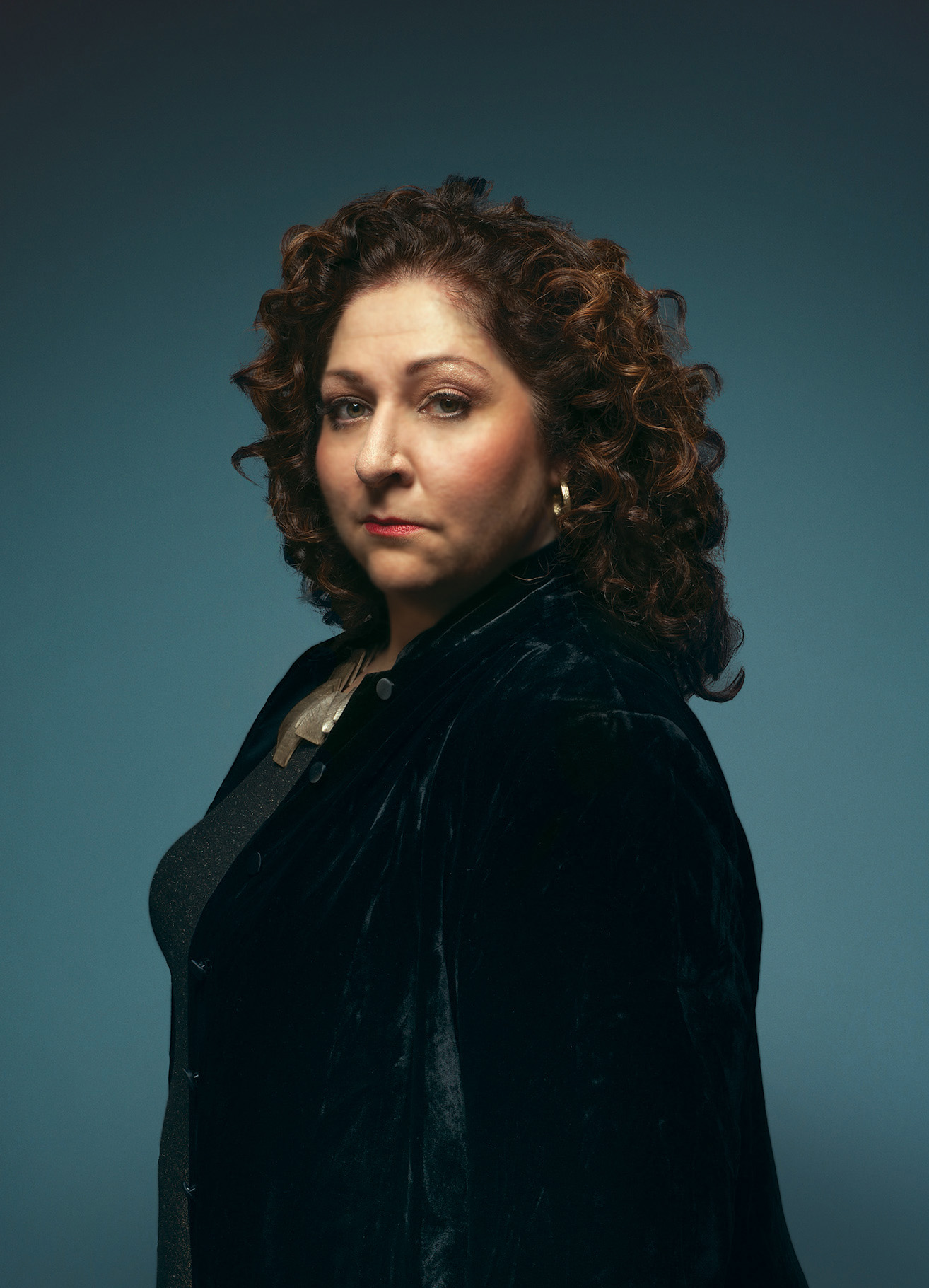
Soprano Christine Goerke (photo by Gary Mulcahey)
How about Christine Goerke’s Walküre? I think you could make a solid case, considering the excitement her casting created. Had she been merely okay the audiences would still have been centred on her. But in fact this was –as you may have heard—completely worth the hype, a performance that even had some genuine swagger to it. When Goerke sings that battle cry to introduce herself at the beginning of Act II she made it a bit of comedy, teasing her dad, at times shining that wacky light –part of Michael Levine’s design—onto him. If the triumph were only in the vocal realm that would still be huge news, given the shortage of genuine dramatic sopranos. Goerke is also a wonderful actress, and will be a joy to watch as she works through the different parts of Brunnhilde in the other two Ring operas that are ahead.
Even so, there might be others who might want to wrest the opera away. Johan Reuter as Wotan gets the last words, and they’re particularly beautiful the way he sang them. While the story in Act I seems to be all about the twins, while the story then gets complicated with the arrival of immortals for Act II, this opera is really about Wotan and his estrangement from himself: enacted via his daughter Valkyries, especially Brunnhilde. In passing I should mention that another Valkyrie, namely the role of Helmwige, can be understood as a future Brunnhilde given that she sings her own brief version of the war-cry in the opening to Act III. Aviva Fortunata was exquisite in her brief appearance.
Who else might claim Walküre?
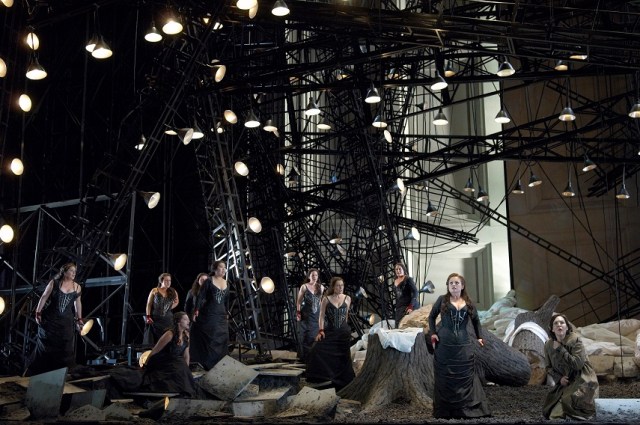
There’s the fellow whose set & costume design is being used again, namely Michael Levine. I adore these designs, which serve the opera wonderfully. They serve the comical opening to Act III, the metaphysical overtones in Act II (when Wotan & Fricka are debating the whole love triangle, while standing over the sleeping bodies of Siegmund & Sieglinde). There’s so much one could say about the design, although I think it’s almost too much of a good thing. My favourite moment in the production as I saw it in the old theatre over a decade ago was largely invisible where I was sitting, obscured by parts of the set. Was I sitting behind a pillar? Nope, I was about ten feet away from the conductor. He didn’t see it either. Is this set too much of a good thing? I ask that in context with the comment from Debbie Voigt during the documentary on the Lepage Ring, when at one point she categorically refuses to get back on the set, although she eventually would relent. There are no moving planks in this set, just lots of small parts that seem designed to trip up singers. I didn’t see anyone fall, so perhaps I sound unkind. I repeat, I love this set. It manages to simultaneously suggest the grandeur of the gods –especially in Acts II and III—and the process of decay, pieces of flooring coming up, the tree chopped up into pieces. It always gives us several wonderful things to look at throughout, when it’s not almost blinding us with glaring lights.
So while I may sound as though I am making the case for Levine’s Walküre I am inclined to look elsewhere. There’s the company’s General Director, Alexander Neef, whose assembly of talent is the reason for the excitement. I love that he brought us Tcherniakov‘s DG, complete with Russell Braun, Michael Schade, Jane Archibald, etc, yet he’s also giving us a decidedly Canadian company, whether in the Zerlina of Sasha Djihanian, the Helmwige of Aviva Fortunata, or several other contributors, Egoyan and Levine perhaps most prominent among them.
 I suppose I should simply upload this now and go to bed. On the weekend there’s another performance of each opera remaining. If you can go to either –or both—I would heartily recommend you do so. It’s quite an amazing pair of productions.




 barczablog