Kidd Pivot-The Tempest Replica@CanStage

“Press releases and announcements” are presented verbatim without comment

Canadian Stage presents
the Toronto premiere of The Tempest Replica created by award-winning Canadian choreographer Crystal Pite

A Kidd Pivot production
on stage at the Bluma Appel Theatre May 7 to 11, 2014
Toronto, ON – Award-winning choreographer Crystal Pite (Dark Matters, The You Show) returns to Toronto with her newest work, The Tempest Replica. Presented by Canadian Stage at the Bluma Appel Theatre for five performances only from May 7 to 11, Pite’s critically acclaimed company Kidd Pivot transforms one of Shakespeare’s final plays, The Tempest, into an innovative dance creation.“In 2012, audiences were thrilled by Crystal Pite’s breathtaking dance work Dark Matters,” said Matthew Jocelyn, Artistic and General Director, Canadian Stage.The Tempest Replica is yet another demonstration of her skill as a storyteller of rare distinction. Gorgeous choreography, stunning visuals, projection and an original score come together to create inventively theatrical dance and we are delighted to have one of the country’s most gifted choreographers back at Canadian Stage.”

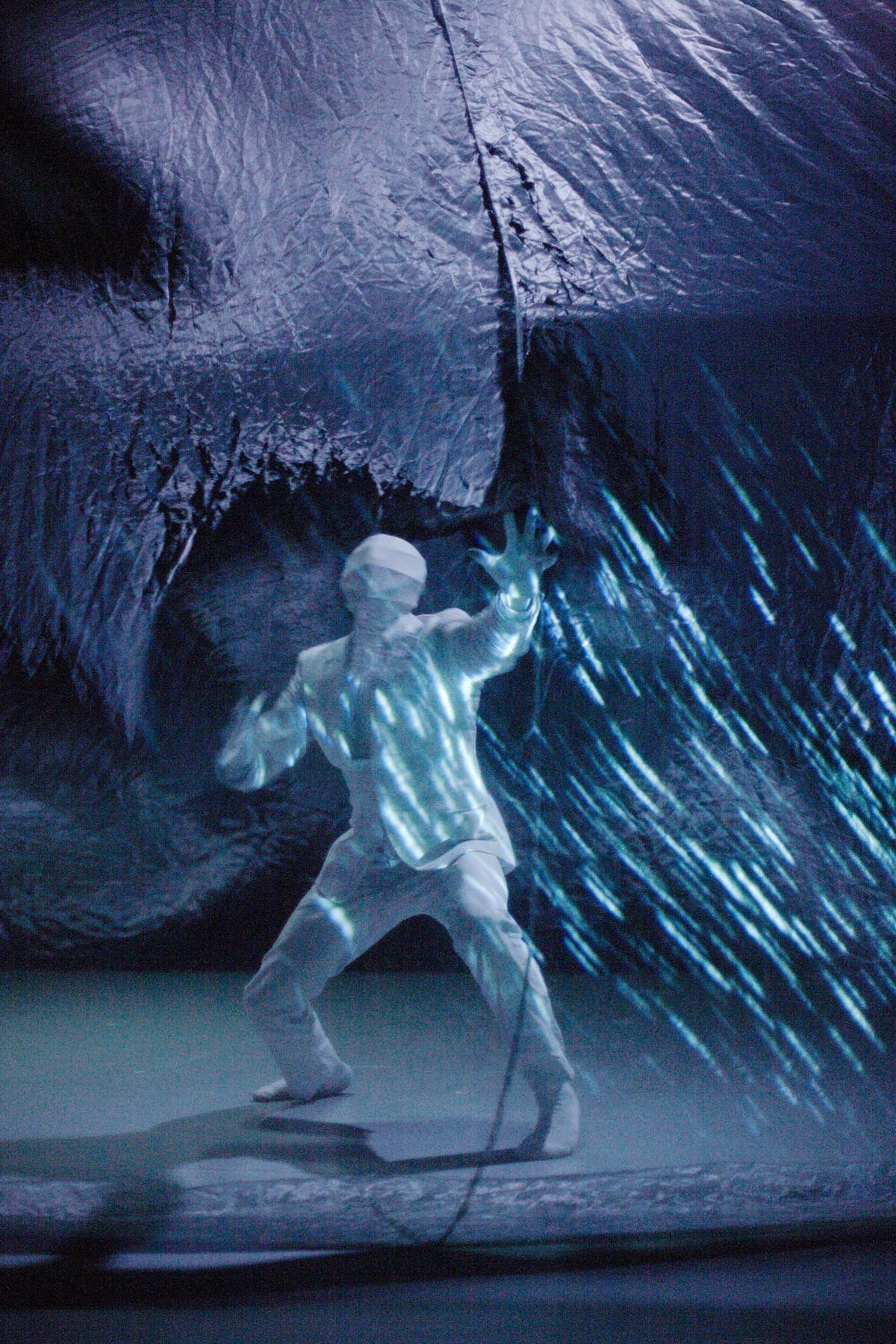
Using the mastery and articulation of dance, The Tempest Replica is a game of revenge and forgiveness, where reality dances with imagination. Pite explores motifs from Shakespeare’s The Tempest through two parallel worlds. Chalk-white replicas deliver the essential plot points of the story, while the emotion and tension of the narrative is fleshed out by real characters through fierce physical language.

“My hope for the viewer is that, armed with the plot points of a narrative, he or she is more deeply invested in the performance,” said Pite. “The choreography becomes more than just a dance between two people – rather, it is imbued with a story we have all shared.”

Lighting designer Robert Sondergaard cloaks Jay Gower Taylor’s set in white light, while seven dancers move through shadows. Music composed by Pite’s long-time collaborator Owen Belton and a film montage by Jamie Nesbitt round out a production that integrates stunning visuals, projection and an original score.

The Tempest Replica will be on stage at the Bluma Appel Theatre in the St. Lawrence Centre for the Arts (27 Front St. E.). Performances run Wednesday through Saturday at 8 p.m., and a matinee on Sunday, May 11 at 2 p.m. A pre-show talk will be held on Friday, May 9 with Crystal Pite to discuss The Tempest Replica‘s themes and development process. A post-show talkback will be held on Saturday, May 10 where dancers from the performance will take questions from the audience. The performance is approximately 80 minutes with no intermission. Tickets from $24 to $99 are available online, by phone at 416.368.3110 or in person at the box office. For details visit www.canadianstage.com.


Facebook: Canadian Stage
Twitter: @CanadianStage; #csTempest

For more information or interview requests, please contact:
Rebecca Shoalts, rock-it promotions, 416.656.0707 x104, rebecca@rockitpromo.com
Ashley Ballantyne, rock-it promotions, 416.656.0707 x111, ashleyb@rockitpromo.com

HIGH RESOLUTION PHOTOGRAPHY: Available in the Image Gallery


Photo of The Tempest Replica by Jorg Baumann

About The Tempest Replica
May 7 to 11; Opening and media night: May 7, 2014
A Kidd Pivot production present by Canadian Stage

Production Sponsor: Scotiabank

Performers
Bryan Arias
Eric Beauchesne
Peter Chu
Sandra Marín Garcia
Yannick Matthon
David Raymond
Cindy Salgado

Apprentice                                        Ralph Escamillan

Creative Team
Composer                                        Owen Belton
Sound Designers                             Alessandro Juliani, Meg Roe
Voice                                                Peter Chu, Meg Roe
Lighting Designer                             Robert Sondergaard
Set Designer                                    Jay Gower Taylor
Projection Designer                         Jamie Nesbitt
Costume Designer                           Nancy Bryant
Costume Builder                              Linda Chow
Prop Builders                                   Hagen Bonifer, Arnold Frühwald

Technical Director                           Jeremy Collie-Holmes
Audio Visual Technician                  Eric Chad
Stage Manager                               Heidi Quicke

World Premiere – October 20, 2011: Künstlerhaus Mousonturm, Frankfurt, Germany
The Tempest Replica is a co-production of Künstlerhaus Mousonturm (Frankfurt), Gemeinnütziger Kulturfonds Frankfurt Rhein Main, Monaco Dance Forum (Monaco), Sadler’s Wells (London), National Arts Centre (Ottawa), DanceHouse (Vancouver), L’Agora de la danse (Montreal), and SFU Woodward’s (Vancouver).

About Crystal Pite:

Crystal Pite has collaborated with celebrated dance artists, theatre companies and filmmakers in Canada, Europe, and the United States. Since 2002, she has created and performed under the banner of her own company. Her work and her company have been recognized with numerous awards and commissions. Kidd Pivot tours extensively around the world with productions that include The Tempest Replica (2011), The You Show (2010), Dark Matters (2009), Lost Action (2006), and Double Story (2004), created with Richard Siegal. Kidd Pivot is the recipient of the 2006 Rio Tinto Alcan Performing Arts Award, and was resident company at Künstlerhaus Mousonturm, with the support of Kulturfonds Frankfurt Rhein Main, in Frankfurt, Germany from 2010 to 2012.

About Kidd Pivot:

Integrating movement, original music, text, and rich visual design, Kidd Pivot’s performance work is assembled with recklessness and rigour, balancing sharp exactitude with irreverence and risk. Under the direction of internationally renowned Canadian choreographer Crystal Pite, the company’s distinct choreographic language – a breadth of movement fusing classical elements and the complexity and freedom of structured improvisation – is marked by a strong theatrical sensibility and a keen sense of wit and invention.


Shows and Tickets:

Single tickets are available starting at $24, with C-Stage Under 30 tickets available for $15 (taxes and fees included). Discount tickets are available thanks to Sun Life Financial, Discount Ticket Programs Sponsor.Tickets may be purchased online at www.canadianstage.com, by phone at 416.368.3110 or in person at Canadian Stage’s Bluma Appel Theatre (27 Front St. E.) or Berkeley Street Theatre (26 Berkeley St.).


About Canadian Stage:

Founded in 1987, Canadian Stage is one of the country’s leading not-for-profit contemporary theatre companies, with the 2013.2014 season marking the organization’s 26th season. Led by Artistic & General Director Matthew Jocelyn and Managing Director Su Hutchinson, Canadian Stage produces and showcases innovative theatre from Canada and around the world, allowing its audience to encounter daring work guided by a strong directorial vision and a 21st-century aesthetic. The company prides itself on presenting multidisciplinary pieces and work in translation that pushes the boundaries of form and style. Canadian Stage reinforces the presence of Canadian art and artists within an international context through work that mirrors the cultural diversity of Toronto. The company stages an annual season of work at three major venues (the Bluma Appel Theatre, the Berkeley Street Theatre and the High Park Amphitheatre) and runs a series of artist development and education initiatives, as well as youth and community outreach programs. For more information, visit www.canadianstage.com.
Posted in Press Releases and Announcements | Leave a comment

AJ Gray this is your life

Harvest Kitchen, Harbord St near Spadina Ave

I came to the restaurant for AJ Gray’s art displayed on the second floor. I’d known this place in its earlier incarnations, and now it has become “Harvest Kitchen”, on Harbord Street in that competitive stretch west of Spadina Ave where there are already several good restaurants (click here to read more)

I’m grateful that Gray has brought me here. For me this is a first experience of its kind. I’ve seen shows encompassing an artist’s lifetime of work. The big Picasso show at AGO two years ago gave us an opportunity to see the art across decades. Of course that’s to be expected with a Picasso. One doesn’t usually encounter work across decades from someone you know,  an artist you know personally whom you’ve seen develop over a long period of time. The headline is maybe a bit hyperbolic, but nonetheless it’s very cool to see art you’ve admired in a kind of context, and to realize you’ve known the artist and seen their work in different centuries.

After Bacon & Moore at the AGO last week, any art I look at in a gallery will seem sedate and that’s certainly true of Gray’s work. No screaming. No war. No death. And that’s great, as I prefer something happy with my food; don’t you?

I’m not going to aim for profoundities. It’s nice simply to share some of Gray’s charm.

"Das Lied von der Erde", AJ Gray

“Das Lied von der Erde”, AJ Gray

One of the older pictures in the show is “Das Lied von der Erde”, or “The Song of the Earth”, title of a symphonic song cycle from Gustav Mahler.  I remember upon first encountering this painting, thinking that the title was impossibly ambitious. The title refers to a rich cycle of songs, six big songs about the meaning of life.  Could one do justice in a painting to a title like that?

But I’m older now, not so judgmental, and i’ve decided that given the choice between safe art that takes no risks and art that ventures boldly where others fear to go, i’ll take the latter every time. I like the work and its ambitions.  And am happy with the way I feel looking at it.

I’m quoting my favourite song of the cycle – “von der Schönheit” or “on Beauty”—because the word appears very delicately lettered into part of the painting.  I think Alison would approve of this selection.

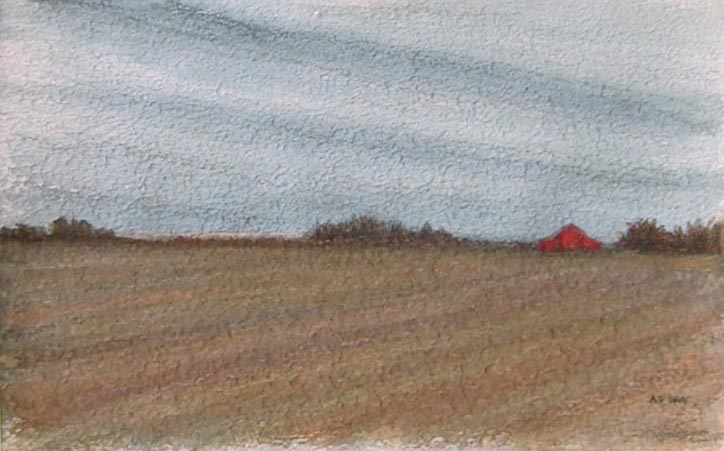
Another Red Barn by AJ Gray

“Another Red Barn” by AJ Gray

“Another Red Barn” paints a scene from out west in the province of Manitoba. I love the way it suggests a relationship with the sky and the elements.  The land seems to be larger than life, the house so small and insignificent. I’ve never been there.  One  of the cool things about AJ and her work is how Canadian it feels, how it evokes places in this country.  She and her partner used to drive, rather than fly, so i suppose it’s no wonder that we have such a clear sense of the places where she lived.

The West Door by AJ Gray

“The West Door” by AJ Gray

“The West Door” is a warm reminder of one of my favourite places in Toronto, namely Union Station.

I see “The Way Out” and “The Way Away from ‘Away’” as related images. AJ and her partner lived in Nova Scotia for awhile, but did manage to make the trek to Toronto. These are more than landscapes, suggesting moods, places over the hill. As light and inspiring as one is, the other is darker, more equivocal.

I giggle looking at “Greater Philosopher’s Kite,” if I do really get it. If you have ever been a kite flyer you know the feeling of losing a kite in a tree. Is this kite really so beautiful, or is it only because it’s lost in a tree? It looks that much more amazing in person.  I see on the website that the title comes from Philosopher’s Walk, a charming bit of landscape running through the University of Toronto.

Greater Philospher's Kite by AJ Gray

“Greater Philospher’s Kite” by AJ Gray

AJ Gray’s show –25 works on paper, plus twelve paintings—runs until April 28th at Harvest Kitchen. I understand that people are encouraged to see the work in the restaurant, but let me add that it’s quite an awesome place to eat with reasonable prices. I ate a subtly spiced peanut soup with African heritage, preceding my kale salad, containing walnuts & blue cheese (gorgonzola?), before I had an Americano to finish.

For more information feel free to go to www.capabilitygray.com (where there’s lots more) or send questions via email to capabilitygray@gmail.com.

The Way Away from by AJ Gray

“The Way Away from ‘Away'” by AJ Gray

Posted in Art, Architecture & Design, Food, Health and Nutrition | Tagged | 8 Comments

Giasone: Back to the Future

What a weekend.  While I only managed to get to three things in three days (Tap:Ex Friday, Hercules Saturday, and Giasone today) I feel I’ve been to a symposium studying the possibilities for opera.  It’s a happy accident that the sequence bore me back in time, from Friday’s modern-day explorations, Saturday’s Regie-mented approach to the baroque, and today’s 17th Century adventure with Cavalli.

As per Opera as Drama, which is on my mind since Joseph Kerman’s passing three weeks ago, it’s worth remembering  the author’s admonition that each composer’s approach is a solution to a particular set of challenges and/or problems that need to be seen in context of the time.  Have we made any progress since Cavalli?  I’m not sure, after looking back at what I saw and heard this weekend, which is another way of saying that the first century of opera may have been its best.

Wagner’s axiom comes to mind. Music may have been enlisted as a means to an end, namely  drama, but in time music had become its end while drama, once understood as the end of opera had become merely a means to an end.  Listening to Cavalli, so much earlier in the history of opera, I can’t help thinking that we’ve found a “wayback machine”, enabling us to experience a time before we went off track, before we lost our way in formal silliness.  Cavalli’s music is as flexible as Monteverdi, which is to say that the relationship between words & music had not yet ossified into the more rigid formal relationships one sees a century later in Handel, conventions that—however beautiful they may be—slow everything down.  Cavalli feels edgy after Handel.  That’s one reason for the headline, the sense that in going back to Cavalli one can possibly discover pathways more fertile than what came later.

Forms and conventions can be helpful pathways, but also traps.   We gain from having expectations as an audience, helping us know what to expect.  But when those pathways get in the way maybe we should re-think those choices: as modern composers appear to do.  My promiscuity is showing, i suppose.  I truly love the one I’m with, and that can be a 21st century composer Friday, a baroque composer Saturday re-thought by a modern American director with funky hair & beads, a 17th century composer on Sunday, or the encore broadcast of Prince Igor from the Met next weekend.

The Toronto Consort: (top row) David Fallis, Alison Melville, Michelle DeBoer, John Pepper, Paul Jenkins, (bottom row) Katherine Hill, Terry McKenna, Laura Pudwell, Ben Grossman. Photo Credit: Paul Orenstein

Today, however, I’m in love with Cavalli & the approach of Toronto Consort, a multi-talented bunch who are thoroughly inter-connected with other companies in Toronto, particularly via Artistic Director David Fallis who’s also resident music director for Opera Atelier, and one of the best choral conductors in Canada.  Size is a recurring theme for me, as companies that have become too big to be sustainable fail to survive, alongside those that strategically avoid getting too big.  Where we expect recent arrivals such as Against the Grain or Opera Five to live the small-is-beautiful philosophy, it’s especially heart-warming in a company that’s been around since 1972.  Toronto Consort are not an opera company, I should mention, but their example is important.

Mezzo-soprano Laura Pudwell

Mezzo-soprano Laura Pudwell

We watched a concert performance with lights up, following in a libretto including side by side English & Italian.  This feels apt considering what I’ve read about performance norms in the 18th century; I wish the COC or Opera Atelier would try this sometime.  Cavalli intersperses serious and comic as quickly as Shakespeare, with a flexibility one doesn’t see in opera from later centuries.  While I didn’t test Cicognini’s libretto with a stopwatch, the words seem to move much quicker per page than most operas, particularly Handel, who can sit on a pair of lines for five minutes.  In places the texture is like a very dry recitative, responsive to whatever hijinks the comedians might wish to put over; in this case the chief comedian was Bud Roach as Demo, a stuttering hunchback servant, although both Laura Pudwell as Giasone and Michele DeBoer as Medea had the audience laughing aloud.  With the exception of Roach whose broad delivery suited a character showing the influences of the Commedia dell’Arte , everyone seemed to underplay in a largely deadpan delivery.

The whole time we’re going back and forth between bawdy comedy & something of nobility, the music was gorgeous throughout, whether groups of plucked, bowed or wind instruments.  The opera is not segmented in the baroque sense, with few full stops to elicit applause.  And so it moves steadily, the music rhythmic, tuneful & always supportive without ever stopping us dead, the way operatic music is wont to do.   What a pleasure getting lost in the richness of Pudwell’s tone.

Now if only someone –Opera Atelier?–would stage this opera for us…(?)

Michael Slattery

Tenor Michael Slattery (photo: Ned Schenck)

*****

Toronto Consort have announced their 2014-2015 season, including an appearance next March by Michael Slattery & La Nef exploring the hypothesis that Dowland might have been Irish.

There’s no way I’ll miss that.

Posted in Music and musicology, Opera, Reviews | Tagged , , , | 1 Comment

Sellars’s Hercules

If I had a dime for every time I’ve seen an opera modernized via the use of modern military garb I could buy an opera subscription.  But someone was bound to make it work, right?

I saw the Canadian Opera Company’s co-production of Handel’s Hercules today.  In the early going, wondering whether it could possibly live up to the hype, wondering whether director Peter Sellars’s interpretation could possibly hold together, I consoled myself with the knowledge that the musical side was impeccable.  Conductor Harry Bicket gets the COC orchestra to sound like a period ensemble, the strings repressing their usual vibrato, the soloists singing and enunciating as well as any cast heard at the COC in a long time.

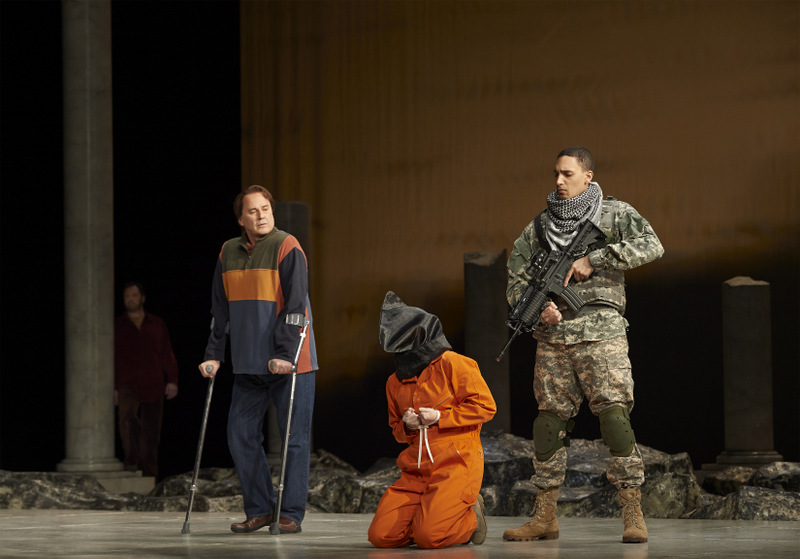
And then a key image.  Hercules has returned from war bringing Iole, the captive princess.  The story is ambiguous, allowing for a number of different approaches and interpretations.  In other encounters with the story I’ve sympathized with Dejanira’s jealousy, largely because Hercules is a swaggering passive aggressive hero who expects the world to revolve around him. While Dejanira doesn’t mean to be the agent of her husband’s death, it has always struck me as karma considering his arrogance, bringing a beautiful girl home.  Usually that is.  This time is different.

13-14-05-MC-D-0226

(l-r) David Daniels as Lichas (in background), Richard Croft as Hyllus, Lucy Crowe as Iole and Kaleb Alexander as Soldier in the Canadian Opera Company production of Hercules, 2014. Conductor Harry Bicket, director Peter Sellars, set designer George Tsypin, costume designer Dunya Ramicova and lighting designer James F. Ingalls. Photo: Michael Cooper

Sure, the image is wonderfully modern.  But what’s remarkable about it is what it accomplishes in the plot.  Whatever politician or film I might cite to segue from, it’s by now trite to speak of  the modern era as anti-heroic, a time when tragedy and heroism are no longer possible.  But wait.  Because of this image, we can confidently believe Hercules.  A captive princess –meaning someone looking like a princess– bemoaning her captivity doesn’t usually have any credibility once Dejanira starts to express her fears.   But no princess gets treated this way (as in the picture).  For once Iole looks & sounds like a genuine captive.

Maybe I’m naive, but to me, this changes everything.  The story is entirely different as a result.

It means suddenly that Hercules’ promises of fidelity  to Dejanira (the ones any Hercules makes) aren’t mere promises.  They’re true.  Suddenly honour is possible, because someone kept his promises, even in this nasty post- classical post- heroic post trauma stress disordered age.

We’re watching this happen in George Tsypin’s setting that’s a lot like Handel’s oratorio, a hybrid of old and new.  Broken columns allude to the classical, surrounding wreckage at centre upstage that resembles nothing so much as the coals on a barbecue.  No one walks into this no man’s land except for the one painful aria near the end, Hercules writhing and moaning as he burns up with the poison that’s to kill him.

I’ve written so much about Regietheater (aka “director’s theatre”) and the perpetual battle between directors and singers –for instance in the lengthy preamble to my review of Tapestry’s current show—that one might assume that I dislike directors who depart from the original.  Certainly I can’t help noticing that it’s a funny time for adaptations of all kinds (not just the operatic sort), possibly due to the sophistication of the modern audience.  Directors can assume a great deal with confidence, pushing audiences out of their comfort zones, especially because there’s excitement in the discrepancies, elaborations on old warhorses.

Let’s put it this way.  I’m an opera score, and I am lying anaesthetized on the operating table awaiting surgery.  Dmitri Tcherniakov, Calixto Bieito and Peter Sellars circle, scalpels ready.  While I like all three as an audience member, I’d feel safest –lying on my back that is– with Sellars, after seeing what he did with Tristan und Isolde and Nixon in China.  Handel is well served if not redeemed at his hands, a life saved, if you will.

I really do feel there’s a kind of battle going on between singers & directors, between the musical & dramatic.  That dialectic is fundamental to opera I suppose.  There is one thing Sellars did that frustrated me, even if I giggled by the time the opera ended.  Sellars felt Wagnerian the way he seemed to thwart the usual segmentation of Hercules. How?   I understand numbers to be opportunities for the soloists, moments for them to shine, impress, knock my socks off.  And when they succeed I want to applaud, and if they’re really good I want to scream bravo in approval.  I say this, slightly hoarse from shouting so much today at the end.  But many times arias would end with a provocative bit of stage business that Sellars created to make it almost impossible to properly applaud.  Singers would leave the stage during the postlude (not at all what’s understood by an “exit aria”), the chorus would come out and obscure the singer.  And so the applause was often curtailed, repressed, bottled up to explode at the end: which was fine actually.  Sellars is a clever manipulator –not  unlike Wagner—but on the whole it was a wonderful experience.

Okay, so let me go back to that other way of reading opera with which I began.  Yes indeed, the singing was wonderful.

Eric Owens doesn’t have as many solos as one might wish for in a title character, but then again the opera is entirely about him.  Failure at this point is the ultimate deal-breaker, but not only do we have a powerful presence, but a truly heroic aura.  Owens’ task is to make us believe something mythic vocally & morally: and he succeeds even while making us believe a contemporary version of a classical hero.  As Dejanira Alice Coote is every bit his equal, larger than life in her passions, particularly in her middle and lower voice.  It’s a long role, an opportunity for an extraordinary singer & personality. Coote takes the stage in every sense.    Lucy Crowe immediately makes an impression as Iole, unexpectedly heart-breaking.  Yes she seemed to have a remote control device to turn on my tear-ducts, and I suspect I wasn’t the only one.  This may be the strongest COC cast I’ve ever heard, down to David Daniels’ clear ringing sound, and Richard Croft’s plaintive tone.

Yes Handel looks & sounds gorgeous especially via Bicket’s passionate leadership.  I know I’m seeing it at least once more, but I ask myself: will that be enough?  There are six remaining performance of Hercules, until April 30th.

Posted in Opera, Reviews | Tagged , , , , , , , , | 4 Comments

Tapestry’s Revolutionary Questions

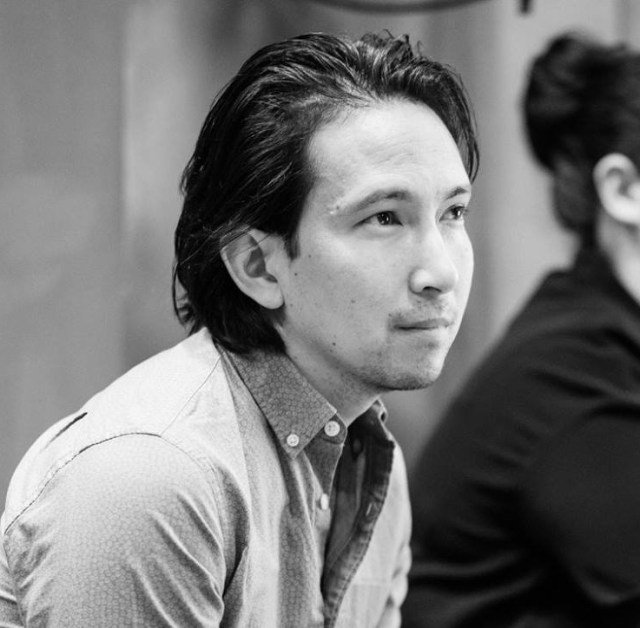
Michael Mori, Artistic Director, Tapestry Opera

I apologized to Michael Mori –Tapestry Opera’s Artistic Director & the director of Tap:Ex Revolutions, the program that opened tonight at the Ernest Balmer Studio—after the show for what I knew was going to say.  Not critical words, but rather, a lot of words provoked by what I’d seen.

I believe this is what Mori wants: to provoke a response and to inspire questions.

It’s a mythical weekend, a perfect triptych of opera in Toronto.

  • Tonight?  Tap:Ex, an exploratory series of provocations
  • Tomorrow? the Canadian Opera Company open Peter Sellars’s Hercules
  • Sunday: Toronto Consort present Giasone. Should I call it “Cavalli’s Giasone” (after the composer) or perhaps “David Fallis’s Giasone” (in recognition of the conductor & artistic director…?)

Tonight was the pure forward step, tomorrow is the hybrid of old (Handel) and new (Sellars: director’s theatre), and Sunday is both the oldest text –from the first century of opera—and in the most historically informed musical presentation.  Can I help it if my mind is grappling with the fundamental questions? Is it the words or the music? Is it the singer or the song?

And yes, there’s also the small matter of Opera as Drama.  Joseph Kerman is very much in my thoughts because he passed away less than three weeks ago on March 17th.  I took the book out of the library again to think about Kerman and his seminal contribution.

SO: is the composer the dramatist, as Kerman says?   If you read what’s been published already about Sellars’s Hercules, clearly he is not, at least not this time.  This is not Handel’s Hercules, it’s Sellars’s.

Haha i want to say “it’s a Sellars’ market”, forgive me!

But these thoughts arise after seeing Tap:Ex.  I am also reminded of something I’ve observed in my studies of opera.  In different centuries opera belongs to different functions.  While Kerman might be right (that “the composer is the dramatist”) if we were standing in an opera house in 1900 listening to Puccini—and I say that knowing that Kerman seemed to loathe that composer and his turn-of-the-century masterwork Tosca –it wasn’t true a hundred years before that.

In 1800 opera belonged to the virtuoso.  A hundred years before that? Perhaps the librettist.

And now?  Ah, that brings us back to our modern dramatists: Sellars & Mori.  The director is the dramatist nowadays.   [See why I apologized to Michael Mori?]

One last bit of context, namely that we watch in the shadow of the corpses of New York City Opera, Opera Hamilton & San Diego Opera, the stench of those huge dead institutions making some of us a little nervous.  For all the brilliant local success stories – the COC, Opera Atelier, Tafelmusik & Toronto Consort, as well as the Stratford & Shaw Festivals—no one can dare be complacent.  I worry about the Toronto Symphony, and yes, even the Metropolitan Opera may be vulnerable.

What to do?   Mori has some excellent ideas.

Partnerships?  That seems to be a new thing.  Canadian Stage have been a pioneer locally, bringing in works from other companies, offering dance & musicals to stimulate their subscribers.  Opera companies have been doing this for a long time, in co-productions that make the medium a little more affordable.

Tap:Ex included work by Volcano Theatre, a group I first encountered via CanStage in 2011.  It’s a great idea on several levels, in the sharing of expenses, the shared exhibition opportunity, Tapestry’s audience seeing Volcano Theatre, and vice versa, the performers and creators from each company stretching themselves in the encounter with the other.  Everyone wins.

Mori spoke briefly during intermission, acknowledging Volcano, while also reminding us of Tapestry’s focus.  Whereas the bigger (read ‘wealthier”) companies can explore mise en scène via expensive sets & costumes, Tapestry’s exploration is through the very heart & soul of opera: via the singers.  Mori put his money where his mouth was in what we saw and heard, a series of pieces putting the four singers—Neema Bickersteth, Andrea Ludwig, Andrew Love and Adrian Kramer—through their paces.

The program is varied, both musically and dramatically.  I liked almost everything on my “plate”, but I am omnivorous.  Because we were in the round, part of the fun was watching the audience react, sometimes provoked by singers up close (including one right beside me), by sounds emitted by human throats defying the usual expectation of what we’d call “operatic”, by moments genuinely virtuosic in their complexity, or tranquil moments of beauty.

Gregory Oh, pianist, conductor & creative soul

Gregory Oh was pianist & Music Director, always softly in support and very unobtrusive.  To return to my Kerman thoughts for a moment, music was in a largely supportive place tonight, not the over-bearing tyrant we sometimes encounter with (say) Wagner.  I can’t forget the role music plays in cinema, where we’ve become accustomed to a more invisible musical helpmate rather than the dominant and ostentatious compositional voice heard in the 1800s.  In this sense especially it was Mori’s show rather than that of the composers, or perhaps the composers cleverly understood how best to serve the dramatic situations.  But that’s another way of saying that above all this was a beautiful encounter with four singers, four gifted performers who were usually able to avoid mere concerns of form & technique to speak and sing directly to us.  Working with choreographer Marie-Josée Chartier, the singers were a fluid presence, transcending the usual (traditional?) concerns directors sometimes have with singers and their vocal production; there was never a sense that the business of making a sound overcame the drama of the moment. That’s a success for all concerned.

Another Tap:Ex Revolution takes the stage at Ernest Balmer Studio Saturday at 7:30 pm.

Posted in Cinema, video & DVDs, Music and musicology, Opera, Reviews | Tagged , , , , | 2 Comments

Bacon and Moore: Terror and Beauty

The show is called “Francis Bacon and Henry Moore” with the subtitle “Terror and Beauty”, opening at the AGO on April 5th and running until July 20th.

Three Way Piece No. 2 aka The Archer (photo: Geoff Stanners)

Moore?

As a Torontonian I have a relationship with Henry Moore, the sculptor & painter whose work already blesses a gallery at AGO as well as” Three Way Piece No. 2″ aka The Archer.

I’d been brought up in the presence of abstract art by a mother who’d studied art and taken us to see shows such as “Picasso and Man”.  Some of Moore’s works are more abstract than others, but there are definitely some that are representational.

And Bacon?

An artist friend showed him to me –that is, examples of his art in books and on posters—back in the 1970s.  He clearly admired Bacon, who surely influenced him more than any other artist.  Oh yes, when I think of it, most of his work at the time seemed to aim for the same kinds of effects.  I believe  art schools were impacted by Bacon—whether in students imitating or desperately trying not to imitate—in much the same way students at conservatories were influenced by great composers such as Richard Wagner.  No wonder his paintings sell for lots of money.

I was surprised when I saw that AGO would have a show combining the two.  I didn’t see the connection, and I’d  thought of them as very different artists.  Yet the more I thought about it, the more sense it made even in the most superficial terms.

  • Bacon’s figures have expressive faces
  • Moore’s figures are archetypes with no faces
  • Bacon gives us unbearable intensity, white-hot
  • Moore gives us coolness
  • Both artists create works of all sizes, but especially some big pieces

Were they in some sense complementary opposites, who belong in the same show after all?  I think so.  Now of course painters or people aren’t mere abstractions even if we may sometimes toss them around in conversation as though they were just that.  How can any people or artists be opposites?  I suppose what I am thinking of is the way we see it in families, where one sibling is quiet and the other loud, or one is a good boy while the other is the black sheep, and all along there are profound similarities underlying everything.
That’s one reason why shows like this one are so important, taking you past superficialities like the ones with which I began this piece, and encouraging deep questions.   If there’s a family relationship to observe, perhaps it comes from seeing a pair of artists presented in context, as survivors of the Second World War, particularly the blitz in London.

Professor Dan Adler, who curated the show

The show is guest curated by Dan Adler, associate professor of art history at York University.

Adler puts a third artist alongside the two painters, namely photographer Bill Brandt, whose images from the blitz powerfully frame the work of the two painters.

The show is a big surprise to me.  These two painters who I think of as contrasting have much more in common than I ever knew.  Adler sets up juxtapositions by putting works on similar themes side by side.  For example, a painting by Bacon with marching figures who seem to salute a giant tooth (or that’s what it says on the card), mutely echoes Moore’s nuclear power meditation; that white shape is also an avatar of power, nuclear or otherwise.

SAMSUNG CAMERA PICTURES

Moore & Bacon in juxtaposition (photo: Leslie Barcza)

One of the miracles of the show is the way the two artists work together.  I felt crowded at times, as though an energy field from one painter’s work were colliding with the energies of the other distinct artist.  I orbited the room, surprised at how energized this group of media seemed to be.  There are points of contact in their subject matter –for instance in the concrete fact of how materials are assembled—even though their approaches seem diametrically opposed to me.

But they are brothers in pain, the one showing a muted and archetypal response, where the other’s responses are unrestrained and painfully individual.

There’s more I would like to say, but I will stop at this point, to think and feel, while looking at some more images. This is a very special show, one you should see if at all possible.

Posted in Art, Architecture & Design, Reviews | Tagged , , , | 1 Comment

A better Mary Poppins

Before I had ever seen an opera, I already had experience with adaptation. I had read Mary Poppins.

And then I encountered the Disney film. Julie Andrews didn’t really seem anything like the character in the book. I was young, so I didn’t have stipulations. I just knew that the film seemed too Hollywood to me, too American. Too commercial.

I didn’t like any of the songs very much. “Supercali….”…what? I suppose I did like the concluding number “Let’s Go Fly a Kite”. It had a very hopeful positive feeling to it. But other parts of the film seemed more Disney than Travers.

Fast forward to another millennium. Tonight I watched a film on PPV called Saving Mr Banks, taking us through the drama of Disney’s adaptation of PL Travers’ classic book. The first hour was excruciating, as Travers resists Disney’s suit, making endless stipulations about how the film of her book must appear.  It was so painful because I always dislike this kind of negativity, but also because i love her book.

I had to wonder: how could they understand the way I felt so perfectly? Here I was, so many years later, reminded that while Disney’s adaptation had won five Academy Awards and that many people had loved it no I most emphatically did not love it at all. Nope. And here I was, listening to song after song that I disliked.

And so too, it seemed, did PL Travers.  Wow we had so much in common.

I am not going to spoil this film for you, but wow, here I was wondering how we were going to get to the end. Travers, as portrayed by Emma Thompson, is very difficult, very picky about how her book is to be filmed. Tom Hanks is a more ebullient Walt Disney than the one I recall from television, but of course we don’t know what the private Disney was really like, do we…?

There’s a genre of film whose name I couldn’t tell you. Amadeus might be an example, at least for those few minutes when it takes Don Giovanni, and then deconstructs it as a personal drama explaining Mozart’s life with the help of Salieri’s narrated analysis.  The film of Wizard of Oz does this too, in creating the whole dream built using the farm-hands.  And so, too, in this case. Director John Lee Hancock and writers Kelly Marcel & Sue Smith give us a rationale for the relationships and the writing of the book.  Mary Poppins, Mr Banks (the father in the book) and the family dynamics of the book are illuminated gradually.

The usual strong performances from Colin Farrell & Paul Giamatti add another dimension. I won’t tell you how we get to the end, only that we get there, complete with Disney’s Mary Poppins, a film that I still don’t like very much. But I found myself thinking that this –Saving Mr Banks—manages to tell the same story. In a real sense it’s Mary Poppins: that is, a better Mary Poppins than the one Disney made.

And that made me smile.

Posted in Cinema, video & DVDs, Reviews | Leave a comment

Hallelujah Sellars

Hallelujah Junction is:

1) A place.
When John Adams went there –so he said recently—he

to buy, click to go to Amazon

figured that it would make a great title for…
2) A musical composition. And so it came to pass, a composition for two pianos. And I wasn’t surprised to discover it’s also the title to
3) A book, as I discovered quite by accident with the help of google.

A book?  Yes, Hallelujah Junction is a book by John Adams that came out in 2008.  I immediately reserved the book from the library (the awesome EJB Library who obtained it in 2008). And it came in this week. I brought it home but only started reading today. How? I looked at chapters. (do you always read books from beginning to end? I do sometimes, especially when I don’t open the book voraciously. But obviously this time is different, considering the book is a bit like a box of chocolates, and my mouth is watering.)

The first is “Winnipesaukee Gardens”. Hmm so is this more biography than theoretical treatise? I really had no idea. I will come back to that one i think.

Ah, Chapter 13 is “A SWIRL OF ATOMS” which suggests Dr Atomic. And I noticed a familiar phrase: “THE PEOPLE ARE THE HEROES NOW.” NB chapter titles are in upper case.

Where had I heard that before? Oh yes, Nixon in China, how could I forget? I must go there immediately…!

I open to page 125, where Chapter 7 begins, and I’m thinking that this is indeed serendipity. Earlier this morning I read a piece by Robert Harris –a writer I especially enjoyed in his previous incarnation with CBC—concerning Hercules and Peter Sellars. I heard Sellars speak in a curious interview with Richard Ouzounian after seeing the dress rehearsal of his Tristan und Isolde production last February, more monologue than interview (did Ouzounian ask perhaps two or three questions in ninety minutes?) .

While I had admired that production –more for Ben Heppner and the COC Orchestra than the direction—Sellars had made much more of an impression on me in the Met production of Nixon in China that I’d been fortunate to see exactly at the time that the COC also produced John Adams’ opera.

And so oh my gosh here he is –Sellars—decades ago, as Adams describes a 1983 encounter. And while I love reading this, the whole time I’m reading I can’t help wondering how Sellars remembers this same moment, how he might recount this encounter.

Sellars was in residence at the [Monadnock Music Festival], directing the staging of an obscure Haydn opera, Armida…. I arrived first that day and sat in the cafeteria carefully examining all the people as they entered, one by one, for their lunch, wondering which of them might be Peter Sellars. When the genuine article entered he came at me con moto with a knowing and open expression that made it seem as if we had known each other for years.
It was typical of his special way with everyone—warm and focused and completely at ease. His small body and extraordinarily large head crowned by a shock of coarse hair that in later years he would wear in an absurd Bart Simpson crew cut made him appear as if he were hard-wired to an electrical outlet. His expressive face and intelligent eyes zeroed in on whomever he was talking to with a wide, appreciative smile. I realized that I was in the presence of very rare spirit. Peter possessed a maturity and interpersonal confidence far in advance of his years. I would later learn that his outré appearance and theatrically extravagant mannerisms were just a diversion, an entertainment even, concealing a man sensitive and empathetic to the extreme, one whose balance of masculine and feminine energies was keenly individuated. Already he was becoming famous for what some misinterpreted as “fast-food” productions of Mozart and Handel operas. What those who dismissed his work were missing, of course, was that hiding behind the pop playfulness of his productions was an intensely serious and sophisticated artist with the moral zeal of an abolitionist. (Adams 125-6)

Now I am not pretending I’ve read Adams’ whole book. I’ve read two pages so far. But I am already recommending it without reservation, as a valuable and important document.  I may have been guilty of the same assumptions Adams cites, under-estimating Sellars.  I am being pushed to re-think, which is something i appreciate very much.  Adams is at the very least an articulate witness.

Director Peter Sellars (click for another interview)

And how unexpected, how fascinating that Adams should be witnessing Sellars, as though Richard Wagner were merely watching Liszt produce Wagner’s opera, when we usually think of Wagner (or Adams) as the real star..? Someone else taking the stage, while he observes? Curious! But this phenomenon—especially Sellars’ role— becomes clear a few pages later. Clear? Like a bomb exploding really.

On that summer day of our first meeting in 1983 Peter already knew several of my early pieces, and he wasted little time in proposing that we collaborate on making an opera. He even knew what to call it: Nixon in China, a wry and mischievous title, like a pop-art mangling of Iphigenia in Tauris. He told me he had been watching Chinese Communist political ballets, the products of Madame Mao’s fevered agit-prop culture campaigns, and these, together wiyh a reading of Henry Kissinger’s pompous, self-congratulatory account of his White House years, had suggested an opera that might be a delicious “East meets West” study in modern Realpolitik. How he could have imagined me, who had never written a note for solo voice, as the ideal composer for such a project beggars understanding. (Adams 127)

Holy crap. And here I had mis-read Sellars as the guy with funny hair and verbose speech patterns, vicariously riding Adams’ coat-tails.

Wrong..!

When will i learn? you can’t believe everything (anything?) you read.

I will re-think, probably in the shower or while stuck in traffic jams. I will notice insights, as I ponder this new version of Sellars, a much taller figure in my imagination. It will change my experience next week, that’s for sure.

Yes it’s a jam-packed weekend, with Tapestry Friday, Toronto Consort’s Giasone Sunday, and something else I was considering (Gaudeamus: Deconstructed and Reconstructed at the Music Gallery) that i’d hoped to see Thursday, the latter now a bridge too far. While Essential Opera’s New Works also premiere on Saturday, I regret that I have to give them a pass (sorry!) because Sellars’ Hercules opens Saturday.

Sellars’ Hercules? I’m curious even if –on this occasion at least– he didn’t tell the composer what to write.  I wonder what Handel would say?

Oh… and i do need to read the rest of Adams’ book.  I’ve barely begun.

Posted in Books & Literature, Opera, Reviews | 2 Comments

10 Questions for Michael Mori

Michael Mori was announced as the new Artistic Director of Tapestry Opera earlier this year. Having worked alongside Tapestry founder, Wayne Strongman for two years as Associate Artistic Director and for the past eight months as Artistic Director Designate, this was the logical path of succession.

In his time at Tapestry Mori has such notable achievements as NewOpera 101 (helping emerging artist) and championing the integration of Hip Hop into Tapestry’s INside Opera program, bringing music theatre creation to at-risk youth in St. James Town.  An accomplished stage director who earned raves for his direction of last year’s Tapestry Briefs, Mori’s next adventure comes to the Distillery District the first weekend of April, namely Tap:Ex or in other words, Tapestry Explorations: Revolutions.

As opening night approaches I ask Mori ten questions: five about himself and five about Tapestry and Tap: Ex.

1-Are you more like your father or your mother?
mori

My mother.

I was raised by a collection of matriarchs in fact. My mother was a teacher, both creative and strict, proud and goofy at the same time, also the first in her family to have a degree. My maternal grandmother was the social lynch-pin of 5 generations of her family, and my paternal grandmother was a scholar and translator in Japan during the US occupation, and an old school social networker (she would write 2-5 letters a day). All of these incredible women were used to going where women “didn’t go” and making choices for themselves. The lesson of defining yourself by your choices and dreams rather than society’s or others’, was modelled from early on.

I almost became an engineer and had a math scholarship to UBC, but my mother’s constant encouragement to follow my passion, turned me back to the arts. She convinced me that learning language was a matter of will and immersion and as a result I have had a lifelong attraction to trying every language I might have a reason to learn. My mother was selfless in her work with special needs students, and I model my work and life goals after hers.

To be honest, I didn’t take the arts as a career seriously until I became an adult. It was her encouragment and passionate language about music that kept me in the music and theatre world long enough to discover my own passion and calling(s).

2- What is the best thing or worst thing about being artistic director of a company such as Tapestry?

Best:
This is opera that has a chance to change the world.

Discovering a company whose mandate was to make opera current (and current operas) and discard the museum stuffiness of the experience, rescued me from giving up on opera. It killed me to see the vast expanse of separation between the interested educated person, and the weak currency of the “traditional” opera experience being perpetuated by most major opera companies around North America. As AD, I have a mandate to change that within our productions and an arts and opera network to rally around updating, unifying, and evolving opera culture in Toronto.

The Bonus:
Being artistic director gives me the ability to work with emerging and world class artists, not only soloists who work at the COC and the Met, but also world-class playwrights and composers.

3- Who do you like to listen to or watch?

Watch: Roger Federer, Maria Callas, Anderson Silva, Pina Bausch

Listen to: Greer Grimsley, Russell Peters, Christopher Hitchins, Nina Simone

4- What ability or skill do you wish you had, that you don’t have?

“These are not the droids you are looking for”

5- When you’re just relaxing and not working what is your favourite thing to do?

Cycle, read, travel, dance… and when possible all in the same day!

~~~~~~~

Five more about Tapestry Explorations: Revolutions, upcoming April 4th & 5th at the Ernest Balmer Studio in the Distillery District.

1-Please talk about the challenges of Tapestry Explorations: Revolutions in the growing tradition of Tapestry Opera and your history of adventurous & original opera.

Challenges:
Challenge #1: Selling out weeks in advance… Well a week in advance… after you publish this, Rob Ford might be videoed ranting about the dangers of “subsidizing the arts for nyew opera” while smoking a monster joint rolled in an Aperghis score. The picture will go viral, the publicity will be incredible and we will have the challenge of turning people away when there are no more seats left.

Our Challenge to Big Opera: Tapestry’s new repertoire itself is a challenge to traditional opera. Tapestry Explorations is a challenge to broaden the skillset and expectations of the practitioners of opera, challenging performers to actively broaden their virtuosity to include the physical. Our performers are already physical and athletic people, in addition to being very accomplished singers and actors. Revolutions will call upon every aspect of their coordinated abilities, to communicate and perform challenging music and drama.

The true challenge: branded “Words”
“Opera” “New Music” “Experimental” – Words are a dangerous thing.
There is a reason why Against the Grain and Queen of Puddings call(ed) themselves theatre or music theatre companies. The word “opera” seems immutable and connected to a rigid perception from both lovers of opera and those who couldn’t be bothered. Many who don’t know opera are afraid of it, and many who love opera are afraid of new music, especially new opera. That puts an experimental opera show in a great place to prove everyone wrong.

Revolutions is exciting in how it allows us to be daring and collaborate with disparate artists:
Marijo is incredibly dramatically intuitive as a choreographer and Greg lives and breathes exciting non-traditional music. We are on DAY 3, and beautiful and compelling sequences are emerging as if they had been rehearsed and researched for weeks!

2-What do you love about Tapestry?

I love the word Tapestry. The word speaks to a combination of colours, of threads, of textures and images. We are empowered by our interwoven connection to artists and artforms spanning the gamut of traditional and contemporary, a unique place in the opera world.

We are small, and like Royce Gracie, our size is also our secret power and gives us advantages over the heavy weights.

What else.. I love that it’s alive (opera), and that young and more experienced performers get turned on by working on repertoire that means something to them.

Tapestry is the only professional Canadian company to completely embrace the evolution of the repertoire. Tapestry has premiered fourteen full-length Canadian operas (compared to the Canadian Opera Company’s four) and over a hundred short to mid-length chamber operas. We have taken our productions across Canada, to New York, London, and Glasgow, but the works we have commissioned have had even greater reach, bringing Canadian operas to many major cities in Europe, Asia, and Austrailia. More importantly, we are building our model around bringing both new and jaded audiences to opera.

3-Do you have a favourite moment in Tapestry Explorations: Revolutions ?

Choreographer Marie-Josée Chartier  (photo by Bill Blackstone)

There are two moments that pair really beautifully. The opening chorus from Bach and a duet by Aperghis between Neema and Andrea, choreographed by Marie-Josée. These numbers highlight music’s exceptional power to reveal humanity to us. Revolutions is about change, and exploring self to find a truer existence… and as we work we are discovering that there is so much in music both as performers and listeners, that precipitates self examination and change.

I am in awe of my performers. These voices are remarkable and any opera house in Canada would be lucky to have their talent. Given this stylized project, they have come in with open hearts and minds, and risen to every challenge (so far!).

4-How do you feel about the relevance of Tapestry as a modern-day citizen?

Zealous. Relevance is what opera companies talk about, but avoid when it means the financial risk of consistently programming new repertoire and supporting living creative artists. Tapestry takes this risk every year.

In a time when children are born with a device in their hand, and 99% of entertainment consumed is digital, the need for transformative live performance is greater than ever. Opera is transformative and Tapestry has relevant and compelling works to share with a contemporary audience and performance culture. So yes, I feel zealous. It is wrong that the majority of our talented emerging operatic artists, connect primarily to masterworks from a different country and time.

5-Is there a teacher or an influence you’d care to name that you especially admire?

Nancy Hermiston and Wayne Strongman: My artist/producer icons

Both of these people took their unique balance of artistic and business skills and created influencial organizations out their drive and passion. Their lives are their work and the opera world has benefited greatly for it.

Nancy Hermiston is the Head of Opera and Voice at the University of British Columbia.  Wayne Strongman is the founder and former Artistic Director of Tapestry, and lead the company for 34 years winning The Order of Canada, garnering multiple Dora Mavor Moore Awards, and leading opera creation in North America.

 ~~~~~~~

Tapestry Explorations: Revolutions April 4, 5 at 7:30 pm (doors open at 7pm)
Ernest Balmer Studio, Distillery Historic District 9 Trinity Street, Studio 316
Tickets: $35 +HST www.tapestryopera.com/tickets    416.537.6066 x222

Posted in Interviews, Opera | 1 Comment

CASP at RBA

I’d like to call the Canadian Art Song Project a recent initiative, but I think the truth is that they’ve been around since 2011 and so I’m late to the party. Today was my first encounter with CASP. They were kind enough to invite me to an earlier event, on a date when I was busy.

Their mission statement is impressive:

To foster the creation and performance of Canadian art song repertoire by commissioning Canadian composers to write for Canadian singers; to facilitate a collaborative process between the composer and the performer; and to promote artistic excellence and the Canadian experience in the living art of song.

CASP Artistic Directors Steven Philcox and Lawrence Wiliford  (photo by Danilo Ursini http://www.ursiniphotography.com)

Who is CASP? As far as I can tell, they’re artistic directors Lawrence Wiliford and Steven Philcox, who saw a need and have found collaborators on several sides:

  • In the community of singers
  • In the community of composers, including SOCAN, who have contributed funding for some CASP events such as today’s concert
  • In the Canadian Opera Company, whose noon-hour concerts in the Richard Bradshaw Amphitheatre had previously provided one of the venues for CASP

While I can’t comment on what’s gone before, today’s outing at RBA seems to fit nicely with that mission. Three established singers sang a varied program by four composers, giving a hint at the breadth of songs that have been and are being written by and for Canadians. Today’s program can be seen here:

As you’ve probably heard me say in this space before, we come to encounter the work and the performer, both objectives being encompassed in CASP’s mission & in today’s concert.

Forgive me if I keep asking existential questions as I go. I’ve been having conversations like this with a friend over the past 24 hours (he asked what makes a score operatic, as opposed to just being a musical theatre piece), so I find myself pondering…

  • What if any is the difference between an “art song” and any other sort of song?
  • Is that difference—if there is one—apprehended in the song or the singer?
  • Just as there are better or worse texts for libretti, are some of these texts more suitable as songs? …what makes a good song text?

And are we really as literate of the ins & outs of art songs, compared to other media such as opera or ballet? I’m hesitant even if I’ve come at these questions from several angles: as a composer, as a performer, as a scholar, and yes, as a listener. Each of the composers, and each of the performances can be understood as answers to such questions.

The concert began with Dissidence (1955), three songs by Pierre Mercure setting trois poems de Gabriel Charpentier. I found it ironic that Mercure leads off with the oldest compositions of the day, when I’m sure I’ve encountered his work leading off in the more normal place for Canadian compositions (at least in a conservative symphony program) but as the newest work to be played, serving as what R Murray Schafer called a piece de garage.   That allusion is not the only sign that I’m perhaps out of touch. Mercure’s three songs are very tonal—as are all composers heard today—employing accompaniments that are often brilliant. Soprano Monica Whicher did not conceal the irony of these songs, which is another way of saying that the texts mean much more than I could glean from a first encounter.

The next group was for me the highlight, four selections from A Play of Passion (2012), by Derek Holman to texts from diverse sources sung by tenor Colin Ainsworth. On this occasion I felt we were coming at art song from a quasi-dramatic direction, reminding me of recent dramatic presentations such as Ana Sokolovic’s Svadba and Against the Grain’s Kafka/Janáček/Kurtág program, each built from songs. And come to think of it, Kafka/Janáček/Kurtág features Ainsworth singing Janáček. The fact that Ainsworth employed a style that was the most operatic of those on display might explain my preference. Ainsworth’s voice showed phenomenal range –and I don’t mean his high notes, although those were on display too—in colour and mood. I think he sang the quietest and the loudest notes heard, or maybe that’s just because the music had me listening so intently. I think it’s also worth mentioning that Ainsworth recounted how the work had been presented previously, likely a factor in his mastery of the texts. I can’t forget how Canadian music has often been consigned to the scrap-heap, performed only a few times; that Ainsworth comes back to the texts—as opposed to merely premiering the work—gives his performance added depth & insight.   I mean, yes Mozart & Puccini are wonderful, but one reason they’re so remarkable is from decades of interpreters adding nuances, singers growing up on these works. Would that someone in this country could write something that could become common currency (thinking of everything from “caro mio ben” to “Down by the Salley Gardens”).

Different again were Whicher’s next group, three recent songs by Matthew Emery. I was moved by Whicher’s words of introduction, acknowledging Emery’s unique voice, which was fulfilled by his songs. He has a gift that I don’t think I’ve ever encountered in a Canadian composer, a gift that is sadly all too rare. Emery is simple and direct. His melodic lines often go exactly where you expect them to go, rising to the high note that crowns the accompaniment, rather than fighting it. Many lines end on the tonic. It’s maybe a little thing but oh my, in a program full of precious composers showing how clever & artsy they can be, he’s a breath of fresh air. Whicher is absolutely right, and I agree with her that Emery’s voice is one we need to hear in future.

The program’s last set was world premiere of an intriguing group from James Rolfe, with texts from André Alexis, and is a genuine cycle. Titled Moths, we’re taken through a night-time of associations, a poetic flight of fancy that sometimes also comes to life musically. I was more delighted by Brett Polegato’s loveliness of tone –one of the nicest baritones to be found in this country—than the actual songs. There’s so much going on in the texts that at times they’re almost upstaging the music. Considering the subject, I believe this cycle of six songs could easily be twice as long, half as fast. The delivery is at times so frenetic as to bely the sleepy world that purports to show itself to us.

For this last cycle we heard CASP artistic director Steven Philcox at the piano, a strong collaborative effort. The previous three sets were ably played by Kathryn Tremills.

Posted in Music and musicology, Opera, Reviews | 4 Comments