If “OuZooooonian” is Ronnie Burkett’s scary word for the dark place of judgment beyond the proscenium in Toronto there’s probably a comparable word in every other city.
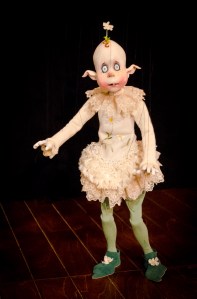
Esme Massengill, one of Ronnie Burkett’s creations (photo by Alejandro Santiago). Click for more information.
I am not sure which sort of virtuosity is most impressive.
The brilliant improvised conversation, all done by one person: Ronnie Burkett
The surreal imagery conjured by the magic hands manipulating the puppets: Ronnie Burkett
This quirky world of divas and dowagers composed with Burkett’s particular genius in mind. We meet a succession of distinct characters.
Schnitzel (photo by Alejandro Santiago)
I became exhausted from laughing roughly halfway through The Daisy Theatre, a show that’s returned to Toronto for a brief stay. I missed it at Luminato last year. It’s not all laughs. There are poignant moments to balance the hilarity, humanity, grotesquerie, and some deep questions. I hope it doesn’t surprise you that puppets can be profound.
Burkett seems to adjust the material to his audience. There we were, mid-week in a theatre for a show beginning at 9:30, observed our canny reader of personalities & moods, cleverly sizing us up before taking us on our emotional roller-coaster ride. While Burkett made the obligatory shots at Hizzoner The Mayor, we were hearing lots of cracks about different theatre companies & spaces around Toronto. We’re cautioned before the show begins that we might get 75 minutes, we might get 90… or more. Burkett gave us two hours without intermission, and I must say I was sad when he –in the guise of Schnitzel—told us we’d have to go home soon, at 11:30 pm. Am I nuts? I’ve got to work tomorrow (as I type this it IS tomorrow… but nevermind).
I don’t believe I’ve seen a more vulnerable performance, even though the power relationships are adjusted & juggled back and forth throughout. Three different audience members became part of the show, placed on display in one sense, but multiplying the effect of the performance, particularly as far as making us laugh uncontrollably. The piece also includes music & sound design from John Alcorn, making for a complete cabaret experience.
See it if you can.
It runs until Sunday, February 23 at Factory Theatre (Studio theatre), Bathurst & Adelaide. Tuesday– Saturday at 9:30 pm, Sundays at 8:00 pm http://www.factorytheatre.ca or 416-504-9971 “This production includes mature content. Restricted to audiences 16+.”
“Press releases and announcements” are presented verbatim without comment.
Robert Lepage names
L’orchestre d’hommes-orchestres (LODHO)
winner of City of Toronto Glenn Gould Protégé Prize
Toronto, ON (February 19, 2014) – Robert Lepage, Laureate of the Tenth Glenn Gould Prize, has chosen the fascinating and ingenious L’orchestre d’hommes-orchestres (LODHO) to receive The City of Toronto Glenn Gould Protégé Prize of $15,000 (CAD). Mr. Lepage will present the award to members of LODHO immediately following a special performance of their work Cabaret brise-jour on Saturday, March 29, 2014 at 2:00 p.m. at The Theatre Centre in Toronto.
“Finding yourself out of your comfort zone is something extremely stimulating – that’s exactly what L’orchestre d’hommes-orchestres does for you. Somewhere between music, poetry and visual performance, they create their own art form and you suddenly find yourself treading territories you never knew existed. They turn the ordinary into extraordinary, the expected into the unexpected, and noise into harmony. They are truly unique,” said Robert Lepage.
“The City of Toronto Glenn Gould Protégé Prize is given by the Laureate to an outstanding artist or collective who they believe embodies the qualities of creative promise, innovation and career potential demonstrated by Gould in his youth,” said Brian Levine, Executive Director of The Glenn Gould Foundation. “We’re absolutely delighted by Robert Lepage’s selection of LODHO, whose work combines an absolutely unique combination of concert, carnival, cabaret, travelling medicine show and alternative reality. There’s no one like them, anywhere.”
“We are very honoured by the recognition Robert Lepage has shown towards our work by choosing us for this prize. The support of an artist whose achievements are so significant, makes us all the prouder of the artistic posture we’ve been advocating for 12 years: un-discipline, anonymity, confusion between current arts and popular cultures. So it is a great privilege to be rewarded for having followed all those invisible strings and created all these imperfect forms,” said LODHO. “We want to share this award with all the people who have joined us, in a variety of ways, over time. LODHO is the meeting of a few people who have chosen to compose with a chaos of fertile contradictions, where the role distribution shifts and where we rarely find ourselves where we thought we would be. And today, we are here.”
Founded in Quebec City in 2002, L’orchestre d’hommes-orchestres (LODHO) is an artist run collective led by Bruno Bouchard, Gabrielle Bouthillier, Jasmin Cloutier, Simon Drouin, Simon Elmaleh and Danya Ortmann. The figure of the one-man band is emblematic of their philosophy in which the musician truly “struggles with his instrument” to create “visual music”. LODHO made its mark in 2005 with Performs Tom Waits, a production that manifests the group’s unique and iconoclastic artistic approach. It has been presented to great acclaim more than 150 times at major festivals and venues in Denmark, Holland, Belgium, Spain, Portugal, France, Mexico, Ecuador, Luxembourg, Finland, Ireland, Germany and Canada. LODHO has created and toured seven other original works including three pieces for the stage and four street performances using antique trucks. Their newest creation, Cabaret brise-jour, will have its Toronto premiere presented by The Theatre Centre March 25 to 29.
In Cabaret brise-jour, the musicians of LODHO adapt the music of Kurt Weill to create a work at the crossroads of theatre, cabaret, visual arts and performance. Set in a high-society salon of the early 20th century, eight musicians sing about the best and worst of the human condition. From Berlin cabaret and Parisian nostalgia to New York’s Broadway, LODHO retraces the path of this musician in exile, using rare instruments and “music-objects” that conjure up Weill’s dramatic and musical world. Superimposed over the music are fanciful and surrealist images concocted by the group to create surprising tableaux vivants, both strange and fascinating.
A limited number of tickets for this special March 29th matinee performance of Cabaret brise-jour are available for sale for $50 and can be purchased as of February 20th by calling The Theatre Centre at 416-538-0988 or online at www.theatrecentre.org. Patrons can also visit the Box Office at 1115 Queen Street West once the new building opens on March 19.
The Glenn Gould Prize Gala in Honour of Robert Lepage will take place on Monday, March 31, 2014 in Ottawa. Further details will be announced in March.
From March 27 to April 1, in recognition of Robert Lepage, the tenth Laureate of the Glenn Gould Prize, TIFF and The Glenn Gould Foundation will co-present Robert Lepage: Possible Worlds, a retrospective of the films of Robert Lepage including Le Confessionnal (1994), Triptych (2013), The Metropolitan Opera HD Live: Berlioz’s La Damnation de Faust (2008) and Possible Worlds (2000). The retrospective will take place at TIFF Bell Lightbox (350 King Street West), for ticket information visit http://www.tiff.net.
About Robert Lepage
The Tenth Glenn Gould Prize Laureate, Robert Lepage, is renowned for his creative and original approach to theatre and opera, using new technologies to shake classical stage direction to its foundations. The Quebec-born artist began his career as an actor, author and director gaining international recognition early on with The Dragons’ Trilogy in 1985, quickly followed by Vinci,Polygraph and Tectonic Plates. In 1994 he founded Ex Machina, his multidisciplinary production company, and under his artistic direction, this new team produced a steady output of plays including The Seven Streams of the River Ota, Geometry of Miracles, The Far Side of The Moon, The Andersen Project and Lipsynch.
His operatic achievements include thrilling productions of the double-bill of Bluebeard’s Castle and Erwartung, The Damnation of Faust, 1984, The Rake’s Progress, Wagner’s Der Ring des Nibelungen at the Metropolitan Opera, The Nightingale and Other Short Fables with the Canadian Opera Company,and The Tempest. He has worked with leading opera producers in France, Spain and Japan.
About the Glenn Gould Foundation
The Glenn Gould Foundation honours Glenn Gould’s spirit and legacy by celebrating brilliance, promoting creativity and transforming lives through the power of music and the arts with the Foundation’s signature activities, including The Glenn Gould Prize. An international symbol of creative excellence, The Glenn Gould Prize – which has been referred to as “The Nobel Prize of the Arts” – is awarded biennially to a living individual for a unique lifetime contribution that has enriched the human condition through the arts. Past laureates include Leonard Cohen (2011), Dr. José Antonio Abreu (2008) founder of El Sistema, Pierre Boulez (2002), Yo-Yo Ma (1999), Oscar Peterson (1993) and Lord Yehudi Menuhin (1990). For more information on the foundation, prize and laureates visit www.glenngould.ca .
The City of Toronto Glenn Gould Protégé Prize presentation is part of the Tenth Glenn Gould Prize celebrations, whose Presenting Sponsor is Power Corporation of Canada. The Glenn Gould Foundation also acknowledges the generous support of the Government of Ontario and the ongoing support of BMO Financial and the Aeroplan Charitable Pooling Program.
I think I recall seeing the trailer for Don Jon last summer. It came & went, and now I’ve caught up with the Don on the small screen via pay per view.
I recall having an argument with a director once after seeing an audition. The girl didn’t get the part even though she brought me to tears. I asked him if maybe he didn’t cast her because she was too good.
“No!!” said the director, upset with me. I knew I’d struck a nerve. It was an ensemble show and he was not just our teacher, but a bit of a svengali / control freak. Of course he wouldn’t stand for someone he couldn’t mentor, someone who showed up with a full bag of tricks and all too ready to rock his world (although nobody used that expression in those days… just as, come to think of it, nobody really uses it anymore).
Joseph Gordon-Levitt, formerly a child-star on Third Rock from the Sun wrote & directed Don Jon. It’s a scary piece of work that’s maybe a bit too racy for Hollywood, concerning the prominent place of porn in the life of some people. It’s a very offbeat romantic comedy. I’ve written a few times in the past couple of years about comedy. The willingness to go beyond the boundaries of the usual seems to guarantee laughs, possibly to guarantee commercial success.
But maybe Oscar—that naked statuette—is ashamed of letting anyone see his bulges. Why is the most accomplished piece of work I’ve seen this year going unappreciated? Perhaps because it feels taboo?
You may recall the trailer. If not, here it is, and –for once—the trailer actually resembles the film without telling you everything you need to know. Wow, how mature, how daring.
And how unfortunate for Mr Gordon-Levitt, as in Oscar decided to Levitt alone.
It’s an astonishingly simple piece of film. Confessions to his priest supply necessary pieces of narrative logic. We are given a very subtle piece of film that deconstructs reality especially romantic reality as we know it.
Joseph Gordon-Levitt and Scarlett Johansson take us inside the modern romantic animal, giving us a few versions of hotness.. Julianne Moore is her usual intense and fascinating self. Tony Danza is surprisingly good too.
Why didn’t this film get any acknowledgment from Oscar? I often think that the big statuette took a wrong turn at Albuquerque, so I shouldn’t be surprised that the Academy got it wrong again.
Don’t let that stop you from seeing this wonderful film. I know i’ll be seeing it again.
I had a look at Oshawa Opera today and liked what I saw and heard, as did the large and eager audience jammed into Kingsview United Church. The space is an inviting one with a surprisingly good acoustic that surrounds performers on three sides.
Although Bizet’s Carmen has a very dark ending, today I couldn’t help noticing how much of the score feels celebratory. Or at least that’s what music director & pianist Kristine Dandavino seemed to emphasize in this concert performance, making for an uplifting and festive occasion.
Near the beginning we’re charmed by a children’s chorus, on this occasion the Durham Girls’ Choir. Later flautist Joanne Averill-Rocha joined Dadavino for the Entr’acte. Oshawa Chorus helped make the last tragic scene that much more splendid with their boisterous reprise of the Toreador Song.
And the voices were up to the occasion.
Sarah Christina Steinert was Carmen for Oshawa Opera (click for more cast pictures)
Sarah Christina Steinert was a seductive Carmen, suitably attired in red, opposite the big voice of Jason Lamont as Don Jose. Michael Robert-Broder was a suave Escamillo.
Getting opera going in any town – big or small—is a huge endeavour. Dandavino made the usual speech of thank-yous to volunteers and local businesses. I hope the message gets through: that the arts help to build a city and its culture. There was no mistaking the genuine love from the supportive audience.
Although today’s free noon-hour concert by Thomas Allen at the Richard Bradshaw Auditorium was titled “Songs of the Sea” the waters could have been the fountain of youth. Allen is the biggest name singer currently appearing in the Canadian Opera Company winter season, with three performances remaining in the run of Cosi fan tutte.
Tracy Dahl as Despina and Sir Thomas Allen as Don Alfonso in the Canadian Opera Company’s new production of Così fan tutte, 2014. Photo: Michael Cooper
I don’t pretend to understand the mysteries of voice, of classifications & casting, only that Allen has graduated to the more senior instigator role of Don Alfonso, after having sung Guglielmo in his youth. Now in his seventieth year (if the internet is to be believed), Allen still commands a formidable instrument. Alfonso doesn’t go as low as Sarastro (Magic Flute) but still lies lower than the baritone roles such Count Almaviva (Marriage of Figaro). Any voice is a mixture of colours, a combination of higher and lower registers. It’s a privilege to watch a great singer mixing from his varied tonal palette, choices influenced both by what he’s been doing with his voice recently and a lifetime acquaintance with these songs.
The glory of these noon-hour recitals is in the removal of theatricality and illusion. We’re all alone with the voice in a most intimate setting with clear acoustics. For close to an hour we’re watching facial expressions, body language, hearing intakes of breath and tiny details of articulation lost on the larger stage.
Allen sang four blocks of songs with pianist Rachel Andrist:
Three by Haydn (“Piercing Eyes”, “She Never Told Her Love”, and “Sailor’s Song
Four by Schubert (“Fischerweise”, “Meeres Stille”, “Lied eines Schiffers an die Dioskuren” and “Der Musensohn”)
A group mostly “by” Britten: that is, a small operatic excerpt from Billy Budd, plus four songs arranged by Britten with a fifth a capella song inserted into the group.
Three more sentimental songs that Allen associated with his youth, in the period before he even knew opera
It was traditional programming in the sense that we moved chronologically through the compositions, from classical to romantic to modern and even popular at the end. I couldn’t help thinking that in the process the real Thomas Allen gradually showed himself. The Haydn songs are a lovely and varied group, especially the contrast between darkness of the second song and the boisterous masculinity of the third: our first excursion into anything genuinely maritime. Indeed the whole program is quite comfortably male without being ostentatiously so.
With the Schubert songs a warmer and gentler tone came to light as the voice warmed up. In “Der Musensohn“ Allen’s baritone began to re-assert itself, a glorious sound that could have been made by a singer in his 40s.
And yet coming to the monologue from Billy Budd, I was struck by the contradictory magic of the moment. Allen won’t be cast as Billy anymore, the part requiring youth. The scene is a reflection in the face of death from a young man, but now portrayed for us by an older artist: as though in valedictory. At one time opera was more open-minded in its casting, to allow older artists to play youth, but nowadays the visuals seem to trump everything. I was surprised just now –when I pulled up a recording of Allen singing this role a quarter of a century ago—to discover how dark he can sound even when singing delicately with his head voice. At least for this one scene he demonstrated that he can still sing the part as eloquently as ever.
The closing trio of songs seemed to take us closer to the Allen who had not yet encountered opera, a young voice that at times seemed to croon gently and without any apparent effort. At the end of the program Allen was clearly having fun with Andrist, enjoying the enthusiasm of the RBA audience.
I’ve crossed over to the other side. I’m sitting onstage rather than in the audience for a student production at Ryerson, playing an electronic keyboard alongside capable student singers & musicians. As I mentioned in a recent post, I’ve been more or less AWOL from the bloggy world. They’re producing Michael Hollingsworth’s adaptation of Charles Dickens’ novel Martin Chuzzlewit.
From my place in the trenches –near bedtime after the cue-to-cue—I can’t really see the whole picture. It’s maddening to say that I will see every performance, but I will never see the play. I sit upstage looking mostly at the backs and sides of these wonderful performers, but I’ll never see it from the front.
Playwright Michael Hollingsworth (click photo for more about his work)
Yet from my distorted perspective there’s loads to see: and hear. As music-director I’ve been reading and listening with an ear to the moods in each scene: all sixty-seven of them. Some of them are substantial, but occasionally a scene is over almost before it began, as though it were part of a cinematic adaptation. I can’t help thinking that Hollingsworth –after all the same man behind VideoCabaret—is a canny observer of media, that this isn’t merely an adaptation of a 19th century book stuck in the past.
Speaking of a distorted perspective, at one point in tonight’s rehearsal –when nothing much was happening, as I chatted to a student onstage—we were speculating about the play. Surely it hasn’t been seen very often before now. I thought I heard about a Toronto production that was cancelled. The internet seems to show it dating from 1988 so I have to believe someone must have produced it before, but I’m sorry I’ve never seen it.
And I heard a rumour that Soulpepper will be mounting their own production, possibly in the next year.
Director Cynthia Ashperger has sought to give this huge sprawling story depth & shape using music. The story is partially narrated by a church organist, so that musical element is a natural departure point. Songs and folk tunes of England put in appearances. When the story wanders across the Atlantic to visit America, the music has to reflect that as well. And Cynthia also had an interesting insight, connecting the mountebank Tigg (purveyor of a pyramid scheme) to music suggesting a carnival.
We’re in the home-stretch, coming up to dress rehearsals and opening night Friday. I’m like a kid in the candy store, watching all the wonderful performances, all the good work that’s been done by this talented crew. It’s a privilege to sit there immersed in the show.
Martin Chuzzlewit opens Friday February 7th, running until Feb 13th at Ryerson Theatre. For further information call 416-979-5118.
Today I took the road less traveled. At the same time as the Canadian Opera Company opened their new production of Un ballo in maschera, in the afternoon before the Superbowl, Opera in Concert took us in a less popular direction under the guidance of Kevin Mallon, leading the Aradia Ensemble. Mallon wears many hats, including his newest as Artistic Director of Opera Lyra in Ottawa.
I studied Rameau’s Hippolyte et Aricie long ago, more recently purchasing a CD with the historically informed approach that’s now de rigueur. While it’s a colourful and intriguing work, I didn’t expect to see this opera onstage. Yes, Abbé Pellegrin’s adaptation of Phaedre may have been “a hit” in the 18th Century, but it’s off the radar now. According to operabase.com’s compilation for 2012-13 Hippolyte et Aricie was the 305th most popular opera in the world (with eight performances), placing it second among Rameau’s works (after Platée and ahead of Les Indes Galantes): which puts it roughly comparable to Handel’s eighteenth most popular opera, but ahead of anything by Telemann, Barber or Orff. Even that low number is suspect, when several operas further down are only there because of the way stats are reported (eg Adès’s Powder Her Face and Benjamin’s Written on Skin are listed lower because the exact number of performances isn’t listed).
So in other words we are fortunate that Voicebox –Opera in Concert offered a semi-staged version, as this can’t be mistaken for pandering to their audience or a blatant cash-grab. Semi-staged means that gods would walk out onstage, and at times the Fates participated in the action, bundling a character up in a huge mass of fabric to rush them offstage: a strategy likely not so far away from what might have been used in the time, but on a much smaller scale I would think. We didn’t get the full spectacle as there were no costumes or sets. But even so the charismatic whiff of theatricality in the presentation was certainly enough for this listener, when coupled with Rameau’s score and Pellegrin’s libretto as channelled by Aradia & Mallon.
I think modern listeners are often off the track in how we respond to baroque performance. These are not so much pieces of music telling a story, but rather stories enlisted to give singers opportunities. Just as Racine’s Phaedre would have been a star vehicle for an actress, Pellegrin also offers a vehicle for a singer in that role. As with so many figures from ancient mythology Phaedre is like a chapter from a psychology textbook, a study in pathology as she gives voice to her desire for her step-son and then –when he vanishes—is wracked with guilt. In other words her extreme passions—rage, desire, remorse—are ideal for an operatic treatment. While there may be lots to listen to in this opera, Phaedre is squarely at the centre of the work.
OiC didn’t disappoint in casting Allyson McHardy. I’ve missed that gorgeous voice, her unrelenting approach to performance. In addition to the villainous side of the performance, McHardy added a surprising vulnerability, an element that felt modern, and made the character three-dimensional. Her passions were larger than life in this portrayal.
Allyson McHardy (photo: Bo Huang)
Several other casting choices demonstrated that OiC understood this as a special occasion, one I’m glad I didn’t miss. As Thesée Alain Coulombe was McHardy’s match at the other end of the emotional spectrum, a powerful dark presence easily filling the space with his warm voice. As Hippolyte we had another opportunity to hear Colin Ainsworth, who has steadily been growing in lyric tenor roles (often for Opera Atelier), a secure instrument gradually getting bigger without losing any of its sweetness. Ainsworth was paired with Meredith Hall, a supple voice capable of articulating subtle emotion. Of the immortals, Vania Lizbeth Chan’s Diane made anything seem possible, both in the plot of the opera and her delightful coloratura.
Kevin Mallon, conductor of Aradia Ensemble (click for Ottawa Citizen announcement about Opera Lyra)
Mallon led a sparkling performance, always putting the singers in a favourable spotlight.
Opera in Concert continue their mission of providing interesting programming off the beaten track on March 23rd with Verdi’s Stiffelio.
The talent pool at the Canadian Opera Company is deeper than ever, yet even so, few singers have the credentials of Sir Thomas Allen, one of the great singers of his generation.
Currently starring as Don Alfonso in the COC’s Cosi fan tutte until February 21st, Allen is also an unparalleled interpreter of lieder & songs, who will offer a program titled “Songs of the Sea” as part of the free noon-hour series at the Richard Bradshaw Auditorium (at the Four Season Centre) on February 13th.
On the occasion of his recital, I ask Allen ten questions: five about himself, and five more about singing “Songs of the Sea”.
1-Are you more like your father or your mother?
Tracy Dahl as Despina and Sir Thomas Allen as Don Alfonso in the Canadian Opera Company’s new production of Così fan tutte, 2014. Photo: Michael Cooper
I’m certainly more like father than mother. Mother was very much the typical devoted wife for dad. Her job was the home, looking after dad and bringing up the boy….me.
Dad on the other hand was blessed with curiosity. They both grew up in the North East of England when times were not entirely easy. There was a great deal of struggle in just surviving for quite a long period of time in their lives. Their life wasn’t easy but despite that they did all they could for me.
My father loved sport as a young man but the loss of a leg when he was 21 put an end to that.
His passion was music. He played the piano at any spare moment …popular songs, dance tunes and such like and he was the accompanist for a male voice choir and conducted a glee club.
He was my only piano teacher. When I joined the church choir and later began taking organ lessons he was really thrilled. Nothing gave me more pleasure than seeing the pleasure he got from my music-making, whether it was when I sang in the choir, played a service at church, or later when he saw me at Covent Garden or the Metropolitan Opera…his only trip abroad.
I miss him every day.
2- What is the best thing & worst thing about being a singer?
Certainly the worst thing is the business of moving around the world and making a home away from home, wherever that may be. So many apartments are the same and after a while they all blend into one boring conglomeration. It’s that business that takes one away from family for long periods of time. Now after so many years of travelling I look back and feel what a great sacrifice was made to miss so much of my sons growing up. The trouble is that once on that treadmill, it’s accepting that life is ever going to be so and one must either embrace it or leave and find something more ordinary and stable to do in life.
The good thing about singing is not the obvious thrill of listening to the cheering of an audience after a special performance…..one quickly realises that special performances are few and far between. For me the good thing is the fact that being a singer has made me inquisitive about so many aspects of life. Every day is different; each day is an involvement in a study of one sort or another – language, history, literature and people, the latter being arguably the most fascinating of all. It’s made me curious about so many things and I have learned so much as a result.
3- Who do you like to listen to or watch?
I don’t listen to singers much ….not a natural canary fancier. Having said that, Fischer Dieskau was a big influence when I was growing up. But I love the quality of certain voices and that of James Mason, for example, I could listen to all day.
4- What ability or skill do you wish you had, that you don’t have?
There’s too little appreciation of the skills of craftsmen in the UK as opposed to those who are more academically inclined. I think that’s a tragedy. As a skill, more than anything I’d want to make good furniture and generally be an accomplished carpenter.
5- When you’re just relaxing and not working what is your favourite thing to do?
When relaxing, or rather not working, I’ve put together several pursuits that have kept me sane when I might otherwise have gone crazy with this job. I’ve been a bird watcher since schooldays and that remains… I usually travel with a small pair of binoculars. There is always a sketch book and pencil in my bag along with a small box of watercolours. Golf was a big part of my life in early days though I play less these days ….it annoys me too much that I can’t play to 3 handicap any longer. But when I’m home I have a workshop and that’s where I like to be to work with wood, either making toys or serious model boats.
Sir Thomas Allen (photo: Sussie Ahlburg)
*******
Five more about the upcoming concert “Songs of the Sea”
1-Please talk about the repertoire you’re singing, especially as a departure from what you’re doing as Don Alfonso in the COC production of Cosi fan tutte.
The recital programme has been put together because the sea is a favourite subject for me.
I’m not a desert person. I was born by the sea, have observed its many moods and find it endlessly fascinating in devising recital programmes.
2-What do you love about singing songs?
Life started for me with the singing of songs. It was something I did that came entirely naturally from the time I was a treble to those first baritonal attempts. I never had a strong desire to sing opera initially. Song is a challenge, each one in a programme asking different questions of us, and all in their own right mini scenes. The pictures in my head that I need for song repertoire have become very extensive over a long period of time. No makeup, no costume, just the imagination, the vocal palette and, importantly, the message the body conveys.
3) Do you have a favourite moment in the program?
Billy Budd is in the programme and I make no excuse for including this short operatic piece in a song programme. The reason being, that it is one of the finest examples of setting the English language that I know.
But I’m also very fond of the Eric Coates song, “I heard you singing”. It’s probably not the greatest creation but it is an example of a sentiment largely lost and which I believe warrants some attention.
4) Talk about the “Songs of the Sea” as a modern singer.
Some of the songs are dated ….well they all are really, some as far back as late 18th century. That certainly doesn’t preclude them from being heard.
The very idea of a recital, whether it be a reading of poetry or prose or song in our times is something that comes in for question. Why? We hear so little of narration of stories or anything else now, be it in school, university or conservatoire . That’s a tragedy in my book and I’m doing all I can to rectify it. Without the song recital we would lose a very important aspect of musical composition. A composer saw fit to set verses to music. My job is to try to show why that happened in the first place, bringing out the qualities of the musical line and the poetry.
5) Is there anyone out there whom you particularly admire, and who has influenced you?
My dad. He was a good man and lived a truly honest life. He was my model. I looked up to him when I was young; I tried to show him that I worked hard to try to achieve something in my life. Perhaps that was because I realised he never had the opportunities …though I wished he might have had and I did it all for him as it were by proxy.
*******
Thomas Allen sings “Songs of the Sea” on February 13th with Rachel Andrist, piano at the Richard Bradshaw Auditorium.
Click the photo for more information about the COC’s free concert series
It’s eerie just how much this film reminds me of the present and where we seem to be going. Today, for instance, I was listening to Norah Young on Spark, discussing etiquette, the boundaries people establish to balance real life and virtual, defining acceptable amounts of electronic invasions of our moments in society.
I’m reminded too of the bridal shower I was at a couple of years ago, one of the four oldest people in the room (me & my partner, and the parents of the bride). About an hour into the party, everything got very quiet, very strange.
Why?
I was talking to someone, in a big party full of silent people. Odd. I noticed a room of chairs occupied by people staring at their devices. The four of us were the only ones looking up, while everyone else looked into their hand, changelings left behind while their spirits flew off through their phones & computers.
Her is a movie that is early in a new genre. I know we’ll see more films like this. Some of 2001: A Space Odyssey could be from this genre: films concerned with virtual relationships, both the ideal and by implication, the not-so-ideal partnerships. There have probably been other films exploring this frontier: where relationships are no longer human with human, but human with electronic. Spielberg’s AI Artificial Intelligence was another film asking some of the questions asked in this film.
What’s different about this one, from Spike Jonze, is how little it has of sci-fi. We could be in the present but for a few odd and even worrisome divergences.
The biggest one is that the waist-bands of the pants are different from what we see nowadays. The waist comes up a bit, the shirts tucked in, as if the tummies are maybe a bit softer, in a world that’s not working out so much because nobody seems as physical. It’s not something you can put a finger on, but yes, it’s as though this whole bizarre world has stopped exercising, because they’re addicted to electronic devices rather than the here-and-now of physicality.
Theodore Twombly writes brilliant letters for people. I am a bit mystified, not sure I understand, but maybe it’s a metaphor. The role was made for Joaquin Phoenix, the man who self-destructed in full view of the whole world. Given his public meltdown, he seems ideal for this man who’s not ready for a relationship with a real woman because he’s so immersed in his own head. So instead of a relationship with another live woman, why not his super-sensitive operating system?
Jonze is a nice guy creating a piece of art about the human heart, not a prophet nor an accurate critic of information technology. It’s an extended metaphor rather than a real prediction. I suspect that IT nerds will not buy this for a few reasons:
Because if the operating system were a purchased product, there would be physical add-ons, a sexual wii that would likely blow your mind (right? surely microsoft or google or apple would think of it and make a fortune)
Because if the operating system were a purchased product there would be liabilities up the yin yang, which means they’d figure it all out
Because if the operating system were a purchased product there would be a way to keep you hooked into progressive upgrades & improvements, so that they could keep making money off you, monetizing your obsession. I know this precisely because it’s alien to what makes me tick.
Be that as it may, it’s a film that disturbs for all the right reasons: because of the questions it asks, because of a new world we see portrayed.
Speaking of “Phoenix” I feel glad that this talented performer is rising from the ashes of his previous meltdown. While i don’t pretend to understand what goes on inside his head, i was shocked that he didn’t win an oscar for his portrayal of Johnny Cash, when Reese Witherspoon did, playing his wife.
In October 2007 I wrote the following review for the Wagner News (the newsletter of the Toronto Wagner Society), concerning Solveig Olsen’s massive book analyzing Syberberg‘s film of Parsifal. I’m pulling it out again because I’m thinking of Syberberg’s film (which i will watch again one of these days), and I want to look at Olsen’s fascinating book once more.
~~~~~~~
Solveig Olsen: Hans Jürgen Syberberg and his Film of Wagner’s Parsifal
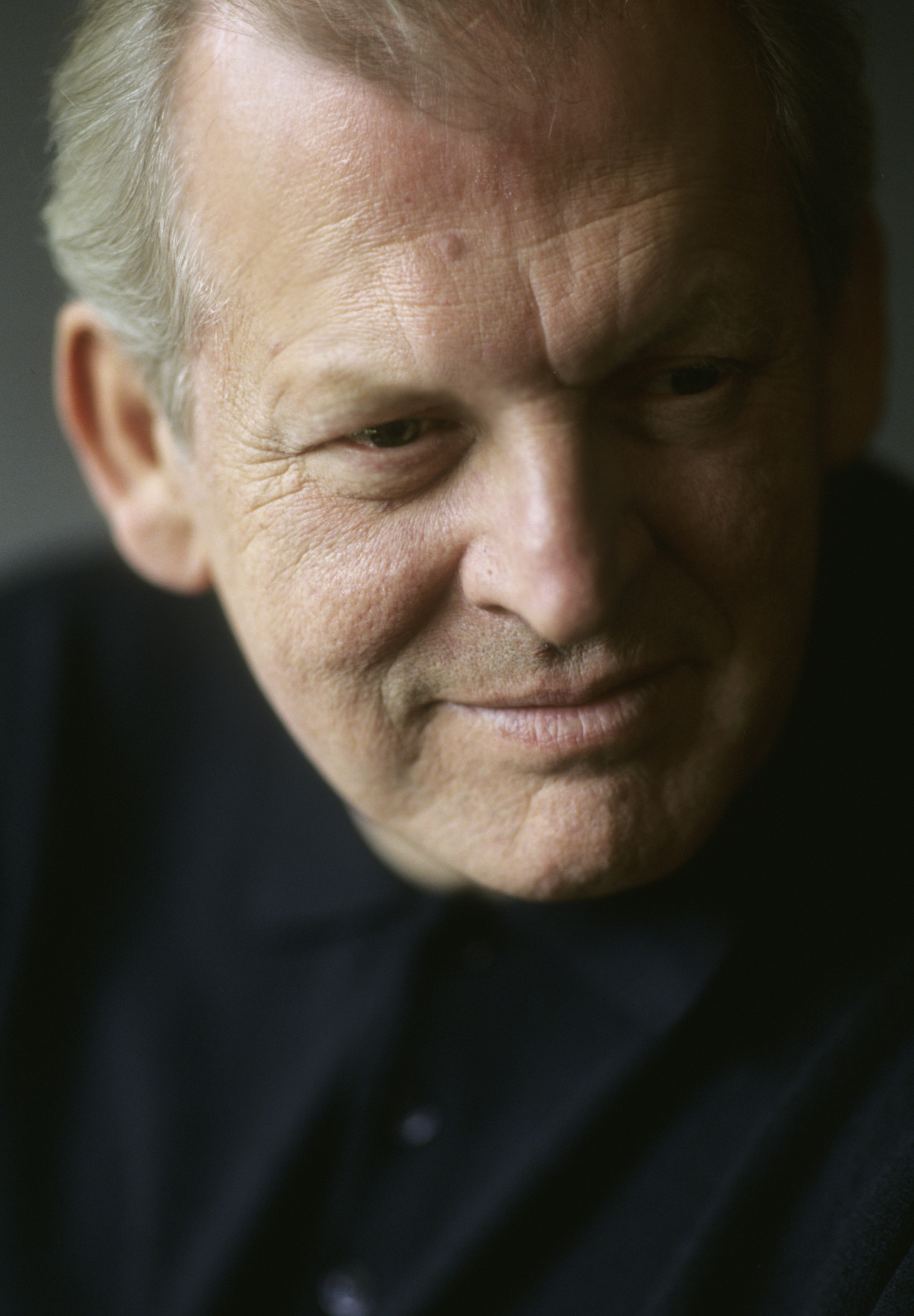
Solveig Olsen’s recent book Hans Jürgen Syberberg and his Film of Wagner’s Parsifal is an immense (554 pages) study of the film and the film-maker. Syberberg— with Fassbinder, Wenders and Herzog, a member of the “New German Cinema”—is likely best known for Our Hitler, a film of over seven hours length. Syberberg was for a time an exile from Germany, a figure of controversy, and in his old age an acclaimed artist, just like Wagner himself.
Olsen sketches Syberberg’s life story, including encounters with Brecht and the works of his ensemble, filmed by Syberberg in the early 1950s; his defection to the west followed the unrest of 1953. Among his most important films is a historic interview with Winifred Wagner from 1975, and a free-form fantasia on Wagner’s patron, namely Ludwig – Requiem für einen jungfräulichen König from 1972, not to be confused with Visconti’s Ludwig from the same year.
Olsen’s book likely will be read avidly by Syberberg’s fans and film students for whom his works are compulsory viewing; those who reject his Parsifal would never pick up a book–length dissection of Syberberg’s film. And that’s too bad. If nothing else she recapitulates the density of associations in the film and the opera, as for example in this passage concerning Amfortas’ throne in the first act:
The throne is modeled on that of Charlemagne in Aachen (Aix-la-Chapelle). In the prelude Herzeleide was sitting on it, but since it was then covered with the star-studded blue cloth, one could not recognize its shape. The throne recalls the establishment of Charlemagne’s First Reich. It relates to Wagner’s biography as well. In 1845 when he staged Tannhaüser in Dresden, the stage decorations ordered from Paris did not arrive in time, forcing Wagner to substitute old sets from other operas. For the singers’ hall he had to resort to Charlemagne’s throne room from Oberon, which the audience remembered only too well. The composer would certainly have objected to another reminder of Charlemagne’s throne room for his Parsifal, but Syberberg forces the throne on him.
Olsen’s study is like a travel guidebook illuminating obscure pathways, including medieval sources, Wagner’s biography, and contexts that one can choose to pursue or ignore. Is even the name of the tenor portraying Parsifal—Rainer Goldberg –meaningful?
Rainer = reiner, “pure”; Gold = alchemically pure substance.
Olsen does not rule it out.
~~~~~~~
Syberberg will be eighty years old in December 2015.







 barczablog