Last night’s brilliant concert at Roy Thomson Hall from the Toronto Symphony was improved by the introductory remarks from Music Director Gustavo Gimeno, explaining his unorthodox choices.

The concert may have been titled “R Strauss’s Don Quixote” but Gimeno explained that the program was built around the North American premiere of Samy Moussa’s Trombone Concerto. The composer felt his new piece would work with Wagner or Strauss so we got both composers last night.
The program consisted of four pieces:
1) Lontano by György Ligeti
2) Prelude to Act I of Parsifal by Richard Wagner
3) Concerto for Trombone and Orchestra “Yericho” by Samy Moussa
–intermission–
4) Don Quixote by Richard Strauss

Moussa’s concerto is a tonal piece full of big sweeping phrases for a huge orchestra, romantic in its implications. I even wonder whether Moussa understood this seven movement work titled “Yericho” to be at some level a kind of “program music”, perhaps telling a story. I say that even though we were not really given a program, at least not in the sense of what Strauss did telling a version of Cervantes’ Don Quixote through orchestral means. I wonder if it matters, given that one can enjoy a piece even without knowing the composer’s subtext(s). The TSO’s notes tell us that Yericho is a work touching upon symbols such as the use of seven movements, seven horns (if we include the trombone soloist plus the four horns and two trumpets), as in the Biblical Book of Joshua.
For what it’s worth, whatever the intended meanings that Moussa may or may not have meant to convey, his concerto is gripping, its first and last movements pulsing with urgent repeated figures shared through parts of the orchestra, slower sections of great beauty, and a phenomenal display of virtuosity from the trombone soloist Jörgen van Rijen. The audience responded to the dramatic power of Moussa’s vision and the brilliance of van Rijen. I hope to hear the piece again.
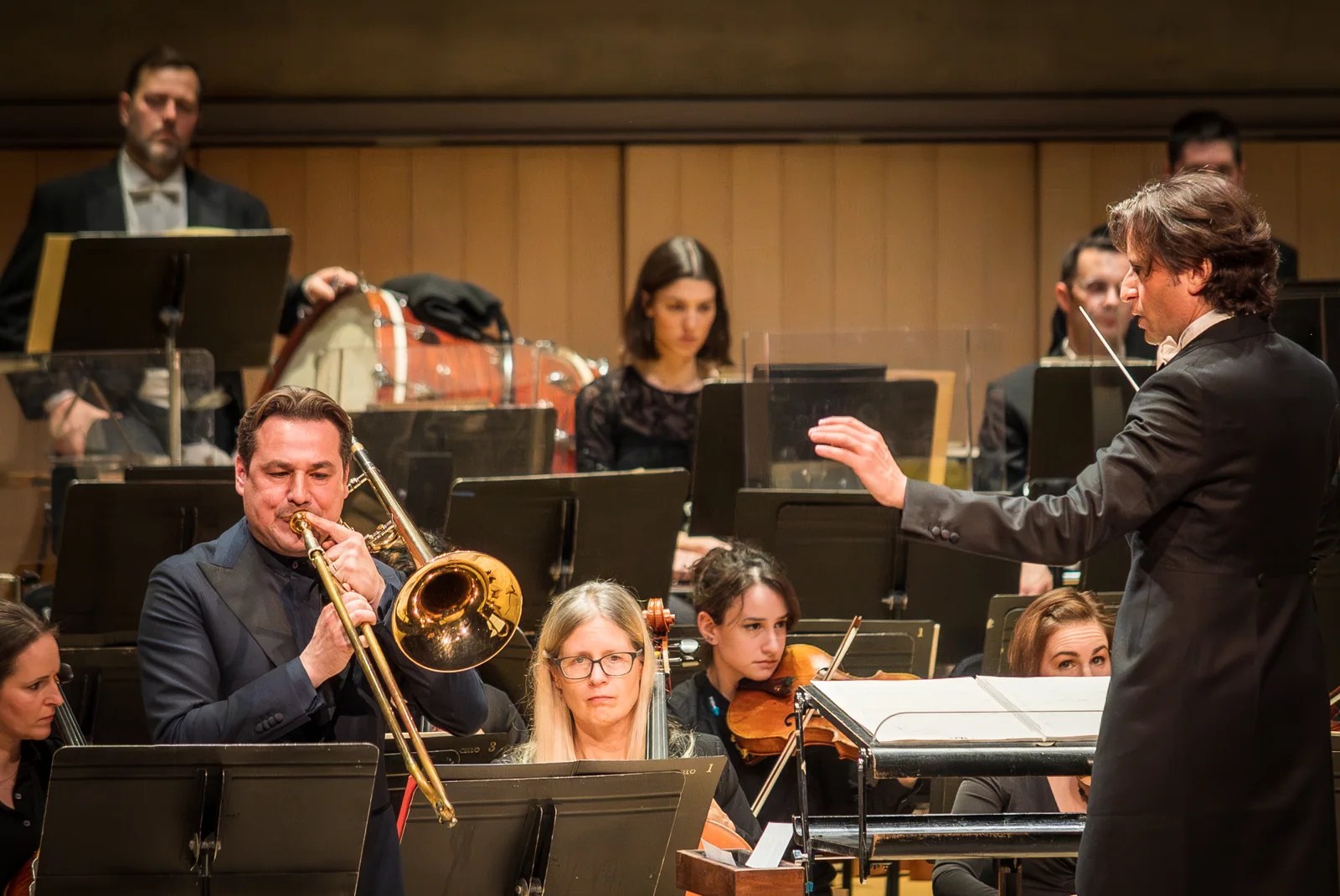
And so I’d say “mission accomplished” as far as Gimeno’s desire to frame Moussa’s trombone concerto in a sympathetic context, all while employing a comparable contingent of players in the other pieces given the large orchestra required for the concerto.
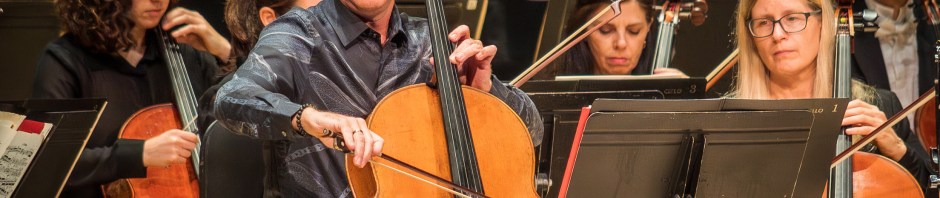
The TSO again chose to showcase talented soloists from the orchestra. Don Quixote is a set of variations that features Joseph Johnson principal cellist of the TSO almost as though portraying the Don. Rémi Pelletier viola, with assistance from bass clarinet and tenor tuba give us Sancho Panza, often debating with the Don.

Before he turned to opera in the 20th century Richard Strauss had a successful career composing orchestral music in his youth. With each subsequent creation, from Aus Italien to Macbeth, to Death & Transfiguration, then Till Eulenspiegel and Also Sprach Zarathustra displayed Strauss’s unique ability to tell stories and paint detailed pictures with orchestra. For me Don Quixote was the peak, given that some of the others such as Ein Heldenleben, Sinfonia Domestica and the Alpine Symphony suggest a colossal ego. But long before Strauss gave us that sublime final trio in Der Rosenkavalier, he was already capturing deep emotions in his tone poems. I find the concluding minutes of Don Quixote every bit as stunning as anything in his operas, especially when played with the subtlety of Gimeno and Johnson. The version I long admired on vinyl from Pierre Fournier’s cello with George Szell leading the Cleveland Orchestra has a more heavy-handed approach to the comedy, the gags in the orchestra sometimes landing like vaudeville schtick. Gimeno and Johnson gave us something more sophisticated, subtler. When we came to the gentle final solo when the Don dies, fading away with a gentle barely audible glissando downwards, I cried. At the conclusion of the piece the audience sat silently for a very long time before anyone applauded.
The TSO are playing at a high level right now, especially in a work like the Strauss where every section gets their moments to shine, responding to Gimeno.
I feel lucky that we again get to hear music of Ligeti. Just last week Esprit Orchestra’s Violinissimo II featured the violin concerto that we had heard from Jonathan Crow and the TSO back in October. Maybe I shouldn’t jump to any conclusions as to whether Gimeno loves Ligeti, but I’ll never complain when his challenging scores are offered to us.
Gimeno again paired Ligeti with a grail-themed Wagner prelude, played without a pause between them. Last season we had the magic of Atmospheres plus the Lohengrin prelude, done without a break. Audiences were silent, hypnotized. This time it was Lontano and Parsifal casting a spell on listeners. Lontano might be meant to literally show us something that seems to be far away (as in the title), the softer passages seeming to be distant.
I recall (a morning after addition) how Gimeno spoke of the Parsifal prelude as the “Vorspiel”, in his charming accented English employing the German word that appears on the page. How many languages does Gimeno have to speak, as he conducts in Toronto and elsewhere, an intercultural ambassador bringing together the Hungarian expat (Ligeti) and the German (Wagner), here for a Toronto audience..? I pulled out my Parsifal piano-vocal score to photograph that first page, as Erika remarked at the stunning patterns of arpeggiated notes that you see rising upwards like the music and indeed like the associated spirit Wagner chased. Roy Howat sensitized me to the design element on the page, the beauty of the patterns. Our ears were especially sensitive to this after the remote far-off sounds of the Ligeti, everyone leaning forward.

I recall professor Godfrey Ridout telling a story in an opera class, how Mad King Ludwig of Bavaria demanded a performance of first the Lohengrin and then the Parsifal prelude, infuriating Wagner by declaring Lohengrin’s prelude to be better. How extraordinary that we have had a pair of parallel performances from Gimeno and the TSO. Lohengrin’s prelude is shorter, a miniature version of the opera’s plot represented in music, while Parsifal’s prelude is more complex. Coming a few days after Easter it’s timely, a piece many of us listen to as a nod to the season. As we await the long-promised Parsifal production from COC I wonder if Gimeno wants to conduct this opera. Of course COC resident Music Director Johannes Debus has led their Wagner operas in the past.
The concert is repeated Saturday night at 8:00 pm. I recommend you go if you can make it.

 barczablog