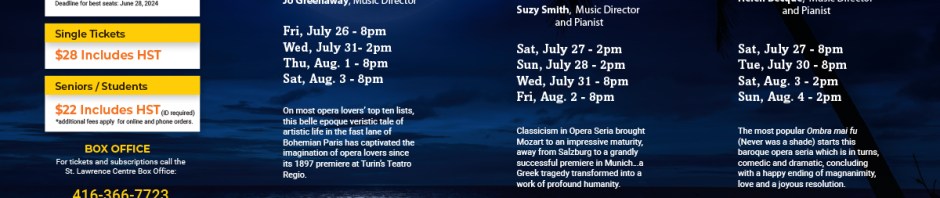
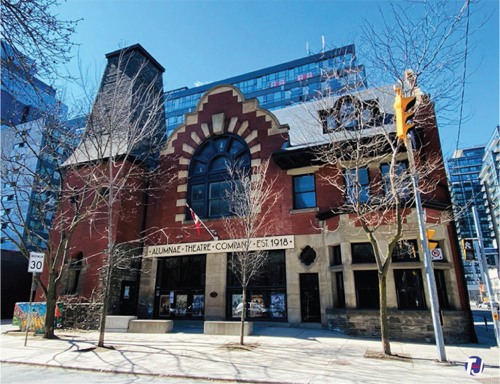
I attended the La Boheme to open Summer Opera Lyric Theatre’s summer season tonight at the Alumnae Theatre.
Guillermo Silva-Marin called it a festival in his pre-show introductory talk.
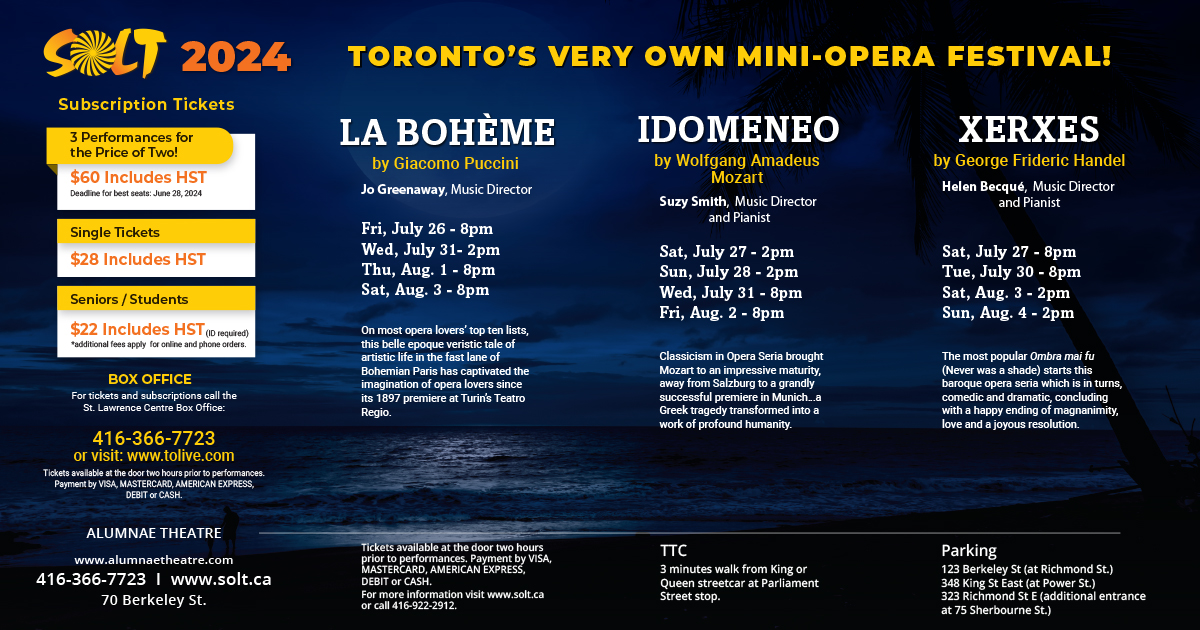
As you can see in the graphic, between now and next weekend SOLT will present three operas (not just Puccini’s bohemians but also Handel’s Xerxes and Mozart’s Idomeneo), two performances by each of the double casts to offer four of each opera, twelve shows in total in their schedule. Xerxes and boheme are offered in English translation while Idomeneo is sung in Italian, a different pianist / music director for each opera.
SOLT is a school for young singers, a summer program that climaxes with the showcase of this festival, when we see what they have learned.
Among the countless productions of boheme that I’ve seen & heard, a few were done in an English translation like this one. The singer’s task becomes quite a bit different especially when we’re working without surtitles. The comedy is foregrounded as we suddenly have funny lines, so long as the singer can make the lines funny. Some of the singers rose to the challenge better than others, balancing their need to sing beautifully while enunciating with clarity. Chances are they will improve in their second time next week. Marcel van Helden as Rodolfo and Cassandra Amorim as Mimi were very successful romantic leads, communicating & acting clearly and eloquently. I love it when I see a familiar opera in a new way. Baritone Joseph Ernst was a standout as Schaunard, both as an instigator of comedy in the first act, and the one who discovers Mimi’s death in the last moments.
Boheme without a chorus is a different animal, the challenge landing squarely on pianist Jo Greenaway. I was impressed by her choices, giving the singers room to be lyrical in their solos, fully honouring the lyrical lines rather than the compulsive quickness one finds in some interpretations (thinking especially of Toscanini, the one I first heard as a child). I think Jo’s approach helped the singers communicate, especially in the pathos of the last scene.
One of the changes in this version is the removal of the children’s chorus chasing after the toy-seller Parpignol, who is reinvented as a waiter in the Cafe Momus singing an aria. Everly Conrad-Baldwin took the stage boldly giving us a different way than the usual to set up the scene in the Cafe.
I will never stop admiring Puccini’s achievement. It’s a piano score I play (once we’ve done Christmas carols) at the annual Italian Department Christmas party (a regular gig at U of T I’ve been doing for over 10 years), apt because the first two acts take place at Christmas time. Puccini gives us joy and despair, romance and comedy in what is one of the most economical scores ever written. It never stops moving me, an effect that carries over into repeated viewings of the romantic comedy Moonstruck, a film relying heavily on Puccini for its charm.
But the other two operas aren’t chopped liver. Xerxes opens with what might be the most performed tune in opera, even though it’s often separated from the original context. “Ombra mai fu” has been paraphrased in such weird ways as “Handel’s Celebrated Largo” or the church anthem “Holy Art Thou”. Alas the irony of the original is usually missing even if it’s an amazing tune.
I used to enjoy playing and contrasting different versions of the melody for opera classes, for instance Gigli and David Daniels. I wouldn’t dream of suggesting one version of the piece is better, so much as that it’s a kind of litmus test of the era and a demonstration of the changing assumptions about the art form and their use of the virtuoso.
And here’s a sample from a rehearsal of Idomeneo by Mike Fan who sings the title role this week for SOLT.
We were grateful for an air conditioned space. Unlike the old Robert Gill Theatre, SOLT’s former home, they shut off the a/c for the start of the opera, resuming for intermission then silencing the blowers again for the last portion. Much as I loved the Gill it was plagued by ventilation noise. And the sightlines are better at the Alumnae Theatre.
 barczablog
Insightful and warmhearted review. The Gigli and Daniels videos were intriguing and lovely. Thx.
LikeLike
Thanks! I guess I was so carried away with the idea of pedagogy (opera students) that I started doing the teaching thing. Haha I can’t help it. But isn’t it amazing how we are able to time-travel and explore different cultures through video. It never gets old, even if the singers (and gulp the writers) do.
LikeLiked by 1 person