In 1967 Joseph Budai was working on a renovation of a Chinese restaurant in Peterborough.
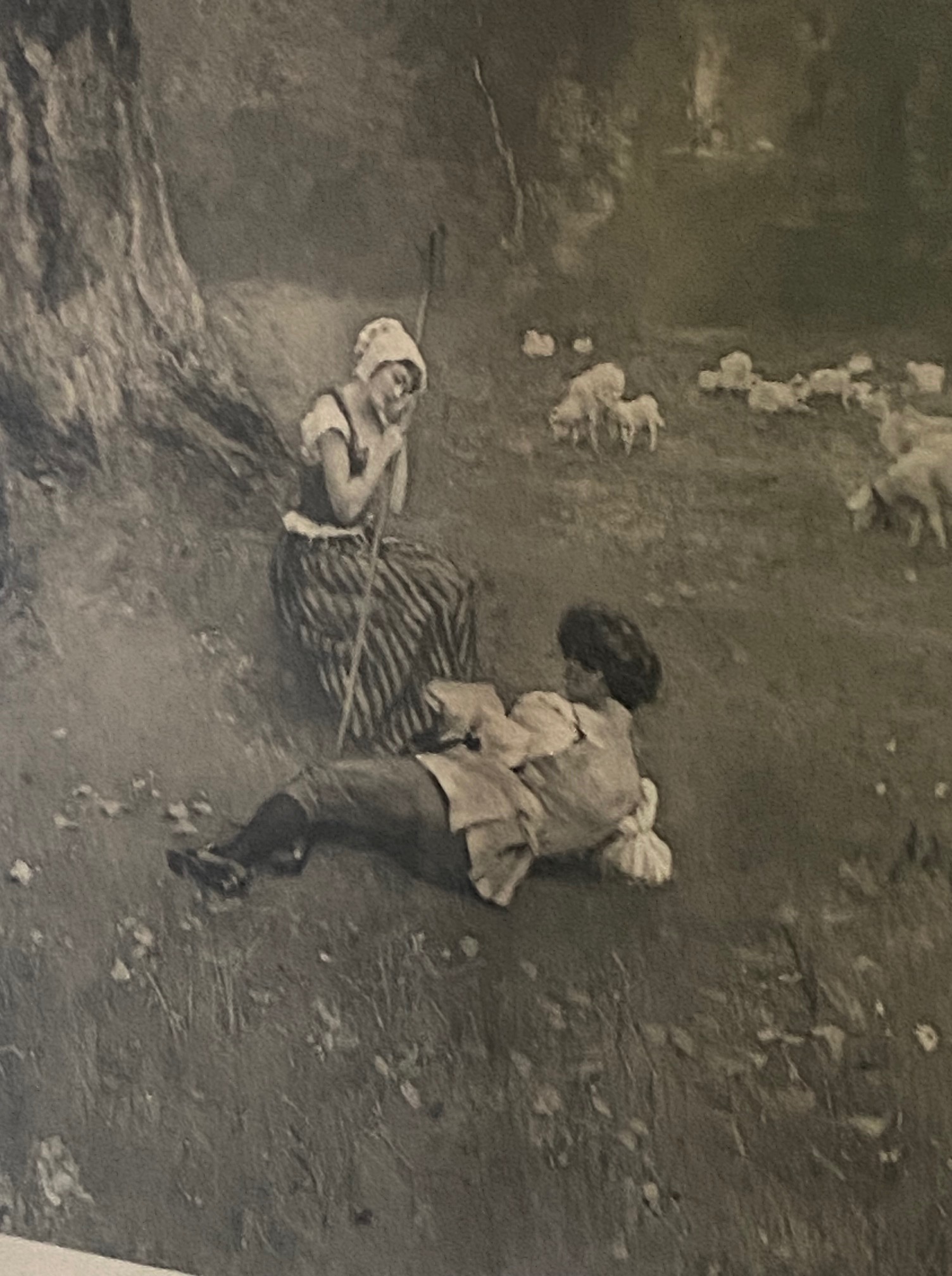
An old lithograph picture was left inside the walls that he was renovating. At the time it was still inside an old ornate frame that was broken and very dirty. Of course it was, they’d stuffed it inside the walls, where it lay forgotten for many years.
Joe retrieved it, took it home, and held onto it for a long time….
1967 was also the year I became a student at University of Toronto Schools, aka UTS. I know I must have been a huge pain in the butt to our music teacher Mr Fitzgerald. Perhaps my whole class was a challenge. I recall that Mr Fitzgerald had a whistle that he would sometimes blow in attempts to get us to be quiet. We were sometimes a rowdy group in grade seven and the years that followed.
I don’t deny that I was a smart-ass, proud younger brother of a great singer, trying to reconcile myself to a UTS music program oriented towards the cadet corps and marching band music rather than orchestral music or opera. While I’d played the cello in grade six I would play euphonium in grade seven.
Mr Fitzgerald, to his credit, had a few great ideas. Decades later and after having worked from the other side of the music, as a music director and teacher, I am abashed recalling how hard we made the poor guy work, trying to impress an impossible group of little boys.
One day Mr Fitzgerald brought us a new piece. The pages of music we placed onto our music stands were pristine, untouched until we opened them: the Poet and Peasant Overture by Franz von Suppé (1819 –1895).
And our leader was new too, as Mr Fitzgerald gave the conducting assignment that first day to an older student. It’s amazing how much better we behaved, no longer acting out against an authority figure, now that we were being led by the cool kid from grade 12, who came in politely, holding his baton with a kind of reverent care. He addressed us with respect, full of a high-minded seriousness before we had even begun to play the piece. Everything that day felt brand new, at least because we had a new leader and new music before us. His attitude was contagious.
I remember that we approached the Poet and Peasant Overture as though we were playing Beethoven’s Ninth Symphony.
I remember classmate Ron Walker playing the melody of the first section on trumpet, sitting in a row in front of me, and clearly having a great time with the piece. I haven’t seen Ron in half a century. I hope he’s still alive. I was on euphonium in the back row beside George Stock on trombone.
The opening phrases are big and bold. Then the softer answering phrase I think was coming from another grouping, perhaps clarinets and other woodwinds, to create a contrast. I don’t know if we ever made it through the whole piece, as it took us awhile to get past the first page. But it was exciting all the same.
Mr Fitzgerald seemed to know what he was doing, putting me on the euphonium. While I wanted to play french horn Mr Fitzgerald claimed my lips were wrong for the instrument. Perhaps he was right? My older sister had played principal french horn at Cedarbrae and later Lawrence Park Collegiate, seemingly coping with the same full lips we inherited from our parents, that didn’t prevent her from skillfully playing the horn solo in the Tchaikovsky 5th symphony.
Or maybe Mr Fitzgerald had his eye on the future of the UTS Band, so that my ambitions were irrelevant. In time I was encouraged to switch from euphonium to tuba, which is very similar in fingerings but hitting lower notes. In fact I loved it even if I didn’t enjoy being called “Tubby the Tuba,” (a reflection of my physique). Clearly Mr Fitzgerald was planning the succession, as older students’ graduation changed the needs of the UTS band. In short order I was the tuba player and offered a bargain-priced trip to Ottawa, at $40 including bus fare and two nights at the Lord Elgin in 1970 or so. I recall an inspection in uniform as member of the cadet corps, where the inspecting officer arrived beside me, commenting something along the lines of “that instrument is bigger than you!”
And I politely replied “yes sir!”
You will recall that Joe Budai found that lithograph back in 1967, when I was 12 years old and his daughter Erika was 15.
Erika and I would meet roughly twenty years later, and were married in 1989.
Joe told Erika that the lithograph in its gold frame, still stashed away in storage somewhere, reminded him of me and Erika. I found the idea not just romantic but flattering, an endearing image. The title at the bottom of the picture says “The Poet and The Peasant”.

Erika was as much or perhaps more of an artist than I. She went to Ontario College of Art (or OCA, as it was then known) now Ontario College of Art and Design University (or OCADU). I remember wondering whether I should think of her as poet (artist) and myself as the peasant in her father’s mind.
I have written about Joe Budai before. Joe was married to Irene. In April 2009 Irene passed away. Joe was still alive but afflicted with Alzheimers. In February 2010 Joe would finally pass away.
A couple of years ago we took the remnant of the lithograph in its old golden frame to be restored, cleaned up and given a new frame. It hung for awhile above our bed.
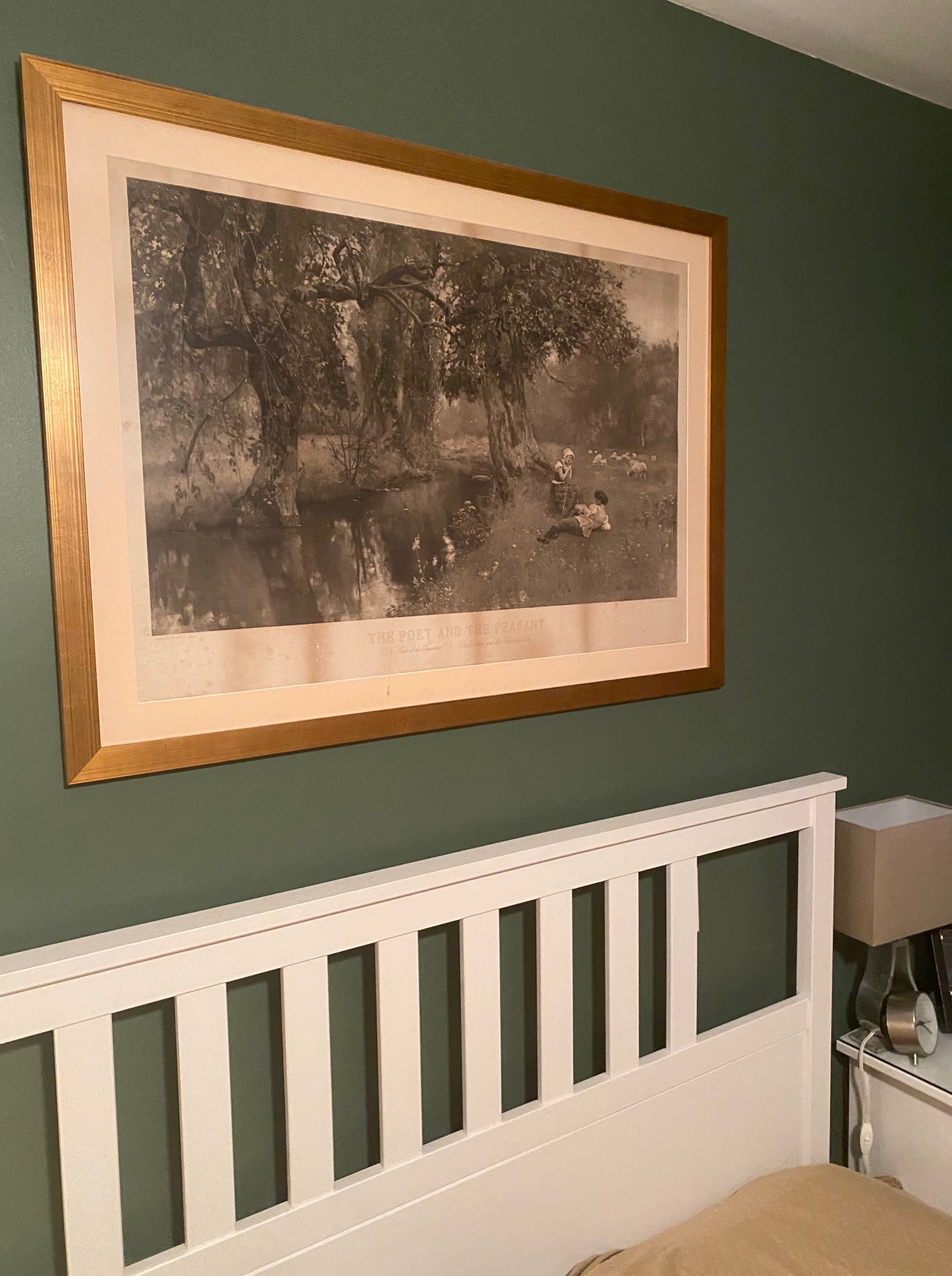
Currently the picture hangs in the front hallway of our home.
The lithograph is actually a copy of a painting by a British painter Henry John Yeend King (1855–1924). The original can be seen online, a full-colour oil on canvas 109 cm by 160 cm. I wonder whether the painter knew the operetta, or merely used the title as his inspiration.
But I was wondering about that image in the lithograph. When I looked around online it led me back to the piece I had heard at UTS decades before. When I googled I saw the connection of the name –between the picture and the overture–even if I can’t find the story original. It seems that the work titled Dichter und Bauer (Poet and Peasant) was composed in 1900 after Franz von Suppé had died. He had composed incidental music plus the overture for a play back in 1846, while the operetta was assembled in 1900 using his music.
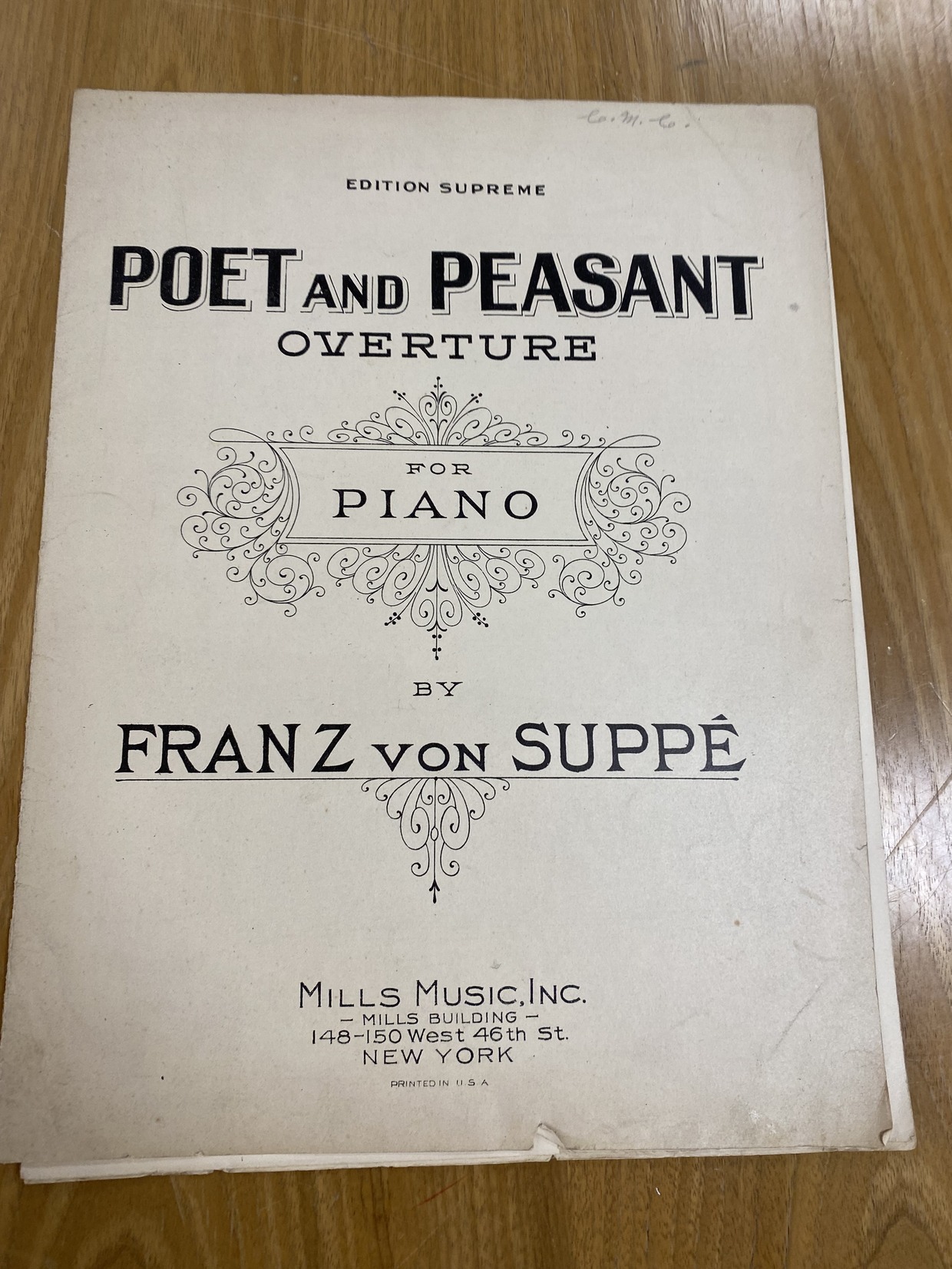
I’ve recently been exploring the riches of the Edward Johnson Building’s music library, especially piano reductions of orchestral pieces. When I looked in the library catalogue I was delighted to see that the EJB Library had a copy of the Poet and Peasant overture in a piano arrangement, one of several items donated by Professor Carl Morey. While it is not permitted to circulate, one can have a look and copy.
I requested the score of the piano transcription, took pictures and then printed a copy at home that I have played through.
As with most piano transcriptions the music has to be reduced from a large ensemble to be played at the piano by a soloist.
Here’s the cover page.
Playing it on the piano was a bit of a nostalgia trip… It opens with a solemn melody that we took very seriously back in the day even if it’s kind of silly in a Bugs Bunny cutting Elmer Fudd’s hair sort of way. Sometimes the piece is sweetly lyrical, sometimes desperately melodramatic, jumping from one mood to the other. Music for the theatre of the time was created in hopes of capturing and inspiring powerful emotions. The transitions in the music were unsubtle, even abrupt, but that just made them more exciting.
There’s a passage where the melody sounds a lot like “I’ve been working on the railroad”. The intense drama in the middle when it gets all passionate reminds me of Rossini’s overture to William Tell, alternating between pastoral lyricism and the powerless desperation of a silent film.
The heroine is tied to the railway tracks. And a train is coming!
Von Suppé’s command of a melody is as sure as any bel canto composer: even if it might be a mistake to use such a label for his music. I wish I knew the original context better, as the piece has been divorced from the original text that inspired the work. All I have so far is a title.
I hope to find out more, but in the meantime I can enjoy hearing and playing the overture.
 barczablog
If memory serves (and it does less and less), I recall hearing my mother-in-law Ruth Watson Henderson playing this in a two-piano arrangement with Dr. Melville Cook in a recital at Metropolitan United in the 1970s.
Thank you for sharing your memory.