
My headline is not just a nod to “Sticks Nix Hick Pix”.
There truly was no ham to see in the gala World Premiere of William Tell, unless we include the man who wrote and directed, namely Nick Hamm speaking to us in the talkback afterwards.
I didn’t know what to expect, even if I had Rossini’s over-played overture to his rarely performed opera in the back of my mind. I came in thinking William Tell was a known freedom fighter, a famous archer, and oh yes, he was Swiss.
Hamm crafted something remarkable, steering his script and his cast clear of the excesses one might expect in a dark violent story. While we might demand passionate responses to such a story the acting was amazingly restrained.
No ham in other words.
My headline is not just for fun. Hamm prevents his actors from overdoing it two ways. He wrote a script requiring restraint, and then he actually followed through, enforcing that upon his actors. One regularly sees actors improvise which might make for better performances, improving a script, until they veer into a language that’s from a 21st century idiom rather than the 14th. The director has to be firm given that nowadays actors normally improvise.
Of course the film is in English, not one of the languages from the actual story, so it’s a matter of simulation, a way of foregrounding historicity. You create a kind of illusion that you’re in the 14th century through art direction, costuming, set, and a choice of words to suggest the story in its time. One desperately wants to avoid being reminded that we’re watching a young person from our own time improvise in front of a camera.
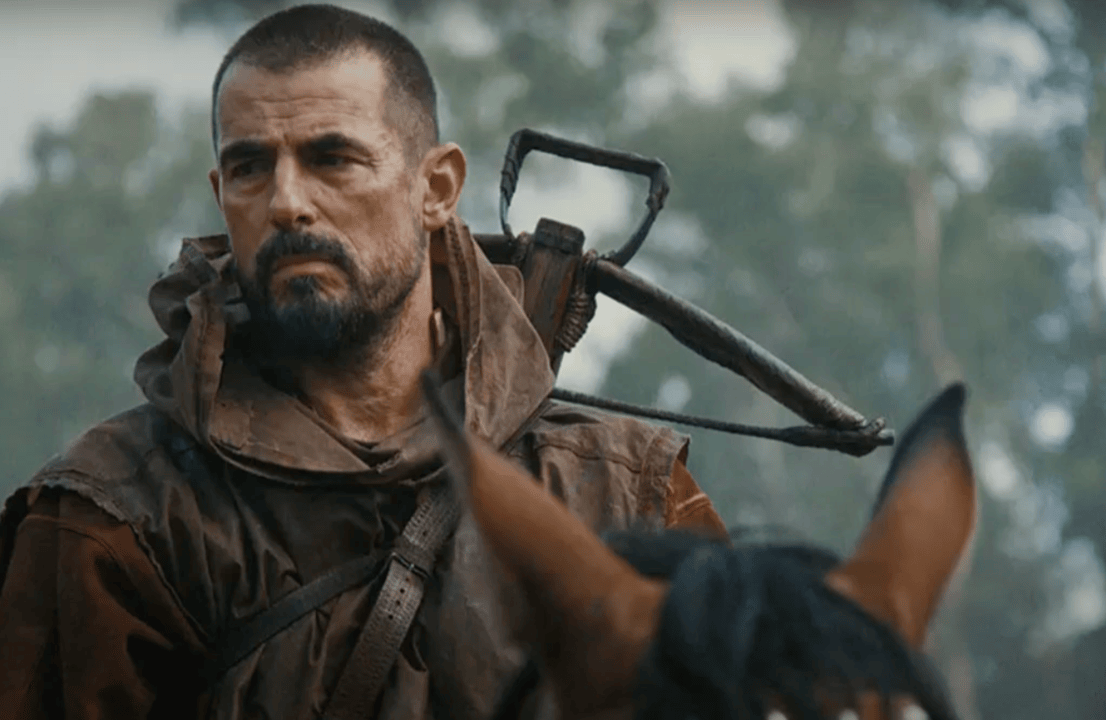
Ben Kingsley and Jonathan Pryce restrain themselves. Claes Bang as William Tell is especially restrained. I am especially mindful of this restraint having seen Rosmersholm at Crow’s Theatre, where Chris Abraham seemed to create the world of the play through the repressed behaviour of most of the cast. Or maybe I was sensitive to it having seen William Tell the night before, thinking that the careful control of Hamm over his cast is a kind of magic trick to keep modernisms at bay.
The original sources including Friedrich Schiller’s 1804 play and earlier legends from the 15th century that I’ve looked up since seeing the film allow Hamm space to insert his own spin on a story that is for all intents and purposes unknown.
We see stunning scenery that as Hamm joked in the talk-back, might remind you of The Sound of Music.
We see more women taking up arms than I have seen in any film, something I enjoyed whether or not it’s in any way accurate. I suspect it’s a genuine possibility when a small community is under attack.
We see that Tell brought back a wife from his crusade in the Holy Land, fathering a son who appears a bit different from the others in his Swiss town. I can’t help seeing a bit of resonance to modern events in that famous moment we all know. It’s set up by details we won’t know of course, as the Austrian bailiff who posted his hat in the town square, demanding a bow of loyal obeisance from everyone. When Tell and his son refuse to bow, soldiers grab Tell’s son. Having heard of the father’s marksmanship the bailiff has the idea of demanding that the father shoot an apple off his son’s head at 20 paces, perhaps 100 feet away. There’s a visible racial marker in Hamm’s film complete with an insulting slur against the boy. I think I heard someone call him a mongrel. The actors portraying the Swiss characters show astonishing restraint in this scene, their emotions building very slowly, inexorably. So while Hamm said in the talkback he was trying to dodge anachronism, that indeed he hates anachronism in film, it was troubling to see something that felt so modern, namely the fascistic overtones to the scene, including soldiers seeming to mock someone as though for their race. But then again maybe that was accurate? Who knows. It made the scene that much more powerful.
As I watched I was mindful of what I knew about the Middle Ages. Agency in a society like this is relatively new, individualism would not be articulated for a long time, as people obeyed their church and their kings. We think of films set in the future especially science fiction as having to perform futurism, assembling mores and fashions and manners to help actors flesh out the future world they inhabit. But the same thing should be just as true for a film with historicity, foregrounding another time remote from our own. I think it’s rarely done this well, as we may think of actors slipping modern phrases and accents into their dialogue, for instance “yonder is de castle of my fodder,” from an American actor. Hamm has done a great job of keeping his actors firmly on track with the script and the world they inhabit.
The orchestral score is from Oscar winner Steven Price, composer of the music to Gravity (2013) for which he won the Oscar, Suicide Squad (2016) and Fury (2014). I don’t know his work. For this project Price seems to have been asked to subtly underline the action, so that when something momentous happens such as a storm or an attack, the music gets louder to underline that excitement. I suppose we’d call that a traditional approach to scoring even though I heard nothing especially artistic: but maybe that’s because Price was working from the same template as the actors, aiming for understatement rather than overdoing it.
I want to see this film again. I found it sometimes very violent in its depiction of combat, but then again that’s only reasonable. If you’re easily triggered you’ll avoid a film featuring battles and hand-to-hand struggles with swords and crossbows. Yet the film is handsome and a worthwhile treatment of its materials.
 barczablog