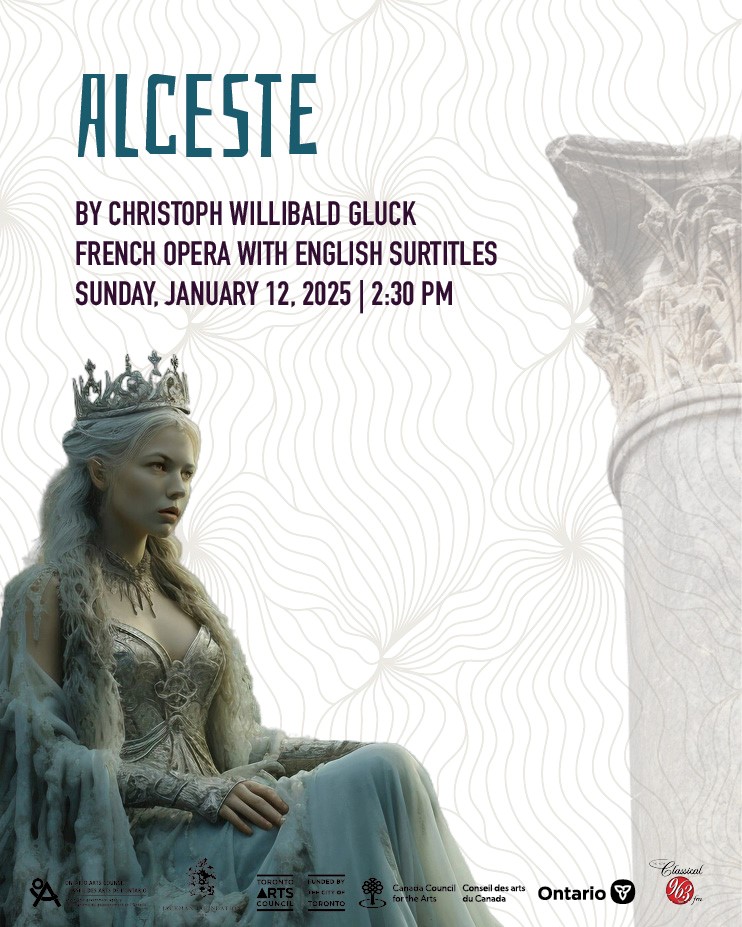
After half a century at the Jane Mallett in St Lawrence Centre on Front St, Voicebox – Opera in Concert presented Gluck’s opera Alceste today at their new venue, Jeanne Lamon Hall in the Trinity-St Paul’s Centre on Bloor St West.
It’s a new beginning.
There are two difficult roles, while the remainder of the parts are tiny in comparison. Without detailing the story taken from Euripides and adapted by Calzabigi, it’s a dark love story, as Apollo has proclaimed that Admète must die unless some other person offers to sacrifice their life for him: and his wife Alceste does so. Their displays of love and loyalty so impress the gods that a happy ending that they are saved from death after all is proclaimed by Apollo himself.
Alceste was undertaken by Lauren Margison, a remarkably difficult role, a great deal of singing over the afternoon. I saw no signs of fatigue, indeed Lauren seemed strongest in the last scene. In our recent interview I shared her recent recording of the great first act aria “Divinités du Styx”. At intermission I chatted with Ryan Harper who recorded this performance, as we mused on what we heard today, even more impressive. Where the video version is more carefully modulated and even, the live version was much bolder, more daring. The high notes popped with extraordinary energy.
Talking to Ryan, we were talking about the interesting acoustic in the Jeanne Lamon hall, that’s so warm and reverberant that Lauren was able to pull back in places to a very soft pianissimo, that was still precisely articulated, perfectly on pitch and distinct. Her legato was exquisite. While the role is not one that she is likely to get to sing again given that the work is relatively rare, I would wish someone would produce it to hear her sing this again.

Admète was sung by the ageless Colin Ainsworth, a tenor known in the Toronto area for his many roles with Opera Atelier, a lovely light voice that has lost none of its youthful agility while seeming perhaps a bit bigger and more powerful.

We heard in Guillermo Silva-Marin’s introduction that Colin had surgery recently, which meant he did not memorize the piece and used a music stand. Yet the result was superb. While Colin may be a fair bit older than Lauren they seemed perfectly matched, a truly romantic pair together who made the classic love story completely believable, irresistibly genuine.
Let me put in my usual plug for Canadian talent. Lauren and Colin are as good as anyone in the world in this sort of rep. I hope we will see them someday singing at the Canadian Opera Company, who might be Canadian in name, Canadian for their orchestra and chorus, but regularly import singers for roles that could be sung by Canadian artists like these two.
The libretto of Alceste is by Calzabigi, who set out a series of reforms in the preface to the published version of the opera.
Reforms? While the arias of Handel for instance would have a contrasting middle section then repeat the opening section (aka “da capo arias”), Calzabigi and Gluck wanted to avoid vocal display for its own sake, aiming to make the words more dramatic with less repetition and improvised cadenzas. The goal was to make opera less a playground for show-offs and more genuinely dramatic. And yet there is still ample room for drama through music. Gluck the reformer wrote beautiful music that had me hooked on the story rather than preoccupied with a soloist’s coloratura.
I loved the work of Lauren and Colin. Pianist and music director Suzy Smith played flawlessly, articulating clearly while leading a tight performance of the entire ensemble, including the OIC chorus led by Robert Cooper. Speaking of reform, the chorus are as integral to the work as if they were another character in the drama, well-articulated, sometimes very gentle and understated, and thoroughly engaged with the story. I especially liked the suggestion of the underworld, the masks lending a theatrical edge to the proceedings.
As I’m speaking of the new location and the history of Opera in Concert, going back to the days of founder Stuart Hamilton so long ago, I thought today’s show might be subtitled “a bridge too far“. Except for Colin –who was recovering from a recent surgery–everyone doing a solo in the show memorized their lines and moved about the stage. That’s impressive and a step beyond the old opera in concert. In its day Stuart’s shows were done entirely from music stands, with minimal interaction between the players. Director Guillermo deserves credit for trying to make theatre out of opera, indeed that’s a hobby horse of mine. Yes opera is drama, a hybrid form of words and music and therefore sometimes under-estimated as something that’s only a musical form.
The problem? I saw a cast that was often singing out of tune and/or mispronouncing their French words. Maybe that’s unavoidable, maybe there wasn’t sufficient time for rehearsal, but I submit that the cast were aiming too high (ergo the bridge too far reference). I was spoiled by Colin and Lauren whose pitch was bang on throughout their roles. Only Ryan Hofman in his brief impressive appearance as the Infernal God was also precisely on pitch and accurate in his diction. For every other tiny solo yes they memorized lines and moved about the stage, but their French words were either badly pronounced, off pitch or (gulp) sometimes both. The two small soprano parts (wasn’t sure which was which) were also accurate, to be fair, but not the rest of the male cast (I won’t name them). Maybe more rehearsal might fix this, but I believe that if Guillermo simply chose to focus on the concert performance, coaching the vocal performances while letting them sing from music stands instead of asking them to memorize and move about the stage, we’d get a better result. I don’t expect theatrics in an opera in concert but I really do wish people would sing their text (this time in French) correctly and on pitch. (okay end of tirade). I usually avoid naming names, but was spared that transgression because the mess-ups were so nearly universal.
Any location has its strengths and weaknesses. Guillermo explained that for a matinee, with light streaming in through the beautiful stained glass, the projected titles were a bit harder to see at times, although future shows will be at 8:00 pm. Yet the words were big and clear, making them easy to see. I think Jeanne Lamon Hall is less conducive to theatre than Jane Mallett. Our sight-lines in this church space from the orchestra seats, looking up at the performers, make it harder to see subtleties: but its warm acoustic is more conducive to concert performance. Their half a century in the old space means they learned short-cuts, clever ways to make things happen, sometimes using aisles and figuring out the best way to deploy their personnel. I’m looking forward to seeing how Guillermo and his artists work in future in the new space. I admire Guillermo’s theatrical ideas, but hope he will make sure his singers first get their lines and pitches correct before undertaking ambitious stagings.
Upcoming from Voicebox-Opera in Concert: two performances of Puccini’s La Rondine March 20 & 21, and Meyerbeer’s Robert le Diable April 25th.
 barczablog