I have been a fan of Eric Woolfe for a long time. My first encounter with his genius was Madhouse Variations, more than ten years ago. I remember sitting in a theatre laughing so hard that I couldn’t stop, my throat sore from laughter. Yet there was an ambiguity about it, as there was a layer of horror with the laughter.

In 2025 Eric and Eldritch Theatre are at their home at 922 Queen St East, Red Sandcastle Theatre. Eric is remounting his Macbeth: A Tale Told by an Idiot. Eric plays all the parts, sometimes using puppets, sometimes playing them himself.
How good is it?
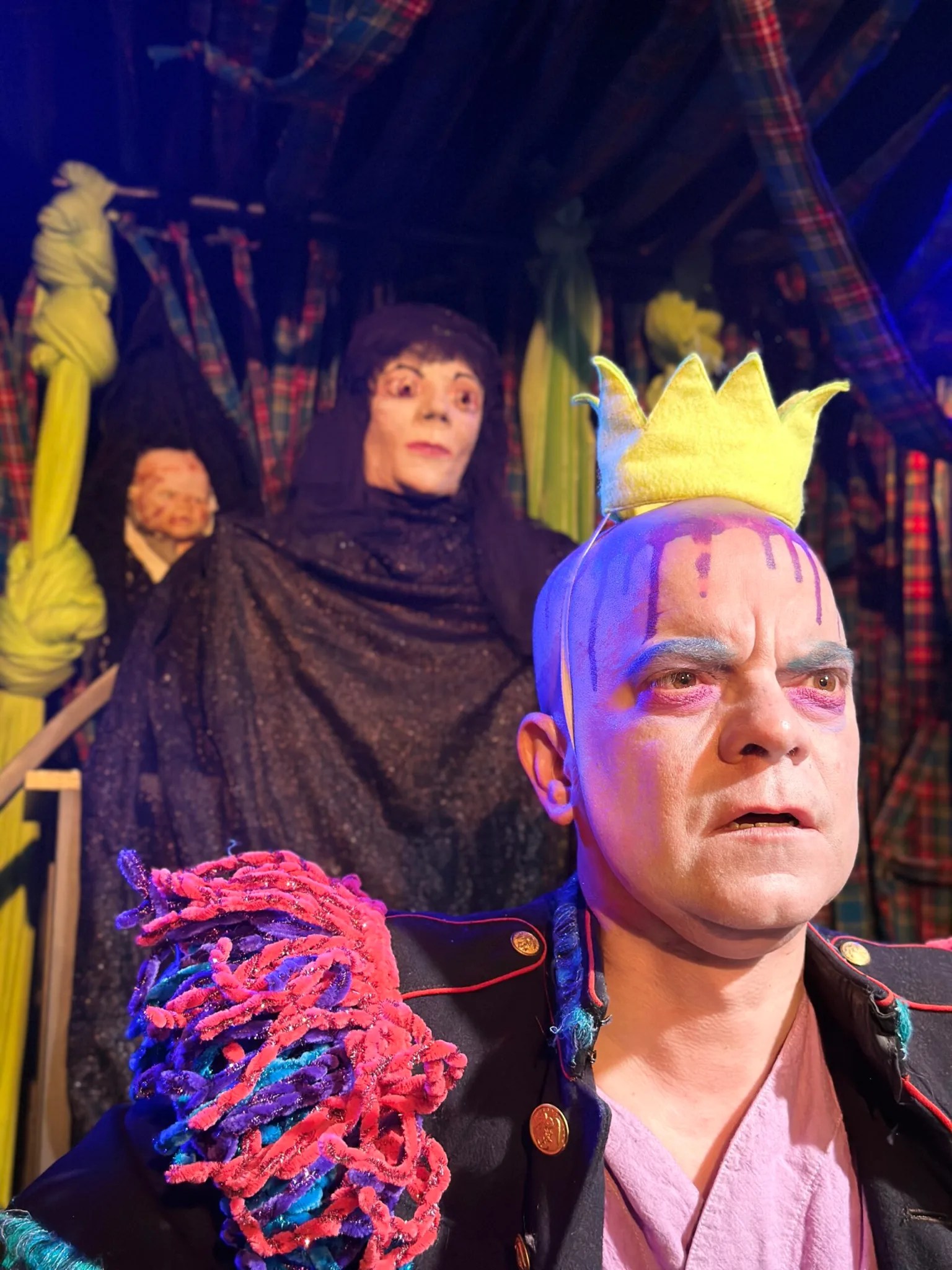
Photo by Adrianna Prosser
I saw it tonight between performances of Wozzeck at the Canadian Opera Company. Saturday was my second Wozzeck, Friday May 16 will be Wozzeck #3. I planned this entrely by accident, although with the benefit of hindsight I feel very lucky. Why? Because William Kentridge’s scheme for Wozzeck is based on Tadeusz Kantor the Polish symbolist who was heavily into puppets. His style has been summarized by epithets such as “theatre of death”, or “object theatre”.
In a week when I’m pondering the meaning of memory, I am remembering Milija Gluhovic, a classmate who was fluent in Polish and therefore able to engage with Kantor in a far more direct way than the rest of us.

Google tells me
“Milija Gluhovic is Professor in Theatre and Performance at the University of Warwick.”
Milija was crazy for Kantor. I didn’t really understand until ha ha ha Kentridge brought Kantor to us in his operatic stagings.
I am trying to contain a mind that is boggling seriously from what I saw tonight, excited in ways that I think Milija would likely appreciate. I recall his enthusiasm. Somehow I wish I could get Milija out to Red Sandcastle Theatre, because I think he’d go a little crazy watching Eric in Macbeth.
But first let me get back to Kentridge again. He came up in my interview last year with Adam Klein.
Adam was in The Nose at the Met.
As we see in his Wozzeck, he uses a variety of methods to tell his story. We get projected images, animation, puppets. Ditto when we come to Wozzeck, the COC’s brilliant production of a work that straddles boundaries thanks to Kentridge’s stunning design concept employing puppets like the one in this picture.
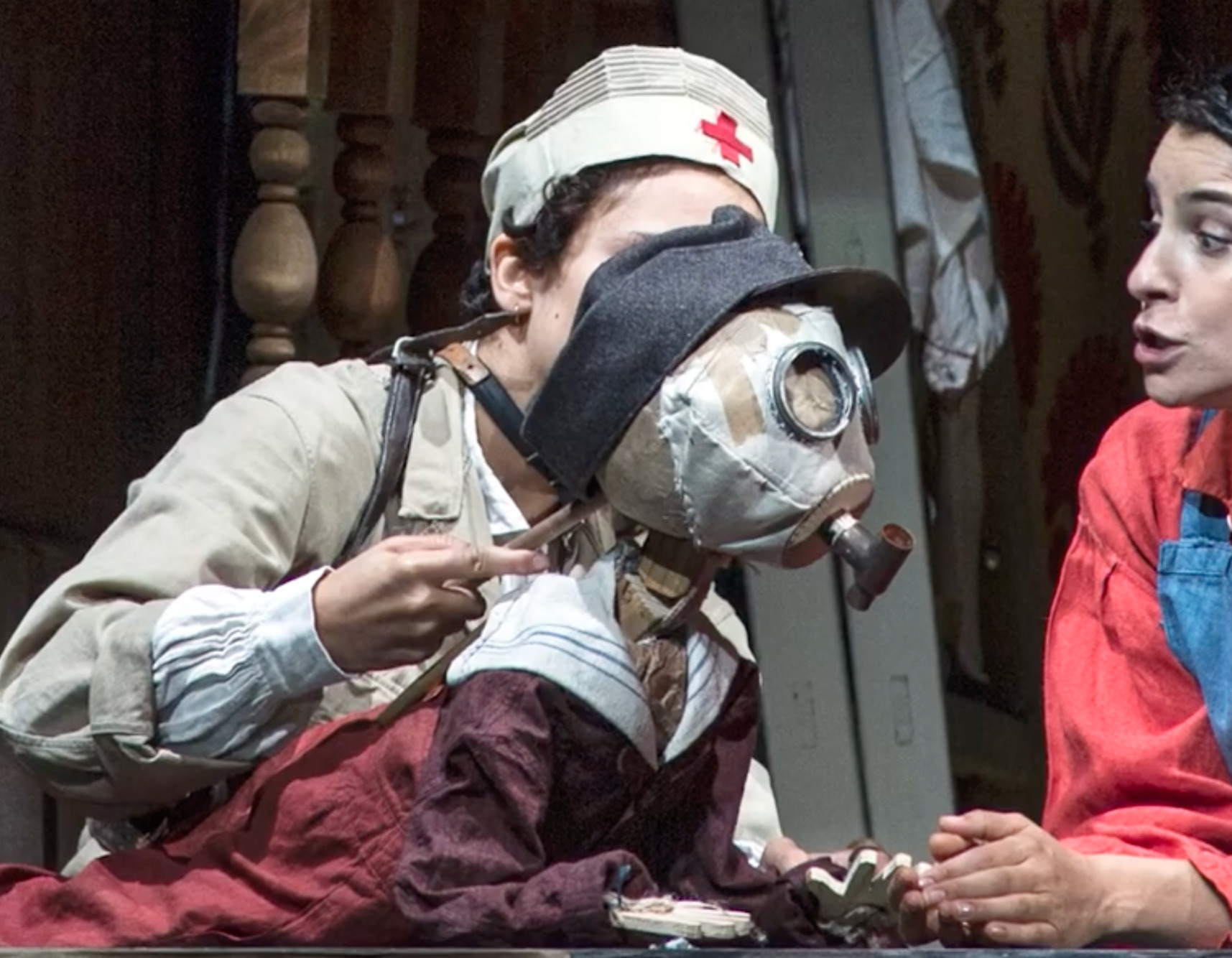
Okay I probably can’t get Milija to come to Toronto from Warwick where he’s a professor (that is if he even remembers me). But I want the cast of the COC’s Wozzeck to go see Macbeth. I will send messages to Ambur Braid and Michael Schade, because I think they will love this show. If anything it may give them a perspective helping them appreciate their own excellent work at the Four Seasons Centre.
Eric Woolfe working all by himself onstage gives us something to make you ask: did Shakespeare understand tragedy the way we do now? He has so many moments in his plays that are comical. Maybe we got it wrong, with all those definitions we memorized in our high-school English classes.
The hubris in the assumptions plays like a practical joke, when we hear that
“Macbeth shall never vanquished be until
Great Birnam Wood to high Dunsinane Hill
Shall come against him“.
Because of course we know what’s going to happen.

Photo by Adrianna Prosser
The gore, the killing, the horror: all play differently when the puppetry pushes us in the direction of a symbolist theatre. I saw Psycho just last week, a film that plays like a very dark comedy. Symbolist theatre is not as straight-forward as naturalism. The puppets make it harder.

Photo by Adrianna Prosser
Yes. Harder in the sense that when a man plays MacDuff, we can see expressions and body language, whereas seeing MacDuff enacted by a puppet held on the hands of the man playing Macbeth: it’s harder. Much harder. Or maybe it’s simply a different kind of theatre, requiring our imaginative engagement. We have to suspend disbelief. That extra work is a good thing. The entire theatre space rocks with the energy required, sometimes rapt in our silence, sometimes laughing our asses off.
When I speak of Eric’s Macbeth as genre-defying it’s because I think maybe we’ve been far too literal-minded in our thinking, an approach that’s disrupted by designers like Kantor or Kentridge, who make you think a bit harder. Wozzeck includes moments that are comical, even if the audience members who expect a certain reverent gravitas will be sorely upset. The overtones of the commedia dell’arte stock characters mess us up, even as Wozzeck is mocked & abused by them as though he were Pagliaccio, another clown-figure whose world implodes on him.
Eric is every bit as disruptive, turning Macbeth upside down. And it’s absolutely brilliant. While we see one person onstage, namely Eric, his team of director Dylan Trowbridge, designer Melanie McNeil, lighting by Gareth Crew and producer Emma Mackenzie Hillier have given us a Macbeth that every student of Shakespeare needs to see, to help us unlearn and rethink the playwright. Wow.
I’m hoping the run will be extended beyond this coming weekend when I believe it’s scheduled to close. But OMG you need to go see it if at all possible.
Further information and tickets.

 barczablog
Thanks always for your deep knowledge and good taste! Heralding Eric’s work and drawing the allusions to all the other great works he is naturally part of, is warming. So glad you can give him some spotlight that he so richly deserves.
Enjoy your blog.
Hope you are well!
x Allegra
>
Thanks for noticing. It was such perfect timing to see Eric’s Macbeth between my 2nd & 3rd viewings of Wozzeck (as Kentridge channels Kantor). In the old-school hierarchy of disciplines where tragedy is viewed as superior to comedy and puppets are dismissed as fit for children’s theatre, we habitually undervalue someone like Eric. Oscar prefers Oppenheimer to Barbie although I thought Barbie was a better film, more important, not so weighted with its own sense of greatness. Ditto Eric compared to Kentridge’s Wozzeck. Dying is easy, comedy is hard, right? Thank you Allegra, great to hear from you. xox