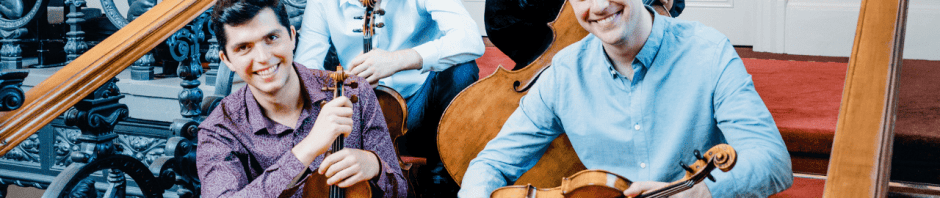
I love ambitious concerts, and that’s certainly what we heard tonight at Walter Hall from Calidore String Quartet, comprised of violinists Jeffrey Myers & Ryan Meehan, violist Jeremy Berry and cellist Estelle Choi.
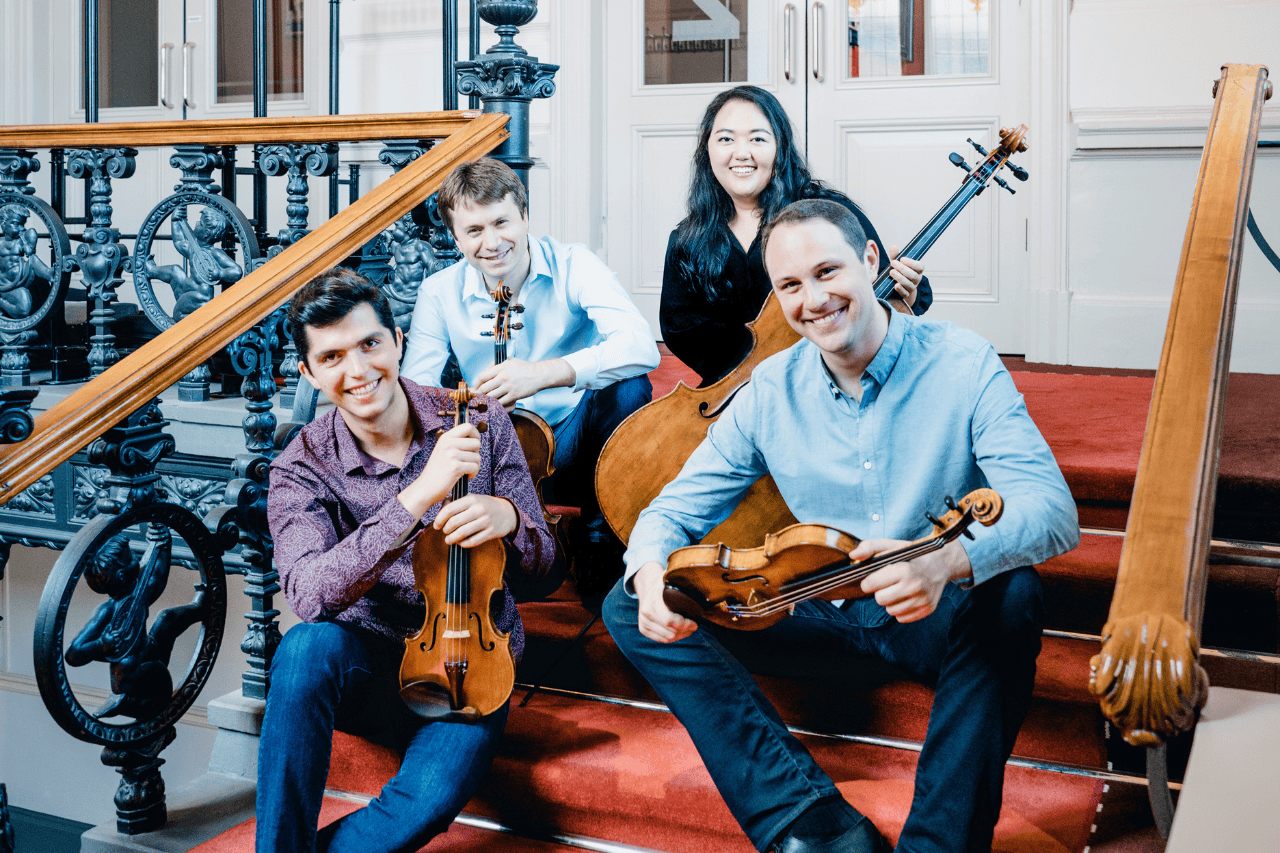
In one of his brief introductory talks violinist Ryan Meehan told us that the concert aimed to show us varieties of American culture. And my goodness they truly did so, in this program:
Samuel Barber: String Quartet op 11
Wynton Marsalis: excerpts from String Quartet No. 1
— intermission —
John Williams “With Malice Toward None” from Lincoln
Erich Wolfgang Korngold String Quartet No. 3
I am sometimes the luckiest guy in the world. This year I picked a few concerts from the Toronto Summer Music Festival’s many offerings.
No I was unable to attend the opening night due to a conflict with the celebration of my mom’s life last week (July 10th).
Tonight’s concert was my first, and is right up my alley. Three of the four items have a connection to film. You may recall my obsession with film music. I used to teach a couple of courses on the topic at the Conservatory & at University of Toronto’s School of Continuing Studies.
The 2nd movement molto adagio of the Barber Quartet is well-known in its string orchestra arrangement “Adagio for Strings” heard in Platoon, and as Ryan reminded us, also regularly employed as solemn music for funerals (I’ve seen it arranged for keyboard). We heard too about the Quartet’s meeting with composer John Williams, who agreed to arrange music from the film Lincoln for them to play (wow what a cool story). Korngold’s 3rd Quartet includes themes the composer repurposed / recycled from films.
The extraordinary thing about the Calidore Quartet is something I hadn’t thought about in a very long time. I recall a violinist I knew from the TSO explaining to me the difference between the way an orchestral section leader plays, a sound necessary for the others who hear that person & follow the leader’s sound, as opposed to the ideal of a quartet. While I heard the theory explained tonight I heard it properly enacted, when the quartet plays as though they are a single instrument, rather than four soloists. I am reminded of something my brother told me awhile ago about choral singing, that is similar, that you don’t want to hear voices popping out of the texture of the ensemble, unless they are singing solos. Just as a chorus needs to have a blended sound, so too even more so with a quartet, although I swear I rarely hear it done as well as tonight.
For example in our encore –the second movement of Beethoven’s Op 74 — there are places where the melody seems to be handed between parts, from the cello to the viola (or maybe it’s the other way around..?).
I found a performance of this piece that they put onto YouTube, that you can hear. My my what a generous piece to play as an encore!
The point is, they made it sound like a single voice, a continuous thought rather than call & response, which is something we encountered quite deliberately in the Marsalis, where it’s a normal thing to find in gospel or blues or even jazz. The quartet found the right way to play each piece, apt for the idiom of that composer.
There’s so much I would like to say, stimulated by this wonderful concert.
Let’s start by thinking a bit about the broad topic we call “film music”. The Barber Adagio is in the category of music that is a pre-existing piece that has been pressed into service in a film. Think of the music Kubrick used in 2001 or Clockwork Orange (although there he transforms it via Wendy Carlos’ Moog-magic), or the way Coppola grabs the Ride of the Valkyries for Apocalypse Now. In each case it’s a piece many of us already knew, even if the film retrospectively alters how we experience the music, so long as we saw that film. For those of you who never saw those films, naturally, that music isn’t really film music.
And then there’s a piece such as John Williams’s lovely little quartet we heard tonight, featuring a stunning cello melody redolent of a church, suggestive of Gospel or Americana: yet the melody is original. I must confess that while I like what the Calidore quartet did with the piece, it’s a classic example of film music, meaning music that I believe is probably stronger in its original context, where we see the images onscreen. Williams has so many of these pieces that one may encounter on the radio or in a pops concert (the Toronto Symphony regularly programs music from Williams’s films). Yet the best music Williams ever wrote is always missing. In Hook the piece that makes me cry is when Tinkerbell is saying goodbye accompanied by a stunning little passage for orchestra, that can’t really be excerpted because it’s less than a minute long and absolute perfection in context. The music Williams made to accompany Donald Sutherland’s powerful speech in JFK always gets me. There’s that amazing moment from Williams in The Empire Strikes Back when Yoda shows Luke that he can raise the ship out of the water, fabulous music that isn’t quite as good if it’s played without the magical visuals. That doesn’t mean the music is no good. I also dislike it when an orchestra plays the Liebestod without the soprano: as that’s a similar case of an orchestra playing something out of context. Concert programming is the attempt to capture magic that we felt in the movie theatre, and for that reason your mileage may vary.
The final piece on the program, is a funny piece in the way Korngold has it both ways. He is both a film music composer and a classical composer, with credibility in both realms. While some look down upon film music as inferior I don’t subscribe to such a philosophy. But while some composers expressed their own misgivings (Bernard Herrmann or Ennio Morricone), seeing film music as a lesser form, even seeming to under value their own creations, Korngold managed to dodge such concerns, seemingly effortless in his compositions for film. We get four very different movements, modernity in the outer movements, lyricism in the middle movements (although the scherzo gives us a huge contrast when we get to a lovely trio).
And then, there was something completely different, the excerpts from Marsalis’s Quartet. OMG I loved it and wished to have heard the whole thing, although when I chatted with a couple of friends in the lobby they thought it was more than enough. Yes it’s dissonant and edgy.
To each their own of course.
I was blown away by the astonishing variety of timbres Marsalis –a classical & jazz trumpeter please note!– was able to get out of the four string players we watched tonight. If it weren’t so much fun I might have called it torture because it was seriously hard work. I didn’t want it to end. This movement –and thank goodness I found an example on YouTube again to show you what I’m talking about– makes the strings emulate a train, in the rhythms and screeching sounds. This is like nothing I’ve ever heard, although maybe its willingness to imitate the noises of a train remind me of the traffic sounds in American in Paris. Yes it’s a true variant of the theme of American culture. Wow it’s beautiful.
I guess it should be clear that I really liked this concert. I admire the ambitions of the programmer, whoever it was, finishing all the modernity with Beethoven in the encore.
I hope someone will invite the Calidore String Quartet to Toronto again sometime soon. They’re remarkable and they are very good. As far as Toronto Summer Music Festival in their 20th season and Jonathan Crow’s final year as their artistic director: so far so good.
 barczablog