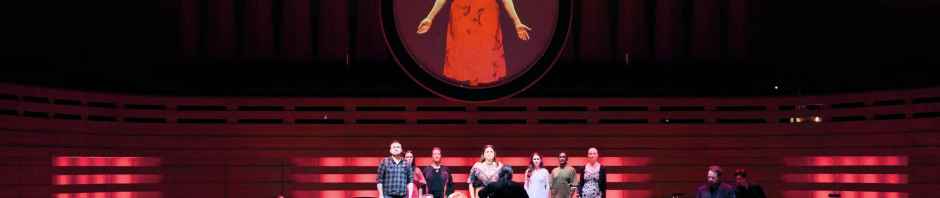
Toronto Summer Music presented a single concert performance of the opera Missing, from a libretto by Marie Clements and a score by Brian Current, to a full Koerner Hall. This was its first appearance in Eastern Canada after having been co-commissioned and co-produced by Pacific Opera Victoria and City Opera Vancouver in 2017, and it was rapturously received by the audience.
The original production website says
“Set in Vancouver’s Downtown Eastside and along the Highway of Tears, Missing is a poetic expression of loss and hope, its creation led by aboriginal theatre and opera artists.”
The title of the opera is wonderfully ambiguous, suggesting both the thousands of women and girls who have vanished and their extended community of family members upset, bereft, heart-broken, hurt by the disappearances.


Although presented in concert the presentation included elaborate projections designed by Andy Moro, the TSM Technical Director, perhaps from the original production. I was sad that Andy didn’t come out to accept applause; the person running the sound board at the back told me he was upstairs in the booth, working anonymously in the background. What he created is like a beautiful film to accompany the opera’s performance.

The screen displayed animations of animals (real & totem images), nature, and sometimes live video in stunning combinations complementing and enlarging the text being sung, as well as displaying the words in English & Gitxsan. Yes Andy was a busy man so I shouldn’t be surprised he didn’t (or couldn’t) easily come down.

What we saw tonight was an opera that worked really well in this static concert presentation, given its resemblance to an oratorio, as full of ideas and the contemplation of spirit as anything by Bach or Handel. I did not expect such a positive life affirming work, reminding us again and again of motherhood, birth and especially rebirth.
The singers and the Continuum Ensemble were conducted by Timothy Long, who led the 2017 world premiere in Vancouver and the American premiere in Alaska in 2023.

I kept wondering: when the work was conceived and created, who did they have in mind as an audience, who did they expect to watch & listen? Opera is expensive and challenging both to the artists creating it and the audience seeing & hearing it. Next month Capitol Theatre in Port Hope premiere the new musical Rez Gas with a hip-hop-infused score from Indigenous musician Cale Crowe, likely aimed at a younger audience to tell a happier tale. When I heard of Missing, concerning the missing and murdered indigenous girls & women, I wondered: how could something so darkly powerful be brought to the stage? But maybe that’s why it’s an opera, rather than a musical, because it’s such a big challenging topic. Opera can be solemn, and choosing that idiom proclaims a seriousness of purpose.
And maybe the audience is meant to include those whose hearts needed changing.
The opera begins as follows (from the synopsis):
“Ava, a young white woman, is thrown from her car and badly injured in a crash on Highway 16. She sees another body – a young native girl – lying on the ground. Their eyes meet.”
We see Ava (Caitlin Wood) living her life after the accident, haunted by memories of what she saw and felt. There’s a sentence in the synopsis that describes a number of moments in the opera, namely “each sees the other in herself and herself in the other.” There’s a delightful sort of ambiguity to many scenes, where we are watching two people singing at one another, whether it’s Ava & the native girl (Melody Courage), her mother (Michelle Lafferty) with her son (Evan Korbut), Ava with her boyfriend and eventual husband Devon (Asitha Tennekoon), Ava in class with her professor (Marion Newman), a back and forth as though at times they’re talking to another version of them self. The approach to duets / dialogue is beautifully original, and captured brilliantly in Brian Current’s setting. The singing is never of the sort we had in much romantic opera, designed to show off the singer’s high notes, but rather coming from a place articulating pain or love or connection. There are a few bold painful moments articulated yet on the whole I was (against my expectations) comforted and inspired.
At times we’re in a realm beyond life & death, where spirits communicate with the living and vice versa. For me those were the most vivid and powerful scenes. I experienced the opera as a ritual celebration of her life (allowing that she is also a kind of every-woman, embodying all the different missing women & girls), to permit the release of the spirit(s) of the native girl(s). Perhaps this is what Marie Clements sought to achieve, a kind of community release for the missing ones, a beautiful and even therapeutic objective.
The part of Jess (Andrea Ludwig) was perhaps the most challenging role of the entire opera, written to be the one person in opposition to the direction of the story and therefore tasked with the least sympathetic lines of the work. I can’t imagine how difficult it would be to be rehearsing and then presenting her part. I have to think librettist Marie Clements believed some in the audience shared such views. I don’t know if Toronto is different from BC (where the piece originated), but I do know some people who are blatantly racist, and wonder whether they’d avoid coming to hear such an opera. It’s a horrible additional layer, but a necessary & troubling part of the story. If they sought to change minds & hearts this kind of language, however disturbing, was a necessary component.
I’m sorry there was only the single performance in Toronto, as I’m sure there’s an interests in the work and its challenging subject, and I agree (quoting from the TSM website) that Missing is “something every Canadian should see.” To learn more about the missing and murdered Indigenous Women and Girls, visit the National Inquiry page found at: https://www.mmiwg-ffada.ca/
There’s a CD of the opera that I obtained at the concert performance, that will allow me to have a closer listen / look at the text of this fascinating work, from “ATOM” (Artists of The Opera Missing: the same people we heard at Koerner Hall).
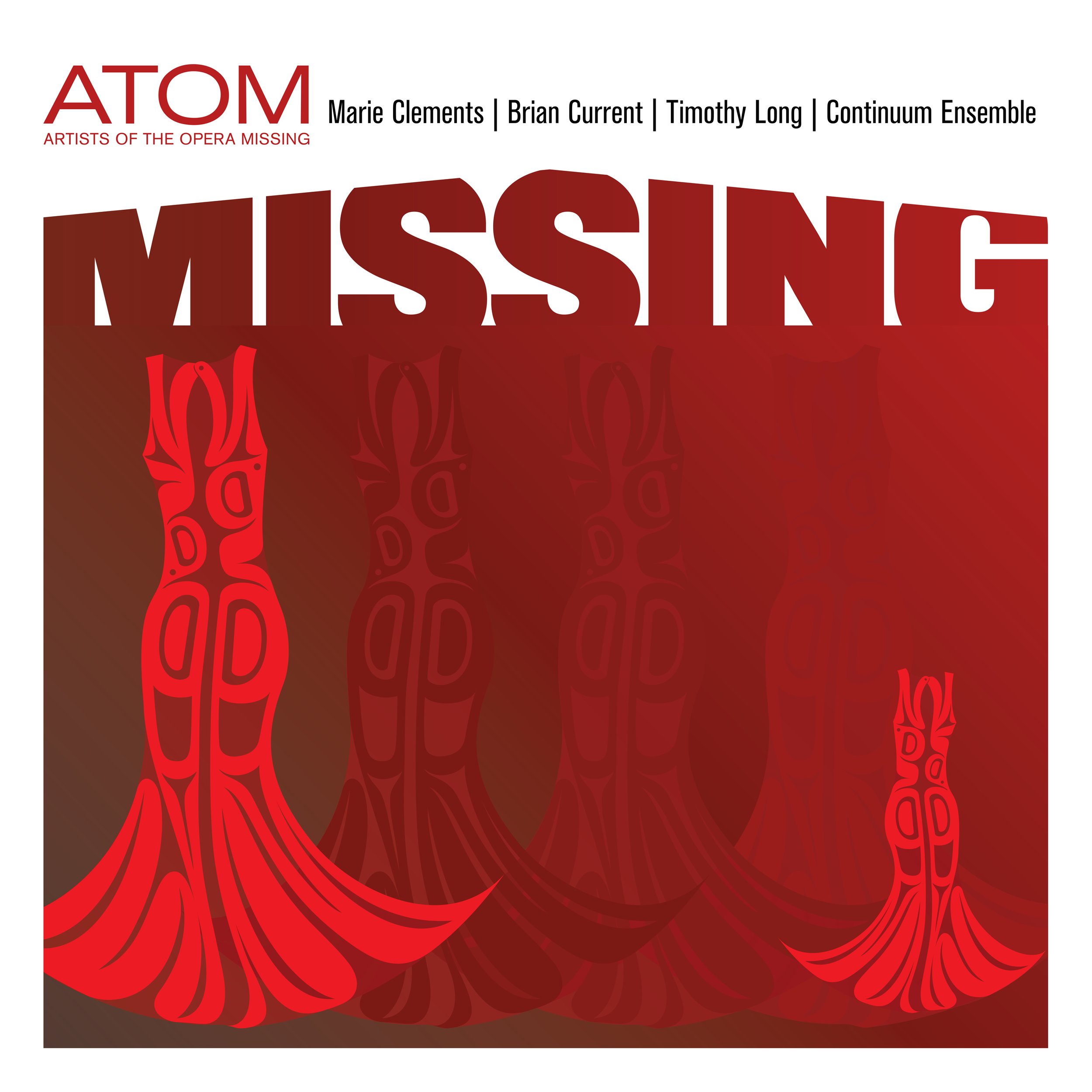
If I can’t attend another performance anytime soon at least I can listen to it again. And again…. If you are interested in obtaining it, here’s the link (click here) to find out more.
 barczablog
Pingback: Feral butterflies: Cale Crowe talks about his new play Rez Gas | barczablog