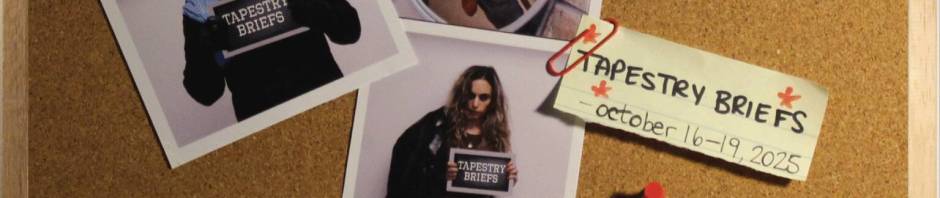
I had my first look at the Nancy & Ed Jackman Performance Centre on Yonge St Thursday night with the first of Tapestry Opera’s experimental programs, titled “Tapestry Briefs: under where?”

Cute title, right?
I was in the audience for the eleven short pieces.
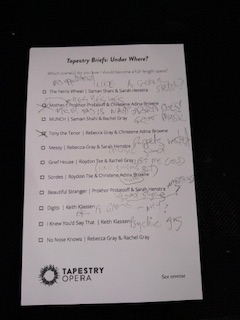
We were invited to comment on what we had seen. They gave us a program with a page inserted that listed the eleven brief works, around five minutes each. Some felt much longer, some seemed to be over in a moment.
We were given pencils to make notes in the few moments between each piece. The promise of adequate time to make comments wasn’t met, indeed for some of the pieces we plunged ahead without a pause for note-taking. Given that my hand-writing (or should i call it printing?) is messy at the best of times, the result was something that was so illegible that I didn’t hand it in. I brought my card home because I didn’t think my scribbling was legible but also because I meant to write something here, to properly comment on the experience.
My feedback doesn’t really matter.
What we were seeing from Tapestry Opera was a bit like the outcome of speed-dating, where a composer and a librettist (the person who writes the words for an opera) were brought together to see what creative sparks might fly. The hope was that some little five minute specimen might have enough legs, enough life to lead the team further, either in a larger version of that five minute creation or at least in their creative chemistry leading them to work together on something else.
I think Tapestry Opera is the most important crucible for new music theatre that I have ever encountered. I can point to several pieces they have fostered like their step-children, providing nourishment & a home for these little ones, and we have seen them grow.
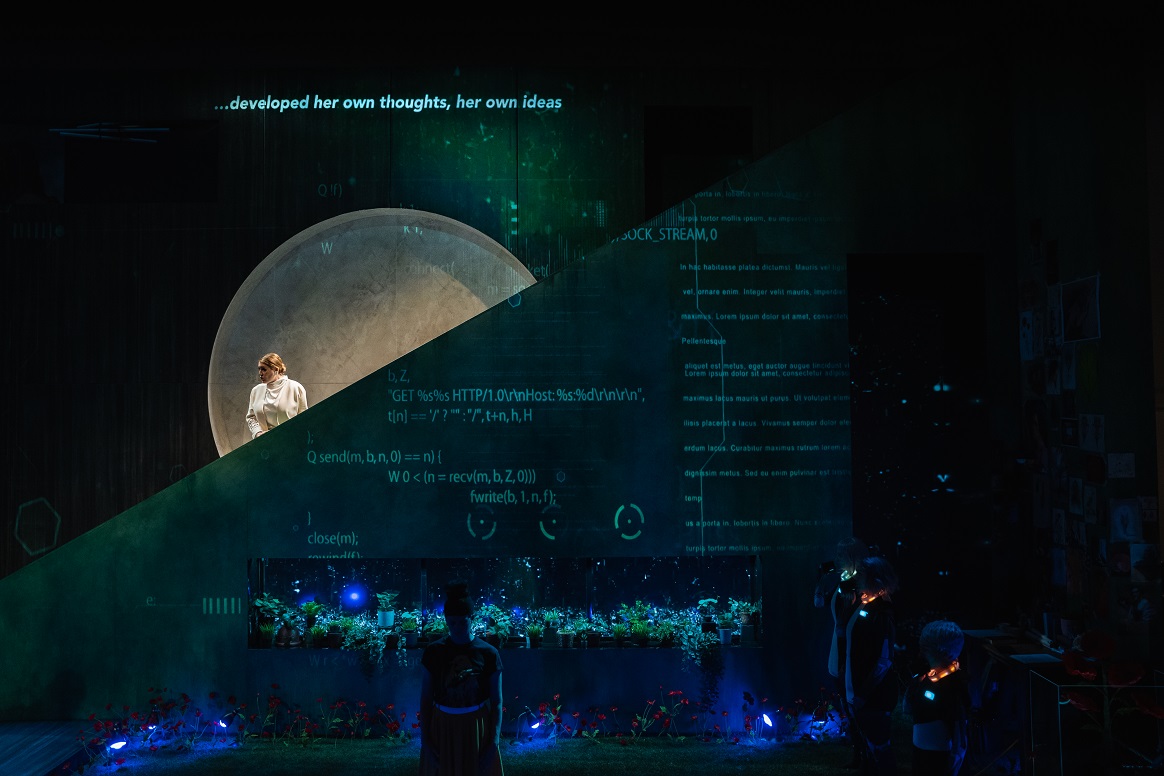
The single most impressive kid was RUR, from a composer who makes me star-struck every time I encounter her work, namely Nicole Lizée. There was a tiny piece that came about in her collaboration with Nicolas Billon, back in 2014 at an event called “Tapestry Booster Shots”, an apt name for a show in the Distillery (once a welcoming place for Tapestry and theatre experiments).
The 2014 encounter between the two Nickies (Billon and Lizée) led to a 2022 birth, the single most impressive new opera I have seen in Toronto or really anywhere in this century. My headline “RUR a Torrent of Ideas” gives you some impression of how i felt. I still remember it, wishing the COC or some other opera company would pick it up. Hey Metropolitan Opera, you have nothing remotely this interesting, why not try it?
No I didn’t see anything last night that felt as exciting as the tiny germ of RUR, but then again it’s not fair to expect that kind of magic every time. The point of this incubator is to fertilize and to support new creation, and then to see what happens. I’m reminded of the mindset of the brainstorm where one is encouraged to offer spontaneously without censoring oneself or holding back out of fear of being critiqued. Excessive criticism or negativity stifles fertility. Giving judgment at the early stage makes people think twice, makes them inhibited.
(oh no I hope I’m not guilty of that)
The audience had a good time. What I think I saw was a kind of skewed process, that may or may not reflect necessity, the practical reality of the process. Of the eleven items I saw the majority seemed to aim for laughs, seeming more like comic sketches that wouldn’t be out of place on Saturday Night Live: and we laughed. Perhaps that’s where the title of the evening was born, out of a spirit of fun. They tell you in improv never to negate, never say no, but to always build on whatever your collaborators bring to the table. No this isn’t stand-up or sketch comedy but there are some impulses that are universal.
So of the eleven I put an X on the page beside two, and considered two others possibly worth further investigation: although I felt a bit rushed making notes so haha next day, I’m not sure which ones to mention. I wonder if the expectation of having to perform something at the end of the process conditions the participants to want to entertain the audience. When you think about it: that’s surely what theatre is at least some of the time. The fact that some people study opera as a musical discipline rather than a theatrical one might lead people to forget about the audience.
One of the sketches (yes that’s what I’m calling it) blatantly played with the repetition of the Tapestry Artistic Director’s name in the piece. While I giggled I wondered: was the composer perhaps confessing to pressure? Nerves? Surely we can’t blame them when the boss’s name pops into their head.
The question I want to ask…
(and forgive me if I sound like I’m judging: but that’s what assessment encourages)
…is how something that might sustain for five minutes of laughter can be used as the basis for sixty, ninety minutes or more. Of the eleven pieces we saw only two or three seemed to have anything that might lead me further. Indeed at least two of the items reminded me of those sketches on SNL that were stretched 30 seconds past their breaking point and were already too long.
I wished for less coherence, to be honest. I wanted the shorts to be left a bit more ragged, as I felt that’s where i’m at these days. I want something to feel less finished, less determined.
My idea of opera may be obsolete so i may be the wrong person to consult. I understand the basis for opera as “big ideas”. I got that phrase from an encounter with Elliott Hayes, who took issue with something I wanted to do. The funny thing is, of course he was right that it was too big for theatre. And that’s precisely why it needed music & the operatic treatment. I was so intimidated and heartbroken in the encounter, I didn’t have an answer at the time. But upon further reflection realized: this is precisely what opera aims to do. Otherwise why make it into an opera? I was out of step with him precisely because what was missing in what I described to him was the musical part, that fills in a significant part, that must carry weight, that must justify the project. Otherwise why do it at all? In hindsight I realize now: the proposal needs to include a healthy sample of the music, arguably to begin in a musical concept fundamental to what you’re doing in the theatre. Otherwise it’s BS, or perhaps can be done without an operatic treatment.
That question lurks in the background. Why opera? We saw some of that answered in the brief fragments.
One reason comes as an implication of the old chicken & egg question. Recalling that opera is both a creation and a style of performance, one might ask: which comes first: the opera or the singer? If we write no new operas, the singers must sing anyway. Therefore one reason to write is to give them something new to sing, at least as an alternative to the huge body of work from past centuries. Some of the items I heard last night were beautiful to hear precisely because of the performances from singers Adanya Dunn, Keith Klassen, Reilly Nelson & Jorell Williams and pianists Hyejin Kwon and Gregory Oh, plus the creative inputs of directors including Artistic Director Michael Hidetoshi Mori. I think this team could have made something exciting or fun or beautiful out of an IKEA catalogue. Indeed maybe next year someone will try that and make it work: but I wonder if that can be sustained beyond 5 minutes? Knowing that you only have to make 5 minutes worth perhaps leads to something wacky & odd, precisely because they know they do not need to sustain it. No I’m not saying this suggests a flaw in the protocol, but it might be worth making a rule that no librettist or composer can make more than one jokey piece per year.
I wonder if there’s a possible creative vector to be pursued in taking existing works and playing around with them, as for instance when we change the gender of a role or re-frame a story in a new way. Can playing with existing operas suggest new pathways for exploitation, I wonder..?
And of course there’s the possibility of mining outside the realm of opera, among symphonic or chamber works that use the voice. What if Tapestry were to stage Berlioz’s dramatic symphony Romeo et Juliette, or Mahler’s Das Lied von der Erde? Pardon me if my suggestions sound strange. But opera has a history filled with adaptations.
The puppets we saw in one of the pieces offer another possible direction in reframing an existing work with a particular set of vocal expectations (thinking particularly of the restrictive thinking surrounding works for a huge orchestra such as the operas of Wagner, Strauss or Berlioz): re-framed in a chamber presentation with puppets. Suddenly Die Frau ohne Schatten, Les Troyens or Parsifal become viable if they’re done with puppets and/or projections in a smaller space with a piano or chamber ensemble. Now of course these are existing works, but pieces that have been understood as prohibitively expensive, and with forbidding vocal requirements precluding all but the biggest voices. I wonder if this strays too far outside Tapestry’s usual purview.
Forgive me if I sound like a bit of a nut, but I’ve drunk from the brainstorm-tank and am letting my mind run wild. It’s a trip, and I’m grateful for having my mind expanded. For that reason alone I’d recommend Tapestry’s laboratory, a place where they don’t insult your intelligence. Tapestry Briefs: under where? will recur again the night of Oct 17th plus matinees Oct 18 @ 4:00 pm & Oct 19 @ 2:00 pm.
Let me repeat, that I am grateful for what Tapestry has done, and look forward to their future undertakings. Discover more about Tapestry on their website.
 barczablog