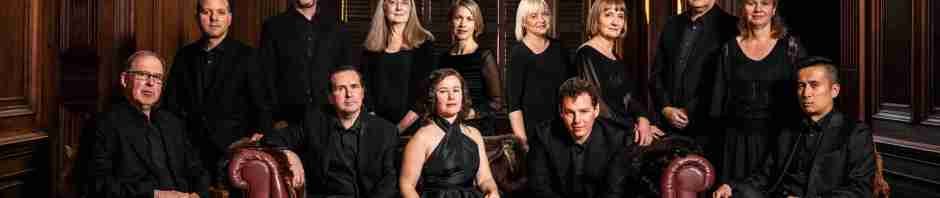
I saw & heard an astonishing concert last night at Jeanne Lamon Hall from Tafelmusik playing a program of well-known music by Johann Sebastian Bach. I heard four of the six Brandenburg concertos and a version of his majestic E-flat Fugue for organ, arranged for chamber orchestra.
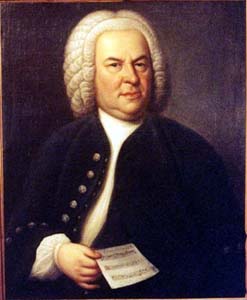
The fame of the Brandenburg Concertos by Johann Sebastian Bach reaches far beyond Earth, when we recall that Bach was chosen to represent humankind on the Voyager space mission, now having reached interstellar space beyond the Solar System.
But this did not sound like the music performed in the 1970s when Carl Sagan & his committee gave JS the nod to be on famous golden record made for the hypothetical space aliens, who somehow would have to figure out how to play the record back. Tafelmusik aim to make something closer to how Bach might have expected his music to sound, both as far as the period instruments they’re playing and the way they are played and tuned.
For Thursday January 29th we had far more down to Earth concerns than inter-planetary travel, after the snow that hit the city last weekend, yet the place was full, and buzzing with excitement.
As Rachel Podger, Tafelmusik’s Principal Guest Director explained, the Brandenburg Concertos combine multiple & rare combinations of instruments with thrilling results.
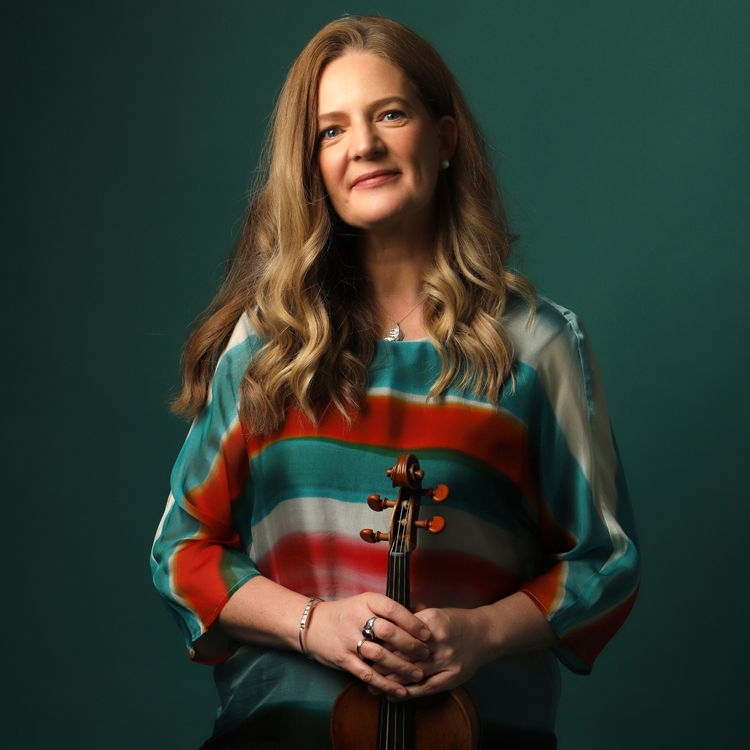
The 1st Concerto included Rachel’s virtuoso performance on a 17th century piccolo violin, tuned a minor third higher and smaller than the usual size. It has a sweeter sound, even as I mused over the challenge of fingering on a smaller instrument (my fingers are humongous), and playing the piece faster than I have ever heard it played: in pursuit of the authentic style. I’m reminded of the violin my grand-daughter played on, with her tiny fingers: except this was adult music making!
Among the players for this concerto we heard a pair of horns played by Todd Williams & Micajah Sturgess, their hunting calls in arresting triplets that suggested adventure & fun, not least because the rest of the orchestra kept glancing their way, smiling. I suppose in its time the hunt meant fun and plentiful game on the dinner-table, so I suspect JS Bach meant to make this sound like party-time, but baroque.
The outcome is so much more fun than this language might suggest, the back and forth between voices transparent not just in sound but in the eye contact between sections in Trinity St Paul’s.
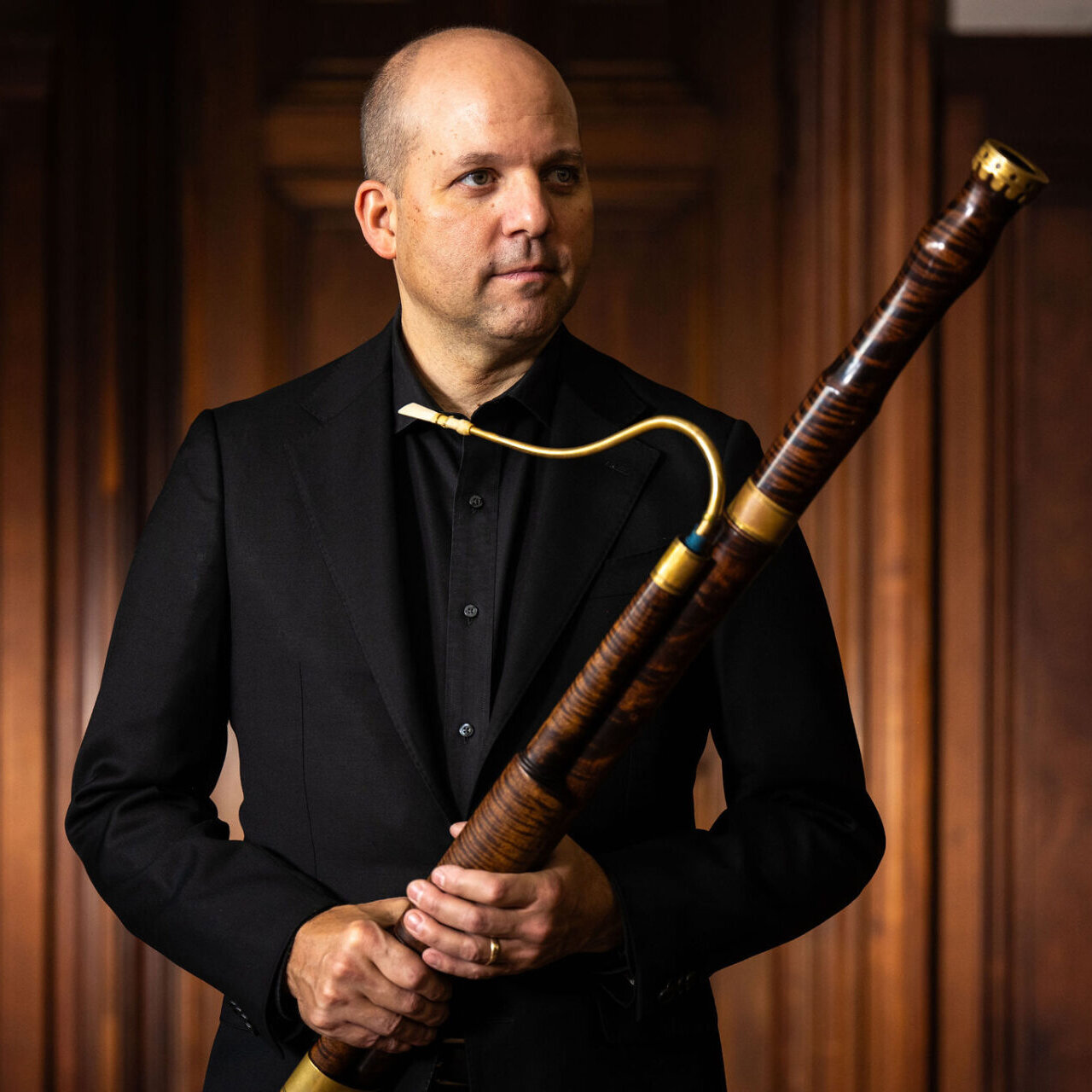
The next item on the program was the reason I came, namely the transcription of the great organ Prelude & Fugue by Dominic Teresi, one of the Tafelmusik Artistic Co-Directors.
I have been listening to this piece since childhood, when I stumbled upon a recording played by Helmut Walcha, from the 1970s or earlier.
More recently I discovered Busoni’s piano transcription in an anthology. So in a way it’s personal to hear Dominic’s version. There have been earlier attempts at this, for instance one by Schoenberg that is as obsolete and dated in its assumptions about Bach as the Voyager Bach that went to outer space, full of drama but turning Bach into a Wagnerian.
I wonder if Bach would even recognize himself. In fairness, we all must work with what we have and know, and for Schoenberg in his time, that was the large orchestra, using every modern instrument. If we did it now we might use synthesizers and computer technology.
But let me get back to the church space where we heard Dominic’s creation played by a small group of instrumentalists. As Rachel explained, Bach sometimes would employ a kind of musical symbolism for the Holy Trinity, apt for a performance at Trinity St Paul’s Centre with the visual reminders before us of a church organ and Christianity.
We heard Dominic’s creation programmed among the Tafelmusik Brandenburg’s, sounding every bit as authentic. I think a great deal about transcriptions, understanding them as aspirational, embodying ambition. I remember once discussing them with Professor Carl Morey, when he asked me why would anyone want to transcribe something? I think in some ways it’s a fundamental impulse. We may tap our toes listening to music (as I wanted to throughout this rhythmic concert). I remember as a child conducting the record player when I heard Beethoven. We imitate and dance along with music, and may wish to sing or play songs we have heard, to make them our own. As we grow up we learn inhibitions and lose our wilder impulses.
When Ravel made Mussorgskii’s piano piece Pictures at an Exhibition into an orchestral suite he was sharing something of the original in a new shape. There is something similar at work when Stokowski or Schoenberg take a keyboard work and turn it into an orchestral work: except that they must use the idiom and the stylistic language of their own time. I am enraptured having experienced Dominic’s version of an organ piece, recast in a manner that I feel certain would be recognizable and even applauded by Bach himself.
That was just the music we heard before intermission, namely Brandenburg #1 and the new version of Bach’s Prelude & Fugue arranged for chamber orchestra. I was already thrilled, with a great deal more brilliance to come.
After intermission we heard three more concertos in order, namely #2, #3 and #4, each with its own different assortment of musicians.
For #2, the first after intermission we had a smaller ensemble arranged across the stage, bringing us Tafelmusik’s take on the concerto that was sent out into space. I was especially stunned by the detailed horn playing from Todd Williams, given a level precision I associate with valves, rather than his older instrument, alongside brilliant play from Kathryn Montoya on recorder, Daniel Ramirez Escudero, oboe as well as Julia Wedman, Tafelmusik violinist stepping into the foreground.
For #3 it was strings strung across the stage, three trios plus the harpsichord-bass in support, with Johanna Novom, Genevieve Gilardeau & Rachel in the violin trio stage right (our left), Brandon Chiu, Patrick Jordan & Christopher Verrette, viola centre stage, and Keiran Campbell, Michael Unterman & Margaret Gay, cellos stage left. The opening allegro was as visual as was auditory, watching voices and fragments played and then answered in another trio-group. The slow movement consisted of an Adagio ad libitum like a cadenza serving as a brief intermezzo, before they launched into the stunning Allegro, some of the fastest playing of the night, everyone working their fingers off: but in a joyous celebratory movement infused with the spirit of the dance.
Finally we came to the cutest music of the night. Can I say that? I find the opening of #4 adorable like kittens and chipmunks frolicking, the pair of recorders played by Kathryn Montoya and the hard-working Dominic Teresi, perhaps wanting to show us that he didn’t mind venturing up into the treble clef for a change (after his huge role in the Prelude and Fugue, not just as arranger but his bassoon singing with a low voice). The two recorders seem to live a third apart, calm and peaceful, going back and forth with Rachel Podger’s quicksilver violin soothing or provoking between them. In the presto finale it’s a terrific release, a lovely conclusion to a superb evening of Bach.
Bach Brandenburgs will be repeated January 30 & 31 at 8:00 pm and February 1st at 3:00, in Jeanne Lamon Hall in the Trinity – St Paul’s Centre.
 barczablog