La Maupin is the title of a new opera produced on film concerning a mythological person of ambiguous gender who may have existed. The historical figure is so interesting, you’d have to invent someone like this if she were not real. There’s a novel by Theophile Gautier using the historical figure, blurring the line between reality and fiction but okay let’s say she is real. Nowadays “real” is already a challenging concept.
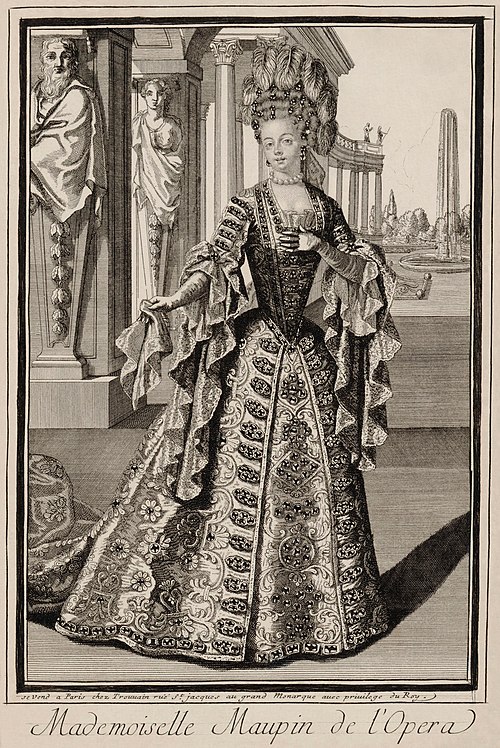
The first person narrator of the new opera seems to embrace and even celebrate the mystery in the telling of the tale, the possibilities hanging in the balance between then and now between female and male, between real & artificial. I suspect the way it’s coded means it will read differently depending on your background, thinking especially of your gender & sexuality.
In some ways the film of La Maupin is a tour de force, directed by Lauren Halasz, featuring Camille Rogers (producer, singing the lead & having written the libretto including poetry of Aphra Behn) , composed by Colin McMahon, produced by Opera Q in residency with Tapestry Opera at the Nancy & Ed Jackman Performance Centre, filmed & edited by Stephen Bell of Coffeeshop Film & Creative.
Yes that’s a mouthful to list, that didn’t even include the players in the string quartet + piano, the choreographer nor the dramaturg. I just wanted to call attention to the oxyoron of a one-person show that is actually a complex machine supported by a myriad of persons. We imagine a story-teller standing at a microphone vulnerably alone. For La Maupin we’re in the presence of something more complex, something subtle in its contradictions and questions.
I love that oxymoron thing in a performance, indeed at one time I thought I was going to employ the word in the title for my dissertation (until dissuaded by a committee member), as I studied the ways Debussy’s opera Pelléas et Mélisande resists being operatic, a vehicle for virtuoso performance that resists the virtuosic. Maybe there’s something similar in play for La Maupin. I wonder, would the score work as a live performance in a theatre? Here we encounter it filmed, a medium that I find to be an automatic site of a kind of conflict, ambiguous by definition.
Full disclosure: I embrace a comment from composer Domenick Argento, who spoke of operatic voices you hear in the same space as a kind of magic trick, skill that moves you in person in your viscera. When it’s on a screen whether from YouTube or the Met, I don’t know for certain what that really sounds like in person. I need to see and feel for sure, especially when I think I see a person lip-synching, pretending to sing to match a sound track, as I saw in La Maupin. Yes I saw the credit for the main personage onscreen, that they are the only person singing: but the separation of audio (singing) and video (movement including lips in synchronization) makes things more artificial for me, an alienating effect. We all saw Singin’ In the Rain, we know that the voice may or may not be the same person as the one we see pretending to sing. Think of me as a bit of an agnostic, as far as films of opera. If a live performance gives us the magic trick of visceral excitement from the live voice, getting a film of opera subverts that magic with a new layer of magic.
To quote an ad from the 1980s, we may wonder is it live or is it Memorex? (or another artificial medium)
And there are so many ways to show off one can sometimes forget what it is to be human. Life is a performance especially nowadays. Aspects of gender have always incorporated performative behaviours, costume & manners signalling powerfully.
Watching the film I found myself bouncing back to Cyclops, a recent live musical I saw in Toronto, noticing similarities & differences.
Both of them were one-person stories venturing into queer territory. Opera Q (who embrace queer and trans voices by creating inclusive, high-camp, and gender-bent performances) produced La Maupin. Cyclops was a modern musical sung in a rock or blues idiom with electronic pattern music noodling away under much of the action, a fascinating disparity between the ancient classic story being told with modern music. La Maupin employs a string quartet + piano, a calm regularity to underscore the adventures of the story segmented into a series of episodes, twice involving duels (one with swords one with guns) but never with a sense of mortality or terror, the calmest storytelling you could imagine because of the civilized underscoring. I think the choice of medium will always be a reflection of the artist’s home medium, that you write something in rock or in modernist string quartet because that feels familiar & right to you (and excuse me if that’s ridiculously obvious). But where Cyclops’ rock was edgy and troubled, La Maupin’s chamber score is actually very comforting, soothing. Have no fear straights, this is not anything to fear!
I can’t decide. Is it better to tell a story with a voice reflecting the terror of the situation, or with the calmness distance provides? I did find myself thinking back to the swashbuckling tradition of music in film, meaning Korngold’s films and maybe John Williams if we allow that Indiana Jones is also a sort of swashbuckler using a whip rather than a sword. But that’s just it, my fantasy is far too unambiguous, in the same ways I spoke of with Debussy’s opera. We are in an oxymoronic realm, sitting on a fence, and therefore must tolerate the ambiguity both in the genders of the personages and in the musical idiom too.
I see so many layers of skill, so many talents in the mix, but might wish for something rougher, recalling the messiness of Cyclops. I like the occasional wrong note or misstep as a reminder of humanity, especially in a medium such as opera that for me is best experienced live. A few days ago I wrote passionately about my experience of the Tristan high-def broadcast, but when I saw it again on a smaller screen the excitement had abated so much that I’m not going to the encore after all, wishing I could see it live in the Lincoln Centre theatre rather than packaged as it is for Cineplex viewing. Again, this is me and my particular background, one that reads this differently because of my age & my cultural associations.
I want to properly cite the work of Camille Rogers, congenial and approachable and so very likeable. Credit too to Stephen Bell for capturing this fascinating meta-performance, a performance investigating and querying the performative.
La Maupin continues to be available (click here) via Opera Q’s site.