Last year soprano Erin Morley and tenor Lawrence Brownlee released an album titled “Golden Age” accompanied by Munich Radio Orchestra conducted by Ivan Repušić featuring opera solos & duets from the 19th century.
Thursday July 16th, the Toronto Summer Music festival heard Erin & Lawrence perform most of that playlist live embellished with a few extra pieces, but this time with pianist Malcolm Martineau rather than the orchestra at Koerner Hall:
Duet from Le comte Ory (Rossini) “Ah quel respect.. Ce temeraire qui croi nous plaire”
Erin: Caro nome from Rigoletto (Verdi)
Lawrence: Je crois entendre encore from Pearl Fishers (Bizet)
Malcolm: Clair de lune (Debussy)
Duet from Lakme (Delibes) “D’ou viens tu?..C’est le dieu de la jeunesse”
–intermission–
Duet from La Jolie Fille de Perth (Bizet) “ils verront si je mens”
Malcolm & Erin: 4 handed piano version of Act II song Carmen (Bizet)
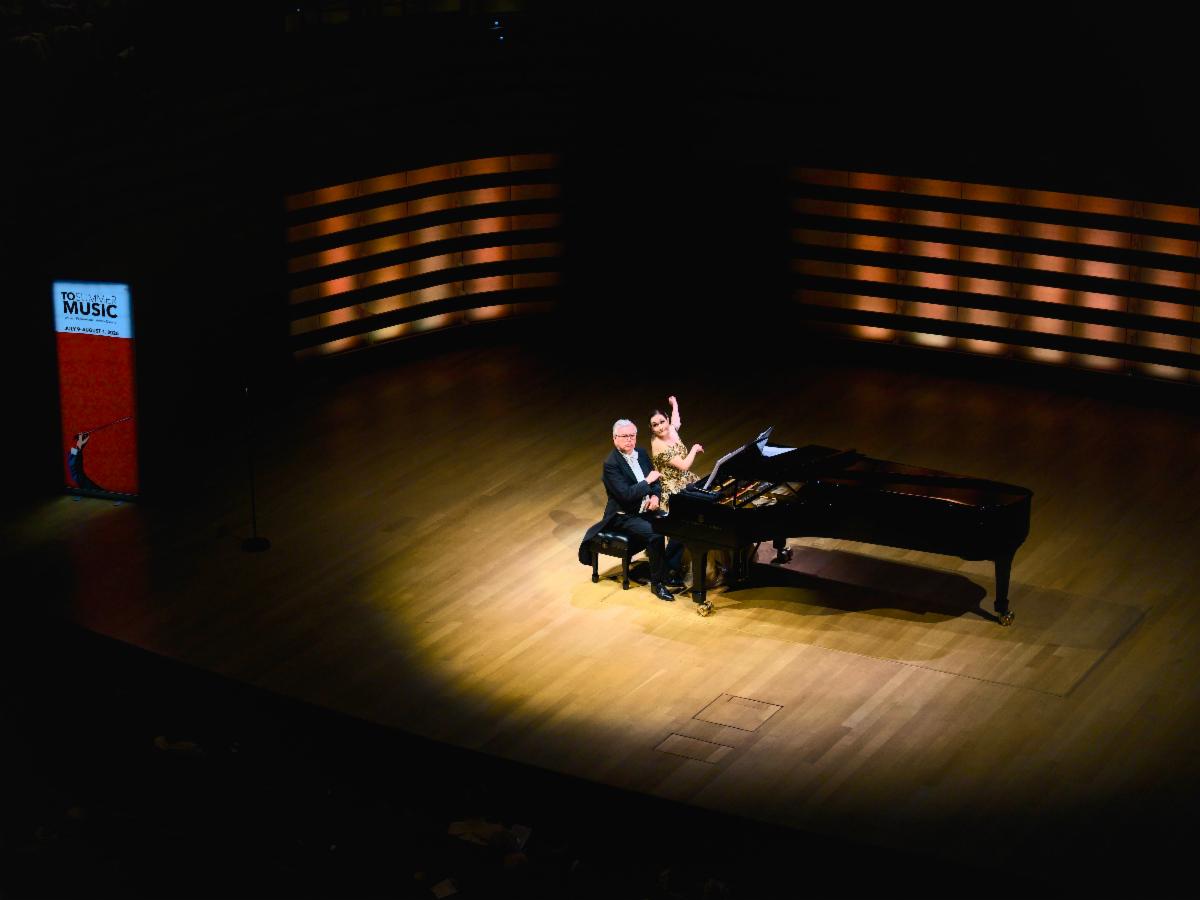
After the piano duet each singer took their turn impressing us with their breath-taking solo arias, Lawrence singing Verdi, Erin singing Delibes.
First it was Lawrence with the two-part aria Parmi veder le lagrime & Possente amor from Rigoletto (Verdi), then Erin with a stunning reading of the Bell Song from Lakme (Delibes).
And then more comic cuteness in the romantic duet from fille du regiment (Donizetti) “Quoi? Vous m’aimez”..De cet aveu si tendre”.
They seem to really enjoy playing off one another.

The audience went wild afterwards, so of course we were offered a lovely encore, a duet from Don Pasquale “Tornami a dir che m’ami”.
Their comic opera duets were the best for me, as both the Rossini to open and the fille du regiment to close had an extra electricity between soprano & tenor. It’s funny, you’d never guess their comic spark from listening to the album, that comes to vivid life before you onstage. The photos are charming but don’t capture their playful chemistry. The fun they were having is infectious.

Erin & Malcolm were making their Toronto debuts on this occasion, Lawrence his TSM debut, having sung here long ago. I confess that while I enjoyed all three artists, I was really there to hear one person.
When I first read the TSM offerings for 2026, this is the one that caught my eye: because I had heard Lawrence in Rossini’s La Cenerentola over 15 years ago in April 2011, when I said the following:
Lawrence Brownlee as Ramiro (the Prince) has an amazingvoice, one of the best voices I have ever heard in person. I experienced Leontyne Price, Luciano Pavarotti, Birgit Nilsson, and Jon Vickers, each a visceral experience for different reasons. I feel I have to put Brownlee in a similar category. Given the ability to edit recordings, or to choose from the best take, it’s important to recognize the drama of a live performance. Brownlee nailed a whole series of high Cs (one for at least 5 seconds), never going off pitch, never sounding uncomfortable, always musical, and a complete thrill. No, it’s not the biggest voice I’ve ever heard (nor was Pavarotti come to think of it); but it’s perfect for this material.
And from time to time I jumped at the chance to hear Lawrence sing in recordings or on video. A few days ago I shared a brief sample of the most famous passage of high Cs, from Daughter of the Regiment, the aria that made Pavarotti famous, that would later propel Juan Diego Flores to fame, that in my opinion is sung best of all by Lawrence Brownlee. Yes Flores reached the notes but the tone had an unpleasant nasal quality. Not only does Brownlee have a pretty tone, he is having enormous fun onstage playing up the comedy.
I may have grown up discovering opera on recordings, but my greatest love is live performance, for a variety of reasons. If we remember that recording engineers sometimes can adjust missed high notes: that makes the whole exercise problematic. Live is magical precisely because the performer is as vulnerable as a trapeze artist, their performance authentic and true. This will get even stranger in years to come if artificial intelligence leads us to question what we see. That’s another reason to treat the concert hall as a sacred treasury, where you see and hear the authenticity of the art and the artists.
Hearing Lawrence in 2026 singing as perfectly as in 2011 confirms something else. People throw around the word “technique”, even as it invokes mysterious abilities. What I refer to is Lawrence’s self-knowledge, understood in two related directions. He knows 1-what to sing and 2-how to sing those roles. Notice I am not proposing to tell anyone how that’s done.
We speak of a “fach” which is like a vocal pigeon-hole, understood as a series of roles making similar demands upon the singer & their voice. If you know from experience that you can sing a part, a careful prudent career move would be to avoid venturing too far outside that imaginary classification. Some of that is the range, how high or low they sing, some of that is the type of opera, given that the style will call for a different sort of singer. And the whole time this is being contemplated, the singer is alive and aging. What they can do for example in 2011, may no longer be feasible in 2026. The fact that Lawrence sounded as precisely in tune, as effortless, and as fluid now as before, suggests an astonishing mastery of his instrument.
Lawrence joked at the concert that no he won’t sing Siegmund (the heroic tenor in Die Walkure), even as he spoke of cautiously venturing outside his usual fach, to undertake Verdi. And we had a demonstration with a two part aria from Rigoletto, namely “Parmi veder le lagrime” followed by “Possente amor”. The contrasting arias are usually easier in the context of a performance of the opera, given that there’s 11 pages of chorus between the two, likely worth a couple of minutes of recovery time for our tenor. But in last night’s concert pianist Malcolm Martineau had to execute the abrupt transition, Lawrence barely given time to inhale let alone rest.
The aria concludes with a high “D”, a note that Lawrence managed competently but not as brilliant as the other notes we had heard. Yes Lawrence sang the note, and maybe with the usual breathing room afforded by the chorus in between the two, maybe he could do more. I wonder if Lawrence will be singing more roles outside his usual fach, given that there surely is a demand. Even if the roles will only be on record, that’s something to anticipate.
The great thing about recordings is that when all else fails I can listen to Erin and Lawrence again, on their album.


