Busy Labadie

As I mentioned in my review of Magic Flute from last night, Bernard Labadie is a busy guy. He’s been alternating between the COC’s Magic Flute (dress rehearsal Tuesday and opening night Thursday) and the Toronto Symphony’s Mozart @261 festival (concert Wednesday, concert tonight – Friday).

I had a look & a listen.

Sometimes I may be a bit reductive, a bit too scientific in how I want to approach a concert. But wow isn’t it remarkable to have the chance to make direct comparisons:

  • Mozart last night and tonight
  • The Canadian Opera Company orchestra (and their production of Magic Flute) and the Toronto Symphony
  • The Four Seasons Centre and Koerner Hall

…because in both cases they were led by Bernard Labadie.

In fairness, it’s apples to oranges, as an opera performance isn’t the same as a symphony concert, an opera house isn’t the same as a concert hall, even if the conductor is the same.

No question about it, Labadie challenges the artists with whom he works. And so there were times when the singers weren’t in time. The three spirits in the quartet (with Pamina) in the latter portion of the opera, came decidedly apart from their conductor, who was driving his orchestra quickly, seemingly insensitive to the fact he was leading a performance featuring three children: who were off by about a beat for a good eight bars or more of messed up music. The children weren’t the only ones being pushed out of their comfort zone. I like it when an artist challenges their collaborators, but it has to be said: there are trade-offs. Sometimes the horn fluffed, especially with the COC orchestra. At times the strings sounded astringent and lifeless, especially the COC orchestra. At times the tempi were simply so quick as to make the music seem rushed and almost unintelligible.

The thing about this comparison is to notice what one can really say with confidence.

The COC orchestra sound so much better because of their venue, the acoustics of the Four Seasons Centre. It was really clear in this comparison that the COC orchestra are not as good as the TSO but we can’t usually hear that due to the mediocre acoustics at the Roy Thomson Hall. When you put the TSO into Koerner Hall suddenly you hear everything, and that means excellence.

And yet I wonder.  Okay, the TSO sounded better than the COC orchestra. But both orchestras (plus the soloists) had mishaps, fluffs.  Is it the style? Or was Mr Labadie given too much to do this week? Once the TSO came to the last item on the program, wow did they hit their stride: perhaps because they had enough rehearsal, and because this was the one piece everyone loves?

But I wish they’d play something else. Playing Mozart led by Labadie, it’s weird to say that it was like watching Tafelmusik or another historically informed band. Last week I heard the TSO play Mozart led by Peter Oundjian conducting them in the old way, which is to say, without the strictures & rigor of the historically informed approach. But tonight –comparing what I heard tonight to what I heard last week—I simply think Oundjian let them play as they are wont to play, with vibrato and passion, whereas Labadie seemed to take them out of their comfort zone. And where they know Oundjian’s beat really well, they’re still getting to know Labadie. It wasn’t until Symphony #38 that closed the program that they seemed fully comfortable playing Mozart, meaning his version of Mozart, that’s super fast, super taut & exposed: and were fully responding to Labadie. Koerner Hall exposes every wrinkle and fingerprint, and I have to say that it makes me want to hear them play Beethoven, Haydn, Schubert, Brahms, Mendelssohn, or Schumann, which is to say, the great romantics using a chamber orchestra. This is an amazing orchestra but we can’t hear it in Roy Thomson Hall the way we can in Koerner Hall, so what a perverse thing, to then have them twisting themselves into knots in response to Labadie. In the Prague Symphony that closed the program we heard them really cut loose, the winds sparkling, the strings crisp and suddenly perfectly attuned to Labadie. I’m sure this was a great development opportunity, the challenge a new conductor posed with his different approach.

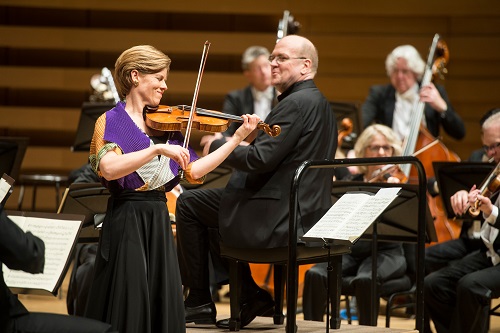
isabelle-faust-bernard-labadie-jag-gundu-1

Isabelle Faust, violin, and conductor Bernard Labadie (photo: Jag Gundu)

The program featured a pair of violin concerti, played by violinist Isabelle Faust on either side of the intermission. She opened with concerto #3. I was especially thrilled with the slow movement, both the sensuous accompaniment from the orchestra and the full tone from her violin. After intermission we heard concerto #1, including a wonderful cadenza to finish the concerto, a witty and extroverted eruption from the violin as Faust made us forget all our troubles, lost in the beauty of her sound.

Posted in Music and musicology | 4 Comments

Feminist Flute Opens

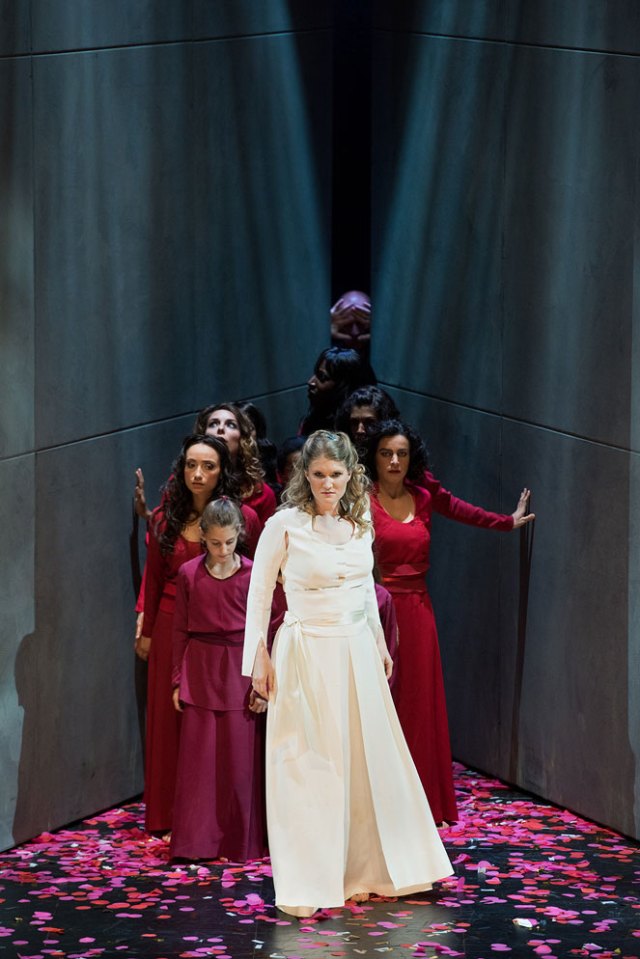
The Canadian Opera Company opened their revival of Diane Paulus’s interpretation of Mozart’s Magic Flute tonight directed for this incarnation by Ashlie Corcoran.

Forgive me for a simplistic headline, but if I had to find one word for Paulus’s reading, “feminist” works for me. As in its first visit in February 2011, we see

  • a framework story concerning the princess Pamina shifts the emphasis somewhat away from its usual misogynistic story ( that can seem like a war between the genders with a clear win for one side over the other), creating more balance
  • an ending featuring a lovely dance of reconciliation entirely in the spirit of the music we hear in that final number, and giving us a framing epilogue similar to what we get from Mozart & Da Ponte in Figaro and Don Giovanni (although Da Ponte’s nowhere to be found this time)
  • lines changed in the surtitles, so that we don’t have to read phrases that seem to be a direct attack on womanhood (I understand it was a collaborative effort between Gunta Dreifelds, who does the surtitles, and the rest of the team, perhaps Paulus and others as well)
  • And the racist elements in the character of Monostatos are deconstructed as well

When you look at this concept, its flamboyant design,  plus the integrity of the music, it’s absolutely first rate and something you shouldn’t miss.

Bernard Labadie is having a busy week. How busy?

He’s splitting his time this week between the Toronto Symphony’s Mozart @ 261 festival at Koerner Hall, and the COC.

  • Tuesday (I think?):  COC dress rehearsal,
  • Wednesday:  first Mozart concert,
  • tonight (Thursday): opening night of Flute
    then
  • second concert tomorrow (Friday) at Koerner Hall.

His life gets easier (!) as he only has to focus on the rest of his run with the COC, meaning another ELEVEN performances between now and February 24th.

And while we’re speaking of being busy, the tempi of his conducting seem to match, as his pace was electric, often the fastest versions I’ve ever heard. The chorus under Sandra Horst’s leadership offered wonderfully clean attacks and diction, perfectly in time. The orchestra seemed to be aiming for a historically informed sound, the strings playing with little or no vibrato.

And there was lots of electricity in the performances.

Ambur Braid as the Queen of the Night in the Canadian Opera Comp

Ambur Braid as the Queen of the Night in the Canadian Opera Company’s production of The Magic Flute, 2017 (photo: Gary Beechey)

I have to mention first & foremost a role that’s really like a cameo, namely Ambur Braid as the Queen of the Night. I wasn’t sure if I could mention her misadventure in her first aria, until she admitted it in social media. Instead of a wardrobe malfunction this was outright rebellion, her colossal dress tripping her up. But Braid is such a complete theatre animal that she turned it into business, crawling on her knees at Tamino. I swear nobody in the theatre noticed, although it did seem like an unconventional approach to the aria. In the second aria, she put the damnedest pause at the end, in full partnership with Labadie (his idea or hers?), holding us in that agonized theatrical moment before she ended the aria. It’s such a tiny part, yet she’s the one everyone remembered, including that last dance with Sarastro.

Andrew Haji was wonderful, his voice and manner a delightful exponent of the role of Tamino. His romantic partner, Elena Tsallagova has a heavier voice than what we usually hear in the role of Pamina, but she brought a passionate urgency to the role. Joshua Hopkins was an energetic Papageno with his heart on his sleeve in quest for a million laughs (and he got them), and a lovely warm baritone that was a joy throughout.

It’s a thrill to see so many Canadians onstage, the company showing its commitment to the development of talent, from director Ashlie Corcoran (who was in the Ensemble Studio herself years ago), Michael Colvin’s charmingly grotesque Monostatos and so many others I could name.

I’m looking forward to checking out the alternate cast. I suggest you go see this celebration of Canadian singing.  Both genders.

Posted in Opera, Reviews | 2 Comments

Questions for Birgit Schreyer Duarte: translator of Liv Stein

I was fortunate to encounter the work of Birgit Schreyer Duarte while she was still a student at the University of Toronto, over a decade ago. While one may sometimes see remarkable talents among a student population, she was at another level entirely, already a significent ambassador for German culture in her directing & translating. She directed Mein Kampf by George Tabori, translated Schimmelpfennig’s Auf der Greifswalder strasse, and more, all while simultaneously working on her PhD.

birgit-schreyer-duarte

Birgit Schreyer Duarte: translator, director, dramaturg, cultural ambassador

Fast forward to her busy life as a dramaturg, director, and translator, often with Canadian Stage. You can see her portfolio, including pictures and more at her website. Last winter Canadian Stage presented Das Ding, directed by Ashlie Corcoran in Schreyer Duarte’s new translation, and this past summer she directed Hamlet for the Dream in High Park. Her latest translation is Liv Stein, opening on January 26th for Canadian Stage directed by their Artistic Director Matthew Jocelyn. I had the delightful opportunity to ask her questions in anticipation of Liv Stein.

1-Are you more like your father or your mother?

I have an identical twin sister, so being compared is something that has happened to us all our lives. The question of who resembles which parent more has been put to us many times as well. Funnily enough, visually, I resemble my mother a bit more than my father, while my sister has more of my father’s visual traits. Sounds unlikely, I know, but it’s true—there are some pictures where it’s totally obvious, but when people hear this they always think we make this up! But in terms of other influences, I am really a mix of both my parents I think. I get my musicality from my dad who’s a musician, for sure, and my affinity for the imagistic/visual arts from my mom, who taught us kids photography. Both are interested and talented in languages, both are well travelled, and extremely loyal people. A healthy portion of pragmatism, as well as empathy—that’s what I probably get from my mother. It’s my dad who is more comfortable approaching new people and speaking in public. He can be very detail-oriented in fulfilling tasks, but it’s my mother who’s extremely perceptive of her surroundings.
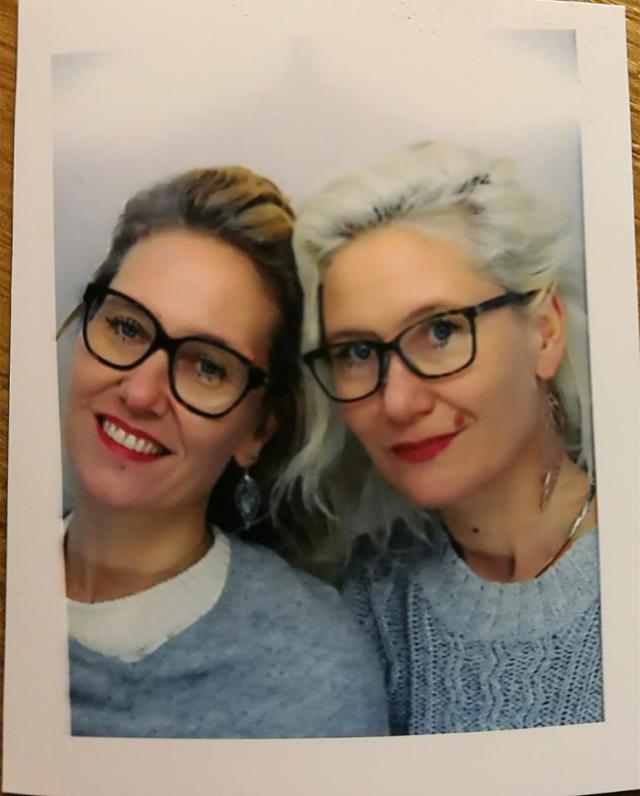
ab-jan17-passbild

The twins: (l-r) Annette and Birgit

2-What is the best thing or worst thing about what you do?

It never gets boring, since I have the great fortune that I get to work in a number of capacities throughout the year—both at Canadian Stage where I work part-time and as a freelancer. In my happiest years, as 2016 was, I get a healthy balance of my three favourite occupations: I work continuously in season planning with Artistic and General Director Matthew Jocelyn and Executive Producer Sherrie Johnson; I translate plays from German to English and see them staged (Ashlie Corcoran’s production of Das Ding (The Thing) by Philipp Löhle was seen at the Berkeley Street Theatre as part of Canadian Stage’s and Theatre Smash’s season, as well as at the Thousand Islands Playhouse); and I get to direct plays I love (an indie production of Taking Care of Baby by Dennis Kelly and Hamlet Shakespeare in High Park). I truly believe practicing each of these professions make me better in the other two.
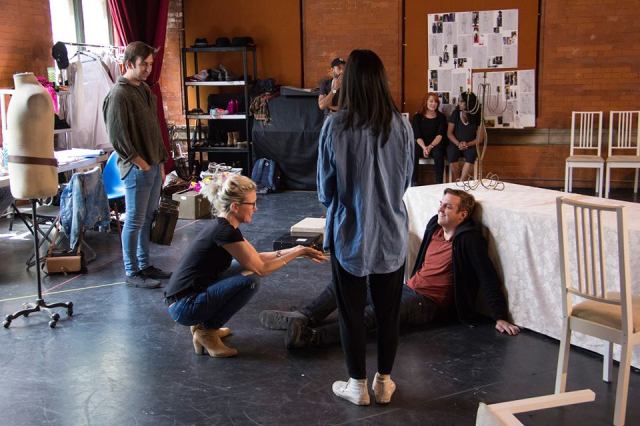
hamlet-2016-rehearsal-shot-2

Rehearsing Hamlet in 2016

The “worst” thing about being a dramaturg, or, more specifically in my case, of working in season planning, is that one is virtually never done working. You could always read more, research more, go see more, make a greater effort to be the one to discover the next great voice in play-writing. I had to learn over time to set myself limits, when to close my laptop, to plan a weekend without reading yet another script, etc.

3-Who do you like to listen to or watch?

At this very moment I’m listening to Sia’s current album “This is Acting” (no idea where this falls in terms of a “cool factor” these days!). On other days, it could be anything from Handel arias, Monteverdi operas, danceable music like Rihanna and Lady Gaga, to my father’s Bavarian folk music recordings, Top 40 hits, or sacred choral music. The last album I actually bought was Canadian singer-songwriter Lisa LeBlanc’s, after I saw her live in concert.

I have been sucked into the Netflix binge watching craze only fairly recently, but if I am hooked, I am hooked hard-core: anything mainstream from 24, Breaking Bad, Downton Abbey, House of Cards, to The Good Wife—I reluctantly admire these shows’ ability to create this perfect bubble for the viewer where nothing else exists and the characters become more real than the people around you (Spoiler Alert: I took days to recover from the untimely death of the male protagonist in Good Wife!). I also find them somewhat educational, to be honest: their milieus are so specific that I always feel like I learned something about their particular period in time and their worlds. Otherwise, I love German artsy films, Atom Egoyan’s work and epic, sophisticated actor-driven mainstream movies (Tree of Life or Manchester by the Sea come to my mind immediately); but I was also crazy about the Bridget Jones movies and was genuinely excited to see the “grown-up” version of Bridget recently in “Bridget Jones’ Baby”! More and more, I’ve come to appreciate a good comedy—perhaps because the plays I get to watch or read are more often than not problematic or tragic and it’s very, very hard to find good comedies.

4-What ability or skill do you wish you had, that you don’t have?

Beaming myself to any place I want and back. I still haven’t given up hope that humanity will master this skill during my lifetime! I would go back and forth between the places I love and where I have family and good friends much more often and with more ease

5-When you’re just relaxing and not working what is your favourite thing to do?

I have a few! Hanging out with my sister: just talking non-stop, or shopping for shoes, or going to the opera, or reading novels side by side. Biking around the Bavarian countryside with my husband. Spending the day in a swimming pool-spa with my best friends in Germany. Philosophizing with my theatre friends in a Toronto coffee shop.

*******

More questions about translating Liv Stein

1-Please talk about Nino Haratischwili.

Nino is from Tiflis, Georgia, but now lives in Hamburg, and I haven’t yet met her in person.

However, the theatre world is a small village, as we know, and my good friend Maria Milisavljevic from Germany, the former Tarragon Theatre writer-in-residence of Abyss and Peace River Country, got to know her several years ago in a professional context in Germany, plus I am now Facebook friends with her, and we’ve communicated several times about Liv Stein (I just finished translating my interview with her that will be published in our Canadian Stage’s programme book for Liv Stein).

nino_playwright

Novelist & playwright Nino Haratischwili

So it feels a bit like we do know each other. She’s in her early 30s and has written no less than 20 plays and several novels, the last of which is a 1000 page epic family history in Georgia, called Das Achte Leben (The Eighth Life). I just ordered it for myself. I am curious how her writing style comes out in her fiction. In her plays, I particularly enjoy her directness—the characters say out loud what they think, they are much more unmediated than many Canadian playwrights’ characters I know. In that way she reminds me of another favourite playwright of mine, Simon Stephens from the UK, although she is of course less of a veteran than he is, and he’s extremely economic as a writer, maybe more than anyone I know at this point. But I also love Nino’s pathos and the boldness in her images and themes; they are pretty operatic. She has a great love for Greek mythology and that’s clearly present in Liv Stein. She wrote Liv Stein at the age of 25 or 26, and most people’s first reaction to the piece is to think she must have been a mature woman to be able to write so insightfully about the extreme situations her characters find themselves in, and to create a couple in their mid-fifties as her protagonists. Her latest play, Schönheit (Beauty), just opened last month in Nuremberg, Germany. She has received a total of 11 prizes for her writing.

2-Tell us about the Canadian Stage Production of Liv Stein that you’ve translated for its premiere in English.

The script of Liv Stein came to Canadian Stage through a trusted fellow artist, actor Alon Nashman. He had seen the play in Tiflis at the Georgian Theatre Showcase, and was quite taken by its poetical force, so he sent it to Matthew in a preliminary English translation from the UK that he had acquired, as something he thought we might consider for Canadian Stage’s future programming. Matthew shared it with me, as I normally have more time to read through the piles of scripts that land on our virtual desks. We had never heard of Nino as a writer.
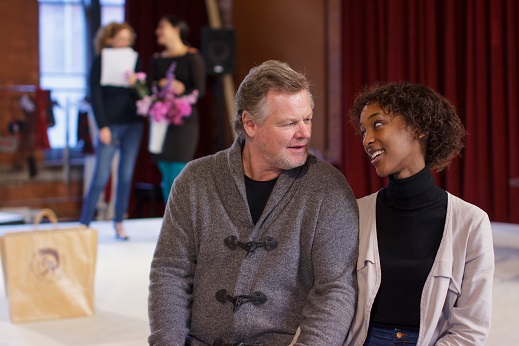
geraint-wyn-davies-sheila-ingabire-isaro

Liv Stein: Geraint Wyn Davies & Sheila Ingabire-Isaro

When I eventually got to it—this was probably about two and a half years ago—I was immediately intrigued: by its setting in the world of a musical virtuoso, its crime thriller-like feel, its heightened, larger-than-life characters, and by its core issues: the effects of obsession (artistic and otherwise), the question of whether our quest for “truth” should trump our need for happiness, the value of success in art vs. success in leading a fulfilled life.

The play stood out to me in so many ways, so I urged Matthew, and later the rest of our artistic team, to read it too. In our internal reading rounds it soon became a priority play that we hoped to find a spot for in the coming seasons. We all loved the strong, complex female protagonist who would make a fabulous role for a strong middle-aged actress.
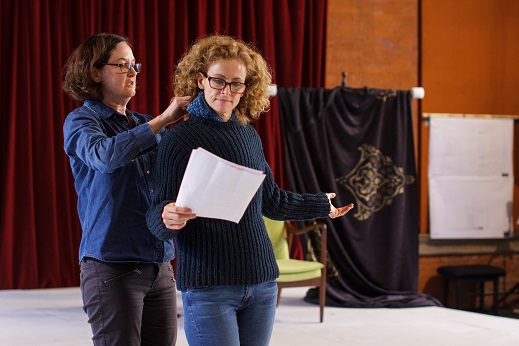
caroline-gillis-leslie-hope

Liv Stein: Caroline Gillis & Leslie Hope

However, we all found that some aspects of the English version didn’t sit well with our Canadian ears. Some phrases sounded belaboured or even a little dated to us, or simply too British, so that we suspected the translation risked making the already pathos-laden script even more artificial and precious. That’s when I realized I should read the German original next to see if the problems for our sensibilities as Canadian theatre-makers (and -goers) lay in the play or in the translation. I remember being even more enthusiastic about the play after reading it in German, the language Nino had first written it in. Her language was direct, witty, poignant, and atmospherically dense and full of surprises. We decided to give it a try and create our own English version of the text.

3-Please talk about the art of translation, and your experience as a translator and what’s involved.

The process of translating for the stage is really ongoing; the work will literally be “done” only at the moment of its premiere. I take about four weeks off and on to translate a full-length play in its first draft. Then the many discussions (with the director, the original writer, actors, designers) begin, and the many rewrites. That continues throughout the rehearsal process, at least in my experience. It gets more complicated when another writer is part of the project, a playwright who was commissioned to adapt the play further after the translation is done. Such was the case in my translation of Friedrich Dürrenmatt’s The Physicists, which was staged in 2015 at Stratford by Miles Potter, for which Michael Healey was hired to write an updated Canadian adaptation. With Michael, the collaboration went very smoothly. We had a number of in-person and online conversations about the tone and style of the play, especially its dark humor, and the biographical and socio-political context of Dürrenmatt. I was invited to the rehearsals in Stratford. If this kind of collaboration isn’t working well and the adaptor has no interest in consulting with the person who has access to the original text, it can be frustrating and ultimately artistically unsatisfying. I’ve only had a couple of experiences like that. Most of the time the directors and writers, if there are any involved, are very happy to have the foreign-language speaker by their side in the process.

I started translating for the stage when I was still in University and realized quickly that there aren’t too many German-English translators in Toronto who are also trained in theatre-making. I enjoyed the process immensely and excitedly took on any translation job I could, and also started choosing German plays I wanted to direct that needed to be translated first. So I almost learned how to translate plays for the stage simultaneously with directing them. I did that with Roland Schimmelpfennig’s post-dramatic extravaganza Boulevard of the Brave (Auf der GreifswalderStraβe), Pascal Mercier’s novel The Piano Tuner (Der Klavierstimmer, which I adapted into a stage play), Felicia Zeller’s social worker drama Kaspar & the Sea of Houses (KasparHäuser Meer), and Marie luise Fleiβer’s seminal early 20th century drama Purgatory in Ingleton (Fegefeuer in Ingolstadt). In other cases, I proposed plays to directors and was commissioned to translate them for their productions, such as for Das Ding (The Thing), or I was approached by directors who had read a play in an older translation or another language and wanted a new English translation for their own productions, as was the case for Brecht’s Life of Galileo (Leben des Galileo) for Jacob Zimmer’s Small Wooden Shoe company or Lukas Bärfuss’s The Test (Die Probe) for Philip Riccio’s Company Theatre production. Occasionally, I also translate a play on my own time that I personally am drawn to, in the hopes it will get a staging someday…

Overall, every translation, whether of literature or for the stage, exists somewhere on the continuum between these two demands: literary quality vs. functionality. There’s an image I like that helps explain the dilemma of the translator’s task (something I heard at a translation conference once): that of the “unfaithful beauty”. Some translators compare their struggle of choosing between a faithful and an unfaithful translation to choosing between a faithful and an unfaithful lover, of which, unfortunately, the unfaithful one often turns out to be the more beautiful one… As a translator we frequently get caught between our desire for each of the two: the desire to create the most theatrically rich and evocative translation of the original text (the beautiful but unfaithful translation) and, at the same time, to retain as much as possible of the original text’s “vision” (i.e., going with the faithful, but maybe “duller” translation). On top of creating something “beautiful”, a translator’s task is to remain “invisible” to the target audience—after all, the translated play should never sound like a translation, but just like a foreign play in a language we understand. Also, as a translator of a play from a language that’s foreign within the receiving culture, one is almost automatically taking on the tasks of the dramaturg: that is, researching the cultural context of the source text, verifying facts and meanings of specific expressions and terms, searching for historical context that might explain vocabulary and determine your translation choices.
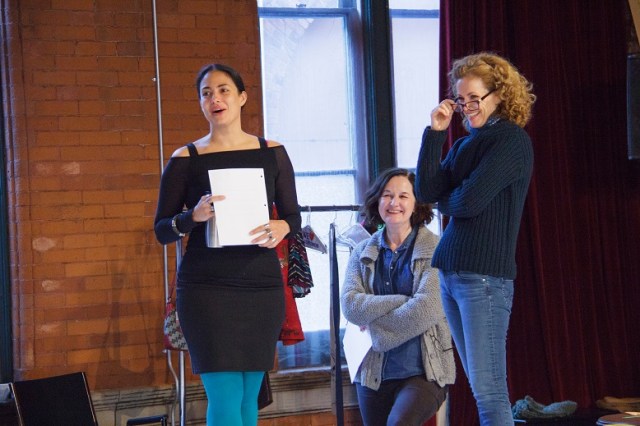
nicola-correia-damude-caroline-gillis-leslie-hope

Liv Stein: Nicola Correia Damude, Caroline Gillis, Leslie Hope

I have found that there are two sets of challenges in translating plays for a foreign audience: first, conveying the stylistic/linguistic qualities of the original language, and second, communicating the cultural specificities of the world of the play. Another great image I have heard translators use is that of the iceberg: the visible tip of the iceberg is the textual translation of a play; what’s underneath the surface is the “cultural underbelly” that needs to be moved as well—moved into the target culture in this case. To get even more specific, I would define the different levels of translating for the stage as the following six categories: grammatical specificities; tone; puns, idioms, neologisms; sound and rhythm (which mostly comes down to the ratio between vowels, consonants and syllables); performative solutions; and social/cultural connotations.

You have to investigate: Are the characters speaking in an ironic tone, with dry humor, very colloquial, or very flowery? To what effect, dramaturgically? How do they differ amongst each other? How important is that for the storytelling? Since a lot of the syntax and rhythm is different in German and English a translator has to find different tools in the English language to recreate the original’s tone and emotional impact. Often, a sentence, even a whole speech, have to be re-organized and in part re-written in English to aim at the original’s effect, or to recreate the qualities the characters display in their original language.

Similarly, the world of a play is in part constructed by the specific cultural markers of the play’s origin: those might be places, names of public personalities, historical references, idioms, even certain foods, musical references or architectural details. In a German play, these may have meaning for a German audience but may be largely unknown to a Canadian audience. In such cases, it is up to both translator and director to decide which of these references are necessary for an understanding of the play. Those that are necessary should therefore either be replaced by equivalents found in Canadian culture, or explained by additional information inserted in the translation. If it is essential to keep the geographic and cultural world of the play intact, the translator retains the original’s “exoticisms” but runs the risk of having some audiences guessing about the meaning of certain details in the play—which could potentially make us lose the audience’s attention.

4- Please speak about your objectives with your translation of Liv Stein.

The world of Liv Stein is contemporary. To premiere it in Toronto, our overall goal was to make the play accessible in its language (as mentioned before, we wanted the hint of artificiality in the characters to be kept at a minimum) so that audiences are intrigued but willing to follow the slightly eccentric story and its larger-than-life personnel and take their issues seriously. We also decided to keep the geographical and cultural context vague; this was possible without changing any specific names or places or other markers of culture and place (which is rather rare, in my experience). In other words: The setting in the original is a large urban centre in Germany, we assumed it was Berlin, but only once the name of a concrete address is mentioned, in the very last scene. The conservatory is mentioned and concert venues but none of them needs to be in a specific city, nor even necessarily in Germany. What’s important in the play is that the characters move with ease within an old, Western culture, an upper middle class world where classical music is part of the fabric of their upbringing and education, and where boarding schools are the elite’s option of the school system. We didn’t employ any dialects or local coloring at all—it’s like we’re watching characters in an unspecified Western city speaking in a Canadian English. I do believe the European roots of this story are pretty obvious, partly because of the natural relationship with the classical music genre that the characters demonstrate. But we don’t point them out in any design or language details.

The process of finalizing the translation contained many steps: I first delivered my own first draft to Matthew several months ago, based on my own understanding of Nino’s original text, in terms of humor, style, rhythm, atmosphere. Then we sat down together over several sessions and discussed anything Matthew challenged me on, and tried to find out what it was that suited both our perceptions of a given scene or moment best. That way a large part of dramaturgical investigation gets done as well—the digging for meaning and motivation, the analysis of dramatic tension and structure, etc. We also had a few questions for Nino to make sure we understood some details correctly.
With this preliminary “final” draft we then started the rehearsal process. During the following weeks, many little changes and edits and refinements were made in collaboration with the cast, while on their feet. There are things that only become clear once you see the story played out live in front of you. You really have to let go of the claim that it’s “your” work, your words—the translation quite literally becomes the work of the cast once they speak the words.

5–Is there a teacher or an influence you’d care to name that you especially admire?

Yes, there are several. Curiously, as a translator I have worked and practiced mostly on my own and have no direct role models to refer to. But I was very lucky and had almost exclusively bright, dedicated professors during my formal education, both at Munich University,where I studied Dramaturgy, and at the University of Toronto. I think very fondly of these formative first years in Toronto as a PhD student in Drama; I was given a lot of freedom to follow my interests, both academically and practically. That’s where I also tried out directing and translating for the first time; I haven’t undergone formal training in either. Then I continued to learn from theatre-makers across the country and abroad: Electric Company’s Kim Collier, as well as Stockholm’s Riksteatern’s Josette Bushell-Mingo, both brilliant creators, were the two first female directors whose work encouraged me to think truly big and bold, who love imagistic theatre and don’t shy away from technical challenges. Josette is also a gifted dramaturg and a political force, at home in many cultures, innovative and fierce. Peter Hinton’s views on directing, especially on directing Shakespeare, have also strongly shaped my thinking about the craft. He’s someone I can listen to for hours on end and be inspired and learn from. And of course, Stratford Festival’s Antoni Cimolino and Canadian Stage’s Matthew Jocelyn, both of whom I have worked withover the past six or so years, are artists and leaders I highly respect as colleagues, and who I’ve regarded as mentors for years now.
matthew-jocelyn

Matthew Jocelyn

*******

Canadian Stage presents Liv Stein by Nino Haratischwili, from January 26 – February 12.

Posted in Dance, theatre & musicals, Interviews | Leave a comment

#coc1718

Tonight the Canadian Opera Company announced their 2017-2018 season aka #coc1718, an event hosted by Brent Bambury in conversation with Johannes Debus & Alexander Neef.  How novel to be permitted –nay encouraged– to tweet during the show about #coc1718.

That’s just one of several innovations.

operaenlevementauserail35_copyrightstofleth

Jane Archibald as Konstanze, in the Opéra de Lyon/COC co-production of Abduction from the Seraglio, 2016 copyright ©Stofleth

As the shows were announced and we kept hearing Jane Archibald’s name announced in show after show, I wondered. And so the COC will now have an “Artist in Residence” for 2017-18, namely soprano Jane Archibald, coming on the heels of several wonderful recent portrayals with the COC, most recently in Ariodante.  As this is the first time the COC undertakes this kind of thing, I suppose it begins with a season organized around her portrayals of several powerful roles:

  • As Konstanze in Mozart’s Abduction from the Seraglio, a new translation & production by Wajdi Mouawad, a co-production with Opera de Lyon
  • As Zdenka in Richard Strauss’s Arabella, a COC premiere, a co-production with Santa Fe & Minnesota Operas,
  • As the Nightingale in a revival of Robert Lepage’s The Nightingale and other short fables

But I can see other ways that an artist in residence might be put to use, mentoring the ensemble while contributing to the company as well as the community.  We’re told that Archibald will do more than just these roles, including a concert in RBA, and who knows what other intriguing responsibilities might develop from this appointment.

It’s a wonderful idea!

Three other shows fill out the season:

  • Rigoletto, in the revival of the Christopher Alden production, this time starring Roland Wood Anna Christy, and Stephen Costello alternating with Joshua Guerrero as the Duke, conducted by Stephen Lord.
  • The Elixir of Love in a new production with a Canadian focus, both in its cast –Simone Osborne, Andrew Haji and Gordon Bintner—and its design concept, which we were told would be Canadian as well.
  • Anna Bolena, as we’ll see a revival of one of the Stephen Lawless productions of Donizetti’s Elizabethan trilogy, starring Sondra Radvanovsky in the title role.

The event was truly celebratory, from the opening number –a chorus from Abduction from the Seraglio—to three solo performances by former ensemble studio member Andrew Haji, plus current members  Danika Lorèn and Emily D’Angelo, each singing an aria from one of the operas to be presented.

_mg_3876

Members of the 2016/2017 COC Ensemble Studio. (back row, l-r) intern coach and pianist Stéphane Mayer, mezzo-soprano Megan Quick, mezzo-soprano Emily D’Angelo, soprano Samatha Pickett, baritone Bruno Roy, tenor Aaron Sheppard. (front row, l-r) soprano Danika Lorèn, mezzo-soprano Lauren Eberwein, intern coach and pianist Hyejin Kwon, tenor Charles Sy. Photo: Bronwen Sharp

Posted in Press Releases and Announcements | Leave a comment

Mozart Forever Young @261

To hear and see the Toronto Symphony Concert tonight was to be confronted with some ageless questions about age.

Mozart, that avatar of youthful brilliance, is indestructible, no matter how he’s played.
Don’t miss this opportunity to hear what the TSO really sound like. When they’re playing in gigantic Roy Thomson Hall (seating 2630) they’re impressive with fortissimos played with a big orchestra, but some of the subtleties of Mozart may tend to get lost in such a big space. It’s simple physics. If the same amount of sonic energy is being shared by 2600+ as well as all those walls and all that air, there’s no way it can be as loud as what you get, for example, hearing Mozart at the Four Seasons Centre (where we’ll have The Magic Flute later this month, shared among a mere 2071 patrons). Now imagine what you get when the TSO pump that same Mozartian sound out in Koerner Hall –their home away from home during the Mozart @261 Festival—for a mere 1135 patrons. That’s fewer than half the number you have at RTH.

No wonder they sound so good there, although the fabulous acoustic doesn’t hurt either. Don’t miss the opportunity to hear the TSO playing Mozart at this festival.

As we’re in the twilight of Peter Oundjian’s career with the TSO, it’s a good time to appreciate what he brings to the table.

He again acted the role of mentor, introducing a pair of young soloists to kick off a festival celebrating Mozart: the quintessential child prodigy.

First it was Kerson Leong, who has appeared with the TSO before, back to play the familiar C major Rondo for violin & orchestra K373.

violin

Violinist Kerson Leong, conductor Peter Oundjian and the Toronto Symphony  (photo: Jag Gundu)

I enjoyed watching the eye contact between soloist and conductor-mentor, Oundjian’s joy unmistakeable.

nediak

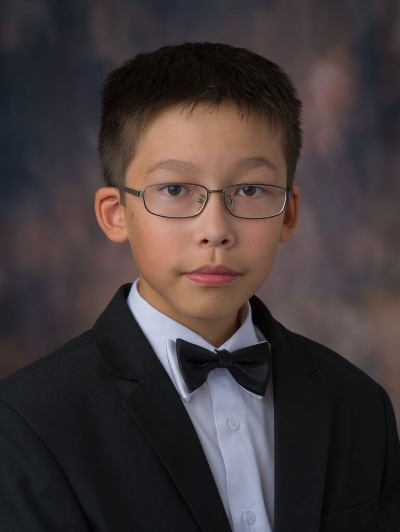
Pianist Leonid Nediak

Then we met young Leonid Nediak, who has one of the most unique set of mannerisms I can recall in a soloist, apparently very humble. He comes across as a brilliant nerd, leading me to wonder if Mozart had been born in our century whether he too would be a whiz at computer science & math: as Nediak is.

His playing is quite delightful, accurate, fluid, and with a deep well of charisma under the surface. Where his body language is understated, the playing is powerful and mature.
After the intermission we heard the TSO with Oundjian, showing us what the orchestra really sounds like in this lovely little hall. Oundjian used a baton for the two outer movements, a choice I’m guessing that has to do with his approach to the tempi. Whereas he’s consistent in the inner movements –the second languid, the third, very quick—and so prefers to conduct using his bare hands, in the outer movements, he needed the extra control that the baton affords. This was especially clear in the last movement, where the first subject was breath-takingly fast, while the second subject (either in its first utterance in major, or its last one in minor) was more wistful, and even introspective: but requiring a quick return to the faster tempo for the concluding bars. This alternation of tempi is a more romantic approach that’s possibly a bit out of fashion, but still quite beautiful to hear, and consistent with what I grew up with on records, thinking for example of conductors such as Karl Bohm or Herbert von Karajan.

For an encore Oundjian led the TSO in a slow reading of “Ave verum corpus” arranged for strings, which I quite loved, both because it reminds me of the fun I’ve had singing this with my church choir, and because for a moment I was put in mind of Stokowski and his arrangements. In so doing it was curious that we were looking both ahead – to the bright future of the talented young prodigies we heard—and back, to the earlier style of playing Mozart.

But it all works.  Magnificent Mozart rules.

This program repeats Thursday January 12th while the festival continues with two other programs:

  • Emmanuel Ax plays concertos # 14 & 23, coupled with Symphony #33, conducted by Michael Francis, January 13 & 14
  • Conductor Bernard Labadie is joined by violinist Isabelle Faust for Mozart’s violin concerti #1 & 3, coupled with Symphony #38 on January 18 & 20

For tickets click here 

Posted in Music and musicology, Reviews | Leave a comment

Danny and that question

I’m viewing Danny and the Deep Blue Sea, the live show I saw previewed tonight, through the same lens through which I stared at La La Land last night. Yesterday was a big movie house full of people. Tonight was an immersive presentation of John Patrick Shanley’s play in a small room in a bar in downtown Toronto. Where LLL asked us whether art should care whether we reach the faces in the crowd, DDBS is right in those faces, who wouldn’t be there if they didn’t care. It’s very intimate.

And yet the big question I asked last night is the same one I’m asking today. Are happy endings possible?  The heart sometimes opens up to the possibility, sometimes closes off, recoiling from our own dream.

The question carries different weight in this utterance. I am finding myself noticing that maybe everything artistic is a kind of proposition, a hypothesis. Sure, you thought Star Trek or Twilight or the Magic Flute were attempts to tell a story. But before any of that, they inoculate you, jabbing something into you that infects you with the possibility of something other than what is literally so. Yes we see spaceships or vampires or singers in these three examples, and if we stay with the story it’s because we buy its hypothesis, that those characters can hold our attention because they persuade us to see more than just actors or singers.

I went into a small room, then after I’d removed my coat, briefly retreated to the washroom to relieve myself. Upon my return, while I was still in the room, I wasn’t alone, because Bria McLaughlin was sitting in the middle of the room.

Where should I sit, I wondered? Bria is a lovely person of course, but no, this was not really Bria, but “Roberta” her character in Danny & the Deep Blue Sea. I was tempted for a moment to sit right in front of her. She’s very beautiful and I enjoy looking at beautiful people (don’t you?). But I also knew that I didn’t want to in any way make this immersive thing any harder by making eye contact with her. Every seat in this charming little room was a front-row seat, so I chose to sit behind her, which might make things easier. So I pulled out my phone and took some pictures. Because the show hadn’t started yet this was permitted, whereas it wouldn’t be once they were underway.

bria_show

The place started to fill up somewhat.

And then Dylan Brenton came in: but no it wasn’t Dylan, it was “Danny”, his character. I glanced his way and again stayed away from eye contact, not sure exactly what the unspoken contract was about the show. I knew Danny to be a violent character from what I’ve read. If I made eye contact would I be in danger?

Yes I know that sounds silly. I asked this question only partly in jest. There’s something slightly dangerous and illicit about sitting in the front row and interacting with a show. I find it intoxicating, that sense of breaking the rules. I do it all the time when I can get away with it. It’s a great way to meet people you admire. But I wasn’t yet sure what our ground-rules were so I kept quiet and distant.

The show begins very quietly, gently. Danny talks to Roberta. At one point a guy sitting a bit to my left seems to get a rise out of Danny, who sounds as though he wants to hit him (hm… stronger language than that come to think of it. Hit him? Or smash his face in? something like that).

We’re in the cage with the lions. And need to be careful of getting scratched.

The play unfolds, and I’m struck as usual by questions of age. In opera we accept that the ages are miles away from what the storytelling requires. Juliette is supposed to be 12, Butterfly 15, and at the very least, Mimi is young enough to move a young man by her beauty: when she’s unconscious, so it’s not just for her ears and therefore it must be his true thought.  Live spoken theatre doesn’t have the musical element to stylize and invite a huge imaginative leap.  Dylan told me he’s 24 in his recent interview. I suspect Bria is roughly the same age because I think they were in the same year at Ryerson.

They are both younger than my kids (who are in their 30s). And they’re telling a story that must be told by people in their 20s. As I’ve noticed before –when thinking about my life, when talking to anyone about their life—the 20s is surely the toughest decade of a person’s life. Suddenly you have adult bodies and hormones and capabilities to procreate and fight and get drunk and kill yourself, but also, with the urgent need to figure out what you’re going to do with your life. Some do, some don’t. And that’s why being in your 20s is so hard. To portray this when you’re older so much is missing, lost in translation. Before a word is spoken their bodies make it 100% authentic.

Shanley’s language is very direct. I read the program note by director Tony Perpuse, which nails one of the keys of this play, both as an objective he aimed for, and as a reality brought home by Bria and Dylan in their performances: that we’re watching theatre representing the working class. I remember when I used to do construction, I dreamed of writing something authentic to capture work and workers, and it’s still a dream I haven’t managed. It’s tough enough if this writing is a novel, but in a theatre people will listen and critique actors, questioning the authenticity of that voice. And even if this feat is achieved, unless the listeners themselves are workers, it may be an unrecognizable idiom to the ear of those listeners.

And to add insult to injury actors need to turn off their powerful apparatus, namely their instrument. Actors build their bodies and especially their voices for Shakespeare or Sondheim: which doesn’t sound like the guy punching the clock or the lady on the assembly line.

There we were with Bria and Dylan, who started so softly. I leaned forward because my space was not being invaded, because the soft delivery invited me to pay attention, to hear them. They spoke to one another with the delicacy of any bar proposition, man and woman feeling each other out. Yes it builds, but it’s always scaled to the room.

But it’s a highly unlikely thing in some ways. Danny & Roberta, the two people who come together in this story are in their way just like the couple I saw in La la Land last night. We watch romance as they attempt to leap across a gap, to make contact and find a common language. It’s a painful story, but one of redemption and humanity. We are teased again and again, and it’s that same romantic question that is the feather tickling you, as we dare to ask and perhaps believe in the impossible dream of romance, a pair of abrasive people who rub and scratch against each other.

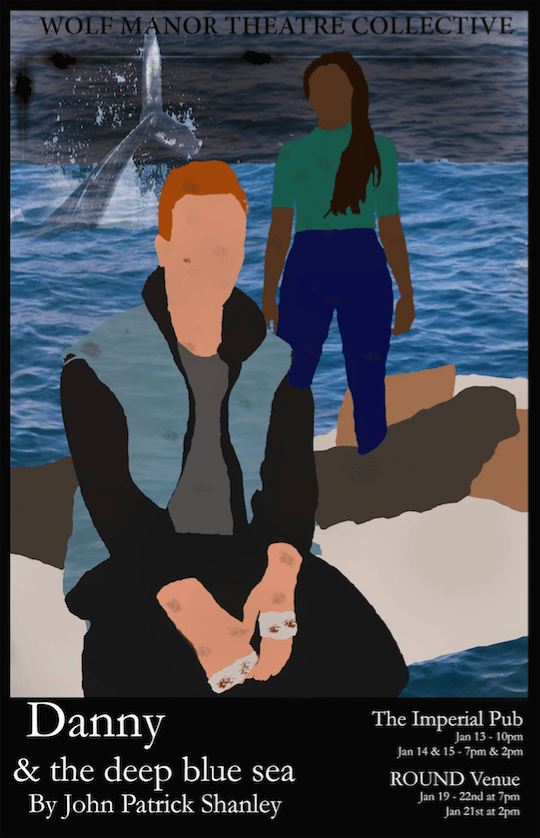
This was a preview.  Danny & the Deep Blue Sea will be presented by Wolf Manor Collective in at least a couple of venues around Toronto over the next couple of weeks. For more information have a look at their website. For tickets click.

dabby_poster

Posted in Dance, theatre & musicals, Reviews | Leave a comment

La La Land and the eternal question

La La Land is a musical but different. How?

One part of the equation is us, the way we were different in 2016. And I suspect we’ll hear a great deal about how we have become different for 2017.

It’s not Singin’ in the Rain, the musical often cited as the best film musical ever made, one of the films that the cast reputedly watched in preparation for their work on this film, and suddenly with the passing of Debbie Reynolds, a work that feels as though it’s from another era, almost another planet.

The operative question in dreaming big is really the same question whether asked by a wide-eyed child or a cynic. “Are happy endings possible?”

damien_chazelle_091316_la_la_land_2c_0

Golden Globe nominee Damien Chazelle

The question was answered differently by the film-makers of 1952 than those of our current time, just as it’s answered differently by viewers of every era. For LLL that means writer-director Damien Chazelle and composer Justin Hurwitz.

One of the recurring images in the film that is introduced by a song but also touched upon repeatedly in the art direction is the idea of faces in the crowd. It will be a matter of discussion as to whether one creates art with that audience in mind or not, as one character more or less says it doesn’t matter whether there’s an audience. LLL offers answers. Sometimes we’re looking at individuals in a crowd, camera dollying along to see each person in a traffic jam complete with a snippet of the music in each little micro-world. Sometimes we’re looking out through the eyes of the performer or barista at the listeners who may or may not be attentive, may or may not care what’s being done. There’s a wall that we see at one point painted with those faces, that will later be overlaid by a huge close-up image of one of the leads who has become a big star: but to tell you more would be a spoiler, so I will try to avoid giving too much away. The plot is built around this ongoing conversation, where each is changed / helped by the other person in seeing past their ideals and finding a new way.

The first musical number signals a very specialized understanding of what music is for and what it signifies. We’re on a jammed freeway in Los Angeles, bumper to bumper and stopped dead. The impossible happens, which in a musical isn’t so unexpected. When you’re stuck in traffic it may already feel like a miracle just getting to your destination. Setting aside diegetic performance, those moments when someone is portraying a live performance of some sort (whether it’s whistling softly to themself or playing an instrument), it’s already miraculous that people sing and dance on film, whether or not instruments are available to make music.

That miracle is the signal in LLL. But this time it’s very much in your face. I know that I was taken aback because it seemed unmotivated. Why would a bunch of people just start singing? And then it came to me that these people –some thin some not so thin and even some actually fat like real people—were expressing their fantasies & their dreams, while acting out in this dream factory, which is how we understand L.A. Stuck on a highway in Los Angeles, going nowhere while trying to get somewhere, the number makes perfect sense. And so the music in this film works that way, signalling a very different discourse. The traditional understanding of musical numbers is that they’re extensions of what’s already happening, so that we sing or dance when words are no longer enough, as we expand the verbal conversation via the emotions available via movement and song. This is a bit different, a more radical understanding. Yes there are characters in the film playing musicians, and so for them the regular diegetic performance of music isn’t an expression of fantasy. But nonetheless we get several moments when the music is taking us out of normal reality into dream / fantasy space.  It’s been done before –thinking for example of the “gotta dance” number in Singin’ in the Rain —but usually there are big signals that we’re in a dream space.  For LLL it’s simply the music. 

Speaking of miracles, Emma Stone & Ryan Gosling surmount the big hurdle: that we can accept them singing and dancing, even watching Gosling play the piano. As this is their third pairing, I can’t help wondering if we’ve seen the birth of a new Fred & Ginger, especially if studios decide that we need these uplifting stories to distract us from the misery of our lives. Yet a big part of the drama is built around the difference between their approaches. Where Gosling seems smooth and confident, Stone’s presentation has a method-acting authenticity to it, often a small squeaky voice (so different from the triple-threat girls with whom she lives & parties) that in spite of itself and in wonderful contrast feels so genuine. As the key scene unfolds, when her audition has to find its way, she finds her voice and sings with a bigger sound and greater confidence.

The last huge sequence of the film offers an answer to that big question about happy endings. I may see it again in a theatre, but when it’s available to me at home I know I’ll be seeing it again and again, thinking about that eternal question.

Posted in Reviews | Leave a comment

Mysterious Satie: Socrate, Hannigan and de Leeuw

People may think they know you.  They can have expectations of you, and be surprised when you don’t behave in the usual way.  I don’t like being boxed in, stereotyped by old friends who think they know me better than myself.

If a musical score could talk, I wonder if it might express similar resentments.  We come to an understanding of a composer (or playwright or poet for that matter) with each new acquaintance with their work, and start to develop expectations. We may think we know their compositional habits, procedures, tendencies.  When we can’t reconcile something anomalous –that is, something outside our prediction of what’s next—do we make the effort to expand our understanding of the composer, or do we shoe-horn this divergence into the old template?

I’m thinking such thoughts after spending the last couple of weeks listening to Barbara Hannigan sing Erik Satie, on the CD Socrate, her recent collaboration with Reinbert de Leeuw.

Layout 1

Reinbert de Leeuw and Barbara Hannigan

If ever there were a composer I wanted to treat as a friend, it’s Erik Satie, an artist who defies easy classification.  Do we know him and his music?  He might be the most easily approachable composer in history, in his refusal to write music of virtuosic difficulty. Anyone can play his piano music.  That fact is already reason for further exploration.

Satie is something of an outlier, having avoided the usual pedagogy and education (at least in his youth) and creative pathways.  This already suggests his scores might be unconventional if not actually iconoclastic.  But where his lifelong friend Debussy was more vocal and angry about his relationship to the establishment, Satie usually took a softer gentler and more whimsical path.  He could draw and this shows his sense of humour.  I can’t help wondering what he was like as a man, as a drinking buddy, as someone to hang out with.

Or to quote Jarrod Annis’s recent review of A Mammal’s Notebook: The Writings of Erik Satie edited by Orella Volta

If kneeling at the altar of benevolent prankster saints is your thing,
A Mammal’s Notebook needs to be on your bookshelf.

All that is a necessary preamble for me before I dare to speak of Hannigan’s collaboration with de Leeuw.  I think one can see three different aspects of Satie the composer on their recording.

We begin with two set of three songs, namely

  • Trois Mélodies (Les anges, Elégie and Sylvie)
  • Trois Autre Mélodies (Chanson, Chanson médiévale, Les fleurs)

The titles of the sets is remarkably apt, considering how little there is in the score, other than the melodies.  Yes we do associate Satie with minimalism, these songs seem to remind us, as the pianist is given next to nothing to play. In other words we’re not in the tradition of Schubert or Schumann, where the pianist’s role is challenging, where there may be an introduction to set a mood.  While Satie’s pianistic skills (or lack of same) have been captured in biographies, the elusive part is how he felt about virtuosity and how he understood music as a result. Not only is there no evidence that he would ever want to play more elaborately, but he pioneered a radically original approach. The piano plays soft chords to frame the melody but rarely calling attention to itself.  De Leeuw’s supportive playing is among the most self-effacing piano I’ve ever encountered yet rock solid in support of Hannigan.

Their rapport is unmistakable.

Hannigan sings with phenomenal accuracy, a purity of tone reminding me of the ink pen drawings of the composer. The CD itself is decorated with one of them, which i think was originally sent in a latter to Jean Cocteau, in 1917.

satie_cd

The CD on my desk, the drawing on the CD

Is this the authentic appropriate way to sing? We can’t really say. There isn’t a comparable tradition with these songs, as there is for the romantic song composers.  I believe these works are like a new continent to be explored and perhaps interpreted.  But I have no reason to deconstruct Hannigan’s approach, other than to marvel at her perfection.

The second of three aspects of Satie can be glimpsed in “Hymne”.  We know only indirectly of Satie’s connection with the metaphysical subculture of Paris.  In Joscelyn Godwin’s 1996 book Music and the Occult Satie is singled out as the single most esoteric composer, narrowly edging out his friend and co-conspirator Claude Debussy.

The ambiguity of these harmonies that refuse to concern themselves with the old idea of “resolution” can also be heard in “Hymne”, another work alluding to rites and rituals for a spirituality that is not documented as a religion.  When we speak of mystery it is in that old sense of the unfathomable, as in the broad discursive area we sometimes lump together under the heading of “the occult”.   While Hannigan sings this without undue forward impulse, corresponding to the score’s instruction (“CALME et DOUX” or in other words “calmly and sweetly”), I wonder if this was originally conceived as a bigger ritual, considering that at the bottom of the page it speaks of “avec adjonction d’un choeur de femmes à l’unisson”.  But for this version (with piano, unlike the later elaboration with orchestra) the communication is through the intimate voice of a soloist.

While Hannigan sings a text we’re in an elevated realm of meaning that’s more like a prayer or incantation, although decoding the implications of the text at this point is difficult.  We can glimpse something larger than life, and more than a little pompous.  Lyrics and more can be found (click) here.

The third guise in which Satie appears is in some ways the most elusive & mysterious, and gives the CD its title.  Here’s how the liner notes describe it:

From the following year he was in contact with Tristan Tzara, the initiator of the Dada movement.  He became acquainted with other Dada artists such as Francis Picabia, André Derain, Marcel Duchamp,, Jean Hugo and Man Ray.  Also in 1919 he composed Socrate, a score he told his artist friends he intended to be white, lucid, transparent and even, in the extreme, fragile, echoing the philosopher’s understanding of our common human fate. To be in the right mood for this composition he ate only white food.

Here the correspondence between Satie’s objectives and Hannigan’s voice seems especially apt.  The vocalism is clean, pristine even.  De Leeuw’s pianism is especially transparent in the three movements of Socrate.

I continue to listen to this CD as I ponder Satie’s mysteries.

Posted in Music and musicology, Reviews | Leave a comment

TOT Pirates

I said a festive goodbye to 2016 with the help of the last Pirates of Penzance of the year from Toronto Operetta Theatre (TOT). They’re taking a well-deserved break for the holiday (and Happy New Year to you too), before resuming their run on Friday-Saturday-Sunday January 6-7-8.

This Gilbert and Sullivan operetta is one of those indestructible pieces that can be done in a myriad of ways. The TOT approach emphasizes musical virtues while offering a faithful reading of the text as we saw today: to the delight of the audience.

colin_ainsworth

Tenor Colin Ainsworth

We saw the latest stage in the development of Colin Ainsworth. The Canadian Opera Company gave him the small comic role of Bardolfo in their recent Falstaff, a completely new direction from anything I’d seen him do, and so it wasn’t a surprise to see how well the comedy worked for him playing Frederic. Ainsworth still has that sparkling diction and lovely voice we know from his Opera Atelier appearances, but was given some genuine schtick to play as well.

Vania Lizbeth Chan was every bit his equal, a sparkling Mabel with so much coloratura to offer in “Poor wandering one” that her cadenzas wandered off into the world of Lakme, brilliantly sung. Curtis Sullivan, whom we’ve seen opposite Ainsworth in several Opera Atelier shows, was the very model of a modern opera baritone, as Major-General Stanley. When it was time for the obligatory political commentary TOT didn’t hesitate to hand the opportunity to Sullivan for a hilarious final verse of the famous tune.  Nicholas Borg as The Pirate King and Austin Larusson as Sergeant of Police sang beautifully.

Derek Bate led the TOT orchestra, a taut clear reading of this familiar score. I wonder if it’s Bate’s adaptation, as the TOT orchestra is eleven players.

The TOT will be back February 25th for “Orlovsky’s Mardi Gras Ball“, a Masquerade including three course dinner, Die Fledermaus in concert, dancing and a silent auction.

Posted in Opera, Reviews | Leave a comment

Triump of the Will, the post-virtuoso era

This morning in the shower contemplating the meaning of life, I saw a solution to an old problem.

The Book of Revelation confused me (and I suspect I’m not alone) in seeming to suggest that The Apocalypse could simultaneously offer the last big war, and a thousand years of peace, a little bit of paradise mixed with a sprinkling of hellfire and damnation signaling the end of everything.  Or were those prophets just covering their butts like good astrologers or weather forecasters, being deliberately vague while hedging their bets?  40% chance of rain, with 10% chance of brimstone and fire?

It struck me that convergence opens doors, creates opportunities, and in so doing may seem to be like the asymptote or the defining condition for both the worst and best of possible worlds.  With rapid change there are winners and losers, and we’re living in a world of such intimate communication that we’ll hear from both groups, if we care to listen.

It hit me that Donald Trump is very much like a crossover artist.  Excellent in his world of BS and bluster, in reality TV, he came to politics the way Aretha Franklin came to “Nessun dorma” or Jose Carreras came to Broadway musicals.  They –Donald, Aretha, Jose or anyone else crossing over—might be good in their old field, but in crossing over we don’t hold them to the usual criteria.

  • Only the opera world (and I struggle to keep a straight face as I say this) objects to Aretha singing out of tune or departing from the original text
  • I don’t think Broadway did object to Jose’s performance, but he was very much a fish out of water
  • And now only those sticklers who actually worry about the usual qualifications of a POTUS have concerns about Donald.

The phrase we keep hearing is “post-truth”. Fake news has depressed the press.  But as a blogger, I must speak of convergence again, that any idiot—me included—can write an opera review or offer their opinions on politics.  We are not so much post truth as post credentials, because disciplinary boundaries have vanished.  Anyone can write, anyone can sing, anyone can run for political office, and the crazy thing is, that so many people seem to prefer inexpert incompetents over genuine virtuosi.  Al Gore was a smooth pro as a politician but perhaps the electorate wanted someone less perfect and more human; enter GWB.   Obama gave several of the best speeches I’ve ever heard.  I cried when his 2009 inauguration alluded indirectly to the Great Depression, citing one of my absolute favourite songs.

Obama said:

This is the journey we continue today.  We remain the most prosperous, powerful nation on Earth.  Our workers are no less productive than when this crisis began.  Our minds are no less inventive, our goods and services no less needed than they were last week, or last month, or last year.  Our capacity remains undiminished.  But our time of standing pat, of protecting narrow interests and putting off unpleasant decisions — that time has surely passed.  Starting today, we must pick ourselves up, dust ourselves off, and begin again the work of remaking America.   (for full address )

Never mind post-truth, when truth isn’t what it used to be.  If a virtuoso plays a brilliant piece and nobody notices, is there brilliance?  We live in a post-virtuoso age.  Convergence means anyone can do anything.  Youtube is jammed with brilliant performances that can all be had for free.  Labour prices are likely to go down in the USA, between Trump’s cabinet appointments and his love for outsourcing.  Convergence’s economic correlative is the interchangeable parts of the world economy, starring third world workers paid next to nothing.   It’s nothing new of course, but the one fascinating development is the huge throng of voters supporting Trump who are likely to be the very people to be in trouble.

This might be paradise if you’re a rich man, or hell if you’re a working stiff. There are huge opportunities and huge risks, all in the same moment. Some are swimming for their lives to reach a land of plenty, others (me?) maybe don’t properly assess the risks and/or bonanzas ahead.

Happy New Year, banzai and mazel tov!

Posted in Personal ruminations & essays | Leave a comment