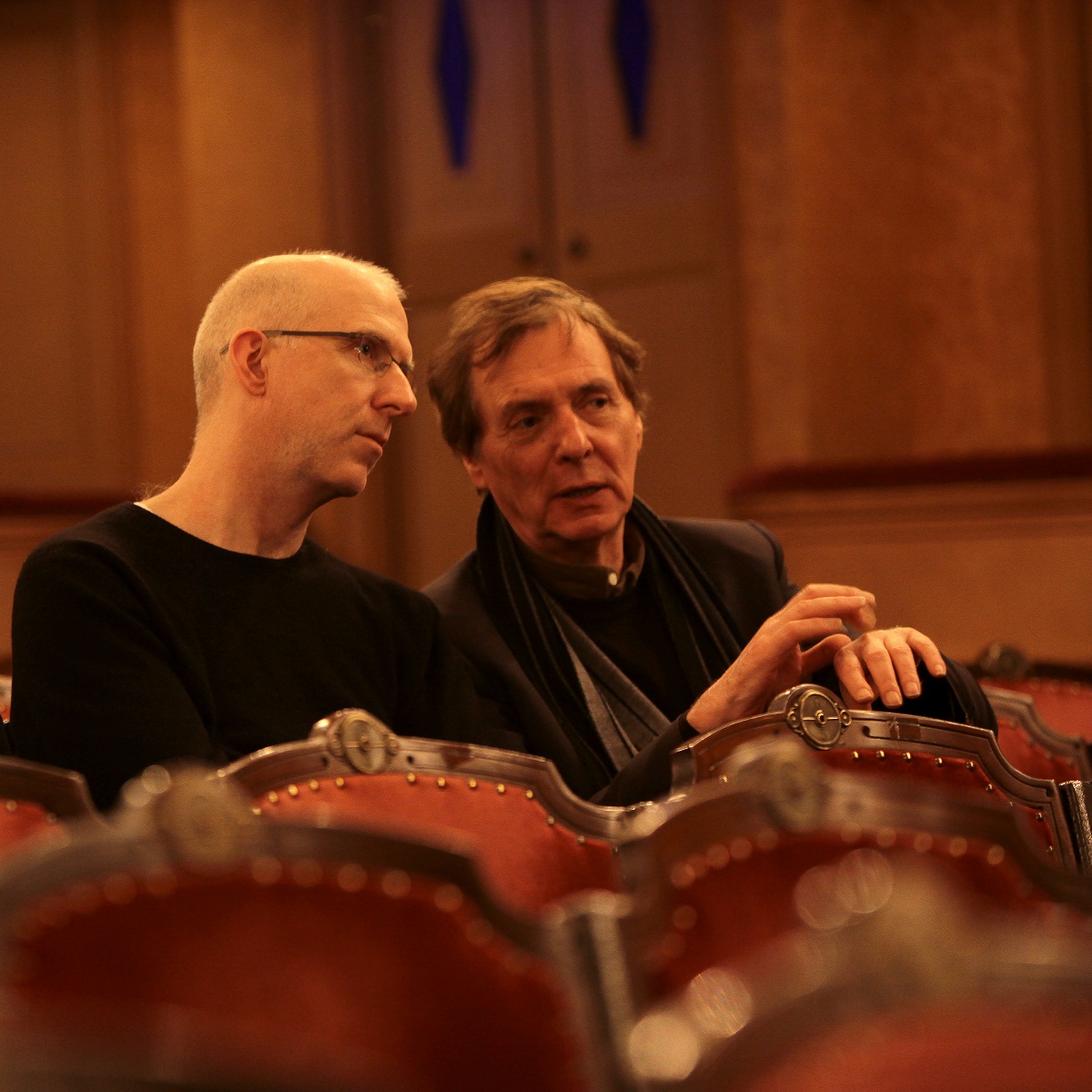
High Def Lulu: Walmart Opera?

An irritated blast I sent to Facebook is the basis for this commentary (I don’t think it’s fair to call it a review), which is really more a series of speculative questions than answers.

At one point in Saturday Nov 21st’s High Definition Metropolitan Opera Broadcast, the transmission died.

Screen blank..!  just a faint wash visible.

No sound..! until i heard  a few people muttering.

I grabbed my iPhone and posted the first thing that came to mind. There had already been some conversation that included James Jorden, Ambur Braid, Ramona Carmelly, Stephen Farrow & other assorted friends & acquaintances (and yes this is shameless name dropping). I’d joked that while I was at a theatre in Scarborough (where I live btw, even if some don’t think much of the place, calling it “Scarberia” and worse), it was empty!

But at this point I posted

And right now we have SILENCE in this theatre. You get what you pay for.

High def = Walmart opera

We lost three minutes or so before the transmission came back, in medias res. If the delay had been longer I would have been more upset, but even so, this seemed reasonable at the price.

Let’s talk $ and the morality of saving money.  If I am all that matters, perhaps i can justify shopping for the cheapest option.  But I am not all that matters surely.

I never ever go to Walmart. I may have been there once, perhaps a decade or more ago, but I avoid those stores on principle. Yes I pay more by shopping at a store with higher prices, but I believe that keeps Canadians employed.

If you follow the analogy i wonder: could Canadian culture even exist if we were to contract everything out, producing all products abroad?  I am still breathing huge sighs of relief over our federal election, one with several subtexts including threats to the CBC due to funding cuts.  I’m hoping that we’ve dodged that bullet.  There are jobs for our actors, writers, technicians, musicians… or anyone else in the supply chain, because there are still productions Made in Canada. They compete with Hollywood, and thank goodness we have rules about Canadian content.
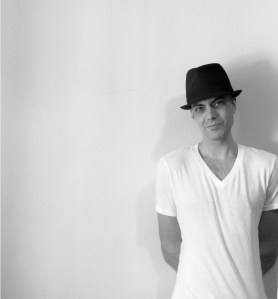
Composer Adam Scime, whose opera L'homme et le ciel will premiere in early December with FAWN Opera

Composer Adam Scime, whose opera L’homme et le ciel will premiere in early December with FAWN Opera

I can’t help thinking about the High-Def broadcasts in the same context.  Now of course, I’m a hypocrite if I decry Walmart while I go to High-Def broadcasts. I pay $28 to the Cineplex to see an opera, rather than support Bill Shookhoff or Guilermo Silva-Marin or AtG or FAWN or the COC or OA or the Canadian producers currently producing new opera such as CanStage/Soundstreams or Tapestry Opera ?

The fact is I am feeling a bit guilty because I chose the Cineplex Lulu over a downtown Prince Igor to be presented by Opera in Concert tomorrow afternoon: because I could only manage one this weekend, and chose the foreign product over the domestic.  It’s simplistic of course, because no single purchase decision is going to damn or save an industry. I can’t help reflecting on this for a few reasons:

  • Because this is my first High-Def broadcast in a long time…
  • Because I am noticing simultaneously, strengths (cheap price, close-up views, great performances) and weaknesses (irritating aspects such as the interviews with the singers, or the outrageous claims: “Only at the Met” they say. Excuse me?)

William Kentridge’s production team created a Lulu that screams out every moment “you’re missing half of the show, you need to come to the theatre to see this properly!”Almost every production in the High-def series teases you somewhat with what you see and what you can’t see, but I don’t believe I’ve ever felt it so keenly as this time, a design that employs a powerful stage picture comprised of illustrations, projected text, mime performers and complex effects framing the live performers, like a bad dream after reading too much Brecht. I don’t believe we had an accurate view of the production for even one moment out of the 3+ hours.

The stars of the production, especially Marlis Petersen, Johan Reuter, and Susan Graham, were especially powerful in closeups that omit the remainder of the stage picture. One can’t have it both ways, but in the relentless pursuit of the ideal close-up, we often were force-fed a paraphrase, an interpretation of what was actually happening on the stage. Chances are this is by now something the artists in question have accepted, possibly because they have no choice, possibly because I’m being too much of a purist.  I’m still pulsing with the emotions of the concluding scene, mostly presented in exquisite close-up of those three principals, even though the last thing we saw ripped us away, giving us a very sloppy full-screen shot that only makes sense if you’ve seen the show before. In the Cineplex one can’t really feel the power of the live human voice, the way it hits you when you’re within the same actual air-mass. Petersen, Reuter, Graham et al only moved me via proxy today, amplified and not really within the same space. The authentic experience of those voices (two of whom I’ve experienced live & in person) is perhaps a purist concern, when the virtual performance is so good.

Is this the future of music, theatre and opera? That is: will other companies follow this path? I know some have tried, including our own Stratford Shakespeare festival but I doubt there’s enough demand for this model to work for smaller companies. Could the National Ballet sell their Nutcracker for an audience beyond Toronto? Could the COC offer their own high-def Christmas treat comparable to what the Metropolitan Opera will offer in December (when they re-broadcast The Magic Flute)?  Whether they do their own Flute or perhaps Hansel and Gretel, there’s surely an audience out there. But I don’t think it has to be either-or, so much as a combination of channels / outlets whereby a content producer earns their revenues.

I am impatient to see another Lulu produced here in Toronto by the COC, or failing that by some other courageous producer; for instance, what about the Toronto Symphony, who have already brought Barbara Hannigan to town a couple of times? I must sound greedy, considering how many ambitious smaller companies are courageously carrying the ball for new & daring opera productions.

And then again I may have to content myself with seeing the Encore.

Posted in Opera, Personal ruminations & essays | Leave a comment

Tap: Ex METALLURGY: Visigoths in the Cathedral

While all roads may once have led to Rome, in the Canadian opera world, all roads seem to begin with Tapestry and artistic director Michael Hidetoshi Mori, whose visionary ideas are like seeds sown onto the blank staff paper of composers all over the country.

David Pomeroy and Krisztina Szabó (photo: Dahlia Katz)

David Pomeroy and Krisztina Szabó (photo: Dahlia Katz)

I am mindful of Rome because Michael invited the barbarians into his wee cathedral in the Distillery District, namely a rock band called “Fucked Up”.  Barbarians? Rock is loud and irrational, at least when it’s billed as “metal”, which was how I understood the title of the show “Tap: Ex METALLURGY”, the latest in Michael’s ongoing series of experiments, provocations, attempts to inspire & encourage the creation of opera.  Michael’s world is a bit like MaRS or Dragon’s Den, a crucible for creation, but without the negative judgment you find in those other places.  Let me say –unlike what you hear on that negative CBC show –“I’m in!” Never mind that experiments don’t always work, that they’re sometimes achingly close while still falling short. We need what Michael offers.

While Michael bravely invited a rock band to collaborate on opera, there’s way too much clever verbiage, too much order, and not enough of the rough and raunchy that makes rock worthwhile.  The headline tells you, indirectly.

I interrupt this somewhat rational discourse for an outbreak of noisy rebellion.  I like the irrationality of rap and metal and even jazz. Noisy music coupled with clear text is an oxymoron! Give me something crazy, challenging.

The example? A song I love, full of rhythm and life and whose lyrics I know um perhaps 1/10th..? Death and pain and agony, and also sex lurk under the surface. It’s an uneasy balance, but the music rides the text abusively, disrespectfully, destructively.  It’s not a happy marriage, it’s a shotgun wedding, if not actually more like rape.

Tonight: Metallurgy B came much closer to this miserable ideal than Metallurgy A.  The second piece’s fifteen minutes include five minutes of gold, and is mostly good because it is far less polite and rational. Even so, both pieces are too nice, too logical.  It’s as though Michael invited the Visigoths to come to Rome, and they not only came to his cathedral, but they sang in his choir without shame, all scrubbed and civilized.  I would strongly encourage Michael to do this again, but next time let the madmen take over the asylum, let the barbarians really bring the metal, smash up the cathedral, at least figuratively, or scrawl messy graffiti all over the polite edifice of the libretti.  Yes the libretti are works of art but they need to be subverted, trashed, stomped on, turned into something more genuine.

I can’t decide whether the outcome was because of strictures placed on the musicians, or because they themselves were cowed or even seduced by the temple to which they’d come? Either way I’d hold Michael accountable, as the ringmaster, the one who might have reminded them that he wanted animals in his circus ring.

Speaking of genuine, the most authentic moment of music in the whole evening came when David Pomeroy took up a guitar and wailed away for a couple of impromptu moments bringing the house to life.  For those moments it felt connected, mind, body and spirit aligned. The remainder was never as congenial, even though there are some lovely moments, especially in Metallurgy B, composed by Ivan Barbotin.

These voices are the two best voices in Toronto, David Pomeroy and Krisztina Szabo.  They are always listenable, although again, I was far more engaged in the second piece than the first.

I would ask Michael to keep up the experiments, mindful that this is a good beginning.  But I wish they would take it further, much much further.


Posted in Opera, Reviews | Tagged , , , | 3 Comments

CanStage / Soundstreams Julie: so old yet so new

Tonight I saw the North American debut of Philippe Boesmans’ opera Julie in a joint production of Soundstreams and Canadian Stage, at the Bluma Appel Theatre, a triumphant opening in front of a full house.  You might want to attribute its success to its adherence to convention.  It’s as old as the clichés of opera:

  • It adapts a known play
  • Its main action concerns a larger-than-life female character, whose portrayal calls for everything understood in the word “diva”
  • The plot includes a love triangle

But that observance of convention is only half the story, as Julie does some things that you don’t usually see in opera.

Left to right Lucia Cervoni (Julie), Clarence Frazer (Jean) and Sharleen Joynt (Christine), Photo by Cylla von Tiedemann

Left to right Lucia Cervoni (Julie), Clarence Frazer (Jean) and Sharleen Joynt (Christine), Photo by Cylla von Tiedemann

A page of text in a spoken play usually moves much faster than what one finds in most operas.  Composers slow things down, adding opportunities for  the singers to show off, to repeat lines or for other purely musical effects (when the composer is the one showing off): which are usually the enemy of verisimilitude.  Opera is usually a form pushing the signification into something symbolic, reflective and normally much slower than the original play being adapted.

But Boesmans’ opera is fast: breathtakingly fast.   Julie runs about 70 minutes, which is actually shorter than the original play, which is normally about 90 minutes in length.  This is especially remarkable when we remember that the story of Julie, from Strindberg’s Miss Julie, is in a “naturalistic” style.   I recall from my Modern Drama class so long ago, that Strindberg sought to play up the element of Darwin & natural selection, and so we shouldn’t mistake “naturalism” for “realism” although there are parallels between the two.  How does one reconcile Strindberg with the poetry of opera?  The answer is Boesmans’ approach plus a libretto by Luc Bondy & Marie-Louise Bischofberger, which is to say, that it doesn’t allow the composer to dwell on anything, the way composers sometimes have done in the past.  Tosca, for example, that verismo opera involving murder & mayhem, still gives the tenor and the soprano moments for arias.  Not so Julie, which really does cut to the chase, making Tosca look like Hansel & Gretel.  There are moments when reactions are a bit operatic, but they’re very economical. Boesmans does build a great deal of ebb and flow into the score, which does sometimes race along, and  at other times seems to pause to reflect or brood.   At some point i’d like to get my hands on the libretto of Julie, to compare it to Stringberg’s play, to see what cuts were made to achieve such economy of means.  Like a fast car, this opera is genuinely streamlined.  

Boesmans’ moody arioso is very original, responding with great agility to the emotional nuances onstage, shifting from one affect to another, seemingly as instantaneous as a good film score, which is to say, it stays out of the way of the story, and doesn’t call undue attention to itself.  The ideal filmscore is supposedly the one that’s never noticed, and indeed there are lots of moments when one gets so lost in the story that one isn’t really concerned about the specifics of the score or the singing.

Director Matthew Jocelyn and Composer Phillipe Boesmans (photo: ©Isabelle Françaix) Click photo for more information.

Director Matthew Jocelyn and Composer Phillipe Boesmans (photo: ©Isabelle Françaix) Click photo for additional information

Director Matthew Jocelyn painted a very busy stage picture, the action often frenetic among the principals, each character given a vivid portrait.  Lucia Cervoni was the larger-than-life aristocrat Julie, the voice rich & full.  Clarence Frazer was a very physical Jean, youthful and strong, while Sharleen Joynt as the more proper & conservative Christine established a completely contrasting presence to the other two.  The acoustic in the Bluma Appel Theatre is very friendly, with a small orchestra in a sunken pit, conductor Les Dala never covering any of his singers.  The text isn’t fully intelligible without the surtitles, which were most welcome.

It’s worth noting that this is not a presentation of a song cycle or something non-operatic purporting to be an opera, as so many companies have done lately in the GTA. This is a real new opera, and wow there’s no comparison.

Julie runs until Noveber 29th at the Bluma Appel Theatre.

Posted in Opera, Reviews | Tagged , | 2 Comments

10 questions for Peter Oundjian

Toronto Symphony Music Director Peter Oundjian

A dynamic presence in the conducting world, Toronto-born conductor Peter Oundjian is renowned for his probing musicality, collaborative spirit, and engaging personality. Oundjian’s appointment as Music Director of the Toronto Symphony Orchestra (TSO) in 2004 reinvigorated the Orchestra with numerous recordings, tours, and acclaimed innovative programming as well as extensive audience growth, thereby significantly strengthening the ensemble’s presence in the world. He recently led the TSO on a tour of Europe which included a sold-out performance at Amsterdam’s Concertgebouw and the first performance of a North American orchestra at Reykjavik’s Harpa Hall.

Oundjian was appointed Music Director of the Royal Scottish National Orchestra (RSNO) in 2012. Under his baton, the orchestra has enjoyed several successful tours including one to China, and has continued its relationship with Chandos Records. This season Oundjian and the RSNO opened the Edinburgh Festival with the innovative Harmonium Project to great critical and audience acclaim.

Few conductors bring such musicianship and engagement to the world’s great podiums—from Berlin, Amsterdam, and Tel Aviv, to New York, Chicago, and Sydney. He has also appeared at some of the great annual gatherings of music and music-lovers: from the BBC Proms and the Prague Spring Festival, to the Edinburgh Festival and The Philadelphia Orchestra’s Mozart Festival where he was Artistic Director from 2003 to 2005.
Oundjian was Principal Guest Conductor of the Detroit Symphony Orchestra from 2006 to 2010 and Artistic Director of the Caramoor International Music Festival in New York between 1997 and 2007. Since 1981, he has been a visiting professor at the Yale School of Music, and was awarded the university’s Sanford Medal for distinguished service to music in 2013.

Later this month, Peter Oundjian will be leading the TSO in a benefit for the Hospital for Sick Children, featuring a performance of Peter and the Wolf.  I wanted to ask Peter (the conductor, not the hero of Prokofieff’s piece) ten question: five about himself and five more about leading the TSO.

1) Are you more like your father or your mother?

My parents were remarkably unalike. One was born in Istanbul during the Armenian Genocide, the other in the north of England but was an orphan by age 7. I grew up in Toronto and south London in a peaceful, fun loving family with sport, humour, and music everywhere. I also grew up with the Beatles and Monty Python which they certainly didn’t! Hard for me to imagine what my parents would have been like if they’d been born after the Second World War instead of before the First. Looking back, we were worlds apart.

2) What is the best thing about what you do?

Without question it is the privilege of communication on so many different levels; from inspiring a young child to love music, to spending time with music lovers, to sharing the passion for so much great music with other musicians.

3) Who do you like to listen to or watch?


I like to listen to Dylan Moran and I like to watch Roger Federer.

4) What ability or skill do you wish you had, that you don’t have?

To be able to play the last 3 Beethoven piano sonatas and to improvise like Oscar Peterson.

5) When you’re just relaxing and not working what is your favourite thing to do?

Peter Oundjian

Play tennis, watch any great sporting event or hang out with family and friends.

*******

Five more about the upcoming year as Music Director of the Toronto Symphony, especially Peter and the Wolf: In Support of SickKids.

1- Please tell us about the fund-raising concert program for the Hospital for Sick Children, and the guests who will be joining you, and is it true that they saved your life?

click logo for more information about the Sick Kids Foundation

They absolutely saved my life when I was 3 months old. My mother took me to SickKids in the middle of the night and I had internal bleeding from intussusception. You don’t last long in that condition especially if you weigh less than a large cat. The opportunity to support the extraordinary work that the hospital does all day every day is extremely thrilling and rewarding for me.

The concert is a wonderful celebration featuring music of tremendous variety. Pianist Coco Ma will play Rachmaninoff”s Rhapsody on a Theme of Paganini. She is only 16 and already a wonderful artist.

Rick Mercer, whom we all know to be an accomplished conductor/skydiver, along with multiple other skills to his credit, will narrate the masterpiece Peter and the Wolf by Prokofiev.

Neil Deland is principal horn for the TSO (click for more info)

It’s also great that Neil Deland, the TSO Principal Horn gets to shine in a delightful arrangement of Hoagy Carmichael’s Stardust – a great American standard and one of the most recorded songs of the 20th century. To start the evening we will play the Young Persons Guide to the orchestra by Benjamin Britten; not only is this a fantastic and exciting piece but I was fortunate enough to make a few recordings with Benjamin Britten when I was a kid.

2- As a Canadian conductor of the TSO, you’ve led performances by Canadian composers, sharing the stage with some great Canadian musicians. Please reflect for a moment on your role as a champion of Canadian musical talent.

If you look back in history, performers have always played a key role in the creation of great music. If we don’t dedicate ourselves to giving opportunities to Canadian composers to write and have their music heard, how can they ever develop or be known. It is both a pleasure in terms of discovery and experimentation and also a challenge to do justice to new music by interpreting with the same care as Beethoven or Mahler or whoever.

3- Tell us about highlights of the current season, such as the Decades Project and New Creations.

I came up with the idea of The Decades Project about two years ago.

The 20th century in most people’s minds evokes modernism in art and culture. It led to the development of the motorcar, the skyscraper, film, and an incredible number of technological advancements. Simply put: The Decades Project aims at putting the music in context. It’s fascinating to see all of the different things that were going on at the same time. For instance, while Sibelius was writing his amazing Second Symphony, Einstein was developing the theory of relativity. Stravinsky wrote The Rite of Spring- an incredible work- shortly after the Titanic sank. The first two decades of the 20th century shaped what we are today! Will being aware of this make people listen to the music differently? Next spring, we will be exploring 1910-1919 withAn Alpine Symphony by R. Strauss, Daphnis et Chloé by Ravel and Elgar’s Violin Concerto (among other things). Each concert includes activities in the lobby, pre-concerts performances with the TSO Chamber Soloists, post-concert chats with AGO Assistant Curator Kenneth Brummel, etc. It’s an immersive experience.

Australian composer, conductor, and violist Brett Dean – one of the most internationally performed composers of his generation – is the curator of the TSO’s 12th annual New Creations Festival. A crucial aspect of Dean’s work as a composer is the fact that art does not arise from a cultural vacuum but is inspired by its environment as well as the social and cultural reality around it. This is interesting, as I was just talking about putting things in context… The music featured in this year’s festival is a comment on our times and, in a festival remix by DJ Skratch Bastid, a comment on the festival itself. Dean has invited fellow Australian composers Anthony Pateras (Fragile Absolute) and James Ledger (North American Première of Two Memorials [for Anton Weber and John Lennon], for works featured in the festival. The festival will also include the Canadian Première of Water, by Radiohead’s Jonny Greenwood. That’s all pretty exciting!

4. Do you have a favourite composer whose music you love to conduct and/or hear?

Most of us end up answering this question the same way; and it’s an honest answer. The music you are playing or conducting at any given moment is your favorite piece. We can be 100 per cent dedicated to it, no doubt about it, no questions asked. I would just add that there are occasionally exceptions but I’m not naming them!

5) Is there a teacher or an influence you’d care to name that you especially admire?

Itzhak Perlman has been an enormous inspiration to me since I was about 9 years old. A great violinist, great musician, an example of how to offer so much to all mankind despite having had so much taken from him at such a young age.

*****

The TSO season rolls along with Peter Oundjian leading them through programs that include the New Creations Festival early next year and some of the first concerts of the Decades Project.  But in the immediate future? On Thursday November 26 Oundjian leads the TSO in a benefit concert namely Peter and the Wolf In Support of SickKids.  

Posted in Interviews, Music and musicology | Tagged , | Leave a comment

Soup Can HERETIC: not the usual martyr

Tonight I watched the latest version of HERETIC, Sarah Thorpe’s latest version of her play with the sub-title ”A Modern Retelling of the Story of Joan of Arc“. I was aware of her objective, to give an old story a new spin, and I confess I was resistant to this expanded version of Thorpe’s one-woman show that was previously presented earlier this year.

Sarah Thorpe (photo: Laura Dittman)

Sarah Thorpe (photo: Laura Dittman)

I was resistant because it’s a story that bothers me at a deep level. Joan’s story is simultaneously a miraculous tale of redemption and cruel punishment. While the first part—where the English are pushed back by a French army led by a bold young girl dressed in armor—is inspiring, yet she doesn’t deserve her eventual treatment. No I don’t like the usual way the story is told because it teases you and then breaks your heart. This is a tale that reminds us of the horrific discrepancy between the ideals of the spirit and the reality of human nature, of the worst sins committed by religion in the name of God. It’s stories like this one that might be the reason so many people fall away from their faith, as we question religion itself, wondering if humanity is really capable of living up to the ideals in the Bible. My usual way of reconciling that is by distinguishing between the ideals in the Bible and the reality seen in the conduct of religions. However inspired their origins, religion is where the murder & genocide comes from. Religion poisons the inspiration of spirit with something sadly all too human, the sick interface where Jesus gets slandered and sold out by child molesting priests and TV preachers. It’s not Jesus’ fault that Christianity is in trouble; with friends like these who needs the Romans (aka the ones who crucified him)?

Enter Sarah Thorpe and her company Soup Can Theatre. HERETIC tells a story I’ve known all my life, but in a genuinely new version. No I’m not saying you will shout “Hallelujah” and rush to a church; quite the contrary. This story is very much the no-bullshit version of Joan.  While it still includes inspiration, it also helps us understand the betrayal, reconciling the two.  As a result I was not freaked out the way I was watching Shaw’s play or the film adaptations I’ve seen.

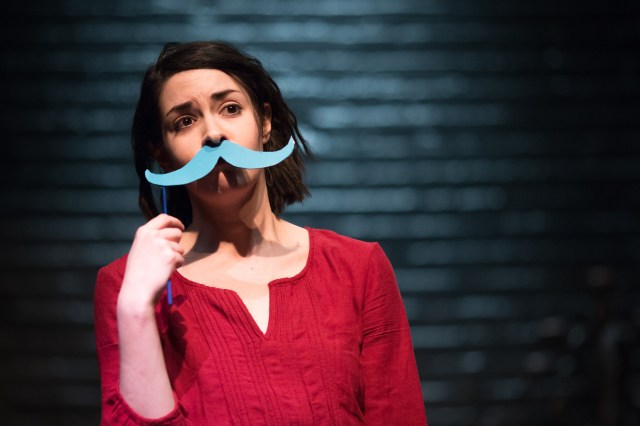
Part of this is Thorpe’s writing, which includes her portrayal of a multitude of characters of both genders. At one point she is the executioner. At another –one of my favourite scenes—we get a portrayal of the Dauphin and his mistress in a dialogue, back and forth in complete cynicism.

Sarah Thorpe as the Dauphin (photo: Laura Dittman)

Sarah Thorpe as the Dauphin (photo: Laura Dittman)

We hear from a priest who is her confessor, yet whose dialogue frames her life as though from an immortal perspective, the view from beyond the grave and beyond life itself. This perspective is the frame-work for HERETIC, and is a brilliant choice for the beginning and end, for although his language is judgmental, she refuses to buy into his criteria, refuses to accept his religious perspective. And that is the reason Thorpe as Joan is free of the claustrophobic enclosure of a religious perspective. Joan is genuinely modern in her refusal to be judged, a refusal to disclose her mystery to our profane and cynical eyes.

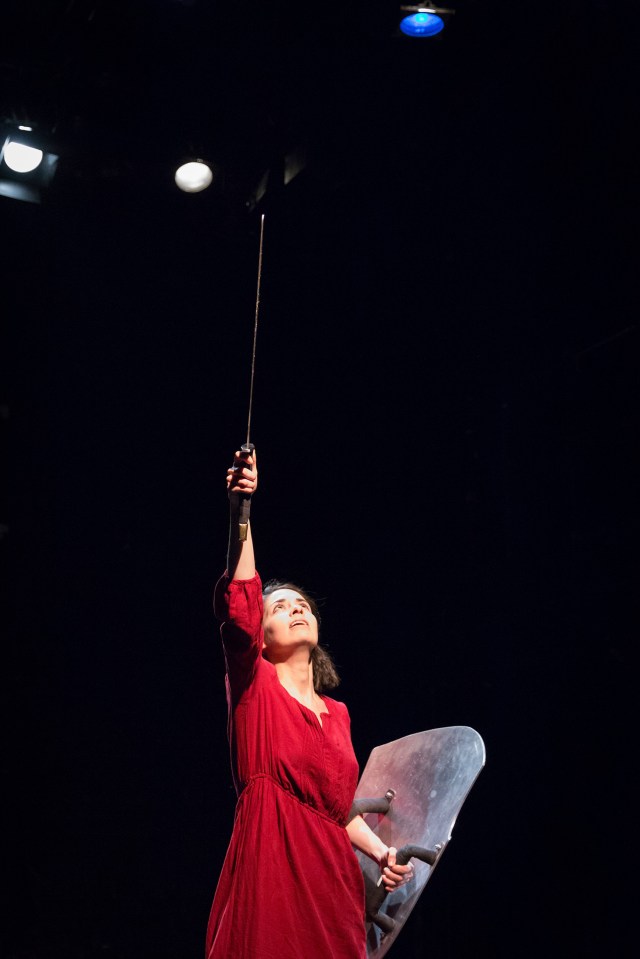
The choices in the mise-en-scene reinforce that contemporary angle. While the design may have been originally chosen simply because it’s pragmatic & inexpensive, it’s an inspired series of choices from Alyksandra Ackerman. As we begin, we’re looking at the sparsely decorated space at Theatre Passe Muraille backspace, with a series of chalk outlines on the upstage wall (at the rear) that resemble stained glass. At the best of times stained glass is cartoony, a clumsy symbolism arising from the expressive limitations imposed by the materials. We see the approach of cloisonism, the same style employed by Gaugin & his circle, echoing the outlines one sees in cloisonné or of course on a church’s glass windows.

Whether it was conscious or accidental, Thorpe steps into this space with big sticks of chalk, telling her story by drawing big chalk outlines on the floor, while walking in this same imaginary space, herself as a sort of icon, among outlines of the cross, of castles & crosses. In a very real sense, she strides among the symbolic icons as though the stained glass were incarnated & walking before us, herself an icon (later a saint) telling her stories of messages from other saints and from Jesus, and her eventual martyrdom.

And so the part that has always bothered me—the political priests—scarcely upset me in this telling, because it was clear that Joan is stronger and clearer than the corruption of these terrestrial politicians. They may drag her down with their limited sexist ideas of how a person should live (for instance, their insistence that she not wear pants): but that only helps make her immortal in the end.
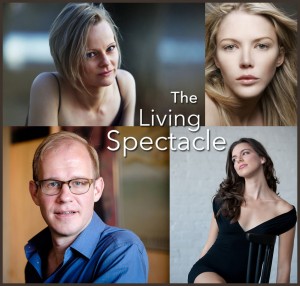
Thorpe wears several hats, not just as writer, but also performer & co-director. Speaking of resurrection & rebirth, to me it’s as though Thorpe has brought this story back from the dead. If for no other reason than to struggle with the meaty ideas in this story, you owe it to yourself to see HERETIC¸ playing at Theatre Passe Muraille’s backspace until November 22nd.

Posted in Dance, theatre & musicals, Spirituality & Religion | Tagged , , | 1 Comment

Mahler’s decade

Michael Sanderling led the Toronto Symphony in a program of works from the first decade of the twentieth century featuring soprano Simone Osborne. We heard a diverse assortment of musical styles represented even though the works have a few things in common. Let’s set aside Mahler’s 4th Symphony from the second half of the program.

We began with

  • “The Dance of the Seven Veils” from Salome by Richard Strauss
  • The Song to the moon from Rusalka by Antonin Dvorak
  • “Depuis le jour” from Louise by Gustave Charpentier
  • The Vilja song from The Merry Widow by Franz Lehar

We heard a seductive dance, a song dreaming of love, “Depuis le jour” (a young girl reflects on her first days in love) and the Vilja song (a sentimental old song concerning love of a spirit of the woods).

Sanderling led a comparatively restrained reading of Salome’s dance, one clearly articulating every sound for the first half of the composition, but gradually building up the pace as though discovering greater levels of passion.

The three vocal pieces (the Lehar piece being an encore) make a nice set. Where the song in Rusalka seems to represent an impossible dream, the Charpentier is a reflection upon the recent achievement of that dream in a young woman’s life, while the Lehar is a sentimental tune meant to look back, as though it were an old folk-song. I found that the orchestral tempo Sanderling gave the Dvorak kept a bit of a lid on its passion, perhaps making Osborne’s reading more polite than it might otherwise have been. Similarly the Charpentier is often done at a moderate tempo. making it more reflective and thoughtful, and as a result perhaps more chaste than what the composer had in mind. In the third item, Osborne fully relaxed into the song, entering fully into the spirit of the song.

After intermission, Sanderling led a fascinating reading of Mahler’s 4th. This is a work that is best illuminated by a conductor willing to make the necessary tempo changes, a piece showing us scenes from childhood, sometimes with wild energy, sometimes with nostalgia and schmaltziness: and Sanderling didn’t disappoint. The TSO responded wonderfully to Sanderling’s choices, opening the first movement gently, building to several break-neck tempi in the first movement, sometimes displaying a playful energy then just as suddenly putting on the brakes. We were treated to several exquisite solos, especially concert-master Jonathan Crow and several of the wind players. The long & dramatic third movement can be done with greater restraint and subtlety than this, which I believe makes the drama ultimately that much more powerful so long as one doesn’t mind making the movement longer; but Sanderling was emphasizing contrasts, bringing forth climaxes from key voices, and making the piece very articulate, very transparent. When we got to the loud climax in the third movement, often spoken of as though the composer is flinging open the gates of heaven, we saw a wonderfully theatrical gesture, as at this moment the stage door opened for Osborne’s solemn entrance, for the final movement.

This is a very different sort of singing from what we experienced in the first half of the program, as the voice must be unforced, gentle, to match the angelic text. Osborne’s charming expression seems ideal for the innocence of the piece, her voice gently floating over the orchestra.  Overall Sanderling and the TSO achieved a spectacular rapport.

The program will be repeated Saturday Nov 14th at 8:00 pm.

Posted in Music and musicology, Reviews | Tagged , , | 1 Comment

CASP: The Living Spectacle

(The) Canadian Art Song Project aim to explore the art song in all its manifestations.  Tonight CASP took a bold new step in the first in a new series of recitals.  “The Living Spectacle”, the first work on tonight’s program, gave its name to the evening, a series of four different works presented by a pianist, two singers and a dancer.  CASP

Pianist Steven Philcox –co-artistic director of CASP along with tenor Lawrence Wiliford—played the entire evening both sitting at and reaching into the piano.  Sopranos Ambur Braid and Carla Huhtanen each sang two cycles, an intense night of singing for both.  And Jennifer Nichols, who is founder of the Extension Room, the site of tonight’s performances, choreographed and danced in the last cycle.

In conversation afterwards, Wiliford explained some of CASP’s ambitions, which were perfectly demonstrated by an evening going far beyond the usual singer + piano.  Wiliford was very humble about defining the art song, suggesting that an evening like this one could potentially enlarge the boundaries of what’s possible, but that the definitions & possibilities are open to revision, and changeable from one year to the next.

I feel a bit promiscuous, on a night when four different works seduced me: at least until the next one came along to turn my head anew…

The Living Spectacle received its world premiere tonight, Erik Ross’ setting three Roy Campbell translations (or should I call them paraphrases?) from Baudelaire.   While I don’t know how Ross works, the composition seemed to be built from the wonderful accompaniment (which isn’t necessarily a bad thing, given that for example Wagner supposedly wrote vocal lines after having sketched the orchestral passages), with the vocals almost like icing on the cake.  Each of the three was totally different in mood and with a distinct style, corresponding to three very different texts.  In at least one I felt the piano was making something that could be described as pattern music, which makes a lot of sense when we remember that Debussy and Satie were arguably the two godfathers of minimalism, although Ross’s pianism was much richer & more beautiful than my description would suggest.  Braid opted for a very dramatic approach to the singing, in a series of very clearly conceived portrayals.

And the next set by Carla Huhtanen took us into a classical realm, both in the first CASP performance that I can recall of a touchstone of vocal repertoire –Richard Strauss—and in the dramatization of a figure from Shakespeare, namely Ophelia in the Drei Ophelia Lieder (1918).  As she was entering Huhtanen delivered a couple of lines of Shakespeare in English to frame the songs.  It seemed particularly apt after seeing Hamlet just a couple of days ago in a production raising the question of the ages of both Hamlet & Ophelia, to be watching these songs that could be sung by an Ophelia of any age.  She seems eternally frozen in that bewildered and broken place poised on the edge of the river before jumping in, a place and a perspective that’s truly ageless.  Huhtanen is one of the regulars with Tapestry, a singer with a gift for singing with great precision that never seems artificial or overly controlled; and when you hear some of the scores she sings, you’d realize what an amazing gift that is.  In the Strauss, with its quirky enharmonics and occasionally funny intervals, she always made it sound natural, even when also sounding mad.  She had the guilelessness of a crazy child, heartbreakingly cute even though she’s a trainwreck.  Philcox had this insane night at the piano but especially in the Strauss, who can be a total killer, remaining playful and delicate throughout.

I’ve described the first two big pieces as though infatuated, and yet each of the next two were better.  Imagine a program with the balls to put the best at the end this way, and you have some idea of what we saw & heard.  But maybe i should say “ovaries” rather than “balls” considering that the works could be said to embody feminist principles, particularly the last two items.

The third item on the program, coming before intermission, was Libby Larsen’s Try Me, Good King.  The idea is so juicy, I’m embarrassed that I’ve never encountered this piece before: because it’s so good.  Subtitled “Last words of the wives of Henry VIII”, each of the five comes from text written by, in succession, Katherine of Aragon, Anne Boleyn (whose song indeed cries out “Try Me” over and over), Jane Seymour, Anne of Cleves and Katherine Howard.  Before we heard the songs, though, Braid came back to the stage carrying a drink to address us off the cuff before the songs.  Is there a smarter singer in this city?  Yes we’ve noticed how attractive she is, how effortless her high coloratura, but let me repeat, I think she’s very intelligent.  For a few minutes she stood before us riffing on the wives of Henry the VIIIth almost like a stand-up comic, giving us the background while enacting a kind of distancing Brecht would have loved.  I couldn’t help thinking –as I watched five distinct impersonations, one per song—that at least one motivating reason was that Braid was seeking a bit of distance for fear of becoming too emotional. Even as it was, I was in tears in several places, overwhelmed by the intensity of these songs and her portrayals.  I wonder if Larsen has ever heard them done this way, so flamboyantly, yet so distinctly?  I would think she’d be blown away, as were we come to think of it.  Almost incidentally, there was a high C-sharp, among singing and characterization in a different style for each wife.

After intermission CASP revived a work commissioned in 2011, namely Sewing the Earthworm with text by David James Brock, set by Brian Harman.  I am reproducing text from the Canadian Music Centre to describe this work, originally premiered by Huhtanen & Philcox back in 2012 in a concert at the Richard Bradshaw Amphitheatre

The character in Sewing the Earthworm is inspired by 1970s punk rock icon Wendy O. Williams. The work dramatizes a private frustration as she looks back on a fragmented life, from the radical punk aesthetic to champion of environmental issues, before her suicide in 1998. This character relates to many other iconic artists: Frida Kahlo, Anaïs Nin and Elizabeth Bishop, for example. Because of these artists’ outspokenness, we find their human weaknesses even more intriguing.The setting for the piece is inspired by an anecdote about Albert Einstein: he loved to garden, but couldn’t bear the accidental killing of creatures living in the ground. Sewing the Earthworm begins with a lonely woman contemplating her garden as a haven for both herself and the many forms of life she tends to within it.The language of Sewing the Earthworm is that of myth, poetry, and spectacle. A physically deteriorating woman remains thankful that her hands can still control larger clumps of dirt in the maintenance of her private garden. She remembers her former abilities, especially with finer manual endeavours, and laments that her mind has remained long enough to know her body’s condition. When she accidentally cuts an earthworm in half while gardening, she decides to attach the pieces with needle and thread to save its life. The seemingly futile attempt is compounded by her desire to prove that physical control has not abandoned her, and the piece makes a rapid shift both musically and textually as a mental struggle takes over.

Clearly Huhtanen has had additional thoughts about the work, as the 2015 presentation is the most involved piece of theatre yet created by CASP (and I say this after chatting with the composer & librettist, who credit her with the key ideas in the presentation).  Joined onstage by dancer Jennifer Nichols, Huhtanen & Nichols are dressed so alike that one might think that they are aspects of the same person.  Huhtanen sings, Nichols dances, although Huhtanen did a bit of dance as well.   Both Philcox and Nichols reach into the piano (I’m not sure if Nichols only mimed or genuinely strummed any strings inside the instrument, as Philcox did).  Huhtanen empties a wheel-barrow of peat moss onto a portion of the performance space, in front of the mirrored surfaces (the Extension Room is a dance studio, which makes it perfectly natural to have mirrors behind the performance).  The dancer & singer both reach into the peat moss, whose gentle aroma permeates the space.  I was reminded of some of Pina Bausch’s works, whereby the organic materials gently perfume the air, creating an effect of great sensuousness.  Watching the two blonde women –virtually twins in their black outfits—probing into the soft living material while Huhtanen sings about earthworms was highly suggestive.  We’re in the presence of some wonderfully ambiguous dualities, that the earth is rich with life but the place where we put our bodies when they die, that the earth teems with little worms, even as those same worms might infest or devour our remains if we were buried there.  At one point Huhtanen has her hands into the dark peat moss while Nichols has her hands into the big dark open piano.

(l-r) David James Brock, Erik Ross, Brian Harman, Steven Philcox, Jennifer Nichols, Ambur Braid and Carla Huhtanen

(l-r) David James Brock, Erik Ross, Brian Harman, Steven Philcox, Jennifer Nichols, Ambur Braid and Carla Huhtanen

And I couldn’t help noticing that while the performers are so young in this performance that hints at death and decay, most of us in the audience were much older, much closer to the death to which they gently allude.

CASP will be back in February, in a program titled “The Pilgrim Soul” featuring Phillip Addis and pianist Emily Hamper performing songs by Canadians Chester Duncan, Larysa Kuzmenko (In Search of Eldorado) and Imant Raminsh (The Pilgrim Soul) as well as works by Gustav Mahler (Songs of a Wayfarer) and Dominick Argento (The Andrée Expedition), at the Enoch Turner Schoolhouse.

Posted in Music and musicology, Reviews | 4 Comments

Mr Turner: painter, paintings, movie

There is a scene in the first half hour of Mike Leigh’s recent film Mr Turner, juxtaposing the creative ambitions of amateurs and professionals. We see Timothy Spall as Turner, greeting a noble on his estate. Another person –likely another artist—hangs back, waiting for the right moment, as Turner and the noble discuss the relative merits of horse and ox pulling a plow or made into dinner. When he sees his moment to jump into the conversation, he wishes him a good evening before asking “are we not blessed… by the heavens… to witness …so glorious… a crepuscular time of day”? Having seized the moment and mangled it so thoroughly, he steps out of the spotlight, as the noble quietly pronounces “imbecile” to Turner, and they enter a large room, to examine the way several of Turner’s paintings are displayed.

Throughout the conversation, an amateur (likely a member of the noble household) is playing Beethoven on the piano, apparently just having learnt the slow movement of the Pathetique Sonata, stopping & starting with mistakes and changes of pace. Turner approaches this handsome woman and in due course, when they discover a mutual appreciation for Purcell, she plays Dido’s Lament. Turner attempts to sing the tune as only ardent fans nowadays sing Turner Swift or Lady Gaga, getting some of the words wrong while fondly chasing the tune. She follows him as he is carried away with the emotion. At the end, he sadly pronounces it “a song of lost love”, and thanks her.

I can’t get this scene out of my head, a litmus test for the accuracy of Mr Turner, and one of the high-points in a film that’s possibly the most authentic representation of 19th century cultural life I’ve ever seen captured in cinema. Coincidentally the qualities of light captured on the screen are unlike anything I’ve ever seen in a film, but reminiscent of the light passing through the clean air in the few places I’ve been where the atmosphere isn’t befouled, such as St John’s Newfoundland or Reykjavik Iceland. The yellow light there is qualitatively different and we see it in this film, which seems to be at pains to help us see as Turner saw, or indeed, as humans saw almost two hundred years ago.

You might know Leigh for his 1999 film Topsy-Turvy, exploring the lives of Gilbert & Sullivan, a film that also employed Spall, albeit in a smaller role. This time Leigh leans heavily upon Spall, who is onscreen for most of the 144 minutes.

We picked up the DVD in the AGO’s store after seeing Painting Set Free, the exhibit of Turner paintings that recently opened here in Toronto. I would strongly recommend seeing the film if you don’t know the painter or his art. While I thought I knew the painter, I had no idea of the man and his extraordinary life.

The film includes a couple of set-pieces built around some of his most famous paintings, that one should perhaps take with a grain of salt:

  • as Turner and friends observe a Napoleonic era battleship being towed away by an ugly steam-powered tug against the most perfect sunset, we see “The Fighting Temeraire” in Leigh’s perfect recreation moments before the inspiration hits the painter, so perfect that it’s in the trailer like an irresistible lure (roughly 40 seconds in)
  • the evils of slavery come up in conversation, as Turner absorbs the conversation and in due course paints that horrific painting of the slave-ship with a tempest approaching, as they throw the sick overboard.
  • Turner watches a steam locomotive, and shortly we see the images replicated into his fantasy “Rain Steam & Speed”

Surely that’s not how it happened –that these images existed in an objective way, especially as shown in the first and third of the examples, and were merely reproduced by an artist who saw them directly before him—but rather it was Turner’s art that created these compositions, in his mind and in the play of materials on the canvas. But I won’t accuse Leigh of being reductive as this is perhaps a bit of whimsy from the film-maker, and delicious to watch.

As with Topsy-turvy, the film takes its time and has no apparent interest in being commercial or cutting corners, which only enhances the sense of truthfulness. We see a painter, we see him painting, and we see him dealing with a public often unable to understand his work, without a clue as to what he was aiming for. But he’s not an ideological rebel or a deliberate revolutionary. I will continue to watch this film, enjoying the way that it offers a new window on JMW Turner.

Posted in Art, Architecture & Design, Cinema, video & DVDs, Opera, Reviews | Tagged , , , , , | Leave a comment

Sondra Radvanovsky in recital Dec 4th

“INHERITOR TO CALLAS”: FROM MET TRIUMPH
TO KOERNER HALL!
SOPRANO SONDRA RADVANOVSKY IN RECITAL

A SHOW ONE PRESENTATION, FRIDAY, DECEMBER 4

“Stupendous”… “flawless…technical command”… a true inheritor to the Callas approach” – New York Times

WITH ANTHONY MANOLI, PIANO

The stunning voice and captivating stage presence of Sondra Radvanovsky come to Toronto’s Koerner Hall when Svetlana Dvoretsky/Show One Productions presents the internationally acclaimed Metropolitan Opera soprano in a rare and intimate recital performance for her hometown audience, Friday, December 4, 8 p.m.  Information is at http://www.showoneproductions.ca.

At the piano will be her longtime collaborator Anthony Manoli, a sought-after recitalist with prominent singers and highly regarded coach.

In an eclectic program sung in five languages, Radvanovsky lends her rich vibrato and expressive timbre to sumptuous operatic arias by Vivaldi, Giordano and Dvorak and the intimate art songs of Bellini, Liszt, Richard Strauss and Samuel Barber.

Tickets, $55-$125, are available by calling 416-408-0208; or visiting the Koerner Hall box office, 273 Bloor Street W., or online at http://www.rcmusic.ca (or directly at https://tickets.rcmusic.ca/public/hall.asp?event=1552).

It was Svetlana Dvoretsky/Show One Productions who introduced Radvanovsky to Toronto audiences in her Canadian debut, in 2010.  She joined baritone Dmitri Hvorostovsky in operatic arias and duets by Verdi and other composers under the baton of Constantine Orbelian. December 4 marks Radvanovsky’s second appearance under the Show One banner.  (Show One will present Hvorostovsky in recital on February 21, 2016, 7 p.m., also at Koerner Hall.)

SONDRA RADVANOVSKY (www.sondraradvanovsky.com)
“Stupendous”… “flawless…technical command”… a true inheritor to the Callas approach” – the New York Times’ Anthony Tommasini’s assessments were just some of the superlatives showered on Sondra Radvanovsky in her Metropolitan Opera debut as Anna Bolena in September.  It was the first of Donizetti’s three Tudor queens she will portray at the Met this season – a feat accomplished by only a few, legendary sopranos.

Based in the Toronto area, Sondra Radvanovsky is adored by fans and critics around the world for the sincerity and intensity of her performances.

The exquisite depth and color of her voice are matched by her artistry and versatility across a remarkable range of repertoire, and she is one of the world’s leading interpreters of both the Verdi heroines and the bel canto roles of Bellini and Donizetti.  Besides her regular Metropolitan Opera appearances, she has performed in most of the world’s leading opera houses – among them the Royal Opera House, Paris Opera and Teatro alla Scala. On the concert stage, she has appeared internationally with such renowned conductors as James Levine, David Zinman, James Conlon and Zubin Mehta.

ANTHONY V. MANOLI
Pianist and Coach Anthony V. Manoli has worked with some of the world’s leading opera companies and conductors.  As a sought after collaborator, he has worked with Dame Kiri Te Kanawa, Mirella Freni, Jose Carreras, Rockwell Blake and Edita Gruberova, among other singers, appearing frequently in recitals around the planet.  Manoli coaches for the Young Artists Programs at the Washington Opera and the Los Angeles Opera.  He is also a faculty member of the Mannes College of Music in New York City, where he lives and maintains an active coaching studio.

SHOW ONE PRODUCTIONS PRESENTS
Soprano Sondra Radvanovsky in Recital
With Anthony Manoli, piano
Friday, December 4, 2015, 8 p.m. at Koerner Hall
PROGRAM:
Antonio Vivaldi: Sposa son disprezzata, from Bajazet
Vincenzo Bellini: Three songs (Per pieta, bell’idol moi; La Ricordanza; Ma rendi pur contento)
Richard Strauss: Four songs (Allerseelen, Befreit, Morgen, Heimliche Aufforderung)
Antonin Dvořák: Song to the Moon, from Rusalka
Franz Liszt: Three songs (S’il est un charmant gazon; Enfant, si j’étais roi; Oh! Quand je dors)
Samuel Barber: Selections from Hermit Songs (At Saint Patrick’s Purgatory, St. Ita’s Vision, The Crucifixion, The Monk and His Cat, The Desire for Hermitage)
Umberto Giordano: La Mamma Morta, from Andrea Chénier

 “Press releases and announcements” are presented verbatim without comment

Posted in Press Releases and Announcements | Leave a comment

13 ways of looking at Pyramus and Thisbe

  1. If a scientist could slice up love and loss into small specimens and put them onto slides and put them under a microscope it would resemble what we saw at the Four Seasons Centre tonight and in earlier performances from the Canadian Opera Company, of this piece called Pyramus and Thisbe, including two short works by Monteverdi and one by Barbara Monk Feldman.
  2. Christopher Small in his home near Barcelona in 2002. Credit Michele Curel (click for NYTimes obit)

    Opera is often meant to show off the skills of the performers: but not always. Christopher Small, decrying the reification of music, said “performance does not exist in order to present musical works, but rather, musical works exist in order to give performers something to perform”.   In the heyday of the virtuoso the singer could dispose of the new aria offered by the composer, and instead pull their favourite piece out of their suitcase instead.   Yet the periods before and after that had no use for the virtuoso.  BEFORE in Monteverdi’s time –when we begin the COC presentation of Pyramus and Thisbe—the composers still adhered to the dream of the Florentine Camerata, to revive the tragic practices of Ancient Greece, dreaming up a second practice that was more intelligible than the churchy counterpoint that came before. AFTER in Debussy’s time—before Barbara Monk Feldman’s opera but in a century bursting free from the tyranny of the virtuoso—singers again served the text as virtuously as they had in Monteverdi’s time. Yes we’re in a reified place, not unlike that mental space where one would propose to submit 13 ways of looking at something.

  3. The libretto in Monteverdi’s time was the focus, the music being a means to a dramatic end. To that end it must be understood.  Are we past that now? Surtitles aren’t really the point, if one is alluding, speaking indirectly in one’s selection of text.  The words in Pyramus and Thisbe­ are from a variety of sources according to the program.  There are words in English and German, quotes from Jaspers & Rilke alongside Faulkner and others.  Am I a conservative bourgeois in wishing to see the libretto, to read it and to be able to go back to the sources?  I know that if I were in a gallery peering at paintings –which seems relevant in a work with such an echo of visual art—I might have all too little to go on, in making a smidgen of meaning.   I do recall that back in 1981 I was privileged to be invited to the North American premiere of Satyagraha at Artpark, Lewiston NY, after having written an interview of Philip Glass.  I was given a score of the opera to peruse.  I can’t help thinking that when we’re exploring something new, we’re more inclined to be sympathetic to what we can understand.  Sympathetic understanding is more remote when the learning curve is too steep.  I recall the radical move of the COC to invite some of us backstage to see their production of Semele up close (even if one of us went & got all star-struck talking to Jane & Allyson, blush….), whereby it became more comprehensible.  That worked for me at least.
  4. The use of these disparate sources, without attribution and without making the text available? At least frustrating. At worst, pretentious name-dropping.
  5. Death lurks throughout this work, but then again that’s what we see with Pyramus and Thisbe, that’s how it is for Tancredi & Clorinda. If we were to reduce our lives to a single plot arc, it might be birth –intimacy—death, where the intimacy is signified by touching. Director Christopher Alden clearly gets this, and clearly signifies this.
  6. I’ve now seen this opera twice, and don’t really think I want to call it an opera. One can make theatre out of musical sources that aren’t opera, for example Against the Grain Theatre company regularly do so using song cycles and oratorios their Messiah is coming up soon.  If I call Pyramus and Thisbe an opera, can I call Die Schöne Mullerin or Harawi operas?  Do we call Messiah or Mozart’s Requiem  operas, when they’re given an operatic treatment?  Ballet companies take a symphony and make it into a dance work but that doesn’t actually change the symphony into something else, tempting as it is to now see it as a text for another medium.

    Director Matthew Jocelyn and Composer Phillipe Boesmans (photo: ©Isabelle Françaix)

    Director Matthew Jocelyn and Composer Phillipe Boesmans (photo: ©Isabelle Françaix). Boesmans’ JULIE has its North American premiere later this month.

  7. I’m thinking a lot about composition. I’ll be seeing Phillipe Boesmans’ Julie very soon in a co-production from Canadian Stage & Soundstreams.  Adam Scime’s L’homme et le Ciel will be presented in early December by Fawn Opera.
    Sirett & soprano Larissa Koniuk, L'Homme et l'Ange qui a venu du Ciel

    Geoffrey Sirett & soprano Larissa Koniuk, L’Homme et l’Ange qui a venu du Ciel

    I was thrilled to participate in the recent premiere of David Warrack’s Abraham at Metropolitan United Church (an oratorio).  There are lots more that I haven’t mentioned.  At the same time, I’ve tried it myself.  I wrote a piece presented at the University of Toronto back in 2000 called Silence is Golden that was a kind of celebration of some of the stories my mother told me.  I did an adaptation of Venus in Furs in 1999 that is still really the trunk of a longer version of the work, if I ever get back to it, to finish it.  So much time has gone by…(!)  So, while I am in awe –that so much time has passed, that people manage to do so much and be so productive– I am not going to be critical that a work that is not an opera was presented on the COC’s stage.

  8. Louis Riel was premiered almost half a century ago, as was The Luck of Ginger Coffey. We are told we’ll be seeing Riel again on the COC stage, and that leads me to wonder about casting.  Who will play Riel? A baritone who can act, I should think.  Is it right for Russell Braun, or is he more apt for John A Macdonald, (another baritone role)?  While my friends are more likely to bet on who might win the Superbowl or the Stanley Cup, I think it’s fun turning the casting into a matter for a wager.  I am betting that they get Riel on stage and that it’s a huge success.  Will they get Kristina Szabo to portray Riel’s wife, the part played by Roxolana Roslak including the text in Cree (or is it Ojibwa?)? She is the designated power-lifter for the COC & AtG (i will never get her ““Doundou Tchil” out of my head, the most ferociously sexy thing i have ever seen in an “opera”…notice i put the word in QUOTES!).
  9. Love can be terribly arbitrary. One minute you’re sailing away with Theseus, the next minute you’ve been abandoned on an island, lamenting your fate. Art too is arbitrary. One century, people like Franco Corelli or Jon Vickers sing “Lasciatemi morire”, the next, we get all fundamentalist and insist it only be sung by a woman.
  10. The act of touching magically bridges the gap between discreet objects & beings. We seem to be all alone, isolated, alone.  Sometimes we make contact, and in that moment there is another possibility.  The poetry of loneliness is in the dream of contact.
  11. Surtitles are so helpful, whether we’re hearing a foreign language or our own. And when no one onstage is moving, there’s always the title to read.  I wish David Warrack’s piece Abraham had been presented with surtitles, a work that was wonderfully well-received (and i don’t think i am biased…. i heard the loud applause).
  12. The deeper we got into the piece, the more people and the less actual life. We are examining specimens, discreet snapshots or toe-clippings of romance. We begin with passion, Ariadne alone.  We have more passion with Tancredi & Clorinda.  But once we’re talking about Pyramus & Thisbe, that’s just it, we are in meta-territory.  We observe, we contemplate, and the singing is removed from the realm of real romance.  Yes they die.  But for the entire piece we are examining death as though we were that detective onstage.  It is forensic opera.
  13. Performances happen in this reified realm. Krisztina Szabo, Philip Addis, Owen McCausland each move and sing.  The deeper we get into the realm of pure thingified thought, the more I stared at Johannes Debus, his gestures conducting the orchestra, the last vestige of genuine life on the stage.  He was worth the cheers.
Posted in Art, Architecture & Design, Music and musicology, Opera, Personal ruminations & essays | 1 Comment