Last summer I mentioned the Pride-themed display & sale at Bay St Video, when, in addition to HBO’s Behind The Candelabra (2013), the Michael Douglas / Matt Damon vehicle about Liberace, I picked up Another Country (1984).
I’d been captured by the familiar baby faces on the cover (NB not the same as the image currently selling the film on Amazon, which only features one of the stars, not the three on the cover at Bay St Video)
Rupert Everett
Colin Firth
Cary Elwes
Now please note, Another Country dates from 1984, when –if the dates in the IMDB bios are correct—Everett was 25, Firth 24 and Cary Elwes just 22, five years before we saw him in The Princess Bride.
Tonght I finally pulled the DVD off my shelf to give it a look. My purchase decision was entirely superficial, namely the assumption that I’d see some famous actors early in their careers, and indeed Another Country gives us Firth & Everett & Elwes before they’d become the personalities we know. Firth’s voice is already highly recognizable, able to grab you right away. Elwes, the youngest of the three, is more or less who he is in many of his roles.
Everett? In fact this is who Everett has always been, the actor who has been out about his sexuality for a very long time. Another Country is Julian Mitchell’s adaptation of his play that had starred Everett in 1981, bringing him to prominence in his portrayal of Guy Bennett, based on Guy Burgess, a real-life British spy. We’re flashing back from the present day, as we see the childhood of the spy in a private school in England back in the 1930s. This is not to be mistaken for period romance, a portrayal of the worst things you’ve heard about English private schools of the time. Firth’s character is a marxist with whom Guy (Everett) has a great deal in common: in their alienation from the brutal conformity imposed at the school.
It may be election time, but it isn’t a time of vision as far as I can see. The two big contenders to replace Harper –the Liberals & NDP—are offering a few key policy choices on child-care, marijuana, restoring the CBC, pharmacare, bill C51. I suppose that when so much of the conversation is about the damage done by the Conservatives, that their decade of disaster defines the discourse. Yes we need the census, we need the CBC, we need to restore Parliament instead of circumventing it with omnibus bills and the PMO all-powerful.
But what if we really stopped for a moment to think about what they could and should offer the electorate?
Stop the election, or at least put it on pause for a moment.
Let’s dream big for a moment. I’m off work today (food-poisoning), recovering, grateful that my stomach doesn’t hurt so much. So i am taking a moment to reflect on the meaning of life, to pause and inhale and imagine.
First and foremost, I think our system isn’t just flawed, isn’t just broken, it’s bullshit. The problem? It is too expensive to run. As a result we have multi-million dollar campaigns. We have millionaire Prime Ministers. Should people get rich leading the country? Maybe that attracts the best people. Or maybe it attracts people for the wrong reasons. What if the office of PM didn’t pay any more than other bureaucrat jobs? What if spending were restricted?
What if all communication were vetted and controlled by the CBC? Imagine if you could log in anytime to see online debates stored, position papers where key questions were directed to the various candidates, who were properly cornered and recorded answering or evading in full public view?
And what if you or I could run for office? Maybe I have nothing to offer, but then again, should it depend on whether I have millions of dollars in my pocket or have been recruited by big businesses to represent them in Ottawa? Lobbying should be illegal. The “conversation” as it goes now is mostly driven by the candidates and large interests, not really a conversation but a monologue. Nobody listens to us. Imagine something like CBC’s “Cross-Country Checkup”, where candidates are perennially asked questions from the electorate, where the conversation truly IS a conversation. No hiding from the electorate (I’m talking to you Stephen Harper).
Okay so we have imagined a very different process. What about policies, what the government offers.
I like pharmacare for starters, as the NDP have proposed. Medicare needs to be shored up and protected, bolstered by this other arm, as well as Denticare. Please don’t tell me we can’t afford it. You get what you pay for always. Toronto (speaking of municipal politics for a moment) is like a Walmart, showing you what you get when you keep playing the game of cheap cheap cheap. A series of Mayors won on a promise of zero tax increase, going back decades. Is it any wonder that our infrastructure is aging, every winter a series of broken water mains tie up traffic, every summer the roads closed for patching up? Taxes are a necessity, and I think the Liberal approach –tax the rich—makes more sense than the NDP choice to tax the corporations, who simply pass it on to us in higher prices or simply leave the country altogether. There are other tools to use for revenue.
The conversation around defense has been knee-jerk, driven by sentiments that are poisonous. Yes we love our soldiers especially when they make the ultimate sacrifice. But do we send them into harm’s way based on posturing, based on pressure from other countries? Our strategy needs to begin with an idea of what Canada is all about. Buying more fighters –whether we want the F35 or something else—puts us into the foreign adventure conversation: a role out of step with who Canada really is. Unless we increase our military spending hugely (recalling that at the end of WW II we had a huge navy and air force), we will never have the army to fight foreign wars. We have been non-aligned peacekeepers for most of the past half-century, taking on a new more belligerent role under Harper. While he also speaks of defending our Arctic –a phrase that must make Putin cough up his borscht with laughter—we simply don’t have the equipment or the personnel. Trudeau is right to propose shifting our emphasis from jets to ship-building, especially given our real priorities. But before we talk about these things, we need a conversation about the Canada we imagine, its role in accepting refugees and helping build a better world, not just as allies in bombing campaigns that only serve to create new orphans, the next generation of recruits for world terror.
The big topic missing from the conversation concerns poverty and income disparity. It’s a complex topic that has the added hazard that there are no votes in it. Generally homeless people can’t or won’t vote, while the rich might oppose policies designed to make the rich pay (the boldfaced phrase is from Communist Party of Canada literature back in the 1970s).
Let me suggest something very simple via analogy.
Profiteering is understood to be immoral and illegal. During the big blackout of 2003, some gas stations raised their prices to capitalize on the desperation of customers: and were punished for it.
How is that any different from owning more than one house at a time that people are living in the street? I would be willing to meet them halfway. Yes it will be legal to own multiple properties (to propose anything else would get me killed but nevermind my own butt). But until such time as everyone has a place to live (and I don’t mean shelters), those second and third homes should be taxed heavily. Perhaps even punitively. Making huge amounts of money while people are forced to live on the street? some think that’s just Darwin at work, some people are smarter than others and deserve their reward. But the reality is that the game isn’t fair and never was.
We are seeing the hollowing out of the downtown, as the statistics on the use of foodbanks –a de facto measure if ever there were one—drops downtown while swelling massively in the suburbs. This isn’t good for the downtown, but (as nobody says much about this) it’s horrific for the poor, who now have to get their groceries in regions totally built for cars rather than transit.
I dream of mass transit that’s cheap or even free in all our cities. The expenditure will pay off.
I dream of free tuition for universities & colleges, just as they have in Europe. I am not sure this would pay off, just an intuition. But huge student debt seems hugely immoral.
Sustainability is nowhere in our conversation. I dream of clean lakes and air and water that is drinkable, fearing that the planet is being destroyed all too quickly. But this conversation is international and one that may lead to conflict. So be it.
I dream of arts funding that recognizes the value of artists and their creations, not just as creators of wealth (which is significant! arts funding dollars are huge drivers in making cities attractive and livable) but art as the essence of a good life. Imagine people wanting to come to Toronto from Italy or Germany to see our art. It’s a funny thought, isn’t it: precisely because we see the profound value of their culture. Imagine if we did that here. It might take 200 years, but why not start now?
But that’s just what I dream of. Imagine a process that allows a real conversation, that isn’t stifled by rich white men who don’t want to hear you or me. Dare to dream.
I saw precisely one film at tiff this year, a movie conceived when I was a toddler. While you might know it as “Alfred Hitchcock’s Vertigo”, I would be more inclined to call it “Bernard Herrmann’s Vertigo”, especially when given the chance (as I was today), to hear Herrmann’s score played live by The Toronto Symphony from the stage of Roy Thomson Hall in accompaniment to the 1958 film.
This old film might be the beginning of something new. The TSO will be offering more live performances of film-scores in accompaniment of beloved old films. Back to the Future with score by Alan Silvestri will be screened Oct 16 & 17, then Psycho –Hitch & Herrmann again—will be the TSO’s Halloween-night offering.
It’s a totally different perspective even if you’re not a film-music buff. Watching Conductor Constantine Kitsopoulos, you couldn’t help noticing the way the film music works, cued by something in the film. I wondered if they would manage to synchronize with the film. Oh yes!
Sometimes it was so subtle as to be barely noticeable, other times the swelling score almost drowned out the dialogue. The music heard by the characters on the screen in the film (for instance, the Mozart record on Scotty’s pal Midge’s record player when she visits him in his psych ward) was left as before. If you could only watch one film done this way, Vertigo would be the one, an amazing collaboration between Hitchcock and Herrmann. There are big sequences that make no sense without a gifted composer. Without Herrrmann? A good film but not nearly the great masterpiece we saw today.
Although Roy Thomson Hall wasn’t completely full, the audience raised the roof a couple of times. There was a loud welcome for Kim Novak who said hello before and did a brief Q & A after. But the biggest applause was at the end of the film, a huge powerful ovation. I have to think many of these people will be back for the October screenings. I know I will.
We were reminded by tiff CEO Piers Handling that the British Film Institute had installed Vertigo in place of Citizen Kane as the new best film of all time in their 2012 poll. What he didn’t mention is the rather curious thing those two films have in common. Kane and Vertigo may not be similar, but they both have scores by Herrmann, a composer who has four of the BFI top 50. Taxi Driver (his last film) tied for #31 and Psycho (not long after Vertigo) tied for #35.
I hope the TSO gets a big response for their upcoming films and makes this a regular feature. The real classics of the past century are the film scores by Rozsa, Korngold, Steiner, Elfman, Herrmann, Williams, and Bernstein, to name just a few. I can’t help noticing that the last popular opera (Puccini’s Turandot premiered in 1926) appeared just before the advent of talkies (The Jazz Singer premiered in 1927). If we look simply at popularity, we can notice that for example
Herrmann wrote one unsuccessful opera (Wuthering Heights) and a huge body of work in cinema (not just the 4 films mentioned in the BFI top 50, but several more wonderful films)
Erich Korngold had success in both media, but is known both for his operas and his films
Philip Glass has had success in both media
It may take awhile for the word to get out on this amazing way to see film & hear music. What I experienced today was something thrilling, a new perspective on a favourite film. Psycho is another favourite that I’m eager to see done with a live orchestral performance. I could name a dozen films the TSO could undertake, beginning with such extraordinary scores as Star Wars and Jaws by John Williams, Beetlejuice and Batman by Danny Elfman (who did a Halloween concert with Hollywood Symphony Orchestra back in 2013 celebrating his collaborations with Tim Burton)…
click for some of the answers
…or Magnificent Seven and The Ten Commandments by Elmer Bernstein.
If tonight’s Tafelmusik concert at Jeanne Lamon Hall (Trinity –St Paul’s Centre), with Mireille Lebel mezzo-soprano, and led by violinist Rodolfo Richter is any indication, I think we’ll see a lot more of him in future concerts.
Richter doesn’t just play brilliantly. We heard his reading at breakneck speed of his transcription of Bach’s Harpsichord Concerto (identified as a “reconstruction” on the fascinating premise that the work was conceived by Bach for violin before it was composed for the keyboard): wonderfully apt for a concert titled “The Human Passions”.
And to begin he offered up a preamble that is the basis for my bizarre headline, as the entire concert could be understood as a kind of experiment. If I understood correctly, this was his concept, his baby that was being explored. Richter said –and here I paraphrase very loosely—that baroque composers express passion for soloists, whether they’re instrumental or vocal, with the baroque big three — Handel, Bach & Vivaldi–all on the program. One of the implications of this might be that the human voice is just another instrument, which is perhaps true. It is only in more recent times that composers exploited the natural dynamics of singers (the tendency for the voice to get louder as it goes up) rather than repressing such tendencies.
To phrase this more bluntly –and without Richter’s delicacy—we’d be asking a forbidden question, at least as much of a forbidden question as could be posed in a concert. But dare we juxtapose instrumental and vocal solos, to compare the way they work and even to ask which is more powerful, which is really the ideal way to convey passion? I had a professor long ago who proposed that all art could be understood as hypothetical, so that in her eyes performance was by definition a kind of research. It is in that spirit that I look at tonight’s concert, as an extraordinary exploration. My response is perhaps suspect as an opera fan.
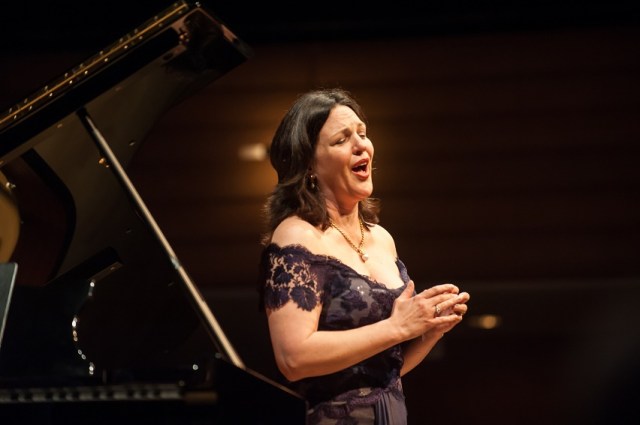
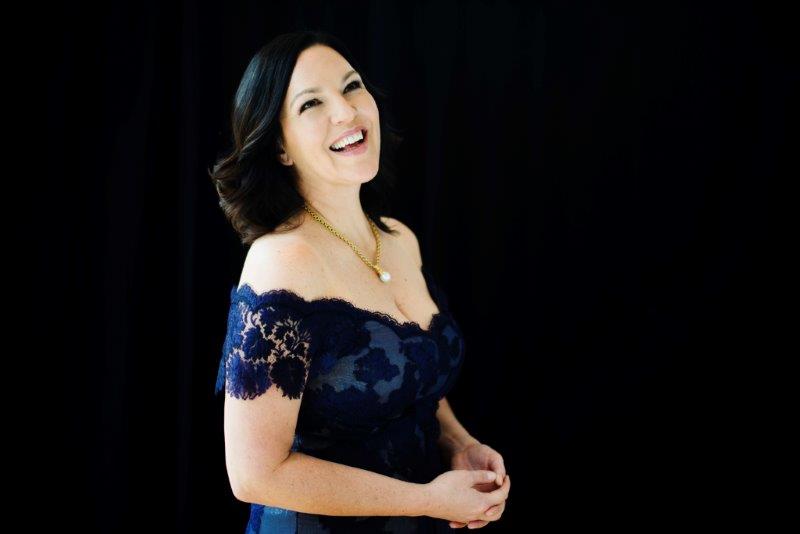
Mezzo-soprano Mireille Lebel (click photo for more)
Mezzo-soprano Mireille Lebel made her Tafelmusik debut even though she had already sung with them in her portrayal of Gluck’s Orpheus last spring on behalf of Opera Atelier (for whom Tafelmusik are the pit band). In tonight‘s program we more or less want back and forth between vocal and instrumental solos. As far as passion is concerned? Each operatic solo took a single emotion, or perhaps two, on the occasions when the da capo section was in a contrasting mood. We who are accustomed to seeing operas presented in their entirety might be astonished at the power of an anthology of unrelated arias.
But come to think of it, this might be far more authentic than what we usually see on our operatic stages even without the modernization of COC productions such as Hercules or Semele, and even compared to Opera Atelier. Lebel was in a lovely red and gold dress, smiling as she came up the aisle to sing her first solo, without any hint of a dramatic illusion. But that is how baroque opera worked, the magic generated by the voice and strengthened by our imaginations, rather than from the kinds of set & costume to which we have become accustomed in recent times. In the centuries of restricted onstage expression, rigid ideas of decorum (even without the additional power of the censor) meant that one would listen rather than watch, for a voyeuristic thrill. The expressions of grief in a mezzo-soprano’s coloratura offered a kind of aural voyeurism, a non-verbal exhibitionism by the singer for a strait-laced world. Each of Lebel’s arias radiated a genuine heat, varieties of beautiful pain in which the listener could indulge.
To answer the forbidden question, much as i enjoyed the other parts of the concert, their passion couldn’t really compare to what could be conveyed with a voice but instead resembled interludes, background music between the over-the-top emotion of Lebel in her arias. Notwithstanding the intensity each of the soloists brought to their concerti (Dominic Tresi– bassoonist as well as Richter), that was always music, never passion. A passionate bassoon cadenza in a baroque composition (Vivaldi’s concerto RV485) is at best an impressive display. Richter’s feat of playing the reconstructed concerto was more exciting given how well-known the original is, so we had the added intensity of a familiar work, and the game of signification we see in any adaptation or transcription. We are accustomed to calling great playing “passionate”, for the play upon our emotions of tension & release. But it was still gorgeous music, and not what i would call “passion”.
Lebel, Richter & Tafelmusik will be back for more explorations of passion through the weekend at Jeanne Lamon Hall.
Adrianne Pieczonka is one of Toronto’s treasures, a fabulous ambassador for Canada when she sings abroad.
I first encountered her in Atom Egoyan’s Die Walkure with the Canadian Opera Company, a vocal and dramatic interpretation so compelling that it was as
though she hijacked the production. Everything was about Sieglinde because she made you forget everyone else. Her Ariadne changed the way i think about that sad mournful character, the most joyous Ariadne I ever saw.
The bio on her website proclaims the basic facts:
Internationally acclaimed for her interpretations of Wagner, Strauss, Verdi and Puccini, Canadian soprano Adrianne Pieczonka has brought to life such powerful women as Senta, Chrysothemis, Sieglinde, the Marschallin, the Kaiserin, Tosca, Elisabetta, and Amelia on leading opera and concert stages in Europe, North America and Asia.
Performances have taken her to New York’s Metropolitan Opera, the Vienna Staatsoper, ROH Covent Garden, Paris, Berlin, Madrid, Munich Frankfurt, Los Angeles, and La Scala, as well as at some of Europe’s finest summer festivals including Salzburg, Bayreuth, Glyndebourne and Aix-en-Provence under the direction of such conductors as James Levine, Riccardo Muti, Zubin Mehta, Sir Neville Marriner, Claudio Abbado, the late Richard Bradshaw, Lorin Maazel, Nikolaus Harnoncourt, Anthony Pappano and the late Sir Georg Solti.
What the bio misses are the impossibilities she encompasses. You cared about Pieczonka’s Sieglinde, the most remarkable dramatic portrayal completed by that big powerful voice. Her Ariadne (or Tosca, or any of a number of other roles) seduced you with a sweet vulnerability that doesn’t usually happen with Olympian vocal production. These qualities are something you need to experience in person. We’ve been very fortunate here in Toronto.
And now Pieczonka goes in a different direction: “beyond the aria“. Soundstreams take her away from operatic portrayals in her upcoming program at Koerner Hall. I had to ask her ten questions: five about herself, and five more about this extraordinary concert.
1) Are you more like your father or your mother?
I am more like my mother than my father. My mother studied English and drama at McMaster University and she attended the Banff School for the performing arts as well. She could have had a career as an actress and she certainly had a dramatic flair in general. She notably played the Wicked Witch of the West in an amateur production of The Wizard of Oz when I was a child. My sister played Toto and I was a Munchkin. She trained as a teacher and taught off and on while raising her four children.
She was interested in all the fine arts – she was a very good painter and she tried her hand at ceramics, flower arranging, etc. She was a gifted seamstress and made many of my clothes when I was young. She exposed her children to all sorts of artistic endeavours – as a child I studied ballet, jazz dance, piano, guitar, saxophone and of course later voice. My parents weren’t big opera lovers but they did have a subscription to the Hamilton Philharmonic and we attended regular concerts as a family. My parents enjoyed lighter musical fare: they enjoyed popular musicals and Pops-style classical music. Both of my parents were very supportive of my desire to study music as a child, in high school, and later at University. I was never told that I should perhaps study something more “reliable” at University in terms of future employment. I am really grateful for their support.
My father is an electrical engineer and has a very scientific, pragmatic mind. My mother was (she died in 2011) a highly emotional being and I’d say I am also a rather emotional person. I suppose my parents balanced each other out in this respect. People often found my mother “larger than life” and a bit intimidating. She was 5′ 10″ and liked to wear rather flamboyant clothes and styles.
Soprano Adrianne Pieczonka (Photo by Lisa Sakulensky)
2) What is the best thing about being a singer?
The best thing about being a singer is that I can earn a living doing something I truly love. Singing is something very special: it’s a physical thing but there is a large emotional element too. It’s also intimate and elusive. It’s a hugely satisfying thing, singing. It can be exhilarating and very daunting too. I am 52 now and I still learn new things every day. The learning never stops – be it regarding repertoire, technical aspects, etc. No day is the same – or year or month. I travel a lot and there is pleasure in this of course. I have had so many marvelous experiences during my nearly 30 year career.
3) Who do you like to listen to or watch?
I certainly don’t enjoy listening to or watching myself! I think there are other singers who feel this way. I have a few DVDs of operas I’ve performed in which I have never watched. I rarely listen to a CD I’ve made. I don’t often listen to opera in my free time. I do tune in on occasion to the MET broadcasts but I’ve never attended one of the HD performances in the cinema.
I love jazz and probably my favourite performers are pianist Bill Evans and singer Ella Fitzgerald. I love radio station 90.3 Espace Musique which plays the best jazz selections from 6-8 pm during the week and some nice classical programming on Saturday and Sunday mornings. I sadly don’t often listen to CBC Radio 2. I find the playlists way too bland. I lived for 11 years in London UK and loved BBC Radio 3. What amazing classical programming they do, 24/7, and all classical! It’s sad to think what has become of the classical programming at CBC. I enjoy watching TV and films. I don’t like blockbuster type action films. I love indie, often foreign films. I like dramas – often quite grim stories, but not gruesome/horror stuff.
Meryl Streep is my favourite actor of all time. I marvel at her body of work, her versatility and artistry. In terms of TV shows, I watch Nurse Jackie, Breaking Bad, Homeland, Better Call Saul, Fargo, Orange is the New Black, House of Cards, Mad Men, and Masters of Sex. I enjoy documentaries too. I’d say I watch a fair bit of TVO – what a wonderful station this is!!!
4) What ability or skill do you wish you had, that you don’t have?
I wish I could speak Russian and Polish. I’ve sung a few roles in Russian and it’s the most gorgeous language, so satisfying! I tried to learn the language with some tapes but I failed badly! I can’t even read the Cyrillic alphabet. My father was born in Poland but we were not taught Polish as children. In Europe I often have people coming up asking if I speak Polish and I am always a bit embarrassed to say “nyet.”
5) When you’re just relaxing and not working what is your favourite thing to do?
Probably playing with our cat, Shadow, is the best relaxation for me – he loves to play and he is very feisty and beautiful. He gives me and my family so much pleasure and we just adore him. There’s nothing more calming than watching him sleep or snuggling up beside him. I love to read and I also find cooking very relaxing. I’m a big tennis fan and watching a great tennis match is also a nice way to relax.
******
Adrianne Pieczonka (photo: Bo Huang)
Five more about the upcoming concert with Soundstreams.
1) The program with Soundstreams is sub-titled “”Beyond the Aria”, a big change from what we are accustomed to hearing you sing, namely romantic opera. Could you speak for a moment about the importance you place on alternatives such as new music and how you feel singing such repertoire?
I am really excited about the Soundstreams concert. I performed Crumb’s Ancient Voices of Children nearly 30 years ago (with the group before it became Soundstreams). I was still a student at U of T at the time. I’m sure Mary Morrison, with whom I then studied, was somehow instrumental in this engagement. I have not performed the piece since then, and so it’s quite interesting to revisit it after so many years. My career is comprised of 95% opera – I’ve just spent the past four months singing back to back Fidelio productions (in Madrid and Salzburg). The pressure to be “Beethoven perfect” for the performances – stylistically, vocally, etc, is huge. Everyone has an opinion of how the music should sound – from tempi to appogiaturi. There’s so much tradition with these composers, so much history and one could maybe describe it as “musical traditional baggage.” I find modern music much more liberating. It’s thrilling to use my voice in different ways. In Ancient Voices, I have to do trills, clicks, sighs, whispers, sirens, etc. I sound like a bird at times, trilling, whooping and flitting here and there. It’s exciting and there’s less pressure to be “perfect.” Of course, my voice is much more dramatic and rich than it was when I was a student at U of T in my early 20’s.
Compared to Krisztina Szabó and Barbara Hannigan, I have performed next to no modern music at all! I saw both Krisztina and Barbara in Written on Skin earlier this year and was really impressed by the entire performance. I must admit that revisiting the Crumb especially has made me think that I should try to do more contemporary music. I am thrilled that the COC will feature more contemporary (and Can con!) repertoire in the present and future seasons. I do think that audiences should sample contemporary music along with the standard romantic/ classical repertoire.
2) Please talk about the program you will be performing with Soundstreams Sept 29th.
The program will appeal to a wide audience. Ancient Voices of Children is by far the most “out there” contemporary piece I will perform at the concert. It will feature last on the program. It’s a setting of some gorgeous Lorca texts in Spanish and I find the piece very earthy, sensual, and extremely beautiful at times. The small ensemble of soprano, boy soprano, oboe, mandolin, prepared and electric piano, and percussion manages to make some really unique sounds. Often the chamber players are required to whisper, yell, chant and hum! Fun!
Krisztina and I will sing a few solo and duet arrangements of some American Songbook songs by Crumb as well. Like in the Beatles Songs which will follow, the audience should be familiar with these tunes: When the Saints Go Marching In, Dem Bones, etc. They are quirky and often humorous settings and I will need to count like mad!!!
I will also sing three Beatles Songs, arranged by Lucianio Berio for voice and small chamber ensemble. I have a lot of fun singing these as I grew up as a child/teenager listening to the Beatles. Again, it will be nice for the audience to hear these very familiar songs (which I guess are now classics themselves) in a unique setting.
3) Please talk about the difference for your voice preparing this kind of repertoire, especially Berio’s version of songs by Lennon & McCartney, as opposed to an operatic role.
I don’t exactly know how I will perform the Beatles/Berio songs – sometimes I practice them with more of an operatic sound but then I sing them with a more natural pop or folk sound. I think if they are sung too operatically, they can appear like a parody and I want to avoid this. Yesterday is one of my favourite songs of all time and I am pleased to be able to perform it with Soundstreams!
Ancient Voices of Children is by far the most challenging piece vocally. When I sang it as a student I’m sure I had more flexibility to my voice. I’ve sung lots of dramatic Wagner, Puccini, and Strauss over the past years and my voice has grown and matured. It’s more rich and dark than it was as a student. Some of the very high bird-like acrobatics in Ancient Voices will be challenging for sure. I am enjoying the process – trying to train my voice to be agile and fast. Again, I have sung nearly 20 performances of Fidelio over the past four months, so I am switching gears technically. I do love playing around with my voice to find the right effect for these songs – playing with vibrato, shading notes with volume, fluctuations, etc. Ancient Voices has a few high C’s and even a high D which is a stretch for my voice. I’m sure I’ll squeak something out! It’s different writing than say Amelia in Ballo by Verdi which also has a few high C’s. The writing in Verdi has longer lines, which rise and fall more naturally. Crumb uses the voice differently – he has it sounding like a loon, like a banshee, and jumps around more from style to style.
4) I’m one of many fans watching your development with baited breath, eager to see what you might do next. After that beautiful liebestod you sang with the Toronto Symphony earlier this year, I wonder if you are considering singing a Wagnerian role such as Brunnhilde or Isolde someday.
I really enjoyed trying the Liebestod for the first time with the TSO last March. I have been asked before to sing the role but the timing was never right. It’s a terribly long role, a veritable marathon – the first act alone is more than an hour and Isolde never stops singing! Acts 2 and 3 require other vocal requirements and I just don’t know if I am up to that challenge. The role of Isolde also lies on the low/middling side for a soprano. This is why you often find mezzos singing the role, for example. Waltraud Meier or Petra Lang. I have sung so many Wagner heroines (Freia, Eva, Elsa, Elisabeth, Sieglinde, Senta) that I am very content. Just Brunnhilde and Isolde elude me and I am OK with this. I am happy to let things unfold and see what happens in the next few years.
Something I am very excited about it is that I will perform Schubert’s Der Winterreise at the Schubertiade next summer in Austria. It’s a prestigious Lieder Festival and I gave a recital there for the first time in 2014. I have loved Winterreise since I was a student. I lived for six years in Vienna at the beginning of my career and I saw Christa Ludwig and Brigitte Fassbaender perform the cycle often. I was always very moved by the cycle being sung by a woman. I know traditionalists might disagree. I am singing it in the tenor key and it fits my voice very well. The text and melodies also suit my melancholy side. I have that slavic tendency to love things in minor keys. I do hope to perform the cycle in Toronto and elsewhere too.
5) Is there a teacher or an influence you’d care to name that you especially admire?
Yes, I would love to mention the teachers who have been instrumental in my career. Mary Morrison was my teacher when I studied at U of T and for many years after, when I’d return to Canada from Europe. Mary initially enabled me to access the top of my vocal range. It was a thrilling time back then and she is now a dear friend whom I see often. I am full of admiration for her dedication to teaching over the years. I think she’s been teaching for nearly 50 years!! Wow. She continues to shape young aspiring singers at U of T and has worked with many fine artists who are enjoying major careers. She is the Grande Dame of Canadian contemporary music and she did expose me to some modern works as a student.
My next teacher was Hilde Zadek who was a leading soprano at the Vienna State Opera and elsewhere for many years. I moved to Vienna in 1989 and lived there until 1995. I have sung there regularly since then and often had lessons with Hilde when I was in town. Hilde will turn 98 in December and she is still going strong. She attended a performance of Fidelio in Salzburg this summer (she was a very fine Leonore herself) and it was just wonderful to see her again. She too is a dear friend. Hilde shaped many roles I performed in Vienna and elsewhere. She sang many of the same roles as I did – Donna Anna, The Marschallin, Tosca, Ariadne, Desdemona, Elisabetta, etc. It was wonderful that she could give me guidance on, for example, where to take breaths, or where the orchestra might be overly loud in a certain section, etc.
I lived from 1995 to 2005 in London. In London I discovered a teacher called Gita Denise. Gita sadly died about eight years ago. She was a Czech dramatic mezzo and she trained in Italy in the bel canto tradition. This was my first exposure to the bel canto style but it was fantastic for my Verdi roles etc. She gave me a lot of technical assurance and guidance as I progressed from my 30’s to my 40’s.
I now work with my wife, Laura Tucker. Laura is a wonderful mezzo soprano but also a gifted voice teacher at U of T. We started to work together regularly about 18 months ago and it has been hugely helpful. Previously it was not always easy to work together. Tempers or egos would flare and up and it made working together impossible. But, something shifted and now we work together beautifully. She knows my voice inside and out and I trust her ears 100%. It’s quite a special thing to have a professional and private relationship!
September 29, 2015 at 8:00 pm
Koerner Hall, TELUS Centre for Performance and Learning, 273 Bloor Street West
Featuring:
Adrianne Pieczonka, soprano;
Krisztina Szabó, mezzo-soprano;
boy soprano; chamber ensemble,
Conducted by Leslie Dala
Repertoire:
George Crumb Selections from American Songbook
George Crumb Ancient Voices of Children
John Lennon, Paul McCartney Beatles Songs, arr. by Luciano Berio
Analia Lludgar Romance de la luna, luna (world premiere)
A pre-show chat with Artistic Director Lawrence Cherney will be held at 7:00 pm before the performance.
Tickets range from $37.50-$67.50 and are available through The Royal Conservatory Box Office at 416-408-0208 or online at soundstreams.ca. This concert will be streamed live at soundstreams.ca. Click image for tickets & further information.
I was playing a delightful piano piece and for no apparent reason was suddenly overcome, and started to cry.
Debussy’s “En bateau” is a lovely piece, about recreation. It’s the end of the summer for North Americans as we observe Labour Day, our last glorious days of fun in the sun. Many of us get into boats, a marvellous escape. I have an arrangement for piano 2 hands that I will be playing in church this Sunday. While it might be apt as a celebration of the end of summer, there’s an additional reason.
What struck me as I was playing was how innocent our enjoyment can be once we’ve found a refuge. If we are in a safe place, a country with lakes for pleasure rather than as routes for armies to invade, water to drink, rather than dried up holes.
We are so lucky in this country.
I love the innocent appearances of these two boys, for all appearances out in their own (virtual) boat. I can’t forget two other boys who were out in a boat but didn’t fare so well. We’ve seen the tragic pictures of one of the brothers, as well as the despondent father who no longer wants to come to this country, no longer wants Canada as the place to plan his future: because his future –his wife and his two boys—is no longer possible. They’re gone.
He decided he’s staying there.
We don’t have to give up having fun or recreation. We can still listen to Debussy’s beautiful meditation, or whatever else you think is fun. But we need to also open our doors. My family is loyal lifelong to the Liberals because they opened the doors of Canada to Hungarians fleeing the uprising. We were already here (having left Hungary in the 1940s), unlike so many who would follow. I am not proud of what I see happening in Hungary now but I don’t presume to judge. I only know that I admire the way Germany & Austria are opening their doors, a welcome comparable to what Canada once offered, both to Hungarians and so many others, such as the boat people of Viet Nam. The Liberals don’t have a monopoly, as Conservative Governments have been welcoming too.
But not the current one. While they toss numbers around, the dynamic is different. Sponsors seeking to bring people here hit bureaucratic roadblocks. In the old days (of the Hungarian uprising and the boat people) as I understand it, the government actually took the lead. My mom told me that Paul Martin’s father went to Europe to help. That’s not precisely how it works now. But once the election is over that can change. Instead of roadblocks, our government can take the lead.
Doctor Gábor Maté is someone I’ve admired from afar for a long time, without really knowing more than a few superficial details. He’s known for the sort of beliefs that go beyond mere image management, an advocate and activist who takes risks. Maté took on the conservative elements of the government (and to be fair, that would likely be true whichever party were in power) in his role with harm-reduction activities in the Vancouver area, helping drug addicts. If there is a single word I associate with Maté it’s “compassion”. In his books, his columns, in his public advocacy, he speaks of addiction and its relationship to health and disease, abuse and pain. Where the law enforcement culture obeys a paradigm where drugs = crime to be punished (and the police–who perhaps also deserve sympathy, follow the orders of their political masters and shouldn’t be blamed for ruinous policies created by people in Ottawa or Washington, far from the battle-ground and with no real understanding of the people involved) , and addicts = criminals to be locked away, Maté is part of a very different movement, one that attempts to understand the root causes of addiction, beginning with the assumption of personhood rather than blame: in other words, compassion.
You can hear his TED talk to get a better idea.
Speaking of pain, Maté’s own life suggests that this isn’t merely an academic exercise, but wisdom acquired the hard way. He is a child of the European Holocaust (for example some family members were murdered in Auschwitz, and his father endured forced labour) born in 1944 in Hungary, whose family then emigrated after the 1956 uprising. Maté has been a doctor for decades, in the foreground of helping people, now mostly as a writer and an activist seeking to change the way we think.
He’s now going on stage in a play that creates a new platform for his ideas & research.
The Damage is Done: A True Story starring Dr. Gabor Maté and Rita Bozi
The Damage is Done: A True Story combines theatre, dialogue, essay, video, music and dance into a multi-layered event. Featuring Dr. Gabor Maté onstage with Rita Bozi, the show weaves together the story of three different Gabors, all of whom emigrated from Hungary to Canada and shaped Bozi’s life. The audience is taken on a journey from the invasion of the Nazis to a failed Revolution, from The National Ballet School to Canadian punk rocker BB Gabor, exploring the impact of historical trauma on its performers and on the characters they play. Gabor playing himself, and Bozi playing a multitude of characters, explore the cultural history and family dynamics that resulted in their experiences of depression, addiction and thoughts of suicide.
The performance reveals how the impact continues to haunt them today. Healing, they find, comes from the ability to look at traumatic events from infancy and early childhood with humour and compassion, and to defuse the emotional charge that first arose in response to those events. Infused throughout the performance are Gabor’s challenging insights as evident in his writing and workshops.
”Understanding that even though the damage is done, we can defuse its impact, is crucial to healing,” Maté says in the final moments of the play.
This is a 90 minute no intermission performance, followed by an audience-participation discussion.
The Damage is Done will be presented October 15th at the Banff Centre, then October 20-24 in Vancouver.
Maté is also busy lecturer appearing all over North America. On September 28th he’s coming to London Ontario, and in the Toronto area (!) there are two appearance September 27th:
George Ignatieff theatre at the University of Toronto in the morning
Toronto Congress Centre, 650 Dixon Rd in the afternoon
I was fortunate to get Dr Maté to answer 10 questions, to get some idea about the man and his current work in The Damage is Done.
1-Are you more like your father or your mother?
Emotionally, I’m more like my mother with a tendency to be withdrawn and depressive. Temperamentally, more like my father, given to eruptions of frustration. Intellectually, more like my father. Although he was not educated, having had to leave school in Grade 8 to support his family, he had a broad interest in the world, in history, in culture. He was also quite open in his opinions—both in expressing them, and also in a willingness to drop them when new information came along.
What neither of my parents had—this task fell to me—was a drive for self-knowledge.
I am compelled to mention here my maternal grandfather, Dr. Joseph Lővi, who perished in Auschwitz when I was five months of age. He was a hidden influence all my life. He was—could this possibly be a coincidence—a physician, writer, and political activist.
Dr Gábor Maté
2-what is the best thing about what you do?
What I most like is to witness the transformation my work helps to induce or support in people, whether through my writing or through personal interaction. My ego, of course, likes the recognition. But what my ego likes and what gives me joy are not at all the same thing. Donald Trump says that “show me a person without an ego, and I’ll show you a loser.” He has it exactly backwards, in line with the ego’s take on reality.
3-who do you like to listen to or watch?
Beethoven string quartets. He wrote sixteen and I have at least seven complete versions. Each is different every time I hear it. “He who divines the secret of my music is delivered from the misery that haunts the world,” the composer said. It’s true, in a relative sense. Not even Beethoven can deliver anyone else from misery, not even the Buddha or Jesus can—that possibility is for each of us to achieve for ourselves–but they can all point to liberation. In the musical realm Beethoven gets me there, transcending mundane reality.
4-what ability or skill do you wish you had that you don’t have
Being a great drummer. Or any kind of drummer. But, at least, I’ve always marched to the beat of my own drum.
5-when you’re just relaxing and not working what is your favourite thing to do?
Reading, music, bicycling, swimming, gazing into my wife’s loving eyes.
*********
Five more about The Damage is Done
1-Please tell us the history of The Damage is Done and how you came to be involved.
Rita Bozi (click image for more via her website)
Rita Bozi, the therapist/writer/dancer—a fellow Hungarian–who created the play was influenced or affected by my writings and speakings and, at some point, somehow wrote me into the production. So there I was and here I am, impersonating myself. Rita plays and dances herself and everyone else.
For me, usually a solitary flyer, it’s been an illuminating process to collaborate with writer, director,
Fellow performer, stage crew, sound people, lighting designer, etc. Difficult at times, since I don’t get to dictate the terms.
Again, the ego does not like that. And the more difficult, the more illuminating.
2-Talk about the intersection between personal history and personal healing in your work
Whatever I write, my books are not only about me, in part, but always for me. We teach what we have to learn. I’ve been deeply challenged throughout my life with the early childhood imprints of trauma, shame, depression and hopelessness. The work of transformation is to recognize the illusory nature not of suffering, but of the self-created dynamics that lead to suffering. The Damage Is Done is a staged embodiment of how historical trauma (Hungarian history, in this case) can severely affect a single family and express itself in the suffering of generation after generation. Ultimately liberation lies in the transcendence of history.
3- The title “The Damage is Done” is a very fatalistic expression. While I suspect the ultimate answer to this question lies in your presentation, please talk about the different ways one can understand this phrase.
I agree, and I argued against this version of the title. It implies that the damage is irrevocably fixed. That certainly does not need to be the case, and is not the case in this play. The Damage Done, I thought, would have been a more accurate title, because it would have left open the possibility of healing—which really is the message of this production. But I’m only a hired hand, playing myself. I don’t get to dictate the terms, as I said above. Well, that’s not true either. More true is that this is a debate in which my views did not prevail.
4-From what I know of your work, you are a healer. In The Damage is Done how do you reconcile the desire to, on the one hand, create (art or entertainment) and your genuine impulse to heal?
Why can’t healing be entertaining? If we succeed, the audience will both be engrossed in and entertained by our depiction of human life and experience for themselves the possibility of healing inherent in human existence. “If we don’t despair of life, healing is possible,” says Gabor Maté in this show.
And I get to play him…
5- Is there a teacher or influence you’d care to name that you especially admire?
In the show I acknowledge two of my great teachers: Eckhart Tolle and A.H. Almaas. They have been the most directly influential mentors in my life, a life I would not wish to imagine without the wisdom they manifest.
*********
Doctor Gábor Maté will be speaking twice in the Toronto area September 27th, and in London Ontario Sept 28th. The Damage is Done will be presented October 15th in Banff where it was workshopped earlier this year, then in Vancouver Oct 20-24. For further information on any of these appearances, or to see if he’s coming to your town (several in the USA as well as closer to home in Western Canada), see his events listing for further details.
The Bicycle Opera Project are now in season four, cycling around from venue to venue, putting on opera. They carry their set, costumes & instruments along (except perhaps the piano…) in trailers pulled behind their cycles. I first encountered them last year (their third season) in two programs (A and B) in a coffee shop in Stratford rather than an opera house, dodging a live dog (well-behaved), children (not quite as well-behaved) and people in the aisles. Each place they take their caravan is a different configuration of venue, a new set of logistical & dramaturgical challenges.
Now as they finish their tour in Toronto there will be two performances in spaces that resemble theatres (tomorrow at Music Gallery, Sunday at Evergreen Brick Works), but I wanted instead to see them cope with an odd venue, this time a bicycle shop.
Tonight seemed oddly fitting when BOP brought their 2015 program –titled “shadow box” – to Curbside Cycle on Bloor St West in the Annex. While cycles are only part of two or perhaps three of the pieces on the program, there is also the small matter of subtext. We know that this company of nomads ride from place to place, building up their muscles & their lung capacity. It is no surprise that they are as attractive to look at as a ballet company but without the tutus or funny shoes. And I like it when the voices open up in the relatively small space, the extra resonance sucked up by merchandise (and by our bodies I suppose), leaving something brilliant but not overly reverberant.
Geoffrey Sirett (L) and Christopher Enns in Bianchi, a Bicycle Opera Project specialty.
Yet every venue is different, and BOP have to adjust, finding their props, their mark for a lighting cue, and yes, even occasionally wending their way up and down aisle-ways.
“Shadow box” is like an anthology, a series of short operatic vignettes linked by one unifying structural element. Where last year’s programs (two distinct ones) did not really aspire to unity, I think this time the bar has been set higher. The combination of works –some short operatic scenes, some instrumental compositions, plus some dialogue—hangs together very nicely. I don’t see an actual writing credit, so I have to wonder where some of the text comes from. Whoever did it –whether Artistic Director Larissa Koniuk, stage director Liza Balkan–the result is very smooth, as though we were watching one opera, which is quite an achievement when it is actually an amalgam of roughly 10 works from eight composers and as many librettists.
The unifying element I spoke of is really a single performer, who functions something like a narrator. Christopher Enns begins as the Auctioneer in The Auction, the first operatic work. If I understood what they were doing, parts of the Auction were used to get us to segue from short work to short work, the items being auctioned (wallpaper and a medal for example) being relevant to the works. Enns had other text though that wasn’t sung, which wasn’t identified in the program, but could be thought of as part of “shadow box” itself. The back and forth between his light-hearted interludes and heavier scenes gave the work a healthy balance, as there is a fair bit of gravitas to some of these brief stories.
Some of the short operas or excerpts from operas have been seen before. This was my second time encountering The Yellow Wallpaper and Submission, both having been created in Tapestry Opera’s Composer-Librettist Laboratory. But that doesn’t mean they were the same as before.
The Yellow Wallpaper benefited from the spare staging BOP employ, engaging our imaginations. While I found the Tapestry presentation absorbing –a short opera about a woman who sees things (ghosts perhaps? Or hallucinations?) that her husband does not see—the BOP presentation tonight seemed to push me to the edge of horror, as there were moments of wonderful ambiguity, as though we couldn’t tell where the sounds and images were coming from. Stephanie Tritchew’s expressions of terror were worthy of a Wes Craven movie (…and yes she made me jump). The score by Cecilia Livingston (libretto from Nicolas Billon) is constructed of some very soft, delicate textures encouraging you to pay closer and closer attention, as we sympathetically stare at the lights coming through the wallpaper.
Submission was highlighted by the most impressive acting of the night, in a short piece that moved me last time as well. Christopher Enns & Geoffrey Sirett are a couple discussing the ramifications of a draft notice received by one: a notice that forces a choice upon them, between exile or compliance. With a libretto by David Yee and music by Dean Burry, we’re in tuneful territory, fully intelligible, and watching performances that are complete commitment for every second of this work.
Our Lady of Esquimault Road (music by Leila Lustig and libretto from Geoff Hargreaves) the next vignette, is poised on the delicate interface between comedy and tragedy, as some laughed uproariously while others sat in silence, watching a depiction of madness that is ridiculed in the sharp remarks from her father, while her mother urges compassion. Lustig’s blues-infused score made it easy for me to see the story poised on the edge of comedy, although that may simply be my projection, coupled with Sirett’s deadpan delivery. I really love this score, especially the way the tension builds and the tone gradually shifts to something highly ambiguous, as the girl who might be called “our lady of Esquimault Road” assumes the role of a saint. The opera masterfully sits on the fence, never fully declaring to us whether she is truly having a vision or has lost her mind.
The other highlight for me was again from Jocelyn Morlock, namely her composition Asylum, serving as a kind of non-verbal epilogue to permit a space for reflection in our shadow box, something like the interludes in Wozzeck or Pelleas et Melisande.
All four performers are wonderful, each in their own way. I quite love the voices of both Larissa Koniuk and Stephanie Tritchew, and only wish we had been given more opportunities to hear them really sing loudly as their voices are fabulous, especially when they sing together. Geoffrey Sirett is the comic foil to the charisma of Chris Enns, the chemistry between these two men always a joy to behold. Enns might be Seinfeld to Sirett’s Kramer…? The final piece on the program was Tobin Stokes’ Bianchi, a piece even funnier this year than last, Sirett upping the melodramatic ante with his deadpan antics and romantically mellifluous singing.
I wonder if they’ll all be back next year. I know I will make sure to see and hear them. But in case you are wondering there are still two performances left this year.
One of the members of the Lberal team had come to our front door and we immediately said we wanted a sign.
I had planned to wait until I returned from my vacation, perhaps getting a sign sometime around Labour Day. Today? well as the last day of August, with a guy at the door, why not, we figured.
What we didn’t figure on was the candidate coming up to us and saying hello. I always put signs on my lawn because I’m a bit of a loud-mouth. I always take a position, which means I always have a sign. But since when does the candidate come and say hi?
We were a bit astonished, and maybe also a bit star-struck. Bill Blair is a tall friendly guy, one of the most recognizable people in this city over the past decade even without his police uniform. We shook hands, a kind handshake rather than the bone-crusher assault you might fear from such a big strong guy.
And he stood at the door talking to us for a good 15-20 minutes. I kept expecting him to need to run off but we had a wonderful conversation like none I’ve ever had with a politician, possibly because Blair isn’t a politician.
Now please note, I say that as a compliment. Bill Blair may be running for office but he is not a politician. In the ugly attack ads that try to suggest Justin Trudeau “isn’t ready”, i figure they might be right only in the sense that he isn’t ready to be the usual sort of politician. After all, who needs the usual sort of politician?
Neither Trudeau nor Blair resembles the old-style politician: thank goodness.
At the doorway, we talked about several things, a rambling conversation. Rob Ford came up, because in our neighbourhood most of the signage (in the election that he won, that is) was for Ford, whereas we supported Smitherman.
I feel very lucky, as we were given some remarkable moments of insight in our conversation. Blair told us that the three parties all approached him about running.
The NDP asked him.
Blair said he’d been a friend of Jack Layton, a man Blair clearly admired, but that’s not who the NDP is anymore he said. Forgive me if my paraphrase is off, but I was a bit starstruck listening to what Blair had to say.
The Conservatives asked him.
Blair said the Harper Conservatives said “they’d let me run for them”. And then what? Blair more or less said he couldn’t abide a situation where he’d be a robot always on a tight leash, told what to say, with no autonomy. Mike Harris also came to talk to him (trying to persuade him to run for the Conservatives), and this was, I think a warmer conversation where Blair admitted he could not see himself working in the Harper government. As a person who never liked Harris’ policies, I have to say, I admire very much what Blair reports as Harris’s very gentle reply: that old MH said “have a good look and decide which one you admire the most, and then follow him”. Which brings us to the third party.
The Liberals asked him.
And the thing Blair remarked upon at this point was that Trudeau said he wanted him to be part of his team. Trudeau recognized Blair’s huge expertise in law enforcement. And Blair spoke of his excitement that so many talented people were being brought together to form a strong team.
There was more said at the door than this of course. There was a big conflict between Harper and Blair (and other police chiefs, with whom he was in a solid consensus) concerning the long gun registry. Police chiefs wanted it kept but the Harper government wanted it gone, and so of course it went. Blair jokingly told us that Harper said Blair was a “leader of a cult”. The police chiefs a cult??
What a weird thing to say.
Trudeau and Blair (click for Ottawa Citizen piece by Mark Kennedy)
I’ve talked about attack ads. Whatever their purpose or affiliation I don’t like them. They are the ugliest kind of manipulation, distorting the conversation. Shouldn’t our political discourse be about vision rather than harping on mistakes, about possibilities rather than covering your butt? Yes the average person is probably too afraid to step into the public eye, too afraid to submit to the kind of scrutiny that one gets in attack ads. That in itself is one of the things wrong with attack ads. Politics should be open to average people too. Anyone with ideas should be welcomed into the conversation. If I had my druthers the spending limit would be much much lower, so that anyone with an idea could immediately get into the race. Why are we limiting our conversation to the guys who have tons of money?
And the polls? I wonder about that. The early lead enjoyed by Mulcair reminds me a lot of the early lead enjoyed in Toronto’s mayoralty election by Olivia Chow. At first, when everyone was in terror of the bogeyman (someone named “Ford”), Chow’s candidacy was welcomed. In due course when the electorate got a better look at the field, saw Tory and Chow, and realized that they didn’t need to fear a Ford, that changed. I wonder if the same dynamics might be at work among those wanting “anyone but Harper” in the Prime Minister’s Office? Mulcair may have solid support in Quebec, but as this super long election campaign goes on I wonder if voters will discover Trudeau’s team?
Blair is not at my door anymore. No, but he is knocking on the door of Parliament. I believe he’ll win in our riding, a star candidate whose support transcends party lines. Every party wanted him.
I know who I am voting for here in Scarborough Southwest.
Halloween is still several weeks away but already terror is more than a gleam in the eye of some.
Opera By Request are presenting Carl Maria von Weber’s gothic masterpiece Der Freischutz on Friday Sept 18th. There will be no special effects in the wolfs-glen scene except what Weber wrote into the score. Der Wilde Heer come riding, led by Samiel himself.
DOC WUTHERGLOOM’S HAUNTED MEDICINE SHOW returns Oct 7-11
THE HOUSE AT POE CORNER follows Oct 29- Nov 7.
And all over the continent, kids are thinking about their costumes. What will they wear? Will they be scary?
And I have my own little horror show planned. I am presenting a course at the Royal Conservatory of Music that’s called “Theatres of Terror” beginning September 22nd.
Tonight? I practiced the last few movements of Mussorgsky’s Pictures at an Exhibition, which contain more than their share of scary moments. Sure, the piano player may be afraid: afraid of hitting a wrong note! but this composition is not for the faint of heart. The piece is so powerful you can almost see the witch flying.
Lots of music was meant to scare you. For example there’s Schubert’s Erlkonig, a song telling a story. If the shadow puppets and the song aren’t compelling enough for you, here’s a site where you can see the German text with a parallel translation here.
And here are a pair of nightmare pieces that are not long after Schubert’s 1815 song, by Hector Berlioz. His Symphonie Fantastique (1830) concludes with a pair of nightmarish movements. They’re awesome in Liszt’s piano transcriptions that helped popularize the piece but originally were composed as orchestral pieces (unlike the Pictures, where the piano pieces were later orchestrated to great effect by Maurice Ravel).
First there’s the “March to the Scaffold.” I don’t listen to it too often because I want to preserve its power to move me. It’s one of my absolute favourite pieces. The hero of the piece has murdered his girl-friend and is being taken to execution. Fear builds throughout, until, we hear the drums and then the guillotine, including the plunk of a severed head bouncing on the ground.
Gory!
And then there’s the Gothic “Dream of a Witches’ Sabbath” to conclude the work:
This is just the bare beginning of horror in music, before Weber’s infernal Wolfs Glen Scene in Der Freischutz, before the ghosts come out in the Flying Dutchman.
Do you dare see where it leads? We’ve had a century of film and more…

 y faces on the cover (NB not the same as the image currently selling the film on Amazon, which only features one of the stars, not the three on the cover at Bay St Video)




 barczablog