Colorature: a CD from Marie-Eve Munger, soprano

My favourite lines in the film The Blues Brothers? The moment when The Brothers arrive at their gig, pretending to be “The Goodtime Boys”, and enquire what sort of music this establishment usually offers.

“oh we got both kinds: country AND western”.

Some people come to music –and this is true whether we’re speaking of country OR western, pop OR jazz, classical OR opera,… or you name it—seeking something new, while others want something safe & familiar. Those words are close to meaningless, given that one man’s safe is another man’s walk on the wild-side. I caution you, reader. When I review something I may be so busy seeking the newness and originality that I fail to properly apprise you of what to expect.

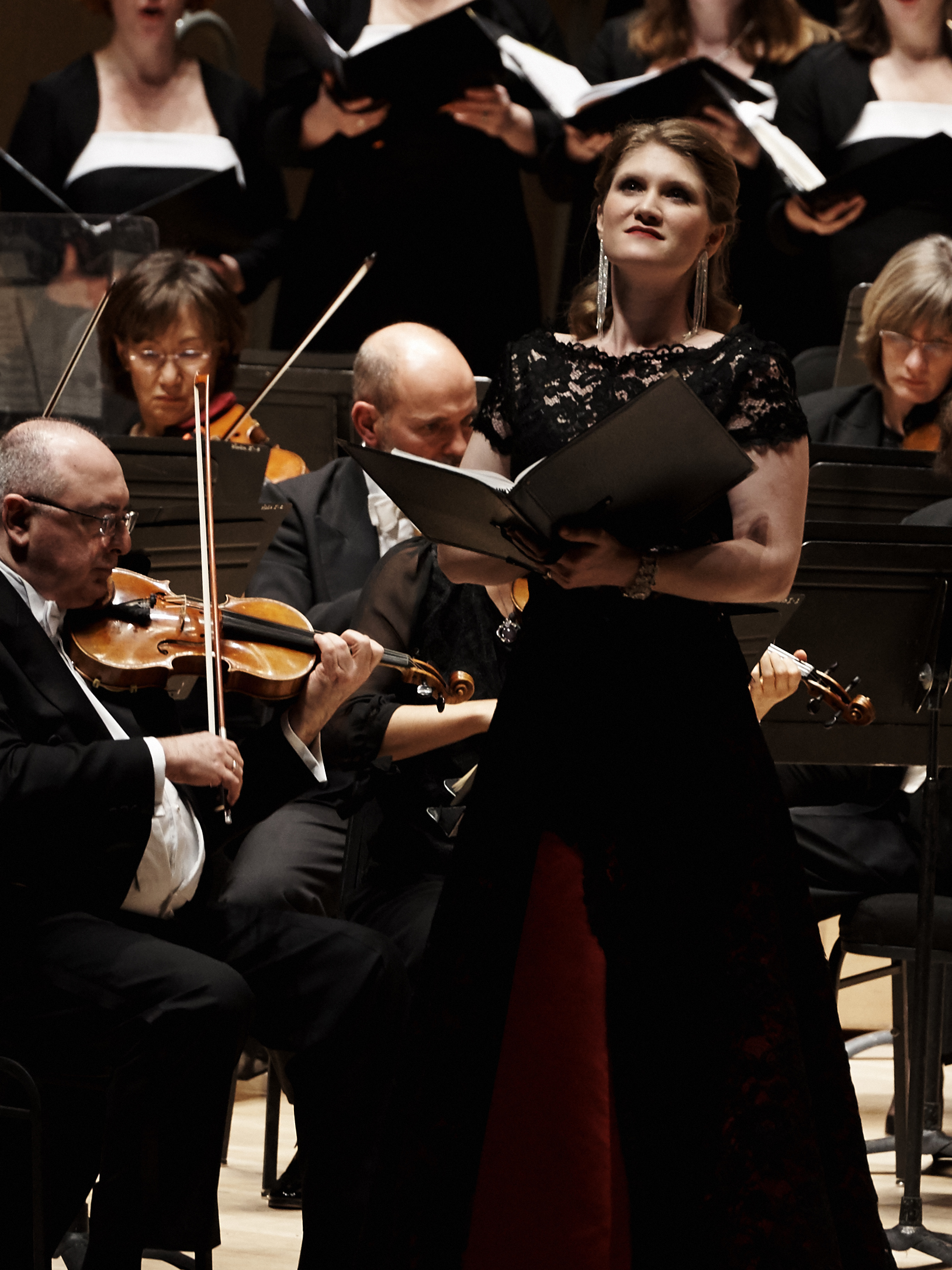
Marie-Eve Munger’s CD Colorature is highly original, or at least that’s how I experienced it. It may not come across that way if one simply wants to hear and enjoy music. And it really does allow for enjoyment, a stunning series of performances from a beautiful voice.  I am afraid however of using that adjective “original” because it may give the wrong impression.  Have no fear whether you think of yourself as open-minded or conservative.

click for ATMA’s website including purchase info

I found myself pondering the word in the title. “Colorature” is the French version of coloratura, a word that is both an adjective and a noun.  A singer who sings certain roles will be known as a “coloratura”, as are the key passages where she earns her money.  Coloratura can be the music and be the singer, or the role or the brief passages in the role  (and in the case of say the Queen of the Night, those 5-10 minutes are the most memorable of the night, the part everyone recalls).  These decorative features in the music are normally wordless. If you’ve never experienced anything like that in opera I’d point to scat in jazz as something similar, where the voice’s expressive power is turned loose in an abstract realm of pure music without reference to the usual need for text in song.

Those of us who teach or who review performances often find a stratified world where functions and styles are separated from one another. Opera is separate from concert singing is separate from jazz or music-hall singing, and separate again from film. Yet in practice singers can be (must be?) all of these at once, especially as they seek careers. The distinctions are largely b.s. if you’ll pardon my choice of words. Sometimes the classifications have more to do with someone seeking to file a review in the right part of a publication or to find the right department in a store than with anything about human vocal anatomy. Versatility is in fact far more natural than specialization.

I mention this because of the CD, where one encounters some intriguing remnants from a more natural world, before things became hyper-specialized. Munger’s rep on the CD is unexpected precisely because it applies the extreme vocal virtuosity one usually finds in opera arias in different types of music.  I wonder, were these pieces ever really popular? And i use that P word in the specialized way we use in speaking of classical rep, where we look at a symphony or opera company staying afloat with government subsidies as “successful”.  These charmers may be obscure compared to familiar coloratura arias but not based on merit.

Some of the singing on the CD is not coloratura. I suppose it’s funny to be phrasing it in the negative, but in a typical opera role, the coloratura is used sparingly, perhaps a little something to jazz up the ends of arias, rather than something continuous, whereas the vocalises for example push a voice.  I wonder what a concert program like this CD would be like for the singer: as in, how difficult.  But I suppose that highlights the many other ways a voice can be used as a colour instrument without necessarily being trapped in the more conventional functions of the voice, especially the verbal/semantic ones.  It’s a bit of a paradox (or an irony if you prefer) that great demands can sometimes seem to overwhelm one, particularly if the performer cannot turn the challenge into display, the moment on the trapeze into an impressive escape from danger. If death is not defied in those high wire moments, the artist is ill-advised to venture into the air, not to tease those of us craning our necks while worrying about the fair maiden’s survival. But this is the happiest sort of performance, one brilliantly assembled to make you rethink what you know about what the voice can do.

She flies through the air with the greatest of ease.

The most typically coloratura moments are in Vocalise-Études by Fauré and Ravel and in Glière’s Concerto pour coloratura, even as the singer is pushed well beyond what we’re accustomed to hearing in well-worn pieces of opera. One of the great challenges with unfamiliar repertoire is the requirement of the artist to make the material their own, to seize the unknown music and make it sing, make it more than just notes. Munger brings a cabaret singer’s charisma, making an intimate connection throughout, and even a bit of swagger. The flamboyance is merely a reflection of quirky material that calls for confidence, masterful technique and precise vocalism. But Munger is at that level beyond, where she’s playing with us, riding the wit of Debussy or the surreal silliness of Milhaud. Her voice is completely at her service and ours, eager and ready.

I am reminded of something I read awhile ago, about opera in an era before pornography, when the only sexual display sanctioned for public theatre was in the vocalism of the diva showing off her brilliant control, her fabulous top (possibly in more senses than one). There’s more than a little ecstasy encoded in coloratura, more than a little pleasure to be had listening to such music. Munger has assembled a CD of startling beauty, requiring personality, charm & taste: and more than met the challenge for each composition. As the review with which I (probably) end 2014, it’s a most impressive assembly of music from the intellectual side, yet a most stirring appeal to the visceral.

Beautiful from beginning to end.

Posted in Music and musicology, Reviews | Tagged | Leave a comment

10 Questions for Darren Russo

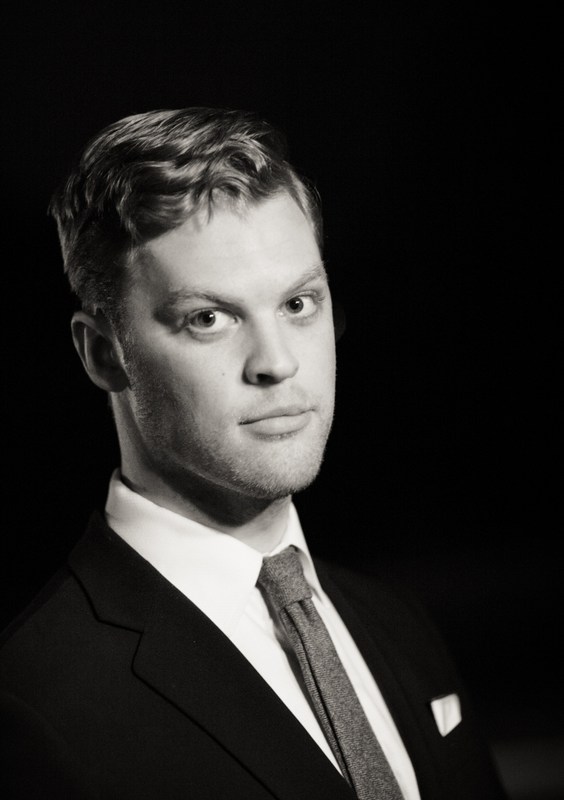
Darren Russo is a composer born in 1984 in Montreal, Quebec.  In 2006 he began his bachelor’s degree in music composition at McGill, including studies with Chris Paul Harman, and Jean Lesage. He was awarded positions as composer-in-residence for the Contemporary Music Ensemble and the McGill University Chorus (Tick Tock, Bang Bang – 2009, Missa Syllabis – 2010 (first prize winner of the SOCAN Foundation Awards for Young Composers—Godfrey Ridout category—in July 2011). He had also collaborated with celebrated writer Sheldon Rosen on creating music for his typographical play Hansel and Gretel which was staged at Ryerson University in May 2009, later featured at the LyricCANADA national conference at Brock University in October 2010.

In August 2011, at the invitation of Tapestry New Opera, he participated in their composer/librettist laboratory. There, he worked closely with artistic director and CEO, Wayne Strongman C.M., and Professor Michael Albano (University of Toronto) in an intensive workshop geared towards meeting the challenges of writing music for the stage. It led to the development of his opera Storybook, commissioned by Opera Five in Toronto for their 2013-2014 season, and now scheduled to premiere January 23rd 2015 in Toronto.  He recently completed a Master’s degree at McGill, studying under Denys Bouliane and Philippe Leroux.

Now, on the occasion of Storybook’s premiere I ask Russo 10 questions: five about himself and five more about composing Storybook.
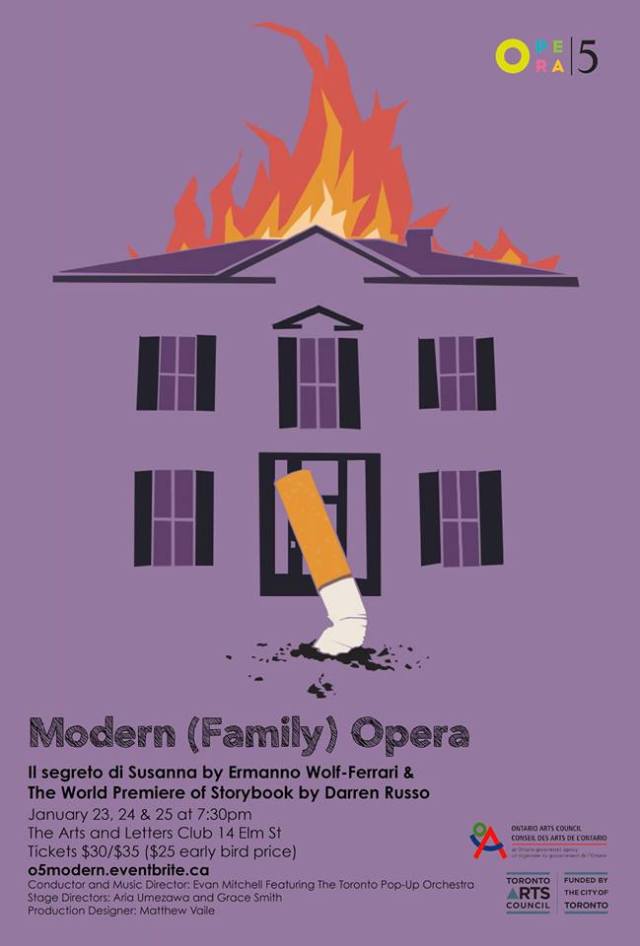
poster

1-Are you more like your father or your mother?

If you asked my mother, she’d probably tell you I’m most like her. If you asked my father, he’d probably laugh at the question. In my eyes, I really am a pretty even mix of the two. My parents are actually very different people: it was interesting growing up watching two opposing forces find a way to work as a team. Like any family, there were bumps along the way and it’s interesting in hindsight to observe the different ways each of them tackled challenges and embraced good times.

From my mother, I take my appetite for books and film; I take the encouragement that fed my active imagination. From her, I take my work ethic and the ability to keep moving through days that are overwhelming without complaint. I take from her the time I need for myself without guilt and without excuses. From my mother I learned how to navigate the subtleties of social interaction and to observe and understand what’s between the lines: I take diplomacy.

From my father I learned a love for food that knows no bounds, often against this formerly picky eater’s will. I learned creativity in the joys of a harmonious blend of flavours and textures. I learned to experiment and to embrace the failures as well as successes. From him, I take the ability to question everything. I take from him the courage to be myself in the face of any situation without worry of offending… so long as the cause is just: I take integrity.

They made me whole.

Composer Darren Russo

Composer Darren Russo

2-What is the best thing or worst thing about being a composer of “new” music?

The worst thing about new music is that it’s dressed in very old clothes. We often use archaic instruments, performers trained in an ancient art form and it seems we so often choose to present it in a highly ritualistic environment filled with out-dated customs. This makes it inaccessible to people who might be somewhat interested but become intimidated by rituals they don’t know how to perform, nor understand. Classical music has the same problem. The pieces that have survived through the centuries and that are still known to most have done so because they are timeless. They still resonate with contemporary audiences because the feelings they bring out are universal. Why then, are we stifling them in a package of obsolete customs?

There are many people, even friends and colleagues of mine that might disagree with this. And they make valid points. Classical music was never music “of the people.” It was performed for the upper echelons of society and that came packaged with a lot of pomp and circumstance. Not to say that the composers of the time were writing music that was pompous and circumstantial, but this wasn’t music that was easily available to the masses. This gradually started to change in the 19th Century, and with it came a gradual increase in the complexity of the new music of the times. When a turn toward the avant-garde took hold in the 20th Century, the composers themselves seemed to alienate audiences who had a difficult time understanding the challenging innovations they concocted. It seemed that a new elite had formed among the artists themselves that relished in complexity, dissonance and inaccessibility. You might think I’m speaking of this as though it was a bad thing, but these were truly bold innovations that probably couldn’t have been developed in an environment of total inclusion. The interesting thing to me is how these innovations gradually filtered down into more popular forms like The Beatles’ A Day in the Life, Pink Floyd, Queen, Radiohead, and electronic dance music.

To use a fiercely snobbish fashion analogy, this trickling down process was described perfectly in The Devil Wears Prada:

                “You go to your closet and you select… I don’t know… that lumpy blue sweater, for instance because you’re trying to tell the world that you take yourself too seriously to care about what you put on your back. But what you don’t know is that that sweater is not just blue, it’s not turquoise. It’s not lapis. It’s actually cerulean. And you’re also blithely unaware of the fact that in 2002, Oscar de la Renta did a collection of cerulean gowns. And then I think it was Yves Saint Laurent… wasn’t it who showed cerulean military jackets? I think we need a jacket here. And then cerulean quickly showed up in the collections of eight different designers. And then it, uh, filtered down through the department stores and then trickled on down into some tragic Casual Corner where you, no doubt, fished it out of some clearance bin.”

But is this really the same thing as with new music? When you think of a fashion show or an art exhibit, what do you see? Where is it taking place? What’s the average age of the crowd? What are they wearing? What are they doing?

If we want an audience to embrace new musical ideas and challenging innovations, I feel we need to present it in an environment that fosters open-mindedness and a level of comfort in communication. I don’t know how that’s possible dressed in our great-grandmother’s clothes performing a set of rituals so elaborate they make the Catholic Church jealous.

3-Who do you like to listen to or watch?

Listen: Ligeti, Mahler, Beethoven, Ravel, Radiohead, Arcade Fire, Jeff Buckley, Nina Simone, Joan as Police Woman, Tune Yards, Joanna Newsom, Outkast, Kendrick Lamar, Queen, George Kranz, Grizzly Bear, Alt-J, Kate Bush, Depeche Mode, LCD Soundsystem, Tool, and yes, sometimes Madonna.

Watch: Game of Thrones, Breaking Bad, Portlandia, Don’t Trust the Bitch in Apt. 23, It’s Always Sunny in Philadelphia, Six Feet Under, Battlestar Gallactica (the new one), Scrubs, Paul Thomas Anderson, and (ok, I admit it), Buffy the Vampire Slayer.

4-What ability or skill do you wish you had, that you don’t have?

I’ve always wished to draw or paint well. Sometimes you just want to communicate everything in an instant. You can’t do that with words or music, and photography lacks the organic flow (for me at least).

5-When you’re just relaxing and not working what is your favourite thing to do?

I’m hopelessly addicted to Netflix.

*******

 Five more questions about the creation of Storybook

1-What’s the story of Storybook?

If I told you, that would ruin it… it’s about life, just go with it!

What happens? Absolutely nothing!  …sort of. People sing what they’re thinking a lot. Nobody really talks to one another (except for that one time (and only to yell at each other (or at themselves?))).

The people here generally are pretty unhappy. Sometimes that’s funny. They’re looking for something, but I’m not always sure what.

People sing what they’re thinking.

A lot.

They have a strange fondness for the poems of William Blake.

They have very active imaginations: there’s magic.

They like to hear themselves talk.

Some of them use mild psychotropic drugs: there’s magic.

Some of them have sex.

Some of them wish they were having sex.

Some of them wish they never had.

Some of them are very alone…

…with their thoughts…

….that they tend to sing…

…a lot.

They’re searching for something.

2-Could you explain how the story of Storybook becomes opera, and how the music works?

Everyone is so goddamn desperate; what could be more operatic? Opera is fantastical melodrama. Except this is all about the painfully mundane ritual of day-to-day life. So, make them all desperately unhappy and it becomes melodrama and they all sing about it. Sometimes that’s funny.

Sometimes it’s really not. Sometimes it’s horrifying. Sometimes it’s heartbreaking. Sometimes it’s sweet. Sometimes it just is.

Storybook had a strange gestation. I’m not sure at which point I decided it was an opera, but it was somewhere about 5 years in (to the 10 year process). The point it became an opera in my eyes was the point it became unified. Suddenly each musical moment had to exist on its own but also relate to other tropes in the stories. And there are quite a few stories, and they don’t always seem to relate to one another at first glance.

That’s where the music comes in. Leitmotif. It’s something Richard Wagner started about 150 years ago to give musical reference points to characters, emotions, ideas and themes. He would then combine them in ways that added layers of complexity to characters and events. Storybook has these and they do much the same thing. They also serve to highlight common themes among seemingly separate storylines and characters. But it’s still vague (and I like vague). Especially here where I feel the themes in Storybook can be interpreted in a million ways. This hopefully will let the audience pick out the things they can relate to so they can interact with the piece and engage meaningfully.

With these systems in place, the music carries the text and creates the threads linking the themes across the stories. To me, that is opera.

But there’s no plot.

So?

3-What’s your favourite Darren Russo composition and what do you like about it?

It is unquestionably Storybook (for now). Next time you ask me, it will be whatever piece I’m currently promoting.

No, but really it’s Storybook. This took a long time to develop. A lot of it was re-written about halfway through the process (the moment I decided it was opera). In no other piece of music have I ever let my guard down so completely. In no other piece have I challenged so freely what I thought to others to think is “new music.” In no other piece have I openly invited all to come and judge me at my most exposed and vulnerable. Because it is exposed and vulnerable, it’s risky and I’m proud of it. When Opera Five approached me about it, I saw the opportunity of a lifetime and knew there would not likely be another chance. I could play it safe or grab life by the balls and go all out. I chose the latter, and whatever the fate of Storybook, this is undoubtedly my favourite composition and the one I’m most proud of.

For now. DARREN_RUSSO

4- The arts often feel very precarious in this country, spoken of as a luxury even as they starve alongside wealthy hockey teams.  Please put your feelings about new music into context for us, especially with respect to opera and the Premiere of Storybook with Opera Five.  

Elaborating on your previous question about what’s the worst thing about new music: I feel it’s in trouble, yes, for perhaps being too exclusive and impenetrable. But then I don’t. Artists will always find ways of expressing no matter how restricting the environment (and, let’s face it, it could be a lot worse). And people will always come in contact with these works, and over time the good ideas will always trickle down in some guise or another.

It would be nice, though, if everyone was encouraged more to take time to create things and express themselves. It would be nice if artists had more opportunities to take the time they need to observe, think and create without having to always worry about he bottom dollar. Complete artistic freedom unburdened by financial woes is a near impossibility here today and now.

The opportunity granted to me by Opera Five came at the perfect moment. I was very fortunate in that I was able to integrate it into my Master’s research, which gave me ample time and a bare minimum of money to live. It’s entirely possible in today’s artistic climate that I may never have such an opportunity again. That makes me both extremely grateful for this one but also somewhat frustrated. On the other hand, it’s entirely possible that this opportunity could open doors leading to more exciting endeavours. It’s a risk to try and live as an artist and it’s not a lifestyle that meshes well with just anyone. It’s kind of exciting though, the uncertainty, and I feel adds an element of adventure to my life that would not otherwise be there. Though, perhaps that’s just cognitive dissonance. I feel I should add that I am in no way advocating putting all your eggs in one basket. I have a wonderful day-job that gives me a unique opportunity to view some of the strangest and funniest things about humanity. Maybe I’ll write an opera about it one day.

5- Is there a teacher or an influence you’d care to name that you especially admire?

I’d like to take a moment here thank my former music history teacher and composer, the late Robert F. Jones. When I was 19 and applying to University, I had to choose two pieces as a selection for my portfolio. I only really had three viable pieces to choose from. Two were dry academic pieces written for the only composition class I had ever had, one with a bitter and tyrannical teacher. The third was something I had written for myself: a setting of the Introduction to William Blake’s Songs of Innocence. My composition teacher had dismissed it as infantile with its simple language and abandonment of conventional structure. I met with Prof. Jones about a day or two before my application deadline to show him my choices. I showed him the two from my class first and he said, “These are quite good. I want to see more, did you bring anything else?” I felt shy and reluctant, but I pulled out the other piece and he looked it over. Anxious for another dismissal, I waited as he looked over the score. Finally, he handed the pages back to me and said, “Send this and only this. These two are great, but this one is you.”

*******

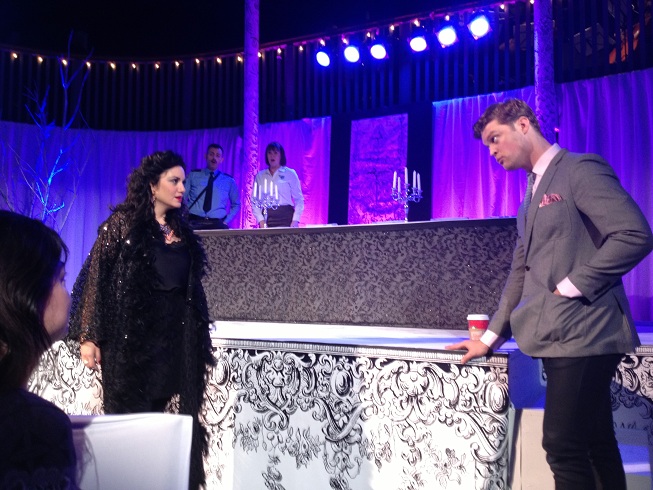
Opera Five presents Modern (Family) Opera:
Il segreto di Susanna by Ermanno Wolf-Ferrari and
Storybook by Darren Russo
January 23, 24 and 25 at 7:30 pm
The Arts & Letters Club 14 Elm St
o5modern.eventbrite.ca


Posted in Interviews, Opera | Tagged , | 1 Comment

Toronto Operetta Theatre’s Mikado

Although I haven’t seen many shows from Toronto Operetta Theatre, tonight’s is timely, after the social media debates between armchair Artistic Directors concerning management strategies. In the years to come we’re likely to see a scaling back of the boldest objectives, including a growing reliance on Canadian talent.

Meanwhile there are companies providing ongoing employment opportunities for Canadian talent, but on a much smaller scale than big companies such as the TSO or COC. TOT, whose Mikado premiered tonight, are one of the regular players on the Toronto scene. They play with a small orchestra in the intimate Jane Mallett Theatre, led by Derek Bate, who also conducts for the COC. Their productions have musical integrity, and a solid professionalism, directed by Guillermo Silva-Marin, who is also behind Opera in Concert and Summer Opera Lyric Theatre.

And speaking again as an armchair artistic director, tonight’s show likely works the same way that other seasonal favourites can work to regenerate fiscal health. The National Ballet have Nutcracker, Lyric Opera of Chicago are presenting Hansel and Gretel while the Metropolitan offer their shortened version of The Magic Flute. Oh and speaking of the TSO, they have their Messiah, as do Tafelmusik. The Mikado can work the same, way: as a wonderful play full of funny lines, familiar tunes, and a timely infusion of cash as well.


Adrian Kramer as Nanki-Poo and Lucia Cesaroni as Yum-Yum

Adrian Kramer as Nanki-Poo and Lucia Cesaroni as Yum-Yum

And why not? As the leads Adrian Kramer and Lucia Cesaroni are an attractive couple with lovely voices, a pleasure to hear and see. This isn’t to be mistaken for one of the Stratford productions of Gilbert & Sullivan, where both the verbal skills & musicianship are flawless. But the singing is almost all excellent, the acting is at times charming and funny, with the occasional flash of inspiration. We only came fully to life when the girls showed up –a bit more like a chick flick than G & S—bringing the energy level higher. The young women show more energy than the men as a whole, possibly because of a holiday season opening before a very well-fed & passive audience.

And speaking of Canadian talent  TOT will be premiering a new operetta adaptation of Wilde’s The Importance of Being Earnest by Eugene Benson and Victor Davies in April 2015.  Artistic Director Silva-Marin and TOT are to be commended.

But this week there’s the irresistible fun and beautiful melody of The Mikado. TOT present Gilbert & Sullivan’s Mikado until January 4th 2015.

Posted in Music and musicology, Opera, Reviews | 2 Comments

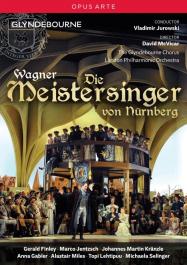
Die Meistersinger von Glyndebourne

I’m trying to understand why I responded the way I did to the Glyndebourne production of Wagner’s Die Meistersinger. It’s a relatively straight-forward production that might even be called conservative. David McVicar and the team who made the DVD have struck a balance, unlikely to offend anyone, possibly pleasing everyone.

click for details on obtaining

Richard Wagner’s operas are regularly updated and re-thought by adventurous directors. Many of the most adventurous examples of Regietheater (director’s theatre) were visited upon Wagner scores:

  • …because his stories are often symbolic templates right out of Jung that seem to invite re-interpretation
  • …because the production history of his operas for a time couldn’t escape the footprints of Nazi jackboots left over it at the Bayreuth Festival

McVicar doesn’t go there, however, doesn’t impose anything onto Wagner’s text. This is a Meistersinger to please the most ardent Wagnerian. Does that make this a conservative production? If by “conservative”, one means a production that includes almost 100% of Wagner’s stage directions, then so be it, this one is conservative.

But the epithet is misleading.  Whatever McVicar asks of the singers & chorus, we’re in the presence of remarkable high-definition camera-work, directed by François Rousillon. Over the course of this immense opera –the longest one that can in any sense be understood as standard repertoire (and considering how rare Meistersinger productions are, perhaps the designation is misleading) –we get to watch not just the singer singing, but many reactions to that singing as well. I am most impressed by the subtle responses, where so much of the drama resides.

I’ve already alluded twice (1 | 2) to Gerald Finley’s Hans Sachs. If 60 is the new 40, then –as I was pondering how Finley might look as Falstaff—Finley is a 21st century sort of old. He’s active, vibrant, really a baby-boomer’s Sachs because he’s middle-aged rather than aged, alongside a foppish Beckmesser from Johannes Martin Kränzle. Neither is really young enough for Anna Gabler’s Eva, yet because Finley is on the boundary line we can feel his genuine pangs of attraction when Eva looks his way. Marco Jentzsch isn’t much younger looking as Walther, but that doesn’t matter, so long as we can believe that these two middle-aged men might long for the beautiful Eva.

Topi Lehtipuu as David is perhaps the key –with Gabler of course—to making the ensemble tick. In Act I a huge amount of exposition must be accomplished in the scene between Walther & David that follows the church scene (where the attraction between Eva & Walther, the other key fundamental, is established). Lehtipuu is the nerdiest of the apprentices, a quality that sometimes makes him seem very old on other performances I’ve encountered. I love Peter Schreier’s take for instance on that wonderful von Karajan recording (which I listened to in its entirety last week), meticulous in his execution of all those musical details that are an indication to poor Walther of the impossible task he is undertaking in seeking to become a master. Lehtipuu has a stunning gentle tone that is in wonderful contrast to almost everyone else on the DVD, a lyrical voice that floats up to his many high notes, even as he seems genuinely young: which may simply be due to his hairstyle and physicality. Look at this guy!  

This is acting, and the point is –as in much of this production—it’s not when he’s singing. It’s in his reactions. The character never lets up for a second, and for much of the opera I can’t take my eyes off of him. His performance alone –of a part that is almost impossible to do this well—is worth the price of the DVD.

See what i mean about the camera-work? We’re watching reactions, back and forth between singer and listener. They’re very close to one another, making the singing conversational and directed, instead of the unfortunate tendency on bigger stages and in bigger theatres to bellow, making these speeches into pompous and self-congratulatory addresses opened out to the audience (an approach that is boring I am afraid). McVicar and his cast avoid those deadly moments fastidiously. In fact Gabler gives both Finley and Lehtipuu a run for their money, never dull and sometimes remarkably insightful. Jentzsch is very sympathetic as Walther.

Credit too must be given to conductor Vladimir Jurowski , leading the London Philharmonic Orchestra and the Glyndebourne Chorus at fearsome quick tempi, which usually means that the audience is the beneficiary. Choreographer Andrew George has the chorus doing folk-dance moves that seem very authentic looking, even as the simmering class-war—between apprentices and masters, between the guilds and the nobility (meaning Walther)– threatens at times to bubble to the surface, but never hijacks the opera.

With Vicki Mortimer’s stage and costume designs, we are not in the Middle Ages, but rather in a post-Napoleonic Nuremberg. I think that’s important because it’s the time of Wagner’s youth, when Germany was an idea that hadn’t even begun. There was no Germany yet, no military juggernaut for decades yet, just a series of smaller states and cities. As such the dreams of the masters and of Walther can focus on the artistic issues Wagner sought to express, without the directorial gloss.

In case you couldn’t tell, this is the Meistersinger I would recommend to any Wagnerian. The camera work gives it the edge of a good comedy –thinking more of Bergman’s Smiles of a Summer’s Night rather than anything Hollywood produces—even as the musicianship is astonishingly good.  It bears repeated watching.  Lord knows i can’t stop watching it.

Posted in Opera, Reviews | 4 Comments

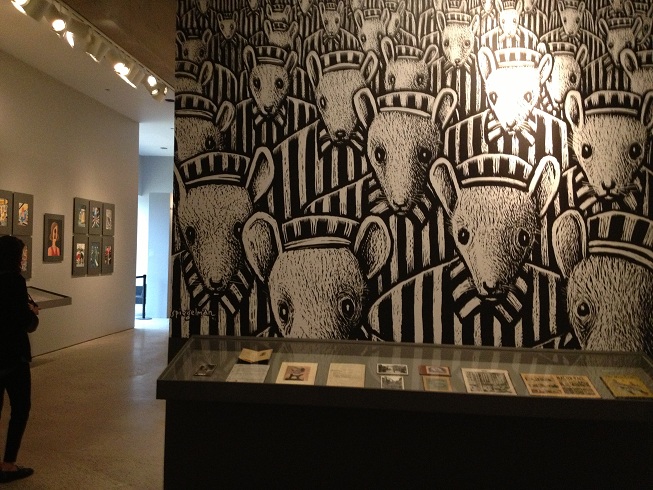
Maus in the haus: Art Spiegelman retrospective at AGO

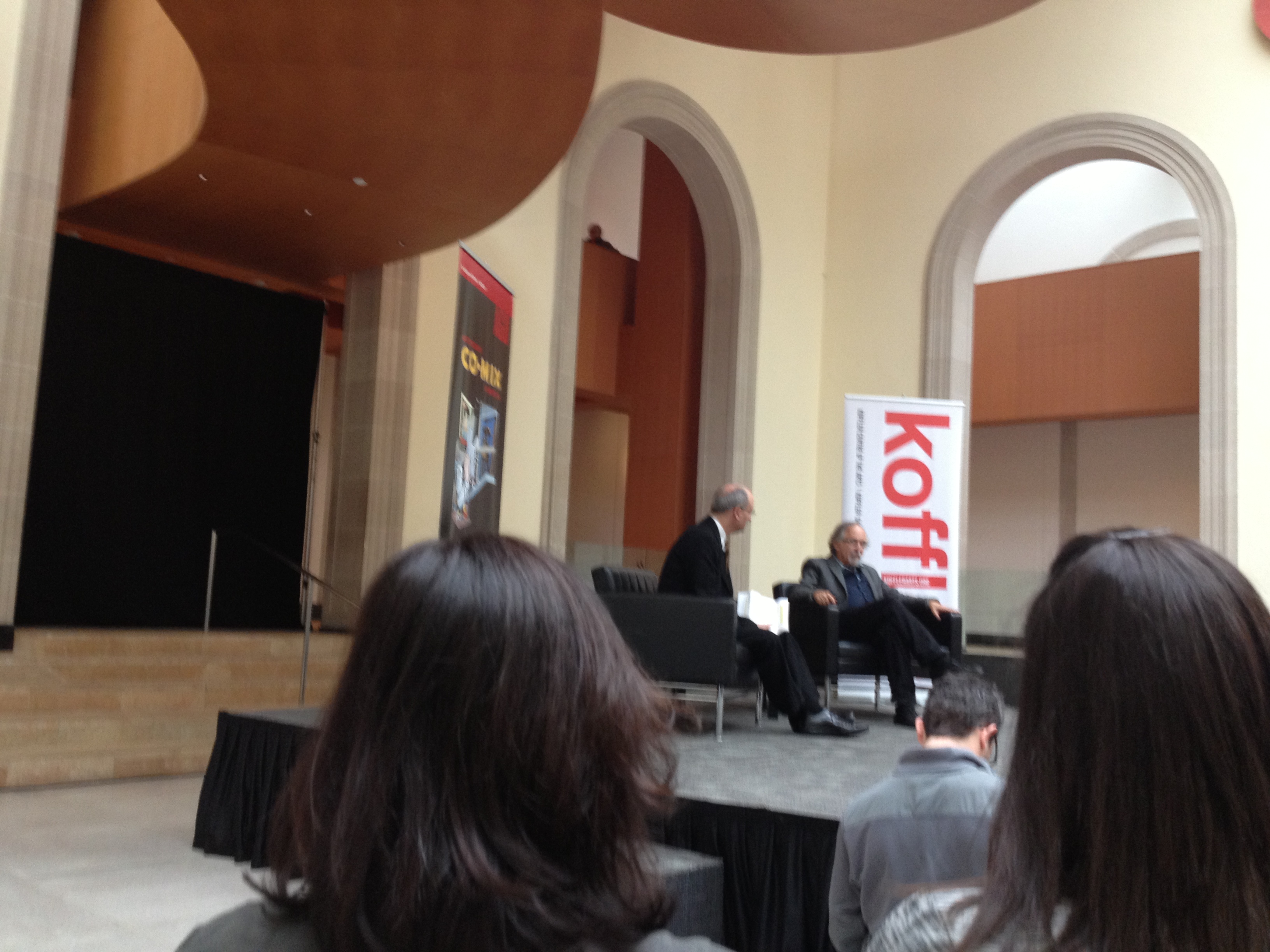
I saw Art Spiegelman interviewed at the media preview for his retrospective at the Art Gallery of Ontario.  I suppose if I were like a typical critic I’d just start talking without a preamble, because (nervous cough) everyone knows his importance. Or do they? But I don’t work that way, whether I’m talking about someone famous or unknown.

Click for more information about Art Spiegelman’s CO-MIX: A Retrospective at the AGO

But how to explain Spiegelman’s influence? I suspect we’re just now ready to look at that, or maybe still too close to the time. I only know that the world has changed substantially in the last half-century, and that we’re still struggling to understand the ways in which the arts have been transformed. When I was young there was a well-defined phenomenon known as the generation gap. Boomers –those of us who came of age in the 1960s and after—experienced a profound cultural disconnect from their parents, whose values were often diametrically opposed. Spiegelman’s Maus begins for me in that disconnect, in a cultural gap between parent and child that nowadays doesn’t happen, or at least not so violently.

My daughter gets the Beatles, she loves Spiegelman and Maus. We don’t have that kind of gap. Parenting is different now. Are we better parents? I don’t know, but we listen to much of the same music, look at the same movies. Spiegelman is part of that generation of transition in everything beginning with art, but reaching right into the way we understand ourselves and our relationship to the old country.

It’s quite the show, five hundred works curated by the artist, making it a genuine retrospective. I’ll paraphrase a few of Spiegelman’s responses to AGO director Matthew Teitelbaum’s questions –as he played Oprah—because you recognize that he’s much more than his art.

AGO Director Matthew Teitelbaum interviews Art Spiegelman

AGO Director Matthew Teitelbaum interviews Art Spiegelman

Spiegelman speaks in aphorisms, not so much because he thinks he’s Friedrich Nietzsche or Confucius, but because his comic art necessitated brief verbal gems to accompany his art. As you discover when you wander around at the show: his verbal gift is every bit as important as what he does with ink on the page, and might be the real reason for his Pulitzer.

The man tells great stories, and knows how to tell them.

When I first heard that Spiegelman was going to give a talk (January 26th at Bloor Hot Docs Cinema: tickets & details via kofflerarts.org) I thought to myself “nice”, but I wasn’t sure how interested I was. After listening to Spiegelman for about 5 minutes, engaging, irresistible, like a time-capsule from the counter-culture, a relic from another very magical time: I knew I have to hear him talk some more.

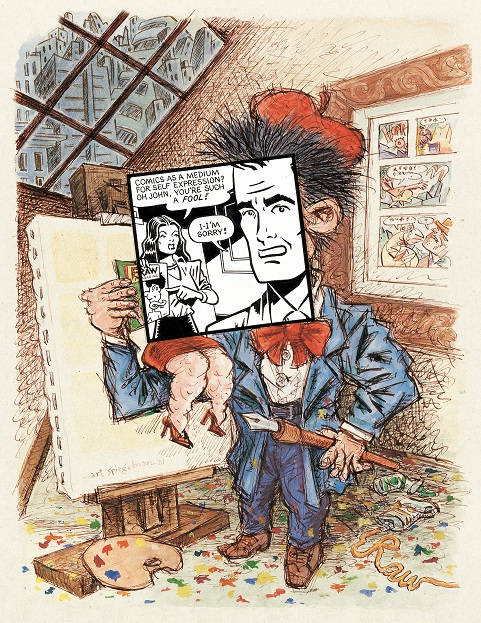
And do I know what I am talking about? I don’t know. But the question I was tempted to ask –and dammit should have asked if I wasn’t feeling sniffly and coughing and too sick to sidle up to a microphone across the room—would have concerned Spiegelman and the druggy imagery in some of his pictures. Goya was mentioned by one polite questioner, but I suppose I am conflating the artist and the art, wondering not just about the life but also life-style. Does anyone care about drugs anymore? I merely meant, that there’s a druggy hallucinogenic quality to his art. It’s trippy, which is an amazing achievement for still images in black ink. No I didn’t ask because I suppose that, phrased the wrong way, it sounds like a moralistic accusation, when I understand it in a positive way, seeing these images as distant cousins to what de Quincey & Berlioz explored long ago.

Art Spiegelman Cover art for Print magazine, May/June 1981 Watercolor, ink, and collage on paper. Copyright © 1981 by Art Spiegelman. Used by permission

Art Spiegelman Cover art for Print magazine, May/June 1981 Watercolor, ink, and collage on paper. Copyright © 1981 by Art Spiegelman. Used by permission

It’s ridiculous if not perverse to walk into the gallery and see Maus in its entirety on a wall. We usually encounter it in book form, not spread out on a wall: as though it were a single work of art. But that’s actually what it is. One can’t see much of it unless one were very tall AND able to bend low to take it all in. My eyes feel weak before all the details in these fabulous creations. I ‘m remembering my recent walk through the Michaelangelo show that’s still here at AGO, another tribute to the power in tiny works of art. Small isn’t just beautiful, it can be awesome & overpowering.  I had to step away partway through, a bit overwhelmed by what I’d seen.

Spiegelman told us that until the 1960s the comics were exclusively a commercial product, so they had to all look the same: that is, until the 60s, when comics –and everything else—changed.  I am recalling the shock of those who decided to rebel, artists who decided to be different.  The images had the same powerful impact of the first musicians who had long hair.  I mean, it may seem like a little thing, but at the time it was overwhelming.

Teitelbaum asks the inevitable provocative question: IS IT ART?

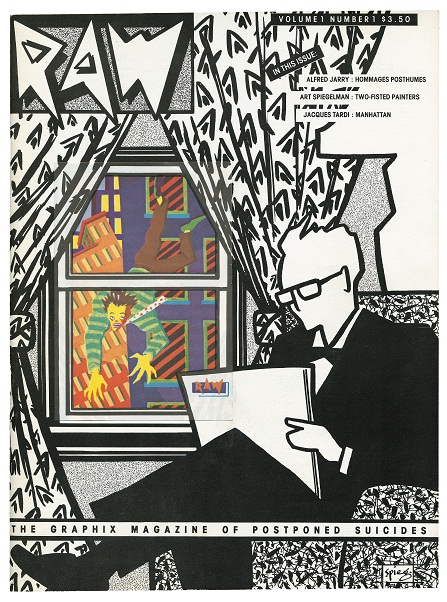
Art Spiegelman Cover for RAW no. 1: The Graphix Magazine of Postponed Suicides, 1980. Copyright © 1980 by Art Spiegelman. Used by permission of the artist and The Wylie Agency LLC. Courtesy Drawn + Quarterly.

Art Spiegelman Cover for RAW no. 1: The Graphix Magazine of Postponed Suicides, 1980. Copyright © 1980 by Art Spiegelman. Used by permission of the artist and The Wylie Agency LLC. Courtesy Drawn + Quarterly.

Spiegelman tells us that “anxiety of place” was something he experienced, as a lower middle class kid. Where do you fit in? Art and especially the criticism of art talks about high and low, good and bad. I sense that his art is addressing the cultural question –connections to the old country and the older generation (as I alluded above)—and that anxiety of place.

Spiegelman is going on with a fabulous lecture that in tiny brilliant chunks explains a lot, while answering Teitelbaum’s “is it art” question.  In passing he speaks of the invention of the cartoon in Montmartre (perhaps thinking of artists like Toulouse-Lautrec?), perhaps to put us at our ease in case we’re hostile to a cartoonist in the realm of great art.

Ha, if only he knew.  Recently we saw shows from Ai wei wei and David Bowie, two others whose aptness for shows at the AGO might also be questioned. I’m glad that the AGO is going aggressively into this discursive space, to interrogate our assumptions, broaden the understanding of what art is.  I’m reminded that maybe Teitelbaum wasn’t merely mouthing questions supplied by his knowledgeable staff, but speaking from his heart.  and yes, i like where the AGO is going.

It took a long time, he tells us, to understand what modernism is about. I wish I could recall where he got this insight –a wonderful one—about Picasso, but wow it’s so clear and simple, and as usual, in a tidy aphorism that knocks you on your ass. If I got it right, he said “just think of Picasso not as a grand artist but as someone going to his studio and jacking off everyday.“

Of course there was this cute moment between Teitelbaum and Spiegelman when they acknowledged that this might not be normal language for such a conversation.

But the importance of that quote is to deflate the aura around the artist, to normalize his work and yes to deconstruct it. Hm I suppose seeing it as masturbation is perhaps deconstruction or possibly just a recognition that the output of these revered artists doesn’t necessarily belong on a pedestal or behind some kind of wall. This isn’t to denigrate the artist, just to put it all in perspective. Spiegelman was –if I recall correctly—trying to explain his own history, his coming to terms with art & artists. Here we are in the AGO with Alex Colville, (whose recognition as a great artist is relatively recent), and Michaelangelo + Rodin; Spiegelman most certainly belongs in their company. The fact that some would question it intrigues me, and i’m grateful for the conversational spaces such questions –especially  the one posed by Teitelbaum– open for us.

Musing away, Spiegelman drops a few more jewels into their dialogue.  He cited Marshall McLuhan, that “when a medium is no longer a mass medium it becomes art or vanishes”. He gave the example of woodcuts. And he boggled my mind when he alluded to the old function of paintings since supplanted by photography, whereby painting lost much of its reason to exist.

It never dawned on me that he was really going to talk about the fading importance of comics.  But by the 1970s comics had ceased to be the popular medium it had once been. As Spiegelman put it, while they were still read widely, they’d been castrated by a comic code.

And then we came to Spiegelman’s projects. As he came up to his 30th birthday he consciously decided he had to do something more significant, and as a result took on something suitably ambitious. There were two projects he envisaged. The other one fell by the wayside, but Maus grew out of his desire to do something significant and important.

In 1972 “The Holocaust” wasn’t known, wasn’t the big topic it would become.  People merely spoke of the war and the things that happened. It was fascinating, I should add, to hear Spiegelman give us some very personal history.

“Holocaust” is one name. Even before that word acquired currency, there was another word coined, namely “genocide”, a word to describe the unimaginable, something that hadn’t been seen before. Then “holocaust” began to be the word used to describe the experience of the war, apparently a word from Elie Wiesel, which Spiegelman unpacked for us, explaining that it’s a word that means “burnt offering”.

Spiegelman doesn’t approve of the word “holocaust” applied to the events of the war, nor, he added, does he approve of the epithet “graphic novel” (something mentioned only in passing).

Spiegelman gave some insight into what he’s really doing when he said ”it’s easier for me to look at drawings than painting. They’re like a seismograph of how the brain works”.
Indeed. As an opera fan who also listens to rock or jazz or folk music, virtuosity and the apparatus of musical expression fascinates me, especially when we come to large-scale works onstage or in the cinema.   The last couple of centuries of art have seen art re-invented and reframed as something more immediate & emotionally authentic. We’ve seen it in the invention of new ways of acting onstage that strip away the alienating theatricality to let us get closer to something and someone with whom we can connect.  The difference between an opera aria and a folk-song –in search of simplicity and authenticity—is very much like the difference between a painting and a drawing. Of course it’s art, but it’s not art that scares you away by being intimidating or difficult.

MY_MICEThere’s a great deal to see at this show, and Maus is only part of Spiegelman’s work. If you know him and his style from the two illustrated novels, you won’t be disappointed. But there’s lots more.

And there’s much more to be said. But maybe that’s best encountered either in the gallery with the art, or perhaps at Spiegelman’s January talk. I know I’ll be back for more.

Art Spiegelman: What the %@&*! Happened to Comics?
Monday January 26, 2015 at 7 PM
Bloor Hot Docs Cinema, 506 Bloor St W, Toronto
Tickets & details: kofflerarts.org

Art Spiegelman’s CO-MIX: A Retrospective opens on
Dec. 20, 2014, and runs to March 14, 2015
at the Art Gallery of Ontario

Posted in Books & Literature, Personal ruminations & essays, Popular music & culture, Reviews | Tagged , , | 1 Comment

Toronto Symphony Orchestra’s Messiah opens

Soprano Jane Archibald with the Toronto Symphony (photo: Malcolm Cook)

Soprano Jane Archibald with the Toronto Symphony (photo: Malcolm Cook)

It’s Messiah season in Toronto.  I understand there are other towns that present Handel’s oratorio, but does any city go quite as nuts as Toronto?  Everywhere I turn it’s happening.  I sang a bit at my church, a friend conducted some more at her church, and of course, then we all try to hear one of the big ensembles do it.

If you’ll excuse the gross over-simplification, for awhile the city has been divided between the two big alternatives, meaning two approaches that were understood to be diametrically opposed:

  • The Toronto Symphony Orchestra playing modern instruments in a more modern understanding of Handel
  • Tafelmusik Baroque Orchestra playing period instruments in a more historically informed understanding of Handel

But if you accept my crude mythology, there were opposite philosophies in place.   While the TSO would play the piece in a bigger space with bigger forces (especially the Mendelssohn Choir) using modern tunings, Tafelmusik made it all a bit more effete, with their smaller more elaborated reading.

Except that now there’s been cross-pollination.  Tonight I heard the first TSO Messiah of the season led by Grant Llewellyn.  If you judged by the tempi or the da capo elaborations you might have been confused, because much of what we heard tonight seemed historically informed.  The orchestra and chorus roared through the evening fearlessly.  I suppose we shouldn’t be surprised considering what conductors have been doing lately with modern orchestras. I think especially of Harry Bicket when he comes to conduct the COC orchestra, and makes them sound like a period ensemble.

Yes the crowd did stand –and some even sang along—for the Hallelujah chorus.  But I think the rules (some overly strict) governing concert behaviour could stand to be loosened.  I believe the TSO crowd is unpretentious, out for a good time: and that’s what they found at Roy Thomson Hall tonight.

The four soloists each have a special function or role:

  • The soprano announces the magical events of Christmas eve such as the angelic appearance, and begins Part III with the direct confession of “I know that My Redeemer liveth”.
  • The alto sings pieces of great drama, particularly the opener for Part II, “He was despisèd”
  • The tenor starts things off for the evening, and in Part II plays a huge role in dialogue with the chorus
  • The bass sings some important announcements, especially “The trumpet shall sound”.

Bass-baritone Philippe Sly displayed a lovely tone, wonderful musicianship even if at times his words weren’t fully clear.  In contrast, Lawrence Wiliford made every consonant clear.  His second utterance of “comfort ye” was a very original reading (or at least one I’ve never heard before), likely to induce the tranquility and peace he was exhorting us to feel.  I saw Allyson McHardy sing Messiah with Tafelmusik a couple of years ago, and it was again marvelous, as she’s very comfortable with this music.

I was sorry to hear that Jane Archibald is nursing a cold, as she was the voice I was most eager to hear tonight, a singer who has had great success in Toronto (Zerbinetta & Semele with the COC, and a Juno award-winning CD before that), and will be right back to take a starring role in a little over a month,  her first Donna Anna in the COC’s Don Giovanni.  We were grateful that she didn’t cancel, as it was great to see her up there,  sounding quite lovely.

It’s a Messiah full of highlights, accurately played and sung, and powerfully dramatic at this time of year. Handel fanatics shouldn’t hesitate.

Handel’s Messiah continues with the Toronto Symphony at Roy Thomson Hall Dec 17, 19 & 20 at 8:00 pm, plus on the 21st at 3:00 pm.

Posted in Music and musicology, Reviews | 1 Comment

2014 CD and DVD reviews

I am way behind in reviewing the CDs & DVDs i have been receiving in the mail, or the ones i have been buying.  This little summary may be too late for Christmas shopping although there are also the gifts we give ourselves, in that happy orgy known as Boxing Day (or is it boxing week?). It’s an anachronism speaking of recordings as if they’re exclusively on CD &DVD when so much content is now downloaded, but i find the discs convenient. Does the medium you use matter? I’m really talking about the content, whether it’s on vinyl, 8-track, cassette, VHS, or anything else you can think of.

Looking back at the year’s reviews I can see I’ve been very pre-occupied with certain sorts of content. As I do a quick statistical tally for 2014 I found the following:

Or we can organize them chronologically:

  • One is from the Renaissance
  • One is from the baroque
  • One covers about two centuries , ranging from Mozart (18th century) to Schubert to Massenet to Ravel to Menotti (McPhee’s Portrait)
  • One is exclusively Beethoven (Stewart Goodyear)
  • Four would be located in some part of the romantic period: Allure and the three Stratton CDs
  • One is about half a century old (Riel) while the other three are from the new millennium (Baby Kintyre, Julie, Cobalt)

I am very fortunate to receive recordings from artists & recording labels, including unsolicited surprises turning up in the mail. Sometimes I have to wait a long time before writing, but occasionally I don’t write because I don’t know what to say. I have a few more reviews up my sleeve that I hope to publish in the next little while, likely too late for Christmas.

There are a few recordings that I listen to or watch obsessively.

  • On my laptop? it’s Gerald Finley. I’ll be posting a review of his Meistersinger one of these days, which I watched on the weekend for the first time. I posted a bit about it (as well as other recordings he’s made) in the wake of the COC’s Falstaff earlier this autumn.
  • Michael Slattery, who will be appearing with the Toronto Consort in March

    In the car? I’ve been playing the Toronto Consort Christmas recording The Little Barley-Corne in the car a great deal lately, which i reviewed recently.  Speaking of Toronto Consort, the only CD I’ve played as frequently in the car is Dowland in Dublin, a CD that anticipates a March concert from that same Toronto Consort, who will be welcoming Michael Slattery and La Nef. I marked this on my calendar long ago as one not to miss.

I’ll be posting more reviews in the next little while.

Posted in Cinema, video & DVDs, Music and musicology, Opera, Reviews | 1 Comment

Saying #Uncle: more on AtG’s latest

I barely scratched the surface in my review of Against the Grain’s #UncleJohn from late Thursday night.  With one prominent exception I barely mentioned anyone.  I am cocooning Saturday because of the cold that burst in on me like a stone guest (although considering Joel Ivany’s adaptation perhaps Peter Schikele’s “Stoned Guest” might be more apt), pounding in my head.  The headline could be me surrendering, even if my laptop is no substitute for a nap.  Maybe later…

So where the first piece was an attempt at something logical and orderly, this is more like the remnants of the wedding reception, glasses still half-filled and unfinished plates to be collected.  I’ll spare you the sound of my blowing my nose, which has been likened to a cross between a Disney character and a foghorn.  Think of Marley’s Ghost played by a duck.

I was struck by a few things reading other reviews, enjoying the agreements and the diversity of responses.  I’ll aim to say what hasn’t been said; otherwise I’d already be napping.

I want to look at –and properly celebrate–what Joel Ivany accomplished. Were there three types of action?

  1. Dialogue (which may have been dry recitative originally, but was re-written into fluid lines)
  2. Accompagnato (corresponding to accompanied recitative that you don’t mess with, such as the grim discovery of the body by Anna & Ottavio)
  3. Arias & ensembles

I suppose opera has always been a hybrid whose grafts are visible, where the shifts of gears from one style to another can be jarring, especially if the singer treats the recit as mere preparation for their big solo, and in so doing kills the dramatic illusion, thwarting anything natural and organic in the process.  I saw less of that than usual on this occasion, but even so I wondered whether Ivany’s respectful treatment of Mozart may not always have been the best pathway.  The flow of the dialogue was so compelling that the music did not always seem like the natural outgrowth it should have been.   I’ve never seen opera do this, showing us opera singers acting so powerfully that the music is almost superfluous.  Each of the principals is so well thought out, so crisply executed that the music is like icing on a cake.  Even so, there are good reasons for recit to sound lame, as it sets up the (hopefully) better segment that follows.  If the recit were too good it would disbalance things.  Perhaps the solution (if anyone else even thinks this is a problem…) would be to trim some of the cleverness that (for me) seems to upstage Mozart when we finally get to the music, making it seem like an anti-climax or a strait-jacket of convention imposed on something fluid and alive.  When it works –as it did in the reinvented Catalogue aria—the setups are golden.  I was rapt for the encounter between the Commander and John (and fascinated that Ivany’s  translation didn’t shy away from the religious overtones of their confrontation), and then not really satisfied by the closing ensemble: an ensemble that I usually find to be an arbitrary tonal shift that may not fit with what came before; but Mozart didn’t make this one easy for anyone.

Ah but then again my head was starting to explode from my cold so maybe I was more sympathetic to a guy popping pills (just like me the past couple of days!) than all those happy peppy people at the end.

I was in too much of a rush Thursday to properly address several contributions. Most glaring was my omission of Zerlina & Masetto, namely Sharleen Joynt and Aaron Durand.  In the worst productions of Don Giovanni that I have disliked, I always still like these two.  Can anyone dispute that Zerlina has the most beautiful music in the opera? (disagree?  “la ci darem”, “batti batti” and  “vedrai carino” would be my choice for the three prettiest tunes in the opera).  Mozart was trying to tell us something about love & marriage, as indeed Joel Ivany was also reinforcing with his beautiful & direct translation.  How could you not melt listening to Joynt asking Durand to marry her while staring up at him as they cuddled in the middle of the stage?

And no i didn’t take a picture; i was a puddle on the floor,  remember?  This one will have to do in its place…

L-RL Sean Clark, Miriam Khalil (sorry that she's facing away,,,) Neil Craighead, Betty Allison, Aaron Durand and Sharleen Joynt, giving Leporello what-for.

L-RL Sean Clark, Miriam Khalil (sorry that she’s facing away,,,) Neil Craighead, Betty Allison, Aaron Durand and Sharleen Joynt, giving Leporello what-for.

I think Ivany is true to what da Ponte & Mozart wanted in three different types of relationship:

  • Ideal matrimony:
    that’s Masetto & Zerlina once they realize it (with UncleJohn’s help actually), and needing very little adjustment in the adaptation
  • Woman pursuing a man:
    Elvira is the most modern of the three women, unsatisfied with the one who has her heart
  • Man pursuing a woman:
    Donna Anna keeps stringing Don Ottavio along, decade after decade (or so it seems); that Anna dumps Ottavio at the end is perfect after what I’ve seen in every other production (sad to say).

This is the first time we’re seeing the adaptation, which had an earlier life in Banff.  I hope good #UncleJohn has another incarnation, to see what new ideas they might have, to say nothing of the different chemistry created by casting.  AtG seem to be here to stay, a company that’s still small but offering remarkable quality & insight with everything they do.  As usual they’re making theatre that’s informed by musicianship.

Next for AtG?

  • Death & Desire with Colin Ainsworth, Krisztina Szabó and Christopher Mokrzewski in May 2015, in other words Schubert (“Die Schöne Müllerin”) and Messiaen (“Harawi”), presumably in Toronto.
  • A Little Too Cosy, a new adaptation of Cosi fan tutte in July 2015, in collaboration with the Canadian Opera Company and the Banff Centre (who also host the production).

    Cam McPhail deep in thought or perhaps it's just withdrawal.  Give the man a tylenol for goodness sake.

    Cam McPhail deep in thought or perhaps it’s just withdrawal. Give the man a tylenol for goodness sake.

Posted in Music and musicology, Opera, Reviews | 2 Comments

#UncleJohn, or COC lite: a new way to do business

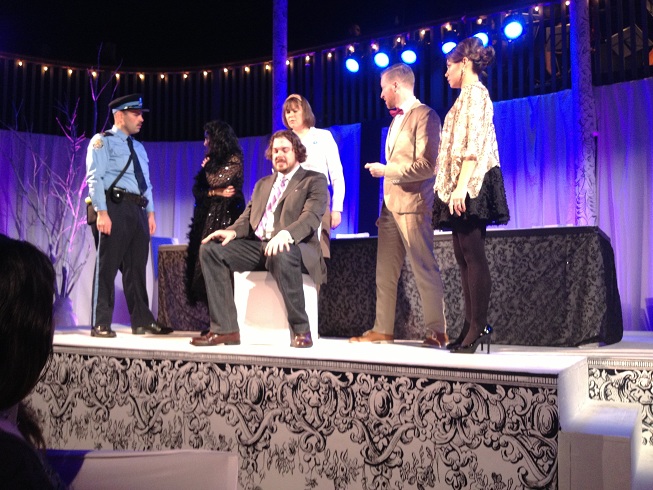
Against the Grain Theatre premiered #UncleJohn, their new adaptation of Don Giovanni tonight at The Black Box Theatre at the Great Hall on Queen St West after workshops out west at the Banff Centre. As much as anything this was the first night for a new concept as well as a new show.

AtG partnered with the Canadian Opera Company and the Banff Centre, and will do so again with A Little Too Cosy, their upcoming adaptation of Cosi fan tutte, to complete their survey of the da Ponte trilogy of Mozart operas. The business model is perhaps more exciting and original than the actual opera presented onstage –which wasn’t too shabby—given that opera is in big trouble all over the world.  Big companies are struggling with big overhead, in the salaries for orchestras, chorus and other staff members. Opera is understood to be the most expensive art form, so naturally this comes with the territory.

Left to right: Miriam Khalil, Sean Clark, Betty Allison and Cameron McPhail

Left to right: Miriam Khalil, Sean Clark, Betty Allison and Cameron McPhail

Or does it? AtG offer something a little simpler. They don’t have a permanent chorus or orchestra, even though they have been gradually tippy-toeing in that direction. While their Messiah last year used a chorus and (if I remember right) their largest orchestra yet, the important point to note is that they have not turned it into something permanent, tying them down with entitlements & pensions. The sound for tonight’s performance was just about right, the small space of the Black Box Theatre filled comfortably by a string quartet plus piano, played by music director Milos Repicky, and no chorus. While the oomph of chorus might be welcome in a few places it would make no sense in Joel Ivany’s modernized story. There are no mass groupings of peasants on an estate, just Torontonians.

There’s no arguing with the business model. It works, or to put it another way, the other one is terribly precarious, depending heavily on private funding and government support. While the government is there in Austria & Germany –where opera has a huge audience and so remains viable—they’re the exceptions to the gradual change to more austere models the world over, Canada included. AtG appear to be in better shape than their bigger parent –the COC—who are in a much more precarious position, balancing huge expenses with revenues from various places. I love the COC orchestra & chorus, but worry about the viability of the company in the long run.

Ivany’s adaptation is every bit as remarkable as what he created with Figaro’s Wedding (first of the trilogy) in 2013. There are aspects that I quibble with just as I did in 2013, yet overall this is new without feeling like Regietheater, where the director is like another author competing or overlaying texts upon the original. It’s simply modernized but still largely faithful to the original text. I don’t want to spoil it for anyone but suffice it to say that almost all the music you know and love is there, including an appearance by the Commendatore in the last scene.

Some of Ivany’s touches are brilliant. By now I cringe whenever I see someone putting a mobile phone into an opera, even if people still titter at the effect. But this time it made wonderful sense when Leporello –who usually disguises himself as the Don to woo Donna Elvira early in Act II—communicates to Elvira through the phone: the perfect modern medium for this sort of dissembling.  Neil Craighead is a messy foil to the tidiness of the Don, the man who gets the most punchlines all night and doesn’t miss once. Putting the entire opera into the context of the wedding of Zerlina & Masetto, with Anna as the daughter of the caterer, helps to make up for the mixed blessing of the venue. At times it was bizarrely real to hear music from the other venue blasting into our space, exactly the way it would if we were in one of those rented banquet halls where so many weddings happen in this city.

The concentration of action around that wedding made some sense, even if it was accomplished at a price, namely reinventing Donna Anna & Don Ottavio without any of the nobility that they had in the 18th century version. It made the new version of “il mio tesoro” one of the highlights of the evening, wonderfully sung and acted by Sean Clark, now more of a soliloquy to anyone who will hear his complaint, concerning his manhood, and probing the numb passivity for which the character is known. Donna Anna became Anna, still a character who seems to have little ability to laugh at herself, making soprano Betty Allison’s job extra challenging.

As a result #UncleJohn shuffles the key relationships ever so slightly. Anna and Ottavio are now a comic pair who seem even lower in the social hierarchy than Zerlina & Masetto; that’s only jarring if you insist that AtG do it as written, a stipulation I’d never make. The two key figures are now Elvira and John (formerly Donna Elvira and Don Giovanni), which is perhaps a reflection of the brilliance of the two performers.

Miriam Khalil’s centrality to the production might be a reflection of her centrality in Joel Ivany’s life as his partner and the mother of his little boy. But she makes the most of every moment, including the most scintillating reading of “Mi tradi quell’alma ingrata”, the big aria that usually tests audiences’ ability to stay awake, coming as it does in the latter stages of the opera. It can seem like an add-on, it can seem like part of the battle between two divas seeking to one up each other. Or in this case, it’s a wonderful affirmation of the empowerment that Elvira is seeking while hoping to redeem her relationship with John, and got one of the biggest ovations of the night.

And speaking of John, Cam McPhail demonstrated a level of star power in his singing & acting that suggests something very radical about the COC Lite business model: that there are wonderfully talented Canadian singers who can actually out-do what you see from the COC. This should be no surprise. It’s an open secret, one that has been whispered in my ear repeatedly since I posted a diatribe about the bizarre spectacle of David Pomeroy’s photo advertising a COC Madama Butterfly sung by a pair of imports who were inferior to the Canadian tenor who was busy singing in Manitoba instead.

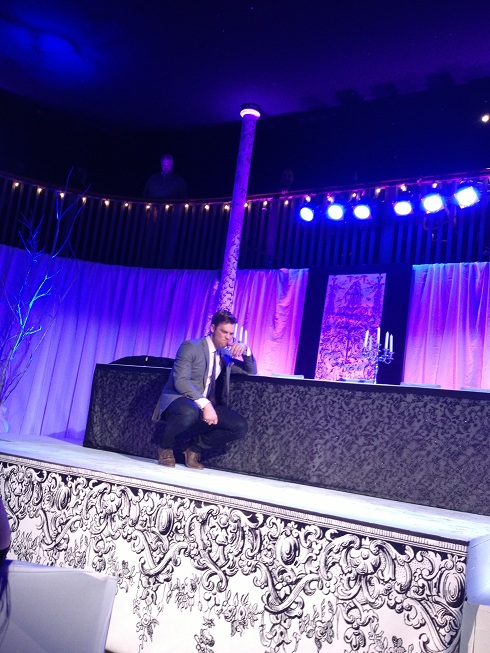
Back to McPhail, this is a very intriguing reading of Don Giovanni –aka Uncle John (no hashtag because I’m speaking of the character this time, not the opera). He’s cruel yet manages to be likeable. His charisma is genuine. The voice has nuances, including two brilliant re-makes of famous arias:

  • the champagne aria –“fin ch’han al vino” –becomes the cocaine aria, and suddenly the quickness of the aria makes incredible sense (and yes it’s the fastest reading i think i’ve ever seen)
  • the serenade by the window –“deh vieni alla fenestre”—becomes a soliloquy about drugs (hm,…no wait, it’s still a love song-serenade, but he’s singing his little love song to the drugs)
Baritone Cameron McPhail

Baritone Cameron McPhail

McPhail carries most of the darkness in the work, more intelligible in his enunciation of the English in this libretto than anyone else in the show, which is a good thing considering he had the most lines by far.  But while he’s the one who goes to the dark side, he’s balanced by John Avey as The Commander (formerly the Commendatore), standing his ground musically and physically in this life and maybe the next.

It’s lots of fun, above all.  #UncleJohn continues December 13, 15, 17 and 19, 2014 at 7:30 p.m, at the Black Box Theatre at The Great Hall.   I look forward to seeing more from this team, and more of this approach to an expensive art form. This business model seems to work.

Posted in Opera, Reviews | 4 Comments

Glenn Gould: extra hands

Thank you Edward Johnson Building library, once again I found treasure in the collection that never disappoints.

I’d grabbed a great mass of scores in anticipation of a couple of gigs, never knowing fully what to play, but wanting to let my impulses lead me.

One pathway of association is the magic of transcription. People sometimes want to hear a tune that they know, whether it’s a pop-tune, a jazz standard, or something classical. There’s an incredible sensation of power in playing something as a piano solo that you’ve heard massively from a full orchestra. This is true whether it’s originally for piano and later orchestrated , (as with Mussorgskii’s Pictures at an Exhibition, a suite that I prefer on piano, especially the last few) or an orchestral piece that’s been transcribed for piano. The most exciting composers I’ve ever experienced in transcription are Berlioz and Wagner, two composers of massive scores that defy easy reduction.

It was in the realm of transcriptions that I found the aforementioned gem.  Perhaps it’s a lost art, but at one time these transcriptions performed an important function. Without a piano transcription it was otherwise impossible to encounter some new compositions. If you were a composer and nobody wanted to play your orchestral pieces, a transcription could help champion your work: which is precisely what Franz Liszt accomplished for Berlioz & Wagner. Nowadays one can easily hear scores on youtube (or of course via various recorded media that you pay for), but in the 19th century? the only way to encounter some music was via a piano reduction.

And that means either you had to play it yourself or hear it played for you. Live music was the only option.

Live performance represented a special nagging part of Glenn Gould’s life. As you may recall, the Canadian virtuoso, famed for recordings such as Bach’s “Goldberg Variations”, made an unprecedented decision to abandon live performance. It wasn’t because he was a recluse or an introvert (although come to think of it, maybe he was those things too, and the personality type was a contributing factor), so much as his preference for recordings, the control he could exercise over dynamics and background noise in a studio. His was a very modern view of music that is in many ways still far ahead of its time.  Recorded music offered a pathway to achieve the perfection one imagines while reading a score.

Let me illustrate further by talking about the gem I found. It’s Glenn Gould’s transcription of passages from Wagner’s Götterdämmerung (or “Twilight of the Gods”). If the opera’s name doesn’t scare you, the published piece is called Morgendämmerung und Siegfrieds Rheinfahrt, or Dawn and Siegfried’s Rhine-Journey. To get some idea of what’s being compressed for the piano, let’s listen to the original. The prologue to Act I of Twilight of the Gods has two scenes:

  • A slow but portentous scene of the three Norns, who weave fate in the dark: and announce the imminent End of things.
  • Sunrise, an exciting duet between Siegfried and Brünnhilde, and after they say goodbye, he rides off into the morning (just to confound fans of westerns, where they ride off into sunsets instead).

The recording that follows is also a kind of transcription from the opera.  In this one Wagner is edited down to orchestra only, without any singing. Now, listen to this full orchestra version, and imagine how you might distill it further by playing all those louds notes as a piano solo.

This is a kind of program music because the music comes from an opera, deriving at least some of its beauty from its story and what it’s signifying. The story? We begin with the darkness that precedes the dawn. After a shift into B-flat and a quiet statement in brass of Siegfried’s motif followed by Brunndhile’s theme in the clarinet, the music begins to grow in loudness & intensity, as if to suggest sunrise, dawn and perhaps two people going out into the day. The lovers are about to say farewell, as Siegfried goes off in search of further adventure. The duet is a kind of pledge of eternal love, building to a climax as Siegfried rides off. Does the music in any sense depict his journey? Or perhaps we’re presented with ideas and themes relevant to the story that’s to unfold. Whatever it signifies, this is especially spectacular when it’s presented by the unique sound of the Cleveland Orchestra brass.

Did you notice the astonishing array of colours Wagner brings to individual moments? That’s part of the challenge for the pianist, who has to emulate 100 instruments of various colours on a solo piano.

The essence of a piano transcription is live performance, the transmission of a composition through a live medium whereby the pianist defies the complexities –for instance, all the notes played by perhaps 100 players suddenly reproduced by one person on one instrument—in daring to imitate and portray something so huge in a compressed and miniaturized form. No wonder then that this was a common pathway for virtuosi, particularly Franz Liszt. While Liszt was a humanitarian in helping out relatively unknown composers (Berlioz & Wagner most prominently, both through his transcriptions and financial assistance, but also as a champion of their work in his own programming), playing such wonderful music made him look good in the process.

Now let’s zip forward to the 1970s. Glenn Gould last played a live concert in 1964. In transcribing he was not celebrating liveness at all, because his transcriptions would be studio entities. Not only would his performances be on record rather than live, but there’s another dimension that’s pure Gould. There are impossible passages where there seem to be so many notes that two hands couldn’t possibly execute the passage, no matter how virtuosic. How could he do it? I wondered as soon as I heard these recordings, and now have confirmation, both from seeing the score that I took out of the library, and after reading the splendid introductory essay from Carl Morey:

Emeritus Professor Carl Morey

Dawn and Siegfried’s Rhine Journey has the unusual feature (shared with and more extended in the Prelude to Die Meistersinger) of having been written for a kind of four-hand duo performance. Gould first recorded the main piano part, then put on ear-phones so that he could hear his own performance and dubbed a supplementary part over the first recording. The final recording thus presented a texture that is complex beyond the capability of even the most brilliant single pianist.

I’d wondered about this when I first heard Gould’s album of Wagner transcriptions, especially the Meistersinger prelude, where the overdub is very clear.

The irony of this floors me. The live performance of transcriptions affirm virtuosity in a live setting, a display for the pure purpose—and exquisite pleasure—of showing off. These big loud pieces are an incredible ego trip to play: except that’s not what Gould wanted. He sought instead to get closer to the ideal text in the book, the reified distilled essence of Wagner, not the live experience of Wagner. That is what the goofy headline is about, that in contemplating an ideal Wagner in the studio far from the crowd, divorced from singers & live performance, Gould creates something that’s not performable live: not without an extra pair of hands, that is.

Here’s Gould’s performance. There are a few seconds missing at the end, but you have the final cadence and a good idea of the piece.  If i had an alternative link to substitute i would.

Gould’s creation (as published in the book i withdrew from the library) is a very playable score, at least until we come to those impossible passages that require you to suddenly grow a third and fourth hand. When one tries the comparable passages in the piano-vocal score (with an accompaniment that’s far from simple) one at least encounters something for two hands, yet even this too can be challenging (and loud!).  Gould’s score is more pianistic, a piece that stands alone.

While we’re at it there’s one hugely important detail I want to mention. As a child I encountered the orchestral excerpt –not the Cleveland one, but another version—without any voices. The piece ends with a nostalgic return to the triumphant E-flat of the beginning that gives the piece a wonderful sense of symmetry and a happy ending. But that’s not how it goes in the opera. Oh no. Siegfried does not happily ride off into the sunset. He dies, murdered in Act III of Götterdämmerung. I can still recall the sense of wrongness I felt the first time I heard the opera, a visceral sense of dread and horror before Act I even begins.

Have a listen (three parts) to the relevant passages from the opera including the vocal parts.
1. Dawn and beginning of love duet:
2. Conclusion of love duet, beginning of Rhine Journey: 
3. Conclusion of Rhine Journey (the key discrepant passage begins at 4:44): 

I believe this discrepancy –between the concert version with its happy ending and the way it flows in the context of the opera—might be one of Wagner’s great achievements. “Might” because I am not even sure it’s his achievement. I understand from my reading that he approved of the excerpts from his operas—that helped publicize his operas—but I don’t know who is really responsible for this insightful ending, going back to E-flat.  I believe that it’s implicit in the music,  that a tone-poem that were affirming tradition rather than seeking revolution would revert to the home key.  I wish I knew more about the creation of the concert piece with its happy ending.

Posted in Books & Literature, Music and musicology, Opera | Tagged , , , | Leave a comment