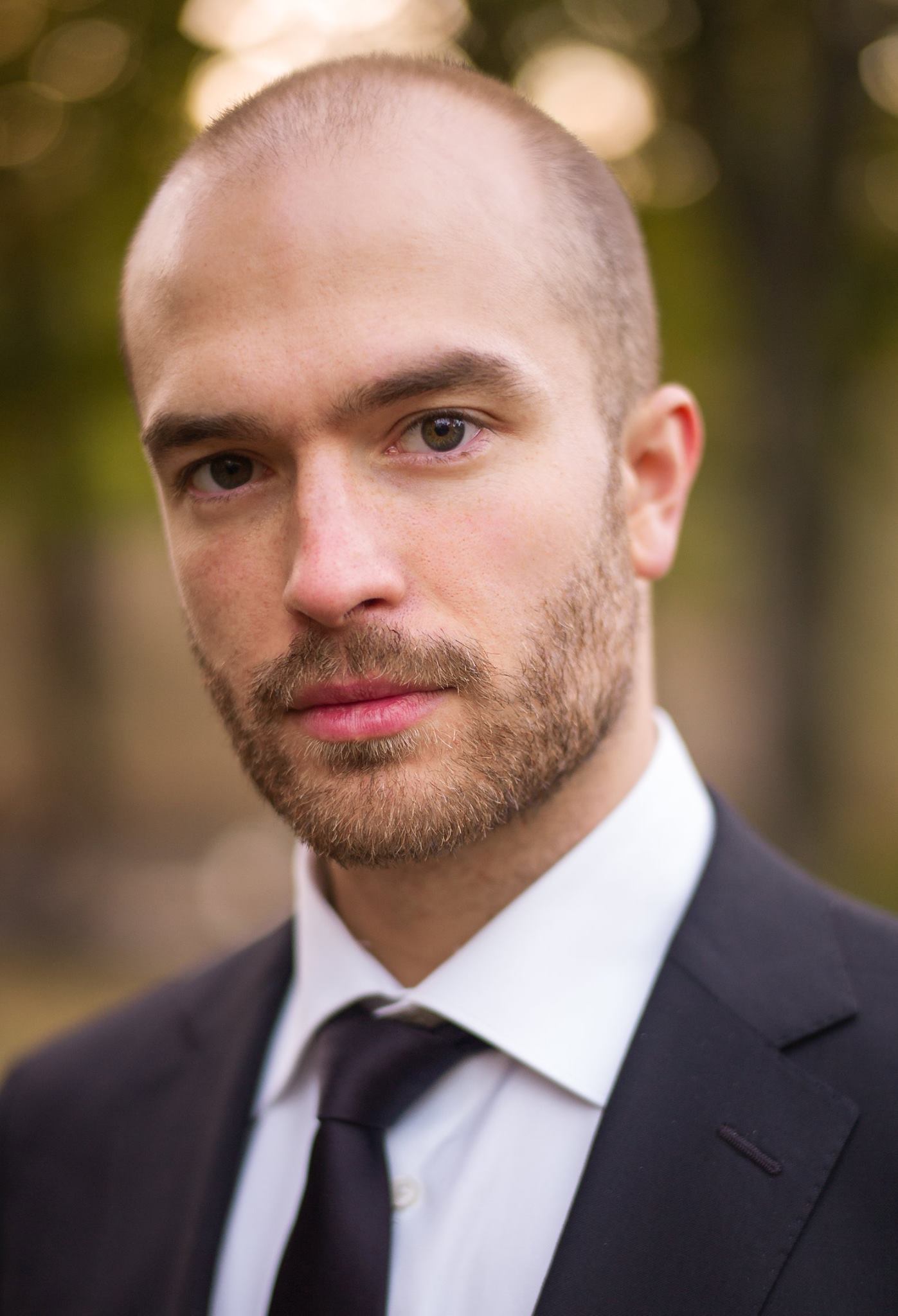
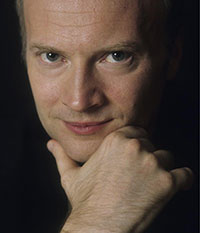
Kevin Mallon, Interim Artistic Director & Conductor with Opera Lyra
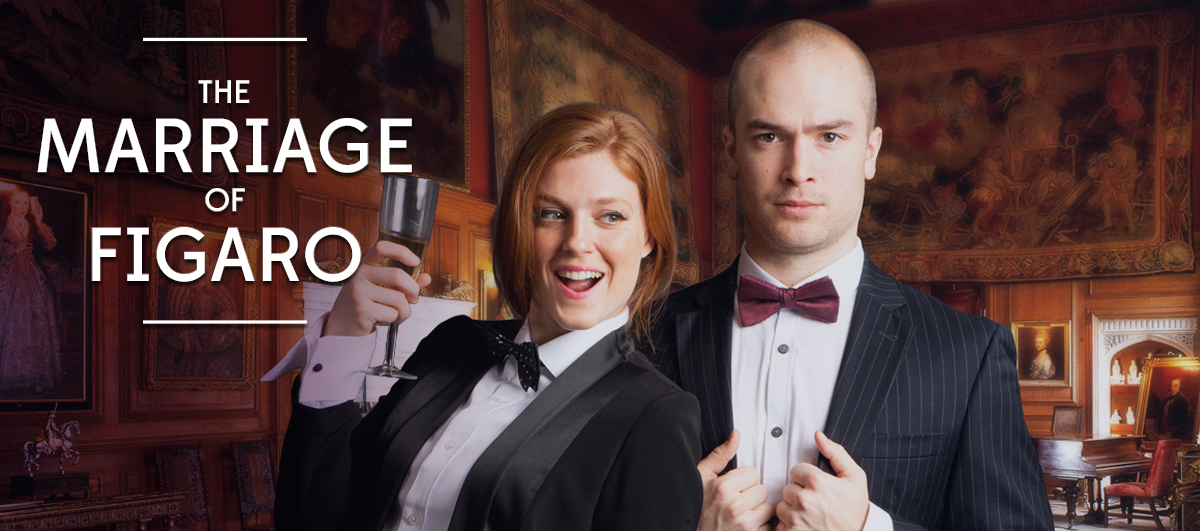
As the climax of their thirtieth season Opera Lyra present Mozart’s Le nozze di Figaro, beginning with tonight’s opening performance. This is an opera company that has come back from the brink, bouncing back from financial difficulty with a series of smart productions. Kevin Mallon is the Interim Artistic Director as well as the conductor.
I had to go to Ottawa to see & hear for myself, hopeful that the company was rising again under Mallon’s clever influence, and yes, enticed by the casting, which was almost 100% Canadian.
I have to quote James Westman from a recent interview:
We have a massive tradition of opera in Canada. It stems from the profound tutelage of the University of Toronto Opera School that was created from talented Italian opera ‘refugees’ after WW2. Most people do not realize that Canada produces more professional opera singers per capita than any other country in the word. Canadian singers have been representing Canada with excellence for many years.
For example, this afternoon’s Met broadcast of Manon featured three Canadians (Russell Braun, Robert Pomakov and Mireille Asselin). Our talent goes all over the world, so why not in Ottawa?
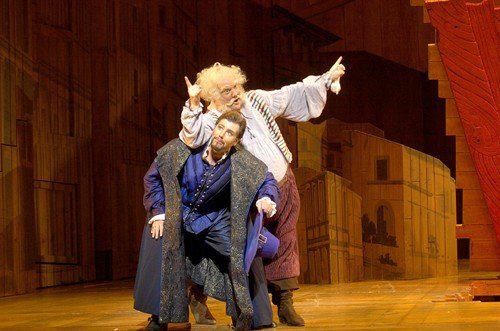
As you may have read in some of the other pieces I’ve posted recently in anticipation of my trip to Ottawa (such as interviews with Westman and John Brancy as well as a piece showing photos of the cast), the design concept of the production set Mozart’s opera in the period of Downton Abbey, aka Edwardian England. And so for instance when Dr Bartolo will usually sing his aria “la vendetta”, including the lines “all Seville knows me, I’m Doctor Bartolo”, in this version that becomes “all England knows me, I’m Doctor Bartolo”. Or when Cherubino is given a commission by the Count to join his regiment, the uniform is from that time.
I can give you several reasons why you should see it, starting with the simple fact that it’s a good production. Director Tom Diamond grounds the action in real motivations, making the interactions sometimes very serious and intense, even if there’s lots of fun to be had. A few moments might illustrate why it’s so special, from a cast that’s strong from top to bottom.
I was caught by surprise watching the moment in a sextet in the third act when Susanna is told that Marcellina is Figaro’s mother, and Bartolo his father. I’ve seen this so many times I didn’t think I could be surprised, especially in a production that’s ostensibly faithful to the text. Sasha Djihanian in her role debut as Susanna did something quite different from what one usually sees. Marcellina (Lynne McMurtry) wants to embrace Susanna as her mother (having just realized the family relationship with Figaro, Susanna’s intended), leading to an exchange that can get quite silly, as Susanna says “sua madre?” (or “his mother”), Bartolo, the Count, Don Curzio and Marcellina reply “sua madre” then she asks Figaro “sua madre?” to which he replies “E quello è mio padre che a te lo dirà.” (or “and this is my father he’ll tell you himself”). The back and forth is already mechanically challenging, so that it can (and often does) become quite wooden in some productions. What I saw this time that was so different was that Djihanian sustained the puzzlement for the entire exchange, while the questions shot back and forth, showing much more truthfulness in this exchange than I’ve ever seen, while building simple suspense, making the resolution of the ensemble into a moment of great pathos and vulnerability.
Djihanian, who’s just finished her run as Zerlina in the Tcherniakov Don Giovanni in Toronto, was taking on this role for the first time, with a beautifully expressive face and natural unaffected delivery, completely believable as the figure at the centre of the story.
Her Figaro was John Brancy, a warm baritone whose friendly manner keeps the story light & funny, without too much emphasis on class struggle. Similarly, James Westman’s Count, while an imposing physical presence (my wife said he reminded her of “Big” from the TV show Sex and the City) with a wonderful voice also chose to emphasize the comical side of the story. Westman’s reading interpolated a great number of high notes into his da capo verses, apparently drawing on suggestions from authentic sources suggested by conductor Mallon. His Countess was Nathalie Paulin, who balanced the light-hearted elements of the show with depth in her arias lamenting the passing of love in her relationship.
The other key role in the opera is Wallis Giunta’s Cherubino. We’d already seen her remarkable trouser performance in La Clemenza di Tito of a few years ago when she channelled Michael Cera. This was entirely different, sung with great authority & confidence, while played with a physical flamboyance that made her every appearance an occasion for laughs, the one you couldn’t help watching.
But there were several more excellent portrayals. Peter McGillivray was his usual talented self, singing perfectly as Bartolo while having several sparkling comic moments. Lynne McMurtry, whom I already mentioned, was a three-dimensional Marcellina, including the rarely performed Act IV aria. Johane Ansell made more of the small role of Barbarina than anyone I’ve ever seen, including a compelling reading of the aria that opens Act IV. Aaron Ferguson made the most of his two roles as Basilio and Don Curzio. And Sean Watson was a surprisingly strong Antonio.
Mallon’s reading was energetic for the most part, bringing the opera home in a very respectable three hours with an intermission, his cast decorating their parts with many attractive interpolations. The National Arts Centre Orchestra are a wonderful ensemble who sounded superb in this space. Diamond’s Figaro is completely straight-forward and without any directorial overlays, and totally intelligible while avoiding cheap laughs, always grounded in the feelings of the story.
Opera Lyra’s Le nozze di Figaro runs until March 28th.
*******
As a postscript there was a joyful announcement at the post-opening reception that drew a huge scream of joy from all present when it was announced that John Brancy (Figaro) and Wallis Giunta (Cherubino) are now engaged to be married. Mazel Tov!
Everything about the presentation of Bach’s St John Passion by Tafelmusik Baroque Choir & orchestra at Trinity St Paul’s Centre seemed fitting.
You are in a church. The space has been somewhat converted for the use of the offspring of this congregation such as the Toronto Consort (whose artistic director David Fallis is or was a member of the congregation) and Tafelmusik (whose bass player & concert conceptualizer Alison MacKay –Fallis’ partner– also has connections to the church), yet is still very much a church. The colossal pipes confront you as you enter, the hymn numbers still posted. Even when the place is full as it was tonight, it’s never secular.
The approach is meant to take us back to 1749, using a version from late in Bach’s life. In Bach’s time the soloists would also sing the choruses: and so they (soprano Julia Doyle, countertenor Daniel Taylor, tenor Charles Daniels and baritone Peter Harvey) did just that, placed upstage of the tiny orchestra (sixteen players), but just in front of the small chorus (twenty-two voices). Ivars Taurins conducted the choruses with his usual exuberant plastic eloquence, but allowed arias to proceed more or less via the dramatic exchange of glances rather than his intervention.
For something taking two and a half hours, with a brief intermission, it flew by, taut and urgent from beginning to end. For anyone who thinks they know this piece, I urge you to attend if at all possible (continuing until Sunday March 22), as this is not the work I thought I knew. I coached a tenor long ago –indeed he was a COC ensemble member—in the role of the Evangelist, who has a very large part. It’s brand new to me in this account, particularly because of the elegance of Charles Daniels’ subtle reading of that crucial role.
Tenor Charles Daniels (click for the Charles Daniels Society. I share their enthusiasm!)
Two of his arias are especially challenging. “Ach, mein Sinn” requires a phenomenal command of the words, a delicacy of delivery, flexibility, a willingness to trip lightly over some notes while agonizingly declaiming others. Daniels sang it very lightly, very easily, a work of great drama precisely because he wasn’t over-working the voice or over-dramatizing. I was very much in awe. The second aria was more of the same even if it’s not quite as daunting, namely “Mein Jesu, ach!”, another subtle combination of emotions in one brief little package. Daniels’ performance alone is reason to go see this wonderful work. Don’t mistake me, while the other soloists were also good, their parts combined are roughly as long as the part of the Evangelist. AND Daniels also sang the choruses. Peter Harvey was a warm sounding baritone, particularly as Jesus, while Julia Doyle’s soprano and Daniel Taylor, countertenor, each had wonderful solos.
Tafelmusik chorus & orchestra are among the greatest treasures of this city, especially on the nights when Taurins is conducting: a musician of great commitment & integrity. This is a performance that does not dishonour the church nor the Christian origins of the story by being overly operatic or performative, entirely suitable for your Lenten meditations.
Tafelmusik Chamber Choir, directed by Ivars Taurins (left foreground). Photo by Cylla von Tiedemann
A young baritone who genuinely seems to be on the verge of an exciting career. I’ve never seen him in person, just through the miracle of modern technology. He’s more than just a pretty voice & a handsome face.
And here’s another example of that voice.
In a season with the title role in a new opera (Tobias Picker’s Fantastic Mr. Fox), and Papageno with Edmonton Opera, his next stop is with Opera Lyra Ottawa as Figaro in Le nozze di Figaro. On the occasion of his “wedding” in Ottawa this weekend, I ask him ten questions: five about himself and five more about portraying Figaro.
1-Are you more like your father or your mother?
Well – I have to say I am more like my mother than my father when it comes to being a performer, but the way I live my everyday life tends to be a bit more like my father now that I think of it. As a performer, I am outgoing and charismatic – I get along with just about everyone and really enjoy being up on stage. I also have a great ability to make and keep friends (I am still in regular contact with a lot of my childhood friends – I even run a snack food company with two of them!) and this is definitely an aspect about me that has been passed down from my mom. But as I’ve gotten older I find that when it comes to work and dedication to my craft, my father really begins to shine through. My Dad is a pilot, so in a sense he had to perform at an extremely high level as well as be very dedicated and organized to make the most of his job. At the end – I’m probably just an even mix of both, but who knows who I’ll be more like when I have kids!
2-What is the best thing or worst thing about being an opera singer?
Best thing about being an opera singer for me is two things -1. Getting the chance to perform for a living and be paid for something I absolutely LOVE to do and 2. Seeing the world through a very specifically beautiful lens, all the while making new friends. I absolutely love to make new friends and some people I’ve recently met at companies I’ve only briefly worked at have become life long friends. It is a beautiful thing.
The worst thing about being an opera singer is definitely the lack of security and stability and the “on the road” lifestyle. I think if you ask this question to the majority of opera singers they will give you the same answer. After months on the road, all you really want is a place you can call your own and some basic security and stability. I guess this is what we sacrifice to have the chance to live this unique experience.
3-Who do you like to listen to or watch?
If we’re talking Opera – my favorite performer at the moment is Gerald Finley (an Ottawa native!). I first caught wind of Gerry when I began my studies at Juilliard in 2007, when a YouTube clip of him singing the Doctor Atomic (by American composer John Adams) aria “Batter my heart” began circulating throughout Juilliard like crazy.
I was so enthralled by his performance, however at the time I hadn’t heard much about him. He quickly grew to be one of my favorite artists to listen to, and watch – I feel he embodies so much of what the “singing actor” is. From his clips of singing Papageno on YouTube (when he was still in his twenties), to his recordings of lieder and song with his pianist, Julius Drake – I totally appreciate and enjoy everything he offers as a singer and artist. He is also an incredible mentor and teacher, and I look forward to any chance I get to explore my repertoire and instrument with him.
4-What ability or skill do you wish you had, that you don’t have?
I wish I had more skills in regards to construction, artisan carpentry and home building – my Dad is definitely a “Mr. Fix it” who, when I was growing up would constantly be fixing up our house or cars when it was needed. He certainly gave me a lot of “tools” to use on my own, but since I ended up being an opera singer with no car or house, my life is so mobile and different that I hardly ever get a chance to apply and practice them. However, I do hope to someday to settle into a home somewhere (whether it be the US or Canada, I’m not quite sure yet) and really understand the inner workings of it all. I’d also love the chance to even design and build my own house – something that could incorporate a sustainable infrastructure and an indoor garden to produce the majority of my food throughout the year. This would be an ideal situation, but will certainly take time and planning to make possible!
5-When you’re just relaxing and not working what’s your favourite thing to do?
My favourite thing to do (outside performing and singing) is cooking – I love to get into the kitchen and whip up a few awesome dishes for the week or for some friends. I have found more and more that being in the kitchen is a meditation for me, where I can completely zone-out. It gives me a mental break from learning music, running my businesses, or anything else that might be putting on pressure. It also gives me immense joy to cook for people and see them enjoy what I’ve made them. I love cooking all kinds of food, but recently I’ve been focusing on eating a more plant-based diet – lots of fresh salads and vegetable curries/stews and healthy smoothies in the morning. There are certainly benefits to eating meat (high in protein), but I am very picky about where I source it and how the animals were raised. It is extremely important for our bodies and our environment as well as for the animal to know your source – so that is why I always choose grass-fed and pasture raised options when possible.
*******
Baritone John Brancy (photo: Gerard Collett)
Five more about taking on Figaro in Mozart’s opera.
1-Please talk about the challenges of singing Figaro.
At first, I was afraid Figaro was going to be 1.Too much singing 2.Too low for my voice and 3. Not the right character for me. As it turns out, none of these fears have manifested, in fact I love Figaro and how similar he is to my own personality, and the amount of singing and how beautiful some of it is, as well as the tessitura of the role. Within the past year I have been exploring a more “adult” sound with my voice (without losing its bright, youthful exuberance) so Figaro was just the right role to help ease me into this space, vocally.
One major plus was being able to work with a master such as Tom Diamond, our director; he has been an extremely educational, commanding and fun personality throughout the entire process. He is a seasoned director and has worked on the Marriage of Figaro now five times. It has been such a pleasure to discover the character with him and all of my wonderful, super talented colleagues.
2) The Marriage of Figaro is a mix of comedy & class-struggle, with a hint of romance & heart-break in the mix. Where do you like to place the emphasis in your portrayal?
Our production is based on the BBC show “Downtown Abbey” – the set, the costumes, and of course the time period (Right around WWI) in which it takes place. The themes I most connect to in this show are the class struggle mixed in with a dash of comedy and a dollop of heartbreak and romance. At this point in the play Figaro has already done so much for the Count and Countess to help them along in their love story together, so it comes with major surprise when he finds out about the Count’s intentions towards Susanna, his wife to be. I think setting it during this time period makes a lot of sense and really lends itself well to the upstairs downstairs theme, which is so clearly evident in Downtown Abbey.
When I’m playing Figaro, I constantly need to shift between scheming and playing the role of the servant, buttoned up in my tuxedo tails, ready to serve “my lord”. It’s a balancing act, but having these elements helps bring an extra layer of insight and color to my character. However, right before the Act III finale, I lose my temper and cannot hold in my frustrations any longer; after all, the Count is delaying our marriage and in a sense ruining what should be the best day of our lives.
3-Do you have a favourite moment in the opera?
Musically, my most favourite moment is when Figaro sings the line “Tutto e tranquillo e placido…” – Mozart really tapped into something special in this music and for me it is the first time in the opera where the audience sees the more tender side of an otherwise witty and willful character whose music is very rhythmic and sharp edged for most of the opera.
Dramatically, from the moment I enter to the moment I leave in the Act II finale I am having an absolute blast. This is where Figaro really gets to play front and center and become a more integral role in the opera and the plot. The scene embodies the genius of both DaPonte and Mozart, giving each character their moment to shine and also playing with the all the elements of the story in very different and imaginative ways. It is just so much fun to sing!
4-As Opera Lyra reinvents itself this season please talk about opera in the 21st century.
I am excited to see what happens with Opera Lyra in the coming season – I think their choice to expand their season’s offerings and explore new types of repertoire in different venues is a very smart move, both financially speaking and in order to bring in a more diverse audience. I believe Opera companies and Opera in general need to embrace this flexible and creative mindset when it comes to programming and community involvement in the 21st Century. I believe one of the key factors in future audience growth lies with performing for students and kids.
My involvement with the company does not end with Figaro this season – Operation Superpower (a Superhero Opera for young students and their families) is going to be making its Canadian premiere with not only Opera Lyra but also the Canadian Opera Company in Toronto in fall of 2015. I co-wrote Operation Superpower alongside composer Armand Ranjbaran, baritone Tobias Greenhalgh and pianist Peter Dugan while we were all still attending the Juilliard School in NYC. It took several years to put the program together, but in 2013 we toured it to over 100 schools for upwards to 20,000 students in New York, New Jersey, Connecticut and Pennsylvania and had great success. Now Operation Superpower is making it’s way into Canadian schools and I couldn’t be more excited and proud. I think this show has the ability to do a lot of things for the companies that are able to present it. It engages the students on a much deeper level than just the music – it inspires the students to discover their very own superpowers (their talents!) and incorporates core curriculum and character building elements as well. It functions as equal parts opera and motivational program and requires a very special type of artist to perform it.
The opera singers required must have a keen sense of what it means to perform for kids and also feel a strong innate social responsibility and want to bring classical music to schools. Operation Superpower has been a major success for us in the past, so I know that these highly professional companies are going to make it into something that much more special.
5) Is there a teacher or an influence you’d care to name that you especially admire?
There are several people in my life, who have been influential and special to me as a developing artist, but one woman has been specifically special and that is Mezzo Soprano Wallis Giunta, my partner of five years. Wallis has been supportive and understanding in all facets of my life – when it comes to my aspirations in and outside of music and in the everyday. She is a sounding board for all of my crazy ideas and she really enjoys my cooking, which is important. I am most happy when I get to share the stage with her in a show; so naturally I have Opera Lyra to thank for giving us a chance to do exactly that, as she is playing Cherubino in our current production. Wallis is a supremely talented artist and I look up to her in so many ways. I feel like the luckiest guy to have found such a partner and I treasure every minute we have together, even when we are on opposite sides of the world (Thank God for Skype!).
******
Aha, now I begin to understand some of the chemistry in this photo—between Wallis Giunta & John Brancy..! It’s coming to the National Arts Centre this weekend, opening March 21st and running until March 28th.
Mireille Lebel is reliving that classic Canadian phenomenon, a singer missed at home while she’s off in Europe making a name for herself, most recently at Theater Erfurt, Theater Basel and Opéra Théatre de Metz, adding role after important role in the mezzo repertoire including Cenerentola, Cherubino, Sesto, Idamante, Nerone and Carmen.
This year, Lebel makes débuts at the Prague State Opera as Carmen, at Festival d’Aix en Provence in Svadba and returns to Opera Atelier in her role début as Orphée in the Berlioz version of Gluck’s Orphée et Eurydice. On the concert platform she will sing Handel’s Messiah with The McGill Chamber Orchestra, the New Jersey Symphony and L’orchestre symphonique de Trois-Rivières as well as take part in a Bach Cantatas project with Les Violons du Roy.
After an impressive debut at Opera Atelier as Annio in La Clemenza di Tito (for example the video!), Lebel returns to OA next month in the title role of Gluck’s Orfée et Eurydice, the occasion for asking her ten questions: five about herself and five about her portrayal of Orfée.
Mezzo-soprano Mireille Lebel (click photo for more details)
1-Are you more like your father or your mother?
Publicly like my mother and privately like my father. My Mom has this unbelievable intensity and let’s things fly in a totally uncensored and sometimes outrageous manner. I feel she missed her calling as an actress! I think it is her way of always showing her hand that taught me to be so open and go no holds barred onstage. My Papa is a deeply reflective and introspective person. A listener, an observer. And when I am not onstage, I flip into this mode.
2-What is the best thing or worst thing about being a singer?
Well, the lack of routine is wonderful! I love that. For me this is not really a job, it’s a passion and it totally dictates how I live my life. There is always that thing (the voice) requiring constant attention. It is exciting to keep working on the voice, and feel it grow and change. But there are sacrifices too. During a contract I basically foreswear the little pleasure of life – which for me are big pleasures! Talking on the phone, talking in general, espresso in the afternoon, eating past 7, drinking martinis are all out. The good thing is, when I finish a project, be it an opera or a series of concerts, I try to plan some time before the next thing. Then you are a free bird. You can sleep until noon, you can meet friends and caffeinate yourself to high heaven, talk loudly in a bar until 2 am. Whatever you want. Your time is your own.
3-Who do you like to listen to or watch?
I am alone A LOT so I have tons of time for this kind of thing! I scour Goodreads for book ideas and always have several on the go. Right now Do no Harm (the memoirs of a neurosurgeon) and The White Tiger. The television series playing right now are
RIDICULOUSLY good. I love Game of Thrones, The Affair, The Good Wife, The Fall, Fargo, The Americans, House of Cards (Too many to name!) When I am sad, when times are hard, when I want to feel good, I listen to Bach, to Handel, to Britten, to Piazzolla… I am always discovering a new piece music that brings out intense emotions! I was jogging to Dolly Parton this fall and I do Youtube the bejesus out of my favorite singers (who shall remain nameless because I don’t want any singers I don’t name to be jealous).
…Ok, twist my rubber arm I will name “Christmas Greatest songs” from Analekta with Lyne Fortin and the Petits Chanteurs du Mont-Royal. I listen to that disc year round and always send a slightly tipsy message to Lyne at the beginning of December telling her she made my Christmas. I’ve been doing this to her since 2009.
4-What ability or skill do you wish you had, that you don’t have?
The ability to keep things to myself.
5-When you’re just relaxing and not working what is your favourite thing to do?
Well, I relax a lot even when working because I have so much time alone, but the things I like to do when I don’t have to maintain such a strict discipline are meet with family or friends in restaurants or bars and laugh a lot and talk loud!!!!!! I also like going to the beach or park or on a hike with a picnic and some wine. And I love to start drinking that wine a little after noon in the hot sun and then take a dip!
Mireille Lebel (Photo: Pierre−Étienne Bergeron)
*********
Five more concerning Opera Atelier’s upcoming production of Orfée et Euridice
1-What are the challenges in the role of Orfée?
With Orphée it is a question of concentration and coordination. I don’t know how it would feel to play him in another production… In this production , there is extremely tight, detailed, and intense choreography which in itself requires a lot of focus. Within that structure I have to find the naturalness of the emotions. And then I have to sing! So, it’s about having enough brain space and coordination to be playing on these three levels.
2- Your work as Annio in La Clemenza di Tito a few years ago with Opera Atelier was one of the most impressive portrayals of its kind I have ever seen. And here we go again with another trouser part. Could you talk about how you approach playing a male, both singing & acting?
Thank you! I love trouser parts. They feel amazing. When I started my career I had to think about male body language a great deal. I studied the way men moved, the way teenage boys moved. I did a workshop where I actually prowled the streets of Berlin as a man, which was terrifying as I thought I was going to be beaten up (didn’t happen!) All that helped me develop a vocabulary. My goal is never to convince the public I am a man but rather to draw on the masculine energy that is already inside me and just let it out. In this production there is not going to be any butch strutting! It is a subtle masculinity.
Mireille Lebel (standing) as Orfee and Peggy Kriha-Dye (Euridice)
3- Opera Atelier are known for historically informed performance. Please talk about what it’s like working with Marshall Pynkoski, David Fallis and the Opera Atelier team.
Oh God, those guys?! (Eye roll) Ha ha. It’s actually kind of amazing to work with people who care so much about the piece and the public. Marshall is a fascinating personality and artist. He is extremely precise in his casting and puts endless thought into the personalities of each artist and the results of them coming together onstage. (Not to mention endless thought into the whole production.) David is such an intelligent, versatile musician and writes us twiddles (that is the official name for them-I swear!) and always has interesting suggestions for phrasing or tempi.
Soprano Meghan Lindsay (Amour)
Yes, it is historically informed, and yet it feels like we are working on a premiere. The incredibly talented Peggy Kriha-Dye (Euridice) and Meghan Lindsay (Amour) work with the company regularly and along with Marshall, David, and the wonderful people behind the scenes, it is a tight knit and supportive team. I feel supported, I feel like I can take risks, I feel very luck actually!
4-Please put your feelings about opera and the preservation of classical culture into context for us.
Music is my religion. Nothing arouses such emotion in me. I don’t want anyone with a heart and brain and soul to miss out on the feelings classical music provokes. It would be SUCH a great loss.
Mireille Lebel (Photo: Pierre−Étienne Bergeron)
5-Is there a teacher or an influence you’d care to name that you especially admire?
Wow. So many. I will name four incredible teachers who I worked with intensely, my teacher in Vancouver, Gillian Hunt, my teacher at the University of Toronto, Jean MacPhail, my teacher at the Université de Montréal, Catherine Sévigny and my current teacher, Scottish soprano Marie McLaughlin. I find inspiration in so many singers, directors and conductors working today. There is a lot of talent out there and some amazing things happening!
*********
Opera Atelier’s production of Orfée et Euridice opens April 9th at the Elgin Theatre, running until April 18th. (click for further information)
If identity is performative, a mere construct that we enact, the demonstration of such notions would be wonderful material for the theatre. And so it is when we come to Dominick Argento’s 1971 opera Postcard from Morocco, currently on offer at the Opera Department of the University of Toronto.
The opera comes from the liminal world of travel, of people who are not actually in their lives but instead in between. We never know whether these stories—as in any exchange with travel companions—are true or false. Do we trust their stories? Do we perhaps see their personal belongings as invitations to discover entire voyages, fanciful or true? I am recalling a trip I took to Guelph long ago, seeing Postcard from Morocco, meeting the charming composer: who as far as I know is still alive. Did it really happen, it’s so long ago I can scarcely recall. Can you believe what you see, what you hear or read? Whether you’re traveling or seeing opera or reading a blog: you never know what’s real, what’s genuine. And what’s an invention.
Director Michael Cavanagh
Michael Cavanagh’s direction and Fred Peruzza’s design dare us to doubt, happily problematizing what we see and hear, by pushing everything in the direction of pure theatricality. The orchestra is visible onstage complete with fezzes and Moroccan attire. We’re on the Brechtian rather than the Wagnerian side of the equation, where the machinery is largely visible rather than concealed, where the viewer is encouraged to notice that everything is illusory, that nothing is real.
That small orchestra, smoothly led by Les Dala, ranges wildly from operatic discourse to a jazzier sound including a flamboyant drum solo from Sam Kim. It’s a fun & eclectic score that –while we’re speaking of travel—includes a section called “souvenir de Bayreuth”, taking several tunes of Wagner and twisting them inside out.
Conductor Les Dala
The work is double cast, with a final performance still to come Sunday March 15th at the MacMillan Theatre. There were several standouts tonight. Charles Sy as the man with the paintbox displayed the gentle tunefulness recently heard in the COC Ensemble competition that he won back in November. Alessia Naccarato had a suitably ironic delivery as the Lady with a Hat Box, while showing a more guileless aspect as the Spanish Singer. Danika Lorèn sparkled as the Lady with a Hand Mirror, and was quite lovely in her duet with Marcel Entremont as operetta singers. Gwenna Fairchild-Taylor as the Lady with the Cake Box was pushed in a somewhat comical direction by the production but she sang with great conviction & pathos.
I wish I could see the other cast. I’m sure it’s worthwhile whoever is singing this fabulous score. Go see it if you can, Sunday at 2:30.
It was a rare performance by the Toronto Symphony tonight, inspired by guest conductor Gianandrea Noseda and the presence of soprano Adrianne Pieczonka. I can’t recall the last time they played with so much commitment, going back over decades of listening, a concert with several highlights whether you’re a fan of vocal music or pure symphonic repertoire.
Noseda & Pieczonka gave us a very subtle reading of Richard Strauss’s Four Last Songs, after the TSO gave us Casella’s Italia. The contrast was quite marked, between the musical vernacular on display in the Casella and the more rarefied language of the songs. Noseda extracted a wonderfully unpretentious & boisterous opening that made the Strauss sound like chamber music in comparison.
Conductor Gianandrea Noseda
Noseda’s tempi on the night were wonderfully energetic. In the songs I’d say we were going faster in all four than, for example, the George Szell recording with Schwarzkopf. Frühling was a reading of subtle mystery—or so it seemed after Italia—with a marked delicacy to Pieczonka’s sound. Even ascending to her high B she was floating her sound against a shimmering orchestral backdrop, her sound easily heard but wonderfully restrained. For September the voice emerged from the orchestra like a jewel against velvet. A fuller sound opened Beim Schlafengehen, leading us to Jonathan Crow’s magisterial solo, ascending like the soul itself, followed confidently by the soprano’s voice. She did not push out the last notes as some do – “zu leben”—but thoughtfully intoned them, seeming to be moved (I am sure I saw her dab her eye at this point, at which point i lost it). And Im Abendrot brought us home with further restraint. To this point I was a bit confused about Noseda, having heard his raucous approach to the opening piece followed by the most subtly conducted Strauss Four Last songs I’ve ever encountered.
After intermission it was time for something completely different. I saw we were to get the “Prelude and Liebestod”: ostensibly from Tristan und Isolde, but actually two pieces usually done as a single piece. We began with Noseda leading the orchestra and no soprano on stage. Hm I wondered how that was going to work, but forgot the question in the outpouring of sound from the TSO. As you may have noticed before, I far prefer quick readings of Wagner which I understand to be more authentic than the lugubrious readings some have attempted, that were for a time fashionable in the 20th century. Give me Luisi instead of Levine, Bohm rather than Karajan. For me the Tristan prelude was the musical highlight of the evening.
Adrianne Pieczonka (photo: Bo Huang)
And then as we came to the last page of the score, Isolde –that is, Pieczonka—wandered onto the stage looking mildly despondent, but finding a more joyful expression as she unexpectedly began to sing with no introduction, just the abrupt modulation from the prelude (an impressive feat in and of itself). Pieczonka sang with the confidence of a true hochdramatiche, showing no signs of distress whatsoever. While we shouldn’t mistake this + the 4 songs for a full Isolde, and an indication that she’d find it easy, I do believe Pieczonka could undertake the role. The orchestra on the Roy Thomson Hall stage is not the same as an orchestra in a pit, which would be more subdued in its sound, especially if the conductor for that occasion were mindful of his Isolde. This time? Noseda did not overwhelm his singer, but did draw a big full sound from the TSO. Does Pieczonka need to undertake this role? Good question. The sound she makes is magnificent in so many roles in several languages; she doesn’t need to attempt Everest, welcome as it might be to hear her assay such roles.
Noseda followed with a crisp & energetic reading of Beethoven’s Seventh Symphony, drawing exquisite playing from the TSO. At times we were in a place of wild abandon, and so I didn’t mind a couple of fluffs, considering the emotional commitment, the rhythmic vitality of the playing, and the sharply delineated features Noseda was able to etch into the sound. It’s a great reminder to me of what this orchestra can do, after having heard Beethoven from Tafelmusik and Wagner from the COC’s orchestra. It’s the best TSO performance I’ve heard in awhile.
The program will be repeated Saturday March 14th at 8:00 p.m.
Tonight’s concert at Trinity St Paul’s Centre felt like an experimental combination of elements, and when I say that I mean it in a good way. I like ambition, I like new perspectives & different approaches to works I’ve known a long time.
Tenor Bud Roach
Bud Roach’s group Capella Intima—without a guitar in sight—collaborated with Gallery Players of Niagara on a program combining Purcell’s best known opera —Dido and Aeneas–with shorter works by Purcell and at least a few light pieces you might never expect to find on such a program.
“The Longitude” by Benjamin Cooke is a “glee”, a multi-part song. While originally they were sung by men we don’t have to be held back by such rules in the 21st century. Hearing this I suddenly understand the attraction of glee-clubs. Here are the lyrics, attributed to Jonathan Swift (and don’t be upset if it makes no sense, as there’s a story to explain it all):
The longitude: Missed on by wicked Will Whiston, And not better hit on by good Master Ditton. So Ditton and Whiston may both be bepissed on, And Whiston and Ditton may both be beshit on. Sing Ditton beshit on, and Whiston bepissed on. Sing Ditton and Whiston, and Whiston and Ditton, Beshit and bepissed on, bepissed and beshit on.
This was on the same program with two pieces from Purcell’s birthday ode for Queen Mary (“Sound the trumpet” and “Strike the viol”) Come, Ye Sons of Art. Instead of counter-tenors we heard male voices, which actually made for an interesting effect (better? not sure… but a worthwhile experiment) when singing of and for once emulating the trumpet’s sound.
I’m reminded of the simplicity of Roach’s CDs in presenting Italian songs with guitar. There’s a brashness there and again tonight in the willingness to combine these disparate materials. It feels as though disciplines are being combined, in the meeting of something popular and something classical. I may have mis-spoken in what I posted yesterday writing about the CD Dowland in Dublin, by La Nef & Michael Slattery, calling them inter-disciplinary, when in fact what I felt was the energy of crossover. That’s clear to me tonight, in the way Roach comes at Purcell. I’m disoriented by him because he can sing baroque (and play it too if his guitar is available) yet has the unpretentious approach of a pop singer. He has none of the stodginess one sometimes encounters in classical music, perhaps because he’s having so much fun. The fun was certainly contagious in some of the scenes of the opera, particularly when Roach’s Sorcerer took the stage.
As he explained the project to us, it was in the meeting of the two organizations (Gallery Players and Capella Intima) that the magic –whether we want to think of it as crossover or unpretentiousness—happened. The original proposition, which was somewhat outside Roach’s usual comfort zone, was to present a well-known opera, namely Purcell‘ s Dido and Aeneas. That was the second half of the program, with the first half an eclectic mix of instrumentals and vocals.
No wonder that the miniature concert version of Dido and Aeneas that followed felt so fresh. Five vocalists undertook all parts, Jennifer Enns Modolo a very direct and eloquent Dido, David Roth a suavely understated Aeneas, Emily Klassen & Sheila Dietrich both brilliant at times, and Roach as an over-the- top sorcerer & sailor. I’m still humming inside from so much lovely sound throbbing in the Trinity St Paul’s warm acoustic. The five Gallery players –Rona Goldensher & Julie Baumgartel, violins, Brendan Chui, viola, Margaret Gay, cello and Borys Medicky harpsichord– made a wonderful sound, whether playing, singing or acting as extra chorus members. There were no hard and fast rules, yet the musicianship was extraordinary in the retelling of a familiar story
The program is to be repeated this weekend, Saturday in Hamilton and Sunday in St Catharines.
Sometimes the art that excites me takes a while to catch on with others. This is among the most poignant aspects of culture. Mainstream acceptance often seems to be reserved for that which is average, obvious, or just plain conservative, while the more offbeat or quirky creations may never fully catch on. At the heart of the whole question of sophistication is this puzzle, that the works that move the sophisticate are not usually embraced by the masses.
In early 2012 I had the good fortune to be sent a CD called Dowland in Dublin. Its daring approach to the composer may have been a bit ahead of its time then. I loved it but as time went by couldn’t understand why i didn’t see comparable enthusiasm around me. Sigh, there wasn’t a huge response. Maybe the idea is just a bit too sophisticated (sorry that word again) to generate a huge response. In fact the performances on the CD are almost shockingly unpretentious. The CD is inter-disciplinary, on the boundary between “folk” and early music. Michael Slattery’s singing is wonderfully direct, and some of the most beautifully moving vocals I’ve ever heard, speaking as someone who is a fan of everything from opera to lieder to rock & jazz and tin pan alley. I like Fred Astaire, Leontyne Price, Robert Merrill, Lady Gaga and lots of other people. Slattery’s singing on this CD deserves the kind of attention regularly lavished upon the people I listed. I did an interview with him, and a couple of times I alluded to Dowland via Slattery on that CD (for instance when I saw the COC’s ensemble competition more than half a year later, in November 2012).
Dowland in Dublin is not about to go platinum, even if the world gradually seems to be waking up to this remarkable recording. The Toronto Consort are inviting the conspirators behind that wonderful album, namely Michael Slattery, and the ensemble La Nef, including Seán Dagher and Sylvain Bergeron, performing two concerts on March 27th & 28th .
I have to quote Sylvain Bergeron of Le Nef from the liner notes of Dowland in Dublin to explain just why this is so extraordinary:
The idea for this project was sparked when, at the end of a La Nef Christmas party, Seán Dagher charmed all who were listening when he took out his cittern and began to sing “Come Again” as a folk song.
Working closely with Michael Slattery, we began to strip some of Dowland’s Ayres of their complex contrapuntal accompaniments, seeking to give them a simple Celtic flavour. We hope that the music on this CD, midway between folks songs and art songs, charm you as much as it does us. Cheers!
Charmed is another word for bewitched isn’t it?!? I’ve been under the spell of this magical CD ever since. I’m pleased to be interviewing both Seán Dagher & Sylvain Bergeron below, but first let me give you their official biographies.
Seán Dagher, cittern, ‘ud, voiceSeán Dagher is an active performer, arranger, and composer of music from various folk and classical music traditions: Celtic, Baroque, Medieval, Arabic, French-Canadian, and Maritime. He is artistic director of Skye Consort and its principal arranger. He often provides arrangements for other ensembles and artists, including La Mandragore, Pierre Lapointe, Shannon Mercer, I Furiosi, Les Voix Baroques, Les Voix Humaines and La Nef. His music has been performed across Canada and the United States. Seán Dagher has worked with the Festival du Monde Arabe creating shows of Middle Eastern and North African music. He has arranged and composed music for audio books, with story-teller and musician Suzanne De Serres Youth Program Director for La Nef, and for American author Sandra Gulland. He has been a composer and sound designer for theatre productions. He has been nominated for numerous Adisq awards and participated in the Adisq-winning CD, La Traverse Miraculeuse with La Nef and Les Charbonniers de l’enfer. Despite all that, Seán Dagher can most frequently be found singing and playing in Irish pubs.
Sylvain Bergeron, lute and theorboAn accomplished performer on the lute and theorbo, Sylvain Bergeron is in high demand on the North American music scene. He gives nearly one hundred concerts each season in and alongside many internationally renowned soloists. Among these are Emma Kirkby, James Bowman, Jordi Savall, David Daniels, Magdalena Kozena, Michael Chance, Charles Daniels, Daniel Taylor, Karina Gauvin, Suzie LeBlanc, Vivica Genaux, Matthew White, Agnes Anne Azema and Agnes Melon. He works regularly with Les Violons du Roy, L’Ensemble Arion, Les Idées Heureuses, Les Boréades, Les Voix Humaines, Les Voix Baroques, Apollo’s Fire, Clavecin en concert, etc.
He has made several tours through the five continents and has performed under the direction of renowned conductors. He has played in the most prestigious halls in the world, including Amsterdam’s Concertgebouw, Salle Gaveau in Paris and Lincoln Center in New York. He has participated in 70 CD recordings on the ATMA label, Dorian, Analekta, CBC PGM and several of these have won prizes and awards. His most recent solo album “The Balcarres Lute Book” (Atma) has received critical praise.
Sylvain Bergeron teaches the lute and baroque guitar at McGill University and the University of Montreal. He has given numerous lectures, workshops and master classes, including Lute Society of America, Berkeley, Vancouver, Rabat (Morocco). He has participated on panels and is often consulted as a specialist in ancient plucked instruments for various recording projects and publishing.
Sylvain Bergeron (photo by Didier Bertrand)
*********
The ten questions are directed at the pair, with five to get a sense of who they are, and five more to open up a conversation about Dowland in Dublin.
1-Are you more like your father or your mother?
Sylvain: I have a bit of both. My father was an intellectual, a history and art lover, quite disconnected from his own time; my mother was a very generous, attentive, and practical person, who also played the piano. I like to think I took the best of each! Sean: I have elements of both. They’re pretty similar in their outlooks and mannerisms so it’s hard to tell sometime what comes from whom. But my mum’s the musician so I definitely identify and connect with that. Sometimes I catch myself looking or acting like my father without meaning to. While I don’t mind that, really, I would rather consciously emulate someone than accidentally fall into their quirks.
2-What is the best thing or worst thing about your musical life? Sylvain: The best thing is surely the fact that I’ve managed a successful musical career, playing the lute, playing only the music I like, with people I like. I am grateful to life for that, and to my family who supported me (in both senses of the word). Sean: The best thing is the diversity. I play in Irish pubs. I do arrangements for choirs and chamber ensembles. I curate 2 concert series, for which I also set up and do the sound reinforcement. I have recorded sea shanties for video games. I have played and toured with the Montreal Symphony Orchestra. I play in a band that does medieval Mediterranean music. I also play in a tavern that sets itself in medieval France. I am glad I get to do all of that because doing just one of those things might get boring.
3-Who do you like to listen to or watch? Sean: I’d like to listen to lots of different things in small doses. All styles. I’m not much of a tv or movie watcher. Sylvain: I am still very fond of 1970s progressive rock bands : Genesis, Jethro Tull, etc.
4-What ability or skill do you wish you had, that you don’t have? Sean: I wish I could speak every language. Sylvain: I have always been pretty bad with numbers. My wife is also a musician (bad with numbers too), so our daughter is in accounting.
5-When you’re just relaxing and not working what is your favorite thing to do? Sylvain: I like playing with techno gear and biking (summer only) Sean: I love playing games. Cards, board games, trivia games, etc. I’m terrible at games and lose most of the time. But I love playing anyway.
*******
Five more about creating Dowland on Dublin, both the CD and the upcoming concert with La Nef, Michael Slattery and Toronto Consort on March 27 & 28.
1-Tell us about the history of your wonderful idea: a musical exploration of the possibility that John Dowland may have been Irish. The liner notes for the CD (excuse me for repeating myself, I’ve already quoted this) say…
“ The idea for this project was sparked when, at the end of a La Nef Christmas party, Seán Dagher charmed all who were listening when he took out his cittern and began to sing “Come Again” as a folk song. Working closely with Michael Slattery, we began to strip some of Dowland’s Ayres of their complex contrapuntal accompaniments, seeking to give them a simple Celtic flavour. We hope that the music on this CD, midway between folks songs and art songs, charm you as much as it does us. Cheers!”
Sylvain: Well, I first hesitated before writing these lines in the booklet – which may seem a bit unorthodox in a normal classical music format – but it really captures the idea quite well. Sean: I actually didn’t know anything about Dowland’s possible Irish-ness. I just liked the song, “Come Again”, when I heard someone sing it so I learnt a few verses to sing in pubs or for pleasure. I knew it worked as a folk-song because nobody ever noticed that there was anything unusual about it. While I was pleased about that, I sometimes wished that someone would recognize it.
At the La Nef Christmas party we were singing Christmas carols and we were taking turns playing the piano. The later it got the worse I got at piano so I eventually took out my cittern, which I have gotten used to playing at all hours of the night. Because I had an early-music crowd on hand I knew they would appreciate Come Again and find humour in my rendition of it. Never did I think it would lead to anything down the road.
That was 2008.
Seán Dagher
2-The CD Dowland in Dublin combines La Nef instrumentals and vocals from Michael Slattery, who are coming to Toronto to perform with the Toronto Consort March 27th & 28th . How did you find Slattery, and please talk about working with him.
Sylvain: Sean will explain Sean: I met Michael Slattery when he was singing at the Lamecque (NB) Baroque Festival in 2003. My wife Amanda Keesmaat was playing at the festival and I went along with our then 5-month-old baby. At the lobster party after one of the concerts we all started singing. Michael sang the best renditions of “She’ll be coming round the mountain” that I have ever heard. I guessed from his last name that he might know an Irish song or two. So we sang a couple and that was that.
Tenor Michael Slattery
I had been looking for a direction for the 2nd CD of my group Skye Consort so the next day Michael and I agreed to work together. He was already planning an Irish CD so it worked out perfectly. “The Irish Heart” was recorded in the Clayton (NY) Opera House the following summer. In a way, Dowland in Dublin was a follow-up to that. But it was the perfect sequel: we had a new direction, Dowland, and a new collaborator, Sylvain. That brought a whole new batch of ideas and prevented anything from becoming stale or rehashed.
3-What do you love about Dowland & his music?
Sylvain: I have played Dowland’s music for years and years, with respectful singers and ensembles, within the more traditional early music format.
Sean, who was rather green and fresh with Dowland, created most of the arrangements. Michael collaborated quite a lot too – much more than you would expect from a singer – and I acted as an artistic director.
The result of Dowland in Dublin is fascinating because it combines total freedom, respect and excellence of interpretation. Of course, I still play the normal Dowland regularly with great satisfaction too.
Sean: I love the melodies. I love that they are so malleable. His original settings are beautiful and I wasn’t trying to improve on any of them. But I really love how the same melody can be set in so many different ways with only the smallest of adjustments, or none at all. I also love the bawdy songs. They can sound so serious and classical but when you listen closely it can get downright ribald. Actually all of the poetry is amazing, even the serious and love songs.
4-Please talk about the challenges of exploring & re-framing Dowland into this other context for us.
Sylvain: It was a bit risky but we all agreed that it worth it, so we dove into the project with great commitment and passion. So far, the vast majority of feedback and reviews we have had are extremely positive (but you cannot please everybody). Life is short and artists should not be ruled by dogmas. Our next collaboration with Michael will bring us to Henry Purcell’s music (October 3, 2015 at Salle Bourgie in Montreal). Sean: Part of the challenge is in the perception. The project has sometimes been overlooked by both the classical and the folk worlds. I don’t mind this, actually. It means we’re hitting the mark right down the middle. Mostly, though, people have been open to the idea. I even heard an audience member say it could have been even more Irish. The main challenge was keeping the arrangements diverse. I didn’t want to give all the songs the same treatment I had given to Come Again. Fortunately Michael and Sylvain were there as co-arrangers so I think we achieved a good balance.
5-Is there anyone out there who you particularly admire, and who has influenced you?
Sean: I’ve been lucky to play with some amazing musicians, both it in the folk and classical worlds and I’ve tried to learn from them all. The folk and jazz musicians I’ve worked with have really taught me about the value of improvisation. When I write melodies or counter-melodies I really try to imagine what my colleagues would invent on the spot. Then I write that down. The classical musicians I’ve worked with have taught me chamber music skills and precision. And that it’s important to have a party after a concert. Sylvain: I always been a big Sean Dhager fan!
********
The Toronto Consort present “Dowland in Dublin” with La Nef and Michael Slattery, 8:00 p.m. March 27th and 28th at Trinity-St. Paul’s Centre, 427 Bloor Street West.
There’s a free Pre-concert lecture with Guest Speaker Sylvain Bergeron,
Artistic Director, La Nef before each concert at 7pm, in the
Gymnasium.
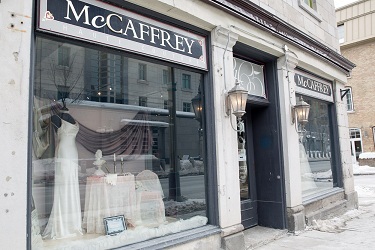
Opera Lyra and McCaffrey Haute Couture invited the media to attend a fitting, a pre-wedding event in celebration of their new production of The Marriage of Figaro, opening March 21st at the National Arts Centre in Ottawa.
Figaro marries Susanna. They’re servants to the Count and Countess, who offer a wedding present to Susanna: a dress much nicer than what Mr & Mrs Figaro would otherwise be able to afford, at least in Opera Lyra’s new production.
Of course the Count is generous to Susanna because he desires her for himself.
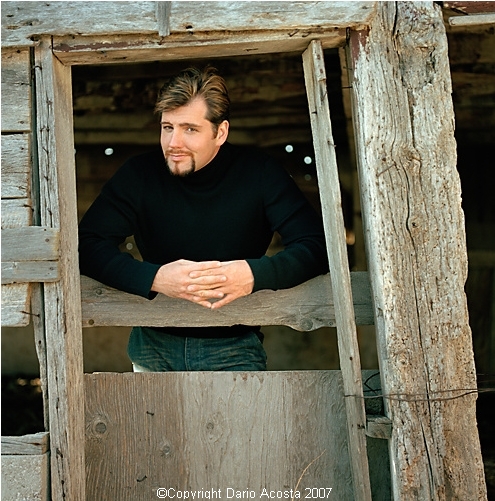
Baritone James Westman (photo: Dario Acosta), who plays the Count
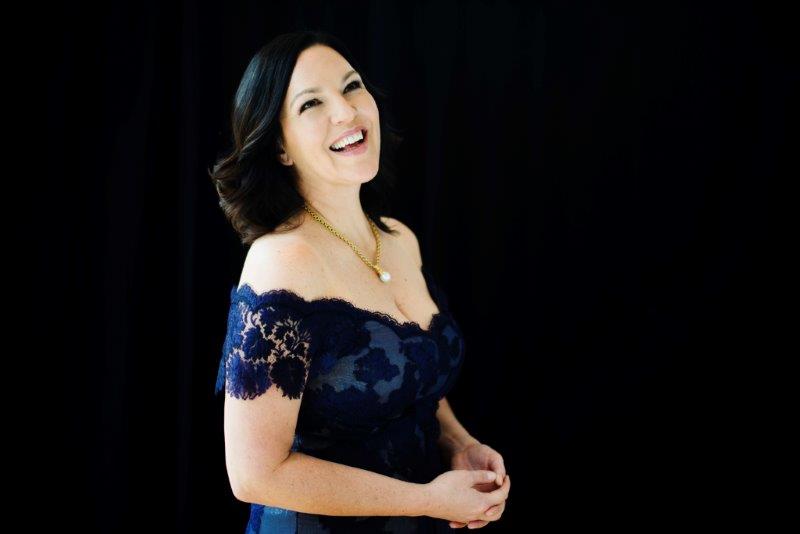
And Wallis Giunta play Cherubino, a young man who also desires Susanna, as well as the Countess: and every other female in sight. Although the role calls for trousers (and male attire), she was at the event wearing a beautiful beaded gown designed for her by McCaffrey for concert performances. Ms. Giunta has worn McCaffrey’s gowns for concert performances around the world.
Wallis Giunta
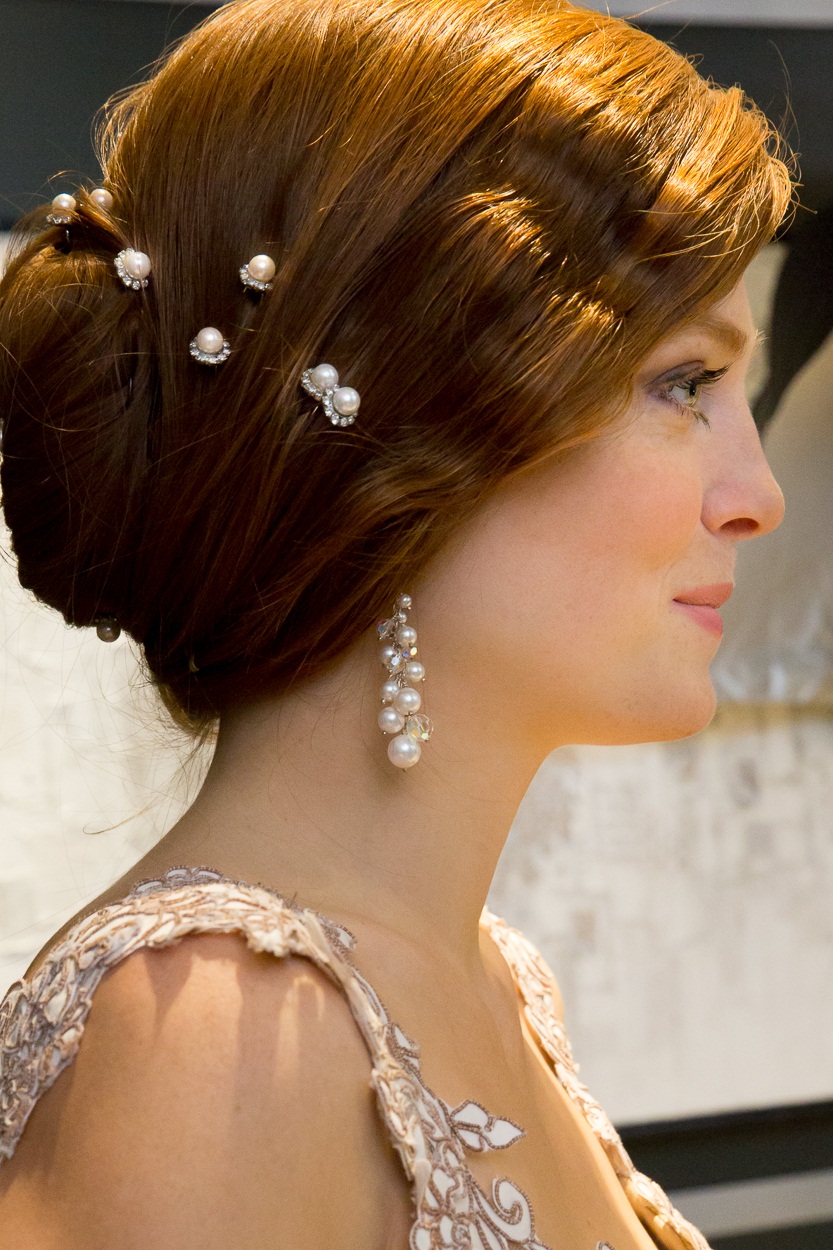
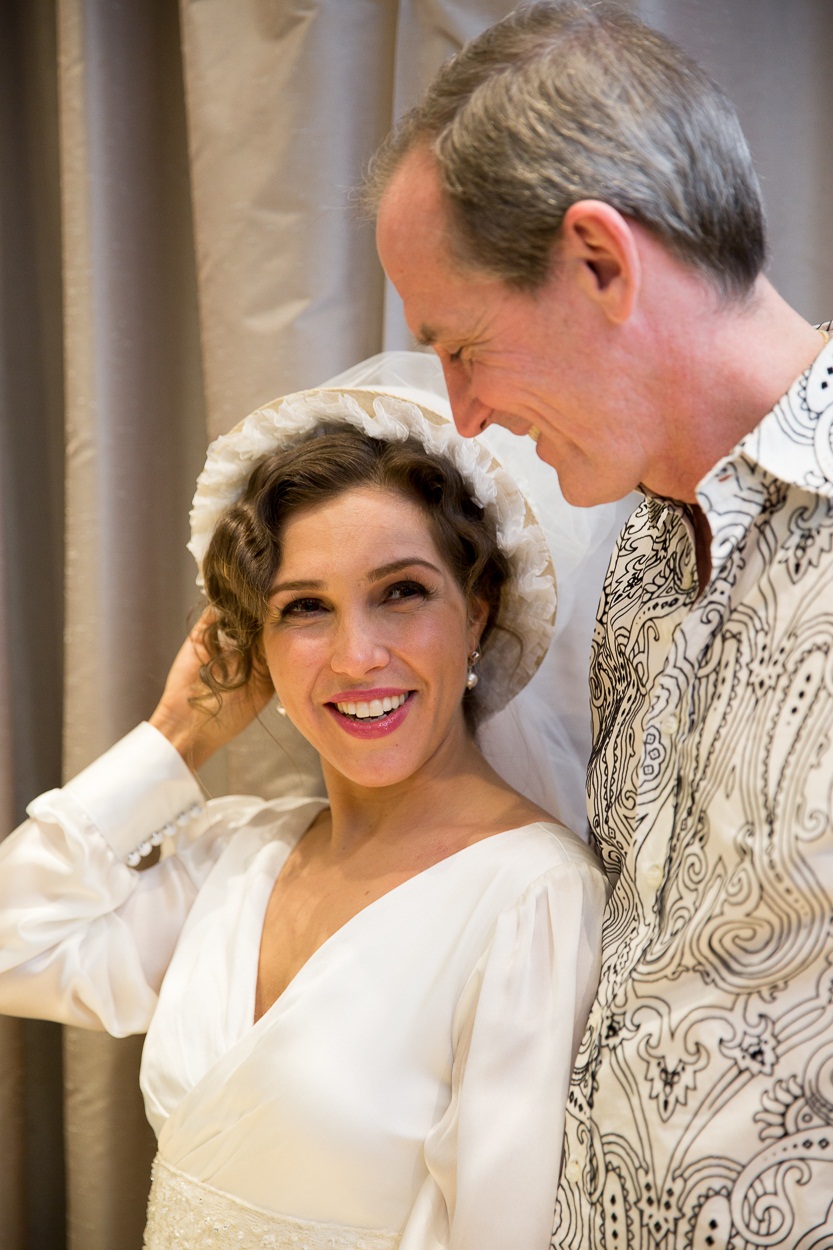
Yesterday the bride-to-be, Susanna (soprano Sasha Djihanian), had her last fitting before opening night. Her elegant wedding dress was created by David McCaffrey specifically for Opera Lyra’s production of Mozart’s sumptuous social satire set in Edwardian England.
Bride-to-be Susanna (Sasha Djihanian) with designer David McCaffrey
Mezzo-soprano Wallis Giunta, who is the face of McCaffrey’s bridal line, approached David McCaffrey about collaboration with Opera Lyra. Instead of picking a dress from his bridal line, McCaffrey decided to design an original for the production. McCaffrey has a long history of creating dresses and costumes for performers.
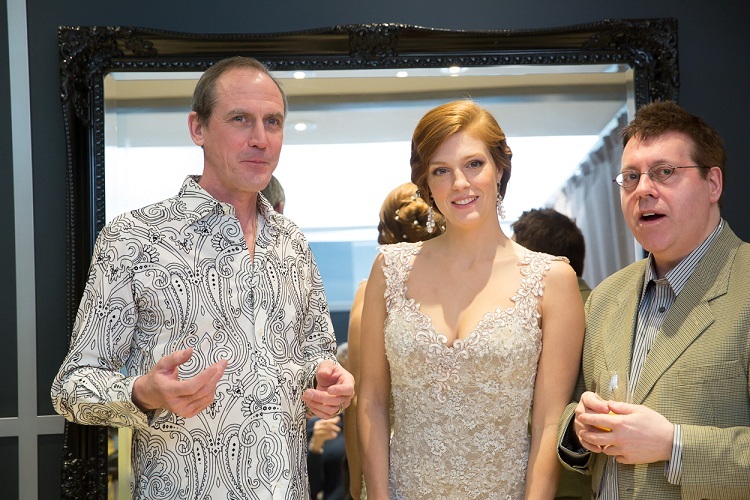
(left to right) David McCaffrey , Wallis Giunta and Kevin Mallon, Opera Lyra’s Interim Artistic Director & the conductor of Marriage of Figaro.
David McCaffrey is tall and thin and wearing a white and black shirt.
Kevin Mallon, Opera Lyra’s Interim Artistic Director has small round glasses and brown spiky hair. Wallis Giunta has red hair and is wearing a McCaffrey Haute Couture gown.
Sasha Djihanian tried on her bridal gown, and then sang an aria for guests and media.
Champagne and mimosas were served.
Photo Credits: TWENTY YORK STREET / MASHAELL Photography
I’ve been hearing the name of Baritone James Westman quite a lot, of late. He’s been in new operas such as Silent Night just this past November in Calgary, or Tovey’s The Inventor.
James Westman plays Lt. Gordon in Calgary Opera’s Silent Night (Photo: Brigitta Diehl)
He was soloist in Messiah with the New York Philharmonic in December, and is fresh from playing Enrico in Pacific Opera’s Lucia di Lammermoor in February. Later this month Westman sings the Count in Opera Lyra’s Marriage of Figaro in Ottawa, and sings Germont in the Canadian Opera Company’s La traviata to open next season.
But first on the occasion of his Count in Opera Lyra’s Figaro I ask Westman ten questions: five about himself and five more about the production.
1) Are you more like your father or your mother?
I am definitely more like my mother, Doris Levy-Westman. She recently passed away, which was very difficult for me, as she was a huge influence on my career. She taught music in over twenty regional school houses. A fantastic fiddler; she chorded piano for June Carter Cash, Ward Allen and the Tommy Hunter Show. She was a relentless yet graceful stage mom who nurtured a deep appreciation for all music in my youth. Many weekends were spent on the 1771 heritage farm jamming with great Canadian fiddlers, country stars and even classical musicians. I believe they came for her famous baked goods, nevertheless, I devoured the live music creations often joining in with my fiddle and voice! Her carefully crafted guidance in my youth enabled me to perform and record with Leonard Bernstein, Benjamin Zander, Vienna Boys Choir, American Boys’ Choir, Paris Boys’ Choir, Boston Symphony and the Toronto Symphony; all before I was 13 years of age!
My traditional father desperately wanted his son to be a hockey playing farmer. He discouraged my mother from accepting a full scholarship at the Royal Conservatory of Music in Toronto to become a farm house wife. He seldom attends my performances. He inspires me greatly in all my ‘Verdian’ paternal roles!
2) What is the best thing or worst thing about being an opera singer?
James Westman’s Ford with Bryn Terfel’s Falstaff in Houston
The worst thing about being an opera singer is the traveling – being away from loved ones, friends and family can be disheartening. As a dad, you miss first steps, graduations, first girlfriends, etc.
Just a few years ago I was only home for 25 days out of 365. It is a challenge, yet I must be creative in finding and pursuing ways to be involved in my families lives. My sons, Liam and Hardy are award-winning musicians and furthermore, play hockey at the highest AAA provincial level. I use Skype to coach, parent, and give them as much foundation as I can. My partner Dini is the absolute best and I am nothing without her! She guides the home front to outstanding success.
The best thing about being an opera singer is the beautiful pleasure of creating, healing and communicating with an audience. It is the best job in the world. It is the responsibility of all artists to relentlessly serve the audience by removing, revealing or escaping stresses of everyday life. Like a doctor loves to heal the body, I love to heal the souls of my patients (the audience)!
3) Who do you like to listen to or watch?
I have collected a huge selection of old operatic 78-RPM records. I have converted many to my ipod and listen to them daily. I love to analyze the traditions of the greats like Warren, Battisti, Caruso, Etc. I play them on any of my several gramophones. The colors and nuances that these early 20th century artists produced continues to astound me.
In general, the current state of opera has little respect for true ‘bel canto’ singing; it’s all about how loud can you sing above an overblown orchestra in a hall usually built for traveling amplified musicals. It is a shame because the audience suffers the most from this trend – of course, there are exceptions to every rule!
4) What ability or skill do you wish you had, that you don’t have?
I am currently [a few days ago, when James sent his answers] performing Lucia di Lammermoor with the great Tracy Dahl (Pacific Opera Victoria) and her coloratura is simply amazing. Furthermore, I studied for many years with Dame Joan Sutherland; I would love to have the ability to sing high dramatic coloratura for just one night. It may be the old boy soprano in me… but to float with that much pure power would be divine!
5) When you’re just relaxing and not working what’s your favourite thing to do?
To catch one of my sons hockey games, to hear them practicing their violin/cello. To spend long walks through the bush on my family farm. I never take these family moments for granted.
*******
click for more information about the Opera Lyra production
Five more about playing Count Almaviva in the upcoming Marriage of Figaro in Ottawa.
1) Please talk about the challenges of singing the role of Count Almaviva.
I would like to tell you that Count Almaviva is a challenge, but frankly, compared to some of the Donizetti/Puccini/Verdi roles I perform, Il Conte is a relative walk in the park. I think the recitative causes me the most grief and yet they give me the greatest rewards.
Like in all music the skill of any musician is achieving precise cooperative dynamics. Creating the perfect arched crescendos and diminuendos while maintaining precise Mozart articulation is a challenge with wonderful rewards.
2) The Count is a character who is sometimes seen as the villain of the piece, sometimes as a bit of a rogue. How do you approach your portrayal?
I love this character for his diverse relations to all that surround him. He is a political figure caught up with useless desires, traditional prejudices, and a displaced ego. Played seriously he is a true buffoon. I study regal posturing and mannerisms from different monarchs to give this character a true sense of stage presence. Even Almaviva’s Italian should be of the highest Florentine precision.
3) Do you have a favourite moment in the opera?
My favourite moment in this opera is the finale in Act 2. Having everyone come into the scene to crescendo into chaos demonstrates the true genius of the work.
My favourite Count Almaviva moment is at the end of the opera when he says “Contessa perdono” (Countess forgive me). It is a sublime truthful moment in the opera that finishes the dramatic arch of my Character. I am in tears every time I sing this.
Baritone James Westman (photo: Dario Acosta)
4) As Opera Lyra comes back from the brink, please speak about the importance of cultivating a strong group of Canadian singers.
We have a massive tradition of opera in Canada. It stems from the profound tutelage of the University of Toronto Opera School that was created from talented Italian opera ‘refugees’ after WW2. Most people do not realize that Canada produces more professional opera singers per capita than any other country in the world. Canadian singers have been representing Canada with excellence for many years.
I am to a fault, truly Canadian…… played hockey……made thousands of gallons of maple syrup…….played fiddle with the best of them and …..tinkers on a 1771 heritage farm. I have the authority to say it is our Canadian duty to support and nurture this truly Canadian art form called Opera. It is humankind’s greatest achieved art form and must continue to flourish in one of the world’s greatest societies; Canada. Canadian opera with Canadian singers healing Canadian audiences – we owe that to ourselves.
James Westman with Joan Sutherland
5) Is there a teacher or an influence you’d care to name that you especially admire?
Miss Patricia Kern is my mentor and without her guidance and vast knowledge I would still be toiling on the family farm. I have had many great close mentors (Dame Joan Sutherland, Martin Katz, Marilyn Horne, Neil Semer, Marlena Malas, Louis Quilico, Sheryl Milnes), however, Miss Kern’s wisdom is in the forefront of my mind every time I sing.
*******
James Westman will be singing the role of Count Almaviva in Mozart’s The Marriage of Figaro at Opera Lyra, opening March 21st and running until March 28th.