Cinematic Music- How We Hear Film: a course at the Royal Conservatory

I’m teaching a course at the Royal Conservatory of Music called “Cinematic Music- How We Hear Film” (register here).

There are many ways to teach the history of film.

Do you see directors as the key to understanding cinema? Then perhaps you go from DW Griffith to DeMille to Hitchcock & Cronenberg.

Film as an actor’s medium? Whether you start in the silent era with Fairbanks & Pickford, or later with Bogart, Gable … there’s a great deal you can learn about the medium watching the ways actors approach the medium.

Or perhaps following through a particular genre:

  • gangster pictures?
  • Monsters?
  • Westerns?
  • Science fiction?
  • Screwball comedy, or perhaps more recently romantic comedy?

Any one of these (directors – actors – genres) can be a pathway to better understand & appreciate your film experience.

And so too with film music. 

For me it’s a natural pathway.  I’ve written music for film. I have always loved watching and listening to any film, to examine how the music in the film works, to understand how the film works.

It’s been a subject I write about on the blog, sometimes coming up when I encounter a new film, other times front and centre in the topic.  This will give you an idea of some of the films I really enjoy, and what you might find in the class.

Cinematic Music: How We Hear Film begins on February 18th, 2015. For further info click here.


Posted in Music and musicology | Leave a comment

Tapestry Briefs: Booster Shots

I took in Tapestry Opera’s latest experimental workshop “Tapestry Briefs: Booster Shots”.

click for more info about Tapestry Opera

The title plays on a few influences:

  • Because Tapestry lives in the so-called “Distillery District” we’re in a realm of booze, so it makes sense to be thinking about whiskey
  • Tapestry Briefs is understood to be a series of samplings of the short operatic experiments from the laboratory work combining librettists & composers, so it was a natural to take the metaphor a step further, offering samplings of delectables such as whiskey and ice cream and sake and herbal tea. Yes I know, that latter seems like an oddball, but for this Scarberian, it was welcome, as I can’t very well drink and then drive home.
  • One of the operas in development –that was disproportionately represented with three rather than one taste—is even called “The Whisky Opera”. Was that one also influenced by being conceived in the Distillery District?
  • I suppose a booster shot is only peripherally about alcohol (via a pun), and so the program cover showed both shot glasses & a hypodermic needle.

New opera is very much on my mind. Driving home to Scarborough means a right turn out of that Distillery District, right past the front door of The Extension Room, where I took in something experimental Thursday night. Last night I watched my new DVD of Boesmans’ Julie, and so I am thinking very positive thoughts about what opera can be. In the opera course I teach, the last class usually addresses the question “is opera dead?” While its health seems very precarious right now when done on the grand scale of the Metropolitan Opera or the COC, smaller companies using young talent keep bursting onto the scene. Tapestry are having their 35th anniversary season, although they’re a long-established incubator, and hardly an institution that feels old in any sense. They’re feeling especially vibrant with their new artistic director Michael Mori.

Tapestry Artistic Director Michael Mori

I had a brief chat with him after the show tonight, when I may have seemed to be complaining. In his pre-show talk Michael invited us to engage in social media, facebooking and tweeting merrily through the opera. I took him up on the invitation repeatedly.  Sure, my tweets were pretty banal (dull little jibes about drink & distillery).

And so I was a bit disconcerted when one of his minions leaned close to me at one point and told me to stop.

WTF?

After the show I told Michael about this without naming names, thinking that our smartphones (ha… an Orwellian phrase quite apt for a night in which we saw a small portion of 1984 adapted) are passionately hated by many in the theatre world. As I drove home I was thinking that Michael’s invitation might be a bit like the Emancipation Proclamation, a decree only as meaningful as the functionaries & bureaucrats who could make it real. All I can say –and I think Michael likely agrees with me—is that while most in the theatre probably still hate the smartphone, there are probably ways to make it work. I sat for part of the show in the very back row, so as to avoid upsetting anyone with my glowing screen.

And what of the operatic tasting, the samples of new work?

It’s as it always is. Some work better than others. And audiences aren’t monolithic, but contain all sorts of people with different responses. There was one piece –not the deepest thing I ever saw please note—that made me guffaw loudly in a theatre where I was the only person laughing. As a result I worked hard not to laugh even harder (which is inevitable when people turn around and stare at you as if you’re from Mars), but of course I was frustrated at what I saw as a conservative response, because surely the composer / librettist aimed for this kind of response. There were other pieces –at least 3—that were received with loud laughter from others in the audience, that didn’t make me laugh nearly so much. But overall, much hilarity ensued, much fun was had by all.

There were two pieces that stood head and shoulders above the rest of the program, and when I say this I know that my response wouldn’t necessarily correspond to that of the majority.

R.U.R.,  based on the Czech Karel Capek’s play from the early 20th century play (RUR =Rossum’s Universal Robots), has long struck me as an ideal vehicle for an opera. I gave it some thought awhile ago, although had no idea really how to adapt it. Imagine my delight that Nicolas Billon and Nicole Lizée not only took this on, but –in the short excerpt—showed a truly inspired idiom for their adaptation.  They created the most impressive interaction between music & text, singers & performers that I’ve seen in any of the Tapestry Briefs exercises I have witnessed. As we watch the two scientists freaking out about their robot creations, we hear music that is on the boundary between electronic & acoustic, between human and mechanical, with repetition that is sometimes human-made and other times seems automated. At times the fade of the music resembles something asymptotic, as if the music and voices fade mathematically, as a function of something profound and inhuman. This interface between words & music, between performer and performance is very problematic and troubling: but in all the right ways.

Please Tapestry, have Billon & Lizée continue their work on this piece! The five minutes we heard are already masterful.

The other opera is really three, namely the triptych of excerpts from The Whisky Opera that with its prominence in the program clearly has the full attention of Tapestry’s braintrust.  All three excerpts seem to enact one of the wet dreams of opera composers: to find a language that is relevant to context of the story (historically & culturally), especially if it can incorporate popular musical idioms. That the story is also darkly humourous, totally Canadian in its focus and almost irresistibly lurid makes this a project that seems to be a can’t-miss proposition. I am sure that Tapestry will hear a lot of voices in support of this project, and not just from those lured by the whisky they were offering us to taste. The Whisky Opera comes from Hannah Moscovitch and Benton Roark.

There were two others that I liked:
1984—“The Note” reminded me that Orwell’s novel never gets old even if the children born in 1984 do: amazingly they turned 30 years old this year. It wasn’t profound but it worked.
Damnation was like a joke on the minimalist composers such as Glass or Reich, the repetition being like the torments of hell. I was reminded of that scene in the film Beetlejuice when we’re told that people who commit suicide end up as bureaucrats in the afterlife. And apparently they’re tormented by repeated patterns of notes.

As usual the performances were superb. Carla Huhtanen and Krisztina Szabo are two of the most important singers in Toronto, irreplaceable when it comes to contemporary rep. Alongside them, Alex Dobson & Keith Klassen are a very musical pair.  The different operas employed varying constellations of the four throughout the evening. Christopher Foley & Jennifer Tung offered solid support from the piano (although there were other musical sources, for instance in RUR), and Mori’s direction was tight and transparent throughout.

It was great to see so many segments that were funny, although I don’t believe any of them (except the four I spoke of) are really sustainable beyond roughly five minutes in length; the fact that i am typing this up in the shadow of Saturday Night Live (which begins at 11:30 pm) might be in the back of my mind, another medium where nothing really deserves to be longer than about 5 minutes.

Tapestry are in their 35th anniversary season, and will be back in January for a party of sorts, although I suspect it will also be a benefit too.   Click here for more information.

Posted in Music and musicology, Opera, Reviews | 2 Comments

Soundstreams and Canadian Stage collaborating on Philippe Boesmans’ Julie

Canadian Stage have already shown a willingness to venture into different disciplines, bringing great artists such as Crystal Pite and Robert Lepage to Toronto to broaden the experience of the CanStage audience under Matthew Jocelyn’s leadership.

Soundstreams and Canadian Stage have announced a collaboration for next season.  Julie is  Belgian composer Philippe Boesmans’ operatic adaptation of August Strindberg’s naturalist play Miss Julie.   The libretto is adapted by Luc Bondy.

click for purchase information

I just watched a DVD of the 2005 La Monnaie production.  It’s 74 minutes long, which is remarkable considering that when i googled the length of the original, i found a production claiming that Strindberg’s play is 75 minutes long.  Operas are normally much longer, sung text usually taking lots more time than the same words spoken.  Boesmans’ score moves along at an astonishing clip, and requiring performances of remarkable intensity: because this powerhouse story that’s being told also requires singing as well.

I’ll talk about the DVD another time.  But I’m happy to say that this is a worthy project, one of the finest scores i’ve heard in a long time.

Almost exactly a year from now –on November 19th 2015– the Toronto production will open, Directed by Matthew Jocelyn, with Music Direction by Les Dala in the 850 seat Bluma Appel Theatre.

Posted in Dance, theatre & musicals, Opera, Press Releases and Announcements | 2 Comments

Ambitious Extensions of Us

This is one of those crazy weeks when it’s difficult to know what to see. I’m missing the opening concerts of Jan Lisiecki’s mini-festival with the Toronto Symphony, a gala concert from Aprile Millo and the opening of Tapestry Briefs: Booster Shots.  But I am a sucker for ambition, and that’s what clinched it.  I had to go see the one night of Extensions of Us, a multi-disciplinary recital that I am hoping might lead to more of the same, an attempt to create something genuinely new & original. How could I resist?

The “Us” is a five performer team:

  • Two dancer / choreographers:
    • Jennifer Nichols
    • Justin De Bernardi
  • Two singing actors
    • Adrian Kramer
    • Lucia Cesaroni
  • Pianist and music director Mai Nash

No wonder i’m thinking of ambition in a program of extensions, a series of performances where in some sense or other someone is reaching above or beyond. The title probably comes first of all from Nichols’ Extension Room, the large multi-purpose space where the performances were presented tonight, a combination of workout space and dance studio.  Many of the pieces were especially wonderful in the way they exploited this long quirky room. Nothing looked average or usual.

The physical elements of the movement and the romantic dimension in the performances all come back to some kind of extension:
• “Son pochi fiori” and “The Cherry Duet” – from L’Amico Fritz by Mascagni
• Traumerei – by Schumann
• Canzoni Napoletane: “Mamma” & “Core ‘Ngrato”
• Arias from Verdi’s La Traviata: “Un di felice”; “È strano…Ah fors’e` lui…Sempre libera!” and “De miei bollenti spiriti”
• “Rejoice, beloved” – from The Rake’s Progress by Igor Stravinsky
• Variations for the Healing of Arinushka – by Avro Part
• La Dame de Monte Carlo – by Francis Poulenc
• La Séparation – Nocturne in F by Mikhail Glinka
• Scenes from West Side Story by Bernstein: “Dance at the Gym”; “One hand one heart”; “Maria”;”Tonight”

It’s a mixed program in several different idioms. The Schumann, Glinka & Pärt were perhaps the most recognizably conventional, in the combination of an eloquent piano solo from Nash with dance. In many of the others, the relationships of the parts are wonderfully problematic. When we’re watching a pair of singers in a scene such as the one from La traviata and two dancers are also involved, it’s not clear what we’re seeing.

Soprano Lucia Cesaroni

As Cesaroni, portraying Violetta, sings of her dream of love, and we see Nichols & De Bernardi dancing, are we seeing Violetta’s dream enacted? Is Nichols also Violetta at this moment?

Choreographer Jennifer Nichols

Choreographer Jennifer Nichols

I was especially moved by the Poulenc, a flamboyant solo by Cesaroni , illuminated by Nichols’ dance. This is a very daring piece of work, a kind of negative virtuosity, where Nichols illustrates a very precarious existence, literally balanced on the edge of falling. She’s a negative image of the singer, taking us to psychological depths that are only implicit or shadows of the surface we experience in the text of the song. Nichols’ willingness to allow herself to be by turns contorted or grotesquely exposed takes her movement beyond mere dance.  This is the obverse of the usual in ballet or dance recitals, when the performers are all so uniformly beautiful that one comes to demand beauty at every turn, and where the expectation of virtuosity that is a kind of display tyrannizes the performers, requiring spectacular physicality and beauty.  It’s also nicely transgressive to see non-dancers dancing.

I’m not quite sure what to call this. Is it a recital? A multi-media piece or a series of pieces? The broad mixture of styles of presentation are inevitable with the eclectic program. While Cesaroni & Kramer crossed the disciplinary boundary (as they not only sang but were choreographed a bit),  neither dancer sang or spoke.   It will be interesting to see if they’ll go further next time. I do hope we’ll see more from this group. Hm, notice that I keep referring to them with a pronoun. Maybe next time their group will have a name.

But there must be a next time!

Posted in Music and musicology, Reviews | 2 Comments

Stewart Goodyear and Czerny’s four boxes

Do you read liner notes?  I always begin to do so.  If there’s something of substance, not only do I read them but I cherish them, making them part of the big conversation that is the work of art.  Nothing exists in a vacuum, given that an audience has to be there (if a leprechaun plays a tune in the forest and no one hears, is there music?).  Liner notes become a big part of a performance when they engage with the issues of the piece being performed.  While music is an abstract form, the liner notes can explicate, telling us how the performer meant us to hear.

Sometimes the notes do more, venturing into the realm of important theory.  Such are the liner notes of the CDs of Stewart Goodyear.  His notes for his complete set of the Beethoven piano sonatas are an extraordinary series of observations that have enlarged my understanding of the music, my experience of Goodyear’s wonderful performances, and –perhaps most important—my relationship with Beethoven.

click image for purchase information

Just a few weeks ago I encountered Goodyear’s new recording of The Diabelli Variations, including a significant essay in the liner notes.   Goodyear tells us about Carl Czerny, a composer who had an interesting way of understanding music, conceptualized around four categories:

  1. studies and exercises
  2. easy pieces for students
  3. brilliant pieces for concerts
  4. serious music

We’re told that what’s so remarkable about Beethoven’s composition is that he manages to defy these categories, transcending these boxes with music that can be fun, can be brilliantly virtuosic and also, serious music, perhaps all at the same time.

While I’m not sure I agree with Goodyear  (if i disagree it’s almost a matter of semantics… let’s set that aside for now) I love his ambition, that he’s not just tickling the ivories, but also theorizing mightily as well.  I would tend to see Czerny’s boxes as his own way of understanding music, and not necessarily one that everyone else followed.

As I type this it’s late at night after a very exhausting evening rehearsal.  I was probably the only one really wiped out in a room full of much younger people, having transcribed most of a dozen songs (there are two still to be found), plus a few surprises tossed my way, such as Das Lied der Deutschen (which I played & sang a few times without the music).  Singing full out, i didn’t pace myself, but loved pouring it all out in this room full of talented performers at Ryerson Theatre School.  In von Horvath’s play Tales from the Vienna Woods we’re mostly encountering light music, which is another category different from any of Czerny’s boxes.  A waltz tune –whether understood as music for a dance or merely a composition to be heard—inhabits a different box again from what Czerny gives us.

But what if we take one of those light compositions and re-contextualize it with something of greater meaning?  For example, what if we’re Stanley Kubrick and we take a Strauss waltz melody, but use it to accompany a journey to Earth orbit, in 2001: A Space Odyssey?  Surely we’re no longer in the presence of a light dance tune, because the context changes the weight of the piece.  

Kubrick accomplished a comparable miracle in A Clockwork Orange when he put the wacky orchestration of Rossini’s Thieving Magpie alongside some very disturbing visuals.  The music may be the same as always, but I think we hear it differently, the composition becoming a backdrop to something substantial. 

It’s pretty early for me to be presuming to know how the various tunes work in the von Horvath play we’re creating.  But the point is, to demonstrate how context can change how we understand a piece of music, putting it into a different box, if you will.  To me, the boxes are arbitrary classifications that exist in one place –such as Czerny’s head– but that vanish in the light of day or the exigencies of a later culture, such as Kubrick’s re-framing.

I wish sometimes that I could get back to the elegance of a formulation such as that of Czerny, where every piece, every concept and yes, every citizen knew its place.  Our messed up world isn’t so neat or tidy, as obstreperous in refusing to stay in neat orderly boxes as the Droogs.  I suppose that’s just the way it is, although when I’m coming home after a rough day, it’s really lovely to be able to put a CD into the player in the car, and especially to be able to hear Goodyear play Beethoven.

For awhile at least, everything makes sense.

Posted in Cinema, video & DVDs, Dance, theatre & musicals, Music and musicology, Personal ruminations & essays, Popular music & culture | Leave a comment

Gerald Finley on the shelf

It’s November. October was Gerald Finley month in Toronto, as his Falstaff jumped up on the table that was our collective experience (and for the final scene of the opera). Don’t let the headline (“Finley on the shelf”) scare you, Finley is not ill or indisposed.

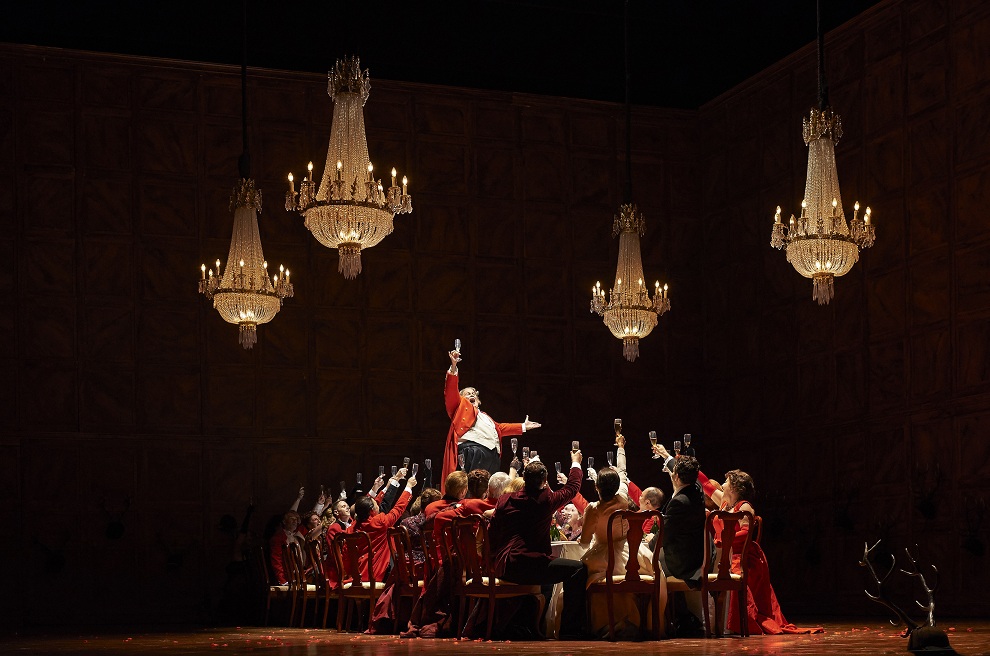
The final scene from the Canadian Opera Company production of Falstaff, 2014. (Photo: Michael Cooper)

The final scene from the Canadian Opera Company production of Falstaff, 2014. (Photo: Michael Cooper)

To be honest I have no idea what his health might be, a week after he finished his run as Sir John at the Four Seasons Centre with the Canadian Opera Company. But wherever he may be, whatever his health or disposition, GF actually is on the shelf, or at least my shelf: because he’s made a lot of recordings, and sits comfortably in a lot of CD and DVD collections.

Let me speak briefly of what’s on my shelf, a fascinating assortment showing remarkable range. This may be a tiny sample of what he can sing, but it’s startlingly representative.

Handel’s Messiah
Finley may have undertaken earlier composers than Handel, but this is the earliest on my shelf. The language is the clearest of any of the Messiahs I have. When I listen to his “Thus saith the Lord”, I don’t hear the usual bass-baritone, trying to persuade us by means of  the thickness of his sound or pure volume.  That might be the virtuoso approach.  No, Finley accomplishes it through the conviction of his delivery. And really sounds like God. That’s not done by volume but a sound that signifies authority, getting inside the implications of the text.

What must God sound like?  You should listen to Finley to find out.

Thus said the Lord the Lord of Hosts:
Yet once a little while and I will
shake the heavens and the earth,
the sea and the dry land.
And I will shake all nations,
and the desire of all nations shall come.

You don’t sound like God by overwhelming us with pompousness or loudness. It’s with calm self-assurance, the certainty that you can do what you say. It’s uncanny, especially because it makes every other version I’ve heard previously sound artificial and false.

Saariaho’s L’Amour de loin
I bought the DVD that stars Gerald Finley in anticipation of the 2012 COC production of the opera that starred Russell Braun. Last month I saw the opera starring both men. It’s funny to reflect on the gentle vocal sounds each can make, considering how few opportunities we were given to hear their warm round sound. I had the feeling listening and watching that one reason the opera seemed to be spreading from opera company to opera company like a rumour, was that lovely voice. Finley has the warm round sound of a lieder singer while singing opera. Any lyrical phrase sounds better when sung by this sort of voice, a singer who finds music where others might not find it. If a composer is a product or a proposition being sold, Finley is the broker, the salesman, the advocate you want pushing your product or proposition.

Strauss’s Capriccio
Sometimes, as in the COC Falstaff¸ Finley is peerless, impossible to ignore as he stands onstage. But sometimes, as in the Paris Opera production of Strauss’s Capriccio you’re watching him emerge from a crowd of great talents. As with Falstaff it’s also a Robert Carsen production, delightfully simple.

Wagner’s Die Meistersinger von Nuremberg
One of the things I was pondering in anticipation of Falstaff was how Finley might portray age. Sir John Falstaff is old. Yet I wondered what we would get. Finley doesn’t seem old to me. Is it because we’re living in an era when “60 is the new 40”, when nobody seems old anymore..? And so I went hunting for Finley’s portrayal of Hans Sachs, someone else who is supposedly old, or at least old-er.   Have a look at Finley’s Sachs and you’ll see why I had to immediately buy the DVD. It’s like no Hans Sachs I’ve ever seen, three dimensional, compassionate, and human in ways that Sachs should be human. He finds elements that are in the character that I’ve never seen before. The voice is again pretty, full, but not overwhelming. As with the Handel, we’re free of mere virtuosity, because the skill is all channeled to a portrayal, to genuine truth.

But look at his energy, in this, the longest of all the operas.

Every year I find a reason to circle back to Viktor Ullmann’s Emperor of Atlantis, and to listen to Finley’s wonderful performance of music that is both old (at least in its adaptation of familiar melodies) and new (from the 1940s that is). This year I feel especially connected to Ullmann and the forbidden music of the early 20th Century, as I prepare von Horvath’s Tales from the Vienna Woods at Ryerson University. I must get Michael Haas’s book Forbidden Music again, as I seek to calibrate Johann Strauss with Viktor Ullmann.

But isn’t it amazing that Finley can sing just about anything old or new.  

Posted in Cinema, video & DVDs, Dance, theatre & musicals, Music and musicology, Opera, Reviews | 1 Comment

10 Questions for Jan Lisiecki 

This month the Toronto Symphony has a festival of five concerts between November 12th and 22nd, featuring Danish conductor Thomas Dausgaard and young Canadian pianist Jan Lisiecki commemorating Carl Nielsen’s 150th birthday, presented alongside the three final piano concerti of his great hero, Ludwig van Beethoven.

  • Click for the Carl Nielsen Society

    On November 12 and 13, the first programme showcases Carl Nielsen’s emotionally charged Fourth Symphony, written at a time of international chaos during the First World War. An affirmation of faith in the power of life amid the darkness of war, his symphony will be the perfect contrast to the mellowest of Beethoven’s piano concertos, No. 4.

  • The focus on Beethoven and Nielsen continues on November 15 with the tempestuous Piano Concerto No. 3 by Beethoven and Nielsen’s whimsical Symphony No. 2.
  • Maestro Dausgaard will then guide the TSO on November 20 and 22 through Nielsen’s optimistic Symphony No. 5, with Beethoven’s heroic Piano Concerto No. 5.

The New York Times has called 18-year-old Canadian Jan Lisiecki “a pianist who makes every note count”, who has been signed by Deutsche Grammophon to an exclusive recording agreement at the age of 15.

Conductor Thomas Dausgaard

Wow.

Lisiecki’s performances have been broadcast on CBC Canada, BBC Radio, Austrian Radio, French Radio, German Radio, Luxembourg Radio, and Polish Radio, as well as on French Television 3 and on TV 1 and 2 in Poland. He was featured in the CBC “Next!” series as one of the most promising young artists in Canada, and in the 2009 Joe Schlesinger CBC National News documentary about his life: “The Reluctant Prodigy”.

Upon the school board’s recommendation Lisiecki was accelerated four grades and graduated from high school in January 2011. Since September 2011 he has been studying for a Bachelor of Music at the Glenn Gould School of Music in Toronto, and in 2012 was named UNICEF Ambassador to Canada in 2012.

On the occasion of this Nielsen-Beethoven Festival of concerts with the TSO, I ask Lisiecki ten questions: five about himself and five more about preparing the upcoming concerts.

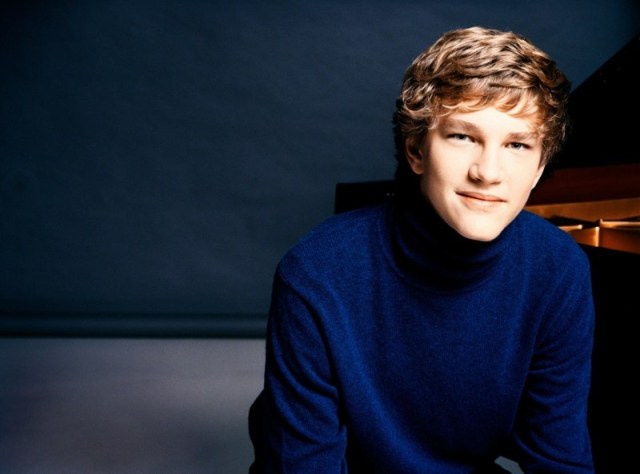
Pianist Jan Lisiecki (photo: Mathias Bothor-- DG)

Pianist Jan Lisiecki (photo: Mathias Bothor– DG)

1-Are you more like your father or your mother?

Some people tell me I look like my father, other like my mom… (It’s interesting, as no one has ever been blonde in my family!) But who I am more similar to? That’s a tough question (though I do get the feeling it is intended to be one!). I do believe I have inherited the more rational side from my dad; the compulsive one from my mom. But since I’m still with them on a daily basis, I am not yet in a situation to be able to assess what long-term effects in my personality I may find. Perhaps the person I’m most similar to is my grandmother (from my mother’s side). She was a math teacher for over 30 years, very calm, never gossips, never criticizes others. If I’m not similar, at least it’s a good role model! 😉

2-What is the best thing or worst thing about being a pianist?

I love something that’s simultaneously the best and the worst. In this case, that thing is pianos themselves. I like to say the piano has to be your friend. That’s true – as with most friends, there are positive and negative sides to a piano, things you’ll like and things you’ll have troubles with. Pianos are neverperfect. Some have a wonderful tone, other have a great action. So one must simply focus on those positives, and try to highlight them. I’m not saying to ignore the downsides, but definitely they should not be apparent to the audience.

3-Who do you like to listen to or watch?

My movie selection is shaped by offerings of airlines (so mostly uninteresting with a gem here and there) and enhanced by suggestions of others. I like watching weekly TV shows – it sets a pace while traveling and maintains some sense of normality. My current favourites are Person of Interest, Modern Family and The Blacklist. As far as listening, I don’t actually listen to much beyond my time with the piano. I enjoy evenings at home with jazz on CBC R2, and will pull out my iPod when I have craving for a reality check with Pink Floyd.

4-What ability or skill do you wish you had, that you don’t have?

Thankfully I think at 19 I don’t have to worry so much about not learning something… I only have to think of “what next!” Time will tell.

5-When you’re just relaxing and not working what is your favourite thing to do?

I truly love traveling, and therefore, whenever I have a spare week I fly around the world, simply to experience. Everything is a part of it: the destination, the country, the airline, the airplane. In December, I will spend 8 days flying around the world with my dad, putting on over 36,000 miles in that week, and visit Dubai, Hong Kong, and Sydney.

*******

Five more concerning the upcoming series of concerts with the Toronto Symphony Orchestra between November 12th & 22nd playing the last three Beethoven piano concerti.

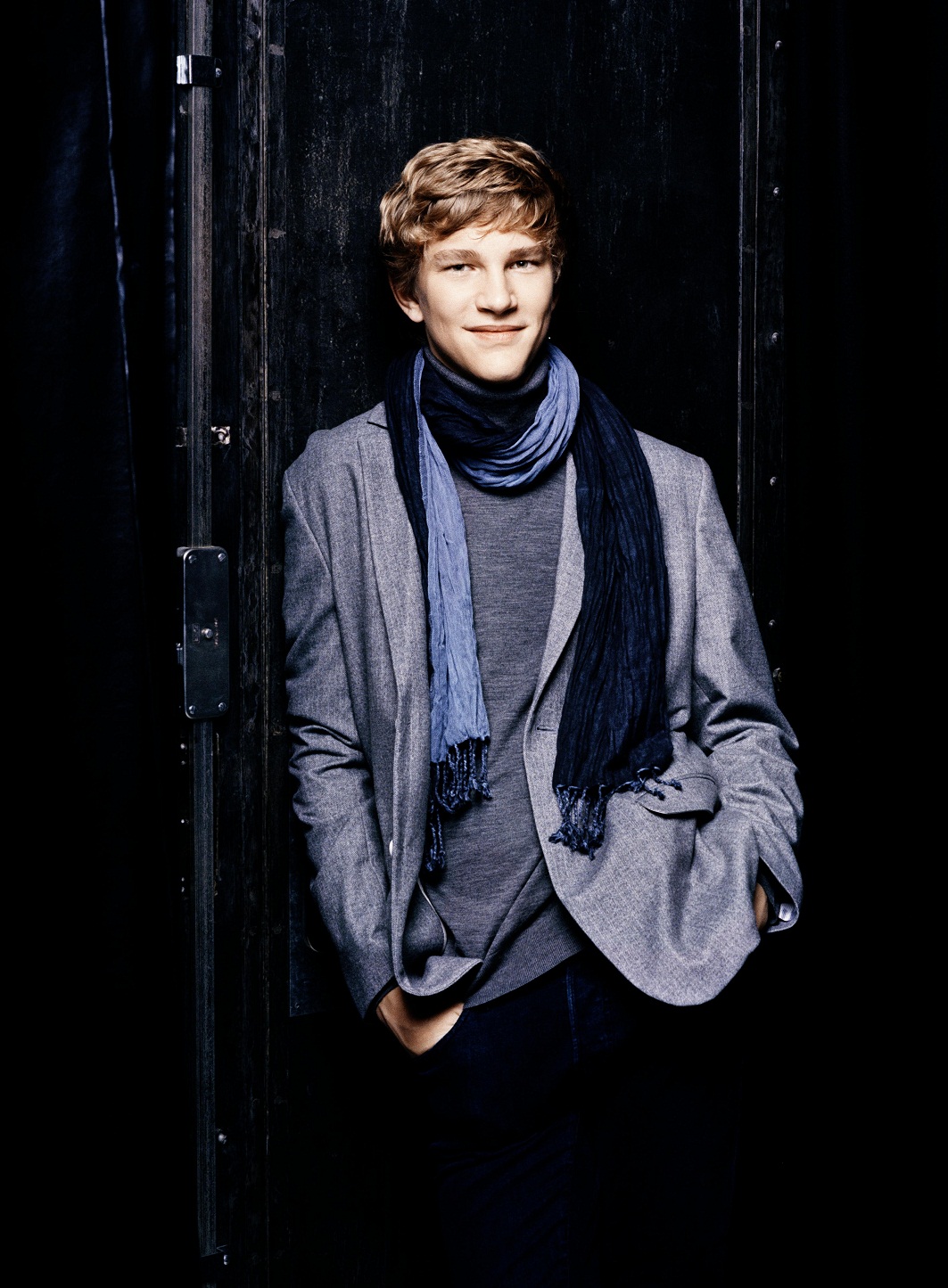
Pianist Jan Kisiecki (photo: Mathias Bothor--DG)

Pianist Jan Lisiecki (photo: Mathias Bothor–DG)

1-Talk for a moment about the challenges of the last three piano concerti: # 3 in C Minor, #4 in G Major and #5 in E-flat Major, three of the most important pieces in the concert repertoire.

We all know that Beethoven was revolutionary. By extension, he also reinvented the piano concerto form. These three concerti are a cross-section of the evolution of his writing style. The Concerto No. 3 is very classically rooted, with significant hints of change to come. The fourth concerto immediately captures the audience’s attention – the piano starts. And The Emperor – well, nothing needs to be said.

2-What do you love about Beethoven’s concerti?

If you take the orchestra away from, say, the Chopin Concerti, you still have a very complete work. But if you take the orchestra away from a Beethoven Concerto, you are left with structure. This is exemplary of the weaving he used to intertwine the parts of the orchestra and soloist. I personally love when it is chamber music being made on stage, therefore I love the Beethoven concertos, and it is also this I greatly look forward to with the TSO.

3-Who’s your favourite pianist, living or dead?

Many of them are dead, many of them are alive. It’s a long list! Zimerman, Perahia, Argerich, Ax, Pires… I can go on forever!

4- The arts often feel very precarious in this country, spoken of as a luxury even as they starve alongside wealthy hockey teams. Please put your feelings about the music you love into context for us, especially with respect to these upcoming concerts with the TSO.

Music is always in a delicate position. Many things can be said to defend its position in our society, but I will make only one argument.  If you don’t mind posting this video, I think it illustrates the point exceptionally well.  

5- Is there a teacher or an influence you’d care to name that you especially admire?

Yes – I study at the Glenn Gould School in Toronto, with a fantastic dean, Mr. James Anagnoson, under a wonderful teacher, Mr. Marc Durand, and all made possible by a generous scholarship provided by Ian Ihnatowycz.

*******

 The Toronto Symphony Orchestra presents a series of five concerts commemorating the 150th birthday of Carl Nielsen, featuring music of Nielsen and Ludwig van Beethoven, November 12th – 22nd.   For information click the image.

Posted in Interviews, Music and musicology | 1 Comment

Dreams of the Vienna Woods

How can a place signify so much if you’ve never been there?  But when we look forward to a promised land –whether it’s America for the immigrant, Mecca or Jerusalem for the pilgrim, or just a personal utopia—it’s a mental landscape more special perhaps if one hasn’t been there.

The Vienna Woods are an ideal place with a different meaning to the locals than to those of us who have never been there. I’m finding that they have a particular lure right now.

There’s a Johann Strauss Jr waltz from 1868 titled Geschichten aus dem Wienerwald or in other words Tales from the Vienna Woods  

Cynthia Ashperger, Director of the Ryerson Theatre School Acting Program

Ödön von Horvath’s play Tales from the Vienna Woods?  It premiered in 1931, with Strauss Jr & assorted other waltzes as a big part of his cultural subtext.  I’m  blushing that I didn’t know von Horvath, a playwright who deserves to be better known.

Among his many titles is Figaro Lasst Sich Scheiden or Figaro Gets a Divorce, a play that (inevitably?) was adapted as an opera in the 1960s.

And so it shouldn’t be surprising that Tales from the Vienna Woods has also become an opera.  HK Gruber’s new adaptation premiered in the summer of 2014 based on  von Horvath’s play, receiving glowing reviews, and likely will be seen again, at least in Germany in 2016, and (if the reviews are any indication) will likely be heard all over the world thereafter.

Ryerson Theatre program will be staging von Horvath’s play early in 2015, directed by Cynthia Ashperger.

I’m the Music Director on the Ryerson production, which means my current task is assembling the dozen or so songs mentioned in the script, whether that means finding them in the library or—if they’re not to be found— transcribing them. Next week we begin rehearsing the gifted young actors at Ryerson.

We’re doing it in English.

I was just listening to “Wien Wien nur du allein”.

In translation that becomes “Vienna, you alone”.

I must apologize for concerts or performances I’ll miss.  But between Remembrance Day Service at Hillcrest playing the organ (Sunday) and wandering musically & otherwise in von Horvath’s Forest, I’ll have to miss a few things I would normally attend.


Posted in Dance, theatre & musicals, Music and musicology, University life | 3 Comments

10 Questions for Daniel Cabena

Canadian countertenor Daniel Cabena is highly regarded in both Canada and Europe for prize-winning performances ranging from baroque to contemporary repertoire, described as “very classy, with his freely flowing slender, well-sustained alto voice”. Cabena holds an Honours Bachelor of Music from Wilfrid Laurier University and a Doctorate of Music from l’Université de Montréal. He has also taken part in numerous workshops and academies, including the Centre for Opera Studies in Italy, l’Académie Internationale de Musique de Comminges, l’Académie Baroque Européenne d’Ambronay, and the Briten-Pears Young Artist Programme, for which he was assisted by the Canadian Aldeburgh Foundation.

Cabena’s engagements this season will include appearances in Europe with Musica Fiorita, Ensemble La Morra, Ensemble Diapsalma, Le Concert Spirituel and at the Schlossmediale Festival. In Canada, Cabena will appear with the Guelph Chamber Choir and Nota Bene Period Orchestra, as well as with pianist, Stephen Runge, in a tour of “A Sanctuary in Song,” a recital program of 20th Century English and Canadian song, which they premièred on CBC radio in 2013. In the summer of 2015, Cabena will appear with l’Orchestre de la Francophonie in the première of Chants dérobés, a song cycle for countertenor and orchestra by Stacey Brown on texts by Québécois writer Augustin Rioux.

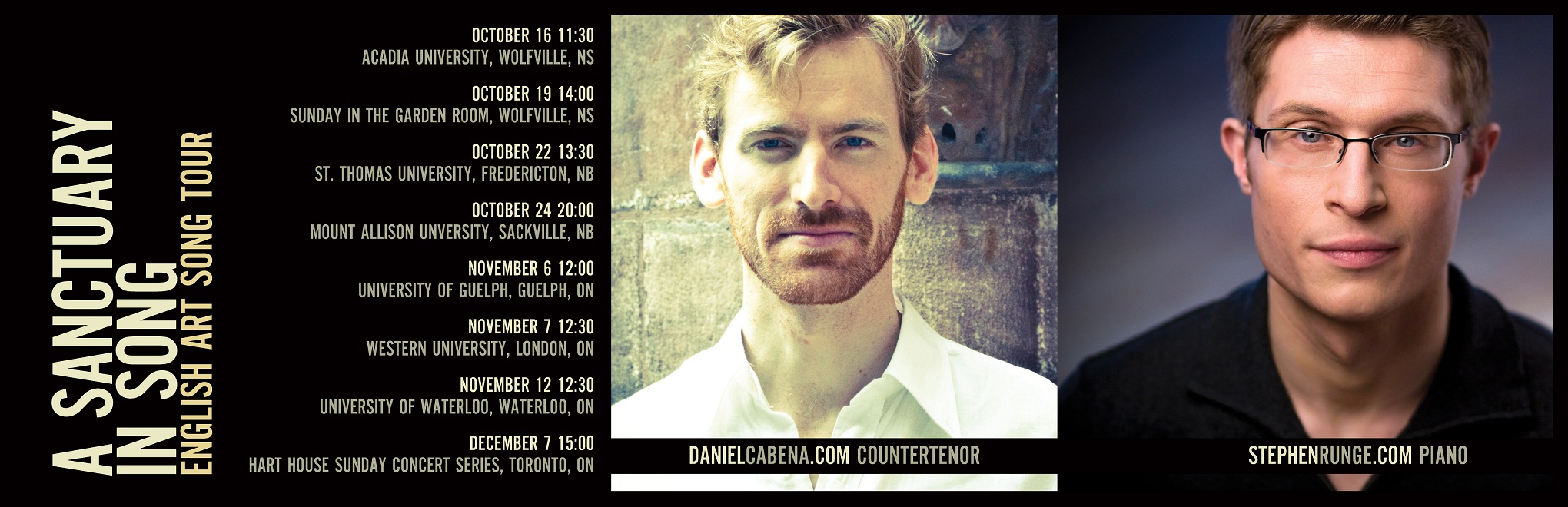
On the occasion of “A Sanctuary in Song”, an eight concert art-song tour running until early December 2014 in Eastern Canada with collaborative pianist Stephen Runge, I ask him ten questions: five about himself and five more about his creative projects.

1) Are you more like your father or your mother?
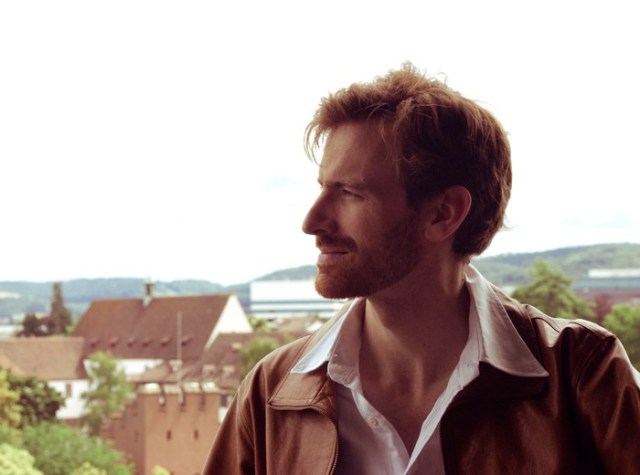
Counter-tenor Daniel Cabena

Countertenor Daniel Cabena

I suspect that I most closely resemble my father, Barrie. I share many of his features and predispositions, especially a passion for music and what I would call a devotion to story, in a number of different guises – fiction, liturgy, anecdote, legend…. We’re also both quite involved in an inner life, both introverts and both fascinated by the processes and influences that shape that inner life. But we’re also temperamentally quite different one from the other, so I might look to my mothers for insight. And perhaps you noticed the odd plural there! My biological mother died when I was a child, a bit too young to have known the term “melancholic,” though certainly old enough to know its most famous representative, “Eeyore; so, in other words, it would be difficult for me to identify in myself traits of temperament that I might share with my mom. But I’ve been blessed with a wonderful step-mother with whom I do share many traits of personality and many values and interests. In choosing a musical path, I follow both my father, who’s primarily a composer and organist, and my step-mom, who’s a very accomplished amateur singer. I’m grateful to my parents for having raised me in a way that honours honesty, love, hard work and intuition. I find that those values inspire me in all that I do, in all my singing and living.

2) What is the best thing or worst thing about being a singer?

Singing has a lot to do with bests and worsts! The process of singing is complex and as fraught with emotional danger as it is full of spiritual possibility. The lifestyle that comes with singing can also be difficult to manage. And singing is a profession in which there’s no single and often no evident career path. In all of those areas one can see “bests” and “worsts,” difficulties and possibilities.

I love the process of singing, that is to say, the intricate technical, musical, poetic, physical, spiritual, theatrical… processes by which something comes to be communicated through the human voice. I love the feelings associated with the most basic singing gesture of uttering and shaping a tone; and I love to speak the language of that tone and the language of speech at the same time. I love to speak with people and to be a conduit by which to share with them beautiful sounds, beautiful music, beautiful words. And I love, perhaps most of all, to be involved in an act that seems to carry with it – for performer and audience alike – the possibility of healing.

There are hard things, too, painful things about singing – like the gap between what one feels one can accomplish in the practice room and that which one can “deliver” on-stage. That can be a frustration, even though I’ve been encouraged to notice that, as the years go by, the gap can actually shrink a bit. And the profession itself can bring with it many challenges, especially simple, practical ones, like the necessity to make music far away from where one might live. I find it painful to be away from my family.
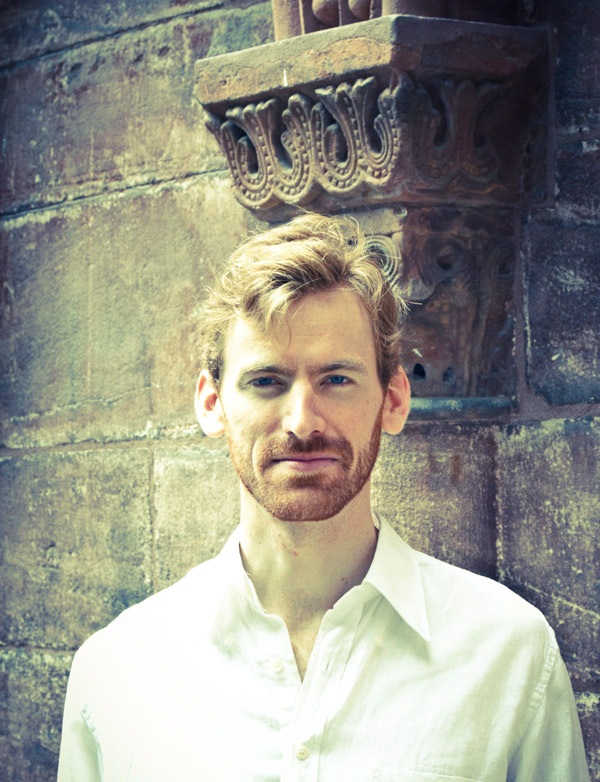
Counter-tenor Daniel Cabena

Countertenor Daniel Cabena

Those are some elements that I see on each side of the singerly coin.

3) Who do you like to listen to or watch?

I find that my days are and that my imagination is so full of music that I don’t spend very much time listening to it! Nor do I find the medium of recorded music to be particularly compelling. And I find far less compelling the newest sound media, which entail so much digital editing and so much file compression that one feels many steps removed from the original moment of music-making.

I do, nonetheless, love the radio. I love live performances on the radio. I love radio documentaries and interviews, and I suppose that what I listen to most are those sorts of things. Garrison Keillor’s broadcasts are among my favourites; and I also like programs like “This American Life.” But I simply adore ‘my’ CBC programs – “Writers in Company,” “Ideas,” “The House”…. I also really love what public radio stands for; and I’m fascinated and inspired by its history. I wish we were, in Canada, more protective of that tradition and more imaginative about all that it can and could be. And I can’t help but be upset by what’s becoming of CBC2, both in terms of its gradual commercialization and in terms of its programming.

As for watching, in the “media” sense, there are lots of fine TV programs that my wife and I like to watch. And I have some enduring favourites, like “M.A.S.H.,” “Star Trek” (especially The Next Generation), the Jeremy Brett “Sherlock Holmes,” and “The West Wing,” to name a few.

But what I really like to watch and listen to are live performances. I love to attend theatre shows and dance shows. I love chamber music concerts, recitals and symphonic concerts. I love the opera. I love to listen at church, in concert hall, under tent, in salon…anywhere where folks come together to appreciate and create something. Together.

4) What ability or skill do you wish you had, that you don’t have?

I wish I could play the piano. When I was wee I fell in love with the violin. So, from about the age of 4 until the age of 23, that was my big musical outlet, to the exclusion of keyboard studies. That’s a bit odd, seeing as my father, Barrie, is a extremely accomplished organist, choirmaster, pianist and composer. But we – wisely, I suspect – decided that I shouldn’t be taking lessons from my dad! But that meant that I – unwisely, I know – never pursued the keyboard. For a singer, indeed, for a musician of any kind, I think the piano is a very helpful ‘tool,’ that, of course, along with being a beautiful instrument in its own right. Anyway, it’s a tool that I don’t have in my toolbox, though I’m always working to improve my skills. (In fact, one of the most enriching elements of all my musical education was the two years of mandatory harpsichord lessons that I took at the Schola Cantorum in Basel. Each lesson was simply a joy; and I would happily have spent three hours a day just doing my little exercises on the Schola’s beautiful instruments and sampling from the large repertoire of pedagogical music.)

5) When you’re just relaxing and not working what is your favorite thing to do?

It’s funny, but I find that there’s no obvious point in a given day when the work ‘stops,’ so restless and curious is the imagination, and so close-to-hand is the voice. (I sometimes wonder if I shouldn’t work harder to create such a point.) In any case, when I’m not practicing or rehearsing or studying or doing business emails or booking travel… I find that my favourite things to do are domestic things. I love doing the laundry and ironing. I love tidying and cleaning. I love cooking. And the thing that I love best of all is to do those things with my wife, Mary. We have a great time making and keeping house!
But we also have a good time reading together, doing the Globe crossword (and swearing at the same, in both official languages), walking, sitting and chatting. Simple things. We also like shopping at vintage shops, searching for hidden gems. And I have a great interest in tailoring and all things sartorial. I also love to do yoga, which I’ve been practicing, sometimes in studios but usually on my own, for almost ten years.
I also have a wonderful time being involved in the busy lives of Mary’s two children, walking beside them as they pass through the adventure that is highschool. They’re both budding artists, too, one a thespian, one a graphic artist, so it’s a joy to be able to share with them some “shop-talk,” and much silliness.

And speaking of silliness reminds me of a quote from G.K. Chesterton, something about home being the one “wild place” in a world otherwise dominated by “rules and set tasks.” I like very much the idea that home can such a place, wild – a place of freedom and adventure as much as it is one of safety and repose.

Counter-tenor Daniel Cabena

Countertenor Daniel Cabena

Five more about your upcoming Canadian tour of concerts & masterclasses.

1- Please talk about the concert programme you’re singing on your tour, including your favourite.

Pianist Stephen Runge (click for more about him)

I feel quite spoiled to be singing this program, which is called “A Sanctuary in Song,” because it’s composed of so many of my favourite songs. The program features music by a number of 20th Century English composers, including R. Vaughan Williams, Gerald Finzi, Edmund Rubbra, Ivor Gurney, Roger Quilter, Herbert Howells and Benjamin Britten. I’ve put this recital together with Stephen Runge, a truly wonderful pianist and accompanist, whom I met while we were both studying for our doctorates at l’université de Montréal and with whom I’ve had the pleasure to work a number of times in the last few years, including in 2013, when we first recorded a version of “A Sanctuary in Song” for broadcast on the CBC.

The idea behind the program is, as its title suggests, to explore some of the themes that surround the idea of sanctuary; and we’ve grouped together the songs in order to address those themes specifically and from a few different angles. We’ve also shaped the program as a whole such as to suggest a narrative, trace the progress of a central figure, a sort of pilgrim who, passing through joy and tribulation, is seen to experience the qualities of sanctuary that the songs describe.

In selecting the songs of our “A Sanctuary in Song” recital, Stephen and I have also sought to recognize a few interesting and touching connexions. One of those connexions is the close friendship between Ralph Vaughan Williams and Gerald Finzi, a friendship that, as it happens, was in part spurred on by a mutual admiration for another composer featured in our program, namely Ivor Gurney. And to mention the latter also highlights another theme which Stephen and I have sought to address in our exploration of sanctuary, that of war, whose tragic reality touched (and in some cases shattered) the composers and poets whose works we are presenting.

We’ve also included in our program two songs by Australian-Canadian composer, Barrie Cabena, who, along with being my father, was a composition student of Herbert Howells’, whose beautiful “King David” in one of my most favourite songs.

2- The counter-tenor voice is no longer the novelty it once was, but there is still sometimes controversy about the correct vocal type to sing certain roles, especially given the various vocal types that are sometimes subsumed under the category of “counter-tenor”. Could you talk about your voice, and what you feel your voice is best suited to sing?

I’ve had an interesting parcours as a countertenor in the sense that I began my studies in Canada, in which milieu my voice type is at once scantly represented in number and provided with a great liberty in terms of repertoire, and completed my studies (insofar as one’s studies can ever be said to be “complete”!) in Europe, where there are hundreds of countertenors but where that voice type’s repertoire is more strictly circumscribed. So, on the heels of a time of intensive exploration of a countertenor ‘orthodoxy,’ I’ll take this opportunity to reveal one of the bees that’s gotten stuck my bonnet, a deliciously strange and liberating irony, which is that, though countertenors have found themselves at the forefront of the early music movement, they represent the newest voice Fach. In fact, to hear a solo falsettist was, as far as I can determine from my own reading, an extreme rarity to say the least until the latter decades of the 20th Century, after Deller had inspired a generation of male altos. It happens, therefore, that countertenors are now very much in demand but that we’re called upon mostly to sing repertoire that would almost never have been sung by singers of our kind.We sing music written for boys, castrati and women; and – in part as a result of the role played by Deller in the Purcell revival – we are often, and in my view too often, solicited to sing music better suited to high tenors (hautes-contre).

And this brings me to a detail of your question that I appreciated very much, which is that you recognize that “countertenor” is in fact a rather large umbrella. I don’t think that’s widely-enough understood, in fact; and misunderstandings in the area of vocal “Fach” can be a real frustration (even a danger) in the training of a singer, which is why I’m emphasizing this point. There are male sopranos, mezzo-sopranos and contraltos – distinctions to be made, I mean, along the lines of range and tessitura; and all the more subtle Fach distinctions can also be applied. Perhaps most of us are “lyric” countertenors; but there are “coloratura” and “spinto” countertenors, I would venture to say. And there are a few who could perhaps be called “Karakter” countertenors – I’m thinking of a singer like Dominique Visse, whose preferred opera roles might be said to fall into that sort of category. In any case, I don’t think there’s any need to define all of that to too great an extent, especially considering the fact that so much of our repertoire is borrowed from entirely other voices! But I do think that it helps to recognize the diversity that reigns under the broad umbrella that’s come to be known as “countertenor.”

And I would say, finally, that, rather than limiting himself to repertoire that’s come, by way of the early music revival, to be understood as “authentically” his, a countertenor should sing the music that he loves and that fits the dimensions of his voice beautifully and challenges him in all the right ways, the music that makes him sound fabulous and his audiences cry.

For me, there are many that fit but no single repertoire that fits those essential criteria. I love to sing Medieval music and music from the Renaissance; I love to sing works from the early Baroque and the high Baroque; I love to sing Classical music (though I regret that there’s not more Mozart that works well for my voice!); I love the 19th Century; and I adore the 20th and 21st Centuries. And I also love the music of the theatre, the church, the concert hall, the recital, the salon…. I love it all!

But, finally, I would say that I’m often struck by the verity of two observations, one made by the founding father of countertenor singing, Alfred Deller, the other by a champion of the generation that followed him, namely James Bowman. I saw the first on the back of a record jacket of Deller’s great folksong recording. The quote was something about the “inherent melancholy” of the countertenor voice. I think one hears that quality in Deller’s singing, and I wonder if it’s not an ingredient of many countertenor voices. (It’s in any case a quality that characterizes a lot of the music written in the 20th Century for male altos and a lot of that which has come to be most closely associated with our voices.) The other comment comes from James Bowman, and he made it to me when I met him a few years ago at a competition in France. His feeling was that the countertenor voice, as he put it, “creates an atmosphere of relaxation.” Those two phrases have often provided me with guidance as I seek to discover just what it might be that I have to offer with my voice.

3-What role(s) are you preparing / looking forward to singing in the future?

I’m very much looking forward to carrying on with the Ontario leg of Stephen Runge and my “A Sanctuary in Song” tour. I’m also eager to begin work on a couple of lovely Bach projects, one with the Spiritus Ensemble in Waterloo, Ontario, and one with another Waterloo-based ensemble, Nota Bene. I’ll also sing Handel’s “Messiah” with the Guelph Chamber Choir before Christmas. And then I’ll turn my attention to slightly earlier repertoire, as I’ll have a concert with Musica Fiorita of Basel, Switzerland, of the music of Vialardo, followed by a project with Toronto’s Scaramella of 17th Century German music. Then it’ll be back to Europe for another “Messiah” project in March 2015; and then I’ll turn my attention towards Purcell’s “Dido and Aeneas,” which I’ll be singing with Les Violons du Roy in April in Quebec City, Montreal and New York City. In the spring I’ll turn my attention towards the 21st Century, as I’ll be learning a new work for countertenor and orchestra by Stacey Brown and which I’ll be premiering with Jean-Philippe Tremblay and the Orchestre de la Francophonie in the course of their 2015 summer season. What a joy it is to have so many fascinating projects on the go, to have the chance to work with such wonderful colleagues and to sing such various and beautiful music!

4-Do you have a favourite counter-tenor either currently singing or from the past, whose voice represents your ideal, possibly a sound you either emulate, or simply one you enjoy?

This is a wonderfully important question for singers, I think, a question that touches upon an important element of any singer’s apprenticeship, which is that special mentorship that recognizes itself – sometimes from a distance; sometimes simply through listening – as kindredness. I’ve always felt a deep kindredness with the singing of Paul Esswood. His singing has always struck me as beautifully well-rounded and beautifully simple. He cares for the text, its clarity and its meaning; he cares for the melodic line, its tensions and releases; and he cares for the tone, allowing it to be magical and animal, deeply alive. I encountered Esswood’s voice shortly after I began singing countertenor, at which point my father kindly and wisely began acquiring for me recordings by the Deller Consort and by the Early Music Consort of London; and it was in the latter recordings that I discovered Paul Esswood, singing Medieval and Renaissance polyphony, and in marvelous company! But, of all the beautiful voices on those discs, it was in Esswood’s that I recognized something of myself; and it was in his singing that I recognized something of how I sought and seek to sing. And that’s why I speak of kindredness.

I had the privilege to spend a week with Paul Esswood, studying with him in St-Bertrand-de-Comminges, France – in the Pyrennees – where he’s been offering summer courses for a number of years. In 2010, when I attended, there were only two students, myself and a very fine Catalan countertenor called Sergi Moreno Lasalle; so we each had about three hours of private lessons each day of that week! And most of the time that we didn’t spend studying and singing we spent eating at a little restaurant with Paul and listening to his tales and anecdotes. He is a most generous and eloquent teacher, which is no surprise, for those two qualities are abundantly present in his singing.
I would say, too, that I’m grateful to have been offered in my teens those discs of Alfred Deller’s, to whose recording of the Couperin Lamentations I’ve listened perhaps more than any other (even more than I’ve listened to the Bach motets and the Ravel and Brahms string quartets or the Magnetic Fields’ 69 Love Songs – and that’s saying a lot!). I find the sound of his voice touching, haunting and his commitment to the text compelling. He’s also a man to whom I, as a countertenor, owe a great debt of thanks; and I must say that I’m mindful of that fact each time that I hear his voice. Finally, I would say that I’ve been deeply touched and inspired by the singing of Derek Lee Ragin, whose recording of Gluck’s “Orpheo” I hold close to my heart.

5- Is there a teacher or influence you’d care to name that you especially admire?

I’ve been blessed to have come into contact with a number of fine teachers over the course of my apprenticeship. Each of them has instilled in me essential insights into the universes of singing and teaching; and the process of learning with each of them, of developing a pedagogical vocabulary and getting to know them personally and musically, has been a great gift.

Wendy Nielsen

In the last couple of years I’ve been studying with two magnificent teachers, one in Canada and one in The Netherlands. In Amsterdam, I work with Margreet Honig, who’s really helped me both to clarify my technique and to bring it into a unity with all the other elements of my singing. She’s also helped me to hear new possibilities in my voice and, more importantly, to feel them. My teacher in Canada is Wendy Nielsen, from whom I’ve gained innumerable and invaluable insights into singing and my voice. Wendy and Margreet have slightly different but entirely complementary ways of working with the voice, and I benefit greatly from their twin influences. But I’m also so inspired by them, by their calm and positive energy, their honesty and their magnificently virtuosic pedagogy.

I’ve also had the great good fortune to have encountered Aaron Low, a Toronto speech pathologist, whom I consult regularly and who’s been a great help to me in breaking down vocal barriers, discovering new physical dimensions, and learning how best to manage the physical demands that every singing athlete must face.

*******

A Sanctuary in Song, Daniel Cabena’s art song tour with collaborative pianist Stephen Runge reached Ontario, with stops at University of Guelph (Nov 6th), Western University, London (Nov 7th), University of Waterloo (Nov 12th), and finally at Hart House at the University of Toronto, on Dec 7th. LOW-RES-Draft-Tour-Poster-v2

Posted in Interviews, Opera | 4 Comments

Extensions of Us 11.13.14 Questions and Answers

The program was created as a reaction to our experiences as recital performers and audience members. We come to this process with a great love for the art form, but also with a combined knowledge and experience as to its most frequent successes and failures. This is the beginning of that discussion as we test the waters of change.
Our goal is to blur the lines of artistic discipline and, in so doing, challenge the audience’s expectations. Simultaneously, we wish to entertain. Too often standard repertoire is shied away from, almost as if a hummable tune is a sign of lower art. We are looking for the one two punch: moments that test our preconceived ideas, followed immediately by the gratification of the familiar and beloved. Why can’t we have both? We are searching for something that works and that is distinctly us.

1-Who’s the “us” involved in Extensions of Us?

Lucia Cesaroni, Soprano
Italian-Canadian soprano Lucia Cesaroni has appeared with The Royal Philharmonic, The Ravinia Festival, The Aldeburgh Festival, Vancouver Opera, L’Opéra de Montréal and Pacific Opera Victoria.
If there were to be a ‘leader’ or group manager, Lucia would earn that designation. She and choreographer Jennifer Nichols conceived of this recital over several bourbon Manhattans at The Comrade in Leslieville. Both Lucia and Adrian will step past the role of vocalist and be integrated in to the choreographic elements of the evening.

Soprano Lucia Cesaroni

Adrian Kramer, Tenor
Tenor, Adrian Kramer, has appeared in opera and concert with many excellent theatres across North America including the Canadian Opera Company, Chicago Opera Theatre, Santa Fe Opera and the Castleton Festival with Lorin Maazel. Adrian was a part of the earliest programming, development and marketing aspects and has continued in that role throughout the process.

Tenor Adrian Kramer

Jennifer Nichols, Dancer/Choreographer
Jennifer Nichols, professional dancer and founder of The Extension Method™, owns and operates The Extension Room. Trained in ballet, she is also the founder of Hit and Run Productions and dances regularly with Opera Atelier. Jennifer has also recently been named Head Choreographer for the popular CW series, Reign.
Jennifer has been an integral part of the recital’s conception and development. She and Lucia worked hand in hand to make the recital a reality. Jennifer has been part of the programming, development and marketing of the recital. Once inside the studio she will take on the role of choreographer and movement leader, as well as dancer.

Choreographer Jennifer Nichols

Choreographer Jennifer Nichols

Justin De Bernardi, Dancer/Choreographer
Justin De Bernardi is one of North America’s newest and upcoming choreographers. A recent graduate from the Performance Dance program at Ryerson University and recipient of the Theatre Dance Award, De Bernardi is an independent dance artist currently residing in Toronto, ON. He is currently teaching and choreographing with companies, dance studios and conventions across Canada and the United States.

Justin, Jennifer, Adrian and Lucia will mirror each other throughout the show and highlight a character’s idea or emotion, an underlying theme and bridge the pieces together.

Maika’i Nash, Pianist
Hawaiian pianist, Maika’i Nash is a sought-after pianist coach & pianist across North America. He is a coach at the University of Toronto and works with a number of opera and dance companies in Toronto. Maika’i is also excited to make his Carnegie Hall debut with soprano, Audrey Luna in January, 2015.

Mai is the orchestra, the palette creator and the support upon which the musical and theatrical elements of the recital rest. His playing and his person will be intertwined in to the movement and multi media elements of the show.

Pianist & Music Director Mai Nash

2- Who was the driver/organizer bringing the team together? Is there an artistic director / someone in charge? Or is it a collective creation?

The program was borne out of Lucia and Jenn’s desire to collaborate and explore the recital format. But the musical chairs had already begun: Adrian and Lucia wanted to sing Traviata and Mascagni together , Mai and Lucia had been exploring the Poulenc and Jenn and Justin are regular partners. Everyone is represented in this concert through their choices of repertoire, individual musical aesthetic, years of experience and differing vantages as pianist, dancer and singer. All members of the team have absorbed multiple roles as performers, programmers, organizers, administrators and promoters.

3- The poster lists “Mascagni, Verdi, Part, Stravinsky, Bernstein, Poulenc, Canzoni Napoletane”. What’s the music you’re performing?

ACT I
Son pochi fiori – from L’Amico Fritz by Mascagni
The Cherry Duet – from L’Amico Fritz by Mascagni

Traumerei – by Schumann

Canzoni Napoletane:
Mamma
Core ‘Ngrato

Un di felice – from La Traviata by Giuseppe Verdi
È strano…Ah fors’e` lui…Sempre libera! – from La Traviata by Giuseppe Verdi

INTERMISSION

ACT II
De miei bollenti spiriti – from La Traviata by Giuseppe Verdi

Rejoice, beloved – from The Rake’s Progress by Igor Stravinsky

Variations for the Healing of Arinushka – by Avro Part

La Dame de Monte Carlo – by Francis Poulenc

La Séparation – Nocturne in F by Mikhail Glinka

Dance at the Gym – from West Side Story by Leonard Bernstein
One hand one heart – from West Side Story by Leonard Bernstein
Maria – from West Side Story by Leonard Bernstein
Tonight – from West Side Story by Leonard Bernstein

4-It’s more than a recital. You’re working in multiple media (music & words with movement & projections). Could you say more about the idioms you’re likely to be working in on this occasion?

Each of us bring key themes and ideas which have driven our repertoire choices and are, well, extensions of us! This program, the images projected at climactic points, the choreography all came out of our desire to build on these themes, teasing out new meaning through movement and in so doing, re-examining the singer-pianist recital format itself…The immigrant experience in Canada, the dynamic tension between a couple… These themes will be the driving force for the slide projections which will serve to colour the moments of transition between musical numbers. We are striving for a fluid product. One that flows from music to dance to projection seamlessly, bringing an element of opera’s Gesamtkunstwerk to a recital.
Just as the musical selections are meant to be an extension of the musicians performing them, the movement aspects are meant to function as personal expression for the dancers. They are an extension of the themes, key phrases, emotional climaxes and private admission of the singers and their characters.

5- Is this a one of a kind or do you see other performances of this sort in our future?

We are hoping that this is the beginning of something bigger than a single evening’s event. Future dates are already being proposed. For now, the most exciting part is that a beautiful program has emerged and we are yet to assemble as a group in the wonderful space of the Extension Room. It is then and there that the organic process of the program’s creation will begin in earnest. Thus far we have a great deal of conceptualization, theory, musical preparation and enthusiasm, but the workshop and group experimentation is still to come!

*******

Singing. Dancing. Good Tunes.
Surtitles & Beer.
What more do you need?

Extensions of Us:
Lucia Cesaroni, Adrian Kramer, Jennifer Nichols,
Justin De Bernardi, Maika’I Nash.
In Recital
The Extension Room
30 Eastern Avenue, Toronto
November 13 @ 8pm
Tickets: Thirty Dollars-General, Twenty Dollars-Students
Available @ luciacesaroni.com /extensionroom.com

Posted in Dance, theatre & musicals, Interviews, Music and musicology, Opera | Leave a comment