Old review of Egoyan’s Die Walküre

I posted this –a review of the current production in a different theatre from a decade ago– on a different website.  I am re-posting it because i won’t be able to see the opening of the new production at the Four Seasons Centre.  I’m busy with a production of Tales from the Vienna Woods at Ryerson Theatre, but FYI the COC Walküre opens January 31st.

Here’s what i wrote back in 2004.

*********

Only a control freak posts an opera review after everyone else has offered their opinion on the matter in question: the Canadian Opera Company’s Die Walküre directed by Atom Egoyan and designed by Michael Levine. This is more of an appreciation than a review.

New productions of Wagner operas can generate international interest, especially when part of a projected Ring Cycle, as this one is. Opera is one of the artforms most welcome in our global village. Wagner addicts will jet across the sea for a fix, especially when the grapevine (also known as the internet) whispers about an important find. And the word on the new COC Ring—so far at least—is very positive. Reviews have consistently credited the production with a degree of depth at least worthy of a second look.

Opera production and set design can be imagined to fall somewhere between two extremes on the following spectrum. At one end you find the most literal and faithful choices, that respect the instructions in the score above all. While for some people this is ideal, to others, such slavish respect is anathema to the creative spirit. The alternative demands approaches to staging that challenge and problematize the instructions in the original text. When one is staging a particularly well-known work, audiences sometimes become so familiar with the plot and music that they won’t tolerate anything lacking in originality and freshness. One of the concerns with such an expensive undertaking as a production of Wagner’s work, is that one is likely to alienate one side or the other of this ongoing debate.

Surprisingly Egoyan-Levine offer an approach that is sufficiently intelligent to be cutting edge, yet without turning its back on the tale-telling that conservatives usually miss in modern approaches. What’s more, the presentation is essentially coherent, and clearly an attempt to honour Wagner fully with an intelligent and probing exploration. In other words this production is modern without necessarily alienating the more fundamentalist members of the audience.

Act One begins in a manner that at first glance appears to be very conservative. Notwithstanding the hints of modernist steel and light that are central to the entire design, the stage picture we first encounter is recognizably Hunding’s home, albeit with a tree that has been cut down, and with strange things happening on the fringes of that stage picture. There is a curious tension between the centre of the stage and the edges of the frame throughout.

I was confused (but not troubled), in my first impression. Where there should be a big healthy tree, we saw instead, chunks of hewn wood: as though we were seeing a post-modern tree, a tree spoken of as alive while we see it as it shall be once it has fallen down and been hacked to pieces. In fact this is clearly an allusion to one of the central symbols of the Ring that is spoken of but never enacted onstage, namely the World Ash Tree. At various times in the Ring Cycle, we are told that Wotan has taken a branch from the Tree for his spear; later, that the Tree has become unwell (a sign of the rot in the world); and eventually we hear that Wotan has commanded the heroes of Valhalla to cut down the tree and pile its logs around Valhalla, in anticipation of the Twilight of the Gods. The only big strong ash tree we get onstage is the healthy one growing through the roof of Hunding’s dwelling in the first act of Die Walküre, long before the catastrophe of the cycle. But as I said, Levine’s design gives us a tree that has been destroyed surrounded by people who behave as though it were alive and well: a discrepancy that is not clarified until later.

Throughout this production we will be confronted with various kinds of fragments and edges in the stage picture, just as in the story. In Egoyan’s reading, memories keep coming back, not just for the character but for everyone else listening as well. Whereas other productions usually present those flashbacks as entertaining stories presented objectively by a tale-teller addressing passive listeners, the originality of this production is to recognize the reality of flashbacks, often privileging the subjective reality of that flashback in the mise-en-scène.

For example, Siegmund tells Hunding and Sieglinde the story of a bride whose enforced wedding he recently was asked to stop, leading to his current plight, lost and weaponless in the forest. At the end of the tale we hear Hunding’s self-righteous answer. As a relative of the people slain by Siegmund’s unhappy intervention this is an unanticipated surprise (unless you’ve seen the opera before, of course). Egoyan’s addition of a flashback throughout Siegmund’s narration changes it from a simple story into a re-enactment, as the disaster is balletically enacted on the stage. We also see Hunding walk into Siegmund’s flashback, embracing a dead relative, and then returning to the “present”. Hunding as a result is far less the usual two-dimensional villain, and more problematic, as a person with genuine reason to be enraged with Siegmund.

Egoyan seems to be particularly keen to delve into Sieglinde’s reality, a choice that pays rich dividends when you have a strong singing-actor such as Adrienne Pieczonka. As a bride forced to the altar by this same thuggish family, Sieglinde listens wide-eyed to a tale of a failed attempt to rescue a different bride, and then a short time later tells us about her own enforced marriage, clearly in search of her rescuer. When, at the end of Act Two she talks in her sleep, regressed to the nightmare moment in childhood when the thugs arrived, her mother slain and her home was set ablaze, the final straw that Levine and Egoyan add is to locate this moment onstage in a virtual replica of the original event. It is not clear where we are.  While we most definitely are not in the prescribed location of the score (on a mountain somewhere), this could be Hunding’s home, or it might even be Sieglinde’s childhood home, when marauders carried her off. The problematic set allows us to be in all places at once, in the same way that a memory takes us back in time. In the same way it makes emotional sense that a tree spoken of as alive can lie in pieces across the stage.

When so much of a story is linked to the past, it’s as though the here and now have been problematized, and the space undermined. Where are we, for example, if someone onstage has a flashback to an earlier event? When Hunding steps out of the flashback and into his home, one can question where he is. I was reminded of the edge of the baseball diamond in Field of Dreams, where Burt Lancaster/Fred Whaley’s joint character (Moonlight Graham) is forced to change from a young ballplayer into an old country doctor. In a conventional fourth-wall representation flashbacks are easily discounted as symptoms, as the viewer fends off the implicit threat to their own reality. But when the viewer is complicit, participating in such hallucinations, one is invited to time-travel, using symbol and allusion to slide through simultaneities. That is the promise that I felt on several occasions in Levine’s design, and fulfilled admirably by Egoyan’s reading.

And that is how we can you have it both ways; this production is both problematically postmodern, and also, a remarkably reverent representation at the same time. The fragments are of the real, encased in a somewhat alien frame. Glimmering at the edges of the stage, one finds bright lights, often glaring directly into the eyes of the audience. And metallic structures run in every direction, chaotically, above the stage floor. These are hard to discern in the darkness that is Act One, a darkness that does not interfere with the story Wagner would normally have expected a director and his cast to tell.

The opening of Act Two, in contrast is not just a breath-taking blast of light, but a virtual gloss on what we have seen, as though to tell us what we were really seeing in the previous act. In a reverent reading, Act Two takes us somewhere else: a mountain top far from Hunding’s forest home of Act One. In Levine and Egoyan’s production, Act Two appears to open in exactly the same place. Siegmund and Sieglinde are apparently sleeping off their love-making of the previous scene.

At first glance Act Two suggests an opera-within-an-opera, as though the set were a traditional representational set, framed within a modern Hollywood soundstage. Upon closer inspection this doesn’t completely hold up, not least, because the resemblance to a soundstage is only via allusion. But notwithstanding the director’s denial—and yes, I did ask him about filmic connections at a conference (he said this was not what it meant, adding that all would be clear once we’d seen the entire cycle)—here’s the evidence.

Egoyan is a film director. When I glibly said that Wotan is like a film director, perhaps his denial meant that Wotan is not ONLY like a film director, which is true. While I made the assertion as much in jest as anything else, the connections are more than superficial. In his production of Salome Egoyan milked every voyeuristic suggestion. If we were to find the director somewhere onstage in that opera, thinking of Hitchcock’s tendencies, I suppose, it would surely be as Narraboth, the frustrated voyeur. The entire production put us into the position of Narraboth. To complete the self-portrait, Narraboth should perhaps walk the stage carrying a handheld camera. Wotan also resembles a film director. Just as Narraboth is unable to control his project or his diva (and makes that most artistic gesture, suicide), Wotan too, loses control of a complex project. But these are only the most superficial connections to film.

The real suggestions of an opera within an opera are the ones that everyone can see (and that were spotted by at least two other Toronto area reviewers). The set floor is a series of tiles, broken by the forces of nature and decay (including that large ash tree), as though the whole world were inside a building: Valhalla resembles a vast art-deco soundstage. Notwithstanding the natural materials that have been lit centre-stage amidst the darkness of Act One, steel rigging, lights, and ropes over-hang that foresty space, suggesting that Hunding’s home was being filmed in the first Act.

And once the lights come up to open the Second Act, it is as though the Director shouted “CUT!” as a throng of support staff (the valkyries) work to clean up the aftermath of the previous scene. At least one of the valkyies wields light as though it were a weapon; others wrap bodies in cloth (shrouds?) as part of their mission to bring heroes to Valhalla, suggesting both the impersonality of forensic investigators at a crime scene or costuming staff. Perhaps most significant is the simple fact of the location of this scene. In a faithful presentation Wotan and Fricka debate on a mountain top, abstractly discussing Siegmund and Sieglinde. By re-locating their debate to this mysterious location (soundstage or centre of the world) Wotan can literally touch his children as he discusses their fate, personalizing and humanizing his struggles.

As a result, Wotan and Fricka are behaving a lot like what we’re told Gods do, at least according to mainstream media. It’s a truism that the gods—or ghosts—walk among us. And counterbalancing all these Gods and Valkyries, is the most mortal of all the characters onstage, namely Sieglinde, whose personal history acts as a thread to pull the work together. But one has to remember that this is opera, where one is moved by resonances & allusions, but without denotative meaning. At his best Wagner is highly symbolic, as in this production. One can make the effort to meet the production halfway by opening oneself to those allusions, or one misses out on that richness.

Musically, too, I was impressed, as both the singing and orchestra playing sounded wonderful. No, it’s not the Met orchestra and the soloists are not the singers one knows from the Met, but perhaps that is a good thing. The COC is probably using microphones to enhance the acoustics of the Hummingbird Centre, but the results are tremendous. I think purists are misguided in their objections when one considers that the Bayreuth Festspielhaus (the opera house Wagner designed himself, where the Ring premiered in 1876 and has been literally enshrined ever since) attempts to do the architectural equivalent to acoustical enhancement by putting a huge orchestra into a covered pit under the stage. Until Toronto’s new opera house is built this is the best we can do: and it sounds very good.

Richard Bradshaw –the conductor and General Director of the company–at times took tempi that were startlingly fast, so much so that Peteris Eglitis’s Wotan reminded me a bit of those portions of Loge or Mime who have such quick lines to deliver that they are declaimed rather than sung. Wotan’s lengthy monologue in Act II was shorter for me than ever: partly due to inspired staging, partly due to Bradshaw’s bat-out-of-hell tempi. How ironic, that Bradshaw made Wotan’s monologue more singable by de-emphasizing singing with such fast tempi. For those enamoured of long and sentimental readings this might sound disastrous; but I believe it worked extremely well. Arguably a fast reading is not just an aid to dramatic intelligibility, but also more historically informed than the slower readings that became popular through most of the 20th century.

Eglitis’s Wotan, sounding at times like George London, while reminding me physically of a young Donald McIntyre in the Chereau RING, was called upon to carry the work through several long monologues. Fortunately he has star quality, his only sin being his willingness to throw himself into the performance without restraint or fear, like the other star of the show, namely Pieczonka.

The twins are a most unequal pair. Clifton Forbis’ Siegmund reminded me at times of that baritonal sound of a Suthaus or a Vinay, but dramatically was only adequate. On the other hand, Adrianne Pieczonka, as his sister-bride Sieglinde, not only sang the part wonderfully, but was the dramatic heart of the production. At times her histrionics could be called over-the-top, but without her commitment everything else would have felt more like abstractions and ideas rather than passion and real life. Sieglinde’s flashbacks are the most convincing moments in the opera, whether in her powerful reading of “der manner sippe” (her marriage tale), or in her dream at the end of the second act. In comparison, Forbis’ Siegmund is merely the usual stiff and stoic Wagnerian hero, although his singing was truly splendid.

As Hunding, Pavlo Hunka makes more of his role than usual, but a great deal of credit is again due to Egoyan’s direction, freeing Hunka of the usual stodginess. Frances Ginzer was at times an affecting Brunnhilde, and properly Wagnerian in tone. There are many wonderful moments, such as the hysterical Ride of the Valkyries, and the delicate Magic Fire music, a quiet ritual to close the evening.

I am sure I have a lot of company eagerly anticipating the complete cycle in 2006. Thank goodness I don’t have to wait that long for François Girard’s Siegfried, coming in January and February of 2005.

 *********

And now Walküre comes to the Four Seasons Centre.  I won’t see it for 3 weeks (busy with my own show) but don’t let that stop you.  The fun starts January 31st.
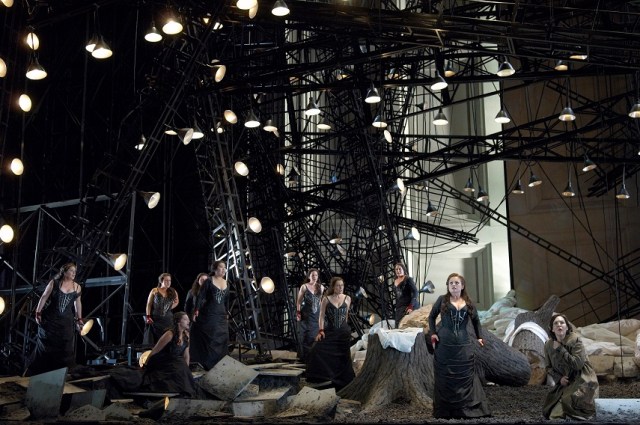
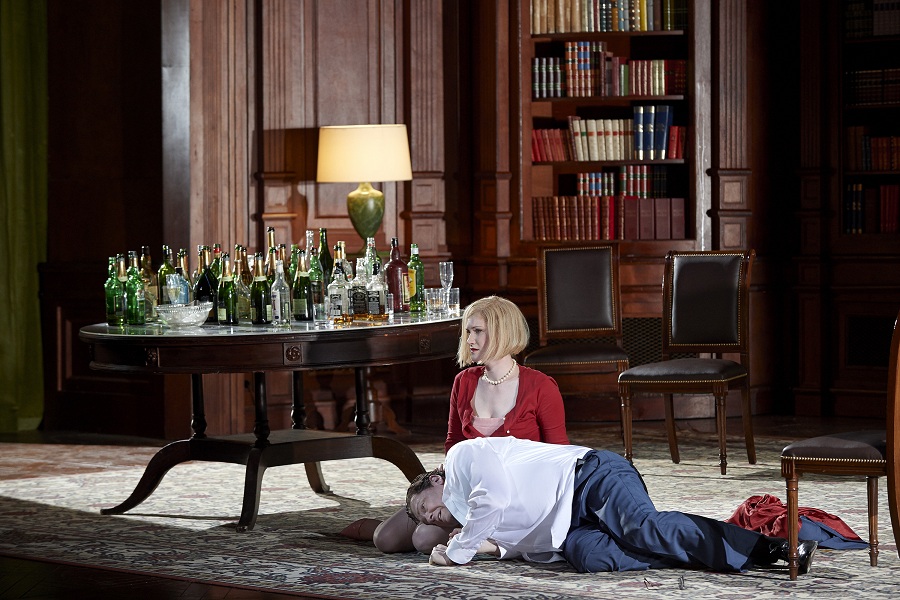
The Valkyries, Susan Bullock as Brünnhilde and Adrianne Pieczonka as Sieglinde in the Canadian Opera Company's production of Die Walküre, 2006.  directed by Atom Egoyan, Set and Costume Designer: Michael Levine (Photo: Michael Cooper)

The Valkyries, Susan Bullock as Brünnhilde and Adrianne Pieczonka as Sieglinde in the Canadian Opera Company’s production of Die Walküre, 2006. directed by Atom Egoyan, Set and Costume Designer: Michael Levine (Photo: Michael Cooper)

Posted in Opera, Personal ruminations & essays | Leave a comment

Tafelmusik’s Beethoven: the romance continues

Let’s begin by saying I’m not your typical Tafelmusik fan.  Yes I love their work with Opera Atelier under David Fallis & at Messiah time with Ivars Taurins (aka Herr Handel), but I am often frustrated by them.  Tafelmusik could be seductive Donna Anna, and I’d be Don Ottavio (thinking of last night’s Don Giovanni), the perpetually frustrated fiancé kept at arm’s length.  When Lord when?

No I don’t want to marry Tafelmusik.

But it’s confession time.  While I admire their baroque performances I am a romantic at heart.   Schumann,Berlioz, Wagner & Debussy are my favourite composers.  And while it’s true that we have the Toronto Symphony, as far as transitional repertoire (from Mozart to Beethoven & Schubert) or the romantics (Chopin, Mendelssohn, Berlioz,  Schumann and beyond),  I prefer the authentic sounds of an original instrument band such as Tafelmusik playing in the intimate confines of Koerner Hall or Trinity-St-Paul’s, to the modern sound of the TSO swimming in the vastness of Roy Thompson Hall.  If I want music by Beethoven (let alone anyone that follows) that usually means biting the bullet and going to the big helmet on King St.

They’re called “Tafelmusik baroque orchestra” for a reason, and that clear sense of identity has served them brilliantly over the years.  They’re solvent and even wealthy because they have a clear business model, they know who they are, as do their loyal audience.  That they only occasionally venture into romantic territory makes it a colossal tease for me (ergo the reference to poor frustrated Don Ottavio).

I wonder if I’m the only one who feels like they’ve been teased?

Roger Norrington and his London Classical players recorded the Beethoven symphonies over a quarter of a century ago.  Since that seminal set (one of many competing sets now available from historically informed bands), Norrington went on to record even more radical music such as Berlioz’s Symphonie Fantastique, symphonies from Schumann & Mendelssohn, early Wagner and even such late romantic composers as Smetana and Brahms.  Yet Tafelmusik only gave us the Eroica in performance in May 2012 for the first time (having recorded it a bit before that time).   And whenever they’ve ventured past 1780 I’ve seen full houses and rhapsodic applause: like I saw and heard today.  Every ticket was sold, every seat was occupied.

Speaking of romance & partnerships, Tafelmusik must be contemplating their future.  With Jeanne Lamon their brilliant leader & music-director of many years having stepped down in 2014, I can’t help wondering about their future direction.   Who will be their next music director and what direction will Tafelmusik take?  Maybe I’m the only one wishing they’d do less baroque and finally claim the 19th century as their own.  That’s my context for listening to today’s Beethoven concert led by Japanese-American conductor Kent Nagano, a program featuring the Mass in C and the Fifth symphony.  Maybe Nagano is just a guest and this will be the only appearance with Tafelmusik by the conductor who currently leads L’Orchestre Symphonique de Montréal.   Whether or not Nagano is a prospect for the job, the management may not believe they need a star at the podium.  They’ve done just fine without one.

Whatever the context –that is, whether or not Tafelmusik would be interested in bringing in a name conductor such as Nagano, whether or not they’d be open to programming more romantic music –there’s the matter of the concert.  It was fabulous.

We began with Beethoven’s Mass in C including soloists Nathalie Paulin, Laura Pudwell, Sumner Thompson & Lawrence Wiliford, and the Tafelmusik Chamber Choir.  It’s a magnificent work that deserves to be heard more often, its unaffected spirituality leading the composer into collision with the usual forms we’re accustomed to hearing.  The words and sentiments are completely intelligible, the soloists’ vocal lines gently mixing with the larger forces without conflict or a lot of drama.

While I credit the composition for the coherence of what we heard, it begins with Nagano, whose decisiveness at the podium was unmistakable. Nagano’s Beethoven matches the expectations of the historically informed performance community: which is to say, faster, and minus the excess vibrato of the previous generation’s performance conventions (although that’s the Tafelmusik sound whoever is leading the band).

This city loves Beethoven, as the TSO have noticed.  The weekend concerts were sold out. As we resumed our seats for the second half, every seat occupied, someone joked that it was like getting into our seats on an airplane, with all the attendant adrenaline.  We knew we were about to take off.

Because of course Beethoven’s Fifth Symphony followed the intermission in a wonderfully accomplished reading.  I’m trying to calibrate my gut feeling, that Nagano’s Beethoven sounds more like the Beethoven that I know, trying to figure out whether that’s even a good thing.  Is that because Nagano is more of a conventional /conservative conductor doing the usual things?   Previously I’ve heard Tafelmusik led by Bruno Weil.  What’s the difference?   Weil somehow had Tafelmusik playing Beethoven and still somehow sounding more like a baroque orchestra.  Maybe it’s because Weil bends more, is flexible with the players, whereas I felt Nagano was leading an edgy & polished performance.  While the sweetness is still there, particularly in that second movement, it moved at a breath-taking clip.  The pace in the scherzo dazzles, the strings fabulously accurate when they come to those speedy triplet passages.  When we came to that unforgettable last movement, presented fearlessly with great commitment and a flamboyant sense of drama I was wishing Nagano could be a regular feature here, at least as a visitor if not as their new music director.

In the meantime I’ll be pining for them. I wonder if I’m the only one..?

Kent Nagano & Beethoven

Posted in Music and musicology, Reviews | Tagged , , | 1 Comment

Some resist seduction by Tcherniakov’s Don Giovanni

Today’s opening of the Canadian Opera co-production of Don Giovanni directed by Dmitri Tcherniakov met with a mixed reception at the Four Seasons Centre. I heard a few boos, saw some empty seats at the end and heard an earful from my companion. That doesn’t mean it’s not a success, given that the COC knew going in that some people wouldn’t like it. You can’t please everyone, especially when you hand your opera over to someone with a reputation for radical & provocative direction. People wanting a conservative approach –such as those who boo’d when Tcherniakov came out for his bow—likely knew that this wasn’t that kind of show.  But then again this review isn’t really addressed to those people.

I’ve seen a few of Tcherniakov’s productions on video, and I liked some better than others. I adored his Prince Igor and Wozzeck, quite liked Ruslan and Ludmilla, but wasn’t as infatuated with either Il trovatore or Don Giovanni. You’ll notice that the two I liked least are so well-known as to be warhorses, operas whose familiarity likely represented a challenge to the director: to do something new with those overly familiar texts, whereas the other three were all works where I felt the director was free to simply direct. And so I think Tcherniakov came in feeling the need to shake things up, to get the dust off the stone guest and everything else in the story as well. While I didn’t like every second it was stimulating and better than most DG’s I’ve seen, a great piece of theatre. And I can’t deny that the dynamic with the resistant ones (including the conversations with my companion) was an added bit of entertainment. Some of the scenes seem designed to deliberately play with our expectations, none more so than the usually sentimental “vedrai carino”, where Masetto and Zerlina usually reconcile. But in an anti-romantic universe the happy ending is elusive, especially when you have Tcherniakov teasing you without mercy.

Tcherniakov’s set design could be a distant cousin to the one for Atom Egoyan’s Cosi fan tutte.  While this opera isn’t a school for lovers –or seducers– the whole opera happens in a kind of library that in some sense represents the collective mind.  It’s a mythical place, a big metaphor, but i won’t pretend i’ve decoded its implications.  Not by a long shot.

There are at least two big changes from the original text in Tcherniakov’s production. One is the insertion of big lapses of time. A curtain will come down, while a projected title informs us that a certain number of days or weeks has gone by. For some scenes this is pure magic. For example in the first ensemble, where Donna Anna runs off to get help, she returns moments later with Don Ottavio & servants, to find her father slain. Instead, a few days pass, and now we get the same formal lines from Donna Anna in a funeral parlour, lines that seem to make much more sense in Tcherniakov’s version. My one problem with these insertions has to do with overall pace. Tcherniakov sometimes has his cast performing their recit as though it were Pinter, inserting colossal pauses (in addition to the ones when the curtain suddenly flops down, telling us of a new delay in the story), that might be meaningful, and add gravitas. But the weight comes at the expense of energy, and makes DG a longer and darker night than it has to be.   I suppose that’s how Tcherniakov likes it.

The second change is a profound revision to the relationships between the personages in the story. This too adds depths & gravitas, due to new familial connections. There’s a Jungian dimension when we start wondering about all the interactions as having overtones of other kinds of connection. The word I think I need to use is “problematize” for almost everything that one could take for granted in the text. Zerlina now has a family relationship to Don Giovanni, so the seduction scene has a different meaning.

Tcherniakov always seems to get full commitment from his cast, so that they’re never out of character for the entire night, and there are always several places you can look in his stage picture. But there are moments when the lines that are sung seem to make no literal sense, because one has to decode what’s happening, to step over the virtual corpse of the original text that’s been knocked down at times. So long as you don’t resent that imposition of new meanings, it can be hugely enjoyable.  Maybe it makes sense in his alternate world, but several times I was puzzled, speaking as someone who knows this opera so well that I know almost every line by heart. Maybe I am in need of an intervention, a visit by a bunch of people dressed up as the characters in Don Giovanni to rescue me from my dysfunctional relationship with the text. But then again the last scene was a lot like an intervention for DG, even if the addict being helped could be the conservative listener/viewer as much as that womanizing Don.

I’m a lover of abstract art and someone who enjoys ambiguity, not someone who needs to have everything explained. For example I don’t know what happened at the end, when the fellow who sang the Commendatore re-appears at the end and the lines seems to suggest that the Don is going to Hell. I don’t mind, it’s fabulous music. The final moments—when the Don is alive, and those who have been in thrall to him have finally shaken off his control and celebrate their freedom—are wonderful. While there are moments that are confusing, that are still enjoyable, presented with commitment & passion; and quite a few stretches of the opera that make more sense in this production than in any Don Giovanni I’ve ever seen, and I’ve seen lots of them. While I like that sense of being disoriented & challenged, some in the audience don’t like that, and they voiced their displeasure.

The cast is strong. Russell Braun continues to captivate with the COC, a winning streak going back over several productions. The voice is sometimes delicate as in his Act II serenade, sometimes powerful, as in the finale to Act I. Everything Tcherniakov is doing with the Don seems to work for Braun, whether he’s at the centre of our focus or simply lurking in the shadows.

Kyle Ketelsen as Leporello is every bit as watchable. The voice is stunning and never less than beautiful, while the body-language is strongly suggestive of a playful servant right out of Commedia dell’arte even if Tcherniakov’s modernized reading makes no direct references to the style. Leporello is not actually a servant, his relationship with the Don being left quite ambiguous. Whenever KK was onstage he was usually the one I was watching.

(l-r) Russell Braun as Don Giovanni and Kyle Ketelsen as Leporello  (Photo: Chris Hutcheson)

(l-r) Russell Braun as Don Giovanni and Kyle Ketelsen as Leporello (Photo: Chris Hutcheson)

Michael Schade’s Don Ottavio isn’t like what one usually gets in this role. With the passing of the Commendatore Ottavio becomes something like the leader of the family, a leadership that’s visible in Schade’s performance. The singing was as flawless as ever: meaning that I don’t think I’ve ever heard this man sing sharp or flat in years and years of roles here at the COC. Some lines were exquisitely delicate, others more powerful. This might be the most macho & confident “Il mio tesoro” I’ve ever seen, sung to a group of characters who seemed to be lost in the slough of despond. Yet his “dalla sua pace” is achingly vulnerable, some of it sung in a foetal position.

Jane Archibald as Donna Anna and Michael Schade as Don Ottavio (Photo: Michael Cooper)

Jane Archibald as Donna Anna and Michael Schade as Don Ottavio (Photo: Michael Cooper)
Jane Archibald sings a wonderful Donna Anna even if Tcherniakov seems to dislike the character & what she represents, considering what he puts her through. At the end we find a genuine reconciliation both with her and the entire cast in the final great aria, which the director used as a kind of abstract template for everyone to drift back in the direction of sanity & possible fulfillment after the travails of earlier scenes. While her lines resist sense—because the lines are meant for Ottavio, not the others—I was grateful that for once the aria seemed to have a central purpose in the story instead of feeling like something Mozart tacked on (as it can in some productions).  It’s such a beautiful piece of music, especially once Archibald cuts loose in the last part that I completely teared up watching this music used in such an original way.

Jennifer Holloway is given a great deal to digest as Elvira, the most interesting of the women in most DG productions that i can recall. She is both an agent and also a reactive canvas, as we watch her reactions. Holloway’s intensity was often the most profound of anyone on the stage, and every moment of her role made sense to me (something I can’t say of everyone in the opera).

I’ll be seeing DG again from up close, hoping I understand it better next time. The production runs until Feb 21st. I’d recommend that you see it if you can.

click for more information (photo: Michael Cooper)

Posted in Opera, Reviews | 10 Comments

Opera 5: Modern (Family) Opera

I was invited to think and feel at tonight’s first performance of the Opera 5 program “Modern (Family) Opera”. I laughed a lot, I felt a lot, and my mind’s awhirl.

The family theme is approached from two very different directions. After Ermanno Wolf-Ferrari’s fun 1909 romp Il segreto di Susanna, we embarked on a much more serious journey with Darren Russo’s Storybook. It’s a very stimulating program.

The first opera made me laugh, pure and simple. Geoffrey Sirett gave a remarkable interpretation of the role of Gil, employing such a variety of timbres & sounds to his voice, that you’d think he was giving a master class in buffo singing. Director Grace Smith was aided by the choice to present the opera in Italian, making it that much sillier once Sirett cranked up the physical comedy, as though he were a big cartoon. Rachel Krehm’s voice sounded full, perhaps bigger than the last time i heard it, filling the Arts & Letters Club space.  Her deadpan cuteness as Susanna seemed to ignite Sirett’s red-hot conniptions. Their chemistry was delightful, and certainly a good beginning in a study of the family.

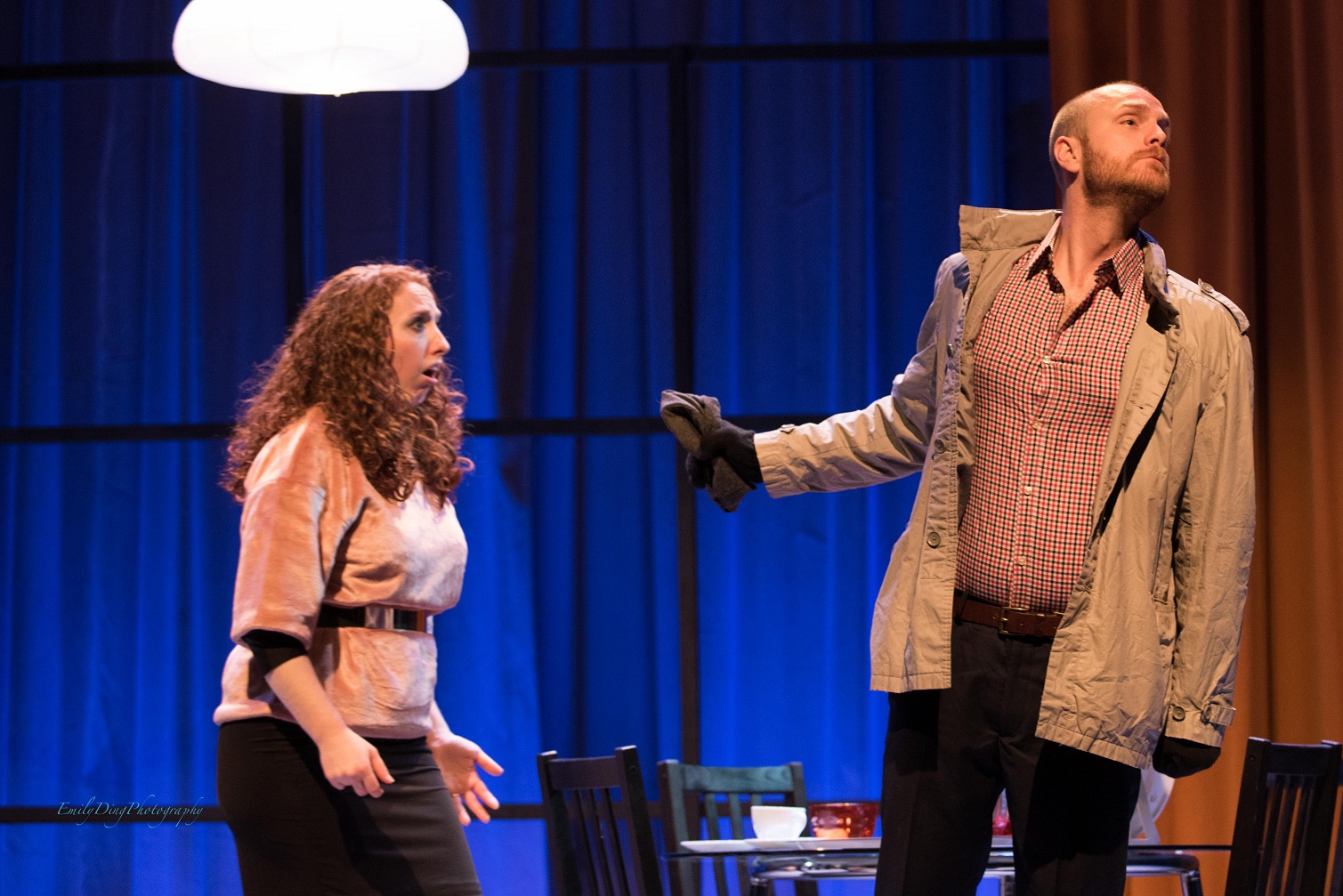
Rachel Krehm and Geoffrey Sirett in Il segreto di Susanna

Rachel Krehm and Geoffrey Sirett in Il segreto di Susanna

And then after intermission came the world premiere of Darren Russo’s Storybook. This is an accomplished piece of work musically, delicately scored for a small ensemble that was mostly tonal. Russo writes very sympathetically for the voice, sometimes playing with his singers but never requiring any pointless virtuosity. No, this was more relaxed than that, allowing us mostly to be lost in the wash of luscious sound.

Storybook is composed for an ensemble of five, named for the vocal register: a pair of sopranos, plus a bass, baritone and tenor. To be accurate, the parts are “Soprano, Soprano, Baritone, Tenor and Bass” even though –for example, “Baritone” is required to sing in a falsetto at one point.

We were in a post-modern place, I think. The stage was divided in director Aria Umezawa’s mise-en-scène (set designed by Matthew Vaile) into five more or less identical boxes with an IKEA chair that more or less held each performer plus a small table with a glass of water, circumscribed by a rectangular line on the floor. The libretto was a composite by several writers including Russo himself, assembled but not synopsized in the program. Do we need a synopsis, do we need to know where the story is going? I’ve joked that we live in a trailer culture, where it seems that our movies are presented with so much information in the trailer that we know exactly how it will turn out. I love that I had no idea where this opera was going.  Indeed, it didn’t “go” in any real sense. It’s a wonderful gift that we can be lost and properly disoriented in this world of GPSs and perpetual surveillance.

I find myself referring to questions of meaning and signification, wanting to remind myself just how it is that music signifies, or at least how it usually works. Yesterday I was immersed in poignantly meaningful music, listening especially to politically charged texts by Brecht & Owen & Apollinaire (for example), music by Poulenc & Eisler. Tomorrow it will be Mozart & Da Ponte as the Canadian Opera Company’s Don Giovanni opens, and then Sunday I get to hear Kent Nagano conduct Beethoven’s Fifth, a touchstone for meaning in music.  But more fundamentally this work has me wondering: must opera always mean something? Tomorrow I’ll be watching Dmitri Tcherniakov overlay meaning on top of the centuries of meaning already imprinted on the Don Giovanni story.  As I sat there, i wondered:  must it mean anything? We have been going to art galleries and staring at abstract images for the better part of a century. There are artists teasing us with a little bit of the old and a lot of the new, pushing familiar buttons while doing things in a different way than what we expect, perhaps changing up the procedure and in so doing altering our understanding. Umezawa presents Russo with phenomenal clarity, which isn’t necessarily a service, because we don’t miss a thing. The stage could afford to be more cluttered, messed up, more chaotic, concealing or shadowing some of this work, whereas Umezawa shows every word and every note with clinical precision. Some directors might have been tempted to overlay textures & movement, to add extras.  Tcherniakov’s extras can be like the plastic surgery that enhances something so aggressively that we can no longer see the original (but then again, some would say the old has become tired and needs the enhancements).  Umezawa’s approach shows integrity and a most authentic sort of faith in the material (this is on my mind after the lack of faith I saw at the COC concert yesterday, in the excessive preambles).

Composer Darren Russo (click for Russo's interview)

Composer Darren Russo (click for Russo’s interview)

Russo’s texts arbitrarily take us to diverse places. At one moment it may be sad and depressive, at others, ecstatic, joyful, or just plain silly. There doesn’t need to be a dramatic through – line. At times I was thinking it was like a modern madrigal, five singers (or fewer) making a rarefied kind of music.  I was reminded a bit of Ana Sokolovic’s Svadba-Wedding, with the group of singers standing there belting directly at us, an experience i found quite enjoyable. At times it was a little precious, but so what? This is Russo’s first opera, his first chance to hear this large-scale work not just performed but with a live audience response and churls like me being picky & critical. It took Verdi and Wagner several experiments before they hit their stride, and found their authentic voice.  I believe Russo already has a genuine voice, one that deserves to be heard.

The family connection in Russo’s piece is much more that of children than parents although we do hear from the parents a few times. I don’t want to misrepresent the work, one that’s still resonating within me. Dreams are invoked near the beginning and again at the end. Madness is also a theme, although it’s more the sort where we fear we’re going crazy, as in the children’s song “I am slowly going crazy, 1,2,3,4,5,6 switch”.
But when the children’s song is coming at you in five-part counterpoint it can begin to suggest genuine madness. That the five performers –adults singing and enacting childhood—are all in their discreet boxes lends additional weight to the possibilities for madness, as though we were watching five different solipsists unable to make any real contact with the outside world.

Aria Umezawa said the following in her program note:

It is my hope that in viewing “Storybook” you can begin a dialogue in your own mind not only about what it means to lose one’s innocence, but also about what it means to be a Canadian opera.

I’m grateful to Russo, Umezawa and Opera 5 for the splendid conversation.  Opera 5’s program “Modern (Family) Opera” will be presented again January 24 & 25 at 7:30 pm at the Arts and Letters Club.

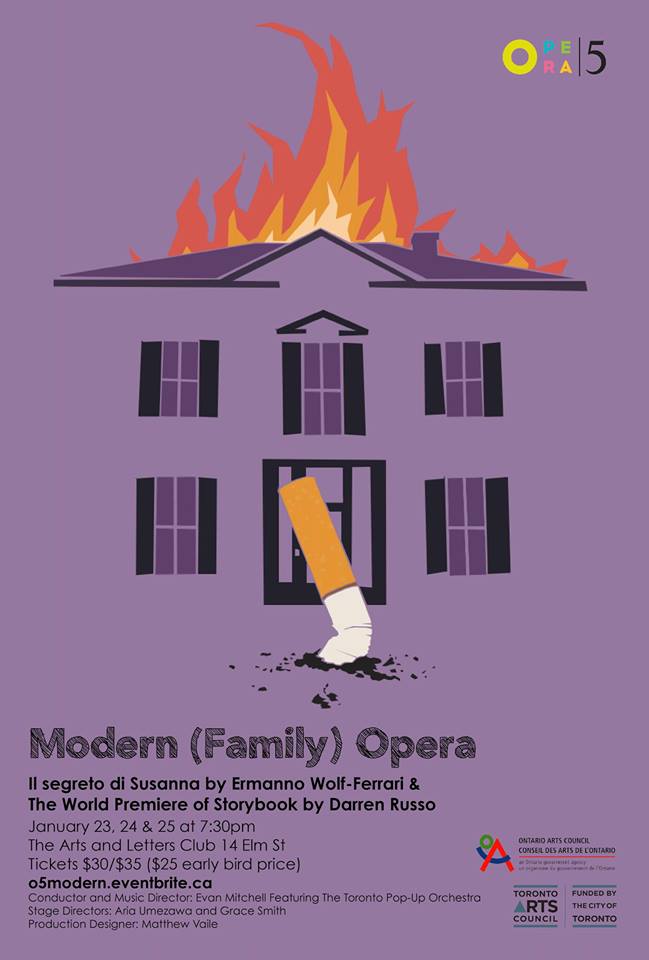
click for more info

Posted in Music and musicology, Opera, Reviews | Tagged , | Leave a comment

Songs of Love and War

The title of today’s noon-hour concert at the Richard Bradshaw Amphitheatre –“Songs  of Love and War”—is  a curious umbrella sheltering a diverse group of songs & composers.  I can only speculate on the rationale for the programme, created for members of the Canadian Opera Company’s Ensemble Studio, except that it strikes me as ambitious and well-intended.  We were told that it started with the observation of the 25th anniversary of the end of the USSR & the removal of the Berlin Wall, but the songs remind me of other wars of the last hundred years of history, the same issues & the same horrible mistakes over and over.  It seems apt that I’m immersed in a production of Ödön von Horvath’s play Tales from the Vienna Woods, a play that premiered in 1931; the issues that hadn’t been settled in the Great War of 1914-1918 would resurface in the war that followed in 1939, issues that are still here even now.

World peace? we’re not there yet.

The five composers had completely different experiences of war & vocal music.   Korngold, Ives, Eisler, Poulenc & Britten are a wonderfully diverse group.

We began with five Korngold songs that date from after his emigration to the USA in the 1930s.  The title “Songs of Love and War” seems to be needed with Korngold, an exile in America whose songs don’t really show us pain or loss the way that the others do, which might be why we start with him, perhaps the happiest exile, a fortunate refugee in Hollywood.  I suspect Clarence Frazer (who sang the tunes elegantly in two languages) is a Korngold fan, as I clearly recall how beautifully he sang an aria from Die Tote Stadt at a previous concert.

Next came Charles Ives’ Three Songs of War, including two with texts by John McCrae (yes that John McCrae).  I quite love what Ives does with that famous text –“In Flanders Fields”—especially when we get to hear it without the politically correct framework of Remembrance Day.  I was surprised at how fresh it felt, particularly in Iain MacNeil’s reading.  The second of the three songs –also a McCrae text—is as joyful as the first is sad.  With the benefit of a century’s hindsight I pondered whether there was any irony meant in Ives’ quotes of American anthems such as “Columbia the Gem of the Ocean”; chances are it’s my jaded ear, not anything Ives meant.

We were next treated to a two-man sampling by Frazer and MacNeil from Hanns Eisler’s Hollywooder Liederbuch, a much bigger collection of short songs & fragments than the nine songs we heard.  I wonder if the original concept for the concert began with Frazer & MacNeil singing Korngold & Eisler, and the other composers & singers were added later…? The net effect today was that the Ives & Poulenc were wonderful escapes & relief from the dark profundities of the two Germans, with the Britten as an intriguing epilogue at the end.

I suppose I felt this because Korngold & Eisler are such an amazing & interesting pair, both exiles from the Third Reich, both to become successful film composers (and film music is an obsession of mine & an academic area of study).  Yet they are a contrasting pair to be sure.  Where Korngold was a darling of the conservatory & concert world, acclaimed as a child prodigy, Eisler turned his back on many of his classical connections, becoming disenchanted with the second Viennese school composers such as Webern, Berg and their leader Schönberg –to which he could claim membership if not an actual allegiance—and instead aiming for something genuinely popular rather than elitist.  Where Korngold seemed to lead a charmed life, narrowly escaping the Nazis, and arriving in Hollywood at precisely the right time to be Warner Brothers’ poster boy for their new artistic legitimacy (as the studio sought to reinvent itself through such high-brow projects as Reinhardt’s Midsummernight’s Dream), Eisler was exile from not one but two countries.

I associate Eisler with his most famous composition, that is itself a perfect image of his tragic life, namely  the anthem of the German Democratic Republic (aka “East Germany”), the country to which he was deported during the American red scare.  The tune is a fond and idealistic song for a country rebuilding after the horrors of the world war, even if it came to symbolize the very lies told to the composer and all the believers who would become disillusioned. 

Seven of the nine Eisler’s songs sung today were settings of texts by Berthold Brecht, another exile who would go back to East Germany, but without the tragic ending.  I wish we could have heard a bigger portion of the book, but I suspect that the organizers might have thought it to be too risky, too darkly ironic.  Speaking of the organizers, I only wish the programmers had trusted the music a bit more.  We were treated to some fascinating pieces of music but also a great deal of text explaining it all, as if to suggest that maybe someone was looking over their shoulders, not believing we’d understand it or like it.

I know I liked it.

As with the Ives, the three Poulenc songs that followed were a wonderful escape, especially in Jean-Philippe Fortier-Lazure’s bravura reading of “Fêtes galantes” (Aragon not Verlaine), one of the most impressive pieces of singing I’ve heard at one of these noon-hour concerts.    We closed with Andrew Haji’s lovely reading of “What passing bells” from Britten’s War Requiem.  Again I felt the organizers didn’t trust the material enough.  After a brief explanatory lecture did we need to hear Haji read the Wilfrid Owen poem that is the text? It’s in English.  We’re sitting close to a singer with wonderful diction, and we have the words in the printed program as well.  I love ambition, I enjoyed every piece on this concert, but only wish there had been less talk and more silence around the songs.

I would be remiss if I didn’t also mention pianist Jennifer Szeto who navigated so many different styles and idioms of music, bringing us home splendidly in each wonderful song.

Posted in Music and musicology, Reviews | 4 Comments

10 Questions for Kyle Ketelsen

Kyle Ketelsen is a special talent, a wonderful voice with extraordinary dramatic presence. I’ve seen him twice. The first time he was in the Canadian Opera Company’s La Cenerentola, when I said that he “brought a majestic sound to the role of Alidoro, the philosopher”. The second time was in the video-recording of the Aix-en-Province production of Don Giovanni directed by Dmitri Tcherniakov broadcast on TFO last year, playing a Leporello unlike any I’ve seen before.

More on that in a moment.

Ketelsen is in demand all over the world, with the world’s leading opera houses and orchestras. You can read more details of his bio here. This weekend that same production of Don Giovanni (the COC’s co-production with Teatro Real Madrid (TRM)/Festival d’Aix-en-Provence/Bolshoi Theatre) opens at the Four Seasons Centre. I had to ask Kyle Ketelsen ten questions: five about himself and five more about his work in Tcherniakov’s Don Giovanni.

Bass-baritone Kyle Ketelsen (photo: Dario Acosta)

Bass-baritone Kyle Ketelsen (photo: Dario Acosta)

1-Are you more like your father or your mother?

Well, of course the appropriate answer is difficult to gauge, since we are invariably an amalgam of DNA. I suppose it’s my father, though I do see my mother in me quite a bit. By appearance, naturally, I’m nearly a clone of my dad. Same size and build, same voice. Same thin face with close-set eyes, just without the firefighter’s moustache he brandished for virtually all of his adult life. The older I become, the more frequently I see him in the mirror. Funny how that happens.

Dad was such a gentle soul, a devoted husband and caring father. He truly was my hero. He wasn’t without a temper, which he inherited from his father, but managed to tone down quite a bit. Much the same as I have with the temper he gave me. That’s the challenge of each new generation – to build on our parentally-taught positive traits, and dull the sharp edges of the negatives. He surely did, and I am.

My sisters and I kept a list of “Dadisms” when we were young. Things dad said that struck us as particularly funny. For example, “He’s ugly as a burnt rope.” Or “Baker Baker,” code for bad breath. “Let the big dog run” was one of our favorites. Many others not fit for printing in a family publication. My sisters and I continue his legacy by repeating as many of these little sayings as we can. It’s not difficult, as they naturally pour out of us. I hear my kids repeating them as well. Passing it down.

Physically, I’m hard-pressed to see my mother in me. I’m 6 feet & 192 pounds. At her apex, she reached 5’2” and maybe 110 pounds. I could heft her like a sack of flour, but mentally she was Plymouth Rock. As in many families, she was the glue that bound us, and the driving force creatively. I have her emotional (read: sappy!) perspectives of things like family, music, nature, movies, and the world in general. Which quite often will leave me in satisfying tears. The happy curse of having sympathy, I suppose. I see it in my kids as well, which is quite beautiful.

There’s an interesting (albeit indirect) connection my mom has with the COC. She was a devourer of books and, until I was out of grad school, ironically, I myself resisted reading. Couldn’t see the point in it when there was a perfectly good television sitting right there in my living room. My mother died much too young just before I was to debut at COC with “La Fanciulla del West” in the 2000-2001 season. My role of Ashby was pretty minimal, so I found I had significant chunks of free time at rehearsals. I remember thinking that there’s probably a reader somewhere in my genes, so I started with Catcher in the Rye in those COC rehearsals 14 years ago. I’m so grateful to have discovered that part of mom in me.

2-What is the best thing or worst thing about being a singer?

Gran Teatre del Liceu, Barcelona. Kyle Ketelsen as Escamillo. Fabio Armiliato as José. 2011 (Photo by Antoni Bofill).

Allow me to make one thing clear: to do what you love for a living is a gift! Plain and simple. I try my best to never take it for granted. Don’t hate me, but I have one of the best (and BIG quotes here!) “jobs” in existence. There’s a lot to choose from when it comes to finding the best thing about being a singer. Is it getting as much sleep as I want every night, or not working in a cubicle, or not attending committee meetings, or playing dress-up for money, or that I have collaborators in lieu of a “boss?” Quite possibly, speaking for my soul, it is that I’m fortunate enough to be fulfilled artistically while at work. That intangible capital, at the same time fleeting and yet somehow cumulative, that you hold inside which gives you pleasure in being artistically alive. Or perhaps this is just from hearing the applause, and feeding my ego. I think maybe these things are related…

Even on the worst day of rehearsal, it doesn’t rate compared to so many other possible scenarios. I like to say, “No one died on the table today.” That said, easily for me the worst part of being a singer is spending so much time away from my family. Becoming a husband and father was always a part of my life plan – well before the idea of becoming a professional singer – so I hold it above all other priorities. Traveling to foreign lands can seem exotic and exciting, which it sometimes is. However, it’s often overpowered by the painful separation from my wife and children.

3-Who do you like to listen to or watch?

I’m a rock-n-roller, for sure. I do enjoy opera, but I hear it all day at work. So it’s usually Led Zeppelin, Stones, Beatles, Jack White, STP, Radiohead, and many others to a lesser extent. Just about every genre of music (shy of country or, say, death metal!) makes it onto the air in the Ketelsen household, including jazz, bluegrass, standards, showtunes, movie soundtracks, pop, blues, and heavy metal. The mainstay of my playlist lately has been Rival Sons, a kind of neo-Classic Blues Rock group with four albums under their belt. Very reminiscent of ‘70s-style rock n roll. I just can’t get enough!

I’m a huge fan of movies, and I’ll see quite a few on the road. Binging TV series is a favorite pastime as well. I’m currently rewatching HBO’s The Wire. Others on my faves list (in alphabetical order) are: The Americans, Archer, Betas, Bron/Broen, Derek, Homeland, House of Cards, Justified, Ray Donovan, Silicon Valley, The Walking Dead, True Detective, and Veep.

I’ll also watch just about any NBA or NFL game. Cubs/Bears/Bulls are always my priority.

NHL??? Sorry, Canada, I can’t follow the puck!!

4-What ability or skill do you wish you had, that you don’t have?

Having played pick-up basketball passionately for over 20 years, I used to actually have dreams about dunking the ball. I could always grab the rim, and even dunk things like a tennis ball, or my sweaty jersey. It’s as close to flying under my own power as I can imagine. So much beauty in that act.

5-When you’re just relaxing and not working what is your favourite thing to do?

Some days on the road it’s just good to do nothing at all; let the brain and body rejuvenate. Most free days, though, I’ll either work out, take a long walk, read a book over dinner at a nice restaurant, see a movie, take in a museum or sporting event. Hopefully I have good colleagues, with whom I enjoy spending time. Quite often I’m working in a city where I have friends or relatives, so it’s a treat to be able catch up with them. This job certainly affords me the opportunity to stay in touch with people I might not otherwise ever see.

When I’m home, it’s all about family. My wife is endlessly creative in finding activities for our kids. I’m on the go quite a bit, taking them to karate, piano, guitar, and ALL manner of sports. Not to mention intellectually enriching classes & events. It’s truly a pleasure to witness your kids thriving and finding things they like and have a talent for.

Five more about Leporello in the new COC Don Giovanni opening this week.

1-Please talk for a moment about the rationale or subtext of Leporello, in Dmitri Tcherniakov’s reading of Don Giovanni.

In this production the roles of master & servant are set aside in favor of a more modern take. Leporello is a wayward youth in desperate need of a father figure, which he finds in Giovanni. It’s established in the staged overture that the two have previously met, though is appears that they’re not yet friends. My character is in his late teens or early twenties, and has been a sort of ward of the state. He’s allowed to live in the house of the Commendatore, to whom he’s related in some obscure way.

Like any youth Leporello has learned how to relate to others from adults – in this case Giovanni. It’s clear he’s been misguided when dealing with just about every other character in the show. Where a son might mimic how his father treats women, such is the manner by which Leporello acts toward the gender. His notions of what makes a relationship are severely warped, clearly demonstrated (I hope!) in his interactions with Elvira. He makes a pathetic attempt at wooing her during the Catalogue Aria, and later tries to impress her with an eerily cold, lifeless kiss.

The mutual contempt he holds for his peers – played by the members of the chorus in one scene – is made clear as well. Every relationship Leporello has is horribly dysfunctional. He’s just a lost little boy at heart.

2-Please talk about working with Dmitri Tcherniakov, his methods and his manners.

I honestly believe Dima is an artistic genius. He creates layer upon layer upon layer of motivation and back-story for each character, and commits an unbelievable amount of rehearsal time to each character, in each scene. Many directors will have holes in their plan, not knowing exactly what to do in certain places. No such thing with Tcherniakov! He arrives the first day of rehearsal with his entire story so well conceived, it’s a Russian novel unto itself. That’s not to say he’s inflexible with his concept. He does allow for artistic interpretation, and honestly considers any input. If he doesn’t agree with a suggestion from a singer or conductor, he will give you a thoughtful reason why he doesn’t want it. No decision is made willy-nilly in his productions. There’s multi-level reasoning behind nearly EVERY move made onstage. Astonishing depth.

3-What’s your favourite moment in this Don Giovanni?

It does happen to be the first act recit and trio with Giovanni and Elvira, leading to the catalogue aria. It establishes in detail what my character is all about, as well as my relationship with the two. It begins with my expressing disapproval of Giovanni’s lifestyle, segueing into flirtatious infatuation with his former love, Elvira. My action during the aria demonstrates my character’s immaturity. In attempting to impress Elvira, I invent sums of the Don’s conquests, mock the contents of her purse, show off with a yo-yo (!), make faces at her through a window, make light of the Commendatore’s memorial, pose and preen as he believes a desirable man would, before moving in for the overt seduction attempt. It all reinforces Tcherniakov’s architecture of the character, to be very boy-like, mocking and insulting instead of praising and positive attention, in an attempt to impress a female.

4- The arts often feel very precarious in this country, spoken of as a luxury even as they starve alongside wealthy sports teams. Please comment on the business and how you observe it unfolding as an artist and as a citizen.

Indeed we’re in an age where the arts are often seen as an elitist indulgence. As a form of entertainment, opera thrived well into the 20th Century with very little competition for viewership. Today’s entertainment options are seemingly unlimited, therefore we need to fight for exposure and relevance. If we’re to guarantee opera’s survival and prosperity, each must do his part. It’s why outreach to schools, creative marketing and audience development are absolutely vital, as well as inventively incorporating social and mass media.

I am concerned about the survival of this very special art form. Public and private financial support are continually scaled back in favor of more “tangible” causes. This is incredibly short-sighted and ignorant. Intangible benefits are benefits nonetheless, and fulfill the soul. Art for art’s sake benefits society, and is indeed for humanity’s sake.

5- Is there a teacher or an influence you’d care to name that you especially admire?

I’ve had the incredibly great fortune to encounter the perfect voice teachers at the appropriate moments in my development as a singer. My voice teacher in undergrad at the University of Iowa was a man named Albert Gammon. He was a perfectionist when it came to vocal technique and diction. He was a living legend 25 years ago, and has a remarkable enduring legacy with hundreds of his students, and their students.

My teacher in grad school at Indiana University was Giorgio Tozzi. Readers who aren’t familiar with him should just search YouTube.

One of the most famous basses in history, he was a caring, insightful teacher. Always positive, famously friendly and generous, he was also incredibly intelligent, and had diverse interests like art, politics and hypnosis!

He very quickly opened my upper vocal register with his Italianate technique. For years we concentrated on legato, warmth of tone, and overall interpretation. He became very much a grandfather figure to me.

click for more information about the production

I’m so very lucky to have encountered these two men at the ends of their careers.

*******

The COC production of Don Giovanni opens Saturday January 24th at the Four Seasons Centre.

Posted in Interviews, Opera | 1 Comment

10 Questions for Jennifer Holloway

Lauded for her “nuanced dramatic impulses” and “voice that is liquid, lambent, and lit from within”, American singer Jennifer Holloway gives new life to the characters she plays and the music she sings at leading opera houses and concert halls at home and abroad. This season brings exciting role debuts, including Rosina, Musetta, and Adalgisa, and her first appearances with the Canadian Opera Company as Elvira in Dmitri Tcherniakov’s production of Don Giovanni.

Recent performances have met critical acclaim, including in her English National Opera debut as Orlofsky in Christopher Alden’s striking production of Die Fledermaus, as well as a breakthrough performance in her South American debut at Argentina’s Teatro Colón as Temple Drake in the World Premiere of Oscar Strasnoy’s new opera, Requiem, and her return to the Metropolitan Opera for Tebaldo in Don Carlo, conducted by the late Lorin Maazel. Among the highlights of her concert work were her first appearances with the Marseille Philharmonic and Maestro Lawrence Foster in a concert tour around China, and with the Jerusalem Symphony Orchestra in a program including the world premiere of Frédéric Chaslin’s Love and a Question, which he composed for her.

She has concentrated her repertory in major roles by Mozart and Handel, performing the roles of Dorabella in Cosí fan tutte (Dallas, Atlanta, Minneapolis, New York City Opera, Tokyo), Cherubino in Le nozze di Figaro (Dallas, Portland, Bordeaux), Idamante in Idomeneo (Opéra National de Bordeaux), Donna Elvira in Don Giovanni (Pittsburgh, Tulsa), Irene in Tamerlano (Teatro Real Madrid, Los Angeles Opera) and the title role in Serse (Pittsburgh). She made her debut with the Metropolitan Opera in New York in December 2010 as Flora in Willy Decker’s new production of La Traviata, and has also appeared at the Glyndebourne Festival in new productions of Hänsel und Gretel (Hänsel) and Falstaff (Meg Page), at the Santa Fe Opera in new productions of Cendrillon (Prince Charmant) and Faust (Siebel), the Maggio Musicale in Florence, the Théâtre du Capitole Toulouse (Rameau’s Hippolyte et Aricie with Emmanuel Haïm), the Théâtre du Châtelet in Paris and the Opera Theater of St. Louis. Concert and festival appearances include the Hollywood Bowl in Los Angeles (Mercedes in Carmen with Gustavo Dudamel and Zweite Dame in Die Zauberflöte with Leonard Slatkin), Anne de Boleyn in Saint-Saëns rarely-performed Henry VIII at the Bard Music Festival with the American Symphony Orchestra (now available on itunes), as both Octavian and as Der Komponist in Chautauqua, NY, and at Chicago’s Grant Park Music Festival in Rossini’s Stabat Mater. She has also formed a strong partnership with Jean-Christophe Spinosi and his Ensemble Matheus in works by Rossini and Vivaldi.

I had to ask Jennifer Holloway ten questions: five about herself and five about her portrayal of Elvira in Tcherniakov’s production of Don Giovanni, that opens this weekend at the Four Seasons Centre.

Jennifer Holloway (photo by Arielle Doneson)

Jennifer Holloway (photo by Arielle Doneson)


1. Are you more like you father or your mother?

There are so many elements of both of them inside of me. Although I have taken on PLENTY of their bad traits, I prefer to focus on the good things I got from them! Both of my parents are very loving, caring, and selfless people. My parents will go out of their way to help anyone in need, even complete strangers. They love big and care big, and want to show that to both family and community. I love that they have instilled in me a feeling that we can all create a better society if we help each other out. I am not as good as they are, but I like to think I try to consider other people, and to make them happy. I try to realize that I am a part of a community, no matter what I am doing… whether I am driving on the road or on stage with my cast. We all work together and help each other out to make something wonderful happen.

One thing that I think is very much like my dad is his learning style. He is a very hands-on person. He can fix anything because he wants to know HOW things function. It kills him to call a repair person because he is pretty sure he can fix anything if he just knows how it is put together…. where the connections are, what comes first, where one part is in relation to another. There were so many stories of him ruining his brothers’ and cousin’s toys when he was little because he would dissect them to find out how they worked. Back then, he couldn’t always put them back together again, so after a while, everyone hid their toys from him! Toys turned into cars and houses his own kids’ toys… and my dad is still that way. Once he has really experienced and touched and felt how something works, and he has asked a lot of questions, he uses crazy powers of deduction and ingenuity to find a solution and fix it. I love that he’s always taught my sisters and me by letting us try. He does the same with my kiddo. It is beautiful to watch. I have found more and more that I learn best that way. I have found that in my career, when I am learning music or when I am learning staging, I have to DO it and EXPLORE it and find out how every part of how it works before I can BE it and PERFORM it!

2. What is the best thing or worst thing about being a singer?

Well, there are a million best things. Ultimately though, opera is so cool because it takes so many art forms… sets and costumes (visual art), movement (dance), acting, words (literary), and music and combines them all to heighten each one. I love being a part of an art form that has the possibility of combining all of those things to make people feel more deeply than they would while experiencing just one art form at a time. I also love that the combination of all of these art forms causes ME to feel and understand so many human emotions and situations more deeply. When it all comes together in just the right way, we can change lives and that makes any crummy things worthwhile!

There are not very many bad things about being an opera singer, but it is definitely difficult to be in a profession that is so unusual to the normal population. Let’s be honest, the fact that time is a practice room or for warm up is actually work time, or that I can’t commit to anything ahead of time because my schedule doesn’t come out until 5pm the night before is just weird! I think the most difficult thing for normal people to understand is in the way our family functions… especially in relation to my little girl. People tend to look at our family as eccentric and odd. Lots of folks have what seems like great advice, and it comes from a good place, but it can be a little ill-informed. Sometimes, knowing that people are a bit judgmental about the time I spend away from home is pretty difficult to handle. My heart breaks when I am away from my child and my husband. When I am not home, she is surrounded by family who loves her, and we make sure to keep things as “normal” as possible. We make a point of traveling to be together as much as my job and her school allows. We keep her as busy as possible in after school activities and friends, and I try to keep as busy as I can doing the “best parts” of my job and throwing myself into them because when I am not doing them, I have time to think about the parts of her life that I am missing and will continue to miss. We make so much use of Skype. We have breakfast together every morning before school and we play and do homework together and read each other to sleep almost every night. It is unorthodox to say the least, and I know we all wish we could just reach through the computer screen and hold each other. It is difficult, but so are many parts of other peoples’ “normal” family lives!! This is our normal.

BTW, when is that teleporter gonna be ready?

3. Who do you like to listen to or watch?

My colleagues. I learn more from the people who I work with than from any recording ever. There are one million right ways to do something, to sing something, to be something. I don’t believe in this “definitive recording” garbage. What we do is so changeable and moveable! I love to see someone taking chances, I love to see someone figuring something out, and I love to see my colleagues taking what they have and don’t have and making something special out of it. I learn so much from it. There are so many things that make a great performer or performance, and it is through watching the people close to me that I can observe and understand what those things are and maybe try to work some of them into what I do!!!

4 What is the ability or skill you wish you had that you don’t have?

I would LOVE the ability to be in two places at once! Not least of all because I would love to sit in the auditorium and watch and listen to myself so I could know what I needed to do to communicate all the way to the lady in the back of the 2nd tier. I depend on other people to give me feedback. What I hear in my head is COMPLETELY different from what you all hear in the audience, so I depend on others’ ears. It is also always shocking to watch myself on a video. There always things I thought I was doing that nobody could ever see, and there are always things I had NO idea I was doing! “oh my! I had no idea I was rocking back and forth like that!!!” We are inhabiting characters and resonating in weird ways, and we have NO idea!!! It’s a weird world we live in hahahaha

5. When you are just relaxing and not working, what is your favorite thing to do?

Well that’s easy. If I am home, I wanna spend every moment with my daughter. I completely lose myself when I am with her. We just do normal everyday things, and they become fun. Things sometimes take more time… grocery shopping, for example. I am the terrible mother who lets her kid drive her around on the cart, or we play games to find the things on our list, or silly things like that. My husband always tells us to behave! The three of us love to be together. We don’t have to go anywhere special, we just like being together.

Five more about preparing Donna Elvira for the upcoming Canadian Opera Production of Don Giovanni

1-Please talk for a moment about the rationale or subtext of Donna Elvira, in Dmitri Tcherniakov’s reading of Don Giovanni.

Director, set & costume designer Dmitri Tcherniakov

This Elvira is very different from the other ones I have met. This Elvira is very tragic. I want to take her and talk some sense into her. I want to be her friend to show her that she doesn’t have to try and please everyone else.

I have always thought of Elvira as a very strong woman who knows what she wants and who will do whatever she can to get it. In this reading, she is so different. She is many young girls that we know today, maybe a little awkward, and desperate to find somewhere to belong, so playing “the cool kid” as much as possible. She wants Giovanni back, and knows somewhere in her mind that she can’t have him, but maybe doesn’t want to admit that. It also kills her to see him with everyone else. Since she can’t get him back, she will try to expose his shortcomings and turn everyone else against him, and in turn be a part of a new group… the group who has Giovanni as a common enemy (Ottavio, Anna, Zerlina, Masetto). She is amazed but a little regretful at the beginning of act two having reached that goal in the end of the act 1, and we watch her struggle with her desire to belong with that group juxtaposed with her desire to do make amends with and to help repair this man (Giovanni) who she deeply loves and whom she feels she has helped to break. We see her struggle to try to keep up the right face for the right people at the right time. She is tired and confused and helpless. By trying to go along with something she doesn’t believe in, she ends up too late in helping the helpless Giovanni, and all is lost.

2- Talk about working with Tcherniakov

This man is amazing – his words, his understanding of human beings, of the millions of ways to react to a situation. His words are wonderful, but his actions are better. I HATE when directors show me what to do. I get frustrated and feel they have taken my power of creativity away. In this case though, when Dmitri gives an example of what he thinks a character will do, there are one million ideas and feelings of understanding that go through my body and brain. I don’t have to do it just as he did, I am not him. He understands the music and the relationships, he shows all of them in his body… and I can understand his vision and my character in a completely different way when he shows me something. It is rare to work with a director of this quality. I feel very fortunate.

He is controversial, some love him, some don’t.  I love him without reservation.  Watch this little clip for a glimpse of that intensity. 


3. Favourite moment in Don Giovanni

There are so many wonderful moments. Truly. But my favorite moment in I think all of opera is in the act two finale when a desperate and scared and charged up Giovanni challenges the Commendatore and sings, “Parla, Parla, ascoltando ti sto.” It is the most heart breaking, earth shattering and at the same time, sexy music. I am so filled with emotion every time I hear this part of the opera. Mozart wrote some really good stuff! hahaha

Jennifer Holloway (photo by Arielle Doneson)

Jennifer Holloway (photo by Arielle Doneson)

4. The arts often feel very precarious in this country, spoken of as a luxury even as they starve alongside wealthy sports teams. Please comment on the business and how you observe it unfolding as an artist and as a citizen.

I am not Canadian, so I can speak only to what I know about the situation with the arts and opera in the United States. The arts in the US has a very big problem in that, in most places in the US, almost anything in the arts is viewed in much the same way people see homeless puppy on the street. “It’s so sad, something should be done about that”, or “Someone should take care of that dog, but not me. I don’t even like dogs… it’s not my responsibility” or even more likely, they just walk past it and ignore it. But for the people who take the time to feed, to take care of, and to get to know the puppy, the amount of joy they will receive back is unlike anything else. Here is one major problem… if you never grew up with animals or if you got bitten by a dog when you were young, you will be likely to walk right past the dog or worse, run away in fear upon seeing it.

We are fighting a difficult battle here as there are so many things stacked against us. People don’t see the arts as important because they haven’t been exposed, partially because the arts have been buried in a sea of easy media. People’s time is easily, conveniently, and cheaply filled. When choosing what to do on any given night, almost everyone has a television and the internet at his disposal. You have sports, drama, and comedy all at the literal click of a button. Cheap and super convenient. If you feel like leaving the house, you can go around the corner and see a movie. You will complain about ticket prices, but still go for less than $50, and be allowed to enjoy the flick while munching away on a snack. Relatively cheap and pretty easy. If planning ahead, maybe you will plan to go see a comedy show, or a basketball game, or a pop concert. Not so close, and requires some planning. Also not as cheap. But what you choose to go and see is something you have been exposed to for a long time. There were all those ads on TV. You have seen that comic or at least SOME comic on television, so you know what that will be like. You think, “It is great to laugh on my own couch… wouldn’t it be great to do it live?” “I have watched basketball or football or hockey on TV for years, I know the sport… I played the sport when I was younger. I think I will get my butt out tonight and see a live game.” “I have seen this video one million times on TV and heard the song over and over on the radio. I bet this pop concert would be fun… and cool. It’s on TV and the radio! Maybe I will shell out the extra money to see that in person!”

The performing arts fit into that last category: Performances are not so close, require some planning, and are not super cheap. In order to be one of the things that people choose to do on a Saturday night, we have to actually make it on to their radar. We have to be the thing that they saw on the commercial and we also have to be cool! Television is a fantastic form of marketing. Think of all the show choirs that popped up once Glee came on the air! Think of how many people have become home gourmets since the advent of the Food Network, and how well Home Depot is doing since we all want to be the Property Brothers! I think our media presence has to be much bigger. The difficulty is that each of our companies has a great marketing department, but we need a HUGE arts partnership marketing TEAM to really make a difference like this. I wish there was some way of all banding together in this. I think the idea of putting opera in the movie theaters is a nice one, but we skipped a step… we haven’t really created a buzz about what we do in the first place.

In addition, and even more importantly, WE MUST BE EXPOSING CHILDREN TO THE ARTS from a young age. We are losing out with the kids. I think we all underestimate the importance of little kids going to live performances several times a year. My daughter still talks about Wayne Tigges’s chicken spitting Leporello from my first Giovanni. She was 3 when she saw it. Now, not everyone has an opera singer mom, so the best way for us to reach them is to hijack them during school! I think I have a photo of the kids in my daughter’s kindergarten class seeing the Atlanta Opera school show in their gym. The kids were completely engaged and into the story and rooting for the hero. It was similar to the way they would watch a movie only the kids were more alive… almost ready to jump out of their seats. I also love when we do school performances. The kids’ reactions are so huge. In heartbreaking moments, you can hear a pin drop, in funny moments, the theater erupts in laughter. Every one of those kids is right with us, and at the end, it sounds like you are in a rock concert because of the thunderous applause. When they get home, they will tell their moms and dads and then we have THREE butts in seats and three new arts lovers. You cannot love it if you are never exposed. As we grow older, it becomes more difficult to understand and to let go of preconceptions and misconceptions about how you have to act and what kind of fuddy duddy goes to the opera. Little kids don’t have those ideas yet. They are open to it all… and as for arts’ importance, I think the proof is in the pudding. The fact simple exposure to the arts makes someone want to come back again, then the arts are something that we need in our lives. They make us feel in a deeper way. They make us all more human. You can forget yourself for the duration of the performance. You can forget the piles of paperwork on your desk, you can forget the sewing that needs to be done, you can forget about the clicking sound that the engine is making, and you can just be. You can be transported out of now, and into another time or city or situation. We can watch people with much bigger problems than our own and feel deeply for them, or laugh with them! We are able to uncover emotions that we cannot always explain.

But people can’t know about that if they haven’t ever experienced it. I wish there was a way to get more money to do more educational outreach and to do more kids shows for free. Catering to the young folks and those who don’t know if they want to spend the money on opera tickets is a great things too. Efforts like Opera Philadelphia’s Opera in the Park, where they show the opening night film on a big screen for free in the park. I loved seeing so many families and 25-40 year olds on their blankets with picnics. I ran into some old friends of mine who had no idea I was on the screen until they got there. They just wanted to come. I love that English National Opera allows you to bring your alcoholic beverage into the theater! What a great way to encourage you to have FUN while watching the opera!. It takes the pomp and weirdness out of what we do and makes it something to try. If we could ramp up the already fantastic efforts of opera companies, we may be able to get the arts back on track in the next 20 years. It’s a long commitment, but it is so worth it.

5. Is there a teacher or an influence you’d care to name that you especially admire?

There is a group of people who puts in more hours and harder days than any other on the stage. They arrive before the first day of rehearsal and they clean it all up after the final performance. They make sure everything is running smoothly every day, and if something goes wrong, they take the blame (even if it isn’t their fault). They field the rolled eyes and the diva fits and the demanding directors. They have to know where we are at all times in the score so they can tell stupid singers when to enter, or what the next line of recit is, where they are supposed to be on stage at any moment, or when to simply be quiet backstage. They have days where they don’t feel good, or when their mom is in the hospital, or there was a flood in the basement, but they still come in before everyone else to set up the rehearsal room or unlock the dressing room doors, and they leave way after everyone else when all is cleaned up and locked again. These men and women are highly intelligent, and incredibly talented. They are also amazingly selfless (something we don’t find often in opera!).

The difference between a great Stage Management team and a not so great one is the difference between a great performance and a terrible one. The stage management team here [at the Canadian Opera Company] is fantastic. Jenn, Tiffany, Stephanie, and Jane are always smiling… and they always have our backs. There are so many things that could go wrong backstage, but because I trust my stage management team, I can concentrate on performing and not of all of the stuff that could kill me in the wings. I could not do their job… most people couldn’t… But I am so grateful they are so great at it.

Sometimes it’s just a person who reminds me how important it is to treat everyone with respect and kindness.

*******

click for more info about Don Giovanni

I can’t wait (…but it’s not Saturday yet!).

The Canadian Opera Company’s production of Don Giovanni opens January 24th at the Four Seasons Centre, running until February 21st.

Posted in Interviews, Opera | Tagged , | 1 Comment

Based on a True Story: Big Eyes and The Theory of Everything

A new production of Don Giovanni opens at the Canadian Opera Company next week, followed shortly by Die Walküre.  Neither one bears the epithet “based on a true story”, as so many current films seem to (thinking for instance of three films I have yet to see: American Sniper, The Imitation Game and Selma).   As an opera fan & lover of all things theatrical, it’s predictable that my favourite film of the past year was Grand Budapest Hotel, a colourful larger than life piece of film-making that moved me as much the third time I saw it as the first.  It’s an adaptation of a novel.  Operas are almost always adaptations rather than true stories.

I suppose some of us have a lower tolerance for reality than others (I’m not about to see American Sniper anytime soon), which might at first glance suggest why I prefer opera.   The phenomenon of realistic storytelling is comparatively recent.  Yes there’s an opera called Louis Riel that the COC will be staging for the Canadian sesquicentennial in 2017.  John Adams wrote an opera about the Achille Lauro incident called The Death of Klinghoffer, as well as Nixon in China and Doctor Atomic (about Oppenheimer).  In the 18th century Don Giovanni may have seemed edgy, considering the behaviour captured in the opera.  And while Wagner in the middle of the 19th century dealt mostly in myth & symbol, his operas offer some of the most profound insights into human psychology at least until Freud & Jung appear on the scene.

I saw two films today that could have that epithet –“based on a true story”—somewhere in the trailer, namely Big Eyes and The Theory of Everything.  I can’t help thinking that nothing is all that different.  We’re still watching someone telling a story that purports to be real even as it clearly wanders into the realm of art.

At first glance Big Eyes seems to be a big departure for director Tim Burton, known for a highly symbolic visual style  in such films as Corpse Bride, Beetlejuice, Sleepy Hollow, and a pair of Batman movies starring Michael Keaton.  Other than his bizarre biography Ed Wood, Burton’s world is one of fantasy & imagination, not harsh realities.

Yet it fits beautifully.  As in Charlie & the Chocolate Factory, Ed Wood, Nightmare before Christmas or Corpse Bride, we’re exploring a kind of misunderstood or even misbegotten creativity.   Big Eyes is every bit as creepy as any of the gothic films.  Artist Margaret Keane is a perfect subject for Burton in her suburban superficiality, her wide-eyed waifs as creepy as something out of Edmund Gorey.  When husband Walter takes credit for her work, locking her away in a kind of artistic sweatshop, she may as well be a living breathing corpse bride.

Without offering any spoilers on the story, I can simply say that Burton seems to be less interested in showing real people and their emotions, than in evoking moments as surreal as zombies or ghosts.  The dichotomy in the film between the creative & commercial sides of art makes it somewhat heavy-handed in its approach to a story.  Perhaps this is progress for Burton as a film-maker, even though nuance is sacrificed.  Maybe he was responding to studio pressure to go with the realistic flow.  But I haven’t connected with a Burton film in awhile –this one included—since at least Charlie and the Chocolate Factory, a decade ago.

I wonder if it makes sense that I experienced Christoff Waltz’s portrayal of Walter Keane as a two-dimensional cartoon rather than a real person, an actor I’ve usually enjoyed in the past.  The part is written that way I suspect, as Waltz is caught in the crossfire of Burton’s critique of an industry that hasn’t always understood or sympathized with his vision, Walter Keane being like the embodiment of everything working against poor Tim Burton.   Amy Adams—nominated for an Oscar—gives a performance that’s very sympathetic alongside Waltz’s.

Unexpectedly I was much happier with James Marsh‘s The Theory of Everything, another film based on a true story. 

This time we’re only peripherally concerned with the newsworthy items –such as Stephen Hawking’s theories—and instead busy with the relationships at the heart of the film.  Eddie Redmayne’s performance persuaded me completely.  Yes we’re in the realm of disability drag, watching an actor portray a broad range of symptomatic behaviours.  This can be very difficult to enact, unbelievable to recreate.  I was very comfortable watching this film even as physics and physicality are cheek by jowl in this film.  Several times we’re pulled away from the objective portrayal into elements that are subjective, inviting us to identify with something impossible to experience.

Felicity Jones as Jane Hawking gradually asserts her place as the most important person in the film, but then again the film is really her story, as it’s her book that’s adapted.  The deeper we get into the story, the subtler the expressions from Redmayne (Stephen Hawking), making him harder to decode.  As a result we’re pushed further towards Jones for reactions, the drama often residing not so much in her husband’s condition as in her wonderful facial expressions in reaction: where the real drama is acted out.  Saintly as he may seem in the film, she’s pushed and provoked by her husband in various ways, leading an impossibly challenging life.  So of course the tale may be a bit self-serving –in its bias towards her—but that drama was unexpected and daring I felt.  All that was accomplished without compromising either, without making anyone a villain, although I’ve seen comments online suggesting that the film is unfair to her.  But then again films always face this kind of flak.  All three of the films I mention above ( American Sniper, The Imitation Game and Selma) have been challenged over their accuracy.

I love the musical subtexts in this film.  I can’t argue with Hawking’s taste in music, if the film is to be believed.  He’s listening in his Cambridge residence room to the opening bars of Die Walküre twice in the film, although never getting far enough for anyone to begin singing.  The third bit of Wagner is highly poetic as symbolism, the physicist having finally made it to a performance of the Ring, but then lapsing into a coma precisely at the most perfect evocation of physics in any opera; when Brunnhilde awakes to greet the sun in the last act of Siegfried, he falls unconscious.  I wonder if it really happened that way, although I know I’ve been to performances of that act when I also became unconscious (that is: asleep).

And the biggest laugh for me came when Jane Hawking’s mom takes her aside to offer her advice: and solemnly tells her to join the church choir.  I guffawed, even if it happens to be brilliant advice whether or not you’re overwhelmed with the demands of family.

I’ll be interested to see how the films are received at Oscar time.  I must search out their books (especially Stephen Hawking’s A Brief History of Time and Jane Hawking’s Travelling to Infinity – My Life with Stephen ).

Posted in Cinema, video & DVDs, Reviews | Leave a comment

10 Questions for Heidi Melton

If a list of engagements on a website is anything to go by, Heidi Melton is coming into her own. Toronto audiences are lucky to be able to see the young soprano at a time when she’s taking on all kinds of wonderful parts around the world.

For Deutsche Oper Berlin, that meant Gutrune and the Third Norn in one Ring Cycle, and Sieglinde, Gutrune, and the Third Norn in the other in 2013-14, with Elsa in Lohengrin for 2014-15, a role she also sang at Badisches Staatstheater Karlsruhe, as well as Didon in Les Troyens, Venus/Elisabeth in Tannhäuser, Ellen Orford in Peter Grimes, as well as revival performances of the Marschallin in Der Rosenkavalier. But I’m only picking a few things from a much longer bio that went from the Merola program at the San Francisco opera, to the Metropolitan Opera, companies in Europe and America, as well as concerts & recitals, including a recent one for the Jussi Björling Society in Voxna, Sweden (the wonderful people I met while walking through their museum this past June).  Next item in that long list of exciting engagements is her upcoming Toronto debut as Sieglinde in the Canadian Opera Company’s Die Walküre that opens January 31st at the Four Seasons Centre.

I asked Heidi Melton ten questions: five about herself and five more about singing Sieglinde.

Soprano Heidi Melton (photo: Simon Pauly)

Soprano Heidi Melton (photo: Simon Pauly)

1-Are you more like your father or your mother?

If I am being perfectly honest- I would say neither! I am not sure who I am like, but if I have to make a guess, I would say that I have always had my family tell me that I favor my grandma, Frances, both physically and personally. Growing up she was my best friend and the person who I looked up to for everything. She began teaching me piano when I was 4, and we would have lessons almost every day after school. If I did particularly well, we would play duets. As I got older and got into singing, she would come to my lessons and accompany me. She always had the best advice, loved baking, giggling, going to movies and didn’t like getting her head wet. She gave the best hugs in the world, loved harmonizing and everything she did, she did fiercely. In my opinion, growing up and now, she was practically perfect in every way. I do not know that I am like her, but perhaps the question should be, who do I aspire to be most like? My answer would definitely be her.

2-What is the best thing or worst thing about being a singer?

Best- The music. The colleagues. The cities. The travel. Meeting amazing people. Trying new and incredible things. Did I mention the music?!

Worst- Figuring out the taxes. The taxes themselves. The travel. The loneliness. Getting sick away from home.

3-Who do you like to listen to or watch?

I like to listen to absolutely everything. Every genre has something to offer – my musical tastes look pretty crazy. I have everything from blue grass to hard core rap to country to rock to pop and dance. I do listen to opera- but I try not to when I am studying that role. As far as watching, I love movies and tv. I love relaxing at the end of the day and watching something. I just finished watching the first season of The Affair. Amazing ideas with storytelling. Just incredible!

4-What ability or skill do you wish you had, that you don’t have?

I was going to go with something deep and serious. And then I thought, no. The ability I want more than anything is teleportation. That way, I would never have to stand in customs lines, be searched because I am wearing an underwire, sit next to coughing people in tight quarters, and I could pack as many fluids as I want.

5-When you’re just relaxing and not working what is your favourite thing to do?

Heidi Melton (photo: Simon Pauly)

I love talking with my friends and Facetiming with my nieces. I love spa days. Going to movies. Walking around new cities. I love getting organized (when I can) and getting things done. And some days you just need a tv binge in pajamas. If I have a chunk of time free, I may even plan a vacation. This past summer, I took my nieces on a beach vacation for a week.  Dolphins were spotted.

Five more about preparing Sieglinde for the upcoming Canadian Opera Production of Die Walküre.

1- Tell us about how you understand the personality & psychology of Sieglinde, a woman who suffers, yet a woman whose ecstatic expressions are among the highlights of the entire Ring cycle.

Sieglinde is one of my absolute favorite characters to sing and act. She is simultaneously one of the most complex and most primal characters in opera. She paradoxically begins the opera very passive and beaten- a result of being kidnapped and forced into marriage at a young age, and then she absolutely explodes into a passionate and vital woman when she realizes that Siegmund is the one who was sent to save her.

It becomes rather tragic then, in the second act when she is on the run from her husband, and she has a complete break down. She has finally discovered love and, because of her clairvoyance (a gift she shares with her half sister, Brünnhilde), she knows that Siegmund will die in battle and be separated from her. Then in the third act, after her visions have been fulfilled and Siegmund is dead, she quickly changes from suicidal dejection to absolute ecstatic rapture when she is told that she is pregnant with her brother’s child, who will become the hero of the world. Sieglinde goes through about every emotion that I can think of in this opera but if I have to say just one word about her (brevity is not my strong suit)- I would say that she is a fighter.

And I love her for it. 

2-It may be a cold month in Toronto, but that might keep the focus on Wagner & Walküre. Please talk about the joys of working with this cast on this opera at this point in time. 

So far, this has been a complete and utter joy. The company itself is absolutely amazing to work for and I am loving my time in Toronto.

Director Atom Egoyan (Canadian Press photo)

Atom is astounding. He looks at this opera with such fresh and open eyes. He really challenges us to bring new ideas and trust ourselves. He believes in the power of the music in a way that most directors don’t and it makes me giddy. At the same time, he doesn’t have all of the pre-conceived notions that so many directors have about it- he has really found new and unusual takes on this and I am so excited to portray his vision of this story.

Maestro Debus is amazing. He is attacking this for the first time and is so clear and focused on his ideas and what he wants the architecture of the piece to be. He’s also incredibly kind and beautifully collaborative. It’s pretty incredible. I can’t wait to do this with the orchestra!

Clifton is unreal. He has done this role over 100 times and still every time we sing and rehearse it is new and different and fresh. He is incredible and I’m so fortunate to be working with him.

Dimitri is one of the kindest and sweetest colleagues but is absolutely a terrifying Hunding. It’s amazing. He will throw me around and then smile and teach me Russian words. And Christine is just rad. She is down to earth, very funny and sounds like a rock star. She is an incredibly intense and giving actress and also a pretty amazing Friday-night- post-rehearsal buddy.

I’m so fortunate to be in this cast. I pinch myself daily. 

3-What’s your favourite moment in this Die Walküre?

I can’t choose! That’s horrible to ask. I have a few! I would have to say, one of my favorites is the end of act one. The whole build up to the pulling the sword out of the tree and the realization of who they are and what they are about to do, and then the orchestral postlude. I really don’t know that there is any sexier music. If I smoked, I would need a cigarette break. 

I also love the Todesverkundigung (even though I am always passed out during the entire thing), of course the end of act three and the fire music is amazing, and I would be completely remiss not to mention the “O herrstes wunder” and the redemption theme.

Can I just say the whole thing is my favorite? Because it is. 

4- The arts often feel very precarious in this country, spoken of as a luxury even as they starve alongside wealthy sports teams. Please comment on the business and how you observe it unfolding as an artist and as a citizen. 

I have just spent quite a bit of time over in Europe and I will say, I love that the arts are considered very important by the government and the citizens. It’s a thing people do from a very early age. It is just part of life. I love that. I believe that we have to fight hard to keep them important. Please note, I didn’t say relevant. No one argues that Rembrandt is relevant for being Rembrandt. Or that the David is relevant as it is. Opera is relevant for being opera. Please don’t think that I am trying to say that we don’t need new ideas or new stagings, etc. What I am saying is that it is relevant. It is alive. This music is incredible. These voices that have trained a lifetime to sing this music are incredible. We need to focus on the music and telling the stories and the relevance is there. I have to believe that, in the end, the art form will survive. 

5- Is there a teacher or an influence you’d care to name that you especially admire?

The teachers/mentors that have been most important to me are- Matthew Epstein, Mikael Eliasen, John Parr, Sheri Greenawald, Hilde Zadek, Cesar Ulloa, Rhoslyn Jones, Steven Moore, Melissa Percy Drumm and most importantly, my Grandma. 

Singing influences- Astrid Varnay. (I’m pretty sure she was perfect.) Kirsten Flagstadt, Birgit, Jussi Bjoerling, Nicolai Herlea, Johnny Hartman, Barbra Streisand, Sarah Vaughan…you really don’t want me to get started on this.

We could be here forever.

*******

Sigh, i wish….(!)

But in the immediate future Heidi Melton’s portrayal of Sieglinde as part of the COC production of Die Walküre begins January 31st at the Four Seasons Centre.

Posted in Interviews, Music and musicology, Opera | Tagged | Leave a comment

COC Season launch #coc1516: come back, all is forgiven

The launch of the Canadian Opera Company’s 2015-2016 season felt like a genuine celebration, a special occasion because of the performances, and a moment when the COC appears to be looking boldly forward.

Speaking as a subscriber, though, I feel it’s a kind of reconciliation, a return to more familiar territory and a coy peek over the shoulder at where we’ve been. It’s very Canadian, very dramatic, and sure to be enjoyable.  For this subscriber it will be easier to persuade my partner to renew in a house where there has been some disagreement and resistance to adventurous stagings. And so I’m both enthusiastic and relieved at the same time. It’s a good news season, likely to be good at the box office.

We’re looking at six operas again, three being among the most popular, namely La traviata, Carmen and The Marriage of Figaro, while a fourth­­—François Girard’s production of Siegfried—continues the current Ring cycle survey begun this season, and opening at month end with Die Walküre and again starring Christine Goerke.

Goerke was a big part of the celebratory atmosphere, contributing a hypnotic reading of the song “Traüme”, aided by a large close-up on the big screen of her amazing eyes.  Hers was one of several sparkling performances tonight, accompanied by the COC orchestra & Johannes Debus .

Another reason for the excitement was the commitment to new opera & Canadian talent. Barbara Monk Feldman’s new opera Pyramus and Thisbe shares the bill with two brief Monteverdi pieces, the Combattimento di Tancredi e Clorinda, and Ariadne’s brief Lament (the only fragment, alas, that remains from this opera about Ariadne). We heard of the progress of Hadrian (a libretto being workshoped etc), of a revival of Somers’ Louis Riel for the Canadian sesquicentennial in 2017 (yay!), and a new opera from Ana Sokolovic concerning Queen Christina of Sweden, for the 2020 season.

And with all the hints in the media of late I wasn’t even a tiny bit surprised to hear that Joel Ivany will be directing Carmen, a development that rewards true merit. Ivany’s recent work is the most exciting seen in Toronto of late, if you think of his work with Against the Grain, namely Messiah, Pelléas, and the first two we’ve seen so far of his Da Ponte trilogy. Given that the COC was involved with the Banff Centre in those productions I wondered if Ivany might get an opportunity to direct with the COC.

Yes!

Director Joel Ivany

Director Joel Ivany

I have no opinion about the sixth opera, except that it intrigues me, namely Maometto II an opera seria by Rossini that I understand – from what I heard tonight—to be a vehicle for a bass baritone.  We were told that Luca Pisaroni is apparently really good in the role, although I have no idea. I do know that Elizabeth DeShong is a fabulous bel canto singer that is always welcome in this town, and that anything conducted by Harry Bicket is likely to be wonderful. Recalling Roger Norrington’s CD of Rossini overtures, I’m willing to bet that this music will benefit from his edgy leadership.

I don’t want to babble on at length, except to remark about the other performances. We heard a wonderful finale to conclude the evening, the whole massive Act II finale from Figaro, including some luxury casting with Jane Archibald as Susanna & Russell Braun as the Count, and Gordon Bittner of the Ensemble Studio standing tall as a very funny Figaro. And be still my heart, Aviva Fortunata sang, one of the genuine talents in the Ensemble, taking a small part in that finale, but also unveiling that lovely line and fabulous top in a bit of the Rossini that’s completely new to me.

And to give us a small idea of Barbara Monk Feldman –whether or not her opera will sound this way or not—we heard a lovely performance of “Verses for five”, a somewhat minimalist piece with lots of colourful percussion (marimba, celesta, piano, gongs, piano and some winds), delicately suggesting magic.

And so the new season sounds safe but exciting, edgy where it matters, and likely to be very watchable.

Posted in Opera | 2 Comments