My eyes are bigger than my stomach

I have reading to do.

Do you ever go to a bookstore and get carried away with what you see? Of course with a bookstore there’s no time-limit. You can buy books that you read this week, or this year, or: much later.  I find that money is what stops me: that is, running out of money.

If you take books from a library, there’s no monetary concern –so long as you return the books and avoid the fines– bur there’s some expectation that you’ll read them, because they have to be returned.  It’s anti-social to take out too many books, and makes no sense when one can only do so many things at once. One can only read so many books at a time. Indeed, some would say you can’t read more than one book at a time. I’m funny, I usually have a few going at a time, but books of different sorts.

But right now, I am in the literary equivalent to that place where someone might say “your eyes are bigger than your stomach!” Too ambitious, too hungry. I’ve taken out more than I can possibly read.

I am going to take a bit of a break from the blog world.  This will be the last thing i post here for a few days.

Is this similar to what they do on a farm? You can’t just keep harvesting crops from the ground without exhausting the nourishment in the soil. Sometimes you have to give it a break. I believe it’s called leaving the land “fallow”.

But it’s probably a bad analogy. If I were to leave my mind to go fallow I’d be hanging out, window-shopping. staring at the garden, playing the piano, walking around enjoying the summer. I wouldn’t worry about my brain, but, oh well, I have this hunger for books, and am intent on reading. I can’t possibly read them all, at least not this week. But they’re inspiring just to look at.

What books are inspiring me?

1) Wagner Kino: Spuren und Wirkungen Richard Wagners in der Filmkunst by Kristina Jaspers, Steffen Vogt and Jan Drehmel, is eye candy that seduced me today in the library. As with Martin Geck’s Wagner book, this one exhibits structural features that could in some ways be influenced by Wagner’s operas. Where Geck had digressive episodes examining other figures from Wagner’s life, this book features a back and forth between essays and interviews, including Werner Herzog and Hans Jürgen Syberberg. But I’m not going to read these essays in German, not this week anyway, as I don’t have the patience it would take, although when motivated I’ve done this before with the help of a dictionary. This week I’m more interested in mining the book for its images.

What a beautiful book!

2) Richard Wagner: New Light on a Musical Life by Lohn Louis Digaetani looks promising, with a flamboyant cover illustration. The author says we might wonder “why another biography”, but explains that there’s new correspondence & new documents that make a new book potentially interesting.

Hm… I’ll look at this eventually. This won’t be the first thing I read.

3) Forbidden Music: The Jewish Composers Banned by the Nazis by Michael Haas is a book I’m intrigued by, having seen a review (NY Times I think). The topic is endlessly fascinating to me, layers of pain & angst that reveal themselves wonderfully both in the histories and in the musical texts. It’s been over a year since I’ve mentioned Kaiser von Atlantis, a work that changes how you listen to “A Mighty Fortress Is Our God” forever. We’ll be hearing Gerald Finley here in Toronto soon, so why not this clip again: that puts the music into its context…? Finley’s singing of these chromatic passages is some of the most impressive singing i have ever encountered.  
4) Lady Gaga and Popular Music: Performing Gender, Fashion, and Culture (a collection of essays by several authors) is another book with a few exotic visuals, although this one doesn’t require a dictionary. I picked it up because I like Lady Gaga and wanted to see what contemporary academics are writing about her. Given the reception of her latest album (unfriendly and hostile as I recall) I’m worried that her career may be in its twilight. I think of her as a very talented artist, not least because she’s funny… 
5) The premise for the novel Orfeo by Richard Powers is so intriguing, I have to check it out. Is this a spoiler? I encountered this, and it enticed me to take out the book. When you start inter-connecting music and microbiology, writing music in microbes, with a thriller subtext, the inter-disciplinary challenge grabs me on principle. I want to see if he can do it (or if i mis-read what i thought i saw in the review). The reviews I have seen suggest that the writing is virtuosic, but I want to see if it moves me, or merely impresses me.  As with the composition of music, sometimes we’re overly pre-occupied with questions of competence & showing that you actually belong, rather than composing something (music or text) that’s enjoyable or beautiful or in some sense meaningful. I suppose I am not interested in writing that’s meant to impress others who can follow your complex games, rather than a genuine expression of something. But now I am curious, and must see for myself.

And so it’s not totally crazy, as they’re from different food-groups. I have 1-a picture book, 2-a biography, 3-history, 4-contemporary culture and 5-a novel, hmm yet all very narrow in their focus on music.

Or will I simply stare at the sky?

Posted in Books & Literature, Cinema, video & DVDs, Music and musicology, Opera, Popular music & culture, Reviews | Tagged , , , , | 1 Comment

Angriest Man

When I was a child the word was “mad”. I get mad. You get mad.

Later I decided I was mis-using “mad” because there was a better word: “anger”. It’s a subtler thing, a more adult thing, or so my seven-year old self must have thought. Mad is this other thing, because mad is crazy, mad is insane, mad is put-him-in-a-straitjacket. Angry, on the other hand? It’s something you choose. You make me angry. Ah so it’s not even my fault, or so I thought as a child.

Of course I’ve changed my tune at least a few times since then, even before I saw The Angriest Man in Brooklyn (2014), tonight’s occasion to contemplate the nature of anger.

Robin Williams plays Henry Altmann, the aforementioned angriest man. It must be hard being trapped in a stereotype, even harder when you have multiple stereotypes. This is not the frenetic comedian we first encounter early in Williams’ career (as in Mork and Mindy or Good Morning Viet Nam), nor the over-the-top cartoon voice Williams (as in Aladdin or Happy Feet) but spiritual break-through Williams, as in Dead Poets Society, Hook, Fisher King, or Good Will Hunting (and there are plenty more I could name). In fairness, Williams is a chameleon of huge range, who likely has added life & legs to any script he’s ever seen.  He could play all the parts if they’d let him.

And he’s remarkable, when angry. Anger is the river that runs through this film, erupting from the circumstances of the story, and Williams’ Altmann could be Huck Finn, given his eagerness to pole his way down the angry river. Williams is physically in the film, and he also narrates what’s inside his head, so we have his emotions framed for us.

There’s another parallel tale, of Doctor Sheila Gill, Altmann’s doctor played by Mila Kunis, and also having her own nutty voyage complete with pills, rages, a dead pet and yes, also narrating her story from her own side.

Speaking as someone who sees anger as madness and something to be overcome, I enjoyed the ride through this film, an amusing study in emotions and miscommunication. This is the most believable Williams portrayal I’ve seen in a long time, possibly because he’s no longer the big star terrorizing directors, possibly because he’s older and wiser.  I am afraid of older Hollywood actors who bray at the camera like a cautionary tale about too much cocaine and not enough directorial restraint (are you listening, Al?)

At times this is a slow, ponderous film, yet in many places it’s delightful, unpredictable, and genuinely deep. I can’t help noticing that the director is Phil Alden Robinson, a man who’s directed fewer than ten films in the past 25 years, including Field of Dreams, one of my absolute favourites.

Yes Field of Dreams can be glacial at times, yet ultimately rewarding. It also includes a marvellous performance from James Earl Jones, who is one of the best things about The Angriest Man in Brooklyn.

Will you like the film? I don’t know. It may have too much content, too much philosophy, and not enough comedy or drama. At times it’s like a parable, but tonight this is precisely what i needed.  I’ve had more than enough anger lately.

Let me close with a series of quotes I found on the internet concerning anger. Just google “quotes anger” and you’ll find zillions more. These are my favourites. I think you’ll have to decide for yourself whether anger is something you can work with or not.

  • Horace:
    Anger is a momentary madness
  • Buddha:
    Holding on to anger is like grasping a hot coal with the intent of throwing it at someone else; you are the one who gets burned.
  • Seneca:
    Anger is acid that does more harm to the vessel in which it is kept than to anything onto which it is poured.
  • Achebe: An angry man is always a stupid man.
  • And someone I can’t identify said:
    Anger is like a poison you take, expecting someone else to die.
Posted in Cinema, video & DVDs, Psychology and perception, Reviews, Spirituality & Religion | Leave a comment

Ten Questions for Greg Finney

Who is Gregory Finney?  As he puts it in one of his biographies, he’s “a predominantly Comedic Baritone with Tenoristic leanings and background”.  This is an artist who is a bit of a chamelon, able to sing high or low, play comic or serious.  Escamillo (Loose TEA Music Theatre ) AND Alcindoro (Against the Grain).

Finney will be back with Loose TEA Music Theatre for roles in their double bill Love in the Age of Autocorrect beginning August 21st.

Originally from Cape Breton Island  Finney’s opera career started out by something he calls “a bit of a happy accident”. Trained as a classical actor through the Royal Conservatory of Music in Speech and Drama, he continued his studies with a Music Degree, double majoring in Music Theatre and Vocal Performance from Acadia University. He’s sung in honour choirs (Nova Scotia Youth Choir, National Youth Choir), Professional Choirs (Toronto Mendelssohn Singers), Musical Theatre (Footloose, Beauty and the Beast, A Funny Thing Happened on the Way to the Forum) Operetta (Die Fledermaus, Countess Maritza, The Merry Widow) and Opera (Figaro’s Wedding, La boheme, Die Zauberflöte, La Donna del Lago) and has a number of Canadian, New York, and World Premieres under his belt.

On the occasion of his appearance in Loose TEA Music Theatre’s Love in the Age of Autocorrect I ask Finney 10 questions: five about himself and five more about his portrayals.

1-Are you more like your father or your mother?

I’m like my mom for sure! She’s a spitfire, that Sheila Finney. She’s a very stubborn, strong, and overly-supportive person to everyone. She’s become the matriarch even on my father’s side of the family. We get riled up easily, but we calm down just as fast.People will be surprised to know that I’m like her a lot in that I’m constantly worrying about something. I come off pretty calm and collected, but inside the brain it’s a whirlwind of panic, anxiety, worry, celebration, music and wait-am-I-supposed-to-be-somewhere-else-right-now? She gave me the fearlessness to try anything at least once, and being open to appreciate new things. That’s the only way I was able to open my mind up from my pretentious beginnings as an all-black wearing aspiring Thespian to a working opera singer.

My dad gave me this pretty badass beard though, so it’s kind of a wash.

Gregory Finney

Gregory Finney

2-What is the best thing or worst thing about being an opera singer?

I think the best thing would be that I get to combine three of my favourite things: Singing, Acting, and making music with others. As someone usually cast in a comprimario role, I find myself getting to sing some of the most beautiful ensemble music in the world. Also, I get to flex my comic chops a lot in these roles usually. The worst thing would have to be either A) the pay rate disparity between union and non-union performers and B) the amount of times I’ve told someone about my show and I get “I’ve never heard of that one…” in response. I just try to use that moment to teach them a bit about it, and hopefully talk them into maybe seeing their first Opera.

3- Who do you like to listen to or watch?

First up, Beyoncé is my spirit animal.

Other than my colleagues in rehearsal (I know it sounds dorky – but I love it, I’ve learned more in the wings watching my coworkers than ever have at the crook of a piano), in my down time I don’t tend to listen to Opera/Classical unless the mood strikes me (I’m always up for a good Verdi or Mozart break though). If you see me around town, I’ll have my iPod blasting – seriously, BLASTING – and it can be anything from The Band to Aretha Franklin to Naughty By Nature to Swedish Folk Music to my Cape Breton/Celtic Favourites. The majority of my music tends to be R & B/Hip Hop or classic Motown era soul or any singer who seriously commits to their vocal production. Current artists on regular rotation include Pharell, Emeli Sandé, Frank Ocean, Adele, Florence and the Machine, Aretha, Candi Staton, and a TON of Otis Redding. 

I’m a big fan of TV and Movies that don’t tend to challenge me intellectually. I love a good brainy artsy film, but I find I like to escape into explosions, magic, and fighting. So, anything with Sally Field, Meryl Streep, William H. Macy, Phillip Seymour Hoffman or Jennifer Lawrence for truth onscreen. Or Dragons. Or LOTR. Or Harry Potter. Or any of the Marvel Movies… I’m pretty easy in the theatre to be honest.

4- What ability or skill do you wish you had, that you don’t have?

Oh My Goodness!! I’d love to be able to A) Ride a horse B) Swordfight (not fencing) C) Combine the two. I have a real thing about wishing I was a real live medieval knight. I don’t know why? But I always thought I’d be good in a joust. It probably stems from my Tolkien addiction – I want to ride a horse with a broadsword aloft and yell “Forth Eorlingas” just once before I die. I also wish I could tumble. I’m a pretty physical actor and I’m a fairly good dancer so I wish I could just rip off a back flip or a side aerial once in awhile.

5- When you’re just relaxing and not working what is your favorite thing to do?

I like to eat. A lot. I enjoy Whiskey and Prosecco while I eat and lighter beers like pilsners and lagers. I also go through serious bouts of ravenous reading – but then I stop and it takes a while to get that momentum back up. I spend a lot of time on imgur.com laughing at things. I have roommate dates where we like to make dinner together and catch up on our favourite TV shows. I also like escaping from the city to somewhere where there’s water. I grew up on the Atlantic Ocean and I miss it a lot. I can trick myself sometimes with Lake Ontario because I can’t see the other side of it, but you can tell it’s nowhere near as deep. The blue is a remarkable colour in the north Atlantic. You don’t see it anywhere else. Oh, and I like to have dance parties in my kitchen/living room/wherever I’m standing.

~~~~~~~

Five more concerning the upcoming works from Loose TEA Opera…

1- Please talk a bit about the roles you’re singing and how you approach this kind of part.

Well for this double bill of one-acts I’m kept pretty busy. In the Mozart Andrew & Andrea (Bastien und Bastienne) I play Mark Z. (Colas). If you know the story of Cosi Fan Tutte at all, this was sort of the precursor to that work with my character being the prototype for Don Alfonso. The good thing about it is, it’s Mozart. So the shapes and the melodies are very familiar and singable and easy to commit to memory. With a role like Mark Z., he’s cocky, smart, well-to-do, good-looking and unfortunately is entirely aware of all these things. It’s a fun conceit to be working in for someone as self-deprecating as I am all the time. He thinks everything he does is the best thing for any situation – as we all know someone like this we’re all well aware that this is not always, in fact is rarely, the case.

The Stravinsky poses a bit more of a challenge for me. The role I’m playing is of the Father. This has been adapted from the original character of “Mother” which was written for a Contralto. The range sits well, although it is quite low at points, but the style of lyricism is a bit foreign to what I’m used to as a Lyric Baritone. There are distinct differences in writing for the female voice and the male voice. I’ve dealt with this sort of thing before when I played Prince Orlofsky in Toronto Operetta Theatre’s DIE FLEDERMAUS. The tessitura remains similar, but it’s the flourishes and the navigation into the extreme ranges are different between men and women, so it takes a bit of time to finesse it so that I still sing the line Stravinsky intended, but not sound like a man pretending to be a woman. The shows themselves are quite funny so obviously I feel right at home. I don’t think (Loose TEA Artistic Director) Alaina relies on me being funny, the material is funny and as long as we’re doing our work right, then the audience will laugh.

Loose TEA Director Alaina Viau (complete with tea cup?)

Gregory is a funny guy, Mark Z. isn’t really a funny guy, but he sets up some funny situations. It’s all part-and-parcel with the marrying of acting and singing for this genre. I view Opera as a play. But the language that the play is written in is Classical Vocal Music, and the Playwright is the composer AND the librettist.

2- What do you love about Loose TEA and this kind of operatic project?

I love working with companies that young people are steering. Don’t get me wrong, I revere the old guard and continue to admire and learn from them all at any opportunity I get, but with Opera as it stands in today’s current climate, I think it’s up to us (the new guard, if you will) to redefine what “Opera” and “Going to the Opera” mean in the 21st century. Gone are the days of putting on a tux or a gown on a Tuesday night to sit through a presentation of Carmen. I think our first step is to make it part of popular culture again, like it was back in the day when Opera Stars were the matinee idols, not just the movie stars and the photoshopped men and women in glossy magazines. Every time I meet someone who’s come to the opera “for the first time” to one of my shows, I usually hear these two things. “Wow, that was so great!” and “I understood WAY more of it than I expected to.” People get scared of the foreign language thing and forget that we’re telling a story. We’re going to act it out for you, trust me you will understand it all. I think the first step is getting that reaction from new audiences, while not alienating the purist/classicists. It’s a delicate balance, and that’s why I like working with companies like LooseTEA. It gives the public a new perspective on some very old stories with very contemporary themes. I also like the intimate venues. Smaller houses allow me to connect with my audience on a more visceral level.

3- Talk about the title and how these operas are being updated, made relevant to a modern audience.

The two operas (the Mozart is really an operetta in my view) deal with mixed signals and crossed-wires. They deal with miscommunication of the written word. Well, we don’t write letters very often these days, unless you count texts. Which really, we should – they’re just short letters that you don’t have to send through Canada Post. I think changing the “letters” to “texts” relieves the audience of having to justify to themselves “Why didn’t they just say it out loud? They were right there!” or “Why didn’t she give him the letter herself?” We live in an age where once a day I get an “Oops, wrong chat…” message. When you draw that parallel, the audience is given more free reign to revel in their suspension of disbelief (Wait… what? They sing EVERYTHING?)

4- Please put Loose TEA and your recent opera work into context, in a culture that doesn’t always bother with opera & classical music.

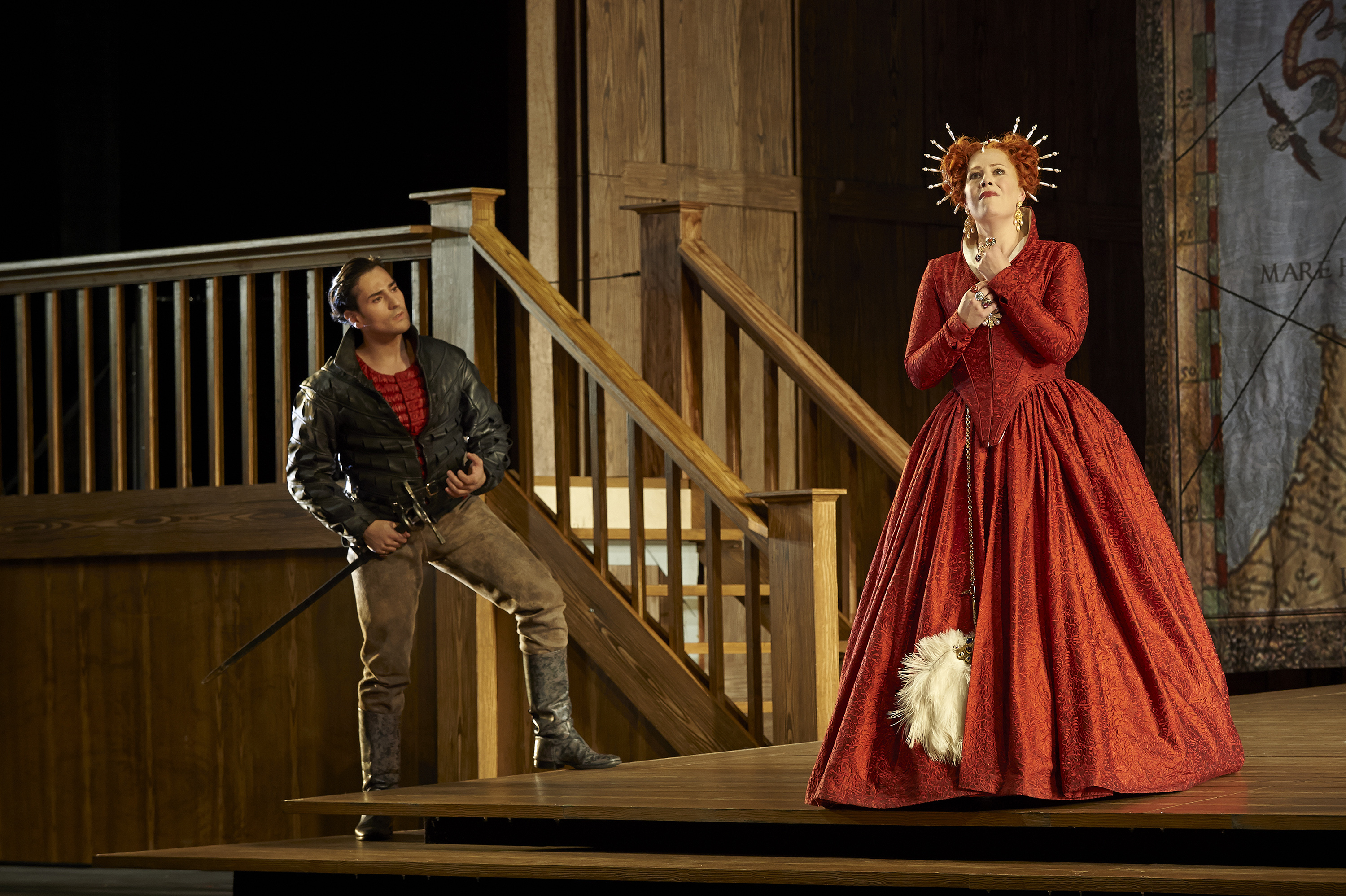
It’s my goal to remind Canada (and hopefully the World if at all possible) that Opera is more than just pretty voices singing loudly. It’s theatre. These are stories. The characters are people – often REAL people from history – that are 3 dimensional, with stakes in the circumstances to varying degrees. Yes, it’s about lovely singing – but it’s opera, the singing should be a given. We need to get back to making this theatre. Audiences are drifting away to other forms of theatrical expression because we’ve been failing them in recent history in this regard. They pay upwards to $300 a ticket or more (for a fancy seat in a fancy house) for an opera, and what we’ve been giving them is a concert where all dramatic impulse is dropped at the downbeat of an aria. Opera singers have an AMAZING capability of sound. The colours, volumes, ranges that are produced are unparalleled and to think that you can’t sing that well and act that well at the same time is ridiculous – I offer Sondra Radvanovsky’s recent performance in Roberto Devereux. I believe it’s performers like her that are what’s going to take Opera through, from now in the 21st century and into the 22nd.
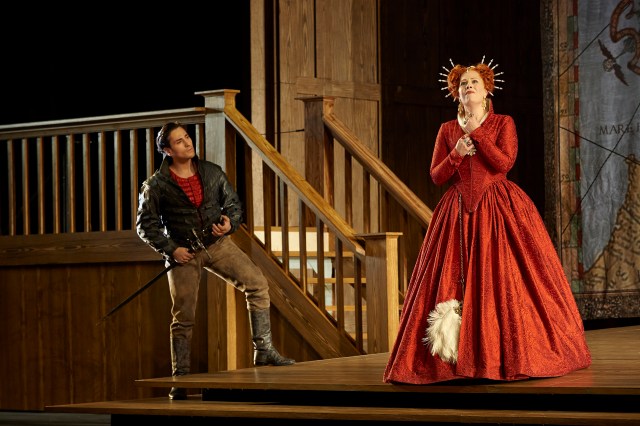
Leonardo Capalbo as Roberto Devereux and Sondra Radvanovsky as Elisabetta in the Canadian Opera Company production of Roberto Devereux, 2014. Conductor Corrado Rovaris, director Stephen Lawless, set designer Benoît Dugardyn, costume designer Ingeborg Bernerth and lighting designer Mark McCullough. Photo: Michael Cooper

Leonardo Capalbo as Roberto Devereux and Sondra Radvanovsky as Elisabetta in the Canadian Opera Company production of Roberto Devereux, 2014. Conductor Corrado Rovaris, director Stephen Lawless, set designer Benoît Dugardyn, costume designer Ingeborg Bernerth and lighting designer Mark McCullough. Photo: Michael Cooper

LooseTEA and other opera companies I’ve sung with recently (Against the Grain Theatre, Fawn Opera etc…) are all leading the charge with this mentality. The story is now gaining more importance in the overall presentation. Audiences don’t want to just hear Rodolfo and Mimi sing that they love each other, they want to FEEL it as well – and I believe they have every right to feel it, and it’s our job as actors (yes we ARE actors and my favourite companies to work for don’t refer to us as singers: we are called actors) to guide them to this. We can’t give it to them directly, but we can show them where it is.

5- Is there anyone out there who you particularly admire, and who has influenced you?

There’s a bunch of them. I’d be remiss if I didn’t send a shout out to Guillermo Silva-Marin over at Toronto Operetta Theatre/Voicebox: Opera In Concert/Summer Opera Lyric Theatre. When I made the conscious choice to focus on operatic rep as opposed to Musical Theatre, he took me under his wing, taught me the differences between the two genres with respect to music preparation, role preparation, hierarchies, and rehearsal ethics and etiquette. He also guided me into discovering which fach is really best suited to my skills and vocal colour. He’s been a friend, a teacher and a colleague. He’s also very supportive of young singers fresh out of their degrees (or often, still pursuing them).
Director Joel Ivany

Director Joel Ivany

Joel Ivany and the crew over at Against The Grain Theatre are very dear to me. I’ve done a few shows with them now and every time I do it’s one of the most fulfilling experiences of my life – musically and dramatically. Also, being able to present works in a new way with my peers (who in my opinion are the best in the country) makes me feel like all the years of having coffee for dinner are paying off.

I owe an incredible debt of gratitude to all the collaborative pianists who’ve helped shape my niche. Nicole Bellamy, Jenna Douglas, Michael Rose, David Eliakis, Christopher Mokrzewski, Jennifer Tung and more I’m sure I’m forgetting. These folks are the best at what they do, and they are just as instrumental (see what I did there?) at helping us singers prepare our roles as voice teachers and directors are and they never get the praise they deserve publicly.

~~~~~~~~

Loose TEA Music Theatre present Love in the Age of Autocorrect,
adaptations of operas by Mozart & Stravinsky:
August 21-24 at Atelier Rosemarie Umetsu
198A Davenport Road, Toronto, ON M5R 3R3
Tel:416.921.6467
Tickets: $30 general,
$25 student with ID available on our website or at the door

Posted in Interviews, Music and musicology, Opera | Leave a comment

Russia After Revolution

When Douglas McNabney –artistic director of  Toronto Summer Music Festival–programmed tonight’s concert, an evening of music that explores at least two compositions of the Soviet Era framed quaintly in the context of the Modernist experiment of the mid-20th Century– it’s unlikely he could have imagined that current events might seek to turn back the clock. Who would imagine that anyone –Alexander Putin most prominently–still cherishes the dream of a Soviet Empire? Futures that never happened have a certain poignancy, like an interrupted song. And yet no matter how noble a dream in its conception, there are often those who turn a dream into a nightmare, misreading or corrupting the original ideals.

Decades later? it’s the music not the political message that resounds, that wins any such debate: so long as the composer refused to be silenced. And so tonight’s program at Walter Hall titled “Russia After Revolution” is really about the music, about approaches to art, notwithstanding attempts to censor or silence free expression. But there are ways to be expressive & original without necessarily being dissonant or revolutionary with the music.

I’m pondering modernity & newness because the theme of TSM is “The Modern Age”, a time that’s passed. What was modern, exactly? The word is kind of dated, one that i think i used when i was a child, one that’s not so relevant now. In fact, used precisely, “modern” is as quaint & old as any other historical period for art or music: for instance “Soviet.”

We began with Prokofiev’s “Sonata for Two Violins”, played by Jonathan Crow and Martin Beaver.

Of tonight’s three works this was the boldest experiment in sound, even if it sometimes displays a comfortable neoclassical blend of old & new. Jonathan Crow and Martin Beaver made an arresting pair, in contrasts on several fronts (such as their physical appearance & body language, their native tone, and their approach). The disparity between the two violin sounds made for a vivid dialogue between the two, as if they were characters rather than instruments. There are moments of genuine dissonance, a few startling passages alongside others that are more conventional.

The second item took us a long way away from Russia, which is only a problem if you need the program to be 100% Russian. The “Phantasy Quintet“ by Ralph Vaughan Williams –a string quartet with an extra viola—is “modern” only via its chronology. Vaughan Williams does not push back the frontiers of music with edgy new procedures, but instead invokes older approaches, luscious sounds that make exquisite use of each instrument alone, or in groups. Crow & Beaver were joined by cellist Marc Coppey, and violas Paul Coletti and Douglas McNabney, the latter the Festival’s artistic director (i’m glad i finally had a chance to hear him play). Coletti and Crow had several stirring solo moments, particularly one near the end from Crow—speaking of birds—that reminds me of  “The Lark Ascending”. I’m glad to discover such a lovely piece, that I need to hear again at some point.

Violinist Jonathan Crow

Violinist Jonathan Crow

After the interval we were back in Soviet Russia, this time with Shostakovich’s Piano quintet in G Minor, Op 57. I was surprised from my experience of the composer at how safe the piece is. I suppose at this time the music was not meant to startle or challenge its audience. The work employs the quartet that played with McNabney but this time joined by pianist Angela Cheng.

Toronto Summer Music continues until August 12th.

Posted in Music and musicology, Reviews | Leave a comment

Radvanovsky: Humble Servant

Tonight at Koerner Hall, Sondra Radvanovsky offered a self-portrait in her recital as part of Toronto Summer Music Festival. It’s not just a huge coup for TSM & Artistic Director Douglas McNabney, the highest profile artist to appear there this summer, but also the most impressive concert I’ve heard so far this year, both for its musical values and the warmth generated in the hall.

Soprano Sondra Radvanovsky

Radvanovsky showed different sides of herself, winning a roomful of new friends. Music & drama aside, she is a hugely likeable figure without the pretentiousness that sometimes goes with recital singing.  At times she was having so much fun, we could have been watching a comedienne.

Hmm i wonder if she will try a comic role..?

But this self-portrait showed someone happily settling into her Canadian home, to an audience ready to eat up any and every reference to that relationship.  It was a love-fest.

And we saw so many different sides to her, all displays of vulnerability & honesty. She is:

  • A singer known for Verdi: and so she began with three songs by Verdi
  • A woman with a Czech / Russian background: and so she sang Rachmaninoff in Russian
  • A woman who has been living in Canada for awhile now, and is obviously settling into her role: and so to “honour Canada”, as she put it, she sang a French set (Duparc, followed by a Massenet aria)
  • A woman who is also American-born with strong ties to that culture: and so she sang three Copland hymns

…and there was quite a bit more besides.

We were all very relaxed, laughing all the way through. In the Verdi song set, Radvanovsky alluded to the tunes that composers may re-use, and lo and behold, there she was singing something that sounded a whole lot like “Tacea la notte placida” from il trovatore, except we were hearing the song “in solitaria stanza.” Attired in a different gown for each half of the concert –the second a dazzling green De La Renta—with diva hair & makeup, this was a very different look than what we’d seen in either Aida or Roberto Devereux, her two big roles in Toronto with the Canadian Opera Company. She alluded to her Dora award for Elisabetta, but so humbly, so sweetly, you’d never know that she’s a big star.

The humility of the headline, though, is taken from the last item in the first half, namely “Io son l’umile ancella”, an aria from Adriana Lecouvreur. This was one of several items that she sang quite distinctively, making the usual whisper soft ending much more poignant & dramatic than usual. As preface to this self-reflexive piece about art & service, she reminded us of the current dramas unfolding in the opera world (without mentioning specific companies going under or the labour battles unfolding at the Met this week), not taking sides but simply offering herself as a servant of the music. The humble servant opened the tear-ducts of many eyes at that moment.

Just as Radvanovsky has several guises, several contexts, indeed, she has more than one sound. The tones we heard in the opening “Ah Perfido”, were like an effortless warm-up in an aria that usually taxes the chords of lesser mortals. The Verdi songs were a more relaxed kind of singing, especially the third –“Stornello”—with body language & hand gestures like something out of an Italian sex-comedy (she would have been Sophia Loren opposite Marcello Mastroianni).

The Rachmaninoff? Here I felt she was truly in her element, the singing unified and organic in a way that opera can never be, because one wasn’t aware of registers or vocal gears shifting; no, her colours seemed to originate right in the language, especially the dark colours we sometimes heard. While she’s known for her top, the bottom & middle in these moody pieces were solid and soulful.

And speaking of Rachmaninoff –that keyboard master—I should mention Radvanovsky’s partner onstage, namely pianist Anthony Manoli. His interpretive voice was every bit as distinctive as the singer he supported, often powerful and sometimes a safety-net, solid & reliable, everything a singer could want.

The other side Radvanovsky showed us was something I didn’t anticipate, but one that this church musician found especially winning. The three Copland hymns were a very transparent display of emotion that makes more sense with the help of google. I googled “Radvanovsky father died” and found an interview from 2011  , that says

“Before each performance she says a prayer and talks to her father, Robert, whom she found dead of a heart attack when she was 17.”

The first two of the three Copland hymns were sung by the adult virtuoso. Tears tears tears, after each. She spoke of her father (without mentioning where he is, but i think we all knew), and then pulled it all together for the third, which I swear she sang as though she were a child singing in her church choir. This  was no virtuoso showing off here, no fancy high notes, just the loyal singing of someone who could have been anyone in their church congregation, at one with the music & the hymn’s meaning.

To close we were back with Verdi, as she wished us peace, at a time when the drums of war are beating on many sides. She sang “pace pace mio dio” from an opera she has yet to sing in a production, namely La Forza del Destino, floating the high note in the slow part before effortlessly tossing off the dramatic note on “maledizione” that closes the aria.  I understood the first encore almost as a cover, as Radvanovsky sang “oh mio babbino caro” with a sauciness –brandishing the obligatory flower bouquet—that belies the usual humility of the piece, reminding me a bit of Bette Midler singing “beast of burden”.  Was she again talking to her dad? Perhaps, but easily floating the high note, after a full evening of singing. And the boisterous “I could have danced all night” –complete with more pianistic pyrotechnics from Manoli—brought us home.

Speaking of home, that’s what this is for Radvanovsky, namely Toronto. We are so lucky that she’s here.

I can’t wait to see & hear her again.

Posted in Music and musicology, Opera, Reviews | Tagged , , , | 4 Comments

Ten questions for Benjamin Bowman

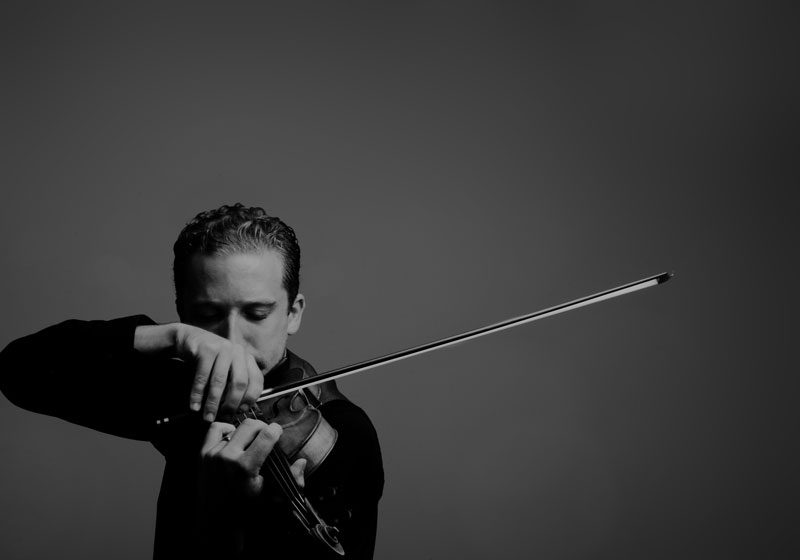
Violinist Benjamin Bowman

American-Canadian violinist Benjamin Bowman performs to critical acclaim throughout North America, Europe and Asia. A very active and engaged chamber musician and soloist, he is a member or frequent guest artist for leading chamber music ensembles internationally, including the twice Grammy-nominated ARC (Artists of the Royal Conservatory), Art Of Time, and Leondari Ensemble. Bowman was featured on the 2013 Juno-winning album ‘Levant’ and the 2011 Juno-nominated disc ‘Armenian Chamber Music’ with the Amici Chamber Ensemble. Other collaborative work includes extensive immersion in contemporary/new music, improvisation and performance with singer/songwriters.

Bowman was Associate Concertmaster of the Canadian Opera Company Orchestra: a ten year appointment that began when he was only 23 years old.   Bowman was recently appointed concertmaster with the American Ballet Theatre orchestra in New York. This week Bowman will be participating in the Saronic Festival, a celebration of chamber music on the island of Spetses Greece beginning August 4th.

Bowman’s performances have been recorded for radio broadcast in the USA, in Canada with the CBC, the UK, Poland, Hungary, Switzerland, the Netherlands, Denmark and Korea. His discography includes recent solo and chamber-music releases on the Sony Masterworks/RCA Red Seal, ATMA Classique, and Innova labels. Bowman received his Bachelor of Music degree from the Curtis Institute of Music in Philadelphia.

And Bowman—as the name might imply—is obsessed with bows, the owner of two very old bows (a Husson and an Henry), and a visitor to bow shops all over the world.

On the occasion of the 2014 Saronic Festival I ask Bowman ten questions: five about himself and five more about his participation in the festival.

1-Are you more like your father or your mother?

I notice, possibly as a function of age, that I’ve adopted many of my father’s mannerisms. But as soon as I stop to think about how I’ve just said something in exactly the same way as my father would, I realize that I’ve just been tapping my foot as my mom would… I guess I really feel like I’m really a mix of my parents. But if you twist my arm, I guess maaaybe I’m a bit more like my dad.…

With respect to our careers, we seem pretty different. My folks are both born teachers. They are university profs (mom in nursing, dad in philosophy of music and music ed), and focus a lot on writing and research in their respective fields. But my dad actually started off as a trombonist. He even played for awhile with the “Fabulous Flippers”, a pretty well-known band touring around the midwest in the 60s. I grew up listening to him practice with “Music Minus One” records, and watching him direct the university jazz band. My mom is also very musical (she’s got a great voice!), even if most of her performance experience was confined to the house, singing along with the likes of Kiri Te Kanawa…

All of this to say that the life I live now has come from both of my parents’ fundamental love for music, and their desire to share this with their children (and others), even if on the surface it appears I was raised more along academic channels.
That my father writes a lot on the subject of music education is not insignificant to how I identify with him. One of his specific focuses is on “being musical and educating musically”. I love this phrasing. This obviously resonates strongly with me, as I believe I have been raised with this in mind. Perhaps I’m nothing more than a philosopher’s guinea pig! Regardless, whatever is behind the words he writes and the notes I play, I believe we share a common philosophy about music, and about life.

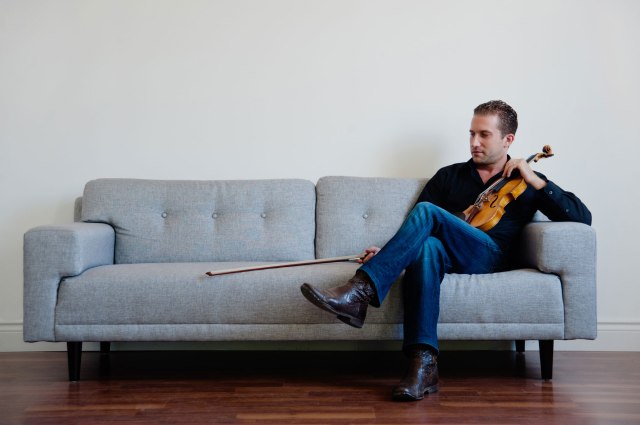
Violinist Benjamin Bowman

Violinist Benjamin Bowman

2-What is the best thing or worst thing about being a violinist?

Most people probably don’t equate the notion of being a violinist with countless hours spent alone. It must seem like a very social activity, playing an instrument. Naturally, people usually are only exposed to us – or us to people – when the lights come on and the music is performed… But to be a violinist is not just to love the music, and to perform. It is to live the music, and to imagine the life that has gone into it, to empathize with the composer as much as possible. This requires immense commitment on the part of the individual. The mastery of the craft is the obviously massive time commitment, but no 5 year-old that picks up a violin can possibly understand the soul-searching they will endure in order to become a professional. And to become a truly successful professional is yet another level of commitment, along with a dose of luck.

To play the violin – to be a musician – is to communicate, on as profound a level as possible. This is the best – and the worst – thing about being a violinist. Once you are committed, there’s no going back! Great music is like a drug. It’s not just the high you get from performing that is great – it’s the complete absorption into another realm of existence, often with friends, often in front of hundreds or thousands of people. At the best of times, you’ll completely forget where you are for a few hours. You just never want to come down.

Is it worth it? Yep.

3-Who do you like to listen to or watch?

I admire anyone who does what they do with utter commitment, skill and passion. It can be anything. If any of these three components are missing, I’m really not interested.

4-What ability or skill do you wish you had, that you don’t have?

Haha, there are so many!

For this conversation, let’s go with the making and restoring of violin bows and violins! I’m actually trying to clear some dates in my calendar to learn how to do this. It’s a beautiful art; one that hasn’t really changed in hundreds of years. I love the idea of a workshop full of old non-electric tools, listening to music that I love, possibly looking out a window into the countryside…. Basically, I wish I could create something tangible and long-lasting.

Music is wonderful, but it vanishes as soon as it happens.

At very least, it’d be great to be able to be confident enough to do all of the required maintenance on my equipment. When you travel around with instruments made of wood, they need adjusting pretty often since all the parts expand and contract with the various climates. And the bows need to have the hair replaced every so often as well. Most of us classical string players wouldn’t dare touch our instruments or bows for fear of causing the slightest bit of damage, and potentially ruining an irreplaceable work of art. This doesn’t seem right.

5-When you’re just relaxing and not working what is your favourite thing to do?

I just had a little two-minute vacation, fantasizing about the next time that might happen…thank you!  I love to camp, and to hike. I really enjoy the outdoors and reconnecting with nature. I actually feel it is a vital experience, one that recharges the body and soul.

When I can’t get all of my camping gear together, I love to eat well and drink well!

*******

ND3_9922-lowres

Five more concerning the Saronic Chamber Music Festival in August 2014.

1-Please tell us more about the Saronic Chamber Music Festival and how it figures in your life right now.

The SCMF is a haven for chamber music. It’s a stunningly beautiful and evocative environment; a perfect place to meet and work with extraordinary musicians from around the world.

This will be my third time going back (the festival is in its 4th year).  When I first visited Galatas, Greece was in the heat of economic crisis. It was quiet, at least by tourism standards. Spirits were high though, and the festival, clearly nurtured by love and determination, was embraced by the local community. It is touching to see the relationships that will create the foundation of the SCMF’s future materialize and grow, along with the audience presence. The Saronic Gulf deserves a world class music festival, and the musicians who go there love to be there. We are all committed to engaging with the community, whether it means busking on the streets or meeting local shop owners, or just talking with audience members. I must say this is a rarity in the modern corporate world. The feeling of family and community keep us coming back, because there’s really no other place like it.

2-Do you have a favourite moment in one of those works?

The Schoenberg sends chills down my spine, every time. It is unbelievable music. The Brahms sextet warms my blood and fills me with love. The Mendelssohn quintet flashes and dazzles. I can’t pick a moment!

3- Talk about the requirements of chamber music, and what it means to you as a violinist to be playing this repertoire.

I think I’ve inadvertently answered this question in my previous answers. But I can reiterate that a great deal of time and commitment is required to become a musician. Sweat and maybe even some blood, over the years. Certainly many tears….To play chamber music is to open the door to some of the most intimate work of the greatest composers to walk the earth. It ’s not for the faint of heart. What does it mean to be a violinist playing this repertoire? Woohoo, is what it means.

4- Please put your feelings about classical music into context for us, especially with respect to what you’re playing and doing this year.

Without trying to go too deeply into this subject (I could probably write a book about it), I’ll say a couple of things.

First and foremost, I LOVE the music that I play. I am grateful for its existence in the world. And for all the hardships involved in trying to play dead people’s music in a world preoccupied with living people stuff, it’s truly an honor. This music is alive, and will always contain the essence of life, no matter how old it is, or how dead the composers are. (I also play the music of living composers, and I compose as well, for the record…)

Classical music, or “music”, as I like to call it, is truly an auditory experience. This is not a popular notion in the world at present. People want to SEE stuff. So do I, I’ll admit. To try to keep up with the times, my industry tries to sparkle up the music and make it impressive to young people – “to attract new audiences” –  but it’s not really what it’s about, and they should admit it. There a niche for that. I really believe there’s a time and a place where just sitting in silence and letting great music stream directly through your ears and into your soul can be more satisfying than just about anything. I honestly do not care what the person playing the music looks like, so long as they do their job well.

I struggled for a long time with the value of playing old music in this world. I felt it was irrelevant somehow, or unappreciated. It was stuffy with all the tuxedos and rules… But I’ve come a long way with this. I now know that there is value in performing this music (especially live), not just selfishly, but as a service to those who have also discovered it, or who are open to giving it a try. It is therapy.

5- Is there a teacher or an influence you’d care to name that you especially admire?

David Zafer (click image for an appreciation)

One of my best teachers, Mr. David Zafer. A true musician, this man taught me for awhile when I was a teenager, and he helped me to find myself in the violin. What a gift! One could feel the joy he experienced from his work. He was certainly brutally honest at times – even mean, but also gentle and supportive, and hilarious, and incredibly generous with his time. My lessons with him were sometimes 5-7 hours long – however long it took to get the point across. I suppose I was a bit dense, then?

A few weeks ago I was in New York playing in an orchestra I recently started work with, and a substitute in the 2nd violin section approached me and told me that she had also studied with David Zafer. The difference between us is that she just retired from the Met Opera orchestra… He has taught across (at least) three generations of successful violinists. And he’s still teaching!

*******

The Saronic Chamber Music festival runs August 4 – 10, 2014 with concerts in Spetses, Hydra, Poros and Galatas.  For more information visit http://www.saronicfestival.com

Posted in Interviews, Music and musicology | 1 Comment

BOP Program B

My trip to Stratford is over, but the cycling singers of the Bicycle Opera Project are still there. By the time I post this they’ll have finished Saturday afternoon’s show. A pair of performances remain Sunday at Revel Caffè presented under the auspices of Stratford Summer Music, followed by other performances elsewhere over the next couple of weeks.

The conversation around bold opera ventures such as this one usually mentions the precarious health of opera.  For example, Peter Gelb has just threatened to lock out the various unions of the Metropolitan Opera, and opera fans are holding their collective breath. The passing of tenor great Carlo Bergonzi could be mistaken for news from another century.  We remember a career that ended in the 20th century, in an art-form that goes back even further.  As we read of civilians dying in various theaters of war, the wars staged or sung inside actual theaters seem especially poignant right now.  Yet we need them more than ever, however irrelevant they may sometimes seem. Opera will not stop global warming or cure cancer. But in the meantime we go on living, never more vividly than in our performing arts culture.

azimuth_1

Mezzo-soprano Stephanie Tritchew and the BOP orchestra, namely Tristan Durie, flute; Wesley Shen, music director/piano and Chelsea Shanoff, saxophone(s).

For all the laughs I experienced at BOP’s Program A Friday morning, Program B did not leave me laughing quite so much. I wonder if that’s because of where I sat? whereas my experience yesterday was to be immersed in the show seated at the front with singers right in my face, today I was at the back of the stage, staring at the serious and verklempt expressions on Stratford faces surprised by grand passions while they sipped their morning coffee. How could I laugh (even if there were several funny moments)?

Mezzo Tritchew, joined by baritone Geoffrey Sirett

Mezzo Tritchew, joined by baritone Geoffrey Sirett

We began with the romance of (What rhymes with) Azimuth, music composed by Ivan Barbotin with libretto by Liza Balkan (who is BOP’s stage director). A man and woman (played by Stephanie Tritchew, mezzo-soprano, and Geoffrey Sirett, baritone) who explore two very different discursive pathways, find meaning and a connection.

The second work is an excerpt from Airline Icarus, music composed by Brian Current and libretto by Anton Piatigorsky.

icarus1

Baritone Sirett & flight-attendant & mezzo Stephanie Tritchew, with music director Shen wearing the Captain’s hat at the piano

This opera premiered by Soundstreams in June. The café becomes part of a jet, complete with a flight attendant bringing around refreshments, in a realm poised on the edge between laughter and tears.

Tritchew offering refreshments to the caffe patrons.

Tritchew offering refreshments to the caffe patrons.

Third was Rosa, with music composed by James Rolfe and libretto by Camyar Chai, a powerful scene between two people that was also the most intensely sung. I wish I could say I know what it was about, although I don’t care (?). The specifics of who Rosa is, and why the two people are arguing and later reconciling in sobs are details that are less important than that Larissa Koniuk and Chris Enns were very good in the indecently intimate space in which they were forced to perform, and that they made me care about them and believe in their commitment to the performance.

Soprano Koniuk and tenor Enns, in Rosa

Soprano Koniuk and tenor Enns, in Rosa

We concluded with Bianchi the short bicycle opera with words and music by Tobin Stokes that also finished yesterday’s program A. Here at last was a place where laughter filled the space.

Enns & Tritchew, in one of the photos that wasn't blurred by all the fast motion

Enns & Tritchew, in one of the photos that wasn’t blurred by all the fast motion

The Bicycle Opera Project may be riding into your town, as they continue their performances into August.

Posted in Opera, Reviews | 1 Comment

Bicycle Opera: Program A

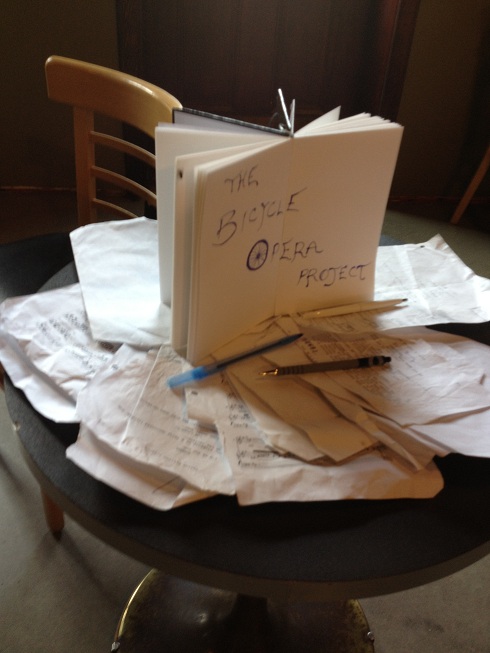
click for more info about The Bicycle Opera Project

Sometimes the writer recognizes that words are limited, that in the end “you had to be there” especially for something that’s more of an event or happening, than merely a conventional performance. It was never truer than this morning as I took in Program A of this year’s Bicycle Opera Project, at Revel Caffè in Stratford.

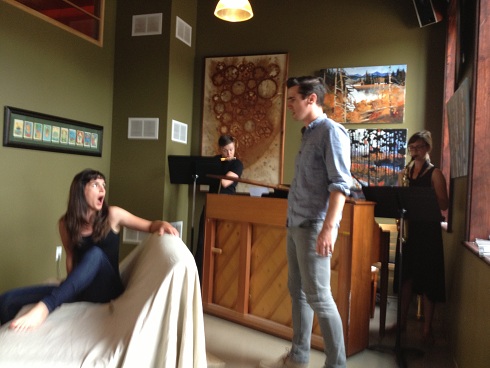
sign_outsideIt’s been an amazing 24 hours, what with Crazy For You Thursday @ 2 pm, Mother Courage and Her Children @ 8 pm, and now BOP at 9 am Friday. It’s only just past 10:30 as I write this up. (although adding the photos etc has pushed me to 11:30). But as I said: for something like this it’s not enough to write. So I took a zillion pictures –with the performers’ permission I must add—to try to give you some idea of the experience.

There’s no FLASH permitted, which means that many pictures aren’t terribly usable. I’ll look them over later (I have paintshop pro at home, but not here with me as I do my usual ASAP publishing). With the exception of the images that I am linking to on the BOP website, any picture you see here is one I took, which I offer with apologies. The cast & musicians are much more beautiful than what you see here.

Let me repeat that, they are seriously a beautiful group. I’m a little sad that the photos don’t do them justice. BOP is not just a company but a kind of political statement, transporting themselves from gig to gig on bicycle. The piano is supplied by the host, but otherwise, they pull hundred pound trailers behind the cycles. So in other words, if they look fit, it’s not just from their excellent breath control. But please God let no one speak of fat opera singers. Opera is a physical discipline, even if in other eras the social consensus permitted big performers alongside thin ones (and there have always been thin singers, no matter what Bugs Bunny told you).

Never forget: that live theatre is magic. Live music, live singing, live dancing, or live bodies simply standing delivering lines, represent something very different from what you see in film or TV.  Don’t believe me? Go see a live performance in your own town, or (even better) come see BOP.

Program A consists of four works to be presented again on BOP’s tour of the province. They’ll do Program B later today (5:30 pm) in Stratford’s Revel Caffé, then reverse themselves tomorrow (Program B in the morning, Program A at 5 pm) with another pair of performances Sunday in the same sequence as today’s.table_pic

After a brief introduction from the ensemble—pianist & music director Wesley Shen; Chelsea Shanoff, saxophone(s) and Tristan Durie, flute—we begin with an excerpt from Dean Burry’s The Brothers Grimm.

dog

I saw his head through a doorway, fore-shortened. Up close i realize he’s not a purebred shepherd. Still, he’s a very well-behaved doggie.

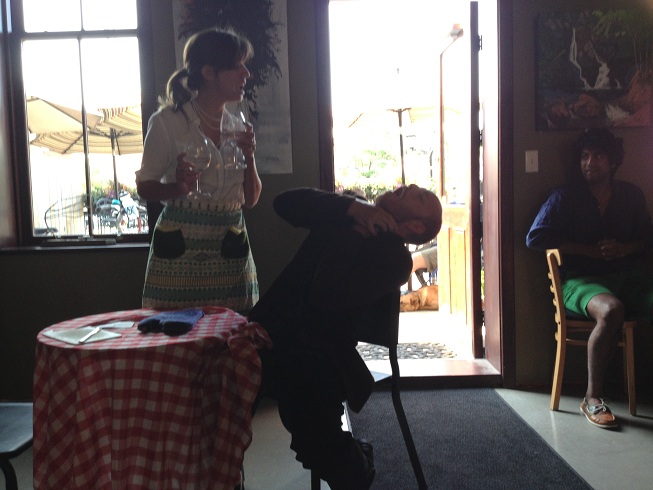
Note: we’re deep in Revel Caffé. My friend and I sit at the communal table, right beside two very young children brought by well-meaning relatives. How young? They’re younger than the age at which I took my daughter to see Magic Flute in English, as her first opera, and hello, these aren’t meant for children (as they found out in short order: vacating their seats…or maybe their auntie finished her latté?). At one point a wacky cat carrier went by, and the whole time –just outside the door that was used for several entrances by the singers—a well-behaved German Shepherd [NOTE: i am fixing this later, having realized i made a mistake in my haste…he’s not a shepherd. SORRY] cocked his head appreciatively throughout (and he shows up in some of the photos….plus THIS PORTRAIT that his owner graciously permitted).

Patrons came and went, lugging lattés and cappucini, mostly very quiet. I was the most disruptive person there, between my loud guffaws (yes I laugh a lot) and my incessant iphone. I told myself this might be fun for the performers, even as I recalled how irritating I usually find it when someone shoots a picture of me with my mouth wide open.  But while the space is phenomenally live –exposed brick and wood floors—I was never uncomfortable about the levels. The voices soar wonderfully, and like good baristas filling but never overflowing their containing space.

Geoffrey Sirett & Chris Enns, aka The Brothers Grimm

Geoffrey Sirett & Chris Enns, aka The Brothers Grimm

In this coffee house, we begin with the Brothers at a table as if with writers’ block. But in short order a table is piled on another, and there’s Rapunzel letting down her hair, as if in a tower. The story is sufficiently self-referential –with the brothers who create the story front and centre in their portrayal of the story—to give it a witty edge. Chris Enns and Geoffrey Sirett are two familiar young singers, enjoyable delivering lines in this super-intimate setting. I was right on top of them (or vice versa?) the whole time.

Sirett & soprano Larissa Koniuk, L'Homme et l'Ange qui a venu du Ciel

Sirett & soprano Larissa Koniuk, L’Homme et l’Ange qui a venu du Ciel

The second work is an excerpt from Adam Scime’s L’Homme et le Ciel. I’m thrilled to have a second listen even if the work is arranged for the different group of instruments. Sirett’s big physical presence changes the effect substantially from what I saw in the spring. At that time the big powerful female voices went with a different physical dynamic. I can’t help remembering (perhaps in context with seeing Mother Courage last night & thinking of feminist readings) that opera has been traditionally a medium where women are violated and killed in front of a voyeuristic audience. That’s not what we get here –in any of the operas—as one can sense composers & librettists seeking to move the medium into a new direction (please God I hope so!) away from the misogyny & violence of the past. And so while we’re still in heavily gendered territory, the male is a physical body onstage, while the female is an aetherial spirit creature, an angel who could be any size I suppose. Sirett is a towering figure, yet he’s crumpled up with the spiritual doubts of L’Homme, in this story. The Angel figure played by Larissa Koniuk? Here is one place I was really sad about how poorly the photos captured what I’d felt. I can still feel Scime’s score pulsing through my head, as if pulling me towards Koniuk’s magical presence. Her gestures are very simple and eloquent, a more minimal response to the score than what we saw in the more elaborate staging by FAWN opera in the spring.angel_homme2

killers

Sirett with mezzo-soprano Stephanie Tritchew–putting the dead into deadpan– in A Little Rain Must Fall

This piece is in French. While we did not have the projected titles (which BOP usually provide in other venues, but couldn’t in this space), I’m lucky that I could understand the text, had heard the excerpt before, AND seen a synopsis. But if there were ever an opera that could work without comprehension purely on the basis of the beauty of the images and the people onstage, this is it. The brilliant light coming from outside –confounding my photography—is in some respects a perfect model for the spiritual experience of the work, which seems to invite us to surrender to pure sensation, to allow the piece to move us whether we really understand what’s happening or not. My God (excuse the pun) I know that sounds pretentious, but that’s one of the things that sometimes happens in opera, particularly when it’s in another language. I—again—was taken back to my experience of opera before surtitles, when we had to listen and try to understand what we heard: not unlike childhood itself.

Sirett and Tritchew again

Sirett and Tritchew again

The third item presented was A Little Rain Must Fall, libretto by David Yee, music by Chris Thornborrow –I think I saw previously?—created not long ago in Tapestry’s LibLab, again re-arranged for the BOP ensemble. A different staging with a new cast can make something seem so different from what you saw previously. Sirett and mezzo soprano Stephanie Tritchew sang the piece full-out and dead-pan which only make the laughs even more explosive in the tight little space.

spoiler alert... oh well TOO LATE

spoiler alert… oh well TOO LATE

To close we were figuratively put onto bicycles. If I understand correctly, the BOP invites proposals from composers, but this time someone wrote about being on bikes. While the presentation was done by two men and a woman running –and falling—in the space, one could imagine the piece on cycles, or perhaps filmed while riding. It’s a five minute piece called Bianchi: A Five Minute Bicycle Opera, with libretto & music by Tobin Stokes that could be subtitled “every bike pun you could imagine”. As a man who likes puns I was in heaven.

Our cyclists --Chriss Enns and Geoffrey Sirett-- go from one end of the Caffe to the other.

Our cyclists –Chris Enns and Geoffrey Sirett– go from one end of the Caffe to the other.

The Bicycle Opera Project (whom I’ve been calling BOP) continue their cycling ways, touring through Ontario into August, eventually coming to Toronto Summer Music Festival August 7 & 8. Their schedule is here. But in the meantime if I can make it to program B (here in Stratford) I’ll write about that too.

Some of the BOP cycles awaiting their riders.  The road goes ever on..(?)

Some of the BOP cycles awaiting their riders. The road goes ever on..(?)

Posted in Music and musicology, Opera, Reviews | Tagged , , , , , , | 5 Comments

Mother Courage

I just saw Seana McKenna tonight as Mother Courage aka Anna Fierling in Brecht’s play Mother Courage and Her Children, at the Tom Patterson Theatre until September 21st.

It’s a horrible week in the news, between civilian planes being shot down, civilians being killed in a Middle East war, and a little girl being hit by a car in a neighbourhood I drive through. As a citizen, as a political being, as a parent, everything confronting me screams that life is painful and futile, that it’s a terrible time to bring children into the world, a time to hide under the covers and say no to anything daring or risky that might break your heart yet again. Of all Shakespeare’s plays the most apt might be King Lear, that Everest that challenges actors if not audiences, even if we can take comfort in its poetry, in the solace of knowing it’s a classic.

I can’t help speaking of Mother Courage and Lear in the same breath, a pair of mythic parental figures, two colossal roles to daunt any actor. Seasons are built years in advance based on complex commitments to the company, so it might be a fluke that these two shows come along in the same year. I suppose while I’m at it I should admit that Man of la Mancha represents another relevant study in an aging personality, although one that doesn’t interest me (because –not meaning any offense –I can’t think of Wasserman and Leigh as peers of Brecht & Shakespeare).

Why would Lear pop into my head at the same time as Mother Courage? First and foremost it’s no magic, just me staring at the calendar, trying to decide what to see.

There they were side by side.

And then I was jarred by the memory, of seeing Seana McKenna as Cordelia in the 1980s. Oh my I don’t think I’ve ever cried so hard at a Shakespeare play, sitting there hopelessly heartbroken when she’s torn away. I saw Lewis Gordon’s gruffly human Lear.

It struck me, though, that Lear and Anna Fierling are an interesting pair, a study in contrasts:

  • Lear begins with all the power, although that’s stripped away
  • Anna is at the bottom of the power hierarchy
  • Betrayals & misfortune push Lear to madness. The portrayal of that madness is maybe the greatest challenge for the mature actor, across many generations of famous actors
  • Anna’s adventures push her to a point where she might go mad: if she had such a luxury. She conceals her feelings much of the time. Anna is a more recent creation, one that has far fewer famous exponents, so perhaps too we can be surprised by a great portrayal such as McKenna’s.
  • Lear is the archetypal father, while Anna is the archetypal mother. Is the difference perhaps that fatherhood has been swathed in tradition & respectability –making Lear’s fall so precipitous—whereas motherhood is still a matter of contention? And is a mother more than a biological function?

The Brecht is also directed by one of the great women of Stratford, namely Martha Henry. Does that mean McKenna + Henry = a feminist reading? I certainly would embrace that: if I knew what it meant.  But I’m not saying you’ll like this version of motherhood. Brecht’s mother is not romantic, not subject to the political correct expressions of loyalty to her children: although we see her stoic suffering, unable to let her loyalties show. But she’s a survivor, unlike Lear. His pride is a luxury she can’t afford. Perhaps the chief difference –excuse me for being obvious—and it’s apt for a feminist reading, is that whereas Lear is a man who loses his power, Mother Courage is a woman, which means she never has much to begin with.

I am intrigued because I am mostly wondering about Brecht, in the anti-Marxist decades following the collapse of the Soviet empire. With the end of the USSR, Marx’s reputation was diminished by implication. I couldn’t help feeling that the ideologically tainted phrases in this play –and others from Brecht—can’t get a fair reading, because we’re in a strange place culturally, unable to even see Brecht’s didactic / activist side.  We have poor people starving on our streets now, and we’ve inured ourselves to such atrocities, so the suffering in Brecht doesn’t sting as it once did.  Maybe I’m imagining things, but I couldn’t help but feel echoes of the cynical laughter I heard when I saw Assassins recently, a willingness to treat anything pointed as social satire. The gravitas Brecht used to connote –especially in this play—seems to be harder to find, when the prevailing tonality of our culture is to embrace ironic laughs. I’m seeing a resemblance between Mother Courage and Heller’s Catch-22 that I never saw before, possibly because the play isn’t usually permitted to be so funny.  War is just a backdrop for both tales, while a more materialist exercise (especially for Milo Minderbinder) is played out in the various theatres of war. Yes there are dark places in the plot –as there are in Heller’s novel—but also places to laugh too.

Excuse me the ridiculously long preamble, but I have long been fascinated by Brecht, both from the political side and from the dramaturgical side. Henry’s Brecht is very unpretentious, and not weighted down by the awe one sometimes encounters in the presence of one of the great names of theatre. Working with composer Keith Thomas, music director Laura Burton & the various performers jumping into the songs, this is a very intelligible telling of the story. I think it works very well.

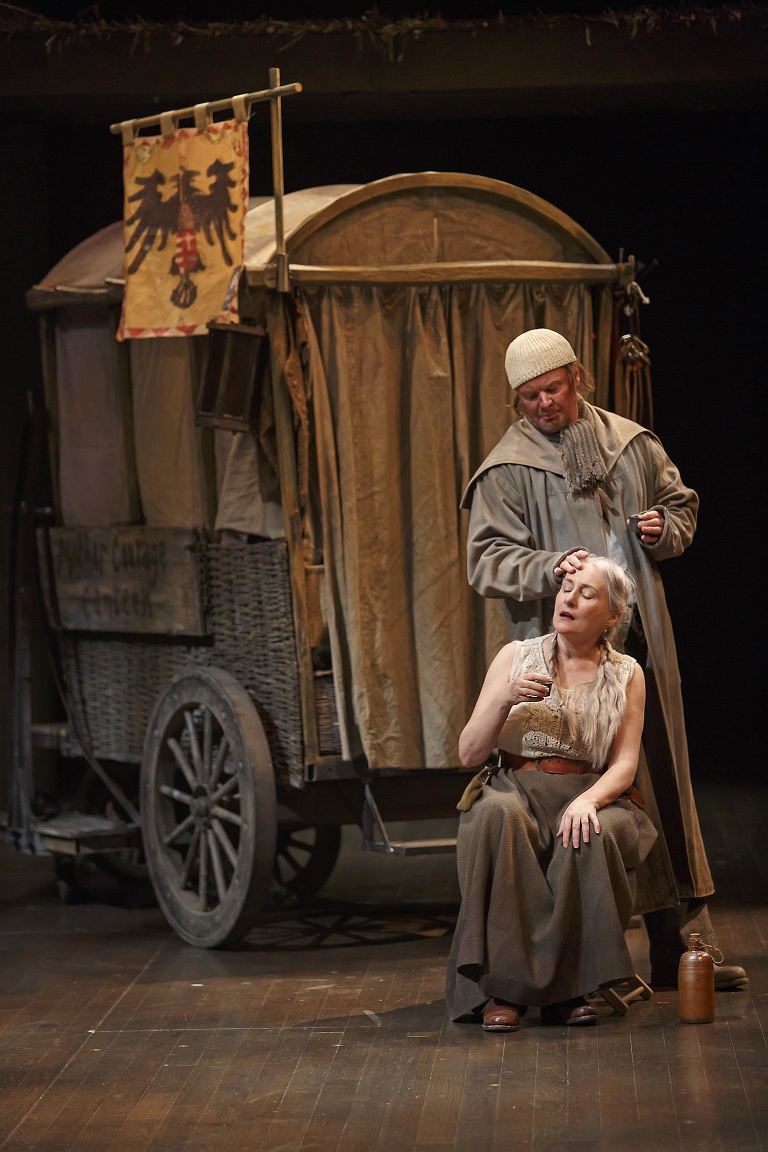
Seana McKenna as Mother Courage and Geraint Wyn Davies as Cook in Mother Courage and Her Children. Photo by David Hou.

Seana McKenna as Mother Courage and Geraint Wyn Davies as Cook in Mother Courage and Her Children. Photo by David Hou.

It’s ironic that some of these ideas –“parenthood”, “war” and “politics”—are sometimes so reified as to lose any direct contact with reality. I’d also add the word “Brechtian” to the list of big abstractions that sometimes mess up a production of a play by Brecht. Henry’s Brecht, however, and McKenna’s Anna sidestep that trap. They’re so simple & direct that they could be a textbook on how to do Brecht without fear.

There are several other meaty performances, and lots of delightful moments in Mother Courage although it’s all dwarfed by McKenna’s work. Patricia Collins & Stephen Russell turn up in relatively tiny parts, but make the most of them. Geraint Wyn Davies is a dense mixture of strengths & frailties every bit as substantial as McKenna’s own blend.

Mother Courage and Her Children continues at the Tom Patterson theatre until September 21st .

click image for further information

Posted in Dance, theatre & musicals, Reviews | Tagged , , , , , , , , | 2 Comments

Crazy For You

It’s summertime, when the livin’ is easy: and Gershwin might be on my mind right now. Summer  musicals are taking over the stages at summer festivals in Stratford & Niagara-on-the-Lake. Crazy For You –the show I saw today at Stratford—is a second-generation Gershwin musical, Ken Ludwig’s inspired re-purposing of songs that had previous lives in shows created on Broadway back before WWII.  George’s tunes and Ira’s lyrics are so well-known that they seem to segue effortlessly out of the plot unfolding before us.

This show is counter-intuitive, because it seems to go against the usual practice. We’re accustomed to encountered musicals (or operas) where the words came first, and then were set to music. Ludwig had a brilliant idea, one that’s been done in other musicals.  Never mind starting with the book.  Assemble some amazing tunes instead, and then work from there.

With Crazy For You..? Imagine a popularity contest assembling the best songs written by anyone in the 20th Century. The results could look a lot like the list of songs in Crazy For You.  How can you miss with

  • “I Got Rhythm”
  • “Embraceable You”
  • “Someone To Watch Over Me”
  • “They Can’t Take That Away from Me”
  • “Nice Work If You Can Get It”
  • “But Not For Me”

I’m reminded of other shows built backwards from the songs, such as The ABBA musical Mamma Mia! or the Beatles film Across the Universe. The well-known set-pieces threaten to over-shadow the story, which is a mere pretext for the beloved & familiar music.

What Ludwig does that’s truly remarkable is to weld together these golden moments into something surprisingly coherent. The music doesn’t really stop the story –the way the ABBA musical stops dead on those famous songs—so much as bring it to life. It’s a truism that in a musical, the song takes over when words are no longer enough. Several times we were in a magical place where an all-too-familiar song such as “They Can’t Take That Away From Me” sounded brand new, emerging organically from the dialogue.

While there were some remarkable star turns that I shall allude to in a moment Crazy For You is first & foremost a showcase for the ensemble values of the company. The creative team of Director & Choreographer Donna Feore and Musical Director Shelley Hanson get brilliant air-tight work from everybody in this huge show, presented with 20+ orchestral players. I can’t decide whether it’s Feore’s choreography or Hanson’s tight hold on the musical values of the performance that makes the most decisive contribution: but they depend on one another for one of the most cohesive and physical displays I’ve ever seen. The excellence from every side in the Festival Theatre almost makes the stars an after-thought. If you’re a fan of dance you’ll love this show. They never stop working, seeming to get more physical as it goes on.

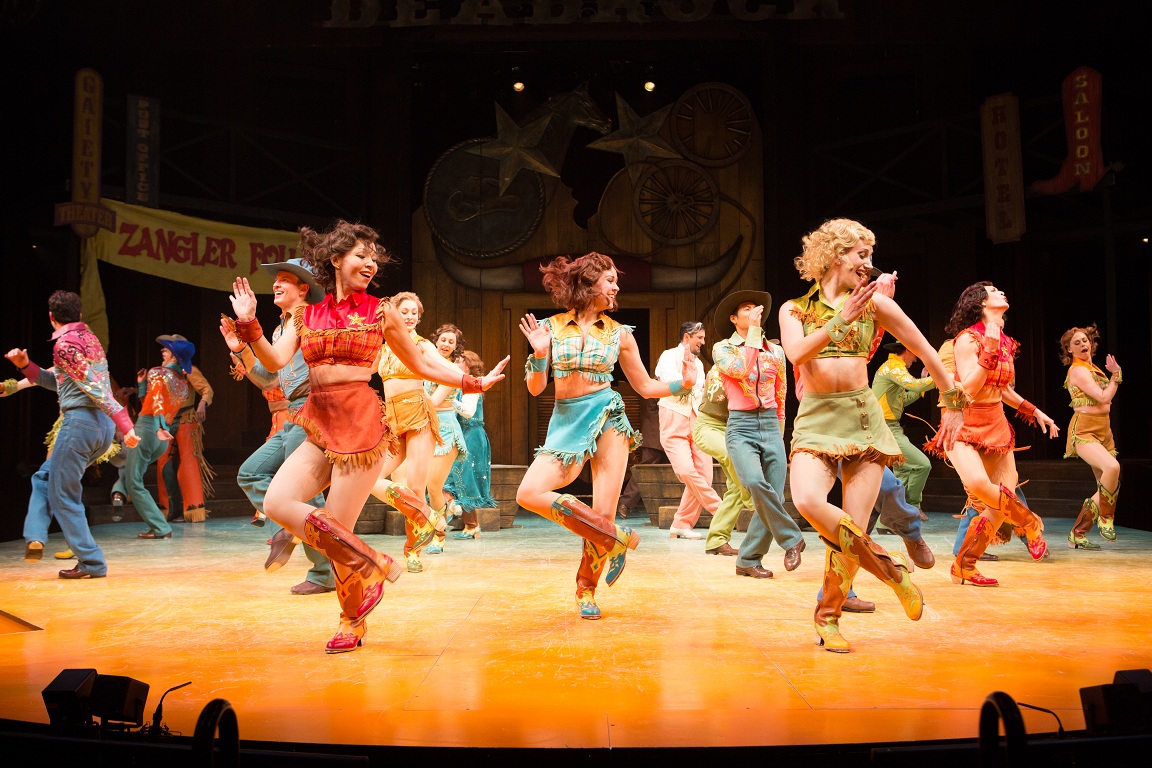
A glimpse of the raw physicality shown by members of the company in Crazy for You, choreographed by Donna Feore. Photo by Cylla von Tiedemann.

A glimpse of the athleticism shown by members of the company in Crazy for You, choreographed by Donna Feore. Photo by Cylla von Tiedemann.

Even so I should mention Josh Franklin and Tom Rooney. While Rooney’s heroics are perhaps expected by now –wonderful physical comedy to go with a larger than life persona—Franklin as Bobby Child is new to me, a charismatic presence who can dance, can really sing and yes, he can act too. The prime reason Crazy For You flies so high is because we care what Bobby feels, the one who is truly crazy for someone.

Crazy For You continues at the Stratford Festival until October 12.

Posted in Dance, theatre & musicals | Tagged , , , , , , , , , | 3 Comments