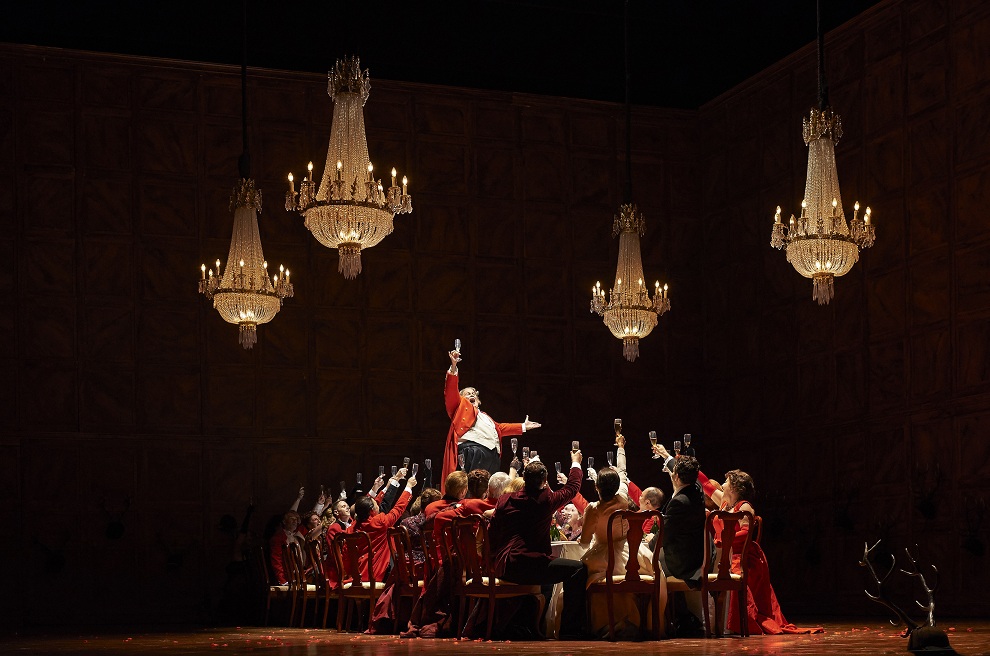
Emerson String Quartet’s Modern Age

The Emerson String Quartet kicked off Toronto Summer Music with a concert tonight.
I’m sure some people were there to hear Beethoven’s Op 95 quartet, many more to hear Schubert’s “Death & the Maiden” quartet, while comparatively few were there mainly for Britten’s 2nd Quartet, a work premiered in 1945 and the one piece on the program that’s genuinely modern.

I can’t help thinking about the programming questions faced by TSM artistic director Douglas McNabney. It’s the same question bedeviling anyone seeking to build an audience. Does a concert comprised of a masterwork by each of Beethoven & Schubert, with a 20th Century work tucked in between challenge the audience? While I wouldn’t normally think so –especially when the Festival theme is “The Modern Age”—I saw two people in close proximity to me sleeping through the Britten: so maybe this is more than enough modernity for some people. I shouldn’t over-estimate what audiences can handle.

Perhaps the advantage of such a combination of works is how it can satisfy a broad spectrum of listeners. While the Beethoven & Schubert are clearly crowd-pleasers that may have been the chief draw –and it should be noted that every seat was sold—I prefer to hear the Beethoven & Schubert as antecedents, key touchstones in the string quartet repertoire that are part of the context influencing Britten. Composed as a homage to Henry Purcell on the occasion of the 250th anniversary of the great English composer’s death, Britten’s 2nd Quartet is tonal, tuneful & clearly pointing as much to the past as to the future.

This is especially true of the third movement of Britten’s quartet, in its use of a baroque form, namely the chaconne, a witty set of variations.  Sandwiched between two works from more than a century before, the Emerson Quartet’s performance of the Britten piece pleased me more than either of the older works. Each of the players shone at times in the Britten, especially in the concluding chaconne.  It’s easy to see that Britten would find his truest voice in opera, considering the flamboyant animation of each part, as if portraying personages.   

Toronto Summer Music –a festival and an advanced institute for players and singers—continues until August 12th.

Posted in Music and musicology, Opera, Reviews | Tagged , , , , | Leave a comment

Ten Questions for Jonathan Crow

Jonathan Crow is a young violinist making in impact on several fronts. This fall will be Crow’s fourth season as Concertmaster of the Toronto Symphony. He is also an avid chamber musician, including his role as a founding member of the New Orford String Quartet. Crow also teaches, previously at McGill and currently at the University of Toronto.

Crow will be participating in Toronto Summer Music on all three fronts: coaching as part of the Chamber Music Institute; playing the “Russia After Revolution“ chamber program August 1st, and he’ll be playing with the Toronto Symphony as Concertmaster as they make their Koerner Hall debut later this summer.  On the occasion ofToronto Summer Music I ask Crow ten questions: five about himself and five about the multiple roles he plays.

Violinist Jonathan Crow

Violinist Jonathan Crow

1-Are you more like your father or your mother?

Not sure I can answer that one- what if they read this? I suspect they would have a better answer for you than I would anyway!

2-What is the best thing or worst thing about being a violinist?

The worst thing about being a violinist is definitely airline travel! Having to worry about finding a free overhead bin on every flight can get tedious very quickly. Most cabin crew are extremely accommodating- especially the pilot on a flight to Portland who put my violin behind his seat as the plane didn’t have any overhead bins. You never know though…

3-Who do you like to listen to or watch?

This summer I’m doing quite a bit of traveling with my family between festivals- which means I’m getting to know the music of Katy Perry extremely well! (I have two daughters…) “Let it Go” from Frozen is also a huge hit with them. For me, I do quite a bit of score listening on youtube- it’s amazing the out of print recordings that you can find.

4-What ability or skill do you wish you had, that you don’t have?

Is this a favourite superpower question? If so- definitely being able to fly. Or perhaps teleport. Anything to avoid taking my fiddle on planes! Seriously though, I’ve wished I was quicker to pick up new languages- both for musical reasons and also just to make traveling more simple.

5-When you’re just relaxing and not working what is your favourite thing to do.

I don’t think this summer is a good time to answer that question- I’m on a plane now to Calgary after being on the road for four weeks. Yesterday night was one of about ten nights in my own bed this summer… A bbq in my backyard with my family sounds great right about now!

*******

Five more concerning the Aug 1st concert “Russia After Revolution”, mentoring at Toronto Summer Music, and the upcoming TSO debut at Koerner Hall.

1-Please tell us more about the works on the  “Russia After Revolution” program, namely

  • Prokofiev: Sonata for Two Violins C Major Op. 56
  • Vaughan Williams: Phantasy Quintet
  • Shostakovich: Piano Quintet g minor Op. 57

This is a great program- the Shostakovich is one of the great works of the chamber music repertoire, and an unbelievable compelling piece. It has everything- great virtuosic moments, humor, and incredible beauty. The last movement is so typically Shostakovich- a seemingly upbeat beautiful movement which is actually bittersweet and almost tragic. The Prokofiev is one of my favourite pieces- I’m lucky to play it at three different festivals this summer. It’s perfectly written for the violin, and the parts interchange seamlessly. And the Phantasy Quintet is a lesser-known piece which deserves to be played more- I love the lush string writing that you get from Vaughan-Williams!

2-Do you have a favourite moment in one of those works?

The middle movements of the Shostakovich 5tet are about the most meaningful movements in the chamber music literature- listen for the contrast between the power and sarcastic wit in the Scherzo and the deep sorrow of the slow movement.

3- Talk about mentoring, and what it means to you as a violinist.

I’ve always loved teaching, and have been lucky to have had opportunities to teach for almost my entire career- previously at McGill University and now at UofT, the Orford Arts Centre and many other summer festivals. As a student I attended the Ravinia Festival and Domaine Forget where I had the chance to play with established professionals in a fashion similar to what we do at TSMAF. For a student on the verge of a professional career this is an amazing way to learn how life really works in the field- everything from how to streamline the rehearsal process when you don’t have an entire semester to learn a piece to how other artists interact when playing a piece with different colleagues. As a mentor it’s also amazing to realize how many new ideas I get when playing a piece with younger artists who might have fewer preconceived ideas about repertoire.

4- Please put your feelings about classical music, The Toronto Symphony & mentorship of the next generation of artists into context for us, especially with respect to Toronto Summer Music.

I hope that the relationship this year between the TSO and TSMAF is the start of something permanent! These are both great organizations that are giving back to the community in different ways and have so much to offer. There are so many articles being written these days about the “Death of Classical Music” but I would suggest that the interest in classical music around the world has never been stronger. Both the TSO and TSMAF are finding creative ways to bring young people to concerts- the TSO Soundcheck program and TSMAF Shuffle concerts are great examples. People love classical music and love the concert experience, but rather than complaining about how hard it is to “sell” classical music these days, it is up to us to offer what we do in new and exciting ways, to find venues and ways of presenting ourselves that are exciting to people in the 21stcentury. Over the past ten years of teaching I haven’t yet had a student who didn’t find a niche for him or herself somewhere. Perhaps the days of expecting to win a job in an orchestra a few weeks after graduation are over, but students these days are incredibly creative with what they find to do in the classical music field. Hopefully TSO and TSMAF are leading the way in setting an example to young people and showing them the different ways that we can all present what we do. Honestly though, I think we learn as much from them as they do from us!

5- Is there a teacher or an influence you’d care to name that you especially admire?

Too many to mention! I’ve had the chance to work with so many great artists over the years, and one of the reasons I auditioned for the OSM while still in school was to have the chance to work with world-class soloists and conductors every week. This has just continued since I moved to Toronto to join the TSO!

Not sure I have much to add to the above! Just in case people don’t know though, TSMAF has wonderful professional concerts, but the gem of what we do is working with advanced students and pre-professionals over the course of the week on a specific piece after which we present it in concert. This for me is always the highlight of the week, and the energy that you see on stage during these concerts is like nothing else!

*******

Toronto Summer Music begins Tuesday July 22nd. Jonathan Crow’s chamber concert is August 1st, which he’ll be concertmaster for the Toronto Symphony’s debut concert at Koerner Hall is on August 12th at 7:00 pm.

click image for more information

Posted in Interviews, Music and musicology | Tagged , , , | 1 Comment

StageWorks Assassins

Tonight I saw opening night of StageWorks new production of Assassins, an occasion that any serious fan of the musical theatre form must celebrate.  The score by Stephen Sondheim is challenging. The material in John Weidman’s book is electrifying, and at one time was too powerful to be presented.  I don’t think I’ve ever seen a show that is so dense with meanings, because there’s so much going on.  If you’re a fan of good musical theatre, if you enjoy political humour you mustn’t miss the chance to see this wonderful play.

In the 1970s H ‘Rap’ Brown said  “violence is as American as cherry pie,” a saying that Weidman and Sondheim seemed to embrace.  Histories usually tell us of great men, wars & inventions and the people in power.  Assassins is an anti-history, at first glance glorifying people usually condemned & hated.  We’re in a realm thick with irony, because of course the play is brutally truthful.  While we hear the story of Lincoln’s assassination from the point of view of John Wilkes Booth, he is razzed unmercifully.  This actor turned killer is skewered by the Balladeer:

Some say it was your voice had gone
Some say it was booze.
They say you killed a country, John
Because of bad reviews

And so we meet both successful killers such as Leon Czolgosz (of William McKinley), Charles Guiteau (of James Garfield) and Lee Harvey Oswald (of JFK), and would-be killers such as Squeaky Fromme and John Hinckley. In every case we’re presented with unhappy people who would use guns as a pathway to a sort of happiness.  For almost the entire play we’re submerged in that inverted world, only rarely coming back to the surface for a reality check. Any production of Assassins faces some interesting tonal choices.  The material includes some of the darkest images in any musical and strong challenges to the intelligence of the audience.  But Sondheim and Weidman never expected mainstream acceptance or success.  It was perhaps ahead of its time when written.  But now?  The work can still be treated with great seriousness, yet much of what they’ve written can be presented as black comedy.   Assassins is like a psychological barometer of an audience, testing their mental health.  I remember seeing the play years ago, in a room full of silent reverent listeners, looking at me as though I was strange when I laughed. Tonight?  I couldn’t help thinking that we –North American culture—have come a long way.  I’ve never seen a production with so many laughs, so many moments that were light and fun.  Yes, there’s still lots of serious political content. But maybe after years of Jon Stewart and Michael Moore, our political sophistication gives us the ability to laugh rather than just cry.  I have to think this is progress, a healthier way to be.  I know that I felt really great at the end of the show, and surely that’s what Sondheim & Weidman would have wanted, even if it seemed far off back at the beginning of the millennium.

The Stage Works production is being presented in the intimate George Ignatieff theatre, powerfully supported by a seven-member band led from the piano by music director Tom Kerr.  Large sections are through composed, although from time to time we’re in a realm of dialogue, often riotously funny.  The most stirringly emotional moments are sung.  But the play doesn’t preach, doesn’t tell us what to think or feel.  It simply holds up a mirror, and then defies us not to be overwhelmed by what we see and hear. As with any play you love, there are several favourite moments to look forward to, and the cast did not disappoint.  Luke Witt as the Proprietor was the dark instigator, and foil to the warm optimism of Hugh Ritchie’s tuneful Balladeer.  Rich Burdett was a terrific combination of strength & vanity as John Wilkes Booth.  I’ve always loved the scene between Leon Czolgosz and Emma Goldman, a curious mix of politics and romance that can be one of the warmest moments in the play;  Dylan Brenton made a strong but vulnerable Leon, opposite the gentle strength of Suzanne Miller as Emma.  Russ Underdown did a fabulous job in one of the toughest songs in the show, namely Guiteau’s cakewalk.  Although Kerr took a brisk tempo in most of the songs, which was especially daring in Guiteau’s number (which is challenging both to sing & to dance), it worked beautifully.  The three characters whose parts function more as comic relief were especially strong in this production, namely the three failed assassins: Samuel Byck, Squeaky Fromme and Sara Jane Moore.  Will van der Zyl commanded the stage effortlessly in Byck’s monologues, while Laurie Hurst (Moore) and Christie Stewart (Fromme) had several explosive laughs from the audience.  Michael Buchanan has one of the most beautiful moments in the gentle & tentative acoustic guitar intro to “Unworthy of your love”, Hinckley’s duet with Fromme; it serves as an anti-romantic change of pace: madness but of a calmer sort.

StageWorks Assassins continues until July 27th at the George Ignatieff Theatre.

click for more information

Posted in Dance, theatre & musicals, Reviews | Tagged , , , | Leave a comment

Late night reading

Whether it was a virus, a cold or summertime allergies isn’t the point. I’ve been awake at night, coughing, sneezing, blowing my nose, and otherwise trying not to be a nuisance to anyone unlucky enough to be under the same roof.

The bright side is that it’s a great time for reading without distraction.

to buy, click to go to Amazon

A few months ago I quoted composer John Adams’ first impressions –in his book Hallulujah Junction—of the director Peter Sellars. It was a great illustration that one shouldn’t underestimate anyone, as I’d clearly underestimated Sellars.

The TV is off. The house is silent. And so I can get back to this book that I set aside.

This time it’s being read in chronological order of course, the way I usually read. I’d been a bad boy previously, partly because I knew only a few things about Adams and wanted to explore his comments on those compositions. But when read in sequence, these events unfold with a fascinating combination of passion, lucidity & unpretentiousness.  Last night I suddenly thought of Philip Glass’ Music:¸a book that contains some marvelously aphoristic passages, quotable quotes. But I don’t recall being absorbed in the book, not like this. Adams’ book is different. Adams life might be inspiring, but it’s especially his writing that is something any composer can relate to.

I am feeling very moved today, recalling the chapter (or perhaps it’s really chapters) describing the crises of his growth as a composer. I am embarrassed to admit that I can relate intimately to what he’s describing: because I didn’t go nearly as far, didn’t commit myself to the struggle the way Adams did.  I too felt the conflicts, the dislike for writing serial music, or more precisely, felt revolted at the orthodoxy in the composition departments.

Forgive me for oversimplifying, but in a nutshell, Adams confronts the central challenges faced by composers in the second half of the 20th century. The way Glass explained what an apprentice composer does –an explanation that was both intriguing and creepy as I recall—was that they must try out other compositional approaches. They must find their own authentic voice in imitating others, until they find one that’s no longer an imitation but one that’s genuine and truly their own.

Please note, this isn’t from a book. It’s from an interview I did with Philip Glass for Music Magazine back in the early 1980s, on the occasion of the North American premiere of Satyagraha at Artpark in Lewiston. When he said this I was simultaneously alienated, yet recognized that it had a ring of truth to it. I was and maybe am so naïve, really. Glass described a very healthy pathway for the initiate even if it also felt a bit like putting on a monk’s robes, praying, and then pausing to see whether your prayers ascend to heaven or you burst out laughing at your own insincerity. There are so many alternative paradigms for disciplines such as acting or teaching or dancing, that posit at least two diametrically opposite approaches. Do you go from the outside in (eg the British actor) or inside out (as in the Method)?

But pardon me if I digress, talking about Glass and about myself. This is very personal to me, and I felt a shock of recognition in the way Adams wrote. Whether or not I have ever managed to be fully sincere and committed to a musical style that I would present as my own authentic voice, I was swept up in Adams’ description of his struggle with himself, with his ego and with the materials (and yes, here I am facing questions I wrestled with not so long ago). It’s not just a matter of the music, because there’s the unavoidable anxiety of influence. While Adams names many composers whose names I expected to read (the inevitable names such as Stravinsky, Webern, Ives, Cage, Stockhausen, Glass and Reich), there are many more I didn’t expect to encounter (Schumann, Wagner and Gershwin for starters). Whatever I may think of his compositional voice, it feels very sincere, every syllable fully uttered, every word proclaimed by the blood pounding through his veins. Adams went through several stages, and to me it felt as though his discovery was from the inside out, a sincere and committed series of choices. Along the way he writes a few pieces that he dismisses or at least critiques harshly. And when he really hits his stride—which is to say, composes something whose music is something from which he doesn’t pull back or repent, but instead stands behind loyally—the prose is superb, the description more dramatic than anything you’d find in one of his operas.

I still haven’t finished the book. I’m now in a chapter called “SINGING TERRORISTS” which surely will tell us about the composition of The Death of Klinghoffer, an opera coming up at the Metropolitan Opera next season.

Adams just experienced his biggest news headlines ever in the past few weeks , because the Met have cancelled their High Definition broadcast of Klinghoffer due to politics (The Met announcement and an eloquent NYTimes response). Don’t feel bad if you didn’t hear about this “big story”, as the firestorm was only in the operatic subset of social media, not the real world. As I come to the part of the book where Adams talks about Klinghoffer, I’m eager to see what the composer has to say.

The funniest thing as I glance over at the book and see that it’s not yet 9:00 o’clock, not even dark, is that I have to admit there’s a certain wistful longing for the house to again fall silent, so that I can once more be absorbed in Adams’ Hallelujah Junction.

Soon.

Posted in Books & Literature, Music and musicology, Opera, Reviews | Tagged , , , , , , , , , , , , , | 1 Comment

July 31 Sondra Radvanovsky concert program

Press releases and announcements” are presented verbatim without comment

Sondra Radvanovsky, soprano
Thursday, July 31 7:30pm
Koerner Hall

Sondra Radvanovsky, soprano
Anthony Manoli, piano

Beethoven- “Ah! Perfido”, Op. 65
Verdi- “In solitaria stanza”, from 6 Romanze, No. 3
Verdi- “Perduta ho la pace”, from 6 Romanze, No. 5
Verdi- “Stornello” (Tu dici che non m’ami)
Rachmaninov- “A Dream”, from 6 Romances, Op. 8, No. 5
Rachmaninov- “Oh, never sing to me again”, from 6 Romances, Op. 4, No. 4
Rachmaninov- “How Fair this Spot”, from 12 Romances, Op. 21, No. 7
Rachmaninov- “Spring Waters”, from 12 Romances, Op. 14, No. 11
Cilèa- Adriana Lecouvreur– “Io son l’umile ancella”

Intermission

Duparc- “Chanson Triste”, Op. 2, No. 4
Duparc- “Extase”
Duparc- “Au pays où se fait la guerre”
Massenet- Le Cid– “Pleurez! Pleurez mes yeux!”
Copland- “Simple gifts”, from Old American Songs, First Set, No. 4
Copland- “Long time ago”, from Old American Songs, First Set, No. 3
Copland- “At the river”, from Old American Songs, Second Set, No. 4
Verdi, La Forza del Destino– “Pace, pace mio Dio!”

Posted in Press Releases and Announcements | Leave a comment

Ten Questions for Hugh Ritchie

I first met Hugh Ritchie at Ryerson this winter, where we worked together on an adaptation of Dickens’ Martin Chuzzlewit. At one point in the show he was all pastoral Americana, singing a down-home “Little Brown Jug”, even though he did a star turn as the felonious Montague Tigg; it’s hard to believe the same person could play both parts.

Ritchie is an actor, singer and musician originally from Brookville, Ontario, a year away from obtaining his BFA in acting from the Ryerson Theatre School, and one of the co-founders of Wolf Manor Presents. I’m excited that Ritchie will be taking on the pivotal role of the Balladeer in Stageworks production of Sondheim’s Assassins,  to open July 17. And in August Ritchie will go on to the debut of a new musical And Now, The End in Summerworks.

On the occasion of the opening of Assassins I ask Ritchie ten questions: five about himself and five more about taking on the role of the Balladeer.

1-Are you more like your father or your mother?

Hugh Ritchie

Hugh Ritchie

I think I’m a pretty decent mix of both! I certainly have inherited my father’s sense of humour and patience, and my mother’s knack for critical thinking and attention to detail. And I think that this business requires the ability to do exactly those things: to be patient, to analyze material contextually, emotionally, logically, to not overlook the details, and above all to learn how to have a good time! Even during the most frustrating parts of the process.

2-What is the best thing or worst thing about being an actor?

The worst thing about being an actor is the times when you aren’t working. I feel very fortunate that I have a full summer of projects because I know that it’s difficult to line things up. And it’s heartbreaking to skip auditions for projects you’d love to do, but you know you can’t because the rehearsals or shows conflict with prior commitments. The best thing is the feeling you get when you can finally sense that the whole cast is on the same page, that everyone’s gelled with each other’s rhythms and you know that you have a ‘real show’. It’s always rewarding to perform for an audience, but I think the real magic happens in the rehearsal room, when you can witness your fellow cast members make discoveries and conquer the material. That’s exciting.

3-Who do you like to listen to or watch?

Frank Sinatra always relaxes me during stressful times. Juggling multiple projects often means 12 hour days of rehearsal, and you have to find your way to unwind at the end of the day. I’m a big fan of British actors, because most of them have had some stage experience and it shows. I find consistently that the screen actors I like have had careers on the stage at some point. Old Hollywood films are terrific too, since most of them WERE plays, so it’s the next best thing to going to the theatre. The best research for acting one can do in my opinion is to watch other actors.

4-What ability or skill do you wish you had, that you don’t have?

I gave up the piano when I was 11 or 12, and I wish I hadn’t. At least I can still read music no problem, but the dexterity in my hands is pretty much gone. I need to take it up again. I’d love to be able to play duets with my sister. She kept it up all these years, and she’s terrific.

5-When you’re just relaxing and not working what is your favourite thing to do?

Well… That’s hard, because when I’m bored I’ll go over and reread whatever script I’m currently working on. So in a way, that’s still working. I like to reach the point when I’ve fallen in love with the show I’m working on. Perhaps it’s good to step away from the material for a while, but I feel it’s more worthwhile if I’ve become emotionally invested in the story, that I feel the NEED to tell the story to an audience. So in a way, it’s an all consuming job for me.

~~~~~~~

Five more concerning  portraying The Balladeer in Stageworks production of Assassins.

1-Please tell us more about how you understand The Balladeer, how you relate to him, and how this casting is right.

I love The Balladeer because he’s very much a metaphorical representation of the American Dream. The assassins in the show all struggle with their understandings of what the country APPEARS to be vs what it OUGHT to be. The Balladeer serves as a narrator figure, he guides the audience through each assassin’s story, and these are DARK stories. But The Balladeer is so antithetical to the chaos he describes, he’s always beaming and singing his heart out. It’s like he’s taken these horrifying moments of history and shaped them into moral nursery rhymes to teach future generations how ‘every now and then a madman’s bound to come along’. Since it’s an all singing part, it’s the hardest musical theatre I’ve ever done. Add to that the fact that it’s Sondheim, the King of Difficult Music! But since he’s this nameless, ambiguous storyteller, he’s incredibly fascinating to play. The trick is to keep searching for WHY he has to tell these stories, and WHY he tells them the way he does.

As far as if it’s right casting, I think the directors sensed my natural cheery disposition and have exploited it!

Photo by: Bokeh Photography 暈 Nicholas Jones — with Russ Underdown, Luke Witt and Hugh Ritchie

Photo by: Bokeh Photography 暈 Nicholas Jones — with Russ Underdown, Luke Witt and Hugh Ritchie

2-Do you have a favourite moment in Assassins?

My favourite moment is right near the end. There’s an incredibly haunting song called ‘Something Just Broke’, performed by the wonderful ensemble we have for this show. Since the show is all about hearing the perspectives of each assassin, this song finally addresses what everyone else in the world felt when they heard that the President was killed. It’s a beautiful song that perfectly illustrates that sense of dumbfounded horror one experiences. Now, I wasn’t around for any assassination, the best thing I can relate to was when I heard about 9/11. It’s a scary time that you never forget, and it’s brilliant that it is finally expressed right at the end of the show. It leaves you frozen in your seat.

3- Talk for a moment about the uneasy mix of politics & music in Sondheim’s Assassins, possibly the most political musical ever written. How do you and this production respond to such a work?

Being a Canadian company working on this, there’s no feeling of possibly offending anyone, which is a nice sense of freedom. In a way, this show seems to poke fun at these brutal moments in history, and sometimes the funniest stuff to make fun of is the serious stuff. I like that the play is only one act, it doesn’t give the audience a chance to take a break. From the start, the directors really wanted to capture the feeling that everyone is getting a peek into the lives of these people, so I love that all the assassins are onstage in the background throughout the whole show, watching the action onstage. It’s both a salute to and a send up of Americana, what it means to ‘be American’. I don’t think we have the same sense of unconditional national pride in Canada, so it’s been fascinating to explore how important it is to these characters that ‘the country is not what it was’ and ‘everybody’s got the right to be happy’.

It helps that the music is so much fun. Part of the reason why the show works is because it doesn’t take itself too seriously. It’s possibly my favourite cast I’ve ever worked with, and it’s great to have such fun people tackling such deep material. And it’s rewarding to feel that we’ve taken these dark figures of history and shown their human sides. When it comes down to it, they’re just regular people who did extraordinary things.

4- Please put your feelings about theatre & the next generation of young artists into context for us, especially with respect to Stageworks & their mission.

I feel as if theatre isn’t as important to the majority of kids my age. They’d rather spend the same amount of money to go see explosions from Hollywood. I love the movies too, but live theatre continues to be the most exciting thing in my life, both to see it and do it. It’s very moving to witness people tell stories right before your eyes, it’s courageous and inspiring. It’s the oldest form of storytelling. The theatre community is intimate, but it’s also constantly inviting new people into it. I commend Stageworks for giving kids like me a shot to work with the amazing talent they’ve collected. While theatre school has been very enlightening, the best way to learn to do theatre well is to just do it, and to always treat it as a learning experience. If it scares you, you should do it. Otherwise, someone else will.

5- Is there a teacher or an influence you’d care to name that you especially admire?

If it weren’t for Kim Belvedere and Darryn De Souza, I wouldn’t be here. They founded Milton Youth Theatre Productions back in my hometown, and they introduced me to this crazy world, and I am forever grateful. And Laurie Graham, my high school drama teacher, who taught me how to work as a part of a team. After all, all we really got in this field is each other.

~~~~~~~

Stageworks present Stephen Sondheim’s Assassins at the George Ignatieff Theatre July 17-27th. Click image for more information.me1197poster


Posted in Dance, theatre & musicals, Interviews, Music and musicology, Politics, Popular music & culture | Tagged , , , | Leave a comment

Confessions of an Operatic Mute

Briane Nasimok and I go way back.

He rode with me in the ambulance that took me to hospital (can’t recall which one) when I fell and split my head open. By then I was of legal drinking age (which has a lot to do with why I fell… but nevermind that, i’m not supposed to be the one making confessions, he is…). And I’d already known him awhile.

Briane Nasimok, aka the Operatic Mute

Briane Nasimok, aka the Operatic Mute

Yes he’s another one that I met through my older brother. Peter was in the Opera School, then a soloist in Canadian Opera Company productions such as the Faust in the mid-70s directed by Leon Major that gave me a chance to shake hands with Jerome Hines. While Hines might have had a better voice than Nasimok –famously described by Hermann Geiger-Torel as having a lousy voice— that’s not relevant. Nasimok was an extra in many shows, ergo the title of his memoir “Confessions of an Operatic Mute”, that I saw presented as part of Toronto’s Fringe Festival.  He’s one of a kind.

It’s so perfectly Jewish –like Briane come to think of it—in its oxymoronic contradictions. Groucho Marx would be proud, even if he might sniff at Briane’s debt to various Jewish comedians of the 20th Century. There’s a bit of Jack Benny’s deadpan expressions, a bit of the self-deprecatory manner of Woody Allen recounting his romantic escapades, maybe a bit of Groucho, perhaps with an extra bit of Shelly Berman (after all Nasimok’s middle name is Shelly) thrown in too. The eyes are wide. The jaw sometimes drops open like a fish. And yes, the stories are very funny.

It needs to be said that while this is a hilarious one-man show, it’s also operatic history. It’s a sad commentary on how little we’ve really recorded –and celebrated—of the previous era at the COC, that a comic monologue such as this one is also a treasure trove of Canadian theatre history. Sometimes we’re backstage, sometimes we’re riding the bus on the COC tour that for a time justified the company’s name, taking opera all over Canada.   No these aren’t exactly important moments in COC history, not unless we need to know about great moments in amateur baseball and marijuana smoking.  But there’s no denying that the extras are still a big part of the show, and represent a fascinating perspective on the show, especially when it comes to getting glimpses of the attractive singers.

A Scene from English National Opera’s 1987 revival of Gildert & Sillivan’s MIKADO starring Eric Idle as Ko-Ko and Ann Howard as Katisha (click picture for ENO obituary)

I too had a crush on Ann Howard (the Amneris starring in one of Nasimok’s anecdotes…who I am sad to discover passed away this year… wonderful voice too!) .

But excuse me, these are supposed to be Briane’s confessions not mine. Even so, given the shared history, I sat there knowing the punch line to at least three of his jokes. No it’s not because Briane’s stories are bad or obvious, but because my brother was there too. It’s so magical to hear stories I first heard in the 1970s retold, but from a different angle. Nasimok shows us a very vulnerable self-portrait that didn’t nearly tell his whole story. There’s much more to Briane than what he included here –given his time at Yuk-yuk’s and in comedy. This is just one part of who he is, via a very touching series of stories (and a very welcome reminiscence of Hermann Geiger-Torel), decorated with a gentle bawdiness reminiscent of Philip Roth.

There’s one more performance of Confessions to come July 12 at 12:30 PM at the George Ignatieff Theatre, followed by a run in the Winnipeg Fringe later this month. Whether or not you have my interest in operatic history, it’s a fun time.

Posted in Dance, theatre & musicals, Opera, Reviews | Tagged , , , | 1 Comment

Ten Questions for Adam Scime

Adam Scime is a young composer and performer living in Toronto, whose work has received many awards including The SOCAN Young Composer’s Competition, and The Karen Keiser Prize in Canadian Music, The Esprit Young Composer Competition, and the Electro-Acoustic Composer’s Competition hosted by American pianist Keith Kirchoff. His music has been performed by ensembles such as Nouvelle Ensemble Moderne, The Esprit Orchestra, The Gryphon Trio, New Music Concerts, Soundstreams and l’Orchestre de la Francophonie. In addition to his activities as a composer, Adam also works frequently as a freelance double bassist specializing in new music. Adam is currently studying with Gary Kulesha at the University of Toronto where he has been awarded a full fellowship to study as a Doctoral student in composition.

This year, Scime’s opera L’Homme et le Ciel has made quite a splash. Presented in April in Toronto by FAWN Opera (and reviewed here), and last month as part of the Open Ears Festival in Kitchener, the opera is getting another life in the hands & voices of The Bicycle Opera Project (July 4th – August 10th) .

The Bicycle Opera Project (click for 2014 season)

On the occasion of BOP taking an excerpt of L’Homme et le Ciel on tour, I ask Adam Scime ten questions: five about himself and five more about L’Homme et le Ciel.

1-Are you more like your father or your mother?

I am more like my Mother. She is the art appreciator in my family. It is my Mom who introduced me to art of all kinds as a young child. To this day, we still attend concerts regularly.

2-What is the best thing or worst thing about being a composer of “new” music?

Making art in any discipline can be extremely beneficial, but also quite risky. To me, there is no greater joy than having the means to create music, hearing this music performed, and have it experienced by a community who is willing to listen. This is all you can ask for as an artist. Although the process of creating art can be endlessly rewarding, there are times when the artist may doubt his or her abilities. Because art is, at its core, a subjective medium, there will inevitably be those who experience distaste with what you create. The artist therefore must posses the courage to not only create their art and release it into the world, they must also be willing to accept the harshest of criticism from their community while maintaining continuous faith in their creative abilities. This is the ultimate risk in art.

Composer Adam Scime

Composer Adam Scime

3-Who do you like to listen to or watch?

Although I could create an endless list of influences from countless genres, there is always one artist who comes to the fore when asked this question. For years I have been inspired by the performance ability of singer songwriter Jeff Buckley. While he was less than prolific as a songwriter, one of his strongest abilities was to completely enamour an audience from the first note. This is a musical quality that I admire very much, and try to emulate in my own music, whether it is through the music I write, or the music I perform.

4-What ability or skill do you wish you had, that you don’t have?

I would like to posses the ability of a world-class tennis professional. I’ve always admired tennis as a beautiful sport to watch. Also, the solitary existence of a tennis player has many traits common to a composer. I certainly don’t have the tennis chops of a pro, however, like any skill, one can become quite proficient with enough hard work and dedication. So, you never know.

5-When you’re just relaxing and not working what is your favourite thing to do?

I like to read. Preferably in a park on a sunny day.

~~~~~~~

Five more concerning L’Homme et le Ciel in its Bicycle Opera version

1-What are the challenges you face with opera?

The collaborative aspect of the medium is completely attractive to me. Composing can often be a rather solitary affair. When dealing with opera, the composer has the chance to collaborate with other musicians, librettists, designers, and producers, etc. This list goes on, and if the right people are involved, there is the potential to create something quite special. This wide spread collaborative environment is wonderful, and truly inspiring.

The challenge with opera is to create a convincing reaction of the text through the music. The theatre of the libretto, and metaphorical meaning behind the text must be carefully represented in the music. For example, if there is a dark and stormy scene, it is not good enough to simply create “thunder” sounds in the orchestra. One has to ask how the storm is affecting the characters, and express it though the music, and the setting for the voice. Furthermore, the setting of the voice for each character must be carefully thought out and unique. Too often composers overlook this crucial musical element in opera, and the music falls flat as a result. It would be absurd to insist that each character in a staged play or movie speak exactly the same way. Opera is theatre, and these considerations must not be overlooked by a composer.

2-what do you love about the story & subject of this opera?

I was attracted to this story for its rather humanistic theme, and the mysterious ways in which the theme is presented. The main character, Hermas, is forced to re-evaluate his existence after certain revelations are brought forth to him by a Messenger in a vision. Although there is a mystical element to the libretto, I believe the audience can easily relate to the general surface message of the text. There are many times throughout all our lives when we engage in a retrospective, wonder how things could have gone better, and if those revelations will have any influence on how we live from that moment onward.

3-Do you have a favourite moment in the opera?

My favourite moment in the opera occurs from midway through the third scene, to the end of the same scene. The two female characters have what seems to be an endless duet. The duet intertwines harmonically with crunchy dissonances and sinewy counterpoint like two strands in a taut rope. The duet comes to a climax and the dissonance lifts slightly as the accompanying harmony becomes a little less unsettling. However, there still seems to be something unnerving in the vocal lines as the scene ends. It’s one of those moments that, as an artist, you know will be successful immediately after writing it. It’s a place I wish I could go to more often.

4- Please put your feelings about new opera & new opera into context for us, especially with respect to The Bicycle Opera Project.

There are so many young artists, composers, and performers who seem to be quite engaged in opera. This is extremely encouraging especially considering the unfortunate cultural baggage that surrounds the genre. In Toronto there are numerous new companies who want to perform edgy new Canadian opera. This is important for many reasons. Most importantly, it proves that opera does not have to be a grand spectacle appreciated only by the cultural elite. For example, The Bicycle Opera Project, who will be taking a section from my opera L’Homme et le Ciel on tour this summer, sees it as their mandate to bring new Canadian opera into small communities via bicycle. This contradicts every stereotype surrounding opera that I can think of. The Bicycle Opera team proves to these small communities that not only is opera an accessible art form, but that there is high value in our Canadian performers and composers.

5- Is there a teacher or an influence you’d care to name that you especially admire?

While studying composition at The University of Western Ontario, I had the fortune of being mentored by award winning Canadian composer Paul Frehner. Paul opened my eyes to many things, and proved to be an indispensible influence on my development as an artist. To this day we still remain friends, we send each other new pieces, and catch a concert here and there.

~~~~~~~

The Bicycle Opera Project could be rolling into your town sometime soon!  check their schedule to see where and when they’ll be presenting their works (including part of Adam Scime’s L’Homme et le Ciel), between now and August 10th.

Posted in Interviews, Opera | Tagged , , , | 2 Comments

Great and Big

Franz Schubert wrote two symphonies in C Major. Indeed he wrote two in D major and two in B-flat major as well.

The two C Major symphonies are sometimes distinguished by size. One is called “the little C Major Symphony”, the other “the Great C Major Symphony”.

What’s so great about this symphony?

I’m thinking about it through a haze of tears, having been transported miles above the traffic on a magical drive home, wanting to capture my fugitive impressions.

I had a relationship with this symphony as a child and young adult, having encountered it in the usual way: using a modern orchestra playing in what had been the usual way: which is to say, much slower than the approach that is now usually taken.

As of 2014, the movement towards historically informed performance, includes at least two groups:
• those who lead bands playing so-called “authentic” instruments
• others simply trying to lead a usual ensemble in a new –that is old—way
And so, when Harry Bicket comes to Toronto to lead the Canadian Opera Company orchestra –who use modern instruments—plus soloists in productions such as Hercules (just a few months ago) or Orfeo ed Euridice (in 2011), he can make them sound remarkably like one of those ensembles playing in the historically informed way. We’re lucky because we have it both ways, given that we get to hear Tafelmusik baroque orchestra.

But anyone encountering Schubert’s Great C Major Symphony in 1975 or earlier didn’t have those options. No, they’d hear modern strings, modern brass, modern percussion and modern woodwinds. In the late 70s I had a great job in a record store, an opportunity to encounter many wonderful performances.  I learned a great deal simply by osmosis. The early attempts to play the old instruments didn’t always work terribly well. I recall arguing with a dear friend –who shall be nameless to protect his integrity—who was permanently persuaded that those old instruments were a mistake, an unmusical alternative. There was a very amusing recording I recall of the Fireworks & Water Music suites of Handel, played very boldly on the brass, which is to say, often barely in tune. I remember laughing at the recording for its daring, but i also remember customers listening aghast.  I think we need to remember that all performance –not just musical but spoken, sung or danced—is in some respect an experiment, a speculative venture.

There are no guarantees.

Now of course, as the years went by, the skills of the players went up, their ability to be in tune improving steadily. I don’t claim to be an accurate historian of these developments, just an observer and a listener. By the end of the 1980s, the revolution is more than under way. Bach and Handel are being recorded by many performers using a new consensus about music, about vibrato, about volume, and perhaps most noticeably, concerning the pace. Historically informed performances of baroque, classical & romantic music are usually faster than the recordings to which we were accustomed in the previous generations.

And gradually the scope of this venture grew, as interpreters undertook composers one might not have expected to include.  In the 1950s and 60s, Bach was the focus. But later? I recall my excitement  (in, say 1988) hearing Beethoven & Mozart & Berlioz and Schumann and Mendelssohn also done in the new way.

I may be exaggerating, but I think that of all the pieces revisited by this movement, that there may not be even one that was better served than Schubert’s Great C Major Symphony. It had seemed to be a plodding work: at least in the von Karajan recording with the Berlin Philharmonic, a vinyl recording I listened to again and again. While Schumann spoke of its “heavenly length” that epithet seemed dubious, given the way the piece seemed to go on and on endlessly.

When I heard it conducted by Roger Norrington that all changed. I have since then obtained several other disks that all revisit the work in various ways, bringing it to vivid life. With all due respect, Herr von Karajan, you misunderstood the piece completely.

Schubert never heard this symphony. No, he’s not Beethoven, but in some respects it’s every bit as poignant as that story about Beethoven facing away from the audience, unaware of the applause behind him during the premiere of his own 9th Symphony. Schubert died young.

My imagination was inspired as a by-product of historicity, especially in the text on one of the CD jackets I read many years ago. Someone observed that the drums we were hearing had been played on the battlefields of Waterloo by combatants: that is, on whichever recording I saw this note.

It took awhile but that little observation forever changed the way I hear this piece. It may be that Schubert never stepped anywhere near a battlefield himself, but does that matter? Both he and Beethoven inhabited a world of anguish, where countries warred and young men died.  We know that they both heard bombardments.

If you listen to this great symphony you can hear it. War is not much of a factor in the first movement (although i imagine it there too), which begins with a solemn melody that segues into something faster & more dramatic. The next three movements, however?

The second movement sounds like a long march, from the point of view of the rank and file. It’s mostly tedious marching, even if we’re given an eloquent portrait of the banal work of soldiering on, and on. Is that a contradiction? Maybe it should be, but it’s not, because of the brilliant painting. There are episodes on the march, moments that are hair-raising, others more romantic, as our minds wander. But I feel Schubert is telling the story in music of his peers, young men who went to war and died.

The third movement –a scherzo with an elegant trio—may seem to have nothing to do with war. I can’t help thinking of it as a ball, soldiers home from the front. The trio is like a peaceful dream of a summer in the country, no guns anywhere nearby. It’s momentary, poignant precisely because it can’t last, and is ripped away from us even as we wish it could last.

The last movement feels most military of all. We begin with something like a trumpet call that could be an order from a sergeant to “charge!”” …except 100% in a musical language. This movement can’t work when played slowly. At von Karajan’s pace? Something with ridiculous control and elegance, like an equestrian display team showing us how they trot or gallop in formation. But when taken up a couple of notches –as Norrington, as Mackerras, as Minkowski, have all done for me—the tension in the piece changes everything. Suddenly we’re aware that the gallop of a charge is break-neck, hair-raising, part of a life and death struggle. When a few furtive phrases play something strongly reminiscent of an isolated group of horses (or a single horseman?), followed by a surge of the whole orchestra, it suggests battle, the back and forth surges of enormous forces, the exposure of individuals and the overwhelming danger. 

And just when you thought you knew where the piece was going, we surge into the development, where the composer quotes the best known theme from Beethoven’s 9th. This furtive reference begins in major then becomes suffused with darkness as if clouds covered the sun, a dream of brotherhood stolen away in the heat of battle.  Will they escape, will they survive?  find out for yourself.

Enough. I suggest you listen to some of it, and see if it moves you.  How about a complete recording? (thank you youtube!)


Posted in Music and musicology | Tagged , , | Leave a comment

Canada Day

It’s Canada Day, a day to celebrate and give thanks.   A big part of gratitude is recognition.  If we’re to be grateful for what we have, our eyes have to be open (and excuse me if i am repeating myself… i know i wrote something similar about Pride a few days ago).

To almost any observer far away “Canada” is a fortunate country.  But do we ourselves recognize what has made this country such a great place to live?  We’re blessed with resources & natural beauty.  Perhaps the first thing that suggests is a need to be more than proud of lakes & trees & mountains & rivers, but to be responsible stewards.  That the current government has gutted governmental agencies charged with monitoring our performance as environmental stewards –and as ruthless exploiters—is a sad commentary indeed.

There are countries who have seemed to remain neutral, uninvolved in wars and colonial exploitation.  Sometimes that’s an accident of geography, as with Switzerland, a country that’s so difficult to invade that it’s a natural stronghold and therefore a great place to put banks (exploiting that neutrality) or simply to have peace conferences.  Sweden is a bit off the beaten track as well, a country that seems to be a beacon of human rights, even if there are also business interests taking advantage of the neutrality.

I mention neutrality as an ideal because Canada evolved in the half century after the Second World War –when we had a strikingly large proportion of the population enlisted in the war effort and a huge navy—to a country involved in peace-keeping activities.  Our swords were beaten into ploughshares, at least for a few decades.  Again, it’s a concern that the current government lacks the vision of the previous one, who had the backbone under Jean Chrétien to say no to Blair, Bush and his coalition of the criminally deluded.  Had it been Harper in charge, I shudder to think how many Canadian deaths there might have been in Iraq, let alone what our involvement in the Middle East might be, given our fearless leader’s willingness to let us be puppets for his American heroes.

I admire a more moderate path, a reflection of Canada’s mixture of values & cultures.  Recent events in the media are maybe the best indication of where that moderation comes from.  Last week?  Toronto hosted World Pride, harmonizing beautifully with the recent election of the Premier of Ontario—Kathleen Wynne— a lesbian, winning with a majority.  This week we’re seeing the return of homophobic Mayor Rob Ford, who times his rehab perfectly so that he wouldn’t have to answer questions from the press as to why he missed Pride Day celebrations (questions he was forced to answer last year).  Let’s not be too cocky. Toronto is both a city of gay rights and a city that has some very conservative values.  This is a city where—until quite recently—you couldn’t get alcohol on Sundays without some kind of sandwich, a city of churches and clean streets.  The respect Canadians have for the law and willingness to do as they’re told bespeaks a place where we probably understand the difference between rights & privileges.  Our stoicism, tolerance for cold and gratitude for having escaped previous places of oppression made us a great ally for Britain, sending sons & daughters to serve.

I’d like to think we’re also sufficiently educated to know when a politician is lying or foolish.  Wynne’s election went a long way to restoring my faith in the system, that Tim Hudak’s bad mathematics did indeed add up: as votes for the Liberals that is.  Today I’m reading that two Liberals were elected in the GTA –Adam Vaughn and Arnold Chan—while the two Alberta ridings stayed Conservative, leading me to hope that maybe Mr Harper will think about following Mr McGuinty into retirement.

And this fall I can’t help but think that Mr Ford will test the axiom we learned from Star Trek (and not from GWB).  

I feel grateful to have this wonderful place, and can live with the outcome.  You know it’s truly democratic because you don’t always like the results.  Sometimes? the majority disagrees with you.  Whether it’s Olivia Chow or John Tory or Rob Ford who win come October 2014, we’re always a weird mix, a funny balance.  We can handle disagreements in our family.

Ah Canada..!

Posted in Personal ruminations & essays, Politics | Leave a comment