Canada Day

It’s Canada Day, a day to celebrate and give thanks.   A big part of gratitude is recognition.  If we’re to be grateful for what we have, our eyes have to be open (and excuse me if i am repeating myself… i know i wrote something similar about Pride a few days ago).

To almost any observer far away “Canada” is a fortunate country.  But do we ourselves recognize what has made this country such a great place to live?  We’re blessed with resources & natural beauty.  Perhaps the first thing that suggests is a need to be more than proud of lakes & trees & mountains & rivers, but to be responsible stewards.  That the current government has gutted governmental agencies charged with monitoring our performance as environmental stewards –and as ruthless exploiters—is a sad commentary indeed.

There are countries who have seemed to remain neutral, uninvolved in wars and colonial exploitation.  Sometimes that’s an accident of geography, as with Switzerland, a country that’s so difficult to invade that it’s a natural stronghold and therefore a great place to put banks (exploiting that neutrality) or simply to have peace conferences.  Sweden is a bit off the beaten track as well, a country that seems to be a beacon of human rights, even if there are also business interests taking advantage of the neutrality.

I mention neutrality as an ideal because Canada evolved in the half century after the Second World War –when we had a strikingly large proportion of the population enlisted in the war effort and a huge navy—to a country involved in peace-keeping activities.  Our swords were beaten into ploughshares, at least for a few decades.  Again, it’s a concern that the current government lacks the vision of the previous one, who had the backbone under Jean Chrétien to say no to Blair, Bush and his coalition of the criminally deluded.  Had it been Harper in charge, I shudder to think how many Canadian deaths there might have been in Iraq, let alone what our involvement in the Middle East might be, given our fearless leader’s willingness to let us be puppets for his American heroes.

I admire a more moderate path, a reflection of Canada’s mixture of values & cultures.  Recent events in the media are maybe the best indication of where that moderation comes from.  Last week?  Toronto hosted World Pride, harmonizing beautifully with the recent election of the Premier of Ontario—Kathleen Wynne— a lesbian, winning with a majority.  This week we’re seeing the return of homophobic Mayor Rob Ford, who times his rehab perfectly so that he wouldn’t have to answer questions from the press as to why he missed Pride Day celebrations (questions he was forced to answer last year).  Let’s not be too cocky. Toronto is both a city of gay rights and a city that has some very conservative values.  This is a city where—until quite recently—you couldn’t get alcohol on Sundays without some kind of sandwich, a city of churches and clean streets.  The respect Canadians have for the law and willingness to do as they’re told bespeaks a place where we probably understand the difference between rights & privileges.  Our stoicism, tolerance for cold and gratitude for having escaped previous places of oppression made us a great ally for Britain, sending sons & daughters to serve.

I’d like to think we’re also sufficiently educated to know when a politician is lying or foolish.  Wynne’s election went a long way to restoring my faith in the system, that Tim Hudak’s bad mathematics did indeed add up: as votes for the Liberals that is.  Today I’m reading that two Liberals were elected in the GTA –Adam Vaughn and Arnold Chan—while the two Alberta ridings stayed Conservative, leading me to hope that maybe Mr Harper will think about following Mr McGuinty into retirement.

And this fall I can’t help but think that Mr Ford will test the axiom we learned from Star Trek (and not from GWB).  

I feel grateful to have this wonderful place, and can live with the outcome.  You know it’s truly democratic because you don’t always like the results.  Sometimes? the majority disagrees with you.  Whether it’s Olivia Chow or John Tory or Rob Ford who win come October 2014, we’re always a weird mix, a funny balance.  We can handle disagreements in our family.

Ah Canada..!

Posted in Personal ruminations & essays, Politics | Leave a comment

From the Closet

We were planning to watch the HBO production Behind The Candelabra (2013), the film about Liberace’s love affair that stars Michael Douglas & Matt Damon.  It’s not just a coincidence that it’s Pride Weekend.  I was so captivated by the Pride-themed display at Bay St Video (such a good store!), I grabbed Another Country from the same display where I saw (and seized) the Liberace DVD too.

But they’ll both have to wait because tonight I happened upon Rock Hudson: Dark and Handsome Stranger a 2010 documentary by Andrew Davies and André Schäfer (thank you TVO!: here’s a link to the video via TVOntario).

It’s poignant in so many ways.  We’re watching the tale of Hudson’s life, which is to say, the biography of a fellow named Roy Fitzgerald who became a Hollywood star named Rock Hudson.   I couldn’t help thinking that it was all meta-dramatic, a performance within a performance.  Whatever you might think of his work in Giant or Pillow Talk, alongside James Dean, Liz Taylor and Doris Day, the whole time he’s playing his role (in the film), he’s doing it while strait-jacketed into that other role (as the star).

It was all a role within a role.

Of course there’s this other person that we weren’t able to know: ha, as if anyone in Hollywood is ever known.  But we get a really good look at him via the devotion of those around him, not just Liz Taylor, whose advocacy on behalf of gays is known, but so many others who played a smaller part in his life.

You can’t help liking Hudson, and noticing how difficult his life must have been.  And yes, my eyes popped out of my head when we see him being brought back to the USA from Paris on a 747 that he had to charter –for $250,000– because at the time a person with AIDS wasn’t permitted on a commercial plane.

It’s a bit of a shock to be reminded how far we’ve come in such a short time.  I was watching the news just now on Global –one of our more conservative outlets surely– showing footage from the Dyke March.  And it’s been wonderful seeing pictures from the big wedding at Casa Loma Thursday night via Facebook.

I remember reading an article in Body Politic in 1981 or perhaps ’82.  It was a rather odd back-page piece of whimsy.  The piece largely went over my head, because I read the paper not as a gay man but simply as a loyal ally and one who loved good writing wherever I found it (and yeah, to be honest I was working in a bookstore so I could read it for free, which i did every issue).  The piece asked us to imagine waking up one morning, unable to get a good haircut or a decent salad.  What if suddenly certain people had vanished in the night…?  I recall smiling and yet being chilled reading it. And of course this played out in a city that was deeply conflicted about the newspaper & its gay community.  I didn’t realize there was a plague underway, although I would find out, would lose a few friends and hear of the deaths of many more acquaintances.

Watching the making-of featurette that goes with that HBO feature, Damon & Douglas make me eager to see their film, but when I’m alert and not when I’m sleepy (it was too late to start so I‘ll watch them tomorrow).  Damon, whose impressive body of work, and place near or at the top of the list of box office draws makes this casting rather unexpected, spoke of his desire to take on the role, one that surely will show us his acting chops in a new light.  It’s a film about the past, but one that shows again that the world has changed.

Both films –the one I saw, and the one about which I am merely speculating– seem very apt for this celebration.  As we’re often reminded, Pride began out of oppression, an attempt to assert rights that hadn’t been granted.

How else can we see how far we’ve come unless we look back, and properly understand where we were such a short time ago..?

Posted in Cinema, video & DVDs, Politics, Popular music & culture, Reviews | Tagged , , , , , , , , , , , , | 2 Comments

When The Sun Comes Out

On the occasion of World Pride in Toronto, Queer Innovative Theatre has brought Leslie Uyeda’s recent opera When The Sun Comes Out to Toronto for two performances at the intimate Ernest Balmer Studio.

If you’ve read about it you’ve probably heard about it’s gay-themed libretto by Rachel Rose. It’s conventionally operatic in making a love triangle the reason for passionate singing.

What they couldn’t really tell you was what it sounds like. I’ve seen many of the recent operas presented in the GTA. Many seem to get caught in the same predicament that music seemed to find itself in for much of the 20th Century, exploring various procedures for making interesting sounds, ways to be new & original, all the while forgetting how to give singers something singable and/ or tuneful.

Composer Leslie Uyeda

Ah but Uyeda doesn’t have this problem: the one that made some 20th Century composers the equivalent of box office poison. No, Uyeda writes in an attractive idiom highly conducive to voices accompanied by piano, a language reminding me of a loud Debussy, often employing glissandi, occasional clusters, open fifths, and pentatonic harmonies. While I like Pelléas et Mélisande (and it’s on my mind because I heard it just last week), it’s a rarefied story in an artificial atmosphere. Uyeda’s voices are big and unambiguously committed to their feelings. At times there are pounding ostinato and big lush climaxes, at other moments something more spare & ambiguous, especially at the end, when we’re not offered an easy resolution to the plot.

I need to say, too, that there are a few places that are so beautiful I didn’t want them to end, fabulous moments when I was overwhelmed by passionate female voices. Imagine the Flower Duet from Lakme but naked in a hot tub. Got that image? It doesn’t really give you what you need, because to really grasp it you’d have to hear Teiya Kasahara and Stephanie Yelovich singing forte at the top of their range in a small room. Kasahara’s singing is among the most impressive vocalism I’ve heard in a great long while, the first 15 minutes or so being a ferocious bit of dramatic coloratura. The role is a huge sing, yet I saw no evidence of fatigue, possibly because of her commitment to the portrayal.

Left to right: Music Director Maika’i Nash, Keith Lam, Stephanie Yelovich, Teiya Kasahara

When Keith Lam appeared my first impression was that his role was a kind of arbitrary cog in the machinery of the plot, an abstraction rather than a real person; but that’s because he was forced into the heat of the love triangle with almost nothing as a transition. He arrives like the angel of death, every bit as welcome. Yet he accomplishes a miracle in short order, clearly winning our sympathy, after having scared the pants off of most of us.

I didn’t see where it was going to go, didn’t expect the openness of the ending, both dramatically and musically. While there are those who demand that music be part of the historical unfolding of the next big musicological thing, that’s not relevant. Uyeda gives us the right music for the story. It’s a tight little melodrama –a word I use affectionately meaning no disrespect—requiring very specialized music. There’s also a little room for reflection, moments for each character to pull back from their ferocious account of the story, to truly get inside their feelings. But whenever there are two or three singers singing the story is urgent with a sense that the characters have no escape from their world.

Hair-raising.

I believe Music Director Maika’i Nash gave a fabulous account of the score, feeling solidly in control, and making me like the music without hesitation. When I think of opera composers, the best of them –Mozart, Rossini, Verdi or Puccini—never lose sight of their mission to create a singable melody, something Uyeda often gives us. The story—especially the moments of physical passion– is told through the music. It’s some of the sexiest music I’ve ever heard.

I hope there will be a recording available.

Posted in Music and musicology, Opera, Reviews | Tagged , , , , , , | Leave a comment

AtG Pelléas et Mélisande

Against the Grain have done it again. Their outdoor production of Debussy’s Pelléas et Mélisande is highly original, illuminating the opera is several unforgettable ways.  Joel Ivany’s director’s note in the program says “Upon getting to know this opera, it became clear to me that AtG’s production must be set outdoors.“

Gregory Dahl (left) and Etienne Dupuis, photo by Darryl Block

Gregory Dahl (left) and Etienne Dupuis, photo by Darryl Block

How did that work?

Watching on the longest day of the year, we saw the opera by natural light for the first three acts. Birds sang throughout, sometimes creating odd & entirely natural effects from first act to last. By the time of the fratricide in a dark forest that concludes Act IV, we were in genuine darkness among the trees of the Max Tanenbaum Courtyard Gardens.

Yet I believe the greatest benefit of the outdoor performance was aural rather than visual. The space does not have ideal acoustics, the trees and landscape sucking up much of the sound. As a result, the operatic voices in the cast were dampened, rarely sounding very powerful, with the result that the effect in combination with the understated pianism of music director Julien LeBlanc was very intimate. No voice could overpower the surrounding, resulting in a subdued and even internalized effect. It reminded me of the Bayreuth Festspielhaus covered orchestra pit in reverse (where the cover restrains the orchestra from covering singers), an acoustical by-product of the space that enhanced the performance, but this time by holding back the singers rather than their accompaniment.

And yet we were in a very tight space, requiring flawless acting due to our proximity to the action. Etienne Dupuis as Pelléas was very gentle, understated until he cut loose in Act IV, the prettiest sounding Pelléas I’ve ever heard in person. Similarly Miriam Khalil’s was a very poised Mélisande, inscrutably beautiful, vocally secure. Gregory Dahl’s Golaud was remarkable for his vulnerability in the first two acts, but becoming progressively more menacing as the opera went on. Dahl & Khalil managed to make one of the hardest scenes in all opera –the scene where the jealous husband drags his wife by the hair—totally convincing in that tight space, where you could see ever facial expression and movement. Alain Coulombe as Arkel had the required solidity of presence & voice for some of the best loved lines in the opera, coming into his own especially in the last scene, where he more or less takes over. Andrea Núñez played a very convincing Yniold in the scene where Golaud uses his young son to spy on his wife & brother; I was sad that AtG decided to cut Yniold’s other scene from the last act, one that admittedly doesn’t advance the action, but one that is nonetheless wonderful both for its music & atmosphere (and happens to be my favourite scene of the opera).

Ivany gave us the most genuinely spiritual interpretation of the opera I’ve ever encountered. I won’t say more, so as not to spoil it for those who haven’t yet seen it. AtG’s Pelléas et Mélisande continues June 23rd and 25th outside at 7:30 at the Canadian Opera Company’s Max Tanenbaum Courtyard Gardens.

click for information


Posted in Opera, Reviews | Tagged , , , , , | 4 Comments

Missing book

No this isn’t a book review.

I can’t get my hands on Thomas Piketty’s 700 page book Capital in the 21st Century. Forgive me if I am paranoid about this.

Since when was a best-seller impossible to obtain? But try it for yourself. So far I’ve been unable to get Piketty’s book from Amazon. Sure it’s a big honking book. But how come there are so many copies of junk (mass market books by the usual suspects) in bookstores? They manage to pump out mega-copies when they know they can sell the book. What’s different this time? Does someone think this book won’t sell?

Or could something else be at work? Like i said, maybe i am paranoid. You be the judge.

Hm, well let’s imagine you were a happy rich dude and you knew of a book that challenges your right to be a happy rich dude. This might not make you poor, but it might indeed make you unhappy.

Karl Marx did this awhile ago when he wrote Das Kapital, a book that was highly influential, at least at one time. Imagine if you were a rich man and –having great foresight—you prevented THAT book from coming out. You could conceivably alter the course of history.

It’s a huge hypothetical, considering that we don’t know the real impact of Marx’s theoretical book, compared to the Communist Manifesto he co-wrote with Engels.

But I can’t help being troubled. Why is this book so hard to get?

I only know Piketty’s book second-hand, via book reviews & commentaries. There’s a subtle point he makes that’s stunningly obvious when you think of it. There are at least two ways we think of wealth:

  • Comparing salaries & compensation
  • Comparing assets & what people actually own

When you think about it, the idea of comparing salaries is foolish. Kids from the wrong side of the tracks can become doctors or lawyers. They can even become President of the United States. But that’s not to be mistaken for wealth. That’s one of the implications of Piketty’s book, a detailed study of wealth disparities. I can’t comment because –hehehehe—I haven’t seen the book yet, I’m just working from 2nd and 3rd hand information.

Will this book –especially if we’re actually permitted to read it—change anything? It could.  Countries demand taxes that are based on income, yet seem to largely leave property alone. Oh sure, I know you’re thinking you pay property taxes, but that’s not really what I mean. I’m thinking more of taxes on inheritance, particularly for those who own multiple houses.

Can you imagine if we tried taxing those who are super-wealthy? This isn’t like asking for taxes on high-earners, and the fear of disincentive. They have their money & property whether they work or not.

Speaking of property, I hope I can eventually own this book. It’s 800 pages, but surely that’s not asking too much, is it?


Posted in Books & Literature, Personal ruminations & essays, Politics | Tagged , , , | 6 Comments

Ideal Pelléas

It may be redundant to speak of an ideal Pelléas et Mélisande. The work is symbolist, which means it’s by definition a kind of ideal work. And notice I did not say “An” or “The” ideal Pelléas. It was “Ideal Pelléas”, where the modifier is an epithet, like Honest Abe.

I want to avoid any suggestion that there’s only one way to do it even if Claude Debussy might not agree with my free-wheeling philosophy. I am writing in anticipation of some objections to a production that’s upcoming in the Toronto area. Against the Grain Theatre are staging Pelléas later this week. I have no doubt their staging will be inventive & interesting: as always. Their team is creative, their ideas fertile.

But oh no, you may say, they’re doing it with piano.

Indeed there has been a bit of a tempest in a teapot in the USA –via the NYTimes– concerning a planned production of a Wagner opera using synthesizers instead of orchestra. Ha..!  I think Wagner himself would be fine with it, especially if he were witnessing the slow death of the art-form of opera.  I won’t lay blame upon labour or management, except to say that in some cities opera seems to be in trouble. Thank goodness Toronto has been spared (so far). Let’s say, then, that opera needs to be open to alternative ways of being staged.

But is it just about money, saving the expense of the orchestra?  Let’s remember our ideal Pelléas that we’re hoping for. We saw a small orchestra assembled by AtG for their Messiah and also for Figaro’s Wedding last summer, so there may be concerns.  Why with piano?

That’s the funny thing. Let’s look at what Debussy himself had in mind.

In May 1893 Maurice Maeterlinck’s play of the same name was staged by a group who became the Théâtre de l’Oeuvre, led by Aurélien Lugné-Poe (I saw the accent placed on the last ‘e’ a few times but that’s wrong, given that his real name was simply “Lugné” + name of the great American poet “Poe” appended: Poe being a huge hero of the French symbolists).

They gave the play precisely one performance. One only. And Debussy was there.

In 1895 Théâtre de l’Oeuvre announced the intention of staging the play again. And then they cancelled: because Debussy had announced that he was going to put on his operatic setting of the play that year.

Now wait a minute, I can just hear you thinking. How could that be? Debussy only finished the piano score in 1895. He orchestrated in the years leading up to its premiere in 1902, and indeed added a lot of music at the last minute when the tiny wings at the opera couldn’t handle the required set changes. So how could he have announced a plan to stage it in 1895..? Was Debussy telling tales, or…

OR maybe he was perhaps planning to do what he did on other occasions. When he wrote his Prelude to the Afternoon of a Faun, yes it’s an orchestral piece, but he played a piano version for several of his friends at this time. The performance for his intimate circle, when he played it for Mallarmé especially, the two alone in the room with the piano & the faun & nymphs, would be something different than when the piece was performed for a large audience. The symbolist idea (or ideal?) was never about blatancy, but about intimation, indirect communication. To hint at something was the symbolist way.

Therefore we might point to the piano version of 1895, especially when the play was still fresh in Debussy’s mind, as his ideal version, the one he played for friends. He’d sing all the parts.

Did he plan to have singers for a performance in 1895? We don’t know.

(i hope not… but it’s not as ludicrous as it sounds.  recording was just barely beginning. nobody knew what pelleas sounded like, right? it’s not as though we had any other version to compare him to. )

What’s the relationship between the piano version and the orchestrated piece, I have to wonder…? Perhaps it’s an incomplete shell, a shadow of what the piece is to become with orchestral colours.

Maybe.

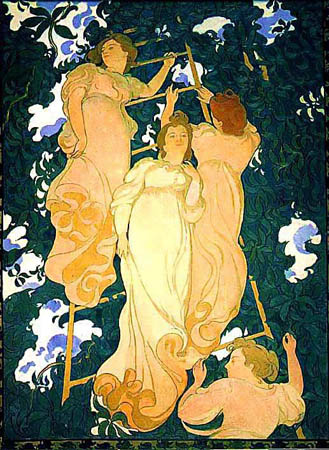
Yet it’s worth remembering another symbolist example. Maurice Denis & Paul Gaugin –two of les Nabis—were very close with Maeterlinck and his circle. Denis (who also created the cover for the first edition of La demoiselle elue) did the program for Pelléas’ premiere (the play in 1893 that is), including a fascinating image of a woman who is likely his beloved; they married later in 1893. Every woman he painted for a year or two had this same face, because she was his ideal.

Does it matter that they are all the same woman? like a dream? (click to see original article)

There are paintings where one sees a group of women, each with the same face, like a crowd of ideal women (if you like this idea), or perhaps like a group of mannequins (if you don’t).

I love it.

But excuse me if I digress, as I am sitting in a hotel room, and my mind is wandering.

A Toronto art professor coined a term for a show of Gaugin & his circle awhile ago. She called them “cloisonists”. It’s a valid description of a style where they create outlines which they colour in. You could compare their paintings to

  • cloisonné—as the professor did—the style of ceramic where blocks of a colour are separated by metal outlines
  • cartoons –a less glorified analogy—at least in the newspaper or print media, which are usually also outlines coloured in as blocks of a single colour
  • stained glass: which could be the most apt reference… I almost said “reverence”. But Gaugin at this time often painted religious allegories, so why shouldn’t his paintings resemble stained glass?

So let’s think for a minute about this composition process and what it resembles. In effect the space and figure ground relationships are all defined pretty much in the outline phase, with colour at the end. There might be scope for editing afterwards, but in effect it seems as though there’s a two- step process, where the colour is after the fact.

I may be over-simplifying, but I can’t help noticing the similarity to the two-step process of writing an opera, where at least some composers make a sketch or short-score, possibly with a piano accompaniment, before orchestrating later (or if you’re like some composers I could name, you even get someone else to do the orchestration, in which case, the piano version really IS the composer’s product). If you do an outline and colour it in later, pardon me if it reminds me of paint-by-numbers or a colouring book, that’s already finished in one sense even if it requires a last step to be fully polished.

So AtG need make no apology for a Pelléas with a piano. Whether or not it actually came to fruition that way, whether it was really staged in 1895 (i don’t think it was): that’s likely what Debussy had in mind.  It’s part of his process.  It’s very relevant to this ideal, this Pelléas

Posted in Art, Architecture & Design, Music and musicology, Opera, Personal ruminations & essays | Tagged , , | 4 Comments

Pilgrimage to Jussi Björling Museet

SAMSUNG CAMERA PICTURESOne of the first things I ask students in my opera course is whether they think more in terms of a favourite opera, or a favourite singer, as it’s a medium that can be understood in at least these two ways:

  • as a series of composers and periods and styles of opera, stories told in different ways
  • as a series of big name stars, beautiful voices, larger-than-life personalities, and yes: divas.
Bjorling 1934 debut in Stockholm was as Rodolfo, the role he played most often.

Bjorling 1934 debut in Stockholm was as Rodolfo, the role he played most often.

My first opera favourite as a child wasn’t an opera but a singer, a Swedish singer, namely Jussi Björling. Long before I had any inkling of music, musicology or musicianship, well before I began playing the piano (and later accompanying my older brother, who would soon be a professional) I was already listening.

I had no idea about the words or the stories or plotlines, although I’d soon be able to name the operas & composers, and even to recognize them. I sympathize with people who are tenor-centric, because that’s how I grew up, in a house with a few complete opera recordings plus a few LPs of arias & ensembles. Björling figured prominently, because he was a favourite in the house.

I hadn’t yet seen an opera. My first was sometime around my 11th birthday, a production of Il trovatore by the Canadian Opera Company starring someone whose name I remember as Francisco Lazaro, who had the unenviable job of somehow living up to what I’d heard: Jussi Björling singing “deserto sulla terra”, “ah si ben mio” and “di quella pira”, and I knew every note of those pieces his way.  It was impossible of course (for him? for me). I vaguely recall it as a disappointment (or perhaps “heartbreak” would be more accurate). I suppose he was okay, but like I said, it was a bit like asking a boy to do a man’s job. There I was, expecting something resembling what I’d heard on the recordings.  I was in a hall with terrible acoustics, but that was one more thing i’d have to learn about.

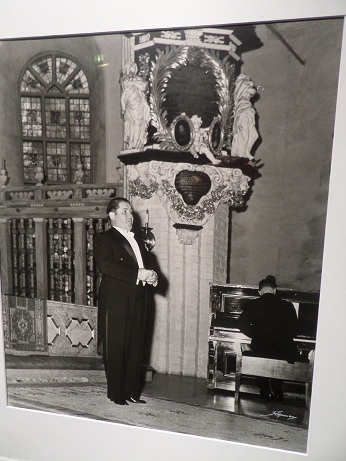
A recital in Stora Tuna Church, where his parents are buried. The caption in the Museet says "Jussi finished his programme by singing Stenhammar's "Sverige", ending with the words "...where under the graveslab our ancestors are sleeping".  This affected him so much that he only with difficulty could finish singing and then rushed into the sacristy with tears streaming down his face."

A recital in Stora Tuna Church, where his parents are buried. The caption in the Museet says “Jussi finished his programme by singing Stenhammar’s “Sverige”, ending with the words
“…where under the graveslab our ancestors are sleeping”. This affected him so much that he only
with difficulty could finish singing and then rushed into the sacristy with tears streaming down his face.”

Fast forward to the 21st century. I’ve been visiting family in Stockholm. The connection is deeper than expected. Yes I knew my brother was born here while the family lived in this city. In a curious way Björling was conflated in my head with my father, as both died in 1960, both dying far too young. I was only five years old when my father died so I hope I can be excused for making a connection that isn’t logical, just the retrospective association of a young boy.

As I sat discussing possibilities –which sights and places to go see on the trip—I wondered aloud if there might be anything commemorating Björling, and was delighted to discover that in fact there’s a museum. While there are societies to keep his memory alive (one in the USA as well as the one in Sweden), a museum can take it a step further, assembling memorabilia. Although I saw it would be a two hour train-ride north, I couldn’t resist.

I had to see for myself.

The trip was quite pleasant. The trains –like every part of Swedish infrastructure it seems—are delightful. The new cars not only have wifi but display the time & their speed. I saw 166 km at one point, which is much faster than anything we’d get in Canada. The tracks feel smooth, without any of the unfortunate rocking motions I feel in Canada even at slower speeds.

Upon arrival I was given directions to the museum when I asked; it’s a short walk in a charming little town.

Yesterday when I entered the Museet I was greeted by Björling’s voice singing one of his signature tunes.  I should have expected it, but even so, for a moment I was overwhelmed with emotion. There are several pieces that I associate directly with Björling. Most songs and arias are sung by every tenor in creation, good or bad. But there are a number of pieces that I swear nobody else sings. It’s not necessarily that the music is difficult, but these are tunes I have never heard anyone else sing. When I came in I heard him sing the song “skogen sover”, or “the forest sleeps”. Its Swedish lyricism suits the sweetness of his voice. And I heard him sing “Ah leve toi soleil” from Gounod’s Romeo et Juliette, something every tenor sings, although nobody with such ringing top notes.

I can still recall the excitement when a new LP came home. My brother did the leg work, I was just the one at home jumping up and down, and then listening to Jussi Björling in Concert. Some of it is with orchestra, some with piano. This is the recording where he does his only version of Lohengrin’s narrative, where he sings Lensky’s aria, where he sings a number of wonderful Swedish songs including “Till havs” with orchestra. There are also others with piano, from a different recital in August 1960, just a few weeks before his death in September, including an encore where we hear him announce “<Devotion>” by Richard Strauss”. Was this the very last recording before he died? The voice was phenomenal even then.

This version is from slightly before, in 1959.

And I grew up.

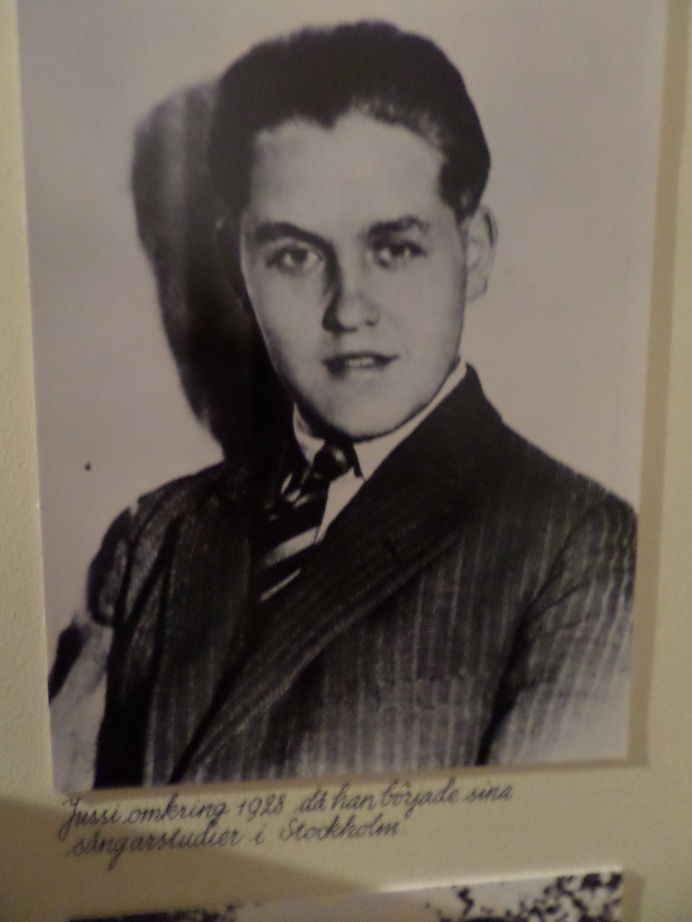
As a young man in 1928

As a young man in 1928

I’ve never heard anyone else sing “Till havs”, a song whose words I don’t know. But it’s a song about the sea as far as I know. You listen to it and tell me you can’t tell what it’s about. It may not be John Masefield, but so what. I posted a few of these on facebook when I knew where I was going earlier this week.

From Il Tabarro, 1934

From Il Tabarro, 1934

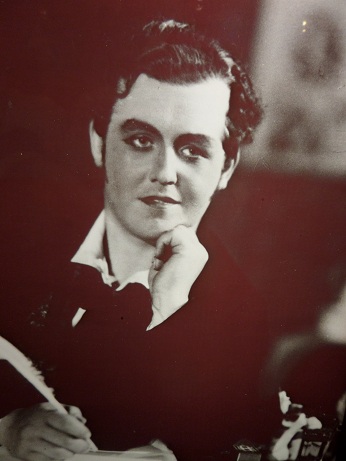
At times I was surprised by my own emotions as I walked around looking at pictures and hearing the voice. We see him as a child with his family, discover his family tree, see his teacher, but mostly we’re immersed in the career. We see a wealth of photos from productions on either side of the Atlantic, often with familiar faces from the middle decades of the century (note: except for the last photo, all photos on this page were taken by me, sometimes through glass–photos of photos– which explains why they sometimes look odd.  Please feel free to use as you wish). There’s also a library and a video room. I was surprised to see video of his state funeral, overcome with emotion for a moment when I realized I’d been too young to see my own father’s funeral, so I watched that segment twice. There’s a small map if one wants to walk or drive to his grave-site but I chose not to. There’s art –several paintings and sculptures of a famous face who was a huge star in his time and is clearly not forgotten—as well as a plethora of cartoons & caricatures.

And there’s an organization there, a friendly and welcoming group of people. I got a glimpse of how many recordings he’s made, how many more there are to hear.

I encourage you to investigate if this intrigues or inspires you to want to know more. There’s a society in the USA, another in Sweden, and the museum itself.

I am very glad I chose to visit.

Posted in Opera | 6 Comments

Richard Wagner: A Life in Music

click for more information including click to buy

I just finished Martin Geck’s Richard Wagner: A Life in Music in Stewart Spencer’s 2013 translation. Published only in 2012 as Richard Wagner: Biografie you can judge for yourself how good this book must be, that its translation was pushed along so quickly. I was fortunate to pick it up from among the new releases on display at the Edward Johnson Library.

If someone were to tell me about this book I’d be a little hesitant, wondering how one can organize this enormous mass of material into something intelligible. But that’s perhaps the greatest achievement of this book, or the reason it’s so deliciously readable, so easy to digest. Each chapter takes a period of Wagner’s life, beginning with his youth, but placing the focus on the composer’s creations from that period. For his first period, that includes his play Leubald, written in his teens and placed in context with what’s to come. While we may get glimpses of the works on the drawing board, it’s all nicely balanced around the work in question: as music, as philosophy, as politics, as Wagner’s life reflected in music.
Geck positions himself in the conversation, sometimes offering his own possible interpretations of an opera. You read about Wagner in the most elegant reconciliation of the many elements of the composer that you can imagine, touching upon his revolutionary activities, his loves & his sexuality, his religion & philosophy. But it is his operas that are the real focus, especially in the musicological treatment, placing them in context with what came before (particularly Bach & Beethoven; I am especially thankful for Geck’s illumination of Meistersinger and the ways it is both new & old), and after (thinking of Mahler, Debussy & Schoenberg). We examine Wagner not just in his time nor in ours, but across the decades of responses, including correspondence & conversations with Cosima, Liszt and Nietzsche, as well as responses in subsequent decades from admirers and critics, composers and interpreters.

And the National Socialist fixation on Wagner is discussed without degenerating into a question of blame, but rather looking at the ways in which Wagner became part of the consciousness and identity of Germans. I wrote not long ago about the failure of a major history (Abbate & Parker) apparently unwilling or afraid to reconcile itself to production & interpretation: a crucial part of the story. Geck is very different. Included in his account of each work are recent –and sometimes the most notorious— productions. For example, Geck’s caption to a photo from Neuenfels 2010 Lohengrin includes this:

The Brabantine chorus is cast as laboratory rats: creatures that can be manipulated. As such they are willing to torment Elsa whenever their superiors require them to do so.

The photograph comes after a lengthy discussion including the following:

   For me, Lohengrin is incapable of concealing its affinities with nationalism and National Socialism, for its ideological aspects not only affect its “political” dimension in the person of King Henry but are inextricably bound up with the action that is centred around Lohengrin. It is Lohengrin, after all, who installs the young Duke Gottfried as “Führer.” It was Lohengrin, too, who provided Kaiser Wilhelm II with his motto “I know no more parties” and who was able to serve as a model for the National Socialists’ attitude of “You are nothing, your people is everything.” However much we may care to stress that it is in Lohengrin’s “nature” to fail in his relationship with Elsa, and that this has nothing to do with “politics,” it remains the case that politically speaking he appears as a God-sent savior who—in the name of the “Providence” that Hitler never tired of invoking—unmasks and destroys the “false” leader of the people in order to install the “right” one.

   This interpretation is not intended as an indictment of Wagner. After all, his political ideas had a different significance in the years before 1848 than they did after 1871 or at the time of National Socialism. Nor was it possible to have predicted the disastrous turn that they would take. If it had been possible to do so, then we should also have to condemn the hundreds of thousands and even millions of Germans who, attending performances of Lohengrin in the spirit of Diederich Hessling, made Wagner’s ideological construct their own and treated it as a mainstream idea.

Between each chapter Geck offers something remarkably like Wagner’s own structuring, and very apt if we think of the book as a work of opera and its construction as a matter of dramaturgy. Geck gives us a kind of digression that reminds me of nothing so much as an orchestral interlude, an escape into a different medium, something reflective. After the youthful chapter we get “A Word about Felix Mendelssohn”, which is indeed a reflection from another angle, a charming little excursion away from Wagner that serves to illuminate the subject of the book all the same. Later “words” include Meyerbeer, Heine, Adorno, Eisenstein and Mahler. They’re like short courses that cleanse the palate and I must say very delicious. Each new chapter begins freshly with a picture (photo or portrait) that is pertinent to that period, and again offering a slightly different entry to the next section.

And now? I shall re-read the book as it’s not due back for awhile, its bibliography a roadmap for further study.

And I must find other books by Martin Geck.

Posted in Books & Literature, Music and musicology, Opera, Reviews | Tagged , , , , , , , , , , | Leave a comment

Nils Dardel and the Modern Age

One of the journeys of my life has been to reconcile myself to fame.  Not everyone gets famous, and often it’s the wrong people.  For this Canadian it is very clear at least how it doesn’t work.

  • It is not fair.
  • Itis not logical.
  • Sometimes brilliance is rewarded, sometimes it is not.
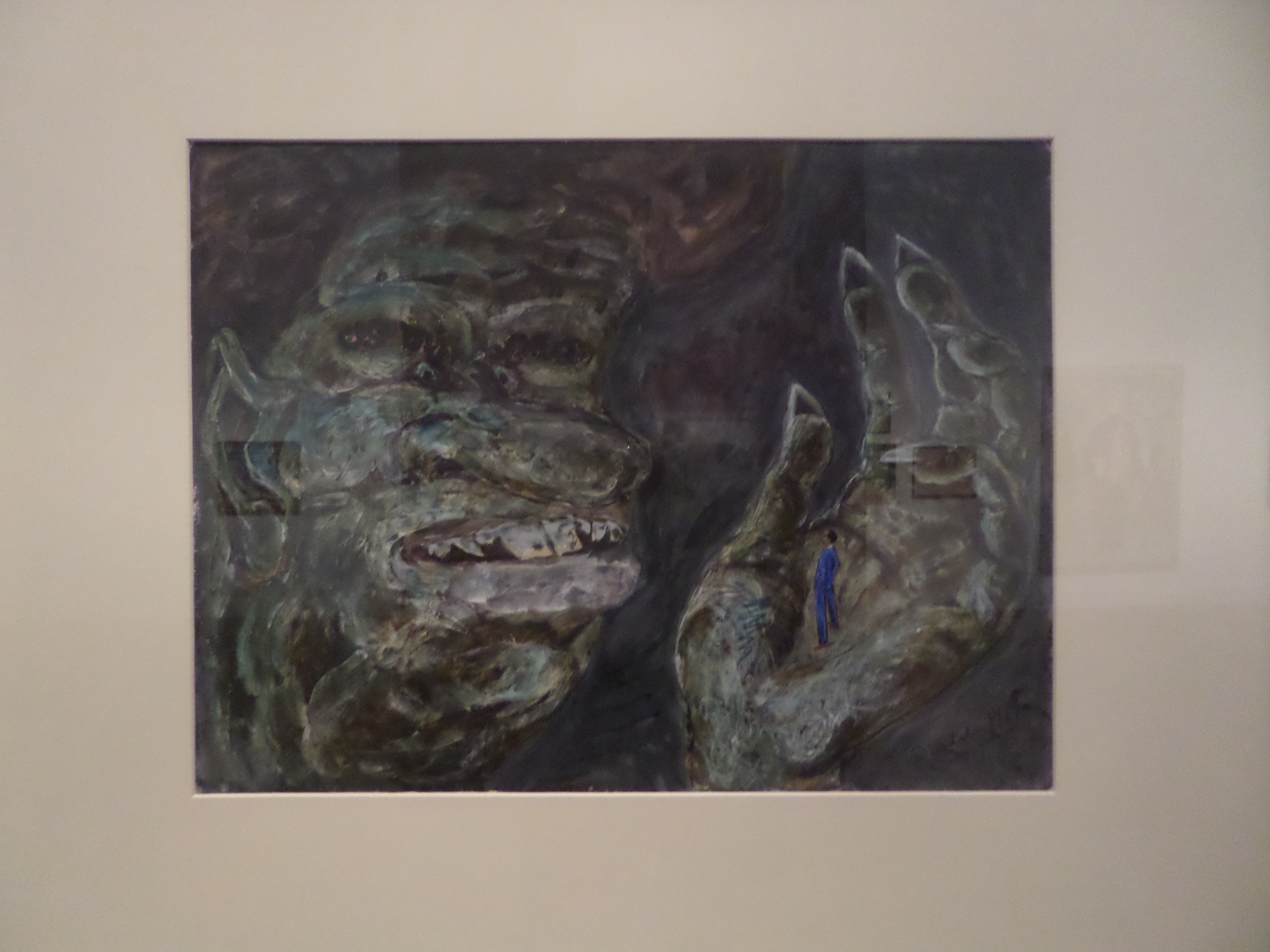
Gulliver by Nils Dardel.  Notice that the little man is a dandy

Gulliver by Nils Dardel. Notice that the little man is a dandy (photograph by Leslie Barcza)

I live close enough to one of the centres of the world (thinking of New York City) that I’ve seen how one’s perspective is distorted by being in one of those places.  NY is a place where talents compete for attention, and where it may seem that those in the limelight are automatically the best. We assume that a star in NY would be a star here or anywhere else because “if you can make it there you can make it anywhere”.

Except that it ain’t necessarily so. Each little cul-de-sac can have a local hero who is unknown on the world stage.

The internet may be eroding regional flavour, but it is still largely true. There have been barriers preventing some from achieving worldwide recognition. Language may be the biggest. Canadians and Australians regularly go to Hollywood and make a huge splash precisely because no one there realizes that theyíre dealing with foreigners. But what if you’re Hungarian? Or Swedish? Then the dynamics and the scope of fame will likely be different. You’re taken up elsewhere only when you have a champion, or when –like Franz Liszt–you make a splash in another city as Liszt did in the Paris of the early 19th Century: the NY or Hollywood of its day.

Nils Dardel is the reason for this digression on fame, the most impressive painter I’ve seen in awhile. His remarkable works are currently on display at The Moderna Museet in Stockholm.

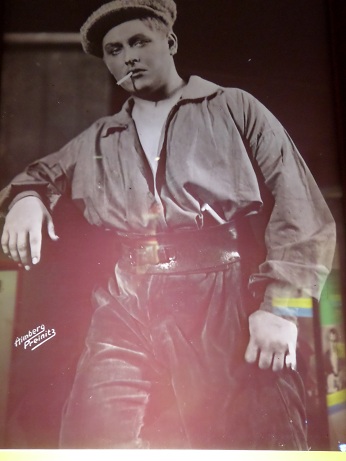
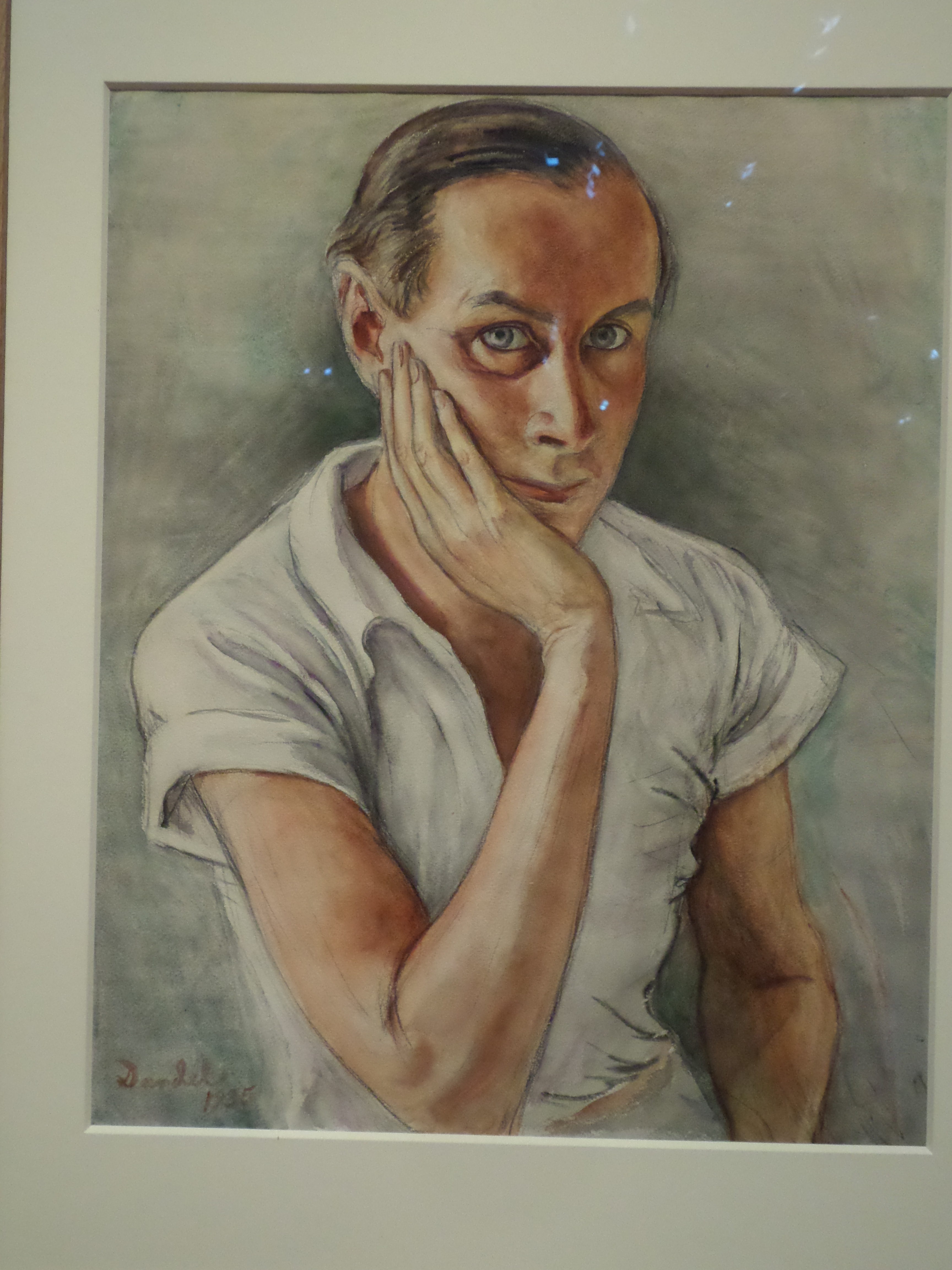
Dardel lived from 1888 to 1943, dying in NY.  I believe it is safe to call him a dandy, considering that he painted at least one picture where he self-identified as such. I suppose I have a weakness for dandies, or a weak stomach in the presence of those who valorize the macho ideal, as we see in futurism. What kind of art do you get with Dardel? In his early art he is influenced by the post-impressionists such as Matisse or Gaugin, add a smattering of cubism, then veers bravely into surrealism.

This is a dandy’s surrealism, the wild imagery of someone well-dressed whose sensibility is informed by good food, good clothes, good manners and all things aesthetic. We could be in a theatre or at least in a place where people play-act.

If Dardel were an American? he’d be famous. His painting is very good, highly individualized & quirky. Because he’s not from a country that is mainstream to the art-world, I suppose he is relatively unknown. Dardel’s art is on display in Stockholm’s Moderna Museet until Sept 14 2014.

Knowing that I’d be unlikely to ever see it again I bought the show catalogue.  It’s very reasonably priced, wonderful reproductions and also fascinating text.

Self-portrait, Nils Dardel (photograph by Leslie Barcza)

Self-portrait, Nils Dardel (photograph by Leslie Barcza)


Posted in Art, Architecture & Design, Books & Literature | Tagged , , , , , | Leave a comment

Grey Gardens

In the 1970s two film makers made a remarkable documentary. I’d never heard of it until yesterday, but had it presented to me in all its garish intimacy. Albert and David Maysles’ Grey Gardens (1975) is a film taking its name from the estate of the same name, owned by a branch of the Bouvier family.

Yes that family, the same one that gave the world Jacqueline Kennedy Onassis and Lee Radziwill. Knowing that, it shouldn’t be surprising that the mother and daughter, Edith  Bouvier Beale –both mother and daughter are named Edith–should both be remarkably handsome women.

If you’ve seen this film you’ve seen one of the precursors to reality television. It’s a documentary like nothing I’d seen before.  Yet of course I’ve seen all too much recently: on television. The camera is unforgiving, invasively close and hungry for every absurd revelation. Celebrity is captured here in the same insane colours we’ve seen in Sunset Boulevard: except this is genuine, not fiction. And it’s even more twisted by decay & spoilage. Here’s a sample, see for yourself.

The reason I was finally exposed to the documentary was in an encounter with the other Grey Gardens, a 2009 HBO meta-drama starring Drew Barrymore and Jessica Lange. The first hour is brilliant, a clever exploration of subtexts for the wreckage we encounter in the doc. Had the film-makers had a bit more nerve they could have made something as profound as their source.  Perhaps they were held back by requirements such as delicacy or even stipulations from the owners of this bizarre story: what they could or could not say. It seems odd, considering how zany this is, that there would be any stipulations, but when we come to the last 30 minutes it’s all suddenly very careful where previously it had been devil-may-care.  Maybe the deal with HBO insisted on certain proprieties, and thereby kiboshed the result.

In a curious mirror to their source, they are undone, it appears by vanity, ego, and old-fashioned ham. It’s much too long. We were sitting there laughing through a last half-hour when we kept wishing it would be over. Drew Barrymore is an actor who carries on her family’s tradition of bravura virtuosity, but likely was the reason the project came undone in its final half-hour. The scene where the young Edith confronts a visiting Jacqueline Onassis is painful to watch for all the wrong reasons. A director with more backbone would have found another way to deliver the lines “I could have been the First Lady” than screamed into her face from three inches away.  Michael Sucsy is the director and co-writer with Toronto’s Patricia Rozema (I have to assume that everything good in the film comes for her). It doesn’t help that Barrymore shares the screen with Jessica Lange, who is her usual study in subtle integrity. On the few occasions when Lange’s delivery diverges from what we’ve seen in the original doc –and yes it’s possible to compare because several moments in the original are replicated in the new film—she makes choices of profound subtlety and stillness.

It’s a very subtle and deep problem because the younger Edith is herself a histrionic ham, someone that Drew must have felt called to play.  In the first hour especially it’s magic.  But I wonder if Barrymore considers whether a histrionic ham can be herself underplayed. That moment with Jacqueline Bouvier Kennedy Onassis (did i miss any additional surnames?) likely could have worked quietly, given the immense pain pulsing under the surface.  Or maybe the purpose was to make Jeanne Tripplehorn look good in her dignified portrayal of the former First Lady.

I recommend this film both for the brilliance of the first hour, and for the laughable last one. And speaking of ache, while the story is a painful study in what might have been –thinking of the stifled talents of the younger Edith—the same applies to Drew Barrymore, a bright shining light that continues to be misused. She needs a director willing to stand up to her.  I’ve seen the same thing with other loud talents –Al Pacino comes screaming to mind– who are loved the way family members are loved: in spite of the horrible things they do.

I keep dreaming that they’ll find the right vehicle.

Posted in Cinema, video & DVDs, Reviews | Tagged , , , , , , , | 2 Comments