Histories

As I revised the outline for “The Most Popular Operas” (a course I teach here at the University of Toronto School of Continuing Studies, beginning September 18th), I was asked as usual to recommend books.

I used to suggest Roger Parker’s Oxford Illustrated History of Opera (1995), a solid and well-written work.  But I believe it’s been supplanted by a new book, namely A History of Opera (2012) by Carolyn Abbate & Roger Parker.  Yes, it’s the same guy + a collaborator, and so it shouldn’t surprise us that the new book has a chattier feel to it.  It’s not so dry, and actually lots of fun.

In comparing the two books, and as I prepared to teach again, I began to think about opera books in general.  Someday I might like to try my hand, although my contribution would be much more specialized.  Yes, there are many different sorts of books.  They succeed –which is to say, find an audience—because there are so many different sorts of readers.

But it starts with the different sorts of authors and what they might have to say.

A.M. Nagler’s A Source Book of Theatrical History

I am inclined to go back to the beginning, which is to say, the history book that is my touchstone for theatre history.  In my M.A. at the Graduate Centre for Study of Drama, Professor Lise-Lone Marker relied very heavily on one book, namely A.M. Nagler’s A Source Book in Theatrical History.  I took this course a long time ago, but the book’s still available, still a landmark of sorts.

Why? Because we’re reading the words of witnesses & participants from the time.  The analyses of modern-day writers are never going to have the authenticity of this kind of material.

Nagler’s book doesn’t have a great deal about opera in it (although there are a few), indeed I believe that opera’s sparse inclusion is perhaps the largest blemish upon this book; as such it might seem like an odd candidate to be mentioned.  But I cite Nagler more as an example of genuine historical specimens, historiography done right.

Let me get back to Parker vs Parker/Abbate.

There are new things in the new book, which is as it should be.  Anyone reading about the beginnings of opera in other histories could be forgiven for finding it all a little unbelievable, a little too perfect.  If the history of opera were an account of a murder, any decent cop would have noticed that the tale makes good use of all available evidence.  If you want to read one of those, go to Wikipedia for example;  but books & historical accounts (mine included) haven’t been much better, so let’s not be too hard on wikipedia.

What I love about Parker-Abbate’s beginning is how it’s framed not as the beginning of opera so much as the beginning of the telling of the history of opera.  We are confronted with the limits of what we know and ironically presented with centuries of myth-making, the way opera has been understood.  They present a series of specimens, including Richard Wagner, telling us variants of the story.  They’re all perfect as setup for the joke.  No it’s not a colossal laugh although I would imagine scholars may have chuckled.  I recall reading this with my mouth hanging open.  And I had the impulse to applaud.  So yes, this is perhaps the biggest quote I’ve ever put into this blog.

    Thus according to the established historical account, was opera born and started its 400-year progress.  But in the latter part of the twentieth century the picture was modified in significant details.  Scholarly research gave rise to a more complex description, almost an historical anthropology of the phenomenon.  Nowhere was this more evident than in accounts of opera’s first decades.  The story still portrayed opera flowing from an important moment of change in Italy around 1600, but the details could take us aback: for instance, the very designation ‘opera’ was not consistently used until as late as the nineteenth century.  An impressive list of genre terms used in opera libretti or scores at various historical periods in various centres or national traditions can be reconstructed, and these differences in terminology reflect important variations in the very nature of the works.  One recent history of opera in seventeenth-century Venice lists around fifteen terms that circulated in the early decades, few of which include the word ‘opera’, and only some of which make reference to music.  It could be attione in musica or a drama musicale or a favola regia, a tragedia musicale or an opera scenica; the sheer proliferation speaks of a genre in the making.
    In this second, more modern manner of telling opera’s history, the precursors and theories underpinning its emergence are now all over Ialy in the sixteenth century.  Opera mutated gradually out of these ancestors,
(Abbate & Parker, p 38-9)

I’d keep it going if it didn’t make my own writing seem impoverished and weak in comparison.  This is a whole new way of seeing that opening chapter of the history of opera.  Their charming conversational tone is a pleasure to read.

Okay, so that’s the good news.

If I have a quibble –and it’s a biggie—it’s how I feel about their response to the last century, a colossal omission or perhaps simply an error in their choice of focus.  I must frame it within my own beliefs about opera, so that you can decide whether I can be trusted.

I love teaching opera as a series of debates, or conversations if you prefer.  These change throughout history.  In the first century of opera the composer is barely in the picture, when we recall that musicians were usually servants, that opera performances sometimes employed substitute arias & solos pulled out of a suitcase.  There was no textual integrity because there was barely any text, period.  Publishing came later.  The conversation at one time was really between the librettist and the virtuoso, whereas in another later century, the composer became the most important figure.

And now?  The most imposing figure in modern opera productions is the director: although you’d never know it from reading Parker & Abbate.  Their focus is on text, which makes sense. They wrote a big honking book. How could they concern themselves over the evanescence of performance?  The ephemera of high notes or interpretations?

But that’s just it.  While they would love you to see opera as a bunch of books –which is what you find in a music library—that’s a very narrow perspective, particularly in this century of convergence.  Opera is both the works and the performers, the songs & the singers.  To focus only on the works is to miss a great deal of the story, particularly now as opera turns up in movie theatres & TV. Now maybe they were concerned that the book was LONG.  I can’t argue, even if i want it longer to include what’s missing. Honestly, yes!

So… How to tell the history of opera? go to opera. See the productions, quibble with them, discuss them with your friends.  That’s where any art form lives.

Not in the book.

Posted in Books & Literature, Opera, Personal ruminations & essays, Reviews | Tagged , , , | 3 Comments

After Mansouri

Lotfi Mansouri (click for COC announcement)

Lotfi Mansouri’s death earlier this week is not the end of an era.  His time had already passed long ago.  But his death is still a fit time to ask “how important was Lotfi Mansouri”?

One answers that question differently as a Canadian.  The Canadian Opera Company before Mansouri was a series of question marks and possibilities.

During his time with the COC big name talent was more willing to take the plunge, to come here to perform.  As a result the optics gradually changed, both abroad (for the artists considering coming) and in Toronto (for audiences noticing the talent).

However much one may associate Mansouri with glitz & glamour, his key achievements were administrative ones that secured the future.  Perhaps they would all have been addressed sooner or later, but his stewardship strengthened the COC’s place in Toronto, at a time when the ecology was changing.

The Toronto Symphony –who had worked in partnership with the COC and who were cut loose with the creation of the COC’s own orchestra—seemed to be the most important cultural organization in Toronto at the time of Mansouri’s arrival in the 1970s.  One can’t point to a single factor.  The TSO’s move to Roy Thompson Hall was a huge disappointment, even after a further renovation to improve the acoustics of the new hall.  In the past quarter century, when opera steadily grew in Toronto, the symphony not only lost its hold but maybe lost its way, as the competition in this city became increasingly diverse & sophisticated.  At the same time Tafelmusik was gradually carving off a chunk of the available audience, while in addition they had a collaborator onstage in Opera Atelier.  To survive in this market one needed not only to know what one’s mission was, but to articulate it and market it clearly to find an audience.

Canadian Opera Company photo of the Joey & Toby Tanenbaum Centre

The COC has been a leader during this period, both under Mansouri’s leadership and after.  Their Ensemble Studio, modeled on the Merola program in San Francisco, changed the relationship to the pool of talent.  Internal organizational moves such as the building of the Joey & Toby Tanenbaum Centre consolidated the company.

There’s one aspect of Mansouri’s career, however, that makes news of his passing of world-wide importance.  Whether you call them “surtitles” (the copyrighted name the COC came up with), “supertitles” or “subtitles” doesn’t matter.  It’s a simple idea that has been adopted all over the world, changing the way people experience opera.  It used to be that one either did one’s homework –listening to the work, learning the libretto, reading the synopsis—or one sat in comparative ignorance during the performance.  Now? Opera has become more inclusive because one simply shows up and understands what’s going on.

People split hairs about the titles themselves.  Some purists dislike them, some resent the laughter that they sometimes elicit, although over the years titles are being written better to avoid the problem.  If I have a beef –and it’s minor—it’s that the titles I see in Toronto work a bit differently than what you get at the Met in NYC.  Here, they always seem to presuppose that you know where the text begins to repeat, where the da capo part goes back to the beginning.  If you watch the first verse you’ll see text.  When the singers repeat, you’re out of luck.  Pardon me, title-writers, but if I knew where the titles were repeating, I wouldn’t need titles in the first place. Why are repeats an occasion for a blank space up top?  Please keep the titles coming.  It means that if I look away from the text and spend a moment watching a singer, I miss the text for the repeated passage.

But I digress.

Lotfi Mansouri’s importance?  In Toronto, he helped establish the COC as the pre-eminent performing arts organization in the country.  And his greatest achievement with the COC –surtitles—have been imitated all over the world, arguably the single most important innovation in the opera world over the past few decades.

Posted in Personal ruminations & essays | Leave a comment

Lotfi Mansouri: COC’s announcement

“Press releases and announcements” are presented verbatim without comment.

August 31, 2013 Toronto, ON – The Canadian Opera Company is deeply saddened to learn of the sudden passing of former general director Lotfi Mansouri, who guided the company from 1976 to 1988.

“Lotfi Mansouri was a legend. There is no question he was one of opera’s most influential general directors; whether it be his passion for promoting young performers, his zeal for attracting new audiences to the art form, or his undeniable love of opera and all its idiosyncrasies,” says COC General Director Alexander Neef.  “The international prestige that this company now enjoys is due in no small part to his strong leadership and tireless efforts.  I am personally very grateful for his friendship and the advice he shared with me ever since I joined the COC.”

Mansouri was the COC’s third general director and played a significant role in launching the COC’s international reputation for artistic excellence and creative innovation, and growing the company into the largest producer of opera in Canada and one of the largest in North America.  During his tenure, Mansouri’s focus was on implementing a longer performance season, audience development, more adventurous repertoire and productions, and advance planning both financially and artistically, the accomplishments of which are essential elements of the COC’s operations today.

The COC’s international reputation was most certainly launched with the growing number of singers of world-renown that Mansouri was able to attract to the company with greater regularity.  Mansouri brought with him to the COC an extensive network of friends and associates developed during his time as a resident stage director at Zurich Opera and Geneva Opera, as well as guest director at major opera houses in Italy and the United States.  Not long into his term the COC presented what has been called an unprecedented season with preeminent opera stars of the day Joan Sutherland, Tatiana Troyanos, Elisabeth Söderström and James McCracken all appearing in the 1980 – 1981 performance year.

Mansouri is also credited with establishing the COC Orchestra and COC Chorus, which have become two of the company’s most distinguished attributes.  The company’s orchestra and chorus are internationally acclaimed for the skill and musicianship possessed by their artists.

A great ambition of Mansouri’s was the creation of a specialized training program for young opera artists that would serve as a bridge to professional life.  This goal was realized in 1980 with the launch of the COC Ensemble Studio, which has become Canada’s premier training program for young opera professionals.  To date, over 180 young professional Canadian singers, opera coaches, stage directors and conductors have acquired their first major professional operatic experience through the Ensemble Studio, claiming such alumni as Ben Heppner, Isabel Bayrakdarian, John Fanning, Wendy Nielsen, Joseph Kaiser, David Pomeroy, Lauren Segal and Krisztina Szabó.

It was also during Mansouri’s time as general director that the COC established permanent administrative offices at the Joey and Toby Tanenbaum Opera Centre and its own production shop, an essential requirement of any major opera company.

Under Mansouri’s tenure, one of the greatest contributions to the COC and the opera world was the creation of SURTITLES™, which were unveiled at the company’s 1983 production of Elektra.  The occasion marked the very first time any opera house in the world had projected a simultaneous translation of the opera for its audience, and the advent of SURTITLES™ allowed the COC to make opera more accessible to audiences.  The idea of titles, once revolutionary to the international opera community, is now accepted practice in all major opera houses worldwide.

Mansouri left the COC in 1988 to become general director of San Francisco Opera.  He returned on multiple occasions to give masterclasses to the young opera professionals of the Ensemble Studio and to direct on the company’s mainstage.

Posted in Press Releases and Announcements | Leave a comment

Adam Klein – Winterreise

On his Vimeo webpage Eric Solstein says  “This amazing performance by Adam Klein & Craig Ketter of the Schubert song cycle will be the soundtrack to a film I’m just finishing. It’s too powerful not to be available on its own terms.“

Solstein is a film-maker, Klein a singer, and Ketter a pianist.  And so indeed he’s made the film available via Vimeo, the site for sharing video: a film of Klein & Ketter performing Schubert’s Winterreise.

It’s highly original.

I’m taken back to the famous painting of a Schubertiade –a concert of Schubert music—that gives us a bit of a sense how that might have been.  The painting shows us a moderate sized room, but sufficiently intimate that everyone can connect with the music, and perhaps more importantly, with the presence of the composer, performing for everyone in the room.

Solstein’s film gives us something comparable, in other words we’re not in the artificial world of a modern concert space, where everyone’s in black, where the audience sits in a kind of thrall to the performance.  Nope.

We’re listening to Schubert in a modern living room, with a grand piano.

If Schubert were alive today perhaps this is how the composer would share his music: that is, in such a space via Vimeo.

The juxtaposition of the modern & the early romantic makes this a performance of which Brecht would likely have a thing or two to say.  We are deep into the illusion of a performance, but we’re reminded of the performers and the apparatus of creation.  We have it both ways, sometimes swallowed by the music’s magic spell, sometimes kept at arm’s length by the remarkable camerawork.

There’s Adam Klein, in casual clothes, standing in the indentation of the piano.

There‘s Craig Ketter, even more casually attired at the keyboard.

Adam Klein, minus his Winterreise beard

And I would say that Solstein’s assessment is accurate. It’s very powerful.  We get views mostly of Klein’s drama in the monological narrative of the songs.  Each one usually starts us with the title & a view of Ketter getting us going, and occasional glimpses of Ketter in the middle of songs. Otherwise we can be very close to Klein.

In the Metropolitan Opera high definition broadcasts, we sometimes get close-ups of singers on the stage.  The new high-definition images bring us in quite close.  Few singers are really good enough to handle these close-ups.  They’re often juggling responsibilities, between their dramatic portrayal, their singing, their air supply, and watching the conductor give the down-beat.  They try to do all this without looking too obvious about it, because the illusion breaks when we see them suddenly notice the camera or breathe too outrageously.  Opera is a very artificial art, so that one rarely can get lost in a close-up performance, without noticing all those competing requirements.  I think the most excellent moments I saw all season were by Susan Graham as Didon, in delicious close-up, madly fuming over the departure of Aenée in Berlioz’s Les Troyens, and yet never betrayed by that camera.

Yet Adam Klein is stripped even more completely by Solstein’s close-up camerawork, including breath-taking moments when the camera is like a  mirror, into which Klein glares madly in a couple of songs.  This is a rare performance, that functions without a real fourth-wall, exposed to our eyes and ears.

This is challenging music, sung without any real sense of difficulty. Ketter makes his contribution look effortless, delicate, flawless at the keyboard.  Klein? his only struggles are the ones situated within the characterization, composed into the texts. He wanders the expressive landscape of the songs, as his voice flows into the room.

The voice?  Klein pushes some interesting buttons for me.  I’ve seen him in the big Metropolitan Opera House, a bigger voiced Loge than the man he replaced, brazenly walking the wall on Lepage’s wires.  This is a versatile singer-actor.  He’s sung Tristan out west, Radames just this past week in NYC, and a Rodolfo elsewhere in New York state not so long ago.  In other words, he has a tenor’s range with Wagnerian power.

In the Schubert we hear the baritonal sound of a heldentenor, recalling that in The Free Voice Cornelius Reid more or less calls the heldentenor a baritone with high notes.  Sometimes I think I hear one of the Thomases, namely the American Hampson or the British Sir Thomas Allen.  But I mostly hear the fulsome voice of a young Jon Vickers, agile, without Vickers’ tendency to gradually slide up to notes.  This is a Vickers as we never heard him, precise in all his attacks.  And yes, I think  I hear another baritone, namely Dietrich Fischer-Dieskau, in the songs of cold detached sorrow; the only consolation we seem to have in those moments is the warmth of the voice, the breath you see before you on a cold day as you trudge alone.

It’s a fuller sound than I’ve ever heard singing the songs as a tenor.  They can be transposed, but to sing them as a tenor, and still have the fullness?  That’s new. This isn’t Peter Schreier, yet Klein’s every bit as agile, every bit as delicate when he needs to be, and effortless up top.

The diction is excellent.  I feel I should mention this because it seems to slide by the boards in most criticism of American singers. The Met chorus are competent, while some of the soloists are syllable-by-syllable accurate, rather than singing words & phrases.  Klein sings sentences, arching phrases, sometimes contorted with pain but clearly etched upon the ear.  We’re in the presence of a powerful instrument holding forth in a small space,  reaching across a small room, but sometimes overwhelmed by feeling.

The face is troubled.  He wears a short beard, sometimes a mask with the emotion within, sometimes his face tormented by his subject.  We are on that winter journey with the singer, traveling through several songs,  traversing several different vocal timbres, approaches to the music, to the text.

I am grateful that this performance has been captured, a valid and highly original response to the music.  It’s not precisely opera, but it’s an entirely different response to the songs than usual.  Klein’s not restrained by the formalities of black dress clothes and a distant audience. We’re right there, or more precisely, he’s right here: in our face.

I wouldn’t have it any other way.

For the song texts & translations:
Song cycle on Vimeo: http://vimeo.com/72821544

Posted in Cinema, video & DVDs, Music and musicology, Opera, Reviews | Tagged , , , , , , | 3 Comments

Dark Blue Jasmine

I went into a theatre expecting brilliance from Cate Blanchett, and was blind-sided by Woody Allen’s politics.  But maybe that was to be expected.

I keep finding politics everywhere I turn.  Maybe it’s me (and the political focus of what i’ve been seeing)? But no, surely this is what Woody Allen wanted me to see, in his current film Blue Jasmine.

While there’s Oscar buzz around Blanchett’s work, I confess I wasn’t blown away.  Maybe it’s because the role is full of the sorts of impressive things actors do that we associate with acting.  Oh look she’s having an anxiety attack. Oh look she’s lying. Oh look she’s a fish out of water, a rich woman suddenly in a place where there are no rich people.

Actually I think she resembles a Hollywood actor doing a star turn.  I liked her work far more in other films that generated no comparable buzz (Pushing Tin for instance).  Is that so-called buzz actually fake, the sound of hands being shaken behind closed doors?  Or is it that the Oscar has to go to performances that genuinely look like acting, rather than performances that resemble real people?  It happens all the time, that the voters in the Academy seem more interested in a performance that hits you over the head with someone who is acting.  Say it loudly, with reverence. The Academy loves ACTING!

Andrew Dice Clay (returning to film for the first time in a long time) is quite wonderful in Blue Jasmine

Alec Baldwin, on the other hand –playing a complete jerk—really does deserve an Oscar, even if pardon my French, people assume he’s playing himself.  But the performance is stunning.  Andrew Dice Clay and Louis CK are both a joy to watch: but it makes sense that Woody Allen knows how to work with comic talent.  And Sally Hawkins (sorry, never heard of her before…) is breath-taking.  Is it heresy to suggest she blows Blanchett of the screen?  No that’s perhaps an over-statement. But considering i had no idea who she is, she’s a happy discovery for me. And I do believe that when they were onscreen together, i was mostly watching Sally not Cate. It may be my prejudice, that i cared more about the character Allen wrote for Sally and the fascinating moral arc of their collective self-deceptions.

Hey Academy! What does Woody Allen have to do to get your attention? In this film he goes a long way in self-revelation.  For starters, he makes one of the main characters a man who leaves his wife for the under-age au pair looking after the kids, a very unlikeable character I may add.  If that weren’t enough, he situates some of the nicest warmest fuzziest moments in the plot around a nice-guy comedian who might be accused of being the alter ego of the film-maker.  And he too turns out to be a jerk.

Give the guy an Oscar already!  His last few films have been brilliantly written & directed. This one is the best yet.  I think he deserves a pair –for writing & direction–but i won’t hold my breath.  Oscar is like the World Cup, except it’s annual heartbreak, rather than getting my heart broken every four years.

Is Allen being political?  We get someone who seems to be modeled on Bernard Madoff, the Ponzi artist.  We watch the juxtaposition of rich and poor, an entitled monster who’s lost everything, and still looks down her nose at the woman who is rescuing her.  Is this a drama that’s completely of Allen’s composition, or possibly something regularly being enacted all over America since the financial downturn?

However you read it, Allen’s focus is the human tragicomedy, not the politics.  We’re looking at fundamental questions of truth, falsehood, good faith & self-deception.  And like a good manners comedy, you feel cleansed for being confronted by these questions, even if he leaves you hanging at the end.

Posted in Cinema, video & DVDs, Reviews | Tagged , , , , , , | 1 Comment

10 questions for Alaina Viau

Alaina Viau works at the Glenn Gould School at the RCM as the Opera and Royal Conservatory Orchestra Manager.  What makes her tick? Real performances where there is natural movement and real emotions on stage, with singing that will make you cry with tears of comic laughter and tragic sadness. Opera should make you feel more alive and human and light a spark in your soul. That is what great opera is.

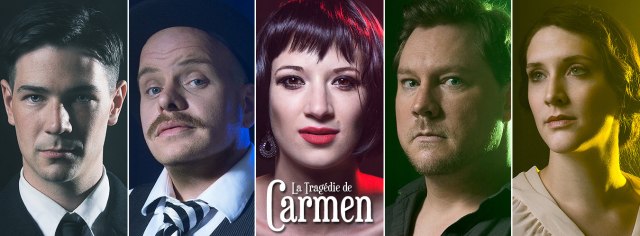
And so we come to the first production launching another new opera company in Toronto.  Viau is the Artistic Director of LooseTEA Music Theatre, setting sail in September with their production of La Tragédie de Carmen, based on Peter Brook’s adaptation of Bizet’s opera.

LooseTEA call it

“opera at its most powerful, a raw and visceral adaptation of Bizet’s most popular work. Set in New York in the 1920s a concentrated night of love and death focuses on the fatal relationships between Carmen, a burlesque dancer, Don Jose a WWI veteran with post-traumatic stress disorder and the mob boss Escamillo, The score retains all of the most famous musical moments of the original; Carmen’s Habanera and Seguidilla, Don Jose’s Flower Song, and Escamillo’s swaggering Toreador Song. “

The opera will be performed in French with English surtitles and with dialogue in English.

On the occasion of the production & the first night of LooseTEA Music Theatre I ask Viau ten questions: five about herself and five about her multiple roles in creating La Tragédie de Carmen and LTMT.

1) Are you more like your father or your mother?

Alaina Viau, Artistic Director of LooseTEA Music Theatre (click for more information)

Luckily, I think I am an even split between both. They are both very hard workers, who think creatively (my mum in the artistic sense and my dad in the business sense) and with an attitude of “if you don’t know how, figure it out!”. Neither mum nor dad believed in TV for children so my brothers and I played in the backyard. We made up stories and sang (a lot)!

My larger personality traits like drive, ambition and discipline are from my dad. I think the ability to take a large project and break it down to day by day tasks is also from my dad. He sees creativity as a process that is worked on every day. He is also very multifaceted; a PhD in chemistry, a very busy wedding officiant, stage manager, and more recently became a certified yoga teacher! I am a Director, Producer, stage manager and conductor who did all my training as a singer! Yes, I certainly got that from my dad. He also always encouraged my interest in physical activities.

My mum is the right brain parent. She is creative and fostered creativity in me and my brothers. She is actually the costume designer for La tragédie. I could not think of anyone else I’d want to work with, because I know that her work will be impeccable. With her enthusiasm she inspires other people who become very loyal to her! I know I got my practicality from her, and I am still trying to learn her amazing people skills.

2) What is the best thing or worst thing about being Artistic Director of a new opera company such as Loose Tea Music Theatre?

The best thing, and the reason I started this company, is to be able to do my own thing and to have creative control! I get to practice what that I have been wanting to do, with the freedom to do it how I want to. Since I was about 11 years old I always had the idea that I wanted to run a business. I remember picking up my dad’s business books, in particular “The Science of Getting Rich” and being completely enthralled. I was always telling everyone what to do and how to do it. My brothers can attest to that.  I have always been a leader but I really love the collaborative process. I think of leading as taking my vision, presenting it to my team and see how, with their expertise and knowledge, it can be made better.  I love that I get to work with incredibly talented and dedicated people. They inspire me to push further, to make something better. It is all about having a great team.

On that note, one of the challenges is finding the right people for the vision; people who are excited by the project and will push with me to make it the best it can be. I’m also wearing several hats, especially with a new company where the infrastructure is still being sorted out. I am producing and directing the show but also having to lead the direction of the company as a whole. It is a lot of work, but I am enjoying the process and learning a lot!!!

3) Who do you like to listen to or watch?

I have been on a huge Beethoven kick. My ear craves his symphonies and string quartets.  Also, the Alpine Symphony by Strauss.  I feel slightly bad for my colleagues at work because I listen to the latter very often. Luckily they like to hear it too. In one day we listened through 6 different versions, and note that the piece is about an hour in length – that was a lot of Strauss! I think we took a break and listened to Mozart’s 40th symphony to give our ears a rest!

Bernstein; I listen to many of his recordings and watch his conducting videos.  I love Joan Sutherland, Jonas Kauffmann and Tafelmusik. On the non classical side I love swing and funk in particular Big Bad Voodoo Daddy and The Soul Motivators who are local in Toronto. Old school jazz is also at the top of my listening like Ella Fitzgerald, Louis Armstrong, Cab Calloway etc… and who can resist a bit of Santana!!

4) What ability or skill do you wish you had, that you don’t have?

Teleportation – hands down!

I wish that I had taken Ballet. While I was working at the Royal Opera House, I watched everything that The Royal Ballet performed! Sometimes, depending on the rep, I would look forward to it more than the opera. My favourite was Manon and I’m sure if I had still been there to see it, Mayerling would also be at the top of the list. Both of them are choreographed by Kenneth MacMillan. I also really loved what I saw of Liam Scarlett’s Sweet Violets based on Jack the Ripper. I am hoping that I will have enough time this year to take the adult ballet classes at the National Ballet School!

5) When you’re just relaxing and not working what is your favourite thing to do?

I run and bike daily. I have a lot of energy to burn off at the end of the day! I am a very social person so I like to surround myself with awesome friends that know you well enough that you can just say anything! I would rather eat lunch at my desk at the RCM so I could take my break to have coffee with a friend!

Sometimes it is hard to define where work ends because I love sitting down with a score and/or recording and going through a work new to me! I get very excited about music so it doesn’t necessarily feel like work. I also love LOVE to read, it feeds my imagination. I love to sit in a comfy chair, in a nice sunbeam with a cup of tea, possibly with a cat on my lap! That is bliss.

~~~~~~~~

Five more concerning Loose Tea Music Theatre’s production of La Tragédie de Carmen.

1) Please talk about the challenges in starting an opera company.

There are many challenges mostly because it is possibly the worst business model out there! You have all the demands of theatre and orchestra put together! My challenge has been, as with any arts organization out there, finding the funding to make the show what you want it to be. Unfortunately for my first production, Loose Tea is not eligible for many government grants. I have found that I just don’t have enough time to really pursue and follow up with corporate sponsorship. Which leads to the next challenge; I have to wear many hats and be able to lead the team with clarity. That being said, I have a dream team crew and cast who have been able to be creative on aspects that I just can’t get to. I am also very lucky that I have strong support from my family.

Building the entire infrastructure is also difficult. I had an idea about the way I was going to structure the company but along the way it has morphed into something else. It is great, and exciting that as you and your ideas grow, the company can be flexible enough to respond to the changes! That is the main reason for the “music theatre” in the name. I didn’t want to be restricted to only opera!

2) what do you love about La Tragédie de Carmen?

What I really like about La Tragedie is that it takes the story back to the original setting of Prosper Mérimée’s novella. In this version, Don Jose kills many more people and only in 1.5 hrs! Now that is an action packed opera! Although Bizet’s Carmen is a fantastic opera, I get weary of the traditional setting and interpretation.

La Tragedie retains all the famous arias but the ensemble pieces have been cut to pare down the cast. Zuniga and Lillas Pastia/Garcia are now acting roles that have no singing. This allows story to focus on the essential relationships. It has also made it easier to give it a new setting (1920s) because there is not as much text about Seville, gypsies and Spain. That being said however, this adaptation was not completely successful.

We have swapped in parts from the original to fill these holes; the toreador song and the final scene. There were also musical and dramatic inconsistencies that we filled, sometimes with dialogue taken from the novella. At points more appropriate music was written to transition between scenes. We also found the accompaniment of the arias a bit sparse, so we opted to use Bizet’s piano reduction. If we remount the show with full orchestra I will have to write my own parts! I like the idea of creating a version that balances the authenticity of both Bizet’s work and Mérimée’s novella with musical and dramatic integrity.

3) Do you have a favourite moment?

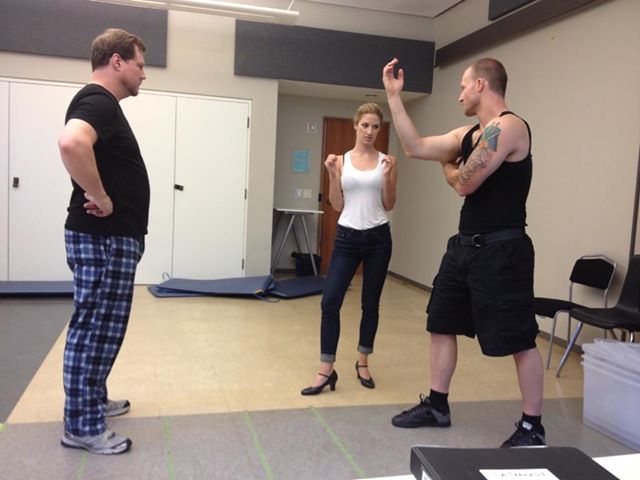
We just choreographed the fight scenes with fight director Sean Brown. I love our fight scenes!! There is actually quite a bit of violence in this adaptation and the cast has been exceptionally receptive to the choreo.

Fight Director and PTSD consultant, Sean Brown, working with Ryan Harper (left) and Cassandra Warner

Fight Director and PTSD consultant, Sean Brown, working with Ryan Harper (left) and Cassandra Warner

I am so glad that we swapped in the original last scene. Musically it is brilliant, and dramatically it gives Carmen the chance to choose her death. In context with the rest of Don Jose’s actions, this scene is even more heightened than in the original. At our venue, Buddies in Bad Times Theatre, the audience will be very close and sometimes in the middle of the action. I think that it will be very effective.

4) How do you relate to this opera as a modern woman?

This whole opera is centred around the sexuality, intelligence and individualism of Carmen in a time when women did not have rights or were thought of as persons.  They were still considered property. The opera exposes how one woman defined her independent existence by maintaining her freedom though control of her sexuality. She is empowered through her sexuality not hindered by it. She is not a victim, she chooses her death rather than give her power away. It shows immense strength of character. I liken it to the samurai who were unafraid of death and thought that dying in battle and protecting their values was an honorable death. Carmen chooses her death and honours herself and her values. She is not Don Jose’s victim. Don Jose is really the victim.

I feel that women today are dealing with these same issues. Many times we don’t honour ourselves because of society’s expectation to be a certain way. It takes a very self aware woman to be who she wants to be in a society where there are still glass ceilings and “womanly” expectations. Carmen’s character could be set in modern day and even into the far future and would still hold the same relevance. I have yet to find out who Mérimée modeled this character after, but do wish I could go back in time and meet her!

Ninette de Valois © Gordon Anthony/V&A Images/V&A Theatre Collections

5) Is there anyone out there who you particularly admire, and who has influenced you?

Ninette de Valois. She was the founder of The Royal Ballet. She started with a small group that danced on all the piers of England. She then developed it into the Saddler’s Wells Ballet and then eventually into The Royal Ballet and the Royal Ballet School. She started out small, doing what she loved and grew it into one of the world’s best ballet companies and school. She demanded perfection and had such drive and dedication to her craft. There was an exhibition at the ROH while I was there that I read over and over again. This is where I developed the idea of my own company. I felt inspired by her demand for perfection and to develop a solid education program in which to draw her dancers. It all came from this one woman with a vision. She worked tirelessly to have it be what she wanted it to be. I love that she was able to reach through history and inspire the seed in my brain.

~~~~~~~~

LooseTea Music Theatre’s production of La Tragédie de Carmen will be presented September 6-8 at Buddies in Bad Times Theatre.  Click image for information.Cover Image

Posted in Interviews | Tagged , , , , , , , , , , | 2 Comments

Loose Tea Music Theatre: La Tragédie de Carmen

“Press releases and announcements” are presented verbatim without comment.

LOOSE TEA Music Theatre proudly announces its inaugural opera, La Tragédie de Carmen. Presented at Buddies in Bad Times Theatre, this opera is a powerful, raw and visceral adaptation of Bizet’s most popular work. Set in New York in the 1920s, a concentrated night of love and death focuses on the fatal relationships between Carmen, a burlesque dancer, Don Jose, a WWI shell-shocked veteran and the mob boss, Escamillo, The score retains all of the most famous musical moments of the original; Carmen’s Habanera and Seguidilla, Don Jose’s Flower Song, and Escamillo’s swaggering Toreador Song.

Director, Alaina Viau, states “LOOSE TEA draws its strong inspiration from the mechanics and artistry of a score mixed with the influence of talented musicians to create new affecting sounds. LOOSE TEA is a creative exploration of how opera and theatre can interact with each other. This company focuses on the “nitty-gritty” of character – a concept where music comes from the depths of an actor’s analysis and their journey on stage.”

Their first production La Tragédie de Carmen features a dynamite all-Toronto cast. Carmen is played by Cassandra Warner while Ryan Harper delivers an impressive Don Jose. Micaela and Escamillo are represented by Lisa Faieta and Gregory Finney. Keenan Viau and Candi Zell play important supporting roles of Zuniga and Garcia & Lillas Pastia. Rounding out the cast is Tessa Dickison as Frasquita.

La Tragédie de Carmen runs September 6 & 7, 2013 at 7:30PM and September 8, 2013 at 2:30PM at Buddies in Bad Times Theatre, 12 Alexander Street, Toronto. Ticket are $25 and can be purchased through the Boxoffice Tel:(416) 975-8555 or online at buddiesinbadtimes.com/tickets/

Cover Image
Posted in Press Releases and Announcements | Leave a comment

Christian Jeffries: Songs From The Couch

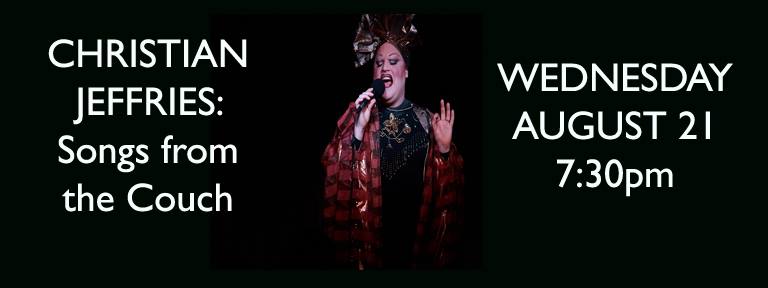
I first encountered Christian Jeffries in the Soup Can Theatre cabaret show Love is a Poverty You Can Sell 2 at the Fringe in July, the most memorable performer we encountered for two brief numbers.

CJ was back last night, ably supported by Music-director Donavon Lenabat on keyboards & Jamie Bird on drums, at the Flying Beaver on Parliament St.  It was titled Songs From The Couch: An Evening Of Skeletons, Therapy and Self Medication.  I’d seen lots of talent in CJ’s brief appearances in July, but wondered if the show could sustain interest.

Oh yeah, and then some.

I knew CJ could sing, and I’d giggled a bit at the comic gifts I’d seen in the Fringe show.  This was much more however.  On the basis of this, I’ll be sad if CJ doesn’t go to NY and perhaps Vegas, to hone that huge talent, and to develop that larger-than-life personality.

I need to see and hear CJ again.  The voice?  I knew I had to attempt to characterize it, even though we heard several different personas, several different sounds.  I believe CJ channels influences as though the act of performance were a kind of psychic connection.

The luscious legato line sometimes reminded me of Barbra Streisand, sometimes KD Lang, but CJ is capable of various harsher sounds, including one that reminds me of a cross between Louis Armstrong & Krusty the Clown.  At one point, singing Joni Mitchell’s “Both Sides Now” I thought I detected an intriguing influence at work, as Joni’s rougher folky singing might be infusing CJ’s polished broadwayesque fluidity with something not so flawless, and more extemperaneous.

The delicate head-voice first reminded me of Neil Sedaka (think of the sweet sounds of his intro to “Breaking Up is Hard to Do”), although as I was straining to identify the right influence, he banged me on the head with it, by singing a Culture Club song: in other words, at times I heard Boy George.  But truly, Christian is an original, a marvellously flexible singer who was on pitch all-night, except when the moment called for something bent or rough sounding.  I look forward to the day that the voice is so well-known that CJ is the vocal touchstone, the influence upon younger artists.

Christian’s not so young.  It’s a lived-in body to go with a lived-in voice, telling us tales of love & pain.  The therapy conceit of the title was explored effortlessly.  This artist has much to tell us, as none of what we heard between the songs felt artificial or contrived, but confessional & authentic.  I am a sucker for parenthetical asides, as though the workings of this mind sometimes bubbles over spontaneously. Sometimes it was hysterically funny, sometimes poignant and heart-wrenching (even though these moments also elicit laughter from some in the audience).  We were hearing songs framed in a larger confessional about self-acceptance, something genuine and real.

I can’t wait for CJ’s next appearance.   CJ_aug21

Posted in Personal ruminations & essays | Tagged | Leave a comment

Trajectory to Elysium

I try not to give away the plots of films I review.  As I write my second piece within a week of seeing Elysium, I don’t want to spoil the story for anyone who has not yet seen it.

The last paragraph of that review is our starting point, when I said

But considering the political itch I’ve been scratching the past few days, I’m happiest to see a film take such an unequivocal position.  It’s too dark for Frank Capra, but I have to wonder if films can change the way people vote.  If so the Republicans will not like this film.

So with that in mind, and my wish to remain spoiler-free, I’d like to look at the film’s politics.  It’s particularly intriguing because at least one review I saw considered the film a disappointment compared to the director’s previous film District 9. I believe that the difference between the two films is that Elysium is so smooth in its construction that it will suck in audience members (as I was sucked in), consumed by the suspenseful story.  If we could interview George Orwell about the matter I am sure he’d say that films with concealed messages are likely more manipulative than those that are obviously complex.

If we’re to consider the influence of such a film it can’t be upon Republicans or Democrats.  The people who matter in this kind of discussion are not solid members of a party, so much as those people in the middle-ground between the two big parties.  Let’s leave aside those people who self-identify as committed members of either party; we wouldn’t expect such people to reconsider their beliefs, and certainly not on the basis of a single film.  Close elections are won or lost on those people who show up or stay at home, and perhaps also the undecided who suddenly commit one way or another on election day.

This film will be seen by a great many people, particularly young and impressionable people who have not yet cast a vote.  Here’s why I believe it could have an impact.

1) The planet Earth shown in Elysium is in bad shape.  The rich have fled the planet to an orbiting sanctuary.  “Elysium” is what the Romans called heaven, and also the name for the orbiting sanctuary, the last remnant of our ecology.  For anyone reading of the  incipient disaster in the biosphere –for example the images in the NY Times a few days ago—Elysium seems like an accurate projection.  Neither Democrats nor Republicans have done much on this issue, so it really doesn’t matter much.

2) The gap between the rich and poor is already an issue in both Canada and the USA, a disparity that appears to be growing.  The Occupy Wall Street movement emphasized language of class struggle, such as their slogan “We are the 99%”.  In Elysium the disparities are much greater than anything we’ve seen before in science fiction.  The privileges of the rich in this film are a life-and-death matter, and become the basis for the plot.

Privileges?

3) Universal Healthcare, at least as experienced in many European countries may seem like the stuff of science fiction.  The irony of this aspect of the film is that the normal privileges of citizens in European cities may be so far removed from fact as to feel like fiction to those who have been pummelled by the rhetoric of despair emanating from the GOP since Obamacare was implemented.  To this Canadian, the oppression of the Californians is outrageous, but a logical extrapolation from the lies already forced upon them by conservative media.

Even so –that is, with the ignorance of the American populace about what many countries (even Cuba) consider normal –societal disparities in access to healthcare drive the plot of this film.  Californians at this time have less access to good healthcare than, say, Canadians.  The citizens of Elysium have access to magically powerful healthcare (recalling Asimov’s axiomatic observation that sufficiently advanced technologies are indistinguishable from magic), but that’s okay, given that Elysium is melodrama.

Who—other than hardcore fans—quibbles with the inaccuracies in Star Wars? But speaking of inaccuracies, if you’re an American chances are you don’t see the connection between this film –where Californians are desperate and destitute—and real life.  Steve Lonegan’s pronouncements in pursuit of a seat in the Senate seem reasonable to Americans because they expect nothing from their government:

I’ll be as callous and uncaring as you can imagine. I have no interest in paying for your health care. I’d hate to see you get cancer, but that’s your problem not mine. I’m going to pay for my health care, I’m going to take care of my children’s health care and tend to my wife.

I feel it’s appropriate to mention Ralph Nader, who called the USA a third world country.  The line plays very differently outside the USA (where he makes a lot of sense) than inside (where he’s perennially a marginal candidate).

4) Workers rights in a non-union world come up as well.  A crucial moment in the plot revolves around the complete disrespect for the worker in this world.  The CEO is outraged when production stops for a worker who has sustained a lethal dose of radiation, and has been condemned to a horrible, painful death within a week’s time.  No wonder then that one of the protagonists wants to get to Elysium, a place where the healthcare system could save his life.

Again, if you’ve been persuaded that unions are bad and that workers deserve nothing, then the ideology of this film will bounce off.

5) Police & civil rights also figure in the film.  Governments are treating civilians with less and less respect.  The latest in Syria & Egypt, inconceivable to civil North Americans, may be setting the bar even lower for what we should expect.  Most of the time we’re the luckiest people in the world, but every now and then, you get something like the G20, or Sammy Yatim’s killing (although the murder charge that the constable faces suggests that the society simply won’t accept that level of violence: at least not yet).       

It occurs to me that the headline actually has at least two meanings.

Hermann Rorschach and inkblots (click for more info)

  • Elysium is a dystopian story; the trajectory to it can be understood as our collective pathway to destruction and ruin
  • And Elysium is the ideal place we seek, with universal health care, a heaven that’s our escape from this flawed world

The film is a Rorschach test of political allegiance, of faith or despair in our collective future.  In other words i recognize that the film will play differently, depending on your background context.

I am not without hope.

Posted in Cinema, video & DVDs, Personal ruminations & essays, Politics, Psychology and perception | Leave a comment

Jobs

Jobs is Steve Jobs, one of the founders of Apple.  While Steve Wozniak may have been the better programmer/designer, Jobs was a visionary.

I can’t help recalling The Social Network, the film that told us about Mark Zuckerberg’s brainchild Facebook.  The subject is so ubiquitous as to make the story irresistible, the protagonist, a colossal nerd, and not at all nice.  I suppose I’m stating the obvious; a film about business can’t be nice, can it? Not if it’s truthful.

As a tale of redemption for both the product & the protagonist, there’s a third layer in the resurrection of the actor cast as the lead.  Ashton Kutcher’s career gets a shot in the arm from this film.  The portrayal is surprisingly physical, employing slouchy body language to make you forget the actor’s usual attractiveness.  Even so I felt i was watching an elaborate sketch on SNL, complete with canny makeup, resemblances to known persons such as Jobs & Wozniak, and lots of historical references.  Of course the film bravely showed him to us warts and all. It’s so carefully contrived that it’s like a boat in dry-dock, still held in place by the scaffolds.  They prevent it from having any real flow or pulse.

I suppose this can’t be a story with surprises: not when it’s a matter of record.

It struck me as ironic that I saw images in Jobs—a movie recording recent history—that are exactly like some of the visuals we see in Elysium, a science fiction flick about the future.  But there they are, unintelligible lines of text dancing across the screen.  In Elysium the computer may as well be the Deus Ex Machina, an agency beyond our understanding that moves the plot forward inexorably: so long as it doesn’t contradict our belief system.  While in Elysium computers save or damn, powerful as if from beyond in Jobs the magic merely makes our economy work.  There’s that collateral meaning to the title, i suppose, that anyone caught up in questions of economics can’t miss; but it’s not terribly interesting.

Jobs does seem to be accurate.  Anyone coming to the film with a modicum of allegiance to one operating system or another will recognize names of products & people.  For some this may verge on something metaphysical.   I understand some people see Steve Jobs as a great man, a visionary and a messiah.  I know i detected some genuine excitement in the audience near me in the theatre.

Not me.  I was intrigued but never entranced.

~~~~~~~~~~~~~~~~~

Postscript (next morning): I think i’m conflicted about the film & its subject, and may have been a tad unkind in the review i published above.  But there are several ambiguities to the film that  are perhaps a reflection of the choices made in the writing.  We’re given glimpses of a darkness in Jobs’ character, but can only guess at what illuminates his choices.  It’s a cryptic film much of the time.  Kutcher does as well as he can with the script by Matt Whiteley.  I would think this kind of subject could be hugely political, courting a lawsuit either from the Jobs estate or the big corporations named.  Maybe those closer to the subject can read between the lines of certain scenes: scenes that i didn’t fully decode.  I was attempting to capture some of that minimalism in my first paragraphs where i am deliberately vague.  It disturbs me –as i re-read this– that this understatement on my part is just as cryptic.  Joshua Michael Stern is the director, the other key influence omitted from last night’s review.

There’s a kind of trope we see in the film, a situation for which i don’t yet have a name. On several occasions Jobs would give a kind of talk to introduce a product, speaking in a kind of visionary speak about what they were attempting to do.  These set pieces are perhaps the highlight of the film, and possibly moments drawing upon something that’s a matter of public record.  I wonder if Whiteley was faced with the task –or gave himself the task– of assembling a film to connect those dots for us, those famous public announcements.  What i think i felt yesterday and still feel today is a bit of a letdown, that those moments were the most inspired in the film, moments that are in a real sense, PR.

Yes I am conflicted.  A few days ago i was impressed by a comparable speech from the CEO at the AGO, introducing Ai Weiwei.  But then we went to see the art, which was a more powerful experience.  Should the marketing magic shine brighter than the other moments?  That’s what i am trying to figure out.  If this is intentional it almost suggests something verging on self-parody, as though Jobs were a madman infatuated with his own hype.  I wish we’d had more to explain what was going on inside Jobs’ head, background to his actions in the public sphere.

Perhaps the story can’t yet be told without generating a huge lawsuit.

Posted in Cinema, video & DVDs, Reviews | Leave a comment