Toddler masterclass with Brian Cox

I’ve just finished reading Brian Cox’s delightful memoir, subtitled Putting the Rabbit in the Hat.
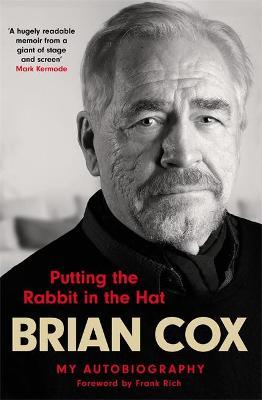
Cox is an actor currently famous for his role as the powerful father Logan Roy, in the tv series Succession, although you might know him for films such as Troy, Adaptation, the Jason Bourne films, or Rushmore, to name but a few.

Cox has now twice had the dubious honor of appearing in the other versions of a famous character, whose portrayal won someone else an Academy Award. In 2017 it was Cox’s Churchill that was largely ignored in the same year as Gary Oldman’s award-winning take. Before that he was Dr. Lecktor in Manhunter (1986), before Silence of the Lambs (1991) gave Anthony Hopkins his Oscar.

Partway through Cox’s book, I came across a bit of pure gold. At one point he’s telling us about an experience from more than ten years ago, captured on film that has supposedly gone viral via YouTube.

He’s teaching a 30-month old toddler named Theo to deliver a Shakespeare soliloquy. Line by line, we hear “to be or not to be”, first from Cox, then from the charming little fellow beside him. Perhaps you saw it long ago, but it’s new to me.

Cox is having a great time with the little fellow. Of course, it’s wonderful fun.

But it’s also a fascinating study of the whole process of theatre, of learning a part and of how we perceive a performance.

I don’t think the little fellow understands what he’s saying, not in the sense of the full import of the speech. How could he possibly? It’s amazing how well he delivers lines, but I doubt he understands much of what he’s saying. The video is charming, lots of fun.

In a sense it functions as a kind of parody of Shakespeare. Instead of a tormented Hamlet we watch the little boy.

For me it deconstructs the experience of theatre. As an opera fan I regularly watch singers perform. Most operas I see are in languages other than English, which means that I’m not usually able to understand unless they offer subtitles, or if it’s one of those operas that I’ve seen and studied so many times that I know every word.

Ideally the singer makes their words sound as smooth as conversation, fluent and convincing. But in practice we sometimes hear singing that isn’t quite believable because it’s been learned syllable by syllable, sung with a phonetic accuracy that might still be lacking genuine fluency. I can sing “che ge li da ma ni na”, one syllable at a time, or “che gelida manina”, making the syllables flow as words. If a singer is learning the words and sings with conviction, the phrases come across as genuine.

Alas that’s the image that comes back to me, thanks to the performance by this charming toddler. The virtuoso magic of someone delivering complex lines of iambic pentameter isn’t something one encounters very often. It’s a bit like a magic trick or a feat we’d see at the Olympics like ski jump or luge. “How do they manage to go so quickly without falling off the sled” you might ask, just as I also question “how do they manage to get through those lines without forgetting”? The delivery of this young lad reminds me of so many bad performances. I wish those moments were somehow redeemed by the cuteness of the person onstage, the way we excuse singers going off key, when they’re adorable kids in a church or school performance. The framework for performance is fascinating in the way context changes the way we listen. I’m sure, yes this is adorable, yes this is cute. Yes Brian Cox knows that his young charge is more or less going through the motions, not really understanding the complexities of what it is saying.

But it reminds me of so many things I have heard spoken and/or sung, especially when we consider the world of opera. When the audience sits, staring up at the titles that explain the foreign words, translating for us “che gelida manina” or “non piu andrai“ or “un bel di”, I listen to the way the words are delivered. I sometimes am enraptured at delivery that sounds like a native speaker. The chorus singing on one of my LesTroyens recordings is a Montreal ensemble, all French speakers. I noticed how different they sound from the Metropolitan Opera chorus, whose sound is bigger but whose phonetics sometimes seem to lurch from syllable to syllable, at least compared to the Montreal chorus, singing Berlioz’s lines as genuine sentences and full thoughts rather than a series of single notes.

There are several passages in his book where Brian Cox undertakes theoretical explanations of what an actor does, how acting works, as a teacher and as a critic. I think he’s a natural teacher, largely because his style is so straight-forward, so unaffected and direct.

This “masterclass” puts me in mind of Maurice Maeterlinck, who famously said this:

“The day we see Hamlet die in the theatre, something of him dies for us. He is dethroned by the spectre of an actor, and we shall never be able to keep the usurper out of our dreams.”

While I have felt uneasy with Maeterlinck’s preference for the page over the stage, this video does remind me of the way the Shakespeare of our inner ear lurks in the background, especially when we’re hearing a performance that fails to persuade. This video is the most extreme case of this I have ever seen, as it calls to mind the entire process of actors learning words that they would never normally utter, drilled into them by rote. It’s not making a compelling case for live theatre.

I need to see a “real” show sometime soon. Isn’t that weird? What is real, after all, in this context, but superior artifice.
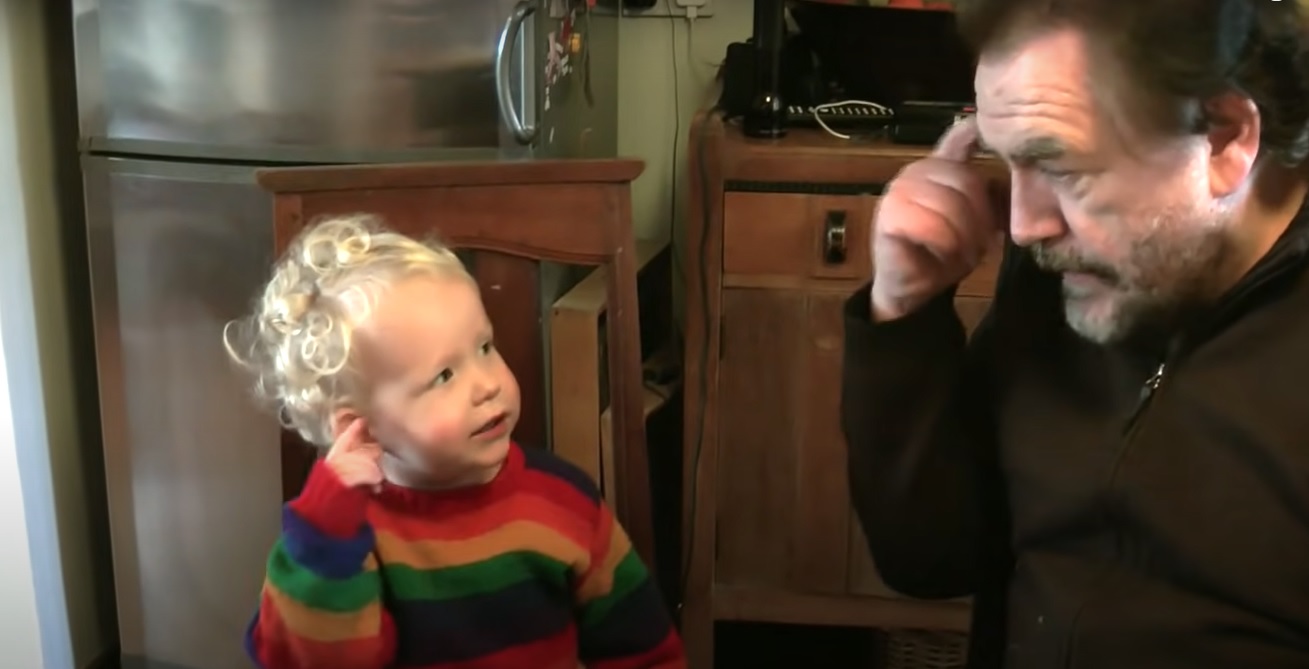
Theo and Brian Cox

I believe that in a classroom the one we call “the teacher” is also learning, sometimes as much or more than the one we’d call “the student”. Who is the teacher and who is the student in this masterclass?

I wonder.
Posted in Books & Literature, Dance, theatre & musicals, Opera, Psychology and perception | Tagged , , , , , , , , , , , , , | Leave a comment

Sky Gilbert talks about Pat and Skee, a dark new comedy about his parents

Pat and Skee opens February 25 at Theatre Aquarius in Hamilton, a darkly comic memoir of a challenging childhood.

Sky Gilbert is a ‘child of divorce.’ Pat and Skee is an homage to Sky’s parents—who did their best to raise him despite all the unpleasantness. Sky plays himself in Pat and Skee, which gives him a chance to chat with his mother (Patricia) about her divorce from his father (Skee). Pat and Skee goes beyond meta-theatre—searching for the wistful, often comic essence of the struggle that lies at the very heart of any broken family.

I asked Sky about his new show.

How long have you been thinking of writing a play like this one, about your parents?

I haven’t thought about it as much as written a couple of plays about it. This is the second. I wrote a play called The Terrible Parents about 6 years ago, that starred Gavin Crawford and Edward Roy, and I produced it at Buddies. It was mainly about my mother’s affair with Jerry — her lover after my father (and during their marriage). There were some kind of cartoony scenes with my own father depicting the ‘happy family’ before that — but mostly it was about my mother’s love for Jerry.

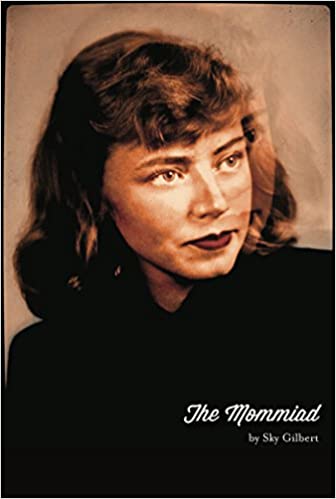
I also wrote a book about my mother — a book of poems — called The Mommiad.

During lockdown I began thinking about my mother again, she died in 2011 and she is the main inspiration for the play.

Back in 2019 I recall that when I interviewed you before the premiere of Shakespeare’s Criminal, you spoke of your mother.

She was an amazing person; she ran for political office in Buffalo in the 60s, started her own business and raised two children. But more than that she nourished my creativity — I remember that as a teen I was torn between music and theatre as professions and she had an upright piano installed in our tiny flat in East York just so I could practice. It’s a long story, but let’s just say that her beauty and her wit were what inspired me; her dark sense of humour about the world is probably also mine today.

…so now I read that this new play is “a chance to chat with [your] mother (Patricia) about her divorce from [your] father (Skee).”

Are you in some sense seeking to discover more about your father, perhaps to reconcile yourself to him in some sense??

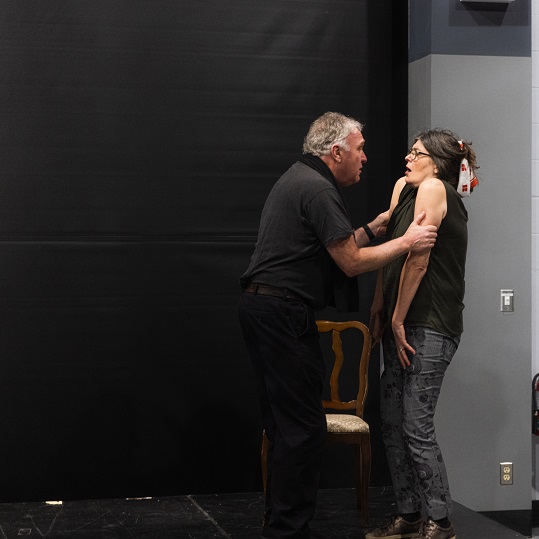
I would say that this is a memory play, pure and simple, It’s me missing my mother and father, since they are both dead, and wanted to bring them back in some way. I get a chance to confront my mother, it’s very odd being in rehearsal with Suzanne Bennett who is so uncanny as her — and having the ‘Pat’ character tell me that I’ll never escape the memory of her — which essentially happens at the end. The play is really about different kinds of love — my love for my mother, and my father’s love for my mother, and my mother’s love for Jerry and of course my mother’s obsession with me.

Pat and Skee: Suzanne Bennett and Ralph Small (photo: Felix Vlasak)

Could you tell me the age of yourself and your parents in Pat and Skee?

There are some scenes when my mother is 35 and my father 39— these are the divorce scenes, when she tells my father she is divorcing him.

Then there are scenes when my mother was 45 — these are the scenes in the 70s, where I am a waiter in a cafe and I am serving my mother and we are talking about her relationship with Jerry after the marriage to my father is over.

I’m a child of divorce myself, and also a divorced adult, on my second marriage. At the risk of asking you a colossal question that’s impossible to answer, I’d be interested to hear your take on the institution of marriage, both from the point of view of the child and as the adult considering marriage or partnership. Please also comment on the changes you’ve seen from the time of our childhoods in the mid-20th century, to now decades later.

I’m against marriage. At the very least I think it’s not for everyone, or for a very select few. I think it is unnatural as monogamy is unnatural for most people. I would say less then 40% of the population is truly happy being monogamous — most people will tire of one sexual partner or need variety. Also people are different. Some people can handle a co-dependent relationship, they think they need it. I hate co-dependence. My partner and I have had an open relationship for 25 years and we lead very independent lives, we would never get married. For me marriage means the oppression of women, as well as conformity, as well as hypocrisy, and trying to fit all of us who are square pegs really into round holes.

Has the process of writing a work that purports to be self-exploratory been in any sense an act of reconciliation for you, either with your parents or yourself?

Yes I’m going through something being in this. I think it might be at the very least odd, or at least an interesting emotional experiment. Ralph is as like my father in his performance as Suzanne is like my mother and it is unnerving.

Ralph Small and Suzanne Bennett (photo: Felix Vlasak)

But it’s nice to have my parents back in my life! Suzanne is putting me through the ringer in interesting ways: “How do we separate the fantasy of your mother from your actual mother?” She asked me this the other day — very interesting question.

The pandemic underlines our need for art, given how dependent some of us were upon the arts to stay sane. How have you been coping?

Are you kidding? I’m furious, angry. I’m actually with the truckers to a certain extent. That is I HATE LOCKDOWNS — and they seem the only ones capable of saying it. I am a social person and I live in my social interactions and in theatre. This has ruined my life and put it to a stop essentially, to all the things I love. They are gone. I need to perform, to be in front of people, to meet strangers, to have promiscuous sex, to go to bars and party. I need that to survive it is essential.

Also lockdowns are homophobic. Many of us don’t have families and we find our families in our community. If we can’t go out into the community we don’t have family. I hate everything online— social media is ruining our lives and ruining our children. Online education is useless and bad for young people. I have nothing good to say about COVID-19 measures— there were too many restrictions, for too long for no reason, with no sense of people’s mental health. Period. They may have been necessary at one point, but certainly no more.

As a professor you have likely been using Zoom and other virtual teaching tools, even though you are a practitioner as playwright and performer in live theatre. Apart from missing live performance (don’t we all): how have the two years of virtual teaching changed your process for live performance?

I have come to realize the incredibly inadequacy of zoom teaching and online learning. The essential of learning is no longer there — the question and answers, the easy improvisational conversations, the expressions on people’s faces — social interaction. Zoom rooms are scary places (did you know they were developed first years ago and very popular for druggie sex parties?) — some students are blacked out, I never see them, some never speak. I don’t know how they are reacting to what I’m saying. It’s awful, and creepy. We need live classes in order to teach and doing living teaching a week after having to zoom makes this appallingly apparent.

The phrase you use of the “broken family” might seem to be a bit of an oxymoron. What’s left, when a family is broken, and do you think it’s still recognizably a family?

Well, there is still habit, there is still shared experience. I know that I love my sister, and that even though the divorce stressed us both out, and certainly left me with abandonment issues, we share all the movies we watched, the culture of the 60s, all the gossip about our crazy mother, etc. There’s always that bond which never disappears.

Does being gay, and coming into relationships from a place that was until recently forbidden in our culture (first, being gay itself, and later, the notion of gay marriage), make partnership or marriage better or more meaningful? And as a gay person do you have special insights about straight relationships?

I wish gay men could bring their honest insights about alternative relationships into the world of gay marriage. We were supposed to CHANGE marriage, we were supposed to make it our own, instead gay marriages are just as dysfunctional and dishonest as straight ones. I have HUGE insights about straight relationships, I mean I used to be in one with a woman, and I’m very aware of the lies that hold straight relationships together, and I understand men, and how awful/wonderful they are, and I understand a major thing — sex between a long term couple never last more than ten years. But you can still love the person you love, totally, and if your relationship is open, there are so many possibilities. If straight couples could open up their relationships when the sex stops (because it almost always eventually does) they would be a lot happier.

That’s my advice….


Sky Gilbert’s Pat and Skee opens February 25 at Theatre Aquarius in Hamilton, running until March 12. For tickets click here.

Trailer:

Posted in Dance, theatre & musicals, Interviews, Press Releases and Announcements | Tagged , , | Leave a comment

Gimeno, Schumann’s Spring, Pal’s Scylla at the TSO

What an unusual night for the Toronto Symphony.

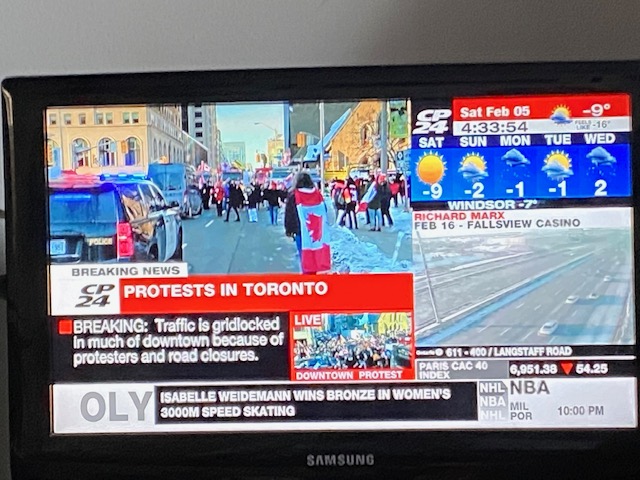
It’s 11:20 pm as I begin to write this, recalling the headline on CP24 (a picture I snapped at 4:33 pm) about Toronto’s downtown, that says “BREAKING: Traffic is gridlocked in much of downtown because of protesters and road closures.”

As of 11:24 CP 24 said the protesters were dispersed, thank goodness. Not only is Roy Thomson Hall’s capacity limited to 500 by current COVID restrictions even though there are over 2600 seats but I suspect some were also daunted by the traffic. I took the GO train.

It’s too bad that there were so few in attendance. In a night of Beethoven, Schumann and a recent work from Jordan Pal, it was the new piece that felt most relevant for a city in turmoil.

Composer Jordan Pal

Pal’s composition is called Scylla, drawing upon the mythology of the Odyssey, as he tells us in his program note:

“In Homer’s Odyssey, Odysseus was forced to choose between Scylla and Charybdis – between two equally dangerous situations. ‘Scylla for Trombone and Orchestra’ is my climate odyssey, embodying the choice we as a species face: climate catastrophe or a sustainable future; inaction or proaction; disbelief or faith. ‘Scylla’ journeys from the future – an inhospitable world, the result of centuries of human neglect – to present-day crossroads where mankind must make climate change its priority.”

The young composer’s three movement concerto was the centre-piece of a night when we were already jarred by the activism of protesters elsewhere in the city, Pal’s ambition wonderful to behold. I’ve been inspired especially by the composers who dare to propose that music can change the world by changing the hearts of humanity, a John Lennon or a Bob Dylan.

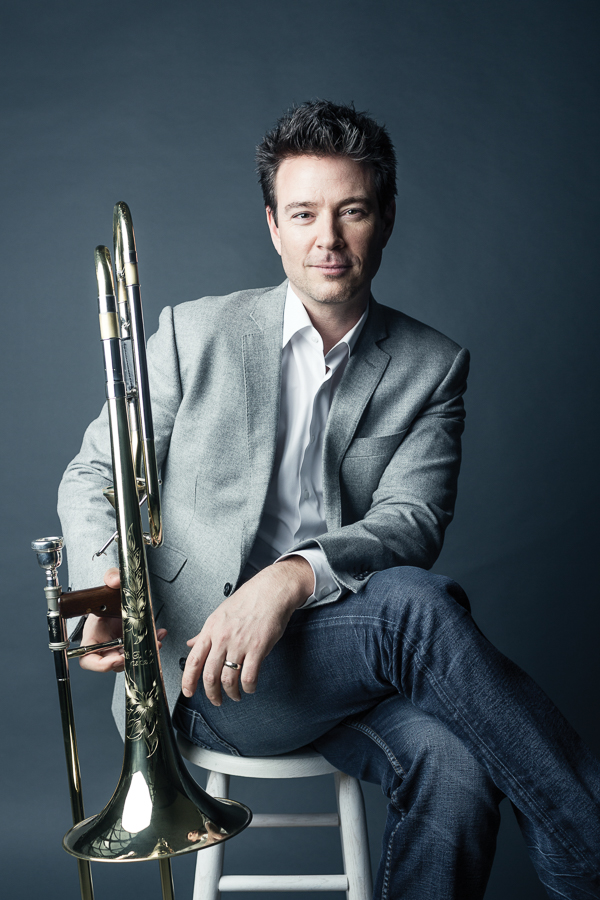
TSO Principal trombone Gordon Wolfe

Pal’s concerto, played by TSO Principal Trombone Gordon Wolfe, puts me in mind of other romantic works that resemble concerti. Like Berlioz’s Harold in Italy, Pal’s trombonist could be a character in a drama, a personage walking onstage partway through the first movement, exiting, then situating himself in a balcony at the rear above the orchestra for a lyrical second movement. At times the trombone seems to be fighting against the forces arrayed against it. In the third movement, I was inspired by the shift in tone, as though the soloist could actually have agency and be heroic, offering cause for hope.

Pal’s music reminded me a bit of John Williams (who’s on my mind admittedly because I’ve been listening to a lot of his music & watching his films lately), especially the bold music when the humans fight the shark in Jaws, and the battle sequences from Star Wars. While I’m sure I don’t always get what Pal is signifying, or what his music is doing, that’s only reasonable with such a complex and ambitious work. I didn’t get Berlioz or Strauss’s tone poems right away either, as I must listen to the piece again.

I don’t know enough about the trombone to have a sense of how difficult the piece is as far as its challenges to trombonist Wolfe, except that he seems undaunted, confident and committed throughout. There are places where he is soft and serene sounding, other places where he is as agile as an Olympic slalom skier, negotiating ferocious hazards without a slip-up.

On either end of the program, music director Gustavo Gimeno led the TSO in something more conventional. We began with Beethoven’s Creatures of Prometheus overture, and ended with Schumann’s 1st Symphony also known as the “Spring Symphony”. The Beethoven is a congenial piece in C major with sparkling sections for the woodwinds and energetic passages running up and down for the strings. Notwithstanding its romantic title this bit of Beethoven doesn’t seem so eager to turn his world upside down (as Prometheus or the protesters might) but simply gives us something with the joyful delicacy of Haydn.

The Schumann symphony was an opportunity to see what our future might be like, as we get a better look at Gimeno. There’s no question that he has been embraced by the orchestra, who follow him doggedly. As I’ve mentioned before, Gimeno was a percussionist, and it shows in his solid metre and bold tempi.

The first movement began with a long moody introduction, apt for Spring when we recall that it’s a transitional season, out of the darkness of winter towards the brilliance of summer. When we get to the main allegro Gimeno holds nothing back, indeed the fastest version of this movement that I’ve ever heard. It’s coherent even if it’s right on the edge a couple of times. When it comes to the climactic phrases, they’re especially clear and powerful. For the second movement we’re into something subtler, a beautiful melody unfolding in the strings, then coming back gloriously in the cellos, decorated by delicate woodwind accompaniments. For the third movement we’re going quickly but without the ponderous or unsubtle tendencies one sometimes finds in interpretations of this movement, the melodic impulse always clear, always musical.

And for the finale oh my we’re again moving very quickly. Gimeno sometimes teases us with the transition passages between sections, where the tempo slows for a thoughtful moment. In such phrases we can see just how exquisite Gimeno’s control is. And then quick as we’re going, we still go faster to finish, the brass all in for the final statement.

It’s going to be fun watching the TSO and Gimeno in the years ahead.

Toronto Symphony Music Director Gustavo Gimeno
Posted in Books & Literature, Music and musicology, Reviews | Tagged , , , , , , , , , , | Leave a comment

The Music of Our Time: John Williams at 90

It can be awe-inspiring to look at a composer’s lifetime of work. We know that JS Bach composed over 1,000 pieces in his 65 years, while Mozart, who lived only 35 years, composed perhaps 600 pieces. Yet we only care about them because of their best work, the melodies that pop into your head as soon as the name is mentioned.

It’s in that spirit that I want to think about John Williams as he approaches his 90th birthday on Tuesday February 8th. He’s still alive, still working, still being paid big fees for his music, because he is often memorable.

Williams has won five Academy Awards:
1-in 1972 for Fiddler on the Roof (“Best Music, Scoring Adaptation and Original Song Score”)
2-in 1976 for Jaws (“Best Music, Original Dramatic Score”)
3-in 1978 for Star Wars (“Best Music, Original Score”) beating his other nominee Close Encounters of the Third Kind
4-in 1983 for ET The Extra-terrestrial (“Best Music, Original Score”)
5-in 1994 for Schindler’s List (“Best Music, Original Score”)

This is his most recent win, almost thirty years ago.

John Williams’ 161st composer entry on IMDB is set to be released in 2023, namely Indiana Jones V.

Let’s stop there, to contemplate what it means to have composed music for 160 films, and the 161st is to be released after your 90th birthday. I can imagine the objection to speaking of this in context with Bach or Mozart. It’s impossible to compare and I’m not for a moment suggesting that we somehow determine who’s better or more important. But it is worth observing that few of us will dent Bach’s 1000 work library significantly, that none of us will hear all of Mozart’s 22 operas performed onstage in a lifetime: yet one could conceivably see all of Williams’ 160 (and counting) films. While Williams may be accused of being derivative (although one might just as easily point accusatory fingers at some of Bach’s pieces), his output is so popular as to be impossible to ignore.

In each of the past five decades there is at least one film that begat a franchise, the brand largely associated with the themes created by Williams.

In the 1970s we saw the first of the Star Wars, Jaws, and Superman films

How well-known are these pieces? Here’s a great demonstration.

We heard similar nervous laughter when the Toronto Symphony played the Jaws theme at a Williams-centric concert.

Oh, and yes that’s another incarnation for Williams, conducting the Boston Pops Orchestra, beginning in 1980 for over a decade.

In the 1980s the Indiana Jones series began. In the 1990s Home Alone & Jurassic Park each started a franchise. Since 2000 we had the Harry Potter films.

In addition there are many more scores every bit as ubiquitous, so popular that if you think about it you might even remember the main theme. Close Encounters of the Third Kind. ET the Extra-terrestrial. Hook. Schindler’s List.

And I’m not mentioning the subtler scores to films that didn’t achieve pop culture status. JFK, Munich, Lincoln, Minority Report, Catch Me if you can, War of the Worlds, Saving Private Ryan, Empire of the Sun.

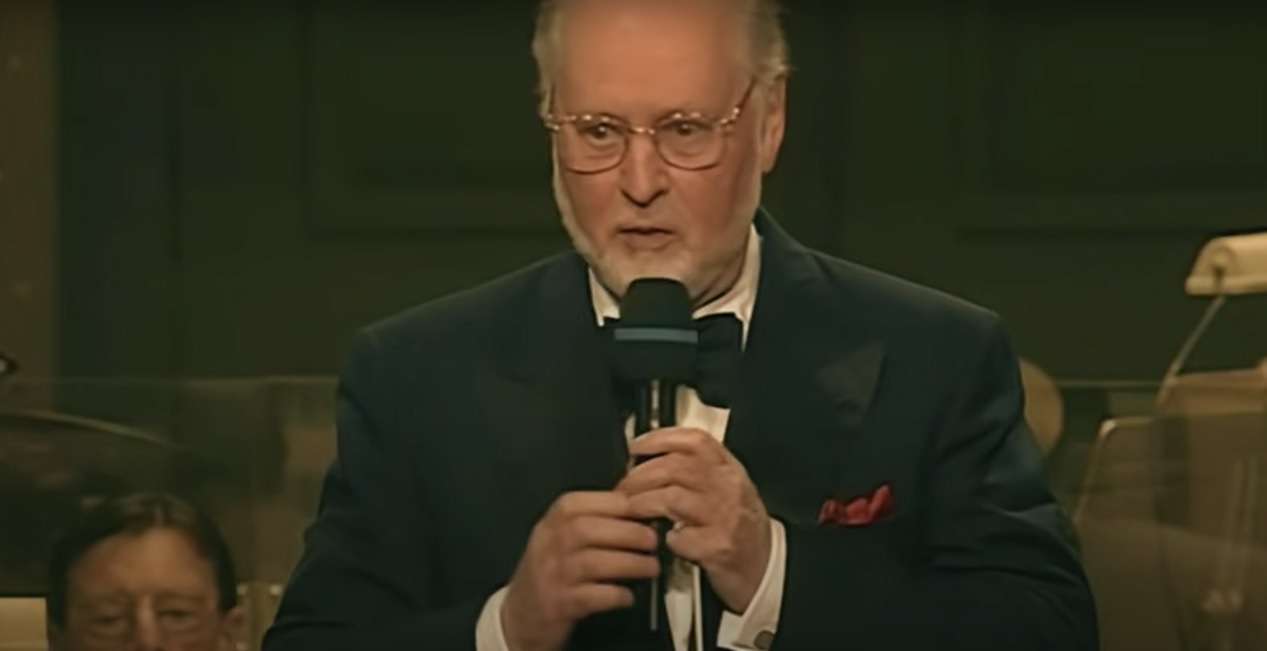
Composer and conductor John Williams

Yes Williams has been around a long time. Among his credits on IMDB you can see credits for TV as well, such as episodes of Wagon Train, 44 episodes of Bachelor Father in 1960 (over 60 years ago, when he was a young composer identifying himself as “Johnny Williams”).

But in addition, IMDB includes another 281 credits for “Music Department”, as for example the 1960s TV show “The Time Tunnel” (29 episodes), Lost In Space (126 episodes), Wide Country (28 episodes), Checkmate (70 episodes), or Amazing Stories (45 episodes), all instances where Williams wrote a show’s theme music. And that 281 also includes instances where another composer uses Williams’ music, as in a Star Wars or Jurassic Park spinoff.

I may be alone in this sentiment, but if it weren’t for Williams, I wouldn’t be able to stand the Star Wars films. He’s the reason I bother, and he manages to elevate the material, more heroic than Luke or Leia.

Over time one sees a change in the role of music. Mozart may have been a success yet he was still a glorified servant, buried in a pauper’s grave. Rossini with his brilliant taste got rich giving audiences what they wanted, one of the smartest of all composers. Liszt and Rachmaninoff too managed to use their virtuosity to make money. In the 20th century we see music begin to specialize more and more, between popular and artistic, music created pragmatically to please and yes, to make money.

While you may quibble when I call it “the music of our time” Williams’ music is a success. He’s been making a living as a composer and conductor for more than half a century. No it’s not the only music we have, not by a long shot. But the big star of 1965 (Beatles?) or 1975 (Supertramp?) or 1985 (Madonna or Bruce Springsteen?) or 1995 (Mariah Carey?) rarely stayed prominent for very long. Taylor Swift or Kanye may be rich and influential now, and there will be others who come along in future. But Williams has been a huge success in each of those decades. You might say “not the 60s” but no, he was huge in television rather than film and perhaps most importantly, has been growing in influence with each passing decade.

And the 90 year old John Williams is still working, and deserving his big fee: because his film scores are always good.

As a closing thought –as much for context as for the pure fun of it—here’s a five minute clip of John Williams conducting a medley of Oscar winners. No this isn’t Bach or Mozart. But it’s fun to see Williams conduct his own themes without any cinematic distractions.

Posted in Cinema, video & DVDs, Music and musicology | Tagged , , , , , , , , , , , , , , , , , | 1 Comment

2021 False starts and #BellLetsTalk

That may be the goofiest headline I’ve ever written.

I waited to post my review of 2021 until today for a couple of reasons, although the main one is simple.

2021 was not a normal year, not one where I could happily celebrate the achievements of artists. Not when there were so many times that the rules chanced, when performing artists had to take a break.

So I’m doing two things today on the day with the hashtag #BellLetsTalk.

You probably know what #BellLetsTalk is. To quote their own words, it’s
“a wide-reaching, multi-year program designed to break the silence around mental illness and support mental health all across Canada. “

How are you feeling?

I don’t type those words in expectation of an answer across the ether, so much as to encourage anyone reading the question to pause for a moment to ask it of themselves.

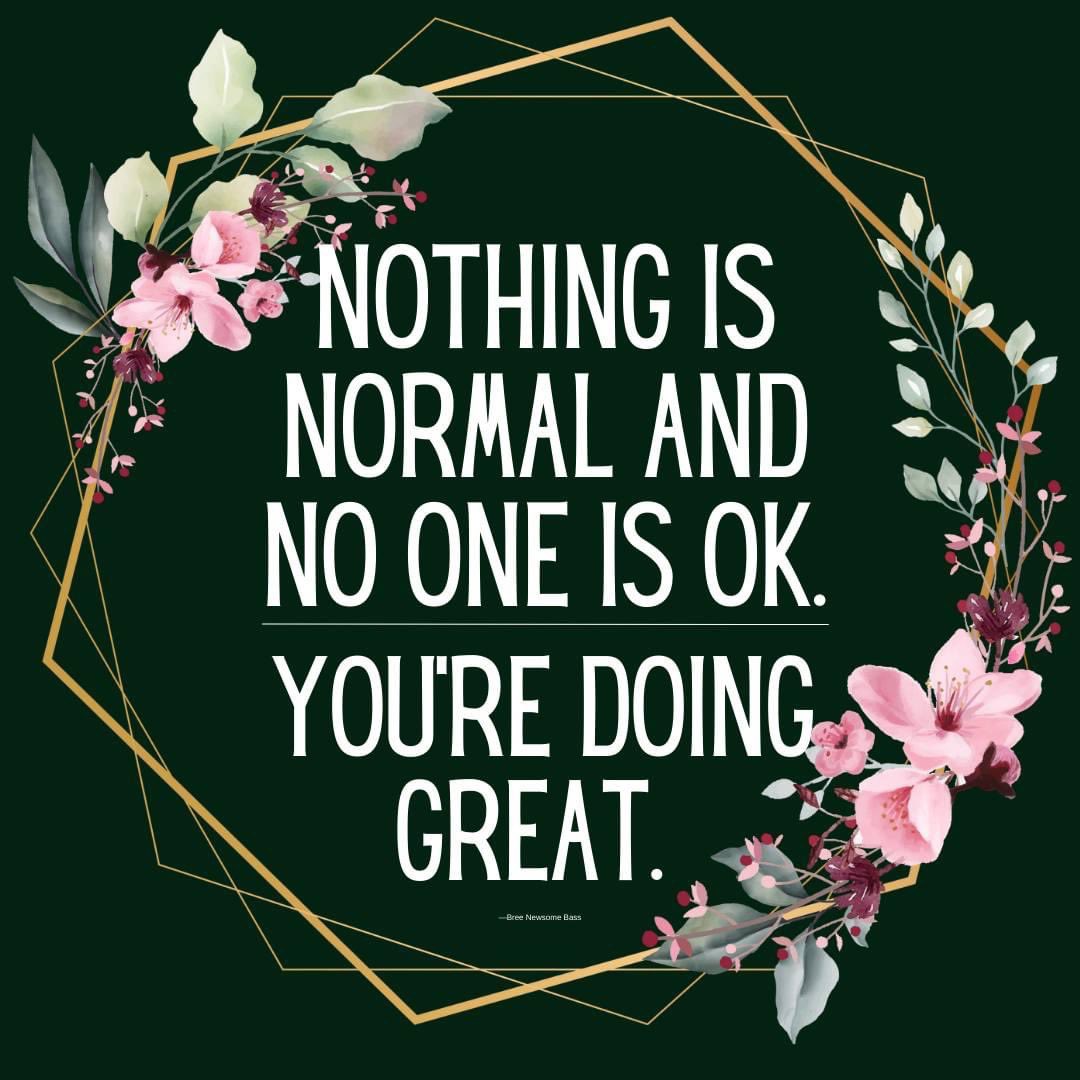
Earlier this week I posted this meme on social media. It seems apt to post it now.

What do you do to get through the day, to make yourself feel better?

Chances are there are many things you do. What I hope you might consider is the role the arts play in your mental health. If your day includes time when you listen to music, watch films, read books, chances are your wellbeing is based on the creativity of arts professionals in many diverse disciplines.

And at a time when our dependence upon the arts has never been clearer, the artists themselves are having difficulty. We’re coming up to the second anniversary of the pandemic.

I have a request. If you have an art-form you enjoy, that you would pay to see: please consider offering support. For example, if you would have been seeing the Canadian Opera Company, Opera Atelier, the National Ballet, Toronto Symphony Orchestra or Tafelmusik Baroque Orchestra, think about the money you’ve saved due to their cancellations. That money could have found its way to artists and companies to pay salaries and fees for artists. Many of them are hurting, from the losses that end up in the pockets of those of us who were not able to attend.

On this day when we’re to talk about mental health, think about what you do to preserve your mental health. You watch a favorite video, listen to a favorite song. Perhaps you look at a picture or even sing a tune. Consider that you might help someone with the money you saved by being unable to attend.

I do want to look back at 2021 briefly. Every time I thought we were coming back, we had an interruption. The arbitrary nature of these abrupt reversals can be upsetting. Speaking of things we do for mental health, I recall hearing that we should distinguish between those things that are or are not beyond our control. No point cussing at the weather (too cold? Put on a jacket or move to Arizona). COVID is a bit like that, but has been less predictable. It’s still so new.

So I simply want to thank the artists who thrilled me this year. I did two great interviews with artists I admire. Yes that’s far fewer than usual, because of course there were fewer shows to promote.

I jumped at the chance to interview Doug MacNaughton in the summer.

And later I heard about the show MixTape from Zorana Sadiq, so I asked her for an interview.

The MixTape opening night felt like a restoration, a full house for the show as live performance was coming back!

Ditto for the Toronto Symphony concerts in the autumn. Even if capacity was reduced the shorter concerts in a half-empty hall with a small orchestra were magical.

And there was the Tafelmusik Orchestra and chorus concert before Christmas.

I don’t apologize for how few shows I’ve seen. I’ve been super-cautious since 2020, because I’m one of the caregivers for my 100 year old mother. As I was already old enough for a full pension, I retired from my dayjob to lessen the hazard to her and my family. Yes, I know that in this review I’m talking as much about myself as the shows I saw. But that’s always true in any review, except it might be more transparent right now. I’m as much a participant in the mental health conversation, confused about who I am in this weird purgatory as any artist. I last went to church in January 2020, missing the music but also missing the fellowship, the sanctuary. Theatres and concert halls also offer that warm fuzzy feeling as a by-product of the performance.

Virtual is better than nothing I suppose but I miss live performance.

Think about what you’ve missed. Over the next few weeks if omicron wanes as expected, theatres and concerts will gradually return. Remember how much you’ve depended upon the arts for your sanity.

They could use your help.

Posted in My mother, Personal ruminations & essays, Psychology and perception | Leave a comment

Being There revisited, with a little help from Mahler

I could use any old film I watched on television for the point I’m about to make.

Last night Erika and I watched Being There (1979). Hal Ashby’s film is based on a best-selling novel from 1970 by Jerzy Kosiński who co-wrote the screenplay. Watching it in 2022 I swear it’s under-rated. I recall the conversations it provoked.

Do you know the film? It’s full of fascinating commentary on media and the way our minds work, that has aged well in a world full of people who seem ready to believe conspiracies, to put political leaders and pundits on pedestals.

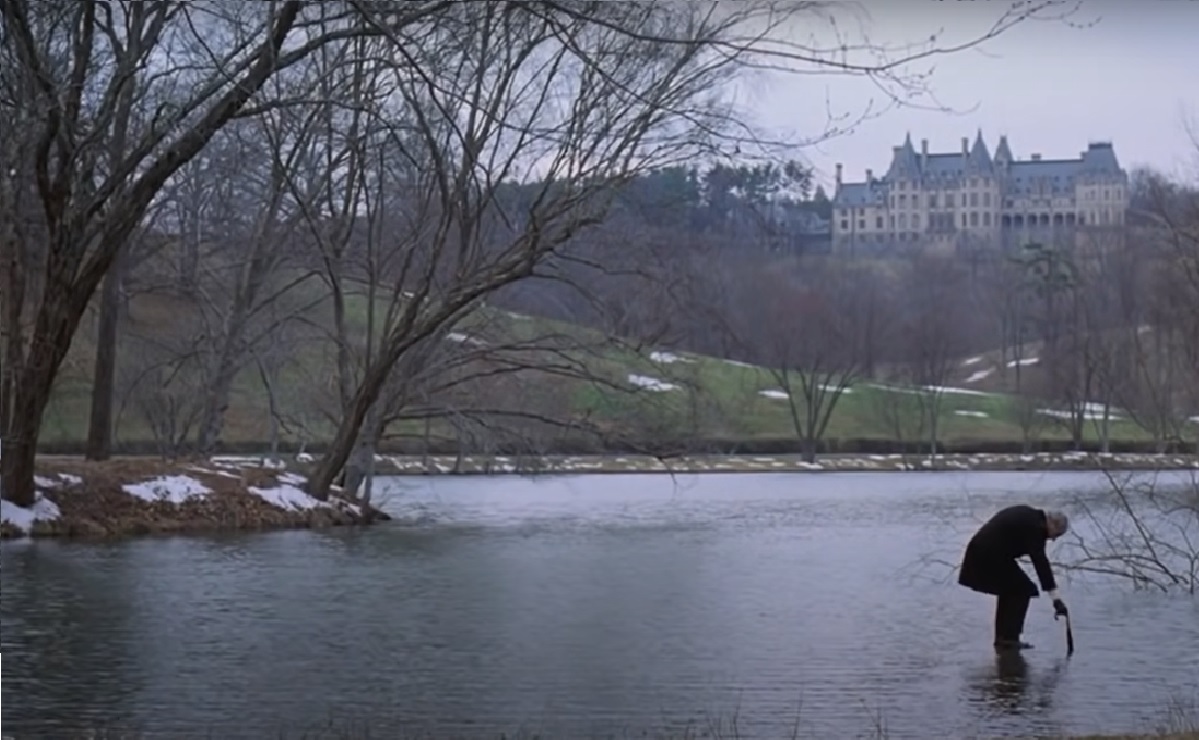
Is he walking on the water?

And I think it would be received very differently if it were released now, because of the way audiences have changed. That brings us to the idea I was alluding to above.

First off: I don’t think it’s a radical idea to suggest that the public reception to a work changes over time. We assume that there’s something cumulative at work, that people remember seeing the first Star Wars film, when they go see the next one, and that at least some of us would be comparing and building on that.

But in addition to franchises like Star Wars, Harry Potter or Lord of the Rings, there are genres where we absorb codes and tendencies. If you’ve seen science fiction, you are prepared for the usual signals built into costuming, plot construction, music, and anything else that is associated with a genre.

We become sophisticated: to use a word we toss around often without thinking about what it implies or where it comes from. I think it’s reasonable to say that we become progressively more sophisticated in our film watching through experience, building upon what we’ve seen. Some of this is simply our development, the way we grow in life. I’m not the same as I was as a child, for example.

All fair and good. But what I want to propose is something I haven’t seen in discussions of cinema, that I will illustrate by analogy.

I’ve heard it argued that the composer Gustav Mahler wasn’t properly understood before the advent of long playing records. Yes one could experience a symphony through a concert or by studying a score.

But the breakthrough for Mahler came via a new kind of relationship with music.

I know how it worked for me. I would listen to a Mahler symphony, and then buy another one, and listen over and over. I didn’t really get his middle symphonies on first hearing. I believe the argument goes that few of us really did, that it was an exceptional person who really appreciated Mahler simply by going to hear his music in a concert hall. The complexity of his works required multiple listenings, to discover the depths of his music.

The listener who explores music this way has the opportunity to become more sophisticated.

Just as the LP gave the world a chance to change how we listen to music, so too with the Video recorder. In my childhood it was uncommon to watch the same movie over and over. Yes we saw Wizard of Oz over and over, via regular annual broadcasts,, and yes we saw A Christmas Carol every year in December. Those were exceptions, before the advent of the VCR and later personal digital devices.

In 1979 it was still uncommon to see the same film over and over. I recall feeling strange when explaining my enjoyment in going to see 2001: A Space Odyssey multiple times, although the usual conversation concerned whether or not we were stoned (and yes we often were) when we went as the film was understood to be “a trip”.

But in 2022 that’s all changed. We binge watch series. We see films over and over, because of course cinema is now seen as art, and that means we watch a great film multiple times.

So to get to my point, I think we see film differently now because we’re all more sophisticated in 2022. Sophistication entails a kind of literacy. If you’ve seen episodes 4 and 5 of the Star Wars franchise, you’ll recognize the themes in the music, you’ll have expectations of the plot trajectories for any of the later episodes.

And that’s merely the most basic kind of literacy. I heard a discussion on tv after the film ended last night, as we heard that Peter Sellers didn’t want the humorous sequence in the closing credits, fearing it would undermine the illusion of the film.

It is true, this bit of film deconstructs the illusion by making it crystal clear that we are looking at something artificial, something being filmed rather than “real” (whatever that means). Nowadays it’s not uncommon to watch bloopers in the closing credits.

But it was brand new in 1979, or at least something uncommon for a mainstream film.

Are we different now? Surely. We have seen this often enough to know what it is.

Of course, sophistication is not necessarily a good thing, as it comes with expectations attached. We don’t experience the kind of surprise we’d feel in 1979. There are always trade-offs.

But today’s audiences have certainly changed.

Posted in Cinema, video & DVDs, Music and musicology, Popular music & culture, Psychology and perception | Tagged , , , | Leave a comment

Things we do for love

This is a brief tale of tail, concerning two things that really happened to me recently.

Event #1 was on Thursday when I was at my mom’s giving her lunch and dinner, as I will do a few times per week.

Washing dishes I was a bit overzealous with one of my mom’s knives. I don’t know her dishes as well as my own, so I think I mistook this knife for something duller and safer. As I was washing, the knife blade made an incision into the joint of my index finger on my right hand. Being left-handed it’s not as bad as it might be.

Yet there I am, now hesitant about washing dishes, with the third in a series of bandages covering the cut. It’s gradually healing, as cuts will do, even if immersion in dishwater has a way of undoing that repair function.

I’ve been washing my hands with the index finger pointing skywards, while I rub palms and nine fingers together. I never washed my hands so often or so diligently as in the past two years, when hygiene became central to our lives.

Event #2 was just before sunset today, the trip outside with Sam the dog.

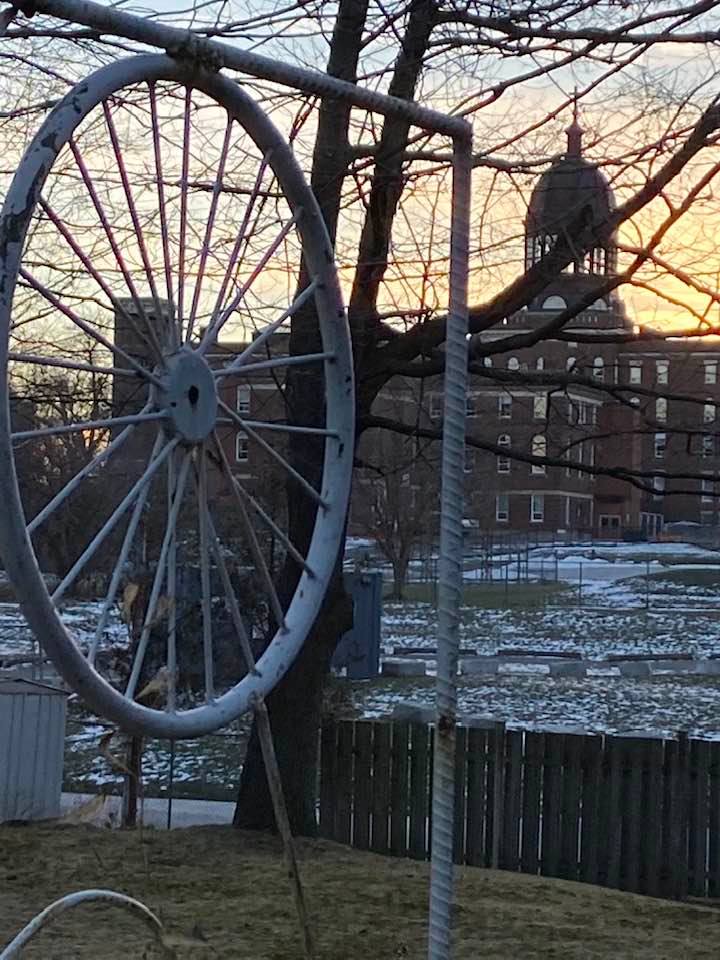
A recent sunset photo including the St Augustine Seminary in Scarborough

Sam did her business, which by the way was also a number 2 if you take my meaning.

I watched the sun vanishing behind the Seminary building, a bit later each day, as the days get longer oh so gradually.

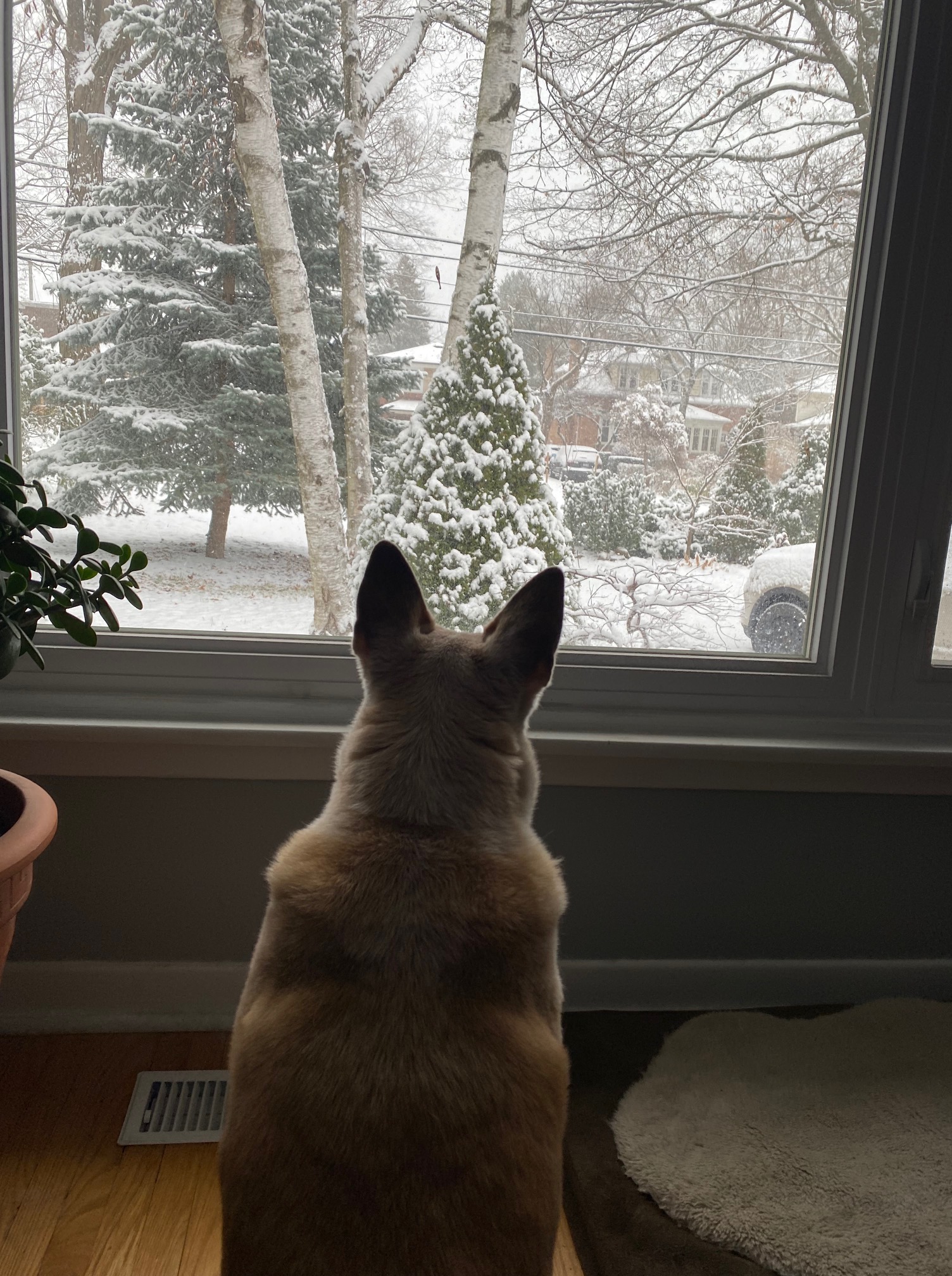
Sam came and sat beside me, more or less staring in the same westward direction.

As she came to sit I thought I caught sight of something a bit troubling. Oh no, it wasn’t anything really bad or really dangerous. She’s 15, she has a huge cancerous growth on her side. We’re thinking in terms of palliative care, minimizing her pain and maximizing quality of life.

So this wasn’t anything threatening.

But I thought I glimpsed a brown lump hanging by a thread from her behind.

“Glimpsed” because it was seen only for a moment before Sam sat right on it. Oh boy.

Sigh, oh well. I walked in front of her, inviting her to walk a bit further and she stood up and did so. As she stood, I saw the meat-ball sized turd, still attached by its peculiar umbilical chord. Nothing had smeared on her leg, perhaps as byproduct of the extreme cold.

Insert momentary hesitation before I did what I had to do. I was wearing nice new gloves, so I took them off even though the wind-chill was -20 or so.

I grabbed the connector, which was some sort of hair going into her poop-chute. I managed to sever the connection, using a twig to golf the ball into the underbrush.

Sam went on her merry way further along the path, likely oblivious. Did she feel what I had pulled out of her? I wonder.

But she didn’t say thank you, not just because she was looking elsewhere. Sam doesn’t talk to me very often, except when barking at mailmen or ruff-ruffing her requests for a doggie cookie.

Sam on sentry duty

But there I was, the hand that had the bandage on it, now having come rather close to the brown stuff. I looked at it, and saw nothing thank goodness.

I kept the glove off, and asap brought Sam inside.

Did she read my mind when I said “go home”, and she complied so readily? Sometimes she listens, sometimes she doesn’t. Perhaps she didn’t really like the chill air either (although she usually revels in the cold).

We were inside before my hands were totally frozen.

But I couldn’t omit hand-washing, not when it’s now de rigeur for any chance encounter with germs, let alone a ball of doggy poop. Sometimes the cold is a blessing, as for example when it prevents one from smelling the poop, when it freezes both #1 & #2, at least for awhile.

Spring will be here eventually, with the onslaught of odors hitting my nose and Sam’s (although she seems to savor what we abhor). Sam seems perplexed at times by the purity of the cold. For now the cold is like a silencer.

It was a pleasure to wash my hands, bandage or no bandage.

Posted in Animals, domestic & wild, My mother, Personal ruminations & essays | Tagged , | Leave a comment

Missing church

The last thing I posted had the word “missing” in the title. A few days ago I wrote a rambly thing as I thought about a canceled show and one of its canceled performers, pushed off the stage by contagious circumstances. I know he’s okay, but I miss him. Alas, not only is the virus catching but that sentiment of missing, too, seems to spread, the more I think about it. I thought (a bit abashed at the end), maybe this will be the first of a series, because there is so much we’re missing.

The Nutcracker has packed up for the year.

Come From Away is gone forever. We are missing lots of things right now.

Perhaps you’re missing the annual junior hockey world championship. One day I was watching the brilliant young Canadians clobbering Austria, and before you know it, damn, the tournament was done.

Canceled.

Please follow along with this, it’s a completely capricious and illogical sequence.

My mom is 100. It’s a miracle she’s alive still. In the summer she had a collapse (weak heart), and for a time she was in Mt Sinai as they watched her closely, then she went to Bridgepoint for two months of rehabilitation. She’s now home, although not as strong and independent as she was a year ago. But wow she’s alive and stronger now than she was when she came home in November.

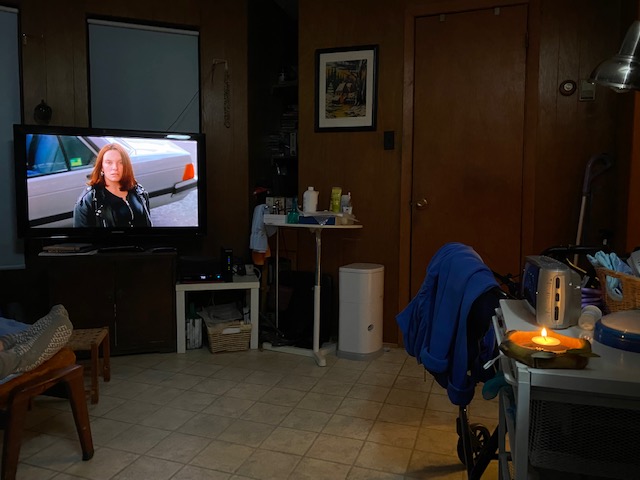
In 1960 I was five years old, the year my dad died. Yesterday was the sixty-first anniversary of my father’s passing. My mom and I watched TV together with a candle lit to his memory. The candle on December 30th is something she has done every December 30th since.

It was my honour to light it for her, for him.

That’s Muriel’s Wedding on the tube.

Today I heard the surprising news that Betty White passed away, just a few days short of her hundredth birthday. Why did I dare be surprised? Sure, she always seemed so lucid, so strong, so beautiful. When I heard it, I was not really surprised by the news, painful as it was.

Living to 99 is already a miracle.

With our recognition of mortality spirituality lurks underneath, like the prayers we make to God when we’re on an airplane in a storm, making bargains begging for our lives, if only…. God and religion are the underpinnings we never think of. You swear an oath in a courtroom. You get married in front of a pastor with Jesus smiling down from the stained glass.

And so consciously or otherwise, I sat down at the piano, where I had my Chalice Hymnal.

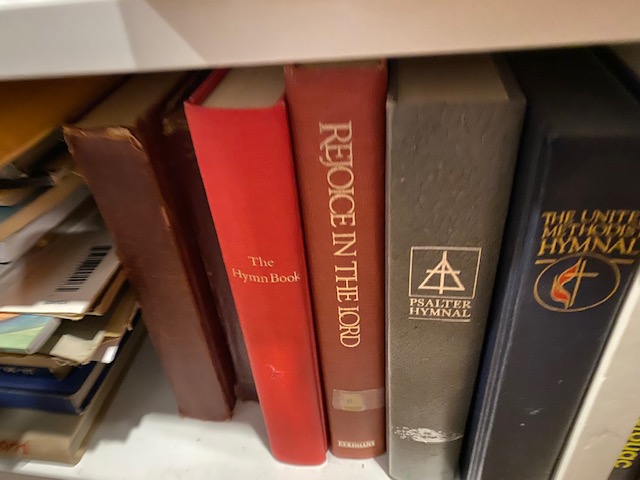
I should explain, I’m an opportunist. When I see something useful in a used book store I buy it. I jumped at the chance to have at least one of all the usual hymnals that one sees in churches, and enjoy playing them from time to time.

Amazing bargains

The Chalice Hymnal is especially important to me because it’s what they use at Hillcrest, where I have been singing as a soloist or in the choir on and off for the past decade, and occasionally subbing for music director David Warrack at the organ, as I did twice in January 2020, the last two times I had the privilege of going to church.

((( Sigh )))

I miss church, the community, the friendships, the music, the energy of the spirit. And it’s been another Christmas of displacement, feeling like an exile.

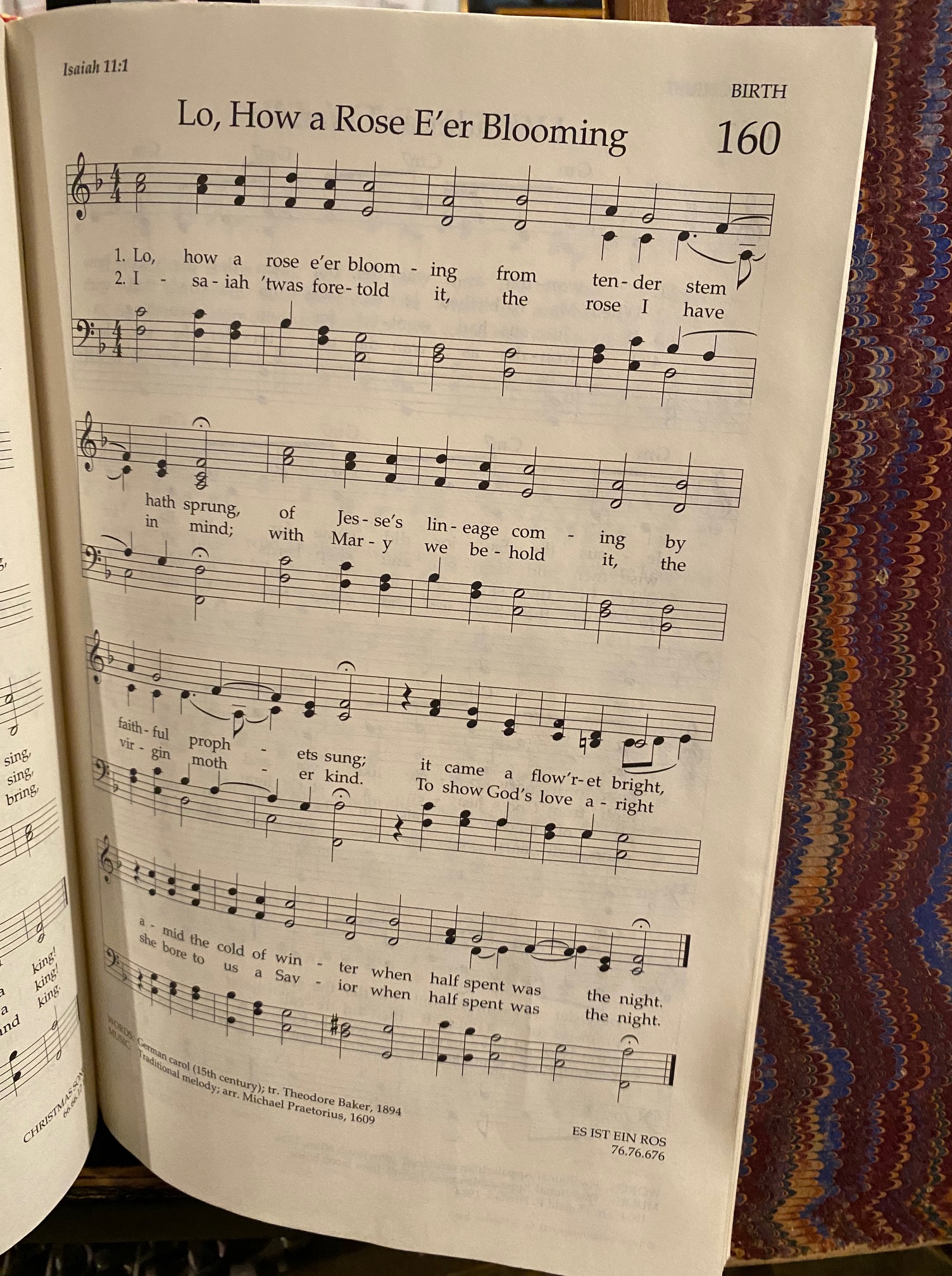
I sat down at the piano to hymn #160, a tune with resonance for me.

Hymn #160

It’s the centerpiece for the film The Time Traveler’s Wife, the carol sung early in the film, that recurs through the movie like its beating heart. Yes I do love the film. Can you tell?

And Tafelmusik Chamber Choir gave us a version of the hymn at their live Christmas concert not so long ago. It was such an opportunity to be able to attend a live concert: especially when seen in retrospect, as we must now miss so many events and performances.

At the end of the concert I had a lovely conversation with people sitting nearby. OMG how lovely to again socialize, the supporters of Tafelmusik being a special breed. They saw me taking notes, and so we started to talk. We discussed the urgent (nerdy) question: how many verses does the hymn “Lo, How a Rose E’er Blooming” really have? In the original German, some would argue that there are only two, as you see in the photo from the hymnal. Those two in English are translated from their German originals. In some congregations in USA one sings four verses, or so said one of my new acquaintances, something google confirmed for me.

Today that was but the first hymn I played. No I didn’t have the voice to sing today. I’m sometimes muted by how I feel, I suppose. I went through the many of the Christmas carols / hymns, into Easter, and beyond. I was aware that I was playing them pianistically, out of touch with the organ that I haven’t, well, touched: not since January 2020. It’s not the same to make a piano piece out of a hymn, or at least the impulse carries one to a different musical place, a different spiritual place.

No it’s not church, not even close. But then again this is a time of estrangement. The piano will have to do for now.

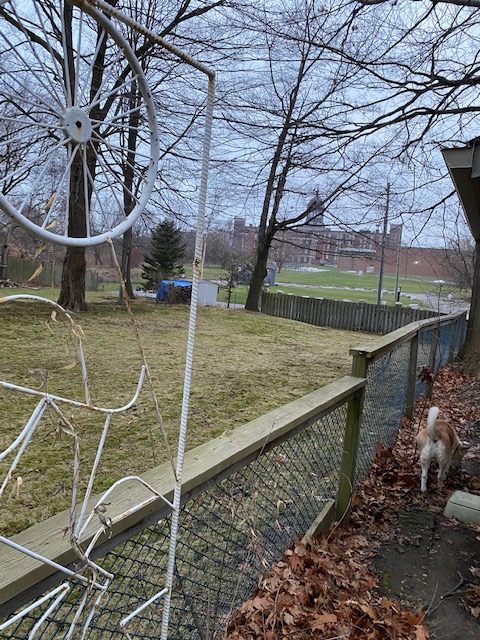
I stopped, went to feed Sam, and after a bit, took her outside, letting her wander about in the fading light before sunset.

Late afternoon today

I’m so lucky to be here at this time, witnessing my mom’s latest chapter. I don’t know how many more days or weeks or years she can manage. But she’s stronger since emerging from hospital, and as lucid as ever. She’s a lot of fun.

Tonight is New Year’s, an arbitrary celebration. We appreciate Betty White at any age, a great soul and a wonderful person. Perhaps we should remember gratitude every day we’re here, noticing one another at any age, regardless of whether it’s the first or last day of the year, whether or not it’s the last year of our lives. I feel like a lucky guy, glad to be here, blessed.

Thank you for reading this. And have a Happy New Year.

Posted in Animals, domestic & wild, Books & Literature, Cinema, video & DVDs, My mother, Personal ruminations & essays, Spirituality & Religion, Sports | Tagged , , , , , , , , | 4 Comments

Missing Greg

In the final week of 2021 I ponder the year that’s passed and contemplate the one that lies ahead. We all may have something we miss doing, something or someone that we wish we could see or hear. Re-reading Dickens’ A Christmas Carol after seeing numerous cinematic adaptations prompted me to think about the many people I miss seeing and hearing.

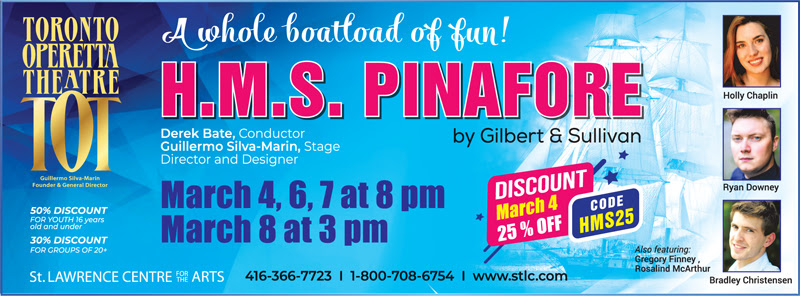
The last show I saw before the closures brought on by the pandemic was the HMS Pinafore on March 7th from Toronto Operetta Theatre.

March 2020

I was hoping to see A Waltz Dream in TOT’s return to live theatre at the end of the month. At least that was the plan.

But it has melted away like the snowfall of a few days ago. Just like the remaining performances of the National Ballet’s Nutcracker, or Mirvish’s imported production of Tom Stoppard’s Leopoldstadt that I was eager to see, TOT have decided to cancel performances in the interest of the health and safety of audiences and performers alike. Just when it seemed we were coming back, we’re again wondering. How safe is it to go to a show, and when will it end?

Greg Finney, an anchor –excuse the pun– for TOT’s HMS Pinafore in 2020, was to appear in the TOT’s A Waltz Dream. I think he’s often billed as “Gregory Finney” so excuse me if the choice to call him “Greg” is confusing.

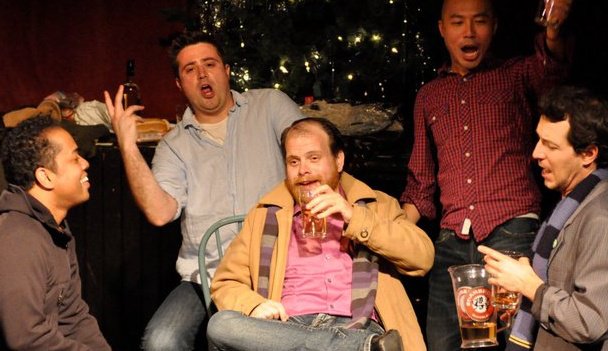
I first saw him in the Against the Grain Boheme at the Tranzac Club a decade ago.

 (L-R) Justin Welsh (Marcello), Adam Luther (Rodolfo), Gregory Finney (Benoit), Keith Lam (Schaunard) and Stephen Hegedus (Colline)


He doesn’t necessarily play big parts, but he makes a huge impression.

What was it that Norma Desmond said in Sunset Boulevard? Someone recognizes her and says “you used to be in silent pictures—you used to be big.”

She replies, “I am big. It’s the pictures that got small.”

I think Greg makes his parts bigger. When he’s onstage he’s usually the one you’re looking at, regardless of whether you think he’s the star. Charisma?

Or maybe because he’s obviously having fun.

Greg Finney

The parts he plays may be meant for comic effect, but that’s much harder to do if you don’t understand humour or timing. His delivery is natural because he’s a natural. He doesn’t appear to be working, doesn’t seem to be acting.

I recall what I said about him back in 2013 when he sang Escamillo in the Peter Brook La Tragédie de Carmen presented by Loose Tea Music Theatre:
“Greg Finney steals the show every time he’s onstage (the funniest one in Against the Grain’s Boheme and again in Figaro), so I am thrilled to see him in a principal role.  This is an Escamillo who perfectly matches the extroversion of Warner’s Carmen, a flamboyant man of charmisma unafraid of crowds.  Finney’s voice is amazingly versatile, as he gave us plenty of voice in the Toreador Song, yet always gave us a perfect balance in his ensembles.  

I remember asking him about his career a few times, wishing to see him playing a leading role again. Finney isn’t a driven madman of an artist. He’s enjoying himself. I wish he would be given more opportunities to play big serious parts, but then again, maybe he’s content.

OH and of course he doesn’t know I’m writing this…? He’d probably think this is kind of corny. What the hell, I’m older, it’s permitted, especially at this time of year.

Another thing I’m missing hugely is church. Sometimes I would sing as a soloist or in the choir, sometimes I would be substitute organist, at Hillcrest Disciples of Christ in Toronto. David Warrack was usually the organist and music director. The last two times I played were in January 2020, stepping in due to David’s absence.

On occasion when the bass was off David would get Greg to replace him. When I had to step in for David at the keyboard, David would get Greg to sub as the tenor. Whenever he showed up, the choir sounded better.

And we had fun.

Greg reminded me a bit of Guy Lafleur the hockey player.

Guy Lafleur (right) getting a light from Quebec Premier Robert Bourassa in 1971

Lafleur was a famous winger for the Montreal Canadiens, who scored over 500 goals in 14 seasons, while sometimes smoking two packs a day. Does it seem unlikely that an athlete could excel while being a smoker? I think it’s even stranger for an opera singer who relies on his wind. But the thing is Greg could hold notes longer than anyone in our choir regardless of his smoking. Amazing.

I’m picturing the impact in operas or operettas that cast Greg. Whatever the size of the role, the rehearsals were surely more fun because of his presence. Not only is he a good singing actor, he’s a larger than life personality.

And I miss seeing him in the lobby. Of course I miss going to shows, which means I don’t see anyone in a lobby anywhere. But if I could run into anyone in a lobby he’d be my first choice, always interesting to talk to, usually well-dressed, friendly.

And I miss the sartorial splendor. Nice clothes in other words. If I had been ready with the iPhone in the lobby when I ran into him, I might have better photos to show, someone who on top of everything else, also knows how to dress with creative flair. I hope I can be forgiven for using an image I found on Facebook.

Greg Finney

One of these days we’ll be back. In the meantime, I miss the church services, I miss the shows and the chats in the lobby.

But I remember. And I must express my gratitude. Thanks Greg.

This might be the first in a series (we shall see…).

Greg Finney
Posted in Opera, Personal ruminations & essays, Spirituality & Religion, Sports | Tagged , , , , , | 3 Comments

A gift from Mel Brooks

It’s been a brutal week of artistic companies facing eviction, shows postponed or cancelled on both side of the Atlantic, an upward spiral of statistics inspiring the panicky pursuit of boosters, masks and safety.

It’s not what you expect in the lead-up to Christmas.

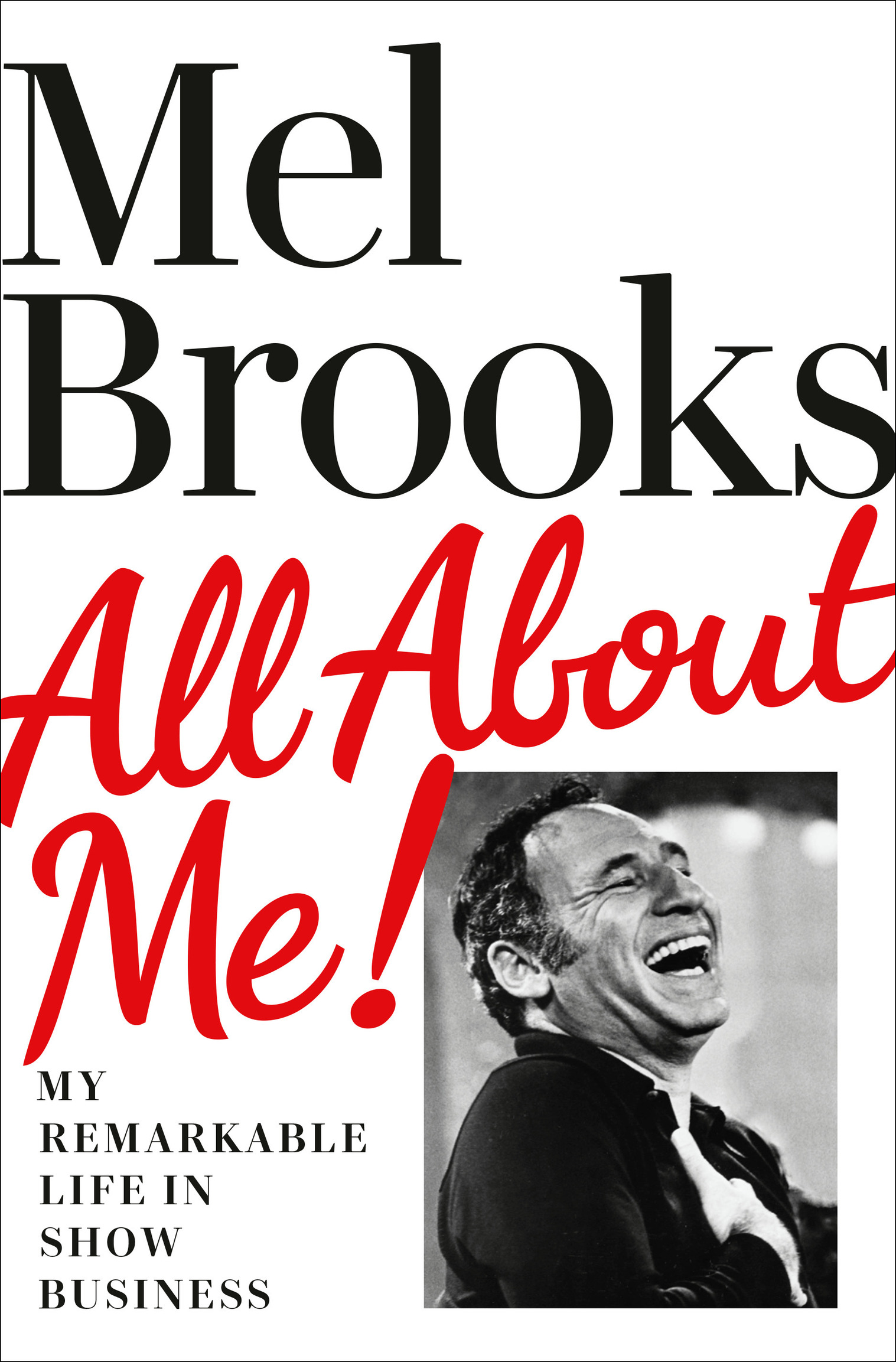
Before we could get in to see Wes Anderson’s French Dispatch, killing some time in the Indigo store in the Manulife Centre, I grabbed a copy of Mel Brooks’s memoir All About Me! My Remarkable Life in Show Business.

There’s a great photo of him guffawing on the front page.

I’ve been laughing too, almost every page

I read almost the whole book today, over 450 pages that flow with the effortless ease of a friendly conversation.

Brooks is very good at making people laugh. If you didn’t already know that the creator of The Producers or Young Frankenstein has a gift for humour, (and chances are you pick up the memoir as I did, eager to hear from a comic legend who already has made you laugh many times) the book will show you that gift, at times giving you a reason to laugh on every page, sometimes big belly laughs.

Today, as I shrank away from the world and its horrors, I was captured completely by Brooks’s story.

At times I wondered what it’s like facing the pressure to be funny. When Brooks wrote for television –in the years before he became famous—he was required to be funny, to create humour week after week. What a miracle but also, what a position to be in. Does that make you neurotic about being funny, perhaps make you compulsive about joking and humour? I wondered even as I sped through page after page of effortless story-telling. Brooks is telling us about his life, and also describing the funny things he created along the way. It’s exciting to read about his creations, how they were inspired, financed, cast, filmed, eventually released, and then embraced by the world.

I knew him for the famous films. I think Young Frankenstein is under-rated, a perfect gem of cinema. I’ve seen it so many times, yet never tire of it, great writing, perfect performances. The Producers is probably the funniest thing I have ever seen on film, even if the movie is uneven. Blazing Saddles is a piece of anarchy full of laughs. I also love The Twelve Chairs and Spaceballs, and I was surprised at how much I enjoyed To Be or Not to Be. There are other films I haven’t seen, as I never made it all the way through High Anxiety, History of the World, or his Robin Hood & Dracula spoofs. When we come to that part of the book, thankfully there’s less to slog through because Brooks knows we’re not hanging on his every word, the way we are reading about his greatest films. And yet it’s still entertaining writing.

In reading the chapter about High Anxiety –Brooks’s attempt at a Hitchcock parody– I feel certain I now understand why I didn’t like the film. We read about how Brooks and Hitchcock actually discussed jokes in the film. Aha. I don’t know about you, but I found the film was a cluster of gags, some hitting their mark, some far too precious and respectful of Hitchcock to actually be funny. I’m sure some people like the film given its apparent success at the box office.

And later we come back to an early film. I never thought I’d like the musical version of The Producers (his own stage adaptation of his own film with songs he wrote himself) that I’ve seen staged and then filmed, but it surprised me, better than expected. In the book Brooks carefully takes us through the creative process step by step. The funny thing with Brooks is that, while he has a huge output, while he’s arguably a great auteur, at the same time the language is unpretentious, mostly humble. Oh sure, he’s telling us of successes, but they never seem inevitable. There’s no arrogance here, indeed Brooks sounds as surprised as anyone else at his success.

In such a long life, the book takes us into a whole series of other creative activities from Brooks. Did you ever watch Get Smart? That was Mel Brooks too. Before that Brooks was part of the team writing for live television such as Your Show of Shows, featuring Sid Caesar in the 1950s. And before that, in the borscht belt and earlier when he was in the army, Brooks was learning the basics of his craft as an entertainer.

Later there were the Brooksfilms projects. I knew of David Lynch’s The Elephant Man. But I was surprised to read about Frances, The Fly, 84 Charing Cross Road. And to discover that one of my favorite films, My Favorite Year, also came from Brooksfilms. Remember how one of the writers for the show always whispered his comments? In chapter four of All About Me (the Sid Caesar Show of Shows chapter) we discover a real-life writer who also did that, none other than Neil Simon, in the years before he became a famous playwright.

I think Brooks is pretty honest in what he’s reporting even if he’s telling us the story of his successful career. Or maybe I’m just desperate for a happy story. I’ve devoured it far too quickly, the prose very fluid. Of course Brooks is a writer. No wonder.

There are moments that seem genuinely risky. More than once we hear about a producer insisting on cuts that Brooks would politely acknowledge, and then ignore. When you’re 95 years old you can afford to be blunt. Was he always this way? Perhaps.

There’s a great deal to enjoy in this book, lessons to be learned. It doesn’t matter if you are short so long as you can make people laugh; that way perhaps they won’t beat you up. Or so he tells us. For me it’s mostly diversion, but alas, I’m almost finished. I can’t escape from the world much longer. Writing this blog is a chance to prolong the experience for a few moments more.

You won’t find a better gift to give your friends for Christmas or any other occasion. I bought it for myself and I’m glad I did.

Posted in Books & Literature, Cinema, video & DVDs, Popular music & culture, Reviews | Tagged | Leave a comment