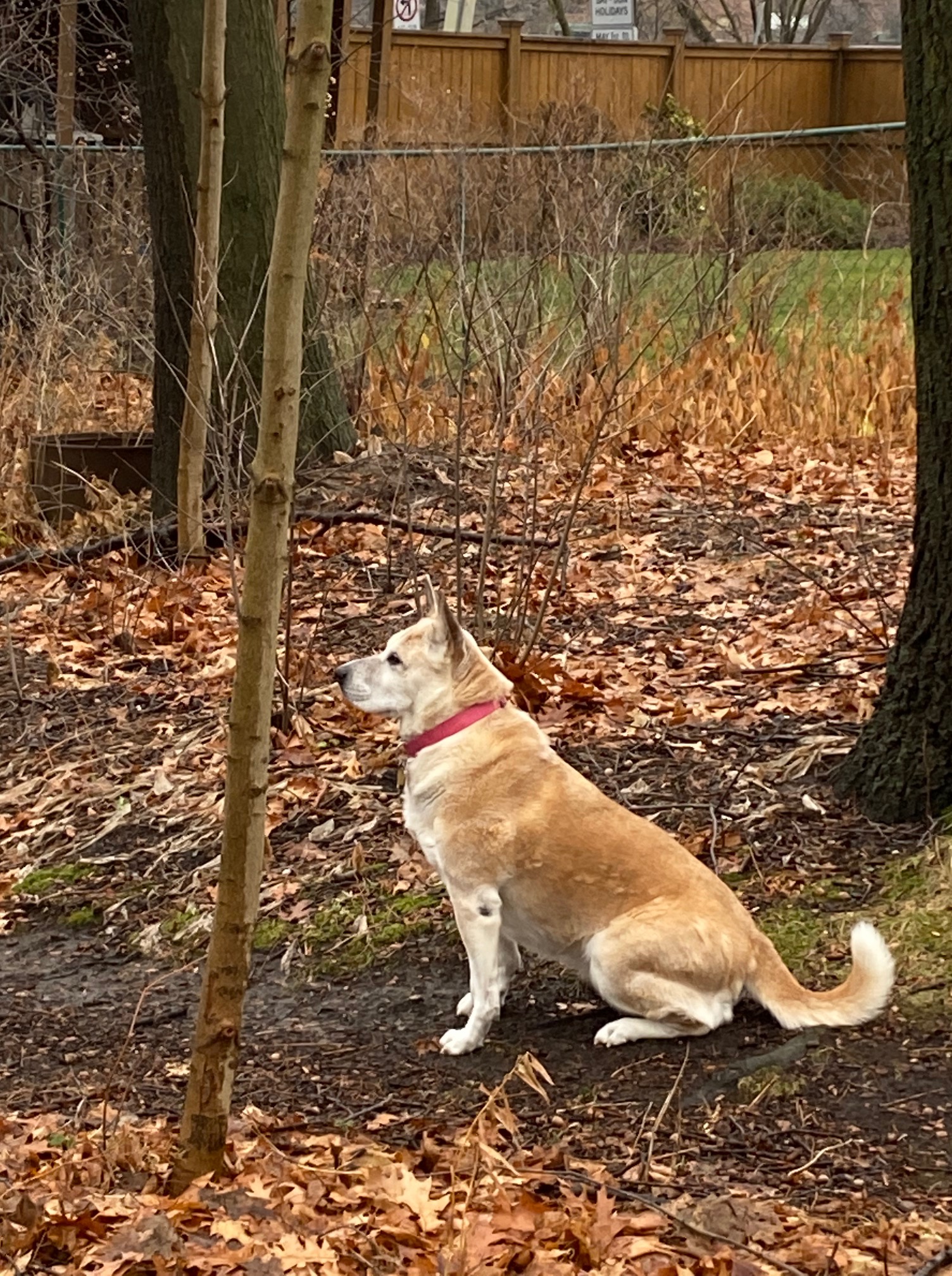
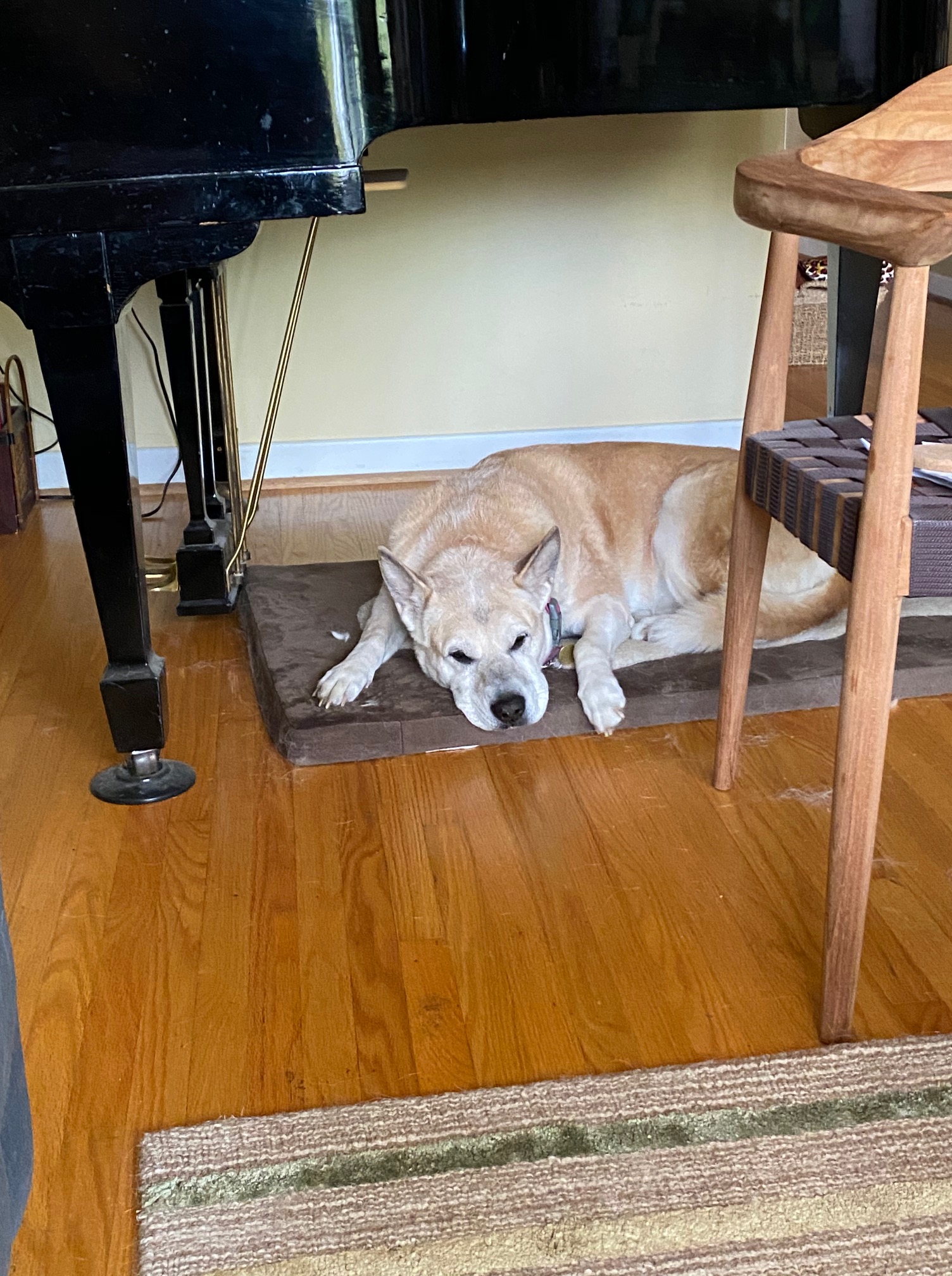
I follow her around with my phone, taking pictures not so much a paparazzo as a pupparazzo.
Samantha (SAM for short) seems to like the attention.
“Hey Sam wanna take a selfie..??”
The pictures? It’s simply that she’s irresistible. I want to capture those beautiful moments.
Sam is very photogenic, notwithstanding the big lump in her left thigh.
It may be cancer, but she is 13 years old. We feed her and do our best to make her life enjoyable.
A friend has suggested that maybe she is a Norwegian Buhund. We don’t know, as she’s a rescue, and we’re the third owner. At this point –to be honest– she really owns us.
And that’s okay.
And the way she looks at the camera I think she likes the attention.
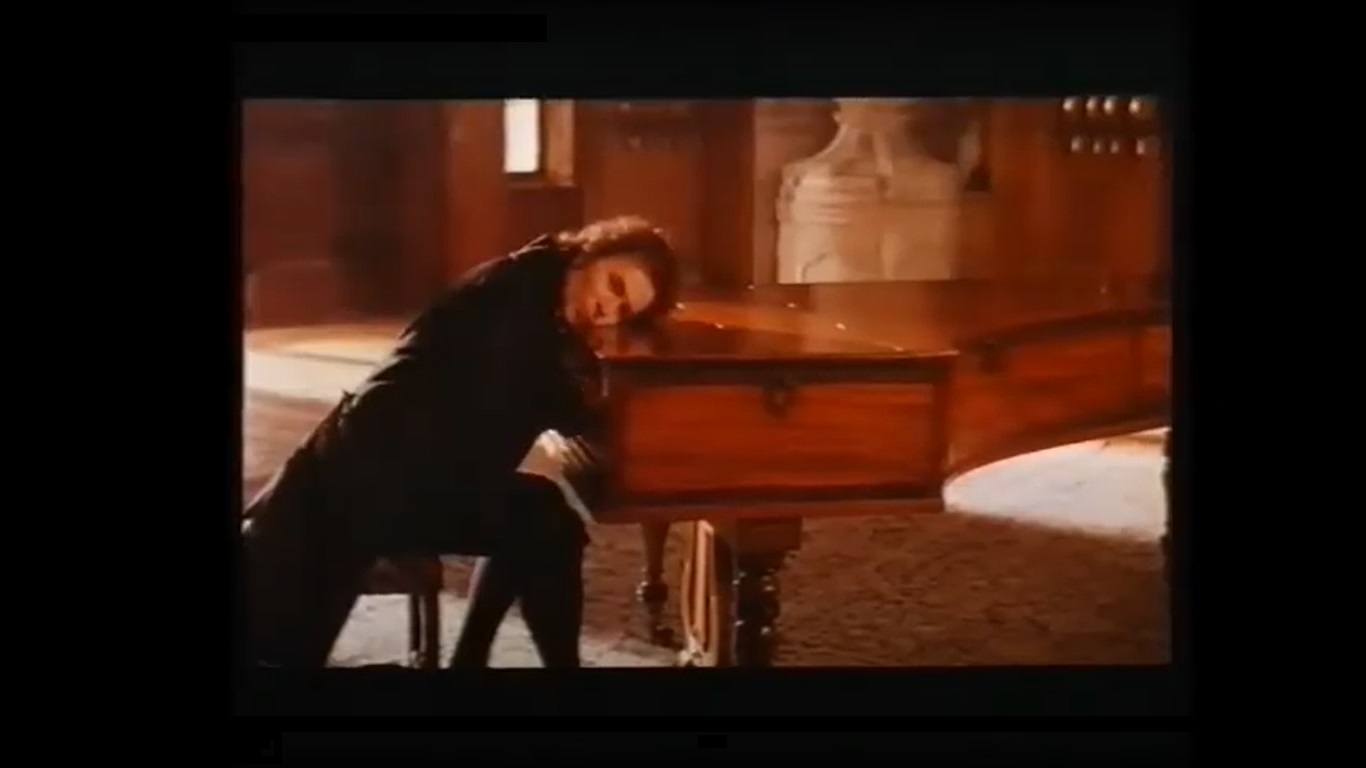
Immortal Beloved (1994) is one of my favorite films. While I’ve been told by a Beethoven scholar that the facts aren’t correct in the film, that doesn’t stop me from liking it. How could it be otherwise?
Spoiler alert #1: I love this film, so don’t expect a balanced commentary from me. I think the film is worth the trouble of multiple viewings, rewarding anyone who bothers to watch it, particularly now as we remember Beethoven 250 years after his birth.
This is the film for which Gary Oldman really deserves his Oscar.
You can’t blame him for worrying about being typecast, recalling his brilliance as Lee Harvey Oswald or Winston Churchill.
Have you seen it? whatever you may think of its accuracy –using modern instruments rather than period ones, messing up some of the time-lines & facts in the interest of a romantic storyline—it’s a compelling combination of visuals & musical performance. I recall Jay Scott calling attention to that one tiny infelicity, that the music is all done with modern instruments via Georg Solti rather than anything utilizing a historically informed performance style. The one exception comes during a piano lesson when the instrument sounds dreadful. If I didn’t know better I’d say Solti’s goal was almost slanderous.
Other than this, I love this film without reservation, as I mentioned in spoiler alert #1.
Spoiler alert #2, I don’t like spoiling stories so I won’t spill the beans about this one. You’ll have to see it for yourself, and decide on its merits.
So let’s start with the premise.
Beethoven has just died. The opening is a powerful scene scored with Beethoven’s Missa Solemnis. We see the funeral procession that might include Franz Schubert; that is, we know Schubert was a pallbearer but we don’t get a good look at the men carrying the coffin.
Later we are listening to Anton Schindler, his admirer, sometime secretary & helper who has been going through his papers, which contain a mystery. A series of letters written in July 1812 were addressed to the “Unsterbliche Geliebte:” the “immortal beloved”.
But who was this person? There are several possible candidates, women to whom the letters may have been addressed: but never sent. The film brings us closer to three possible candidates, one of whom is not taken seriously by the academics who know about such things (in other words, I’ve been told in private correspondence in no uncertain terms).
Beethoven died alone, a single man without any apparent survivors. The film would suggest that our assumptions are incorrect: that in fact Beethoven did father a son. I won’t reveal any more.
What I like about the film is how it makes me think about him in a new way. He is a person living with a big secret, namely his hearing loss, which he must conceal. I think Oldman does a remarkable job of making the character believable.
Directed & written by Bernard Rose, it has an interesting intersection with another Rose film, namely his adaptation of Tolstoy’s Kreutzer Sonata (2008). Tolstoy’s story about marital infidelity might be the subtext for Rose’s earlier Immortal Beloved. Rose seems to believe that the music in Beethoven’s sonata (which we hear briefly in the earlier film) is telling the same sort of story we find in Tolstoy, that the passions of the sonata concern an ardent traveler trying to reach his beloved.
In passing we’re given one of the most perfect definitions of music (or any art for that matter) that I have ever encountered. See if you agree.
Allied Properties makes a transformative contribution to the Massey Hall Revitalization expanding the scope of the project.
Featuring an additional performance venue and new dedicated spaces for artist development and community education initiatives
Allied Music Centre, Rendering Rendering courtesy of Massey Hall / KPMB Architects
(TORONTO – December 8, 2020) – With enormous gratitude, Massey Hall today announces that Allied Properties (TSX:AP.UN), a Canadian provider of creative urban workspace, has made a landmark contribution to the Massey Hall Revitalization. This transformative support expands the project’s original scope and introduces Canada’s premiere multi-purpose performance facility, Allied Music Centre, home of historic Massey Hall.
“We’re truly grateful for the opportunity to partner with historic Massey Hall,” said Michael Emory, President & CEO of Allied. “This partnership will enable us to contribute meaningfully to our communities. It will also enable us to propel our vision over an extended period of time and to enrich the experience of the many creative organizations and people who use our urban workspace across the country.”
Massey Hall will always be called Massey Hall, but Allied’s significant investment to the Revitalization is the catalyst for the creation of Allied Music Centre. Featuring NEW state-of-the-art performance venues and dedicated spaces for Artist Development and Education & Outreach initiatives, all located in the 7-storey tower adjacent to the National Historic Site.
These previously unannounced additional spaces include:
The Theatre. An entirely new and intimate venue that will be a welcome addition to Toronto’s music ecosystem, serving as a launch pad for emerging artists and a home for community programming and engagement. With retractable seating akin to Massey Hall’s revitalized orchestra level, it easily transforms from traditional theatre for more intimate performances and presentations – seating 100, into a standing room club or education workshop setting.
The Studio. With the acoustic treatment and technical capability you would expect of a professional recording facility, The Studio has multi-function flexibility for educational programming and artistic development at the core of its design.
The Studio adapts to a range of these uses, whether as a “wired” classroom for education programs delivered in person or remotely, as space for emerging artists to create, or as a sequestered rehearsal space for acts performing at any of the venues.
Artists’ Lab. A suite of dedicated resources for creators providing all the modern tools needed to develop their craft. Featuring professionally appointed digital audio workstations, a unique instrument library, acoustically treated practice rooms, and more – a home for artists.
The Lounge. A gathering place for artists, industry, and fans alike, the Lounge will offer a casual gathering place for the music community by day and will be abuzz at night as concert-goers and creatives mingle and take in the awe-inspiring view of the city.
This extraordinary investment is a testament to Allied’s on-going commitment to creativity and connectivity and a bold extension of their Make Room for the Arts program, an initiative providing much-needed affordable spaces to the artistic community.
“In Allied, we have found a partner who shares our values, believes in our mission, and from day one wanted to know what they could do to make the Massey Hall Revitalization even more impactful to the community,” said Jesse Kumagai, President & CEO, The Corporation of Massey Hall and Roy Thomson Hall. “As a result, their insightful and meaningful investment is not only bringing Massey Hall a significant step closer to reopening, but also serving as the catalyst for expanded scope, adding a new performance venue and dedicated spaces for artist development and music education. We are immeasurably grateful for this remarkable contribution to Canada’s music scene!”
When complete, Allied Music Centre will play a profound role in our cultural ecosystem, creating inspiring new opportunities for artists and music fans at every step along their journeys. From emerging artists making their debut to the world’s most celebrated stars, young students discovering a passion for music to lifelong fans soaking in the energy of live performance, Allied Music Centre will be a home for all music and all people.
As previously announced, the Massey Hall Revitalization will restore and renew both the interior and exterior of this National Historic Site, unveil over 100 restored original stained glass windows, introduce new music venues, feature archives and exhibits located throughout and, offer a new retractable seating option on the orchestra level of the Allan Slaight Auditorium for energy charged performances.
Also previously announced, the new seven-story tower – in addition to today’s announcement will feature; a new 500-capacity club with incredible sightlines to the city, additional patron amenities that will include accessible seating options throughout and, state-of-the-art production facilities with turnkey content capture, wired to every stage and studio in Allied Music Centre.
After seeing a preview, I recommend Rituaels, a new film-concert from collectif9 especially to anyone who is missing live performance, wanting the experience of live music in their home setting, and especially to any artists intrigued by the challenges and contradictions in bringing something live to life, via a lifeless electronic device.
For artists curious about what is possible? Have a look.
Rituæls premiere broadcast (via http://www.collectif9.ca) will be on Friday, December 11, 2020 at 8pm for free, and will be accompanied by a discussion with the members of the group. The film-concert will be accessible free of charge for a period of 48 hours, after which it will be available for rental on their website until January 11, 2021.
As you can probably tell from that little teaser-video, a great deal of thought seems to have gone into this project, projected to be the first “film-concert” of a series. I remember Marshall McLuhan and his identification of media as “hot” or “cold” or even “cool”. A film seen in a theatre or a concert presented in a concert hall or church is a hotter medium event than when it’s seen as a video on your personal device. For better or worse, the creators of Rituaels seem to understand that this film needs to be constructed in such a way so as not to overwhelm us with its intensity. The choice of repertoire, the presentation of each musical piece by the players of collectif9, the visuals and the montage all contribute to the effect. The word “cool” is one I want to use, not just in the McLuhan sense but in the sense of something hip and attractive to those in the music world who are not—like myself—over the age of 60.
There can be an awkwardness to Zoom and other attempts to simulate liveness in the virtual realm. I recall the weird first attempts at a Saturday Night Live, the unevenness of interviews on CBC or CNN even between professionals. Facetime or whatsapp or Messenger may give you a close-up look at friends and loved ones, but we are still learning the vocabulary, still getting adjusted to pandemic life. And even so, how then does one possibly preserve a sense of liveness? especially without anything awkward or odd..? Do we get a sense of a real live concert when there’s something still & orderly, if the chaos of people in between movements with their coughs or chair noises are in some sense how we know that something is not recorded but live…?
As I think about what I saw in my preview of Rituaels I am reminded of Bertolt Brecht who would have something to say –recalling his Verfremdungseffekt –about the process from the audience’s viewpoint. Do we gain something when the performers turn their pages, tune up or move their chairs, before playing? I think so. That bit of mechanical movement is a gesture to us, reminding us that the music is not just something artificially recorded on a soundtrack, but being made for us in the moment by the living musicians, calling attention to the mechanics of playing music. It puts our focus on the music and the music-making rather than the images.
Can one make something that has the freshness of a live performance while also relaxing us & putting us at ease? At times it’s very laid back, but when I played Rituaels last night there were moments when my wife thought I was listening to rock music, probably during Aheym by Bryce Dessner, the most intense moments of the film-concert. This version by Kronos quartet is different from what collectif9 did, but gives you both a sense of Dessner’s piece does as well as some visuals that may have influenced the team working with collectif9. I’m reminded of Reggio’s Koyaanisqatsi, that seminal film with timelapse & the music of Philip Glass.
Excuse me for repeating myself, but I would recommend that anyone wondering about bringing live performance into the virtual world should have a look at this film-concert. I was intrigued when I saw the press release for Rituaels, indeed, when I saw that they were calling it a “film-concert”. Whenever we make something, especially something new, we may not always know what we’ve made. It’s therefore quite marvelous to discover something displaying genuine mastery, created with a deep understanding of the issues facing the audience.
It works, and it’s a pleasure.
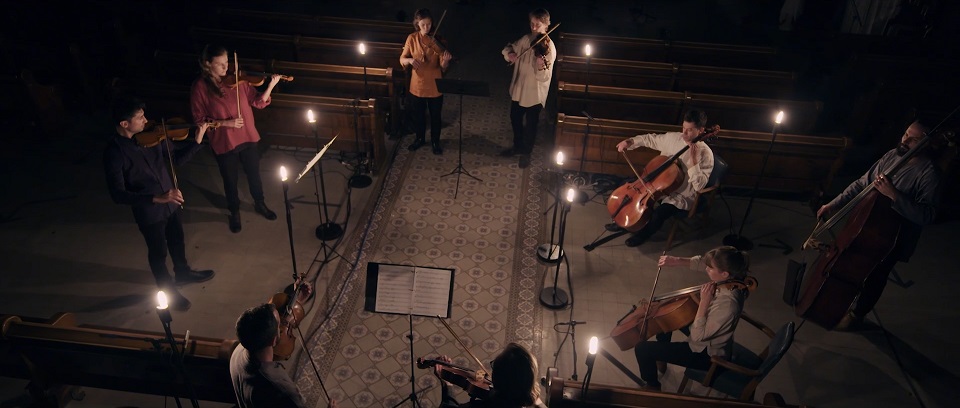
Collectif9 are an ensemble of four violins, two cellos, two violas and a bass. Their nine string players have been performing for almost a decade. Rituaels includes ten live performers, namely the nine of collectif9 plus dancer Stacey Désilier.
Stacey Désilier (photo: Clément Dietz)
I chose to watch Rituaels on a big screen, to allow the visuals to move me, and wasn’t disappointed. Even enlarged there’s a great deal of detail & complexity to reward the viewer. We find ourselves in a church space where the bodies of some musicians are already discovered in place, and others process in slowly using the church aisles while playing. It suggests a ritual quality because of the space, because of the way they process slowly, and perhaps also because I’m mindful of the title. I wonder, not for the first time, what does that word mean?
We’re put in a funny hybrid space. The music emerges from live players who don’t seem overly coached or stagey, just doing what musicians do. They play, their focus is their music or their instrument not a fake performance or anything stagey or ostentatious. Yet there are artificial visuals too, some from CGI, some from the dancer shown in close-ups, some from cinematography of the natural world. While Stacey Désilier may be a dancer, there is very little that one might identify as “dance” in the usual sense of the word. We are mostly presented with Désilier in a variety of postures & attitudes, mostly static & at times very contemplative. That bold choice to be understated gives the film-concert additional intensity & power.
After the very first item on the program we’re listening to relatively recent compositions.
Hildegard von Bingen (1098-1179): O vis æternitatis Arvo Pärt (né en 1935): Psalom et Summa Nicole Lizée (née en 1973): Another Living Soul Bryce Dessner (né en 1976): Aheym et Tenebre Michael Tippett (1905-1998): Lament Jocelyn Morlock (née en 1969): Exaudi (arrangement pour violoncelle solo et cordes)
Collectif9 includes nine string players:
– Chloé Chabanole, John Corban, Robert Margaryan, Elizabeth Skinner, violin – Scott Chancey, Xavier Lepage-Brault, viola – Jérémie Cloutier, Andrea Stewart, cello – Thibault Bertin-Maghit, bass
The team behind the film—concert is led by their bass player. – Conception et direction artistique: Thibault Bertin-Maghit – Réalisation vidéo: Benoit Fry & Lucas Harrison Rupnik – Réalisation musicale: Carl Talbot – Éclairage: Alexandre Péloquin – Scénographie: Joëlle Harbec
Rituæls will be broadcast for free for the first time on Friday, December 11, 2020 at 8pm, and will be accompanied by a discussion with the members of the group. The film-concert will be accessible free of charge for a period of 48 hours, after which it will be available for rental on their website until January 11, 2021.
As I reminisce about a piece choreographed by Brian Macdonald I hope I can be forgiven for seguing into remembrance of the man, who is known for many things. You probably saw one of the musicals he directed at Stratford, perhaps on film or TV if not in person.
Back in 2005 I brought him in as a keynote speaker for the FOOT Festival at University of Toronto’s Drama Centre. It was an honour and a huge thrill.
The obituary I pulled up mentions opera. “In October, Macdonald returned to the Canadian Opera Company in Toronto and from his wheelchair supervised yet another revival of his critically acclaimed 1990 production of Madama Butterfly. His curtain call was his last public appearance.”
His career was long. I see in that obit I shared above, that he was also “artistic director of Montreal’s Les Grands Ballets Canadiens (1974-77).” During one of their visits to Toronto at the O’Keefe Centre I saw Macdonald’s Diabelli Variations.
I see in that obit that Macdonald “aspired to be a concert pianist.” I wonder if Macdonald ever played the Diabelli Variations himself? Surely.
The tickets for that show back in the 1970s were available among my acquaintances at Trinity College, University of Toronto when I was an undergrad. A red-haired fellow in our group named Barry sounded off to me during the intermission that there was simply no way to make a ballet out of the Beethoven piece, “Diabelli Variations”. He said “you can’t do this” and of course I disagreed then, and recalling the conversation now am thankful for the boldness of Macdonald’s ideas. I had wanted desperately to come see it again before they left town, but didn’t manage it.
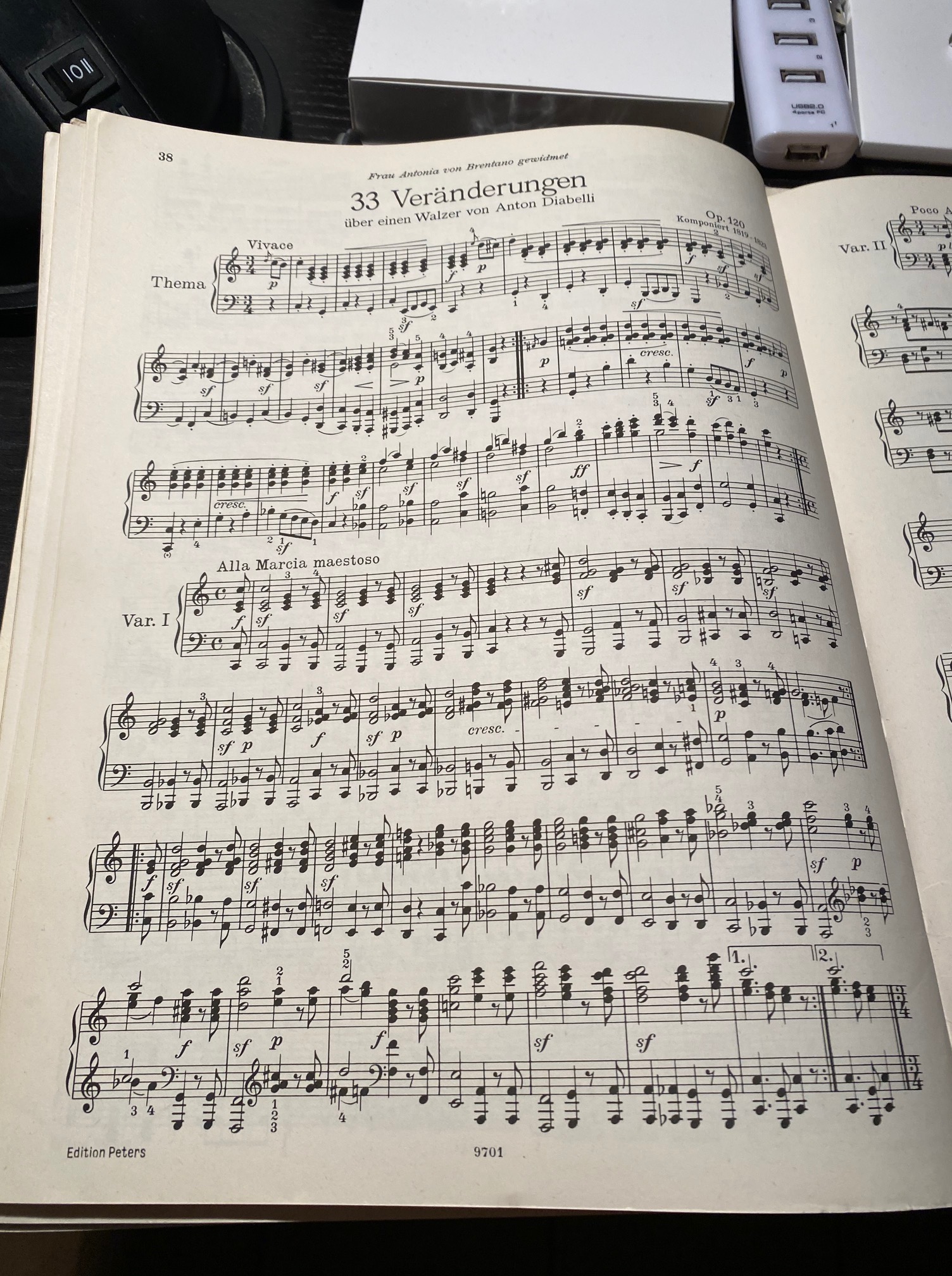
Do you know this piece? The Diabelli Variations are among my most favorite of all Beethoven’s works, piano or otherwise. Someone had the idea of giving a tune to several composers, and then assembling all their variations into one piece. When I think about it, especially when remembering what Beethoven came up with: it’s not really such a good idea. Yes I suppose one might be intrigued at the comparison, between a variation by Schubert (who actually wrote one), and one by Beethoven. But you wouldn’t get the satisfaction of a unified composition such as what Beethoven gave us.
You start with a dinky little tune in 3, a dance tune in C Major. And then Beethoven proceeds to create one of his most remarkable compositions.
Theme and the first of 33 variations
First he does a kind of march which is of course in 4: as if to smash the tune into little pieces, someone said. (was it Anton Kuerti? I can’t recall….but it would match his interpretation). Then the next variation starts with something meek and mild, building over the next few variations, bigger & faster, until we get a climax at variation #7. Variation #8 is a chance to chill out, relax a bit, almost like a lullaby or even an elegy for the massacre of the tune that has been happening. #9 is angular & in chunks in C minor then #10 is a breath-taking release of tension, Presto. 11 and 12 are waltzy with very little movement, gently exploring the melody. #13 is another explosive release of tension before we come again to something elegiac and maestoso, namely #14. But 15, 16 and 17 are fast & playful. 18 is a slower dance melody, then 19 is a vivid presto again, leading us to the slow-motion of 20. 21 is faster, then 22 is a light parodic interlude mocking the opening of Don Giovanni in its variation. 23 is fast & intense,, then 24 is a thoughtful fughetta based on the melody of course. 25 is as fluid as a skater’s waltz, building to a climax through 26 & the Vivace of 27. For 28 Beethoven is again grinding things into small pieces, before the shit hits in the fan in 29, 30 & 31, successively more pathos & drama in each variation. 32 is a stunning allegro Fuga in E flat major, that leads us back after cadenzas & an introspective adagio like a recitative, to the 33rd variation in C major, tempo di menuetto.
Yes it’s a series of variations, but it’s like a commentary on music & the possibilities of composition. I don’t know that I would have had such a clear understanding of the piece without Macdonald. The piece makes me especially sad today as I think about what we’re unable to do during the pandemic, missing the usual sorts of human society to which we were accustomed. I desperately wish I could talk to Macdonald about the piece.
And I’m sure Beethoven would have loved what Macdonald created. I cherish that conversation with Barry –the one who said “you can’t do this” – that makes the poignancy of the memory so much deeper, even if it’s as far beyond recall as the prospect of getting Ludwig and Brian together for a beer after the show.
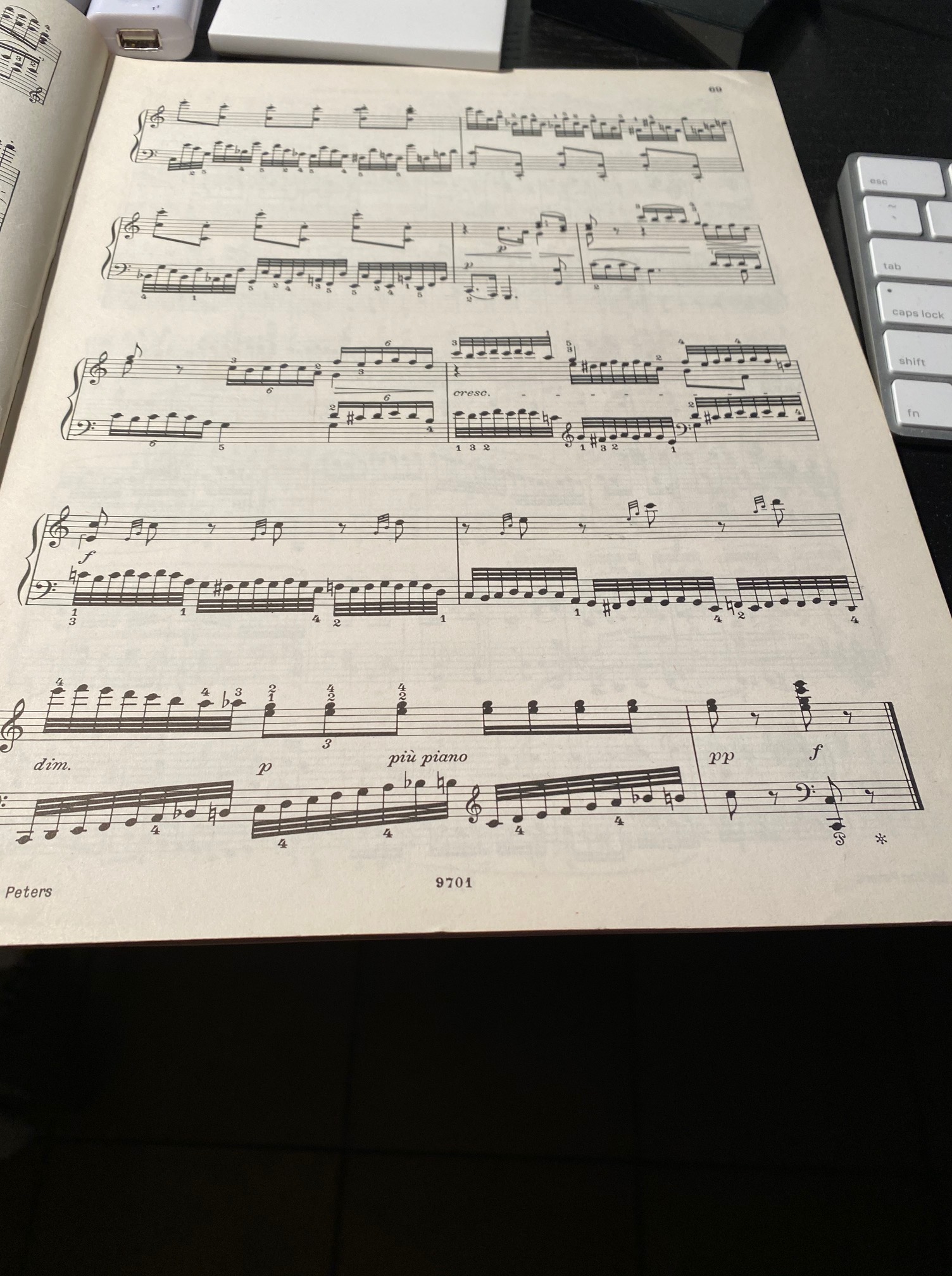
Macdonald puts his piano onstage, the ballet dramatizing as the piece gets played. I couldn’t help feeling that this piece was conceived as Macdonald the choreographer played the piece once upon a time. At first it’s just one man dancing while the pianist plays. In due course we see the various actions of the piece, the roughness of the passages such as the first variation where the music seems to be destructive. The piece is ultimately social, the dance element in the music understood as two or more people dancing onstage with the piano, the dance as a kind of response to the music of the piano. It feels like a conversation, that the pianist makes the dance happen in response to what the music is doing. The drama is especially moving at the end, as the erupting energies of the fugue in variation #32 lead to the noble tranquility of the last variation, as though it were about reconciliation, world peace. That’s what it feels like.
The final image that haunts me, as I picture the music of the last bars, is that the dancer is coming back to the piano, where he started, the big open space on the page that parallels the big space on the stage, that would imply lots of people and lots of energy, closing up into something smaller, tighter, intimate, reconciled.
The end
Am I a fool to wish someone would try to choreograph this music again? It’s a fond beautiful image I dimly recollect from another century from an artist who is no longer with us. But the piece is about dance, about human society, about conflict & resolution. I like it.
There are days when I’m sure the powers that be are trying to tell me something. Anything can be an omen, but some creatures are especially portentous.
I didn’t take Sam the dog outside right away, when I got home from my visit to my mom’s house. Erika called me to the window, excited.
the busy bird
Some sort of raptor was exploring the insides of a smaller creature. It’s head was down, busy busy. I suppose that’s where the “unwrapped” part comes in.
We have a couple of intriguing places for birds to perch, because trees have been damaged in the worst of recent winters. The cherry is a funny abstraction. While the neighbours still enjoy a great deal of shade and even fruit from the northern remnant, the southern branch –which used to shade our yard—had to come off a couple of years ago, as the tree began to split down the middle. And so while the northern half prospers the southern half comes to a sort of stump up in the air: where birds and animals sometimes enjoy the view.
That’s where the raptor decided to improvise his/her butcher’s block, on the flat wooden surface, unafraid of me when I came outside to take a few pictures: but also so unimpressed that I couldn’t get a really good picture.
When Sam & I finally went outside the bird was long gone. So Sam made a point of sniffing a lot, and pointedly marking her territory at the base of the tree. I thought to myself “well you certainly showed him (or her).”
But of the course the big bird was long gone, not noticing either of us (neither Sam nor me). I wonder if Sam could smell the remnants of whatever the raptor was rapt for.
“Rapt” means attentive, right?
Earlier at my mom’s? My mom was lost in thought, asking me about an author.
She asked me if she was nuts to be thinking of an author, whose name she remembered as “Kurtz Mahler”. Was there such an author, she mused to herself. That was how she spelled it out, while wondering if maybe there was such a person. And why did it come back to her. The name would be the author of romances, not a great writer.
Then I googled and found Hedwig Courths-Mahler who had indeed written popular romances back in the 1920s in Europe.
My mother recalled that her own grand-mother read the romances of Courths-Mahler, that back in the 1930s when she was just a child, she had seen the books. This was reported to me without any sense that the author is great or talented. It was a dim memory of books that my mom never read. She had seen more than one book by this author. My mother didn’t want me to mistake Courths-Mahler for serious literature. She was a bit apologetic, that her grandmother wasn’t educated.
I was impressed that the name had suddenly come to her, that she remembered her grandmother and recalled moments when she would help her, bring her comfort when she was in pain, late in her life.
At one time, so my mother tells it, her father lived with three women, namely his wife, his mother in law and her mother as well (aka the grandmother). And at one point she was no longer there, but no one made a big fuss, so as not to upset anyone. I think the memory was as much about what wasn’t said as anything else.
The episodes I experienced today are full of unknowns and ellipsis….
-Courths-Mahler herself
-the books by Courths-Mahler
-the mysterious reader of Courths-Mahler aka my mom’s grandmother. I’ve never seen a picture of her, nor do I know her name.
-the creature that ended up on the bird’s improvised butcher block
-the bird itself.
-the split cherry tree
A raptor is a portent of vision. While they soar high in the sky on this occasion we were visited close to the Earth. Am I being alerted to something, I wonder?
This blog expands on something I proposed November 20th when I talked about Beethoven’s multiple incarnations.
Everyone has dimensions or facets to their personality. I hope that’s not a radical idea. There are things we proudly show off, other things to make us blush at the recollection. There is the person we bring to business meetings, where we wear the appropriate armour and joust according to the rules of our chosen discipline: and the person who falls into bed at the end of the day, hopefully removing all our masks, willing to drop our defenses in sleep. Our aspirations may bring out some qualities, just as our background and upbringing likely influence us in other ways. We are perhaps the sum of our influences even if we are also sometimes searching and dreaming, sometimes dissembling and playing, often ignoring the instructions we’ve been given, not always remembering who we are or what we want. That’s as true of the average person as for the great ones we admire.
Yes I’m on a fishing expedition. When we talk about famous composers, there is naturally a body of work that may become canonical, the core works that are played by famous artists, big orchestras or important opera houses. The creations understood to be most popular or most admired should not be mistaken for the sum total, as they represent aspects of a composer. If the artist is especially lucid and notices what’s working, what’s selling, what’s exciting to audiences, then they will have a chance to replicate their success. But this part of the composer’s creative life –and the personality that might be associated with their greatest work— is not the sort of fish I’m looking for. I’m not looking in an obvious place, but rather am going off the beaten track, into the backwoods of obscurity. I’m not sure we can learn anything from digging into the underbrush. I came up with the title before I really knew what I was going to say, only sure that a few examples I found might lead me to something meaningful.
It’s impossible to know with certainty what a composer was listening to in childhood, what music influenced them as they grew up. But among their own works one can sometimes find traces of their actual background, their history. Dvorak wrote symphonies and operas, but also Slavonic Dances, that admittedly might have been what put him on the map & made him famous outside his native land. Chopin composed Etudes and Preludes but also Polonaises and Mazurkas. I am not saying that the compositions that have an ethnic flavor are better or worse, whatever that might mean, only that they represent an aspect of a composer’s identity that likely offers a key to understanding their appeal.
When we come to the music of Beethoven, you might well ask “what could that even mean” to speak of his ethnic music. Perhaps you see now why I said I’m fishing. But let me offer some examples first of the pieces I’m thinking of, and then the later compositions that show traces, suggesting that this is at least an aspect of LvanB that hasn’t fully been explored.
I tried googling without any success. If you try, you’ll see pieces discussing the possibility of Beethoven’s Moorish heritage. That isn’t what I’m exploring, and please excuse me for mentioning something I will not explore. Yes there are some amazing passages in Beethoven. I even saw someone extol a remarkable passage in a sonata as evidence, thinking of the earliest example of boogie woogie in the syncopated variation of the finale to piano sonata #32 (and for what it’s worth, Andras Schiff does not agree, as you can hear him say explicitly on this video.) But a style that only appeared in the 1940s can hardly be relevant for a composer in the early part of the 19th century.
I’m going to share a series of Beethoven compositions that are mostly under the radar, even if they have been published & even recorded. There are over 200 pieces without an opus number, catalogued as “WoO”, which is short for “werke ohne Opuszahl”, (German for “works without opus number”). While the important pieces like the sonatas & symphonies were given opus numbers, anything that’s given a WoO number is usually considered less important. And please note that Beethoven isn’t the only composer who has works that are identified as “WoO”.
I’m fishing, remember? I figured that there could be early pieces of this sort that might signify something as indications of Beethoven’s early tendencies. And then wow wouldn’t it be cool to see if anything survives as a remnant or a vestige in the pieces that do have opus numbers..!?
I have several examples. These are Ländlers WoO 11.
They employ a very simple meter & are wonderfully easy to play. In #s 4, 6 and 7, Beethoven is complicating things with his use of chromaticism, the accidentals that make the piece a bit more edgy, surprising to hear.
Here are the Ländlers WoO 15
These Dances are simple, direct, and perhaps do not suggest the word “ethnic” to you.
Listen to this German Dance.
It’s not a huge step from dances like these that I’ve shared, to the Scherzo movements we hear in Beethoven’s second or third piano sonatas offering us in passing a kind of snapshot of the evolution of dance music.
First let’s listen to the Scherzo from Op 2 #2. It’s like a German dance.
When we come to the scherzo from the third sonata Beethoven raises the stakes, adding chromatic complexity, tricky rhythms & even a bit of counterpoint.
A piece we’d call “scherzo” is often the most complex & challenging piece, thinking for instance of Chopin and especially of what Mahler would do.
Let me play something very well-known, but framing it alongside the simple construction of the German dances.
Let me put another piece out there for your edification, one that puzzles me frankly. Beethoven at this moment–the rondo finale to the 3rd Piano Concerto– reminds me of Liszt for his remarkable melody in this movement. Where did it come from? It reminds me of something non-German, although I’m unable to say what nationality is suggested by this dance.
I don’t know.
This is of course art music, not folk music yet the chromaticism & rhythmic vitality suggest something far from the concert realm. Music criticism in the 21st century shies away from making wild speculation without evidence. As I recall the scenes in Immortal Beloved between Beethoven and Maria Erdödy (which include Hungarians speaking Magyar) I wonder if the composer had been influenced by something he had heard? As far as I can tell the composer’s relationship with Maria came almost a decade after this concerto. But we don’t know what or who else he heard, music that might have influenced him.
The opening of the Piano Concerto #3 finale
There are a great many recordings of WoO music, available on youtube and elsewhere. They’re a glimpse of another side of Beethoven, as though we were watching out-takes or casual recording sessions from his early days before he became famous. They may jar in their simplicity, their lack of pretense or guile. And they illuminate what came later, suggesting how Beethoven built magnificent structures from the simplest & most basic component parts.
collectif9 announce the online release of the film-concert Rituæls on December 11, 2020 at 8pm. A 60-minute feature-length film, this production brings together works dating from the Middle Ages to the 21st century, launching a series of films that create various multidisciplinary universes.
FILM-CONCERTS
With the desire to nurture our connection with audiences, collectif9 has reimagined our 2020-21 season as a series of film-concerts; complete concert programs combining live performance footage and cinematographic footage, recorded in the highest quality – the equivalent of a visual album. In the same way that a concert is designed to be presented on stage, the film-concert is specifically conceived for viewing on the screen, creating a musical experience enriched by visual and artistic elements.
RITUÆLS
The first film-concert in the series, Rituæls slowly and meticulously offers moments of beauty and calm during a time of mental and emotional turbulence. Rituæls is a mystical artistic experience confronting the infinitely large to the infinitely small, the cosmic with the macroscopic, delicately questioning our place in the universe and in relation to our environment. The performance of the charismatic dancer Stacey Désilier accompanies us through the concert like a supreme presence, complementing this imagery.
The musical performance itself can be seen as an grand artistic ceremony during which the musicians occupy several spaces throughout the Church of Saint-Pierre-Apôtre in Montréal in a way that echoes the grandeur and depth of the pieces on the program and becomes our own ritual. The lighting, scenography, and staging contribute to the creation of a succession of moments that transport us and invite contemplation, creating a moment of connection despite what separates us.
MUSICAL PROGRAMME
Hildegard von Bingen (1098-1179): O vis aeternitatis Arvo Pärt (born 1935): Psalom and Summa Nicole Lizée (born 1973): Another Living Soul Bryce Dessner (born 1976): Aheym and Tenebre Michael Tippett (1905-1998): Lament Jocelyn Morlock (born 1969): Exaudi (in an arrangement for solo cello and strings)
AVAILABILITY
Rituæls will be broadcast for free for the first time on Friday, December 11, 2020 at 8pm, and will be accompanied by a discussion with the members of the group. The film-concert will be accessible free of charge for a period of 48 hours, after which it will be available for rental on our website until January 11, 2021.
Chloé Chabanole, John Corban, Robert Margaryan, Elizabeth Skinner,violin Scott Chancey, Xavier Lepage-Brault, viola Jérémie Cloutier, Andrea Stewart, cello Thibault Bertin-Maghit, double bass
Stacey Désilier, dancer
Stacey Désilier photo: Clément Dietz
CREATIVE TEAM
Conception & artistic direction: Thibault Bertin-Maghit Video production: Benoit Fry & Lucas Harrison Rupnik Audio production: Carl Talbot Lighting: Alexandre Péloquin Scenography: Joëlle Harbec
COLLECTIF9
Montréal’s classical string band collectif9 has been attracting varied audiences since their 2011 debut. Known for their innovative programming and unique arrangements of classical repertoire, the group performs “with an infectious energy and vigour that grabs an audience’s attention” (The WholeNote). collectif9 has performed across North America, Europe, and Asia. The group operates on the premise that a change of context can influence communication and experience.collectif9 presents several new programmes every season in Montréal, Canada, and their national and international touring schedule includes performances in chamber music series, festivals, universities, and more. Recent highlights include concerts in the Festival de Música de Morelia (Mexico), La Folle journée de Nantes (France), and Sound Unbound (Barbican Centre, London). Inspired by the processes of other artistic movements, collectif9 continually searches for new ways of expression within the classical medium, fostering communication and collaboration between artists of all kinds and members of society.
For more information, please contact: Thibault Bertin-Maghit collectif9@gmail.com 438-939-2939
A short video shot last year that features clips from the program.
As a subscriber I received an email late this morning from Jonathan Morgan, Chair of the Canadian Opera Company Board of Directors, addressed to COC community members, announcing the new General Director Perryn Leech who we’re told “will step into the role on March 1, 2021”.
Perryn Leech, COC’s incoming General Director
Here is the rest of that email.
“Perryn is currently the Managing Director of Houston Grand Opera (HGO), one of the largest and most highly acclaimed opera companies in the United States. HGO has built a reputation for commissioning new opera, with 67 world premieres to date, and has received a Tony Award, two Grammy Awards, and three Emmy Awards — the only opera company in the world to win all three honours. It is also the COC’s most frequent artistic collaborator, having co-produced more operas with us than any other organization.
Perryn brings more than 35 years of performing arts experience to the role, having begun his career in technical directing roles and rising through the ranks with the Glyndebourne and Edinburgh touring festivals, English National Opera, and Welsh National Opera.
Perryn’s long list of accomplishments is greatly impressive. His creative thinking and tenacity, in addition to his talent for assembling teams that deliver, has resulted in award-winning programming and deep-rooted community engagement. In addition, he has demonstrated an extraordinary ability for transforming challenges into opportunities and I am confident that we will be well-served by his comprehensive background.
During his tenure with Houston, Perryn guided HGO through the devastating impact of Hurricane Harvey, which struck the region in 2017. Under his leadership, the company rallied not only its patrons and supporters, but the entire city in an uplifting, city-wide effort to connect with diverse communities and build grassroots interest in and support for HGO’s work. Due, in large part, to his collaborative approach, Perryn was able to secure an alternate performance venue almost immediately, enabling HGO to complete its season as planned; he later balanced the company’s financial losses in just three years.
Something about Perryn that I believe you will notice immediately is the warmth and welcome he shows to everyone that he encounters. He holds a firm belief that opera should feel familiar and accessible for all people and has put this belief to work through a number of community-access initiatives spearheaded over the course of his career, including a popular low-cost ticket program for students and new audiences at HGO. Forging more connections across diverse communities — and bringing more opera out of the opera house and into our neighbourhoods — is a top priority for the COC and I very much look forward to seeing this develop under Perryn’s leadership.
At this point, I want to congratulate Colleen Sexsmith, Chair of the COC Succession Committee and her entire team for their detailed work in finding our new company leader. The committee is comprised of: • Myself, Chair of the COC Board of Directors • Nora Aufreiter, Member of the COC Board of Directors • Paul Bernards, Treasurer of the COC Board of Directors • Marcia Lewis Brown, Member of the COC Board of Directors and Sistema Toronto Board of Directors • Adrianne Pieczonka, Canadian soprano and Member of the COC Life Trustees Council • Richard Phillips, Former Chair of the Toronto Symphony Orchestra Board of Directors
Before approaching a single candidate, the committee spent months in conversations and interviews with an extensive range of COC stakeholders. The goal was to hone in on where the company is in this exact moment — and how our team and community would like to see it move forward.
Perryn’s forward-thinking ideas and unique expertise immediately stood out from a long list of over 100 diverse candidates — and continued to impress us throughout our conversations.
In the immediate, Alexander Neef will remain in his leadership role as COC General Director. He will continue to oversee daily decision-making and planning, with COC Deputy General Director and Executive Director, Philanthropy and Audiences, Christie Darville leading introductions and knowledge-sharing throughout the transition period ahead.
The COC’s passionate and deeply-engaged community of staff and supporters is one of its greatest assets and I know that you will join me in congratulating Perryn Leech in being named the next COC General Director and making him part of our Canadian Opera Company family.
Sincerely,
Jonathan Morgan Chair of the COC Board of Directors”
*********
“Press releases and announcements” are presented verbatim without comment
John Lithgow is one of the most theatrical personalities I can think of. Yes he acts in film & television, but perhaps more importantly, he is an ostentatious performer.
He’s not subtle. Not only is he a big man with a larger than life physical presence, but he has a unique speaking voice.
And so I was delighted to see that he had undertaken to write something funny about the American presidency at a time when everything seems so so very serious. Trumpty Dumpty Wanted a Crown is Lithgow’s second book, following bestseller Dumpty. Alas I didn’t see the earlier one, and only know of it from the jacket blurb for the new book. From looking online it seems that the previous book is –wow–from 2019. It reminds me of Lithgow’s cautionary preface where he expresses his frustration at how fast things are moving, that his “new” book may already be out of date even though he only finished writing it in June.
Aha so Lithgow’s “old” book is actually newer than many books I consider “new”..!?
It seems apt on the American Thanksgiving weekend to express gratitude for an artist who’s willing to put himself on the line & in print. Perhaps the target is easy, perhaps the humour isn’t especially profound, in silly couplets alongside line drawings.
As I read them I can hear them resounding in Lithgow’s powerful speaking voice.
And so perhaps the best thing I can do is to remind you of his greatest moments, that echo in the mind as we read the poems and look at his drawings.
I first discovered Lithgow in the early 1980s for a series of performances I saw again & again through the magic of home video. He was Roberta Muldoon in The World According to Garp, Sam Burns in Terms of Endearment, and Pastor Shaw Moore in Footloose. Yes there were lots of other roles but these were the ones that persuaded me to trust Lithgow no matter what sort of character he was assigned to portray.
And then came Third Rock from the Sun, my favorite television series of its era. Not only did I admire the premise but I loved the execution.
Whether romancing Emma Horton in Terms of Endearment, driving all the kids crazy from the pulpit in Footloose or taking orders from The Big Giant Head in 3rd Rock, there‘s an intelligence manifest in everything he does. It can be a twisted intelligence, for instance his masquerade as a university professor in 3rd Rock, a pompous ignoramus who manages to seem smart: not unlike a few professors I remember.
And shortly thereafter came Shrek, with Lithgow in a kind of self-parody as the diminutive Lord Farquaad. The animated character looks just like Lithgow, loudly overcompensating.
Lithgow explains that there’s another purpose to this book beyond entertainment. In time you may want to recall the name of one of the bit players in the story, one of the grotesques. Do you want to have to look them up on google? Or better yet you can pull up one of Lithgow’s rhym-inders, to recall Bill Barr the door or the Tortoise named Mitch (although those two alas aren’t fading away quickly enough for my taste).
It’s no surprise while perusing Lithgow’s bio to discover that he has also done children’s books. Trumpty Dumpty is really just another kids book, perhaps best thought of as bedtime verses with the pictures to match.
I’m ready to turn to a children’s author for whatever solace I can find.











 barczablog