Questions for George Frideric Handel

I feel blessed to have had a chance to interview a hero and one of the most popular of all composers.

“Popularity”? Let’s set aside the 21st century understanding with the weekend “box-office champion”.  When a work of art survives and is loved long after the death of its creators (whether we’re speaking of a painting, an opera or oratorio, a film, a play, or a dance-piece), it becomes part of the collective unconscious. Humanity at its best is the sum of works such as Messiah.  Life is never better than when we’re enjoying one of those great works.

How universal is Handel?

  • This month Handel will be brought to the stage by Against the Grain Theatre in their new transladaptation BOUND.
  • Various versions of Messiah are performed in and around Toronto every year including Electric Messiah from Soundstreams (in its third incarnation),  the Toronto Symphony’s Messiah December 18-23 at Roy Thomson Hall led by Matthew Halls, and Tafelmusik Baroque Orchestra and Chamber Choir December 13-16 at Koerner Hall led by Ivars Taurins.
  • And on December 17, a week from today, Herr Handel returns for his annual visit to lead the Sing-Along Messiah with Tafelmusik Baroque Orchestra and Chamber Choir, plus soloists at Massey Hall, (and because of the upcoming renovation, it will be the last time at this venue until at least 2020).

Herr Handel indulged me with answers to a few of my questions.

Are you more like your father or mother?

My father died at age 75 just some days before my twelfth birthday. That made me, as you say, “the man of the house”, taking care of my dear mother and my two younger sisters, aged seven and ten. My father, who had been a surgeon, wanted me to become a lawyer, and have an honourable, well-paying, and socially well-regarded profession, rather than dabble in music. He forbade me from pursuing music in any form. (My dear friend and colleague Georg Philip Telemann was in the same predicament when we first met – I was sixteen then, studying in Halle, he was twenty – where he was reluctantly enrolled in the University of Leipzig to study law. Well, we all know how that turned out!).
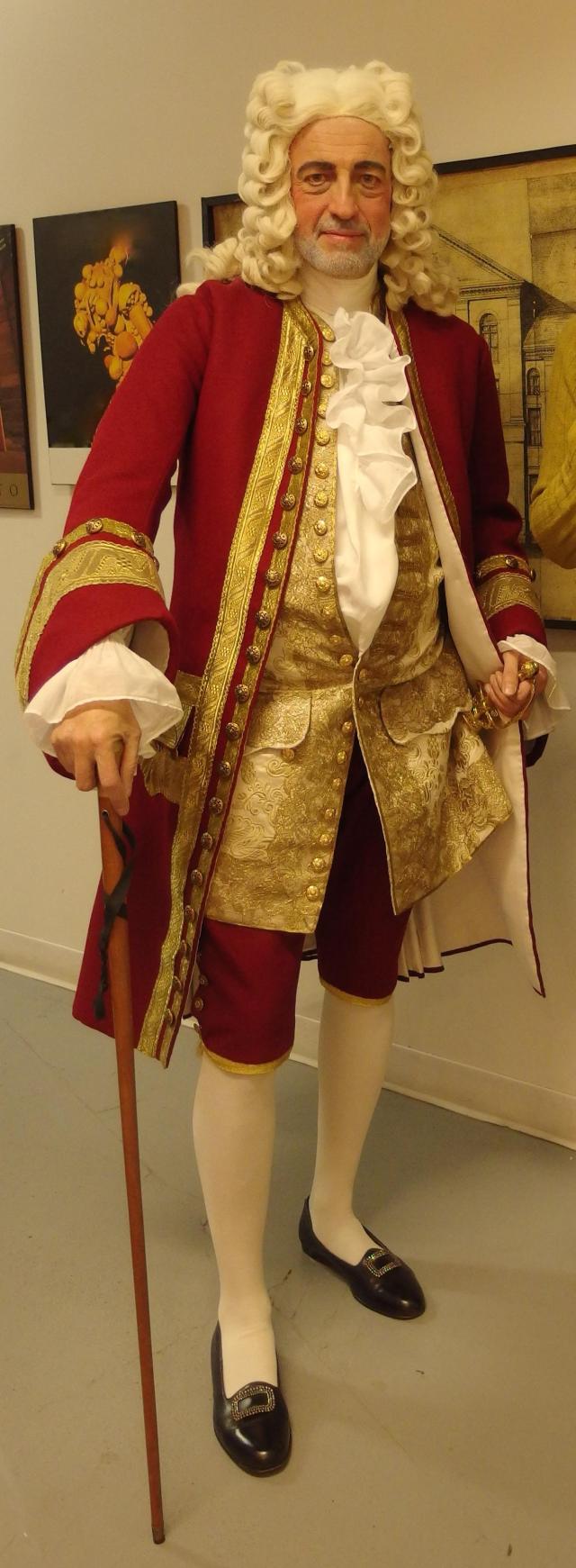
portrait

It was my dear mother who, understanding my keen desire for music, secretly conspired to aid me, and procured a clavichord (a very quiet instrument perfect for this subterfuge), which we secreted up to an unused garret in the house, and there I spent many nocturnal hours eagerly learning and playing music to my heart’s content! I was, and remained devoted to her, and drew strength and inspiration from her strong, independent disposition and keen intelligence.

What is the best thing about what you do?

Well, since meeting my Creator and entering the Celestial City, I have been able to enjoy life – or should I say the after-life – and pursue my music without all the – how you say – “hassles” of my career on Earth. No more ignorant critics and nay-sayers, or having to curry the favour of noble and wealthy patrons. No more vain, preening, and dim-witted singers (Mein Gott – those castrati!) who interested themselves in nothing more than showing off their artifice rather than their art. Now I can enjoy the extraordinary company of philosophs, artists, musicians, poets and writers, and perform my music sung and played by angels … for eternity!

Who do you like to listen to or watch? 

Here in the Celestial City we have the opportunity to hear the ongoing work of poets and musicians and philosophs; we enjoy some – how you say – “smoking” evenings of chamber music … well, jam sessions actually. And seeing Shakespeare and Moliere going at it on their improv nights is hilarious.

When you’re just relaxing, what’s your favorite thing to do?

As always in my life, and quoting my friend John Keats: “Give me books, French wine, fruit, fine weather (which we always have here) and a little music played out of doors by somebody I do not know.” … Though I prefer my own music, or at least that of my most talented colleagues.

But there is no greater enjoyment to me than contemplation, smoking my pipe, and sipping a fine claret (as Martin Luther said: “Beer is made by men, wine by God”).

I also have taken to doing crossword puzzles in five languages.

When you first arrived in 21st-century Toronto, what was the most disorienting thing?

It has been 36 years since my first descent to Toronto for Tafelmusik’s Sing-along Messiah. It was quite the experience – I would have to say it was the enormity of the bustling humanity that overwhelmed me… the noise!! Then at the turn of the century, in the early 2000s, we were inundated with the plague of youPhones and Blueberries… and then mePads, and all the texting and twitching and selfies… even during my concerts!

Of all the places you have lived in [cities in what we now call “Italy” and “Germany”, and of course England] what was your favorite place for the food, the climate, the musicianship, the singers, the appreciation of your music?

In a word: Italy. When I traveled to Italy at the age of 21, the Italian people opened my eyes to music, art, fine food and wine, and a love life, all done with gusto! My experiences in Italy inspired and influenced my creative muse. I used to write like the devil in those days!

Other than your own music, who is your favorite composer? 

I recall, near the end of my life and totally blind, listening to a performance of my oratorio Jephtha. My colleague William Savage commented that it reminded him of old Purcell’s music. I replied: “If Purcell had lived, he would have composed better music than this.”

… and my dear friend Telemann could write a motet for eight voices more quickly than one could write a letter. I recall that as students, Telemann and I were constantly occupied in fashioning melodic movements and examining them, frequently visiting each other as well as writing letters.

And although circumstances prevented us from meeting on Earth, I now enjoy the company and music of Johann Sebastian (and that of his talented son, Wilhelm Friedrich). Though you wouldn’t know it from his portraits, Johann enjoys an evening of lively debate, and a hearty repast. Wilhelm tends to overindulge, … though, in the Celestial City, we don’t experience o̶v̶e̶r̶h̶a̶n̶g̶s̶ hangovers.

Does the church appreciate what you accomplished with Messiah?

I wrote Messiah for my Creator, not to please the Church. Though many people claimed it to be a “fine Entertainment,” I should have been sorry if I only entertained them – I wished to make them better.

Is there a teacher or mentor you might care to mention?

Agostino Steffani was my predecessor as Kapellmeister at Hanover. He was my mentor as a youth, and urged me to study in Italy. He was a master at the Italian duetto, and his fine music was an inspiration to me.That he remained virtually unknown after his death until this century is both lamentable and remarkable. I am glad to see that in the last few years the cognoscenti have come to their senses, and we are now able to   appreciate his music – especially his operas – through many fine productions and concerts.

*******

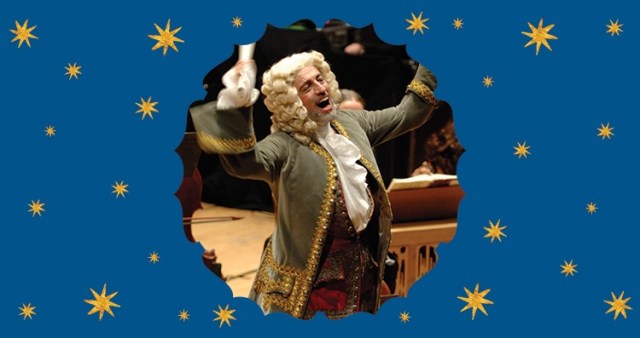
On Sunday December 17th, Tafelmusik Baroque Orchestra and Chamber Choir present their annual Sing-Along Messiah at Massey Hall at 2:00 p.m. led by ‘Herr Handel’ with Joanne Lunn, soprano, James Laing, countertenor Rufus Müller, tenor, and Brett Polegato, baritone.
12-Sing-Along-Messiah

Posted in Interviews, Music and musicology | 6 Comments

Best of Tchaikovsky

Tonight we heard one of the three Toronto Symphony orchestra concerts titled “Best of Tchaikovsky” at Roy Thomson Hall.  While I’m not sure if I’d agree with the title (I can think of pieces I would prefer), if they’re playing Tchaikovsky? I’m there. And I will enjoy it, especially if they bring the level of commitment to the playing that we experienced tonight.

The evening was mostly Russian with a tiny bit of Canadian:

  • The Talk of the Town (Andrew Ager)
  • Romeo and Juliet Fantasy Overture (Tchaikovsky)
  • Variations on a Rococo Theme (Tchaikovsky)
  • Symphony #5 (Tchaikovsky)

The opening Sesqui by Andrew Ager was a fascinating two minutes of darkly foreboding unison in the lower strings, some impressionistic swirling in the upper strings, and the promise of more in the last thirty seconds, making me think: why must it end so soon?

Speaking of Russians, we grabbed a copy of principal cellist Joseph Johnson’s CD of Russian cello sonatas, with one each from Rachmaninoff & Shostakovich, having heard him as soloist tonight in the Rococo Variations.  It was a nice feeling even if it was bittersweet, with the record store scheduled to close later this month (go while you can!).  On the way home it was a pleasure to bask in that rich cello sound in the car.

Keri-Lynn Wilson_3 (@Nick Wons-TSO) (1)

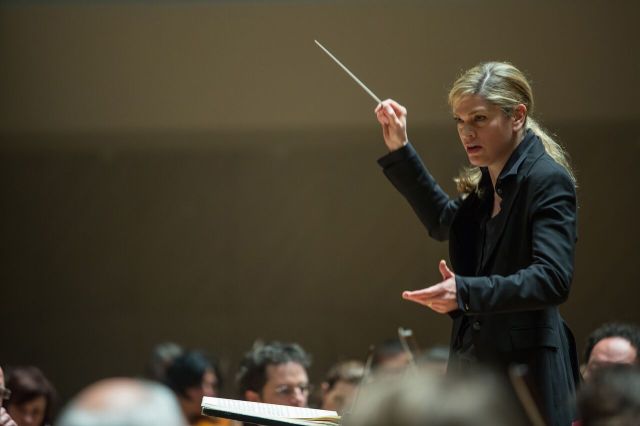
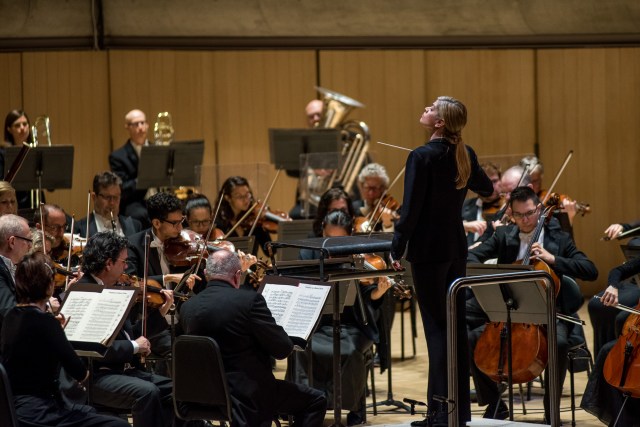
Keri-Lynn Wilson leading the TSO (photo:: Nick Wons)

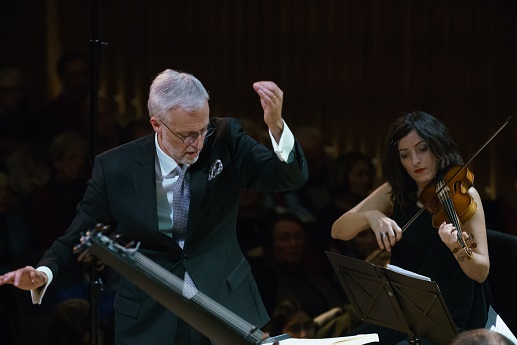
It was a happy collaborative experience, as the TSO, led by guest conductor Keri-Lynn Wilson, sounded oh so sensitive in dialogue with JJ’s cello.   This is the same conductor who led the Canadian Opera Company’s recent Tosca, a production where everyone seemed to be listening thoughtfully to one another, surely due to her solid leadership.  I have to think we’re now in an era when conductors are less and less the people telling an orchestra what to do, and more and more listening to what they can do. Wilson has a unique presence at the podium. She has a solid stance that’s well-nigh unshakeable, a very athletic approach with her baton & arms.  At the end of tonight’s concert there was no sign of anything resembling fatigue, her energy as inspiring at the end as when she began.

The Romeo and Juliet overture, with melodies that are so well known, did not contain any surprises. Indeed I thought Wilson was trying to avoid over-doing it, steering the orchestra in the direction of subtlety and unity rather than sentimentality and schmaltz.

But in contrast I felt she wore her heart on her sleeve in the big symphony.  The tempi overall tended to the brisk side– which I prefer—with every note in place, every entrance crisp and clean. At times she would observe a rubato, a phrase expanded for pure emotional value.  In the finale, especially the closing few minutes, the orchestra seemed to be enjoying themselves, like a horse given their head and allowed to run freely.

Tchaikovsky, Wilson & Johnson are back Thursday night.

Posted in Music and musicology, Reviews | 2 Comments

TIFT Candide

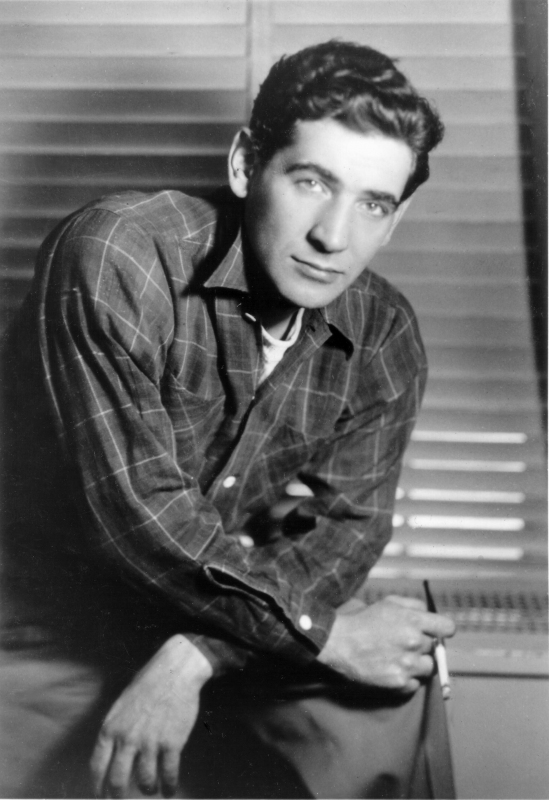
While 2017 was a year to celebrate Canada’s 150th, we’re now coming up on the 100th birthday of Leonard Bernstein.  Whether you pronounce it Bern–steen or Bern-stine, the composer, pianist & conductor was born in 1918, which means that it will be a year of commemorative programming.

bernstein_1-1483549591-lboximg Credit Courtesy of The Leonard Bernstein Office, Inc.

Photo courtesy of The Leonard Bernstein Office, Inc.

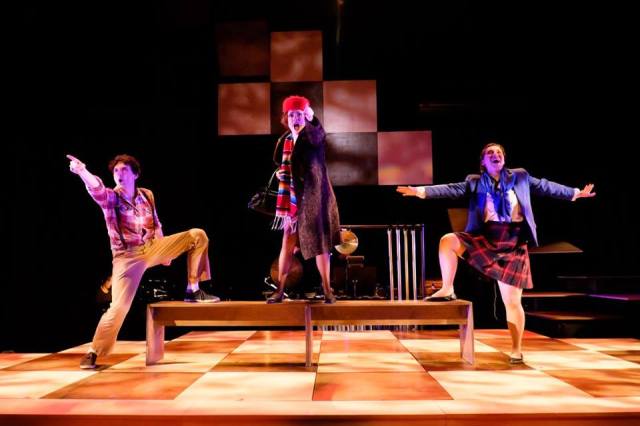
The first such celebration that I’m aware of has just happened in Barrie Ontario of all places, home of Talk Is Free Theatre.  It was certainly worth the drive to see the closing performance of their production of Candide in an original adaptation at the Mady Centre.  Another production in a different version is coming in just a few weeks from Toronto Operetta Theatre; while I haven’t asked TOT for the details it must be different, because of the uniqueness of TIFT’s version.

I’m not sure which decision is more brash & daring:

  • To adapt the play for five singing actors: director & adaptor Richard Ouzounian taking his cue from Peter Sellars 4-person Midsummernight’s Dream at Stratford in 2014.
  • To adapt the score for a pianist & percussionist: Lily Ling (piano / co-orchestrator) and Jamie Drake (percussion / co-orchestrator), in a genuine tour de force.

Neither of those pathways would mean anything if they hadn’t been done well.  I hope we get to see this version again.

But let me back up for a moment.  Bernstein is or was at least two people. Yes yes, he played the piano brilliantly, he was an amazing conductor (my favourite interpreter of Gustav Mahler): but I mean as a composer, he sometimes seemed to be two people, or a person torn between contrary impulses.  At times his music was very accessible, tuneful.  But he also wrote in more serious styles, music that hasn’t quite caught on as much as the composer might have hoped.  He might be the composer of West Side Story, of On the Town, a successor to Gershwin in bringing jazzy melodies to Broadway or Hollywood, but he also had far more serious aspirations.

And perhaps Candide epitomizes that conflict.

It has been through several incarnations.  Much as some of the songs & ensembles are beloved, Candide was not a big success its first time out in the 1950s, far more successful in Harold Prince’s re-think in the early 1970s, in a version that was still immense & unwieldy.  Some would call it operetta some would call it a musical. The difference between the two is mostly semantics, as musicals are operettas, except that you use different personnel for Hamilton or Dreamgirls or Cats than you’d employ for Student Prince or Mikado.  But on paper, the form isn’t different.  At least one number in Candide seems to epitomize that conflict, namely “Glitter and be Gay”, a song that forces you to cast a coloratura soprano, and then –cruel joke—expects her to act on top of everything else.

Ouzounian, Ling & Drake accomplished a miracle in scaling this colossal work down, without killing it.  We still had the pace, the energy, the theatricality. Indeed, when you require your five actors to play so many parts –plus a few extra ones for good measure—we’re firmly in the realm of something theatrical, making the audience think.

Ah thinking, thinking, there’s the rub and one of the issues Bernstein & his librettists faced in each version, built into the material. Candide for all its music and imagination, is a play of ideas, an appeal more to the head than the heart.  Yes Brecht would approve. When singing about an auto-da-fé with a big smile on your faces, expecting the audience to make the imaginary leap, to follow along with commentaries on the Lisbon Earthquake or taking us through syllogisms right down to the QED, there has to be more than just energy and thought.  And Ouzounian gets it I think.  The smaller cast actually changes the balance, boosting the warmth & heart while deflating a lot of the philosophy & logic that kills warm fuzzies. When there was a chance to be sensual, to ground each character in earthy impulses, to show us vulnerability rather than cleverness, those opportunities were boldly seized, to give the work balance, to make it truly alive.

I confess, I find that brilliant as the work is—a work that makes you nod, impressed with its cleverness—Bernstein didn’t quite convince me with his final song, that leaves me always thinking and pondering, rather than feeling.  And while Brecht and even Bernstein might approve of that response (Brecht feeling like Ouzounian’s secret ghost dramaturg), I think it’s a weakness in the writing, one that Ouzounian made heroic attempts to surmount, in the strong final statement of the show.

THREE

Mike Nadajewski, Gabi Epstein and Holly Chaplin (photo: Luca Ragogna.)

Mike Nadajewski was most exceptionally human as Candide, his emotions always crystal clear, his heart on his sleeve.  Thom Allison as Pangloss comfortably strode through the philosophical and vocal challenges of the work.  I probably laughed loudest at Gabi Epstein’s broad repertoire of voices and accents, to go with a huge movement vocabulary, as Paquette & the Old Lady.  Michael Torontow was enjoyable in his many different characterizations.  And Holly Chaplin impressed, singing well and acting sympathetically as Cunegonde.

As we were leaving, I mused on how far TIFT have come, in a downtown where it’s getting increasingly hard to find a parking spot. TIFT’s artistic producer Arkady Spivak has much to be proud of. tift-logolong1

Next up: Shaffer’s Amadeus in 2018.

Posted in Dance, theatre & musicals, Music and musicology, Opera, Reviews | 3 Comments

Four Weddings, a Funeral and a Coronation

That headline is the fanciful title for Tafelmusik’s latest concert.  While it may remind you of a certain British film, it’s a fair description of the evening’s program: one of such remarkable variety, as to constitute a veritable smorgasbord of delights. At times we had Tafelmusik playing, at times, they accompanied Tafelmusik choir, or soloists, sometimes just a few playing.

We were mostly in the French orbit, if you allow that in addition to Lully & Charpentier, English composer Henry Purcell bears the influence of the French style: and we also had Blow, Pachelbel & Handel.


Four Weddings_Taurins_Citterio

Music Director Elisa Citterio, led at this moment by Choir Director Ivars Taurins (Photo: Jeff Higgins)

But it really did feel like several concerts combined into one.  Tafelmusik are at an interesting place in their history, continuing their remarkably collaborative approach to leadership.  As in the days of Jeanne Lamon (who is now gone) Elisa Citterio may be leading the band, but shares the mantle with choral specialist Ivars Taurins and Opera Atelier’s David Fallis (who is also a brilliant choral scholar btw).  No wonder Tafelmusik seem especially inspired, as they are unafraid to allow themselves to grow in all directions.

Tonight there was the electricity that comes with sharp changes of tone & focus.  Consider this program and how the different contexts demanded a different sensibility from the players:

  • Ballet from Xerxes by Lully (the first of four pieces for a wedding), for the full orchestra
  • Symphony and Airs from Ode From hardy climes” by Purcell (second wedding piece), played by a dozen players
  • Coronation Anthem “God spake sometime in visions” by Blow
  • Canon & Gigue by Pachelbel, so often played in our own century at weddings (I know I did on the organ a couple of years ago) played by keyboard, cello, theorbo and three violins
    (intermission)
  • Requiem (the funeral piece) by Charpentier
  • Overture & Chorus “S’accenda pur” for another wedding

I can’t recall a concert with so much variety, but also, with so many genuine shifts.  At the end of the first segment, I was in heaven simply from having the experience of new pieces by Lully, arguably the most important unknown composer in history.  You’re always going to do well if he’s programmed and Tafelmusik didn’t disappoint.  From the Lully with its remarkable variety of timbres, including plaintive winds, long melodic lines and even drums played by Ivars Taurins, we came to the Purcell, on a smaller scale yet every bit as vibrant.

Taurins now assumed the conducting duties for the Blow as the choir came out, a piece full of wonderfully long phrases that were reflected in Taurins delightful sweeping gestures at the podium, building to a fervent Allelujah.  The contrast between Citterio & Taurins animated the performance, a visceral shift of gears.

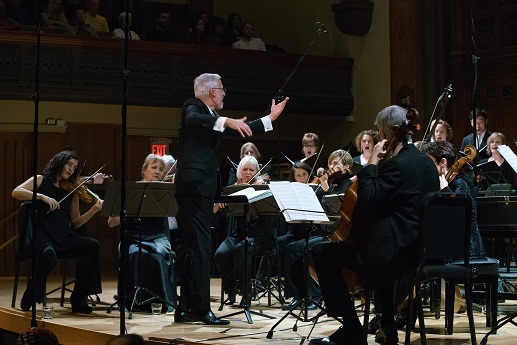
Four Weddings_performance

Tafelmusik Baroque Orchestra and Chamber Choir, with Music Director Elisa Citterio (far left), and dynamic Choir Director Ivars Taurins (Photo: Jeff Higgins)

And to close the first half came a piece we think we know, but presented with remarkable freshness. It’s that wedding warhorse, the Pachelbel Canon & the Gigue (although the Gigue is not so well known) , played by three solo violins. But for each entry they would ornament as if improvising, bringing a jazzy edge to the work that’s actually apt for a band purporting to offer something historically informed.  How wonderful to make this well-known piece—and the Gigue that follows—seem so new.

To begin the second half we were in an entirely different place emotionally and musically, namely Charpentier’s Messe des morts, a setting of the Requiem texts that we know so well via Mozart, Berlioz, Verdi and others. But Charpentier holds up a mirror, suggesting that those others are merely making music, merely creating entertainment.  For Charpentier it’s clear that these texts are real, that he was engaged in an act of piety, a work that stays devoted to its subject rather than spiraling off into decorative orchestration as we hear from the romantics (mentioned above).  At times Charpentier calls upon a soloist, but not as a virtuoso act –as we came to expect with those later composers I mentioned above—but rather to shift from something broad and public, fit for a large chorus, and to speak with the solitary voice of a soloist.  Echoing what I said about Lully, similarly, this too is a work deserving to be better known.

We closed with a Handel chorus including solos, a short celebratory piece for another wedding.  Taurins gets an entirely different sort of response from his chorus to finish, in a piece that isn’t as intense as the Charpentier.

The concert repeats Friday & Saturday night plus Sunday afternoon Dec 1, 2 & 3 at Jeanne Lamon Hall, Trinity-St Paul’s Centre.  For further information click here.

Posted in Music and musicology, Reviews | Leave a comment

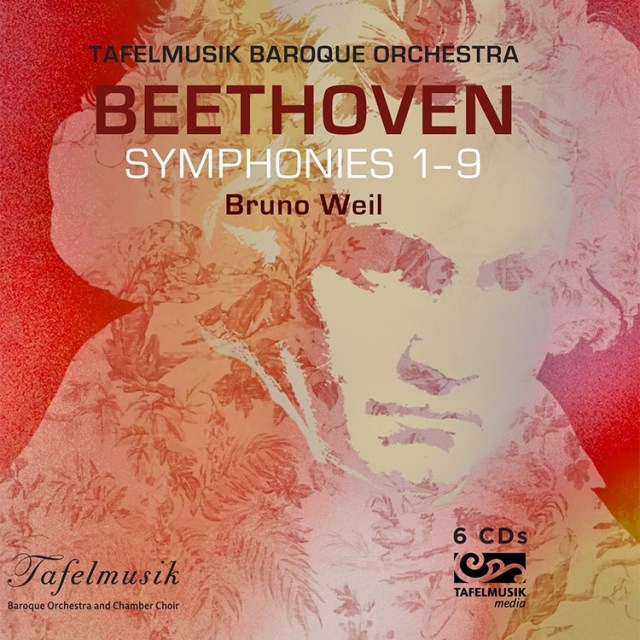
Tafelmusik Complete Beethoven Symphonies

Tafelmusik have released their recording of the nine Beethoven Symphonies.

Before I start going into detail, getting philosophical, getting all mushy about Beethoven, let me say that if you’re looking for a gift for the music-lover in your life, this is likely the single most perfect gift you could give.

Beethoven-Symphonies_CD_FULLCOVER

If they know Beethoven well, they get a fresh perspective on music that they likely know. Some people know a few of the symphonies, like those people who go to church only at Christmas or Easter, familiar with # 5 and #9.  For those who know every note, it’s even more exciting, a genuinely fresh approach to the symphonies, that only becomes clear to me now that I hear them as a set.  And even for that person who has never become acquainted with Beethoven, in this set they’ll get a brilliant introduction to some of the greatest music ever written.

Beethoven-Symphonies-Bruno

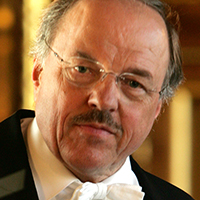
Conductor Bruno Weil

There is something truly special in the interpretations of Bruno Weil, conducting Tafelmusik in the decade plus that this cycle was created.  I struggled with it for awhile, trying to identify what I experienced, whether I really was having a concrete experience or just failing to understand. It wasn’t like the Beethoven I knew, and at one time I felt frustrated. In the process, I’ve been moved to re-think the word “interpretation”.

I grew up listening to Toscanini & the NBC Orchestra first (a mono set my father purchased), then the von Karajan set with the Berlin Philharmonic from the 1960s.  Conductors took the music and shaped it, bringing out voices the way a piano player would emphasize a melodic line.  I was listening as a child in the ’60s, an era of the all-powerful conductor.  Imagine that the music is like a facial portrait, and those older recordings all had the hair slicked down, or parted on one side or piled high as though wearing a wig. Bruno Weil dares to let the hair be a bit messy, to let us see the face as it really is.  What if, I now dare ask myself, all that fancy hair (metaphorically speaking) is a distortion?

What I found myself doing was listening to every note, every line, every voice.  Weil does not suppress one part to help bring out another. What’s daring and new for me in these recordings is that I can hear every little part.  I can’t help thinking that this is what Beethoven must have sounded like in his first appearance: that is, in the performances before conductors started regularly “interpreting” symphonies in particular ways (aka distorting and changing the music).

This is especially important when you factor in the use of Tafelmusik and their gentle sound.  Yes the opening of the Eroica is loud, as is the opening of the 5th and 7th and 8th and even the  9th(after a few bars).  And yet, this is a different sort of loud.  I hear every note, and it’s not harsh.  Weil lets us hear every part, without giving undue emphasis to the lines that Karajan or Toscanini (and a host of others) brought out, according to their doctrine of interpretation.  It means we experience the noise, the disorder, that must have presented itself to the listeners who encountered Beethoven early in the 19th Century, when there was not yet any idea how to approach these works. This makes it edgy & new in the most fundamental way.  Moreover, maybe those ideas –of bringing out certain voices—is a wrong-headed approach.  Especially if you explore and discover these works at the piano keyboard via transcription –as some do—there is an automatic tendency to simplify and paraphrase: as a transcription is usually a paraphrase that must leave some of the music out to allow a single person to play it.  I can’t help thinking that conductors are simplifying, domesticating, pruning their Beethoven, by reducing the disorder and complexity, by rationalizing the music into something simpler than it should be.  They become like plastic surgeons, going about their mission to beautify that which is already beautiful.  Why am I suddenly thinking of poor Joan Rivers?

I have to ask this underlying question. Is the job of the conductor to tidy up the music, to be a kind of dramaturg, making a set of assumptions about what we should be hearing, and then editing the original via selective emphasis, to change the music into something different?  We don’t notice this process if there’s a decades long consensus, that leads conductors to tidy and rationalize, if conductors are always being unfaithful to the music.

I found it especially in the 9th Symphony.  This is a performance like no other I’ve ever encountered, and not because they’re doing something so wild and radical. Instead, they’re singing more softly, playing more softly, and letting us hear what Beethoven wrote.

That first movement starts oh so softly, all the voices contributing to the cloud of mystery that builds, resolving in the first big statement of the theme.  It’s not overly loud, not all tidied up, but instead, rough around the edges: the way it was written.  Voices burble up from all sides, woodwinds and brass commenting softly but never entirely taking the focus, the strings solid but not the pristine clear sound one gets from modern strings.  This is a passionate sound, the bite of the bows grabbing you as surely as they grab the strings to make sound.  I’ve been playing this Ninth over and over the past few days (since last week).  The scherzo is perhaps an indication of how good the composition is: that it sounds like most other recordings of this movement, one that I always enjoy.  This one is as good, without the necessity of the colossal climaxes we sometimes get in recordings of this movement.  There is less of that sense of a conductor managing us and controlling us, as the piece simply flows to its climax.  The  third movement moves at a good pace, but again, exquisitely detailed, every inner voice heard, without treating any part as though it is the most important.

When we come to the last movement, Weil is making sense of this movement for me, for the first time. I have heard so many performances that capture choruses straining and sounding pained, stressed –rather than joyful—while competing with an orchestra that is just too loud.  Weil gives us something on a more human scale, which is hardly surprising when we remember what Tafelmusik and Opera Atelier usually accomplish.  The recitative for the lower strings makes so much sense, played very directly, until we get to the first statements of the melody.  I have yet to listen to the full tutti eruption of the main theme without either grinning like a kid on Christmas, crying like a baby, or both.  It’s probably because so much of this recording is done on a human scale, and suddenly we’re hearing a full eruption of passionate sound, that grew organically from the first tentative sounds of the strings in that recitative.

When bass-baritone Simon Tischler declares the famous opening lines of the movement, it’s the calmest and clearest I’ve ever heard.  I recall so many versions, the big loud sound of Walter Berry for example, on that 1960s era Karajan recording.  That orchestra is so loud, the singer so operatic, so over-the-top in his demand for our attention when he says “Oh Freunde”.  It’s a scary sound, actually. I wouldn’t talk to MY friends that way unless they need to be asked to leave, or I had a room that seats 3,000.  Tischler is much gentler, he really sounds like someone addressing his friends in an intimate way.  He articulates every note, and when he starts into the famous tune, it’s effortless and comforting, the way a good tune should be.  We’re not listening to a virtuoso vehicle –which is what Berry makes it feel like—but a simple folk tune.  And when the Tafelmusik chorus echo him, they sound joyful too, not pained the way so many choruses sound in this music.  The gentler quartet lines that follow are again joyful, effortless, and for once, musical. They are in tune.  Soprano Sigrid Plundrich floats up to the high notes rather than the usual struggle one gets.  I can’t help thinking that we’ve been doing it wrong for almost 200 years, when I hear such lovely sound, and so much less tension and pitch struggles.  I’ve never heard a soprano make it sound so easy. Is that because Plundrich is better than Gundula Janowitz (for example)? Or that all those other conductors turn it into a struggle, a titanic display of force comparable to D-Day, instead of letting the piece be calm & joyful.  The Tafelmusik sound is easier on the soloists.

When tenor Colin Balzer sings his solo “Froh, Froh, wie seine Sonnen fliegen…” we get a similar breath of fresh air.  This should sound like a happy tune, right? And it does. Balzer makes you smile immediately, with his beauty of tone, his easy flexibility, a colour perfectly suited to this music.

There is comparable magic in every symphony of the set.  For awhile I thought the Eroica was my favourite, particularly the epic first two movements.   But then I got stuck for awhile on #4, especially the pulsing Adagio with its alternation between powerful brass and subtler woodwind voices.  And then I disappeared into #5 and 6, back and forth between the two for a couple of days.

This recording encouraged me to think about hearing, about the music a deaf composer writes and how it might have sounded to him inside his head as he wrote it.  There are places where I swear Beethoven seemed to be playing with sound, as though he were testing our ability to hear.  The music can be especially clear on a digital recording yet as one phrase dies out and mixes with the next do we really hear it properly?  In some symphonies, thinking especially of #8, I wonder.  Is he testing our hearing, with those sudden loud passages followed by softness?  In a hall with any kind of reverb, we lose detail, if a loud chord is fading with soft notes following, as we get in the 8th.  And in those carefully rhetorical constructions such as the opening of the Eroica finale, was he telling his audience about his infirmity?  There is something so plaintively mechanical in those first notes, I wonder, was he signalling? Telling us that even this bare bones structure was beyond his ability to hear?

The CDs are beautifully organized, on three pairs of CDs:

  • 1 & 2, then  3
  • 4 & 5 then 6
  • 7 & 8 then 9

I am going to keep listening to these CDs for the next little Weil… I mean while.  They’re quite marvelous, and I can’t recommend them highly enough.

For further information see this.

Posted in Music and musicology, Reviews | 2 Comments

Venus ascending

I keep hearing about Venus lately.

There’s the novel by Sacher-Masoch, namely Venus in Furs.

Yes that’s the Sacher-Masoch whose name has been immortalized in the word masochism, a reminder that sometimes fame isn’t always desirable.  You write a novel and your name is immortalized as a pathology?

Great.

Then there’s also the play called Venus in Fur, by David Ives that premiered in 2010.  It was produced in Toronto a couple of times.

I avoided it, at least until now.  Why?

Ives adapted the novel in 2010. I also took a stab at it, writing an opera called Venus in Furs back in 1999.  It was a very quick and hasty adaptation that had to be rushed to the stage at the Graduate Centre for Study of Drama (as it was then called).  When opportunity knocks, such as a festival with an apt theme for such a work, you get it done; nobody ever gives you enough time.  And so, knowing that I wasn’t really happy with my 1999 adaptation and hoping to return to it again, I avoided seeing the play.  You might call that something like anxiety of influence, but when I know I’m going to be revising something I would prefer not to see how someone else has done it.  Please God let no one accuse me of stealing someone else’s idea.

And so it’s a funny thing that last week I heard about Roman Polanski’s 2013 film adaptation of Ives’ play, and decided to grab the DVD and see it, finally confident from what I’d heard that we really were so completely dissimilar –me with a crowded stage, him with only two personages, me setting it more or less back in the time, him modernizing it– that any fear I might have had was groundless.  Our approaches are so different that there’d be no danger in seeing the film or the play.

I’m wondering if it’s an omen that lately Venus is coming at me from all sides.

In the last week

  • A friend quoted passage from Sacher-Masoch’s novel on Facebook
  • Ives’ play came up in conversation with strangers, praising the Canadian Stage production
  • Another friend said he’s seeing the play in England
  • …and published his review

And I’ve been talking to a director about a revival of my own piece.

What stunned us as we watched Polanski’s film was the conflation of several realities.  Sacher-Masoch is almost forgotten, or perhaps irrelevant in this modern treatment of the subject.  Ives uses the novel as a pretense for something more up to date.  The novel is clumsy and wooden in comparison to what Ives accomplishes. And Polanski doesn’t leave himself out, as his own sordid past, or at least the popular mythology about that past, becomes part of the frame for the picture.  That’s amplified by Mathieu Amalric’s remarkable resemblance to a younger Roman Polanski.  At first we wondered: were we watching Polanski himself on the screen?

At the risk of belaboring the obvious, notice the resemblance.

And so, in this script about a playwright adapting and directing Sacher-Masoch’s novel, there’s that additional layer when we see the film-maker also implicate himself.  Do we really know what he did, what he’s been accused of?  Nope. But that mystique, that aura, lurks in the air like cheap perfume, something that Polanski is perhaps using to play with us, having it both ways I suppose.

There’s almost no Sacher-Masoch in the film or the play, just a couple of indirect allusions.  It’s rather funny when you realize that everyone knows who and what Sacher-Masoch is, while most people have not bothered to read his tawdry little book.  Ives creates something quite different, and Polanski brings it faithfully to the screen.  Emmanuelle Seigner is literally a towering presence in the inevitable power struggle that is at the heart of the play & the film.  I’m not sure how interesting it is. Yes we see where it’s going, and isn’t it clever the way the novel and the modern reality of staging an adaptation seem to melt together.  Beyond that cleverness, I’m not sure there’s much more to it than that.

I want to be persuaded and moved, I want passion and excitement, and somehow I wasn’t given the magic I craved.  I may have a conflict of interest, naturally, so maybe my opinion can’t be trusted. I wanted it to be really good. Perhaps it’s better live in the theatre, watching the tussle between the two principals.

Now I have to go find a production somewhere to find out.

Posted in Cinema, video & DVDs, Reviews | Leave a comment

Runnicles’ Mahler 6

Tonight’s Toronto Symphony concert led by guest conductor Donald Runnicles was an affirmation of the value of live music.

There are things you do in person that you simply can’t capture on video let alone on CDs.  Tonight we heard Mahler’s 6th symphony.

Donald Runnicles close up (@Jag Gundu)

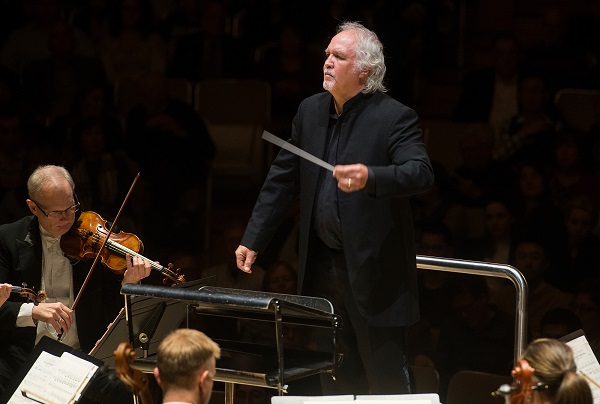
Conductor Donald Runnicles leading the Toronto Symphony (photo: Jag Gundu)

Mahler was an opera conductor, a theatre animal.  It sounds odd to say but it struck me, this composer who was capable of keeping audiences sitting spellbound for symphonies that often exceeded an hour in length.

How? Several of his symphonies are as arresting visually as they are musically.

  • In his 2nd Symphony we hear something like the trumpets of Judgment Day, calling the dead to arise, another small pack of brass sounding like ghosts marching in formation, and then an unaccompanied chorus announcing and affirming The Resurrection.
  • In his 3rd we hear a mysterious offstage serenade from what could be a heavenly instrument.

Tonight’s concert featured Mahler’s 6th Symphony, one of his most theatrical and arresting works. At times we hear

  • bells as though from afar
  • cow bells
  • a powerful hammer stroke on a drum

The theatrical visuals include the sudden exodus as players tippy-toe off the stage to work their magic in the wings. Or we watch a percussionist do his best Thor impersonation, lifting an improbable looking mallet.  Of course the real Thor takes no orders from a conductor, so the analogy fails in this case.

And Mahler fills this symphony with exquisite solo writing. At this point late in the tenure of Peter Oundjian one can’t help wondering whether each new guest at the podium might also be a suitor romancing this talented young orchestra.  That the TSO responded so well is certainly a good sign.

To begin, Runnicles led the TSO in Abigail Richardson-Schulte’s Step Up¸ another in the ongoing series of Sesquis, the 2 minute fanfares in celebration of Canada’s 150th Anniversary.  I’d call Step Up a friendly & whimsical creation, one that sidles up to us rather than blaring loudly, a fascinating series of textures that emerge in short order, making a lovely impression, leaving me wishing it could have gone on longer than its prescribed two minute length (but that’s the nature of the Sesqui commissions).

The TSO are back next week, first with the film Home Alone in concert, followed by three Best of Tchaikovsky concerts led by guest conductor Keri-Lynn Wilson.

keri_lynn

Keri-Lynn WIlson (photo: Daria Stravs Tisu)

Posted in Music and musicology, Reviews | Leave a comment

Angela Hewitt’s Keyboard Workout

That was quite a workout tonight, watching Angela Hewitt leading the orchestra while playing four different concerti on one concert programme with the Toronto Symphony at Roy Thomson Hall. She had a very busy evening, playing note-perfect as far as I could tell.

The two halves of the concert were similar, each one consisting of a Bach keyboard concerto & a Mozart piano concerto.

  • JS Bach: Keyboard Concerto #3 BWV 1054
  • WA Mozart: Piano Concerto # 9 K 271
    (intermission)
  • JS Bach: Keyboard Concerto # 7 BWV 1058
  • WA Mozart: Piano Concerto #20 K 466

While the orchestral forces were relatively small tonight, we were watching the A team, the top performers. For the Bach concerti the orchestra was a mere 28 players, including the principals in most of the sections, augmented for the Mozart by four additional wind players in the Jeunnehomme Concerto K271, and a few more for the D minor concert 466.

Angela-Hewitt-1024x688

Leader & pianist Angela Hewitt

Hearing this sort of program had the remarkable effect of making the Mozart sound edgy and new.

Roy Thomson Hall was packed for the occasion, and I think it’s fair to say that Hewitt did not disappoint. The audience reception got stronger with each piece.

The program repeats Sunday November 19th at 3 pm at the George Weston Recital Hall.

Posted in Music and musicology, Reviews | Leave a comment

Blade Runner 2049 and the first film

I have a good memory.

The first Blade Runner (1982 ) was not a big success, at least not at first.  I remember the review in the Toronto Star by Ron Base. He didn’t like it.  At one point (perhaps speaking of the Oscars?) he even spoke of “boring old Blade Runner”.  Heresy in my view!  It caught on later, via video, and with subsequent versions.  But at the time, I recall being furious that it lost out in the art direction category, where brilliant foresight & anticipation of the future  ought to be rewarded by rights.

Nope. Gandhi won for art direction. E.T. won for best visual effects.  I can understand that second one at least.

I was just fine with the voice-over version, where Harrison Ford’s character seemed to be a sci-fi version of Philip Marlowe from a Chandler novel.  But in 1982 people weren’t ready to deify Harrison Ford, indeed he was still viewed mostly as a pretty boy whereas his performance in the new film might get some attention from the Academy as best supporting actor.  He’s okay, as I’m not sure he really deserves it this time, whereas I would have been really happy to see him recognized for his work in 42 as Branch Rickey.   Oh well.

The decision to make a sequel –Blade Runner 2049–is a curious one, coming so long after the original. The first film was more of a cult hit rather than a commercial success.  And considering the huge cost of this new film, I wanted to make sure to see it before it vanishes from the cinema, a film that needs to be seen on the big screen.

There’s a great deal of violence in the new film, but come to think of it, that’s also true of the old film.  There was a great deal of what felt like gratuitous and even pornographic violence, particularly the way two of the women in the old film died.   Unfortunately the spectacular outbursts of aggression in the new film are every bit as bad as in the first one.

The first film was not short (roughly two hours), but this one feels really long (closer to three hours!). I can’t deny that there were times I was hoping it would end. That length seriously compromises the number of showings per night, making it harder to make money.  There was one moment when I considered walking out, for one of the most pointless homicides I have ever seen onscreen.  It made no sense except as part of the bloody spectacle. But we stayed, and I was glad I did.

The futurism of the first film was one of the first things to grab me, a sense of authenticity in its window on a possible future world.  At times the new film seems intent on replicating things we saw in the first film such as the streetscape, the food vendors and the pleasure units.  Maybe I need to see the film again, but I didn’t have the same sense of accuracy in their ability to predict a future world.  They were perhaps feeling a bit constrained, so intent on pleasing anal fans (like me??? gulp) that of course they had to give us a look at a much older Edward James Olmos’ character, and –as expected– he has his trademark origami.

Some of Vangelis’ music from the first film is replicated, perhaps as a leit-motiv we can recognize. The theme that I’m thinking of first appears early in the first film when we get a look at a big towering building that could be an icon for the bravest and most positive view of our future: a future that seems to have vanished.

The theme seems to be a proud motto proclaiming their faith in science & technology.  In the new film—conceived in a time when the future is a much scarier place than it was in 1982—the theme becomes much more wistful, like a fragment of a remembered dream upon waking.  But we do hear it.


That first film did give us glimpses of something more dystopian, but with every passing year, as our world gets more and more like those dark and creepy images, its prophecy seems more and more astute.  The second film has its moments but still stops far short of the obvious trajectories one can see on the news every day, whether in the realms of ecology & nature, in policing and weaponry, or in surveillance and authoritarianism.  Sadly, the realities of the past year seem to be outstripping this film, as a template for horror.

Director Denis Villeneuve certainly does a good job keeping things moving, in a very long movie. All of the characters seem genuine, and a couple are totally detestable; I will let you discover that for yourself.

I expect that there will be at least one more film after this one, considering that the story seems like the first chapter of a much longer epic.  But then again I’ve also heard that they aren’t making nearly the $$ they hoped to make (on a colossal investment after all), which might signal the end of the franchise, at least for the time being.

There are some wonderfully poignant moments. I won’t spoil it except to suggest that if you’ve seen the first film, you will be reminded of a great deal this time around.  It’s not unlike Episode 7 of Star Wars, that mostly gives us a story we’ve seen before, with only a few twists.  This time, too, we’re seeing characters from long ago, only older; this time it’s Rick Deckard rather than Han Solo, but we’re again watching Ford’s weathered face reacting to what’s happening around him.  Ryan Gosling and Robin Wright offer great performances.

I found the sound levels in the theatre a bit too high, such that whenever anything sudden happened, one would jump.  I look forward to seeing it in some video medium, when I don’t have to endure such a ridiculously loud soundtrack.

Those who like such things, will probably love the film and should try to see it before it leaves the big screen (my rationale in going tonight).

And those who don’t know the older film, or who don’t enjoy this sort of film (like the person sitting beside me often with her eyes closed)? Steer clear.

Posted in Cinema, video & DVDs | Leave a comment

Haus Musik: lavender love letter

I am always inclined to appreciate artists who choose the ambitious path.

Tonight’s Haus Musik in The Great Hall directed by Jennifer Nichols aimed to make some challenging connections. This multi-disciplinary work (live music, a DJ, video, painting, poetry in two languages and dance) spoke to me.

Throughout I was asking myself those words: does this speak to you?  We watched and heard four members of Tafelmusik playing in different groupings, namely Felix Deak (viola da gamba), Charlotte Nediger (harpsichord), Geneviève Gilardeau (violin) and Patricia Ahern (violin). They played works by Couperin, Rameau, Constantin, Leclair and Marais.

Sometimes DJ Andycapp’s creations would answer the acoustic sounds of the four instruments of bygone days with a more contemporary sound.

And Jack Rennie came strolling into the space accoutred as one of us, which is to say, in modern dress and carrying a drink.

And then it was a bit as though the music was infecting him at first, as he seemed to fight the impulse to dance as though it were an illness or a kind of madness. And I felt that the music spoke to him.  There was an answering voice, speaking in French as though paraphrasing the latent poetry of the moment.

On the big video screen we saw images of lavender, to complement the bunches hanging throughout the Great Hall, as Jennifer Nichols walked and danced in that virtual space while the live music was performed in our acoustical space below the screen, a suggestive series of images employing older buildings, as if to echo that older music.

Version 2

And so this abstract dynamic was enacted, of two people seeming to be moved and even transformed by the music. We watched both Rennie’s figure –dancing in spite of himself, reading and painting—and Nichols’ video image dressed both in modern clothes and something as if to match the baroque era of the music. Where Rennie seemed to begin in the present and get drawn into the past, Nichols first appearance was in the old guise, but later incarnated in modern dress among a rougher urban landscape.

I was reminded of something I saw a lifetime ago. Brian Macdonald took Beethoven’s Diabelli Variations and turned it into a series of dances, the pianist a woman, the chief dancer, a man responding to the poetry of that overpowering work.  I was especially ready for this after last night’s Triptyque, a largely abstract work whose dance was mostly dance qua dance, rather than dance as drama or story-telling.  Perhaps Nichols’ history with Opera Atelier makes her ready for a dance connected to a story, where the impulse to dance seems motivated by a scenario.  I invoke Macdonald’s work because in both instances we watch a kind of romance that is set in motion by the music-making. The proposition that is music, the demand that we open our hearts and imaginations to the beauty of the music, is ultimately a proposition that is seductive, at least at the platonic level, of one voice –the music– seeking someone to listen, someone to follow and perhaps dance, in response.

At the most fundamental level music calls for some kind of response, and our modern rigid silence doesn’t really match the way the music speaks to a normal person. Normal? I refer you to the children crying, who were being shushed (a morning after addendum after realizing that this is vague; there were a couple of small children crying during the show… why they were there in a dark club at night? a mystery) . It’s “normal” for parents to repress their kids, alas, and tell them to be silent.  OR we can look at how Rennie twitched to the music. My toes tap, but I’m among silent reverent watchers, as though in a church. I wish for something more pagan I guess, where we all join in the Dionysian revels.

You know that old saying “if a tree falls in the forest and no one hears it, is there a sound”? Another way of saying that might be “if music is played and no one dances: is there music”?

There is a natural romance in our encounters with the past. We are simultaneously of the present with our electronic devices, our modern clothes and sensibilities, and yet, of the time we encounter. Rennie’s impulse to dance is the music speaking to him, and mostly we stifle ourselves, except for our polite applause at the end.  I love that Nichols put all that on the stage for us, both the torture of it and the seductive beauty all at once.
I’m grateful for the experience and the romantic thoughts it provoked.

It spoke to me.

Posted in Dance, theatre & musicals, Reviews | Leave a comment